Sample Paper 03
SOCIOLOGY (039)
CLASS XII 2025-26
Time: 3 Hours Max. Marks: 80
General Instructions:
1. The question paper is divided into four sections.
2. There are 35 questions in all. All questions are compulsory.
3. Section A includes question No. 1-16. These are MCQ type questions. As per the question, there can be one answer.
4. Section B includes question No.17-25. These are very short answer type questions carrying 2 marks each. Answer to each question should not exceed 30 words.
5. Section C includes question No. 26-32. They are short answer type questions carrying 4 marks each. Answer to each question should not exceed 80 words.
6. Section D includes question No. 33-35. They are long answer type questions carrying 6 marks each. Answer to each question should not exceed 200 words each.
7. Question no. 33 is to be answered with the help of the given graphics.
SECTION A
1. Assertion (A) : Social mobility is the movement of individuals or groups from one social stratum to another.
Reason (R) : : The degree to which systems of stratification are open or closed depends on the extent of social mobility.
Codes
(a) Both (A) and (R) are true and (R) is the correct explanation of (A)
(b) Both (A) and (R) are true, but R is not the. correct explanation of (A)
(c) (A) is true, but (R) is false
(d) (A) is false, but (R) is true
View AnswerAns. (a) Both (A) and (R) are true and (R) is the correct explanation of (A)
2. Assertion (A) : The world communalism in Indian context refers to aggressive chauvinism based on religious identity.
Reason (R) : : Chauvinism is an attitude that see one’s group as the only legitimate or worthy group with other groups being seen as inferior, illegitimate and opposed.
Codes
(a) Both (A) and (R) are true and (R) is the correct explanation of (A)
(b) Both (A) and (R) are true, but R is not the correct explanation of (A)
(c) (A) is true, but (R) is false
(d) (A) is false, but (R) is true
View AnswerAns. (a) Both (A) and (R) are true and (R) is the correct explanation of (A)
3. According to the demographic transition theory, population growth moves through specific stages. Which of the following sequences appropriately explains the stages?
I. High birth rate, high death rate, low growth
II. High birth rate, declining death rate, rapid growth
III. Declining birth rate, low death rate, stable growth
IV. High death rate, low birth rate, population decline
(a) I., II., and III.
(b) II., III., and IV.
(c) I. and II. only
(d) I., II., III., and IV.
View AnswerAns. (a) I., II., and III.
4. Assertion (A) : Raja Rammohun Roy was the founder of Brahmo Samaj movement in 1828.
Reason (R) : : His influence was apparent in fields of politics, public administration and education as well as religion.
Codes
(a) Both (A) and (R) are true and (R) is the correct explanation of (A)
(b) Both (A) and (R) are true, but (R) is not the correct explanation of (A)
(c) (A) is true, but (R) is false
(d) (A) is false, but (R) is true
View AnswerAns. (a) Both (A) and (R) are true and (R) is the correct explanation of (A)
5. The emergence of machine production based on the inanimate power resources like steam and electricity is known as
(a) Globalisation
(b) Capitalism
(c) Colonialism
(d) Industrialisation
View AnswerAns. (d) Industrialisation
Read the passage given below:
Formal demography is mainly concerned with measurements. It is concerned with things like birth, death, emigration, marriage, divorce, etc. whereas social demography focuses on the social, economic and political aspects of the population.
The main function of formal demography is measuring the components of population change whereas social
demography study the reasons for changes in population and its structure and their result.
Based on the given passage answer Q.6 and Q.7
6. How does formal demography differ from social demography?
I. Formal demography focuses on measurements like birth, death, and marriage.
II. Social demography examines the social, economic, and political factors affecting the population.
III. Formal demography studies the reasons behind population changes.
IV. Social demography deals only with statistical data.
(a) I. and II. only
(b) I., II., and III. only
(c) III. and IV. only
(d) I., II., and IV. Only
View AnswerAns. (a) I. and II. only
7. Which of the following is true about formal and social demography?
(a) Formal demography focuses on measurements, while social demography studies causes and consequences of population changes.
(b) Social demography primarily deals with measuring population components.
(c) Formal demography examines the economic and political aspects of the population.
(d) Both formal and social demography focus solely on statistical data.
View AnswerAns. (a) Formal demography focuses on measurements, while social demography studies causes and consequences of population changes.
8. Assertion (A) : The principal reasons for the decline in the death rate after 1921 were increased levels of control over famines and epidemic diseases.
Reason (R) : : The major epidemic diseases in the past were fevers of various sorts, plague, smallpox and cholera.
Codes
(a) Both (A) and (R) are true and (R) is the correct explanation of (A)
(b) Both (A) and (R) are true, but (R) is not the correct explanation of (A)
(c) (A) is true, but (R) is false
(d) (A) is false, but (R) is true
View AnswerAns. (a) Both (A) and (R) are true and (R) is the correct explanation of (A)
Read the passage given below:
Raja Ram Mohun Roy also known as the ‘Father of the Indian Renaissance.’ He is widely known for his role in the abolition of sati. He also propagated Western education among Indians. He campaigned for rights for women, including the right for widows to remarry and the right for women to hold property. He stressed on rationalism and modern scientific approach. He also make efforts against the caste system, untouchabilities and use of intoxicants.
9. Which of the following is not true about Raja Ram Mohun Roy?
(a) He is known as the ‘Father of the Indian Renaissance.’
(b) He promoted the abolition of sati and women’s rights.
(c) He opposed the idea of women holding property.
(d) He stressed on rationalism and a modern scientific approach.
View AnswerAns. (c) He opposed the idea of women holding property.
10. Which of the following best describes the contributions of Raja Ram Mohun Roy?
I. He campaigned for the abolition of sati and women’s rights.
II. He promoted caste-based divisions in Indian society.
III. He propagated Western education and rational thinking.
IV. He made efforts to eliminate untouchability and intoxicants.
(a) I. and II. only
(b) II. and III. only
(c) I., III., and IV only
(d) I., II., III., and IV.
View AnswerAns. (c) I., III., and IV only
11. Which of the following statements is correct about the second phase of Green Revolution in India?
(a) The second phase of the Green Revolution was introduced only in semi-arid regions of India.
(b) The second phase of the Green Revolution was introduced in dry and semi-arid regions of India.
(c) The second phase of the Green Revolution was introduced in rice and wheat regions of India.
(d) The second phase of the Green Revolution introduced only in South India.
View AnswerAns. (b) The second phase of the Green Revolution was introduced in dry and semi-arid regions of India.
12. ‘When we say India is a nation of great cultural diversity, we mean that there are many different types of social groups and communities living here’. The term diversity stands for
(a) neither differences nor inequality
(b) difference rather than equalities
(c) difference and inequality both
(d) inequalities rather than equalities
View AnswerAns. (b) difference rather than equalities
13. Assertion (A) : A falling dependency ratio can lead to economic growth and prosperity.
Reason (R) : : A lower dependency ratio indicates a larger proportion of workers compared to non-workers, which is referred to as the demographic dividend.
(a) Both (A) and (R) are true, and (R) is the correct explanation of (A).
(b) Both (A) and (R) are true, but (R) is not the correct explanation of (A).
(c) (A) is true, but (R) is false.
(d) (A) is false, but (R) is true.
View AnswerAns. (a) Both (A) and (R) are true, and (R) is the correct explanation of (A).
14. Assertion (A) : Civil society is the non-state and non-market part of the public domain where individuals voluntarily create institutions and organizations.
Reason (R) : : Civil society fosters collective action, enabling individuals to address social, cultural, and political issues outside the control of the state and market.
(a) Both (A) and (R) are true, and (R) is the correct explanation of (A).
(b) Both (A) and (R) are true, but (R) is not the correct explanation of (A).
(c) (A) is true, but (R) is false.
(d) (A) is false, but (R) is true.
View AnswerAns. (a) Both (A) and (R) are true, and (R) is the correct explanation of (A).
15. ‘After 1990, the Government of India has followed a policy of liberalisation. Under this policy, the private companies, especially foreign firms, were encouraged to invest in sectors which were earlier reserved only for the government, including Telecom, civil aviation, power, etc.’
Read the above mentioned statements and mention the term that is used to call when the government tried to sell its share in several public sector companies.
(a) Industrialisation
(b) Disinvestment
(c) De-colonisation
(d) Globalisation
View AnswerAns. (b) Disinvestment
16. According to the demographic transition theory, population growth moves through specific stages. Which of the following sequences appropriately explains the stages?
I. High birth rate, high death rate, low growth
II. High birth rate, declining death rate, rapid growth
III. Declining birth rate, low death rate, stable growth
IV. High death rate, low birth rate, population decline
(a) I., II., and III.
(b) II., III., and IV.
(c) I. and II. only
(d) I., II., III., and IV.
View AnswerAns. (a) I., II., and III.
SECTION B
17. The notion of minority groups is widely used in sociology and is more than a merely numerical distinction – it usually involves some sense of relative disadvantage. Thus, privileged minorities such as extremely wealthy people are not usually referred to as minorities.
Based on the given passage, briefly explain the meaning of ‘privileged minorities’.
View AnswerAns. Privileged minorities refers to a special group of minorities for whom some special provisions have been made. For example, religious minorities like the Parsis or Sikhs may be relatively well-off economically. But they may still be disadvantaged in a cultural sense because of their small numbers relative to the overwhelming majority of Hindus.
or
Religious or cultural minorities need special protection because of the demographic dominance of the
majority. In democratic politics, it is always possible to convert a numerical majority into political power through elections. Due to this, religions or cultural minorities become politically vulnerable.
Based on the given passage, answer the following question.
What is minority? Why do minorities need protection from the state ?
View AnswerAns. Minorities need protection from the state due to following reason
(i) The protection of minorities require special consideration in a context where the normal working of the political system places them at a disadvantages vis-a-vis the majority.
(ii) Minorities are small in number so their political rights may be overshadowed by the majorities. These can be prejudice and discrimination for the political dominance in favour of the majorities. So, minority may feel neglected.
18. Discuss the major features of social movement.
View AnswerAns. The features of social movements are as follows
(i) A social movement requires sustained collective action over time. Such action is often directed against the state and takes the form of demanding changes in State Policy or practice.
(ii) Social movement activists hold meetings to mobilise people around the issues that concern them. Such activities help shared understanding.
19. What were the demands of workers in the Bombay textile strike of 1992 ?
View AnswerAns. The demand of the workers in the Bombay textile strike of 1992 was the right to form their Union and they wanted better wages. Dr. Datta Samant led this strike who was the leader of trade union. According to the Bombay Industrial Relations Act, a union had to be approved it if has gone up the idea of strikes. The Congress led Rashtriya Mill Mazdoor Sangh (RMMS) was the only approved Union and it helped in breaking the strike as it brought workers from outside.
20. What are counter movements?
View AnswerAns. Counter movements means a social movement opposed to another social movement. Whenever one social movement start up another group starts a movement to undermine the active group. For example, social movements often arise with the aim of bringing about changes on a public issue such as ensuring the right of the tribal population to use the forests or the rights of displaced people to settlement and compensation.
21. In political systems, the distribution of power significantly affects citizen participation and rights. Some systems prioritize control and stability over individual freedoms. Define the term ‘Authoritarian State’.
View AnswerAns. Authoritarian state is one in which the people have no voice and those in power are not accountable to anyone. This authoritarian state is opposite to democratic state. This state often limits or abolishes civil liberties like freedom of speech, freedom of press, freedom of political activity and right to protection from wrongful use of authority, right to the due processes of the law and so on.
22. Experience of industrialisation in India is in many ways similar to the Western mode and in many ways it is different’. Discuss.
View AnswerAns. Experience of industrialisation in India is in many ways similar to Western mode and in many ways it is different. This statement can be understood by the fact that there is no standard mode of industrial capitalism. Different countries have taken different routes to reach industrialisation, for example, in developed countries, majority of people work in the service sector and less than 10% in agriculture or agriculture related activities. In India (2021-22), nearly 45.5% people were employed in agriculture or mining, 17% in manufacturing, construction and utilities sector, and 32% in the trade, transport and financial services sector.
23. Prejudices play a significant role in shaping social dynamics, often influencing individual and group interactions. These biases, rooted in stereotypes and assumptions, impact social harmony and equality. Elaborate the term ‘Prejudices’ in context of sociological study.
Ans. The term ‘prejudices’ literally means ‘pre- judgement’. In sociological study, it refers to pre- conceived opinions or attributes held by members of one group towards another. It means an opinion formed in advance of any familiarity with the subject, before considering any available evidence. Prejudices can be positive or negative. For example, a person may be prejudiced in favour of numbers of his/her own caste or groups without any evidence believe them to superior to members of other castes.
[/expand]24. Caste and economic inequality have been deeply intertwined in India’s history, shaping access to resources and opportunities. Although legal and structural changes have been introduced, the legacy of caste-based exclusion still influences socio-economic conditions. Is there any relationship between caste and economic inequality today? Elaborate.
View AnswerAns. Caste inequality is directly associated with the economic status and occupation as it is evident from ancient history. The high castes were almost invariably of high economic status. On the other hand, the low caste was almost always of low economic status. However, in modern society the link between caste and class is not that rigid as it used to be earlier. Structural and economical changes have gained new opportunities and challenges in the last few decades
25. The best way to respond to regional aspirations is through democratic negotiations rather than through suppression. Look at the situation in the 80’s-militancy had erupted in Punjab, problems were persisting in the North-East, students in Assam were agitating, Kashmir valley was on the boil. Instead of treating these as simple law and order problems, the Government of India reached negotiated settlement with regional movements.
Read the above passage and answer the question that follows
How regionalism creates problems in India ?
View AnswerAns. Regionalism creates problems in India as it leads to protests and agitation by the people of the under developed regions. People feel they are discriminated and greatly neglected by the State or Central Government. This disrupts the normal peace and unity of the country and often results in mass-movements.
or
How regionalism can be reduced? Mention any two points.
View AnswerAns. Regionalism could be reduced with the help of following initiatives
(i) Government should give equal grants to all the regions, states and adequate help according to demands of that region.
(ii) Government should not give preference to any particular region over the other regions to prevent the sense of inferiority among the people of other regions.
SECTION C
26. The 19th and early 20th centuries marked a significant phase of social reform in India, with many efforts focused on improving the status of women. Male reformers played a pivotal role in these initiatives, addressing issues like education and oppressive social practices. The struggle for women’s upliftment in the 19th and early 20th centuries was led by male reformers.’ Discuss with suitable examples.
View AnswerAns. The struggle for women’s upliftment in the 19th and early 20th centuries was led by male reformers. They are
(i) Raja Ram Mohun Roy He attacked the evil practice of sati which was present in society. He opposed it on the basis of humanitarianism, natural right doctrines and Hindu shastras.
(ii) Jyotiba Phule Female education was encouraged by him and he also opend the first school for women in Pune.
(iii) Ranade His writing supported the remarriage of widows on the basis of Shastras. He wrote the book, ‘The Texts of the Hindu Law’ on the lawfulness of the remarriage of widows and vedic austerities for widow remarriage.
Or
The 19th century was a period of intense social and cultural awakening in India. Reformers sought to
address traditional practices by incorporating modern principles while respecting India’s cultural identity. In what ways, 19th century social reform attempts were the modern context and mix of ideas?
View AnswerAns. These 19th century social reform attempts were modern context and mix of ideas in the following ways
(i) It was creative combination of modern of Western liberalism and a new traditional literature.
(ii) Raja Ram Mohun Roy attacked the practice of Sati on the basis of both appeals to humanitarian and natural rights doctrines well as Hindu Shastras.
(iii) Ranade’s writing entitled The Text of Hind Laws on the lawfulness of the remarriage of widows and vedic authorities for widow marriage elaborated the shastric sanction for remarriage of widows.
(iv) The content of new education was modernising and liberal. The literary content of the courses into the humanities and social sciences was drawn from the literature of the European Renaissance, Reformation and Enlightenment. Its themes were humanistic, secular and liberal. (v) Sir Syed Ahmed Khan’s interpretation of Islam emphasised the validity of free enquiry (itihad) and the alleged similarities between Koranic revelation and the laws of nature discovered by modern science.
27. Sociologist MSA Rao describes three different situations of the urban impact in India. Describe each of the three situations.
View AnswerAns. Sociologist MSA Rao describes three situations under which a village experiences the urban impact in India. These three situations are
(i) Lot-of people migrate from villages to far off cities or overseas towns. They send money to their natal villages. Besides, they invest money on land and industry and donate for educational institutions. They build fashionable houses at their villages and have invested on land and industry.
(ii) Some villages are situated near the industrial town e.g. Bhilai. Demand for houses and the market inside the village increases but at times it lead to hatred between immigrants and native population.
(iii) Growth of metropolitan cities do have influence over the rural areas or villages. Some villages are completely absorbed in the process of expansion of these cities. On the other hand, some villages lose their uninhabited land for urban development.
28. Social reform movements in India addressed pressing issues to create a more equitable society. Despite their diversity, these movements shared common goals and principles. Describe common theme of different social reform movement.
View AnswerAns. The common theme of different social reform movements can be proved with the help of following points
(i) For some, the concerns were confined to the problems that the upper caste, middle class women and men faced. For others, the injustices suffered by the discriminated castes were the central questions.
(ii) For some, social evils had emerged because of a decline of the true spirit of Hinduism. For others, caste and gender oppression was intrinsic of the religion.
(iii) There were movements of Muslim women. One group had argued against the practice of polygamy whereas, other group had fought for the abolishment of Triple Talaq.
(iv) Debates within communities were common in various movements. For instances, Sati was opposed by the Brahmo Samaj. Orthodox members of the Hindu community in Bengal formed an organisation called ‘Dharma Sabha’ and petitioned the British arguing that reformers had no right to interpret sacred texts.
29. The concepts of caste and varna are integral to understanding India’s social hierarchy. While they are often used interchangeably, their origins and functions differ significantly. What is meant by the terms ‘caste’ and ‘varna’? Elaborate the precise relationship between varna and jati.
View AnswerAns. The term ‘caste’ is essentially taken from the Portuguese word ‘casta’ which means pure breed. Caste as an institution is uniquely associated with the Indian sub-continent. Although a central aspect of the Hindu society, it has spread itself to major non-Hindu communities especially Muslims, Christians and Sikhs. It refers to a broad institutional arrangement that is referred in the Indian languages by two distinct terms, varna and jati.
The word varna literally means colour, but it refers to the four fold division of society into- Brahmana, Kshatriya, Vaishya and Shudra. This term, however, excludes the panchamas or the fifth category which comprises of outcastes, foreigners, slaves, conquered people and others.
The precise relationship between varna and jati has been the subject of much speculation and debate among scholars. The most common interpretation is to treat varna as a broad all-India aggregative classification, while jati is taken to be a regional or local sub-classification involving a much more complex system consisting of hundreds or even thousands of castes and sub-castes. This means that while the four varna classification is common to all of India, the jati hierarchy has more local classifications that vary from region to region.
30. What is industrialisation? Discuss de-industrialisation and urbanisation as the products of British industrialisation in India.
View AnswerAns. Industrialisation refers to the emergence of machine production, based on the use of inanimate power resources like steam or electricity.
De-industrialisation and urbanisation are the two important changes that were also the products of British industrialisation in India. They are discussed as follows
De-industrialisation
Some sectors of Indian economy underwent de- industrialisation due to industrial policies of the Britishers in India. Indian silk and cotton fabrics could not compete with the Manchester products. Therefore, there was a heavy blow to the domestic as well as international market of Indian cotton and silk textiles. Thus, these industries were adversely affected.
Similarly, the village industries were more or less destroyed, as their products could not compete with the cheap imports of the machine made goods from Europe.
Urbanisation
British industrial policy in India led to the decline of many towns and cities, but at the same time, it also facilitated urbanisation in some parts of India. Since, the main purpose of Britishers were to earn maximum gain and benefit, they developed the coastal cities like Chennai, Mumbai and Kolkata to facilitate different types of exports and imports.
Or
Colonialism in India introduced a wide range of change in every sphere. Explain.
View AnswerAns. Colonialism introduced a wide range of change in every sphere be it legal or cultural or architectural. Almost every aspect of human life was affected in India.
Some of the areas in which the influence of colonialism can be seen are as follows
(i) Law System: Indian legal and police system is based on the British model. Beside, Britishers brought laws such as Forest Acts and Transport of Native Labourers Act which affected the lives of pastoralists, labourers and people in general.
(ii) Architecture: It was also influenced by the Britishers. They developed towns in India which had spacious bungalows, elegant apartment houses, planned streets and trees on both the houses of the street.
(iii) Culture: It is a way of life and British colonialism has deeply affected the Indian cultural life. English language is widely used in India and it is a doorway to various opportunities.
(iv) Education: Indian education system is mostly based on the British model. India also has a great number of literary writings in English.
(v) Political System: Indian parliamentary system functions more or less similar to that of British. Our Constitution also has influence of British system.
31. Secularism in India has evolved uniquely due to its diverse religious and cultural fabric. It emphasizes coexistence and equal respect for all religions, differing from the Western notion of separation of church and state. What are different sense in which secularism has been understand in India ?
View AnswerAns. The different senses in which secularism has been understood in India are
(i) Secularisation was related to the arrival of modernity and the rise of science and rationality as alternatives to religious ways of understanding the world.
(ii) In the Western context, secularism implies separation of Church and state. This implies the progressive retreat of religion from public life, as it was converted from a mandatory obligation to a voluntary personal practice.
(iii) The Indian meaning of secular and secularism imply that states does not favour any religion. This implies equal respect for all religions rather than separation or distancing the religion practiced by the majority form the minority.
32. State the two reforms programmes related to land reforms in Independence India.
View AnswerAns. There are two major reforms related to land reforms which were carried out in 1950s to the 1970s after India’s independence. These are as follows
(a) Abolition of Zamindari system: The first step taken by the Indian government under land reforms post-Independence was passing the Zamindari Abolition act. It removed the layer of intermediaries who stood between the cultivators and the state. In many areas, superior rights were taken away from the zamindars and weakened their economic and political power. However, Abolition of such intermediaries not only improved conditions of farmers by establishing their direct connection with government but also improved agricultural production.
(b) Land Ceilings Act: The reform which the government passed the Land Ceiling act in order to bring uniformity across states. These laws imposed an upper limit on the amount of land that a family could own. The ceiling varies from region to region, depending on kind of land, its productivity etc. Very productive land has a low ceiling while unproductive dry land has higher ceiling limit.
SECTION D
33.
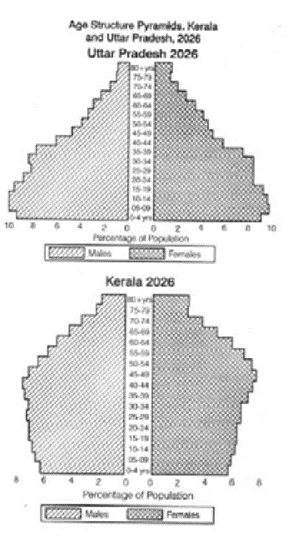
(i) What is meant by the ‘age structure pyramid’ of the population? Why is it relevant for the population study?
View AnswerAns. (i) A age structure pyramid is the graphical representation of the distribution of the population by age group. A population pyramid is a graph that shows the distribution of ages across a population divided down the center between male and female members of the population. The graphic starts from youngest at the bottom to oldest at the top.
Population pyramids are relevant for studying the future of a region as well as examining historical and current population trends. If part of the population has been affected by sudden changes, such as casualties from armed conflict, high female mortality in childbirth, or the migration of young workers out of poorer regions, the graph will offer a way to visualize how the future population will be affected. They can also help direct government and private industry distribution of services for regions based on population needs.
(ii) Which age group is the widest part of the pyramid in Uttar Pradesh and Kerala?
View AnswerAns. (ii) In Uttar Pradesh, 05-09, 10-14 age group in case of female and 05-09, 10-14 in case of Male are the widest part of the pyramid.
In Kerala age group 45-49, 50-54 in case of female and 40-44, 45-49 in case of Male are the widest part of the pyramid.
(iii) How much percentage of females are found in age group of 55 to 59 years in Uttar Pradesh?
View AnswerAns. (iii) In the age group of 55 to 59 years, 4 percentage of females are found in Uttar Pradesh.
34. Write a note on the working conditions in mines in context of Indian industrial society.
View AnswerAns. The working conditions for workers in industries in India are varied, but often very harsh. The government has passed many laws to regulate working condition. But they are not always effective and conditions of workers remain dismal.
For example, in the mining industry, a number of people are employed. The Mines Act of 1952, included in Health & Working condition 2020, specifies the maximum number of hours a person can be made to work in a week, the need to pay overtime for extra hours of work and safety rules. These laws may be followed by large mining firms but in small mines and quarries they are overlooked. Further, with sub-contracting, contractors do not maintain proper registers of workers. Thus, they avoid any responsibility for any accidents as well as benefits. After mining has finished in an area, the company is supposed to cover up the open holes and restore the area but this is never followed.
The workers working in underground mines face very dangerous conditions because of flooding, fire, the collapse of roofs and sides, the emission of gases and ventilation failures. As a result many workers develop breathing problems and diseases like tuberculosis and silicosis. Workers working in over-ground mines work in both hot Sun and rain and face injuries due to mine blasting, falling objects etc. Thus, the rate of mining accidents in India is very high in comparison to other countries.
35. (i) Un-touchability is an extreme and vicious aspects of the caste system. Explain the difficult dimensions of untouchability.
View AnswerAns. (i) Untouchability is an extreme and vicious aspects of the caste system. The three dimensions of untouchability are exclusion, humiliation- subordination and exploitation, which are as follows
(a) Exclusion Dalits experience forms of exclusion that are unique and not practised against other groups, for instance, being prohibited from sharing drinking water sources or participating in collective religious worship, social ceremonies and festivals. Untouchability may also involve forced inclusion in a subordinated role, such as being compelled to play the drums at a religious event.
(b) Humiliation and Subordination The performance of publicly visible acts of self-humiliation and subordination is an important part of the practice of untouchability.
(c) Exploitation Untouchability is almost always associated with economic exploitation of various kinds, most commonly through the imposition of forced, unpaid under paid labour, or the confiscation of property.
(ii) How did ‘Schedule Caste’ and ‘Schedule Tribe’ came into existence?
View AnswerAns. (ii) The term Schedule Caste and Schedule Tribe came into existence during the colonial period. During this period, the British government, the administration took an interest in the welfare of downtrodden caste referred to as ‘Depressed Classes’. It was the Government of India Act of 1935 which gave legal recognition to the lists or schedule of castes and tribe marked out for the special treatment by the state.