Sample Paper 02
SOCIOLOGY (039)
CLASS XII 2025-26
Time: 3 Hours Max. Marks: 80
General Instructions:
1. The question paper is divided into four sections.
2. There are 35 questions in all. All questions are compulsory.
3. Section A includes question No. 1-16. These are MCQ type questions. As per the question, there can be one answer.
4. Section B includes question No.17-25. These are very short answer type questions carrying 2 marks each. Answer to each question should not exceed 30 words.
5. Section C includes question No. 26-32. They are short answer type questions carrying 4 marks each. Answer to each question should not exceed 80 words.
6. Section D includes question No. 33-35. They are long answer type questions carrying 6 marks each. Answer to each question should not exceed 200 words each.
7. Question no. 33 is to be answered with the help of the given graphics.
SECTION A
1. Assertion (A) : Men migrate out periodically in search of work and better wages.
Reason (R) : Commercialisation of agriculture has led to the growth of migrant agricultural labour.
Codes
(a) Both (A) and (R) are true and (R) is the correct explanation of (A)
(b) Both (A) and (R) are true, but (R) is not the correct explanation of (A)
(c) (A) is true, but (R) is false
(d) (A) is false, but (R) is true
View AnswerAns. (a) Both (A) and (R) are true and (R) is the correct explanation of (A)
2. Assertion (A) : Historically, states have tried to establish and enhance their political legitimacy through nation building strategies.
Reason (R) : Most states feared that the recognition of such difference would lead to social fragmentation and prevent the creation of a harmonious society.
Codes
(a) Both (A) and (R) are true and (R) is the correct explanation of (A)
(b) Both (A) and (R) are true, but (R) is not the correct explanation of (A)
(c) (A) is true, but (R) is false
(d) (A) is false, but (R) is true
View AnswerAns. (a) Both (A) and (R) are true and (R) is the correct explanation of (A)
3. In the context of urbanization and resource allocation, consider the following progressions:
I. Urban population grows in geometric progression, such as 2, 4, 8, 16, while housing facilities grow in arithmetic progression, such as 2, 4, 6, 8.
II. Urban population grows in arithmetic progression, such as 2, 4, 6, 8, while housing facilities grow in geometric progression, such as 2, 4, 8, 16.
III. Urban population grows in geometric progression, such as 3, 6, 12, 24, while water supply grows in arithmetic progression, such as 3, 6, 9, 12.
IV. Urban population grows in arithmetic progression, such as 3, 6, 9, 12, while water supply grows in
geometric progression, such as 3, 6, 12, 24.
(a) I. and III.
(b) II. and IV.
(c) I., II., and IV.
(d) I. and IV.
View AnswerAns. (a) I. and III.
4. Assertion (A) : In Indian Nationalism, the dominant trend was marked by an inclusive and democratic
vision.
Reason (R) : It was democratic because it recognised diversity and plurality.
Codes
(a) Both (A) and (R) are true and (R) is the correct explanation of (A)
(b) Both (A) and (R) are true, but (R) is not the correct explanation of (A)
(c) (A) is true, but (R) is false
(d) (A) is false, but (R) is true
View AnswerAns. (a) Both (A) and (R) are true and (R) is the correct explanation of (A)
5. Choose the incorrect statement about position of caste and caste based issues within the nationalist
movement.
(a) The dominant view was to treat caste as a social evil and as a colonial scheme to divide India.
(b) Anti-touchability programmes became a big part of the Congress agenda.
(c) Efforts to organise the depressed classes and particularly the untouchable caste began during the nationalist movement.
(d) There was an initiative taken to organise depressed classes from both ends of the caste spectrum.
View AnswerAns. (b) Anti-touchability programmes became a big part of the Congress agenda.
Read the passage given below :
Some sectors of Indian economy underwent de-industrialisation due to industrial policies of the Britishers in India. Indian silk and cotton fabrics could not compete with the Manchester products. Therefore, there was a heavy blow to the domestic as well as international market of Indian cotton and silk textiles. Thus, these industries were adversely affected. Similarly, the village industries were more or less destroyed, as their products could not compete with the cheap imports of the machine made goods from Europe.
6. Which of the following best explains the impact of British industrial policies on Indian industries?
I. Indian silk and cotton textiles faced severe competition from Manchester products.
II. Domestic and international markets for Indian textiles suffered a major setback.
III. Machine-made goods from Europe led to the decline of village industries.
IV. Indian industries remained unaffected despite competition from British goods.
(a) I., II., and III. only
(b) I. and IV. only
(c) II. and IV. only
(d) I., II., III., and IV.
View AnswerAns. (a) I., II., and III. only
7. Which of the following is not true about the de-industrialisation caused by British policies?
(a) Indian silk and cotton fabrics were unable to compete with machine-made goods from Manchester.
(b) Village industries in India declined due to the influx of cheap European goods.
(c) British industrial policies promoted the growth of Indian village industries.
(d) Both domestic and international markets of Indian textiles were adversely affected.
View AnswerAns. (c) British industrial policies promoted the growth of Indian village industries.
8. Assertion (A) : Social movements often arise with the aim of bringing about changes on a public issue.
Reason (R) : Protest is the most visible form of collective action.
Codes
(a) Both (A) and (R) are true and (R) is the correct explanation of (A)
(b) Both (A) and (R) are true, but (R) is not the correct explanation of (A)
(c) (A) is true, but (R) is false
(d) (A) is false, but (R) is true
View AnswerAns. (b) Both (A) and (R) are true, but (R) is not the correct explanation of (A)
Read the passage given below:
Formal demography is mainly concerned with measurements. It is concerned with things like birth, death, emigration, marriage, divorce, etc. whereas social demography focuses on the social, economic and political aspects of the population.
The main function of formal demography is measuring the components of population change whereas social
demography study the reasons for changes in population and its structure and their result.
9. How does formal demography differ from social demography?
I. Formal demography focuses on measurements like birth, death, and marriage.
II. Social demography examines the social, economic, and political factors affecting the population.
III. Formal demography studies the reasons behind population changes.
IV. Social demography deals only with statistical data.
(a) I. and II. only
(b) I., II., and III. only
(c) III. and IV. only
(d) I., II., and IV. Only
View AnswerAns. (a) I. and II. Only
10. Which of the following is true about formal and social demography?
(a) Formal demography focuses on measurements, while social demography studies causes and consequences of population changes.
(b) Social demography primarily deals with measuring population components.
(c) Formal demography examines the economic and political aspects of the population.
(d) Both formal and social demography focus solely on statistical data.
View AnswerAns. (a) Formal demography focuses on measurements, while social demography studies causes and consequences of population changes.
11. Which of the following factor is not responsible for the caste system in the contemporary period?
(a) Subsidised public education.
(b) Opportunities offered by rapid development.
(c) Expansion of state sector jobs after Independence
(d) No inherited educational or economic capital.
View AnswerAns. (d) No inherited educational or economic capital.
12. Which of the following statements is/are correct about the gender identities?
(a) Trans gender refers to conversions of gender status of body into opposite gender by using choice or certain compulsions.
(b) Third gender refers to the persons having alternates of both genders i.e. male and female.
(c) In India, a third gender person can nominate themselves to contest in elections
(d) All of the above
View AnswerAns. (d) All of the above
13. Assertion (A) : Population momentum refers to a situation where a large cohort of women of reproductive age will fuel population growth over the next generation, even if each woman has fewer children than previous generations did.
Reason (R) : This occurs because the existing population base continues to contribute to growth through high birth rates over time, despite declining fertility levels.
(a) Both (A) and (R) are true, and (R) is the correct explanation of (A).
(b) Both (A) and (R) are true, but (R) is not the correct explanation of (A).
(c) (A) is true, but (R) is false.
(d) (A) is false, but (R) is true.
Ans. (a) Both (A) and (R) are true, and (R) is the correct explanation of (A).
14. Assertion (A) : Social inequalities are reducing due to industrialisation.
Reason (R) : Industrialisation creates opportunities for economic growth and employment, which often transcend traditional barriers such as caste, gender, and social status, promoting greater equality.
Options:
(a) (A) and (R) are true, and (R) is the correct explanation of (A).
(b) Both (A) and (R) are true, but (R) is not the correct explanation of (A).
(c) (A) is true, but (R) is false.
(d) (A) is false, but (R) is true.
View AnswerAns. (a) (A) and (R) are true, and (R) is the correct explanation of (A).
15. Adivasis and their struggles are different from the Dalit struggle because
(a) They were not discriminated against like the Dalits.
(b) They did not face social exclusion like the Dalits.
(c) Adivasis were concentrated in contiguous areas and could demand statehood.
(d) Their social and economic conditions were better than the Dalits.
View AnswerAns. (c) Adivasis were concentrated in contiguous areas and could demand statehood.
16. Arrange the following statements in the correct order:
I. The farmer agrees to sell the produce at a lower price.
II. The middleman offers to buy the produce directly from the farmer.
III. The farmer is unable to repay the loan taken for cultivation.
IV. The middleman continues to exploit the farmer in subsequent transactions.
(a) III., II., I., IV.
(b) I., III., IV., II.
(c) II., III., IV., I.
(d) III., I., II., IV.
View AnswerAns. (a) III., II., I., IV.
SECTION B
17. The India Nation-State is socially and culturally one of the most diverse countries of the world. It has a population of about 1.21 billion people. According to census of India 2011, it is the second largest country in terms of population in the world.
In terms of religion, about 80.5% of the population are Hindus, who in turn are regionally specific, plural in beliefs and practice.
What is meant by cultural diversity? Why is India considered to be a very culturally diverse country?
View AnswerAns. Cultural diversity is the existence of a variety of cultural or ethnic groups within a society. India is a nation of great cultural diversity. There are many different types of social groups and communities living together. There are communities with different cultural markers like language, religion, sex, race or caste.
India is considered to be a very culturally diverse country because India has a population of about 1.21 billion plus people speaking about 1,632 different languages and dialects.
or
Sanskritization is defined as the process by which a low caste or tribe or other group takes over the custom, ritual, beliefs. Ideology and style of life of a high and a twice-born (dwija) caste.’ It suggests a proven by which people want to improve their status by adopting name. Customs and culture of high placed groups in the social hierarchy. How is Sanskritization a process of social change?
View AnswerAns. Sanskritization is a process of social change by which a low caste or tribe take to the customs, rituals, beliefs, ideology and the style of life of a high and in particular a ‘twice born caste’. Its influence can be seen in language, literature, ideology, music, dance, drama, style of life and rituals.
18. What were the negative effects of the Green Revolution in its second phase?
View AnswerAns. The major negative effect of Green Revolution during its second phase in India was regional inequality because Green Revolution was mainly concentrated in Punjab, Haryana and Western Uttar Pradesh. Other regions of India could not reap the benefits of Green Revolution and thus, remains stagnated.
19. Analyse the relation between rituals and secular goals.
View AnswerAns. Rituals in India are followed by the people to socialise and to show off to the people about their wealth, status, etc. Rituals also provide men and women with occasions for socialising with their peers and for showing family wealth. Whereas, secular simply that goals which allow the individual to make the religious choice and anything not being enforced. Secularisation has usually meant a process of decline in the influence of religion.
20. Discuss the main features of industrialisation in the early years of Indian Independence.
View AnswerAns. The main features of industrialisation in the early years of India’s Independence are as follows
(i) The first modern industries in India were cotton, jute, coal mines and railways. After independence, the government took over the commanding heights of the economy which involves defence, power, transport and communication.
(ii) The government also tried to encourage small scale sector through special incentives and assistance.
21. The concept of gender has evolved to recognize identities beyond the binary framework of male and female. This acknowledgment highlights the diversity of human experiences and identities. What is meant by the term ‘Third Gender’?
View AnswerAns. The term ‘Third Gender’ refers to that social category of persons, who are neither male nor female. The third gender of the person is based on self-understanding or made up by group choice. In India, people with third gender have legal recognition and can nominate them self to contest in elections.
22. Highlight two important transformations in the nature of social relations in rural areas during the first phase of Green Revolution in India.
View AnswerAns. Two important transformations in the nature of social relations in rural areas during the first phase of Green Revolution included
(i) an increase in the use of agricultural labour as cultivation became more intensive.
(ii) a loosening of traditional bonds or hereditary relationships between farmers or landowners and agricultural workers.
23. Societies evolve over time through various processes, driven by both gradual developments and collective actions. Understanding the distinction between these processes is essential for analysing societal dynamics.
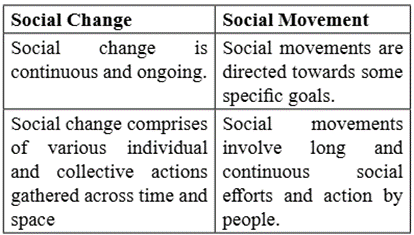
Exemplify the difference between social change and social movement.
View AnswerAns. The differences between the social change and social movement are as follows:
24. The development activity of the state and the growth of private industry affected caste indirectly through the speeding up and intensification of economic change. Explain.
View AnswerAns. Development activity of the state and growth of private industry affected caste indirectly through the speeding up of and intensification of economic change. Modem industry created various kinds of jobs for which there were no caste rules. Modem individuals attracted to the liberal ideas of individualism and meritocracy began to abandon the extreme caste practices.
25. ‘The argument for a tribe-caste distinction was founded on an assumed cultural difference between Hindu castes, with their beliefs in purity and pollution and hierarchical integration and the tribals with their equal and kinship based modes of organisation.’
State two key points of tribe-caste distinction are the part of this debate.
View AnswerAns. The two key points of tribe-caste distinction are as follows
(i) Tribes should be seen as one end of the whole society with caste-based (Hindu) peasant society which is just less stratified and more community based.
(ii) There is no coherent basis for treating tribes as pristine (pure or original) or societies uncontaminated by civilisation.
or
What are the some of the rules that the caste system imposes?
Ans. The rules that the caste system imposes are
View Answer(i) Caste is determined by birth, a child is born into the caste of its parents. It is never a matter of choice.
(ii) Membership in a caste involves strict rules about marriage. Caste groups are endogamous
i.e., marriage is restricted to members of the group.
(iii) Caste membership also involves rules about food and food sharing. What kind of food may be eaten is prescribed and who one may share food with, is also specified.
SECTION C
26. Understanding societal transformations requires distinguishing between natural evolution and deliberate collective action. These differences highlight the unique roles each process plays in shaping society.
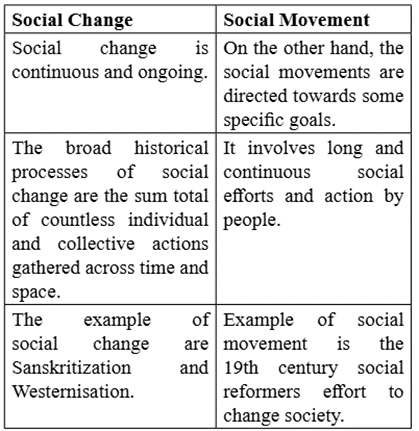
Mention some differences between social change and social movement.
View AnswerAns. The differences between the social change and social movement are as follows:
or
The worker’s movement has been a cornerstone in advocating for lobar rights and challenging economic inequalities. It exemplifies how collective action addresses systemic issues in class-based hierarchies.
Discuss about the worker’s movement as class-based movement.
View AnswerAns. The first trade union was established in April 1918 in Madras by BP Wadia, Social worker and member of Theosophical Society. The All India Trade Union Congress (AITUC) was an organisation involving diverse ideologies.
The formation of the AITUC made the colonial government more cautious in dealing with labour. It attempted to grant workers some concessions in order to contain unrest.
In 1922, the government passed the Fourth Factories Act, which reduced the working day to 10 hours. By the mid 1920s, the AITUC had nearly 200 unions affiliated to it and its membership stood at around 250,000.
After the British rule, the communist gained considerable control over the AITUC. The Indian National Congress chose to form another union called the Indian National Trade Union Congress in May 1947. In 1966-67, due to major recession, it led to a decrease in production and consequently employment.
In 1974, there was a major railway workers’ strike. The confrontation between the state and trade unions became acute. During the emergence in 1975-77, the government curbed all trade union activities. The workers movement was very much part of the wider struggle for civil liberties.
27. Industrialization has reshaped societies worldwide, but its impacts have varied across regions. Compare the experience of industrialisation in the West with that of the Indian experience.
View AnswerAns. Experience of industrialisation in the West with that of Indian experience can be compare with help of the following points
(i) Unlike Britain where the impact of industrialisation led to more people moving into urban areas, in India the initial impact of the same British industrialisation led to more people moving into agriculture.
(ii) Just as manufacturing boomed in Britain, traditional exports of cotton and silk manufactures from India declined in the face of Manchester competition. This period also saw the further decline of cities such as Surat and Masulipatnam.
(iii) The British took over Indian states, towns like Thanjavur, Dhaka, and Murshidabad lost their courts and therefore, some of their artisans and court gentry.
(iv) Industrialisation in the West was accompanied by the growth of a Western middle class. However, in India, it could not create any genuine middle class.
28. The colonial era significantly impacted various sections of Indian society, including tribal communities.
Their lives were disrupted through policies and exploitation under British rule Tribal have faced colonialism in the pre-Independent India. Explain.
View AnswerAns. Tribal have faced difficulties and discrimination during the British rule. During the pre-Independence period, on the political and economic front, tribal societies faced incursion of moneylenders. They also lost their land to non-tribal immigrant settlers. Their access to forests was restricted because of the British government’s policy of reservation of forests and the introduction of mining operations. In this way, their source of livelihood was snatched by the British government.
or
One of the most significant yet paradoxical changes in the caste system in the contemporary period is that it has tended to become ‘invisible’ for the upper caste, urban middle and upper classes. Elaborate.
View AnswerAns. Upper caste, urban middle and upper classes have benefitted the most from the developmental policies. Their caste status had been crucial in ensuring that these groups had the necessary economic and educational resources to take full advantage of the opportunities offered by rapid development. In particular, the upper caste elite benefitted from subsidised public education especially professional education in science, technology, medicine and management. At the same time, they were also able to take advantage of the expansion of public sector jobs in the early decades after Independence.
29. Disinvestment, the process of selling government stakes in public sector enterprises, has far-reaching implications. It affects not just the economy but also the workforce involved in these enterprises. Discuss the impact of disinvestment on employees.
View AnswerAns. The impact of disinvestment on employees are as follows
(i) Many government workers are scared that after disinvestment, they will loose their jobs. In the Modern Foods India Ltd., which was set up by the government to make healthy bread available of cheap prices, and which was the first company to be privatised, 60% of the workers were forced to retire in the first five years.
(ii) Indian agriculture as well as service sector such as shops, banks, the information and technology industries, hotels and other services, are employing more people on contract basis. this develops job insecurity.
30. How the process of Sanskritization uplifts the lower caste people?
View AnswerAns. The process of Sanskritization through which the low caste people try to uplift their political and economic status are
(i) The lower caste assume that upper caste is being superior hence to be imitated. Justification of the practice of inequality and exclusion as a marked privilege of upper caste makes it a discriminatory system.
(ii) Process that is gendered though progressive for men, upper caste practices like Purdah system, low age of marriage, dowry in place of bride price are regressive as far as women are concerned.
(iii) Erosion of dalit culture would be an expected outcome. The work performed by the Dalits is also considered shameful and it leads to the erosion of dalit culture and ethos.
(iv) The upper castes look down upon the lower castes. It reflects the undemocratic vision in society. Thus, Sanskritization creates inequality and discrimination in society instead of erasing them.
31. Analyse social reform movements initiated towards women’s equality and rights in the 19th century.
View AnswerAns. Social reform movements initiated towards women’s equality and rights in the 19th century, saw the growth of women’s organisation at a national and local level. The organisations including the Women’s India Association (WIA) was started in 1917, All India Women’s Conference (AIWC) in 1926, National Council for Women in India in 1925 started for women. The AIWC began with the idea that women’s welfare and politics were mutually exclusive. Over the years, there have been numerous campaigns that have been taken up towards violence against women.
Important legal changes have taken place because of the women’s movement such as issues of land rights, employment have been fought alongside, rights against sexual harassment and dowry. The reformers of India used to revere the glorious past of India considering the woman’s presence as significant belonging. They safeguarded the western influence in society. The Purdah system extended the distancing between opposite sexes, social isolation and mental numbness.
32. India’s diversity is both its strength and its challenge. Communalism is an important issue in India because it has been a source of tension and violence. Elaborate.
View AnswerAns. Communalism is an important issue in India because it has been a recurrent source of tension and violence. During communal riots, people become faceless members of their respective communities. Every religious community has faced this violence in greater or lesser degree, although the proportionate impact is far more traumatic for minority communities.
Communalism is an aggressive political ideology linked to religion. Communal means something related to a community or collectivity as different from an individual. It is important to emphasise that communalism is about politics and not about religion. There is no necessary relationship between personal faith and communalism. One of the characteristic feature of communalism is its claim that religious identity overrides everything else.
SECTION D
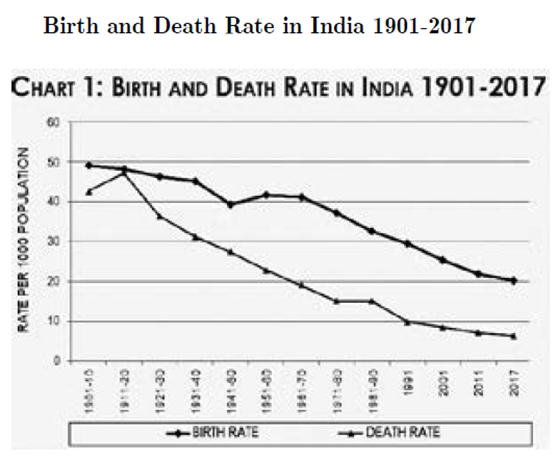
33. The given table and answer the following questions.
(i) What is meant by ‘birth rate’ and ‘death rate’?
View AnswerAns. (i) Birth rate, also known as natality, is the total number of live human births per 1,000 population for a given period divided by the length of the period in years.
Mortality rate, or death rate is a measure of the number of deaths in a particular population, scaled to the size of that population, per unit of time. Mortality rate is typically expressed in units of deaths per 1,000 individuals per year. A mortality rate of 9.5 (out of 1,000) in a population of 1,000 would mean 9.5 deaths per year in that entire population.
(ii) Before 1931, both death rates and birth rates were high. In given chart, what happened after 1931 to birth and death rates?
View AnswerAns. (ii) Before 1931, both death rates and birth rates are high, whereas, after this transitional moment the death rates fall sharply but the birth rate only falls slightly. The principal reasons for the decline in the death rate were increased levels of control over famines and epidemic diseases. The major epidemic diseases in the past were fevers of various types, plague, smallpox and cholera. But the single biggest epidemic was the influenza epidemic of 1918-19, which killed as many as 125 lakh people, or about 5% of the total population of India at that time.
(iii) What was the birth and death rates in the year 2011?
View AnswerAns. (iii) In the year 2011, the crude birth rate is 21.8 and death rate is 7.1.
34. What do you understand by home-based work? Elaborate the work process in the bidi industry.
View AnswerAns. Home-based work is a significant part of the economy. This includes the manufacturing of laee, zari or brocade, carpets, bidis, agarbattis and many such products. This work is mainly done by women and children at their homes. An agent provides raw material and also collects the finished products. Home workers are paid on per piece-rate basis, depending on the number of pieces they make.
The process of making bidis starts in forested villages, where villagers pluck tendu leaves and sell them to the forest department or a private contractor who sells them to the forest department. An individual can collect 100 bundles (each with 50 leaves) per day on average. The leaves are then auctioned off to bidi factory owners, who then send them to the contractors.
The contractor in turn supplies tobacco and leaves are then delivered to home-based workers. These workers who are mostly women, roll the bidis by dampening the leaves, cutting them, uniformly filling them with tobacco, and tying them with thread. The contractor collects the bidis and sells them to the maker, who roasts them and labels them with his own name. The producer then sells them to a dealer, who then sells them to wholesalers, who then sell them to your local pan shops. This is how the bidis get their brand name.
35. (i) Discuss globalisation.
View AnswerAns. (i) Globalisation is a process of increasing interconnectedness interdependence, and integration of economies and societies to such an extent that an event in one part of the globe affects people in other parts of world. The effect of globalisation is far reaching. It affects us all but affects us differently. Thus, while for some it may mean new opportunities, for others the loss of livelihood.
For example, women silk spinners and twisters of Bihar lost their jobs once the Chinese and Korean silk yarn entered the market. Weavers and consumers prefer this yarn as it is somewhat cheaper and has a shine.
(ii) What is your opinion on the impact of globalisation on employment ? Does it always have a negative impact on indigenous art forms?
View AnswerAns. (ii) Globalisation affects the employment situation through trade liberalisation, through encouraging exports and imports and through increasing incentives for investment and innovation. It also encourages FDI which supplements domestic investment and leads to higher growth of the economy. Globalisation, which is often combined with domestic liberalisation, also results in reducing the power of trade unions and encourages informal contextualisations and lock outs.
Yes, globalisation always have a negative impact on indigenous art forms. Negative impacts of globalisation on indigenous art forms are (i) The traditional industries like weavers in Bihar and Benaras got impacted badly due to cheap imported goods from other countries.
(ii) The Western music became so popular that classical music is followed by very less people in young generation.
(iii) The cheap imports from China has impacted the traditional art of creating Ganesh idols, Indian rakhee, etc.