Sample Paper 01
SOCIOLOGY (039)
CLASS XII 2025-26
Time: 3 Hours Max. Marks: 80
General Instructions:
1. The question paper is divided into four sections.
2. There are 35 questions in all. All questions are compulsory.
3. Section A includes question No. 1-16. These are MCQ type questions. As per the question, there can be one answer.
4. Section B includes question No.17-25. These are very short answer type questions carrying 2 marks each. Answer to each question should not exceed 30 words.
5. Section C includes question No. 26-32. They are short answer type questions carrying 4 marks each. Answer to each question should not exceed 80 words.
6. Section D includes question No. 33-35. They are long answer type questions carrying 6 marks each. Answer to each question should not exceed 200 words each.
7. Question no. 33 is to be answered with the help of the given graphics.
SECTION A
1. Assertion (A) : India’s structural and cultural diversity is self-evident.
Reason (R) : This diversity shapes the different ways that Modernisation or Westernisation, Sanskritisation or Secularisation effects or does not affect different groups of people.
Codes
(a) Both (A) and (R) are true and (R) is the correct explanation of (A)
(b) Both (A) and (R) are true, but (R) is not the correct explanation of (A)
(c) (A) is true, but (R) is false
(d) (A) is false, but (R) is true
View AnswerAns. (b) Both (A) and (R) are true, but (R) is not the correct explanation of (A)
2. Assertion (A) : India has had an official population policy for more than a half century.
Reason (R) : India was perhaps the first country to explicitly announce such a policy in 1952.
Codes
(a) Both (A) and (R) are true and (R) is the correct explanation of (A)
(b) Both (A) and (R) are true, but (R) is not the correct explanation of (A)
(c) (A) is true, but (R) is false
(d) (A) is false, but (R) is true
View AnswerAns. (a) Both (A) and (R) are true and (R) is the correct explanation of (A)
3. According to the demographic transition theory, population growth moves through specific stages. Which of the following sequences appropriately explains the stages?
I. High birth rate, high death rate, low growth
II. High birth rate, declining death rate, rapid growth
III. Declining birth rate, low death rate, stable growth
IV. High death rate, low birth rate, population decline
(a) I., II., and III.
(b) II., III., and IV.
(c) I. and II. only
(d) I., II., III., and IV.
View AnswerAns. (a) I., II., and III.
4. Assertion (A) : Migrant workers come mainly from drought-prone and less productive regions and they go to work for part of the year on farms in the Punjab and Haryana, or on brick in U.P., kilns or construction sites in cities such as New Delhi or Bangalore.
Reason (R) : Labourers migrate due to the increasing inequalities in rural areas from the mid-1990s, which have forced many households to combine multiple occupations to sustain themselves.
Codes
(a) Both (A) and (R) are true and (R) is the correct explanation of (A)
(b) Both (A) and (R) are true, but (R) is not the correct explanation of (A)
(c) (A) is true, but (R) is false
(d) (A) is false, but (R) is true
View AnswerAns. (b) Both (A) and (R) are true, but (R) is not the correct explanation of (A)
5. Which one of the following statements is incorrect about India’s Demographic Transition?
(a) According to Registrar of India, Census data from India suggests that population growth is on the decline since 1991.
(b) India’s population is projected to increase from 1.2 billion today to an estimated 1.6 billion by 2030 due to population momentum.
(c) The drop in Crude Death (CDR) and Birth Rates (CBR) for the past four decades indicates that India is progressing towards a post-transitional phase.
(d) From 1950 to 1990, the drop in CBR was less steep than the drop in the CDR.
View AnswerAns. (b) India’s population is projected to increase from 1.2 billion today to an estimated 1.6 billion by 2030 due to population momentum.
Read the passage given below:
Formal demography is mainly concerned with measurements. It is concerned with things like birth, death, emigration, marriage, divorce, etc. whereas social demography focuses on the social, economic and political aspects of the population.
The main function of formal demography is measuring the components of population change whereas social demography study the reasons for changes in population and its structure and their result.
Based on the given passage answer Q.6 and Q.7
6. How does formal demography differ from social demography?
I. Formal demography focuses on measurements like birth, death, and marriage.
II. Social demography examines the social, economic, and political factors affecting the population.
III. Formal demography studies the reasons behind population changes.
IV. Social demography deals only with statistical data.
(a) I. and II. only
(b) I., II., and III. only
(c) III. and IV. only
(d) I., II., and IV. Only
View AnswerAns. (a) I. and II. only
7. Which of the following is true about formal and social demography?
(a) Formal demography focuses on measurements, while social demography studies causes and consequences of population changes.
(b) Social demography primarily deals with measuring population components.
(c) Formal demography examines the economic and political aspects of the population.
(d) Both formal and social demography focus solely on statistical data.
View AnswerAns. (a) Formal demography focuses on measurements, while social demography studies causes and consequences of population changes.
8. Assertion (A) : Contract farming has sociological significance in that it disengage many people from the production process.
Reason (R) : Contract farming focuses on export oriented products such as flowers and gherkins.
Codes
(a) Both (A) and (R) are true and (R) is the correct explanation of (A)
(b) Both (A) and (R) are true, but (R) is not the correct explanation of (A)
(c) (A) is true, but (R) is false
(d) (A) is false, but (R) is true
View AnswerAns. (b) Both (A) and (R) are true, but (R) is not the correct explanation of (A)
Read the passage given below :
Some sectors of Indian economy underwent de-industrialisation due to industrial policies of the Britishers in India. Indian silk and cotton fabrics could not compete with the Manchester products. Therefore, there was a heavy blow to the domestic as well as international market of Indian cotton and silk textiles. Thus, these industries were adversely affected. Similarly, the village industries were more or less destroyed, as their products could not compete with the cheap imports of the machine made goods from Europe.
9. Which of the following best explains the impact of British industrial policies on Indian industries?
I. Indian silk and cotton textiles faced severe competition from Manchester products.
II. Domestic and international markets for Indian textiles suffered a major setback.
III. Machine-made goods from Europe led to the decline of village industries.
IV. Indian industries remained unaffected despite competition from British goods.
(a) I., II., and III. only
(b) I. and IV. only
(c) II. and IV. only
(d) I., II., III., and IV.
View AnswerAns. (a) I., II., and III. only
10. Which of the following is not true about the de-industrialisation caused by British policies?
(a) Indian silk and cotton fabrics were unable to compete with machine-made goods from Manchester.
(b) Village industries in India declined due to the influx of cheap European goods.
(c) British industrial policies promoted the growth of Indian village industries.
(d) Both domestic and international markets of Indian textiles were adversely affected.
View AnswerAns. (c) British industrial policies promoted the growth of Indian village industries.
11. “When as a nation we adopt the spinning wheel, we not only solve the question of unemployment but we declare that we have no intention of exploiting any nation, and we also end the exploitation of the poor by the rich.”
Who said this above mentioned statement?
(a) Jawaharlal Nehru
(b) Vallabhbhai Patel
(c) Mahatma Gandhi
(d) Vinoba Bhave
View AnswerAns. (c) Mahatma Gandhi
12. Which of the following is/are the negative impact of globalisation on economic growth?
(a) Threat to sovereignty
(b) Interdependence
(c) Inequitable distribution
(d) All of these
View AnswerAns. (d) All of these
13. Assertion (A) : Fertility rate refers to the number of live births per 1000 women in the child-bearing age group, usually taken to be 15 to 49 years.
Reason (R) : Fertility rate is an essential indicator used to measure population growth and assess reproductive health trends in a society.
(a) Both (A) and (R) are true, and (R) is the correct explanation of (A).
(b) Both (A) and (R) are true, but (R) is not the correct explanation of (A).
(c) (A) is true, but (R) is false.
(d) (A) is false, but (R) is true.
View AnswerAns. (a) Both (A) and (R) are true, and (R) is the correct explanation of (A).
14. Assertion (A) : Discrimination refers to actual behavior or actions directed towards another group or individual, often based on prejudice.
Reason (R) : Discrimination is the practical implementation of prejudiced attitudes, where individuals or groups are treated unfairly due to stereotypes or biases.
(a) Both (A) and (R) are true, and (R) is the correct explanation of (A).
(b) Both (A) and (R) are true, but (R) is not the correct explanation of (A).
(c) (A) is true, but (R) is false.
(d) (A) is false, but (R) is true.
View AnswerAns. (a) Both (A) and (R) are true, and (R) is the correct explanation of (A).
15. Which of the following statements is/are correct about the Halpati system?
(a) It represents a kind of bonded labour, where the poor workers were involved in hereditary labour relationships with the landowners
(b) This system shows how landowners controlled the poor through land ownership by exploiting their dependence on land for survival.
(c) Jeeta system is the name given to Halpati system practiced in Karnataka.
(d) All of the above
View AnswerAns. (d) All of the above
16. Put the following statements in the correct order regarding the process of Sanskritisation in Indian society:
I. Lower castes aspire to improve their social status.
II. They begin to adopt the rituals, customs, and practices of the higher castes.
III. Over time, these changes in lifestyle help them gain acceptance in the social hierarchy.
IV. The process requires sustained effort and may take generations to complete.
(a) I., II., III., IV.
(b) II., I., IV., III.
(c) I., II., IV., III.
(d) II., III., I., IV
View AnswerAns. (a) I., II., III., IV.
SECTION B
17. ‘Access to land forms the rural class structure because agricultural land is the most valuable productive resource in rural areas. The role one plays in the agricultural production process is largely determined by one’s access to land.’
Based on the given passage, answer the following question.
Which system is referred to the structure or distribution of hand holdings according to the above mentioned statements? Explain.
View AnswerAns. Agrarian system is referred in the above mentioned statements. An agrarian system is the dynamic set of economic and technological factors that affect agricultural practices.
The basis for a prevailing agrarian system may be derived from one of a number of major types, including agrarian social structure, for example, tribal or ethnic divisions, feudal classes or family based systems.
or
“Sociologists use the term social stratification to refer to a system by which categories of people in a society are ranked in a hierarchy”. What are the principles of social stratification?
View AnswerAns. There are basically three key principles help to explain social stratification. They are as follows
(i) It is a society wide system that unequally distributes social resources among categbries of people.
(ii) It is closely linked to the family and to the inheritance of social resources from one generation to next.
(iii) It is supported by patterns of belief or ideology.
18. To what extent colonialism affected tribal communities during the pre-Independence India. Explain.
View AnswerAns. In India, British colonialism have affected tribal communities during the pre-Independence period, on the political and economic front, tribal societies faced incursion of money lenders. They also lost their land to non-tribal immigrant settlers. Their access to forests was restricted because of the British government’s policy of reservation of forests and the introduction of mining operations. In this way, their source of livelihood was snatched by the British government.
19. How did the state address the issues of caste and tribe discrimination? Elaborate.
View AnswerAns. There are several initiatives taken by the state to address the issues of caste and tribe discrimination, some of which are as follows
(i) The most important initiative of the state is the reservation. This involves the setting of reserve category for the dalits and tribal communities in different spheres of public life including reservations in educational institutions and government jobs.
(ii) In addition to reservations, there have been a number of constitutional laws passed to end, prohibit and punish caste discrimination and untouchability.
20. Karl Marx and Mahatma Gandhi saw mechanisation as a threat to employment because it focuses on productivity over workers’ well-being, exploiting them through extended hours or increased output, and replacing human labour with machines. Why both Marx and Gandhiji saw mechanisation as danger to employment?
View AnswerAns. Both Karl Marx and Mahatma Gandhi saw mechanisation as danger to employment because they agreed upon the fact that the basic task of manager is to control workers and get more work out of them.
Further they argued that there are two main ways of making workers produce more. One is to extend the working hours. The other is to increase the amount that is produced within a given time period.
21. The population of a country is often studied in terms of its composition and distribution across age groups. This helps in understanding the social and economic dynamics of the population. What is meant by the ‘age structure’ of the population?
View AnswerAns. The age structure of the population refers to the proportion of persons in different age groups relative to the total population. The age structure changes in response to change in levels of development and the average life expectancy.
22. How has the formation of AITUC made the colonial government more cautious in dealing with the labour? Explain.
View AnswerAns. The formation of the AITUC made the colonial government more cautious in dealing with labour. It attempted to grant workers some concessions in order to contain unrest. In 1922, the government passed the Fourth Factories act which reduced the working day to 10 hours. In 1926, the Trade Unions act was passed which provided for registration of trade unions and proposed some regulations.
23. ‘The struggle for women’s upliftment in the 19th and early 20th centuries was led by male reformers.’ Discuss with suitable examples.
View AnswerAns. The reform movements of the 19th and early 20th centuries tried to address the issues that discriminated against women. The struggle was led by male reformers in this regard. Some examples are
(i) Raja Ram Mohun Roy attacked the evil practice of sati which was present in society. He opposed it on the basis of humanitarianism, natural right doctrines and Hindu shastras.
(ii) Jyotiba Phule supported the women education and opened the first school for women in Pune. (iii) MG Ranade writings supported the re-marriage of widows on the basis of shastras.
24. The state often adopts various strategies to manage cultural diversity and promote unity. These strategies aim to create a shared sense of belonging among diverse communities. How the policies of assimilation and integration are used by the state to strengthen national identity?
View AnswerAns. The policies of assimilation and integration are used by the state to strengthen national identity because assimilation policies, often involving outright suppression of the identities of ethnic, religious or linguistic groups, try to erode the cultural differences between groups.
On the other hand, integration policies seek to assert a single national identity by attempting to eliminate ethno-national and cultural differences from the public and political arena, while allowing them in the private domain. Both sets of policies assume a single national identity.
25. This is a real life story of Rukmini Devi who lives in a small hut in Gaigotha Village in Wada Taluka of Palghar District in Maharashtra State. She belongs to the Warli tribe. Her husband is a marginal farmer who cultivates on two acres of land. They have two children, one daughter aged 10 years and an 1 son aged 6 years. Both the children walk to school and back daily (located about 3 miles away).
When cultivation season is over, (or if the rice crop is damaged due to heavy rains or pests) they face many hardships. A section of the crop is kept for their personal use, for the year. Tur Dal (lentil) is also grown in one small area, again for personal use. Ina small backyard, they grow vegetables like chilies, cucumber, and bitter gourd (karela).
During the off-season, both husband and wife go to the brick kilns (about 7 miles away) to do piece-rate work (That is, they get paid for each brick that they make.) While the men earn `300 per day, the women earn `150-200. Rukmini Devi stated that they prefer to walk the 7 miles both ways because the bus fare is `35/- per head one way. They cannot afford it.
Point out and discuss briefly, gender discrimination in this setting.
View AnswerAns. Rukmini Devi is facing wage discrimination i.e., discrimination on the basis of sex in the payment of wages, where Rukmini Devi and her husband perform work of similar skill, effort, and responsibility for the same employer under similar working conditions but they don’t earn the same amount of money.
This implies discriminative employers save on the cost by employing the tribal females. Rukmini Devi is working in informal labour market where there is an absence of policies to safeguard gender rights.
or
Discuss the nature of the economy of the Warli tribes.
View AnswerAns. The economy practiced by Warli tribe is subsistence economy and simple. They use out model techniques therefore their production is insufficient. They cannot fulfill their basic needs. They try to fulfill their needs by collective efforts. Thus, the simple and collective economic life is an important characteristic of the tribal economy.
SECTION C
26. Social movements play a crucial role in shaping societies by addressing inequalities and advocating for change. In India, such movements have targeted various social, economic, and political issues. Explain the types of social movements in context of Indian societies.
View AnswerAns. Social movements classify into three types in context of Indian society. These are as follows
(i) Redemptive social movement This movement aims to bring about a change in the personal consciousness and actions of its individual members. For instance, people in the Ezhava community in Kerala led by Narayan Guru tried to change their social practice.
(ii) Reformist social movement The movement strives to change the existing social and political arrangements through gradual incremental steps. The 1960s movement for the re-organisation of Indian states on the basis of language and the recent right to information campaign are examples of reformist movements.
(iii) Revolutionary social movement This movement attempt to radically transform social relations, often by capturing state power. The Bolshevik Revolution in Russia that deposed the Tsar to capture a communist state and Naxalite movement in India that seeks to remove oppressive landlords and state officials are examples of revolutionary social movements.
or
The industrial revolution in India during British rule led to the growth of industries and factories, which significantly impacted workers’ lives. This created the need for organized labor to address issues like poor wages and working conditions. Write a brief note on establishment of trade union in context of preIndependence India.
View AnswerAns. The economy practiced by Warli tribe is subsistence economy and simple. They use out model techniques therefore their production is insufficient. They cannot fulfill their basic needs. They try to fulfill their needs by collective efforts. Thus, the simple and collective economic life is an important characteristic of the tribal economy.
27. The distinction between tribes and castes has been a subject of extensive scholarly debate in India, as both concepts hold unique social and cultural significance. Understanding their distinctions is crucial for addressing issues of inequality and representation. Write a brief note on the debates about tribe-caste distinction in India.
View AnswerAns. The argument for a tribe-caste distinction was founded on an assumed cultural difference between Hindu castes, with their beliefs in purity and pollution and hierarchical integration and the tribals with their equal and kinship based modes of organisation.
The debate posed whether tribal was one end of the caste based society or a different kind of community.
There are some important viewpoints about tribe- caste distinction as follows
(i) Tribes should be seen as one end of the whole society with caste-based (Hindu) peasant society which is just less stratified and more community based. However, some opponents argued that tribes were wholly different from caste because they had no notion of purity and pollution which is central to the caste system.
(ii) There is no coherent basis for treating tribes as pristine (pure or original) or societies uncontaminated by civilisation. Rather, tribes should be seen as secondary phenomena arising out of exploitative and colonialist contact between pre-existing states and non-state groups.
28. The Khasi matriliny generates intense role conflict for men. Explain.
View AnswerAns. The Khasi matriliny generates intense conflicts for men is following ways
(i) Khasi matriliny generates intense role conflict for men. They are torn between responsibilities to their native house on one hand and to their wife and children on the other.
(ii) There is an inherent disagreement in matrilineal systems. On the one hand, the line of descent and inheritance, where woman inherits property from her mother and passes it on to her daughter.
The other structure of authority and control is where a man control his sister’s property and passes on control to his sister’s son. The farmer, which links the mother to the daughter, comes in conflict with the latter, which links the mother’s brother to the sister’s son.
(iii) The tension generated by such role conflict affects Khasi women more intensely. A woman can never be fully assured that her husband does not find his sister’s house a more pleasant place than her own.
Thus, men are the power holders in Khasi society, the only difference is that a man’s relatives on his mother’s side matter more than his relatives on his father’s side.
or
Tribes have been classified according to their ‘permanent’ and ‘acquired’ traits. Highlight the demography of tribal communities in India on the basis of the permanent traits.
View AnswerAns. Permanent traits of tribal communities in India include region, language, physical characteristics and ecological habitat.
On the basis of language, tribes are categorised into four categories, namely Indo-Aryan, Dravidian, Austric and Tibeto-Burman. The Indo-Aryan accounts for 1% of the population and the Dravidian accounts for 3%. The other two languages are primary spoken by tribals having 80% of the concentration.
On the basis of physical characteristics, tribes are classified under the Negrito, Australoid, Mongoloid, Dravidian and Aryan categories. The last two are shared by the majority of the Indian population.
In terms of size, tribes may vary in great number. The biggest tribes are the Gonds, Bhils, Santhals, Oraons, Minas Bodos and Mundas. The total population of tribes amounts to about 8.2% of the Indian population or 84 million people according to 2001 Census which has grown to 8.6% or 104 million tribal population according to 2011 Census.
29. ‘Social stratification is supported by patterns of belief, or ideology.’ Justify your answer with suitable examples.
View AnswerAns. Social stratification is supported by patterns of belief, or ideology because no system of social stratification is likely to persist over generations, unless it is widely viewed as being either fair or inevitable.
For example, the caste system is justified in terms of the opposition of purity and pollution, with the Brahmins designated as the most superior and Dalits as the most inferior by virtue of their birth and occupation. Not everyone, though, thinks of a system of inequality as legitimate.
Typically, people with the greatest social privileges express the strongest support for systems of stratification such as caste and race. Those who have experienced the exploitation and humiliation of being at the bottom of the hierarchy are most likely to challenge it
30. Communalism is an important issue in India because it has been a source of tension and violence. Elaborate.
View AnswerAns. Communalism is an important issue in India because it has been a recurrent source of tension and violence. During communal riots, people become faceless members of their respective communities. Every religious community has faced this violence in greater or lesser degree, although the proportionate impact is far more traumatic for minority communities.
Communalism is an aggressive political ideology linked to religion. Communal means something related to a community or collectivity as different from an individual. It is important to emphasise that communalism is about politics and not about religion. There is no necessary relationship between personal faith and communalism. One of the characteristic feature of communalism is its claim that religious identity overrides everything else.
31. Explain Green Revolution and the social consequences associated with it.
View AnswerAns. The Green Revolution means increasing production of food grains by using High Yielding Variety (HYV) seeds especially of wheat and rice. It was a government programme of agricultural modernisation which was funded by international agencies. The programme of Green Revolution was introduced only in those areas that had abundant irrigation. But only some parts of the country could reap the benefits of Green Revolution like that of Punjab, Western Uttar Pradesh, Andhra Pradesh and some parts of Tamil Nadu.
There were many social consequences of Green Revolution, which are as follows
(i) The agricultural productivity increased very rapidly and the medium and large farmers who produced a surplus for the market got the maximum benefit through Green Revolution.
(ii) Small and marginal farmers could not benefit from Green Revolution as they could not buy new seeds and technology. It was only large farmers who were able to benefit from the new technology.
(iii) The excessive use of pesticides hybrid seeds, etc., that needed assured irrigation also brought negative impacts. Many farmers shifted from multi-crop system to mono-crop system.
32. Gandhiji believed in promoting self-reliance and human dignity, emphasizing manual labor over mechanized production. His views on machinery were rooted in his philosophy of simplicity and sustainability. What was Gandhiji viewpoint on the growing relevance of machinery?
View AnswerAns. Gandhiji’s viewpoint on the growing relevance of machinery included the following points
(i) He was deeply critical of the modern age in which machines enslaved human beings and displaced workers.
(ii) He argued that the growing importance of machinery would lead to mechanisation and mechanisation possess a threat to the labourers by substituting them for the machines.
(iii) He also pointed out how the craze of mechanisation and machinery took exploitative profit. These exploitative measures impacted the workers directly.
(iv) He believed that modern machinery would lead to a concentration of wealth in a few hands.
SECTION D
33. The Declining Sex Ratio in India, 1901-2011
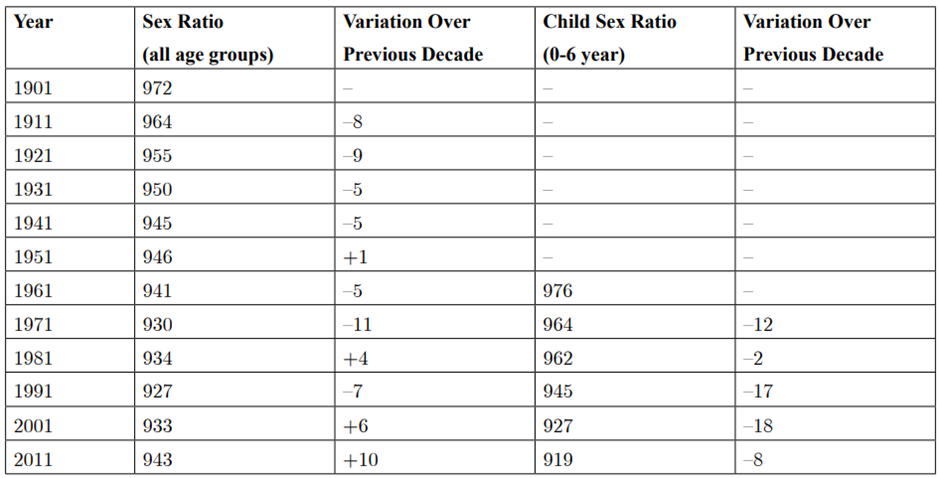
NOTE : The sex ratio is defined as the number of female per 1000 males. Data on age-specific sex ratios is not available before 1961.
(a) What is meant by the term ‘sex ratio’? Briefly explain.
View AnswerAns. (a) The sex ratio refers to the number of females per 1000 males in a given area at a specified time period. Despite the fact that slighty more males are born than female ones, historically, there are slightly more females than males.
In other words, sex ratio favour females. This is because of the factor where girl babies have high resistance to diseases in infancy.
(b) How much the sex ratio was decreased between the years 1901 and 2011?
View AnswerAns. (b) The declining sex ratio were 972 females per 1000 males at the turn of the 20th century, the sex ratio has declined to 943 at the turn of 21st century. It decreased 29 points from 1901 to 2011.
(c) What is the increasing point in over all sex ratio from 1991 to 2011 and also find out the deceasing points in child sex ratio from 1991 to 2011?
View AnswerAns. (c) The decade 1991 – 2011 represents an anomaly in that overall sex ratio has shown an increase of 16 points from 927 to 943.
The child sex ratio had dropped 26 points from 945 to 919.
34. Do you agree that all sections of people have benefitted from the liberalisation policies in India? Justify your answer with examples.
View AnswerAns. This is a fact that all sections of people are not benefitted from the liberalisation policies in India because the effect of liberalisation is not uniform on all sections. There are some major consequences after the effects of liberalisation.
These are as follows
(i) After this policy, the government tried to sell its share in several public sector companies, a process which is known as called disinvestment. With disinvestment, many government workers feared that they will lose their jobs.
(ii) More and more companies are reducing the number of permanent employees and outsourcing their work to smaller companies or even to homes. For the multinational companies, this outsourcing is done across the globe, with developing countries like India providing cheap labour.
As small companies have to compete for orders from the big companies, they keep wages low as well as their working conditions are often poor.
(iii) Very few people in India have access to secure jobs and even the small number in regular salaried employed are becoming more insecure with incoming of contract labour. Now-a- days, employment by government is also coming down. According to economists, both liberalisation and privatisation is associated with rising income inequality.
(iv) As the secure employment in large industry is declining, the government is embarking on the policy of land acquisition for industry. These industries do not necessarily provide employment to the people of the surrounding areas, but cause major pollution.
35. (a) What are the challenges faced by rural people while sending their children for higher education?
View AnswerAns. (a) The challenges faced by rural people are as follows
(i) There is a lack of availability of resources and infrastructure in the rural regions in India. There is no availability of benches, playgrounds, laboratories, washrooms or if present they are in the worst condition. (ii) Sometimes the textbooks are not available in proper quantity, or if available they are not in good condition. Also, the availability of stationery is also a challenge. Many rural Indians don’t have enough money to bear stationary charges and other expenses.
(iii) There is no transportation availability as there is poor connectivity from one place to another place.
(iv) There is less availability of teachers. In India, the school in rural areas have only one or two teachers in the school.
(b) What makes rural people migrate to cities?
View AnswerAns. (b) The rural people migrate to cities due to following factors
(i) Environmental Factors Natural disasters are a common factor that pushes rural residents to migrate to urban cities. This includes events that may immediately displace people, such as floods, droughts, wildfires, and intense weather.
(ii) Social Factors Increased access to quality education and health care facilities are a common pull factor in rural-to- urban migration. Rural areas often lack government services when compared to their urban counterparts. More government spending often goes towards providing public services in cities.
(iii) Economic Factors Employment and educational opportunities are cited as the most common pull factors associated with rural-to-urban migration.1 Poverty, food insecurity, and lack of opportunities in rural areas are a consequence of uneven economic development and push people to urban areas where development has been greater. When rural people migrate to urban areas for better prospects leaving behind everything. The negative impact of migration on rural communities are there is labour shortage in farms, only senior citizens, women and children are left behind, increase in child labour, children’s are forced, to work in fields, increased workload for women’s decreased population, disorganization of family, customs and in this way rural culture slowly fades away.