SOCIOLOGY (039)
Time: 3 Hours Max. Marks: 80
General Instructions:
1. The question paper is divided into four sections.
2. There are 35 questions in all. All questions are compulsory.
3. Section A includes question No. 1-16. These are MCQ type questions. As per the question, there can be one answer.
4. Section B includes question No.17-25. These are very short answer type questions carrying 2 marks each. Answer to each question should not exceed 30 words.
5. Section C includes question No. 26-32. They are short answer type questions carrying 4 marks each. Answer to each question should not exceed 80 words.
6. Section D includes question No. 33-35. They are long answer type questions carrying 6 marks each. Answer to each question should not exceed 200 words each.
7. Question no. 33 is to be answered with the help of the given graphics.
SECTION A
1. Assertion (A) : Men migrate out periodically in search of work and better wages.
Reason (R) : Commercialisation of agriculture has led to the growth of migrant agricultural labour.
(a) Both (A) and (R) are true and (R) is the correct explanation of (A)
(b) Both (A) and (R) are true, but (R) is not the correct explanation of (A)
(c) (A) is true, but (R) is false
(d) (A) is false, but (R) is true
View AnswerAns. (a) Both (A) and (R) are true and (R) is the correct explanation of (A)
2. Assertion (A) : Historically, states have tried to establish and enhance their political legitimacy through nation building strategies.
Reason (R) : Most states feared that the recognition of such difference would lead to social fragmentation and prevent the creation of a harmonious society.
(a) Both (A) and (R) are true and (R) is the correct explanation of (A)
(b) Both (A) and (R) are true, but (R) is not the correct explanation of (A)
(c) (A) is true, but (R) is false
(d) (A) is false, but (R) is true
View AnswerAns. (a) Both (A) and (R) are true and (R) is the correct explanation of (A)
3. In the context of urbanization and resource allocation, consider the following progressions:
I. Urban population grows in geometric progression, such as 2, 4, 8, 16, while housing facilities grow in arithmetic progression, such as 2, 4, 6, 8.
II. Urban population grows in arithmetic progression, such as 2, 4, 6, 8, while housing facilities grow in geometric progression, such as 2, 4, 8, 16.
III. Urban population grows in geometric progression, such as 3, 6, 12, 24, while water supply grows in arithmetic progression, such as 3, 6, 9, 12.
IV. Urban population grows in arithmetic progression, such as 3, 6, 9, 12, while water supply grows in geometric progression, such as 3, 6, 12, 24.
(a) I. and III.
(b) II. and IV.
(c) I., II., and IV.
(d) I. and IV.
View AnswerAns. (a) I. and III.
4. Assertion (A) : In Indian Nationalism, the dominant trend was marked by an inclusive and democratic vision.
Reason (R) : It was democratic because it recognised diversity and plurality.
Codes
(a) Both (A) and (R) are true and (R) is the correct explanation of (A)
(b) Both (A) and (R) are true, but (R) is not the correct explanation of (A)
(c) (A) is true, but (R) is false
(d) (A) is false, but (R) is true
View AnswerAns. (a) Both (A) and (R) are true and (R) is the correct explanation of (A)
5. Choose the incorrect statement about position of caste and caste based issues within the nationalist movement.
(a) The dominant view was to treat caste as a social evil and as a colonial scheme to divide India.
(b) Anti-touchability programmes became a big part of the Congress agenda.
(c) Efforts to organise the depressed classes and particularly the untouchable caste began during the nationalist movement.
(d) There was an initiative taken to organise depressed classes from both ends of the caste spectrum.
View AnswerAns. (b) Anti-touchability programmes became a big part of the Congress agenda.
Read the passage given below:
Some sectors of Indian economy underwent de- industrialisation due to industrial policies of the Britishers in India. Indian silk and cotton fabrics could not compete with the Manchester products. Therefore, there was a heavy blow to the domestic as well as international market of Indian cotton and silk textiles. Thus, these industries were adversely affected. Similarly, the village industries were more or less destroyed, as their products could not compete with the cheap imports of the machine made goods from Europe.
6. Which of the following best explains the impact of British industrial policies on Indian industries?
I. Indian silk and cotton textiles faced severe competition from Manchester products.
II. Domestic and international markets for Indian textiles suffered a major setback.
III. Machine-made goods from Europe led to the decline of village industries.
IV. Indian industries remained unaffected despite competition from British goods.
(a) I., II., and III. only
(b) I. and IV. only
(c) II. and IV. only
(d) I., II., III., and IV.
View AnswerAns. (a) I., II., and III. only
7. Which of the following is not true about the de-industrialisation caused by British policies?
(a) Indian silk and cotton fabrics were unable to compete with machine-made goods from Manchester.
(b) Village industries in India declined due to the influx of cheap European goods.
(c) British industrial policies promoted the growth of Indian village industries.
(d) Both domestic and international markets of Indian textiles were adversely affected.
View AnswerAns. (c) British industrial policies promoted the growth of Indian village industries.
8. Assertion (A) : Social movements often arise with the aim of bringing about changes on a public issue.
Reason (R) : Protest is the most visible form of collective action.
Codes
(a) Both (A) and (R) are true and (R) is the correct explanation of (A)
(b) Both (A) and (R) are true, but (R) is not the correct explanation of (A)
(c) (A) is true, but (R) is false
(d) (A) is false, but (R) is true
View AnswerAns. (b) Both (A) and (R) are true, but (R) is not the correct explanation of (A)
Read the passage given below:
Formal demography is mainly concerned with measurements. It is concerned with things like birth, death, emigration, marriage, divorce, etc. whereas social demography focuses on the social, economic and political aspects of the population.
The main function of formal demography is measuring the components of population change whereas social demography study the reasons for changes in population and its structure and their result.
9. How does formal demography differ from social demography?
I. Formal demography focuses on measurements like birth, death, and marriage.
II. Social demography examines the social, economic, and political factors affecting the population.
III. Formal demography studies the reasons behind population changes.
IV. Social demography deals only with statistical data.
(a) I. and II. only
(b) I., II., and III. only
(c) III. and IV. only
(d) I., II., and IV. only
View AnswerAns. (a) I. and II. only
10. Which of the following is true about formal and social demography?
(a) Formal demography focuses on measurements, while social demography studies causes and consequences of population changes.
(b) Social demography primarily deals with measuring population components.
(c) Formal demography examines the economic and political aspects of the population.
(d) Both formal and social demography focus solely on statistical data.
View AnswerAns. (a) Formal demography focuses on measurements, while social demography studies causes and consequences of population changes.
11. Which of the following factor is not responsible for the caste system in the contemporary period?
(a) Subsidised public education.
(b) Opportunities offered by rapid development.
(c) Expansion of state sector jobs after Independence
(d) No inherited educational or economic capital.
View AnswerAns. (d) No inherited educational or economic capital.
12. Which of the following statements is/are correct about the gender identities?
(a) Transgender refers to conversions of gender status of body into opposite gender by using choice or certain compulsions.
(b) Third gender refers to the persons having alternates of both genders i.e. male and female.
(c) In India, a third gender person can nominate themselves to contest in elections
(d) All of the above
View AnswerAns. (d) All of the above
13. Assertion (A) : Population momentum refers to a situation where a large cohort of women of reproductive age will fuel population growth over the next generation, even if each woman has fewer children than previous generations did.
Reason (R) : This occurs because the existing population base continues to contribute to growth through high birth rates over time, despite declining fertility levels.
(a) Both (A) and (R) are true, and (R) is the correct explanation of (A).
(b) Both (A) and (R) are true, but (R) is not the correct explanation of (A).
(c) (A) is true, but (R) is false.
(d) (A) is false, but (R) is true.
View AnswerAns. (a) Both (A) and (R) are true, and (R) is the correct explanation of (A).
14. Assertion (A) : Social inequalities are reducing due to industrialisation.
Reason (R) : Industrialisation creates opportunities for economic growth and employment, which often transcend traditional barriers such as caste, gender, and social status, promoting greater equality.
(a) Both (A) and (R) are true, and (R) is the correct explanation of (A).
(b) Both (A) and (R) are true, but (R) is not the correct explanation of (A).
(c) (A) is true, but (R) is false.
(d) (A) is false, but (R) is true.
View AnswerAns. (a) Both (A) and (R) are true, and (R) is the correct explanation of (A).
15. Adivasis and their struggles are different from the Dalit struggle because
(a) they were not discriminated against like the Dalits.
(b) they did not face social exclusion like the Dalits.
(c) adivasis were concentrated in contiguous areas and could demand statehood.
(d) their social and economic conditions were better than the Dalits.
View AnswerAns. (c) adivasis were concentrated in contiguous areas and could demand statehood.
16. Arrange the following statements in the correct order:
I. The farmer agrees to sell the produce at a lower price.
II. The middleman offers to buy the produce directly from the farmer.
III. The farmer is unable to repay the loan taken for cultivation.
IV. The middleman continues to exploit the farmer in subsequent transactions.
(a) III., II., I., IV.
(b) I., III., IV., II.
(c) II., III., IV., I.
(d) III., I., II., IV.
View AnswerAns. (a) III., II., I., IV.
SECTION B
17. Based on the given passage, answer the following question.
The term Modernisation was associated with positive and desirable values in the 19th and 20th century. In the earlier period, modernisation referred to the improvement in technology and production process, but now it refers to the path of development that much of the West Europe or North America has taken.
What are the two characteristics of modernisation?
View AnswerAns. Modernisation is a conceptual tool which social scientists have widely used in analysing the process as well as the quality of social change.
The two main characteristics of modernisation are as follows
(i) Modemisation assumes that local ties and narrow thinking give way to universal values and commitments.
(ii) The principles of rationality and science are favoured over emotions and religious tendencies.
OR
How the term ‘tradition’ and ‘modernity’ are expressions of values?
View AnswerAns. The term ‘tradition’ and ‘modernity’ are expressions of values which helps us in observing the process of social and cultural transformation in societies as they pass from the ‘primitive’ to ‘pre-industrial’ to ‘industrial’ and ‘post-industrial’ phases of social development. The passage from traditional to modern stage of society initiates major social and cultural transformation.
18. State two examples of Dalits experience forms of exclusion that are unique and not practiced against other groups.
View AnswerAns. There are two examples of Dalits experience forms of exclusion that are unique and not practiced against other groups are as follows
(i) Being prohibited from sharing drinking water sources or participating in collective religious worship, social ceremonies and festivals.
(ii) Untouchability may also involve forced *inclusion’ in a subordinated role, such as beating the drum at a religious event.
19. Highlight the basic reason for the rise of old social movements during 1970s in India.
View AnswerAns. The basic reason for the rise of old social movements in India in the 1970s is to people’s growing dissatisfaction with parliamentary democracy. The institutions of the state have been captured by elites. Due to this, electoral representation by political parties is no longer an effective way for the poor to get their voices heard. People left out by the formal political system join social movements or non-party political formations in order to put pressure on the state from outside.
20. What is the role and value of civil society?
View AnswerAns. Civil society is the non-state and non-market part of the public domain in which individuals get together voluntarily to create institutions and organisations. The role of civil society includes
(i) advocate/campaignes or lobbying government or business on issues including indigenous rights or the environment.
(ii) building active citizenship; participating in global governance processes.
21. Social movements in India have taken various forms, addressing issues ranging from political rights to spiritual transformation. Redemptive movements, in particular, aim for profound personal and societal change. Define the term ‘Redemptive’ in context of social movement in India.
View AnswerAns. The term ‘Redemptive’ or transformatory in context of social movement aims to bring about a change in the personal consciousness and actions of its individual members. For example, people in the Ezhava community in Kerala were led by Narayana Guru to change their social practices.
22. Ecological movements aim to address environmental concerns and promote sustainable development. These movements have emerged as significant responses to environmental degradation caused by industrialization and modernization. Elaborate the term ecological movement with giving an example.
View AnswerAns. The ecological movement is a diverse scientific, social and a political movement for addressing environmental issues.
The Chipko Movement is an example of the ecological movement in the Himalayan foothills. It not only raised the issue of social inequality between the villagers and government, but also raised the issue of ecological sustainability.
23. Caste has historically been a defining feature of Indian society, influencing various aspects of life, including occupation. This linkage has shaped social and economic structures for centuries Castes are traditionally linked to occupation. Explain.
View AnswerAns. Castes are traditionally linked to occupation because a person born into a caste would have to practice prescribed occupation. Thus, occupations became hereditary as a result of which occupation could only be pursued by one caste. Members of other caste could not enter the occupation.
24. Rites and secularisation are key concepts in understanding the changing relationship between religion and modern society. These shifts highlight the evolving role of rituals and beliefs in contemporary life. Write a short note on Rites and Secularisation.
View AnswerAns. The customs and the activities associated with a religion are categorised as rites or rituals whereas securalism means a process of decline in the influence of religion. A considerable part of ritual in India has direct reference to the pursuit of secular ends. Rituals have secular dimensions i.e. they provide men and women occasions for socialising with their peers and superiors.
25. The harsh working conditions suffered by laboureres in rural India were an outcome of the combined effect of the economic power of the maliks as a class and their overwhelming power as members of a dominant caste. A significant aspect of the social power of the maliks was their ability to secure the intervention of various arms of the state to advance their interests. Thus, political factors decissively contributed to widening the gulf between the dominant class and the under class.
What measures do you think the government has taken, or should take, to protect the rights of landless agricultural labourers and migrant workers?
View AnswerAns. Measures taken by government to protect the rights of landless agricultural labourers and migrant workers are
(i) Abolition of bonded labour legally
(ii) Abolition of zamindari system
(iii) Abolition and Regulation Act for Tenancy
(iv) Imposition of Land Ceiling Act
(v) Consolidation of Land
OR
There are direct linkage between the situation of agriculture workers and then lack of upward socio-economic mobility. Name some of them
View AnswerAns. There is direct linkage between the agriculture workers and upward socio-economic mobility as
(i) Indian rural society has patrilineal kinship system.
(ii) Most of the people in villages are landless and for their livelihood they become agriculture workers.
(iii) The tenants also have lower income because they have to pay a large amount of production to the landowner.
SECTION C
26. The caste system in India has historically been guided by deeply entrenched social and cultural norms. These principles have structured societal hierarchies and influenced various aspects of life. Elaborate the two major sets of principles of caste system in India.
View AnswerAns. The two major sets of principles of caste system in India are as follows
(1) Based on Difference and Separation Each caste
is different and is strictly separated from every other caste. Many scriptural rules prevent the mixing of castes. These rules include marriage, food sharing social interaction, occupation, etc.
(ii) Based on Wholism and Hierarchy The different and separated castes do not have an individual existence. In other words, they do not exist in isolation, but can only exist in relation to the whole society that is comprised of all other castes. Further, the caste-based society is not based on equality. It is essentially hierarchical wherein each individual caste occupies a distinct place in the ordered rank.
OR
Tribal communities in India have experienced significant socio-economic changes over time. The contrast between their conditions before and after Independence highlights both progress and ongoing challenges. Compare and contrast the socio-conomic conditions of tribals before and after Independence.
View AnswerAns. Tribals have faced difficulties and discrimination during the British rule. During the Pre-independence period, tribal societies faced incursion of moneylenders. They also lost their land to non- tribal immigrant settlers. Their access to forests was restricted because of the British govemment’s policy of reservation of forests and the introduction of mining operations. In this way, their source of livelihood was snatched by the British government.
Post-independent era, involved the building of large dams, factories and mines. The tribal areas were located in mineral rich and forest covered parts of the country. Thus, their places of dwelling was either destroyed or snatched away in the name of development. This kind of development has benefitted the mainstream at the expense of the tribes.
27. Gandhiji’s philosophy emphasized simplicity and self-reliance, rejecting practices that exploited people or the environment. His views on machinery reflect his concern for human dignity and sustainability. What was Gandhiji viewpoint on the growing relevance of machinery?
View AnswerAns. Gandhiji’s viewpoint on the growing relevance of machinery included the following points
(i) He was deeply critical of the modern age in which machines enslaved human beings and displaced workers.
(ii) He argued that the growing importance of machinery would lead to mechanisation and mechanisation possess a threat to the labourers by substituting them for the machines.
(iii) He also pointed out how the craze of mechanisation and machinery took exploitative profit. These exploitative measures impacted the workers directly.
(iv) He believed that modern machinery would lead to a concentration of wealth in a few hands.
28. Women’s movements in India have been instrumental in addressing gender inequality and social injustices. These movements evolved through different phases, focusing on both specific issues and broader societal change. Write short notes on Women’s Movement in Indian context.
View AnswerAns. The early 20th century saw the growth of women’s organisations at a national and local level. For example, the Women’s India Association (WIA) (1917), All India Women’s Conference (AIWC) (1926) and National Council for Women in India (NCWI) (1925).
Women participated along with men in struggles and revolts originating in tribal and rural areas in the colonial period. The AIWC began with the idea that women’s welfare and politics were mutually exclusive. Over the years, there have been numerous campaigns that have been taken up towards violence against women. Important legal changes have taken place because of the women’s movement. In the mid 1970s, there was growth of autonomous women’s movements. Apart from organisational changes, there were new issues that were focused upon by women’s movements. For example, violence against women, issues of land rights, employment for women and rights against sexual harassment and dowry.
29. ‘Social stratification persists over generations.’ Explain.
View AnswerAns. Social stratification persists over generations because it is closely linked to the family and the inheritance of social resources from one generation to another. A person’s social position is ascribed. It means children assume the social positions of their parents.
Within the caste system, birth dictates occupational opportunities. A dalit is likely to be confined to traditional occupations such as agricultural labour, scavenging or leather work, with little chance of being able to get high-paying white collar or professional work.
The ascribed aspect of social inequality is reinforced by the practice of endogamy. In this system, marriage is usually restricted to members of the same caste, ruling out the potential for blurring caste lines through inter-marriage.
30. Highlight two common features of ‘ascriptive’ identity.
View AnswerAns. The two common features of ‘ascriptive’ identity are as follows
(i) Expanding and overlapping circles of communities (family, kinship, caste, ethnicity, language, region or religion) give meaning to our world and give us a sense of identity. That is the reason why people often react emotionally or even violently whenever there is a perceived threat to their community identity.
(ii) Ascriptive identity is universal. Everyone has a motherland, a mother tongue, a family or faith. This may not necessarily be strictly true of every individual, but it is true in a general sense and we are all equally committed and loyal to our respective identities. This may not necessarily be strictly true of every individual, but it is true in a general sense and we are all equally committed and loyal to our respective identities.
31. What is meant by the term agrarian structure? Explain.
View AnswerAns. The term agrarian structure refers to the structure or distribution of land holdings. Indian rural society is marked by different social and agrarian structures. Here in, agricultural land is the single most important resource and form of property, but it is not equally distributed.
In some parts of India, some people hold majority of land and some people own a small plot, there are also people who don’t own any land at all. As the rural society is based on the agrarian structure, access to land shapes, the rural class structure. It determines the roles that an individual plays in the agricultural production.
OR
Explain major types of land holdings. Elaborate your answer in context of agricultural structure of Indian rural society.
View AnswerAns. In context of agricultural structure of Indian rural society, major types of land holdings are as follows
(i) Medium and Large Landowners They own a sufficient amount of land from which they get large incomes by virtue of cultivation.
(ii) Agricultural Labourers They have no land of their own and they work for others. They are more often than not paid below the statutory minimum wages and earn very little. Their employment is also insecure and they do not work for most of the days of the year.
(iii) Tenants They are the cultivators who lease their land from landowners. They have lower incomes than owner cultivators as they have to pay the landowner a share of their profit, often as much as 50 to 75 per cent as rent.
(iv) Women They are usually excluded from ownership of land in most regions of India because of the patrilineal kinship systems and the mode of inheritance.
32. The 19th century witnessed transformative social reform movements in India aimed at challenging oppressive traditions. Reformers emphasized education and equal rights to uplift women and create a more inclusive society. Analyse social reform movements initiated towards women’s equality and rights in the 19th century.
View AnswerAns. Social reform movements initiated towards women’s equality and rights in the 19th century, saw the growth of women’s organisation at a national and local level. The organisations including the Women’s India Association (WIA) was started in 1917, All India Women’s Conference (AIWC) in 1926, National Council for Women in India in 1925 started for women. The AIWC began with the idea that women’s welfare and politics were mutually exclusive. Over the years, there have been numerous campaigns that have been taken up towards violence against women.
Important legal changes have taken place because of the women’s movement such as issues of land rights, employment have been fought alongside, rights against sexual harassment and dowry. The reformers of India used to revere the glorious past of India considering the woman’s presence as significant belonging. They safeguarded the western influence in society. The Purdah system extended the distancing between opposite sexes, social isolation and mental numbness.
SECTION D
33. Read the following table carefully :
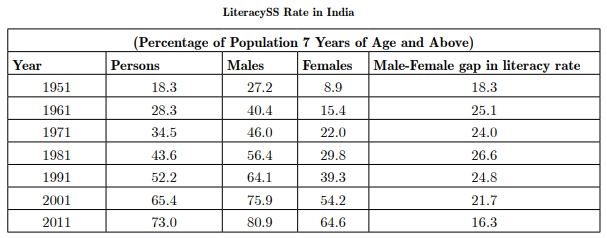
(a) What is the male-female gap in literacy rate in the year 2011?
View AnswerAns. (a) In the year 2011, the male-female gap in literacy rate is 16.3%. However, female literacy has been rising faster than male literacy, partly because it started from relatively low levels.
(b) How much the female literacy rate increased as compared to the rise in male literacy rate between the years 2001 and 2011?
View AnswerAns. (b) Female literacy rate rose by about 10.4 per cent between 2001 and 2011 compared to the rise in male literacy of 7.6 per cent in the same period.
(c) Is literacy as a pre-requisite to education, an instrument of empowerment? What is the difference of male and female literacy rates between 1951 and 2011?
View AnswerAns. (c) Literacy as a pre-requisite to education is an instrument of empowerment. If there would be more literate population, it would increase the consciousness of career options and participation in knowledge economy. Literacy can lead to health awareness and fuller participation in the cultural and economic well-being of the community.
The differences of male and female literacy rates are 53.7% and 55.7% respectively between 1951 and 2011.
34. What do you mean by urbanisation? What are the situations according to sociologist MSA Rao under which village experiences the urban impact in India?
View AnswerAns. Urbanisation is a process in which more and more people opt for urban life and live in cities. In this phenomenon, the villages or small towns are gradually transformed into bigger towns or cities.
Sociologist MSA Rao describes three situations under which a village experiences the urban impact in India, which are as follows
(i) Firstly, lot of people migrates from villages to far off cities or overseas towns for employment apportunities. They send money to their native villages. Besides, they invest money on land and industry and donate for educational institutions. They build fashionable houses at their villages and have invested on land and industry.
(ii) Secondly, some villages are situated near the industrial town (for example, Bhilai). Demand for houses and the market inside the village increases but at times it lead to hatred between immigrants and native population.
(iii) Thirdly, growth of metropolitan cities does have influence over the rural areas or villages. Some villages are completely absorbed in the process of expansion of these cities. On the other hand, some villagers lose their uninhabited land for urban development.
35. (a) Given an example of how machinery creates a problem for workers.
View AnswerAns. Machinery creates a problem for workers: For example, an automatic printing machine prints books automatically with the help of two or three persons. Without the use of big automatic printing machine nearly two hundred labourers are required to do the same work or produce the same volume of production. It means due to use of big automatic machine unemployment is generated.
Gandhi ji was opposed of all types of exploitation. He opposed exploitation of the poor people by the rich people. Gandhi ji had alternative in his mind that India should be labour intensive modern industrial unit or firms. Adopting spinning wheel as tool to solve the problem of unemployment by providing employment to thousand villagers, poor urban people, farmers and labourers.
(b) Discuss industrial society and different views of theorist on it.
View AnswerAns. (b) Industrial society refers to society that is driven by the use of technology to enable mass production. It generally supports a large population with a high capacity for division of labour.
Views of theorists on industrial society are as follows Social theorists like Karl Marx, Max Weber and Emile Durkheim associated a number of features with industrialisation such as urbanisation, loss of face to face relationships in rural areas and their substitution by anonymous professional relationships in modern work places. According to them, industrialisation involves a detailed division of labour and their work is often exhaustive and repetitive but it was much better from being unemployed.
Marx specifically emphasised upon his concept of alienation of labour, whereby he illustrated how a labour or worker is disconnected with the product he is producing and working only for survival and to meet his needs.There were eventually mixed views of the theorists on the effects of industrialisation. But eventually, they agreed upon the positive impact of industrialisation on modernisation and the benefit that industrialisation led to modernisation.