SOCIOLOGY (039)
Time: 3 Hours Max. Marks: 80
General Instructions:
1. The question paper is divided into four sections.
2. There are 35 questions in all. All questions are compulsory.
3. Section A includes question No. 1-16. These are MCQ type questions. As per the question, there can be one answer.
4. Section B includes question No.17-25. These are very short answer type questions carrying 2 marks each. Answer to each question should not exceed 30 words.
5. Section C includes question No. 26-32. They are short answer type questions carrying 4 marks each. Answer to each question should not exceed 80 words.
6. Section D includes question No. 33-35. They are long answer type questions carrying 6 marks each. Answer to each question should not exceed 200 words each.
7. Question no. 33 is to be answered with the help of the given graphics.
SECTION A
1. Assertion (A) : Both Karl Marx and Mahatma Gandhi saw mechanisation as a danger to employment.
Reason (R) Machinery helps to increase production, but it also creates the danger that eventually machines will replace workers.
(a) Both (A) and (R) are true, and (R) is the correct explanation of (A)
(b) Both (A) and (R) are true, but (R) is not the correct explanation of (A)
(c) (A) is true, but (R) is false
(d) (A) is false, but (R) is true
View AnswerAns. (a) Both (A) and (R) are true, and (R) is the correct explanation of (A)
2. Assertion (A) : Literacy as a prerequisite to education is an instrument of empowerment.
Reason (R) Literacy can lead to health awareness and fuller participation in the cultural and economic well being of the community.
(a) Both (A) and (R) are true and (R) is the correct explanation of (A)
(b) Both (A) and (R) are true, but (R) is not the correct explanation of (A)
(c) (A) is true, but (R) is false
(d) (A) is false, but (R) is true
View AnswerAns. (a) Both (A) and (R) are true and (R) is the correct explanation of (A)
3. The concept of population rising in geometric progression and resources growing in arithmetic progression is a common observation in socio-economic studies. Which of the following appropriately explains this phenomenon?
I. 1,2,4,8 for population and 1,2,3,4 for resources
II. 2,4,8,16 for population and 2,4,6,8 for resources
III. 1,3,9,27 for population and 1,2,3,4 for resources
IV. 1,2,3,4 for population and 1,3,9,27 for resources
(a) I. and II.
(b) III. and IV.
(c) I. and III.
(d) II. and III.
View AnswerAns. (c) I. and III.
4. Which one of the following is incorrect about the concept of secularisation in modern world?
(a) In the modern West, secularisation has usually meant a process of decline in the influence of religion.
(b) It has been an assumption of all theorists of modernisation that modern societies become increasingly secular.
(c) Indicators of secularisation have referred to levels of involvement with religious organisations.
(d) None of the above
View AnswerAns. (d) None of the above
5. Assertion (A) : The customs and the activities associated with a religion are categorised as rites or rituals.
Reason (R) Secularism means a process of decline in the influence of religion.
Codes
(a) Both (A) and (R) are true and (R) is the correct explanation of (A).
(b) Both (A) and (R) are true, but (R) is not the correct explanation of (A)
(c) (A) is true, but (R) is false
(d) (A) is false, but (R) is true
View AnswerAns. (b) Both (A) and (R) are true, but (R) is not the correct explanation of (A)
Read the passage given below
Caste-based discrimination is exclusionary as well as exploitative in nature. It takes multiple forms based on the underlying notions of purity and pollution. It includes social and economic exclusion, segregation in housing, denial and restrictions of access to public and private services and employment.
6. Caste-based discrimination poses a serious challenge to societal harmony because:
I. It leads to systematic exclusion from social and economic opportunities.
II. It perpetuates inequality based on notions of purity and pollution.
III. Denial of access to resources can create social unrest.
IV. It leads to the complete dissolution of community ties.
(a) I. and II. only
(b) I., II., III. only
(c) II., III., IV. only
(d) I., II., III., IV.
View AnswerAns. (b) I., II., III. only
7. Which of the following is not true about caste-based discrimination?
(a) It creates systemic barriers to equality in society.
(b) It fosters a sense of unity among affected groups.
(c) It restricts access to essential resources and opportunities.
(d) It is based on deeply ingrained cultural and social norms.
View AnswerAns. (b) It fosters a sense of unity among affected groups.
8. Assertion (A) : In Indian nationalism, the dominant trend was marked by an inclusive and democratic vision.
Reason (R): Inclusive because it recognised diversity and plurality. Democratic because it sought to do away with discrimination and exclusion and bring forth a just and equitable society.
Codes
(a) Both (A) and (R) are true and (R) is the correct explanation of (A)
(b) Both (A) and (R) are true, but (R) is not the correct explanation of (A)
(c) (A) is true, but (R) is false
(d) (A) is false, but (R) is true
View AnswerAns. (a) Both (A) and (R) are true and (R) is the correct explanation of (A)
9. Protection of minorities poses a challenge to the secular nature of the state because:
I. The state’s actions may not always align with secular principles.
II. Economically strong minorities can still face cultural disadvantages.
III. Secularism requires the state to treat all communities equally, which is difficult in practice.
IV. Minority groups always demand more privileges than the majority.
(a) I. and II. only
(b) I., II., III. only
(c) II., III., IV. only
(d) I., II., III., IV.
View AnswerAns. (b) I., II., III. only
10. Which of the following is not true regarding the challenges faced by minorities?
(a) Minority groups can be economically well-off but culturally marginalized.
(b) The state sometimes struggles to uphold its secular commitment.
(c) All minority groups face uniform economic and cultural disadvantages.
(d) Secularism ensures equal treatment of all communities by the state.
View AnswerAns. (c) All minority groups face uniform economic and cultural disadvantages.
11. Which of the following is not a correct statement about the term Jati?
(a) It is a local classification that varies from region to region.
(b) It has a segmental organisation.
(c) Membership of Jati involves rules about food and food sharing.
(d) It is an all India aggregative classification.
View AnswerAns. (d) It is an all India aggregative classification.
12. Which one of the following facts is correct about Raja Ram Mohun Roy?
(a) His ideas represented a curious mixture of Western rationality and an assertion of Indian traditionality.
(b) He undertook the campaign against sati which was the first women’s issue to receive public attention.
(c) He attacked the practice of sati on the basis of both appeals to humanitarian and natural rights doctrines as well as Hindu shastras.
(d) All of the above
View AnswerAns. (d) All of the above
13. Assertion (A) : Social inequality and exclusion are systematic and structured because there is a definite pattern to these inequalities.
Reason (R) : They are social in nature as they pertain to groups rather than individuals and often have a strong link with economic inequality.
Options:
(a) Both (A) and (R) are true, and (R) is the correct explanation of (A).
(b) Both (A) and (R) are true, but (R) is not the correct explanation of (A).
(c) (A) is true, but (R) is false.
(d) (A) is false, but (R) is true.
View AnswerAns. (a) Both (A) and (R) are true, and (R) is the correct explanation of (A).
14. Assertion (A) : Assimilation refers to a policy aimed at encouraging all citizens to adopt a uniform set of cultural values and norms.
Reason (R) : It promotes the erasure of distinct community identities in favor of a common cultural framework.
(a) Both (A) and (R) are true, and (R) is the correct explanation of (A).
(b) Both (A) and (R) are true, but (R) is not the correct explanation of (A).
(c) (A) is true, but (R) is false.
(d) (A) is false, but (R) is true.
View AnswerAns. (a) Both (A) and (R) are true, and (R) is the correct explanation of (A).
15. When the difference between Birth rate and the Death rate is zero we say that the population has stabilised or has reached the
(a) stabilisation level
(b) highest level
(c) replacement level
(d) highest point
View AnswerAns. (c) replacement level
16. Put the following statements in the correct order regarding the process of social mobility in closed systems:
I. Individuals are born into specific social positions.
II. Social mobility is restricted due to rigid social hierarchies.
III. Positions are often inherited and not based on personal achievements.
IV. Attempts to break these restrictions face strong resistance.
(a) II., III., I., IV.
(b) I., III., II., IV.
(c) III., I., II., IV.
(d) I., II., IV., III.
View AnswerAns. (b) I., III., II., IV.
SECTION B
17. Some changes that took place in India can be understood in terms of process of Sanskritisation, Modernisation, Secularisation and Westernisation. Sanskritisation, existed before colonial rule in India. While the other three processes were developed to respond to the change that were brought about by Colonialism.
How is Sanskritisation a process of social change?
View AnswerAns. Sanskritisation is a process of social change by which a low caste or tribe takes to the customs, rituals, beliefs, ideology and the style of life of a high and in particular a ‘twice born caste’.
OR
Kumudtai’s journey into Sanskrit began with great interest and eagerness with Gokhale Guruji, her teacher at school. At the University, Head of Department was a well known scholar and he took great please in taunting Kumudtai. Despite all odds she successfully completed her Masters in Sanskrit.
Do you think Sanskritisation is a gendered process? Give a reason for your answer.
View AnswerAns. Yes, Sanskritisation is a gendered process. According to passage, Kumud Pawade felt that the study of Sanskrit can help her break into a field that was not possible for her to enter on grounds of gender and caste. As she proceeds with her studies, she meets with varied reactions ranging from surprise to hostility from guarded acceptance to brutal rejection.
18. What is meant by the term ‘Untouchability’? Explain.
View AnswerAns. The term ‘Untouchability’ defines as an extreme aspect of the caste system where members of certains castes are considered as untouchable by upper castes. The three main dimensions of untouchability i.e. exclusion, humiliation-subordination and exploitation are equally important.
19. With what objectives did New Farmers Movements began in the 1970s?
View AnswerAns. The New Farmers Movement began in the 1970’s, in Punjab and Tamil Nadu.
The objectives of this movement are as follows
(i) The basic ideology of the movement was strongly anti-state and anti-urban.
(ii) Novel methods of agitation were used such as blocking of roads and railways, banning politicans and bureaucrats entry to villages.
20. Is caste system exclusionary and exploitative? Explain.
View AnswerAns. Caste based discrimination is exclusionary as well as exploitative in nature. It takes multiple forms based on the underlying notions of purity and pollution. It includes social and economic exclusion, segregation in housing, denial and restrictions of access to public and private services and employment.
21. In response to the harsh working conditions workers have expressed anger through trade unions. Differentiate between strike and lockout in the light of the above statement.
View AnswerAns. In light of the above statement, the difference between a strike and a lockout is given below
A strike is a situation where the workers do not work because they want to have better wages. It is a risky move on the part of the workers because the management may not decide to take them back after the strike and they may employ substitute labours.
On the other hand, a lockout is a situation when the management closes down the factory or industry for a particular period of time. They shut-down the gate of the factory and do not allow any worker to enter.
22. The caste system is a deeply rooted social structure in India, significantly influencing social, economic, and cultural life. It is based on a hierarchy that defines roles and responsibilities for various groups in society. Explain some defining features of caste system in India.
View AnswerAns. Some defining features of caste system in India are as follows
(i) Caste is determined by birth.
(ii) Caste groups are endogamous, i.e. marriage is restricted to members of the group.
(iii) Caste involves a system consisting of many caste arranged in a hierarchy.
(iv) Castes were traditionally linked to occupations.
23. Contract farming has emerged as a significant practice in modern agriculture, linking farmers directly with buyers. It aims to ensure stability for farmers and meet the demands of agribusinesses effectively. Mention the positive and negative sides of contract farming.
View AnswerAns. The positive side of contract farming is that the company associated provides guarantee of purchase from the farmers just at the time of produce and that too at a pre-determined fixed price. The negative side associated with contract farming is that it can lead to greater insecurity as farmers become dependent on companies for their livelihoods.
24. Modernisation and secularisation have profoundly influenced societies worldwide, shaping contemporary cultural and institutional frameworks. Modernisation and secularisation are part of a set of modern ideas. How are the two processes linked ?
View AnswerAns. Modernisation and secularisation are part of a set of modern ideas. There was a close connection between the modernisation and secularisation. Modernisation refers to the improvement in technology, production process, etc. This was the part of development taken by West Europe or North American countries. Secularisation is a process of decline in the influence of religion in the public sphere.
25. Anti Caste Movement which began in the 19th century under the inspiration of Jyotiba Phule and was carried out in the, 1920s by the non-Brahmin movements in Maharashtra and Tamil Nadu and then developed under the leadership of Dr. BR Ambedkar had characteristics of all types. It was revolutionary in terms of society and redemptive in terms of individuals. In partial context, the post Ambedkar Dalit Movement has had revolutionary practice. It has focused on changes in the entire society, from radical revolutionary goals of abolishing caste oppression and economic exploitation to the limited goals of providing scope for members of scheduled caste to achieve social mobility.
Distinguish between social change and social movements.
View AnswerAns. Social change is continuous and ongoing. The broad historical processes of social change are the sum total of countless individual and collective actions gathered across time and space break.
Whereas, social movements are directed towards some specific goals. It involve long and continuous social effort and action by people. Sanskritization and Westernisation as social change and 19th century social reformers effect to change society as social movements.
OR
What is the relationship between caste and economic inequality today?
View AnswerAns. In today’s scenario of hierarchy of caste system, each caste has a specific place and social status. There has been a correlation between social or caste status and economic status. The high castes were almost invariably of high economic status. However, in the 19th century the link between caste and occupation had become less rigid. At the macro level, things have not changed much.
SECTION C
26. Agriculture has been a cornerstone of human civilization, shaping societies, economies, and traditions. It deeply influences cultural practices and societal values across the globe. Express the correlation between agriculture and culture.
View AnswerAns. The nature and practice of agriculture varies greatly across the different regions of the country. These variations are reflected in the different region cultures. Both the culture and social structure in rural India are closely bound up with agricultural and agrarian way of life.
Agriculture is the single most important source of livelihood for the majority of the rural population. Many activities that support agriculture and village life are also sources of livelihood for people in rural India. Rural life supported many other specialists and craft persons, storytellers, astrologers, priests, water distributers and oil pressers. Thus, we can say that there is a close connection between agriculture and culture.
OR
The shift toward commercial agriculture has transformed traditional farming practices. It emphasizes market-oriented production, replacing subsistence farming methods. Discuss the consequences of commercialisation of agriculture.
View AnswerAns. The consequences of commercialisation of agriculture are
(i) The commercialisation of agriculture was beneficial to the British planters, traders and manufacture, who were provided with opportunity to make huge profits by getting the commercialised agricultural products at throw away prices.
(ii) The poor peasants were forced to sell their produce just after harvest at whatever prices they could get as they had to meet in time the demands of the government, the landlord, the moneylender and their family members requirements.
(iii) Commercialisation of agriculture did not encourage growth of land market because major profit of commercialisation went to company traders and mediators.
(iv) Commercialisation effected traditional relations between agriculture and industry. In India, traditional relations acted as factors for cach other’s development which were hampered.
27. The protection of minorities is crucial for fostering an inclusive and harmonious society. However, it can present complexities for governance in diverse and multicultural states. How can commitment to the protection of minorities also be a challenge to the state?
View AnswerAns. Commitment to the protection of minorities can be
a challenge to the state because the Constitution of India declared the state as a secular state. However, in practice, minorities are often hurt by the actions of the state. There are many religious minorities which may be better economically but a disadvantaged group in the cultural sense because of their small numbers.
It is important to provide them with protection due to the following reasons
(i) Religious and cultural minority groups need protection because of the demographic dominance of the majority.
(ii) They should be given special consideration so that they are not considered a minority in the political sphere.
(iii) These groups are vulnerable and can face major risk by the majority community. They can use their power to suppress their religion and cultural Institution and eventually forcing them to completely abandon their identity.
28. What is Taylorism? Would Gandhiji have supported the idea of Taylorism?
View AnswerAns. Taylorism is a production system that divides the manufacturing process in small steps that reduce the degree of skills required to perform each activity. This system was invented by Frederick Winslow Taylor in 1890s, which was also referred to as scientific management or industrial engineering.
The aim of Taylorism is to increase productivity and to reduce training times to increase output levels. It was a system broken down into its smallest repetitive elements and divided between workers. Workers were allotted time-based tasks where they had to finish the task within the stipulated time.
29. Malthus’s theory of population growth highlighted the tension between increasing human populations and limited resources. His views have sparked debates on sustainability and human survival. Why did Malthus believe that catastrophic events like famines and epidemics which cause mass deaths were inevitable?
View AnswerAns. English political economist Thomas Robert Malthus suggested that catastrophic events like famines and diseases were inevitable because they were nature’s way of dealing with the imbalance between food supply and increasing population. Malthus argued that human population tends to grow at a much faster rate than the rate at which the means of human subsistence (food, clothes, etc) can grow.
According to him, population rises in geometric progression, whereas agricultural production can only grow in arithmetic progression. He believed that humans are unable to observe any preventive checks. In such cases, catastrophic events like famines are positive checks or natural process of population control that maintains balance by removing any imbalances.
30. Modern agriculture has witnessed the emergence of new practices to connect farmers with markets. Contract farming is one such arrangement that benefits both farmers and buyers. Write briefly about ‘Contract Farming’.
View AnswerAns. Under the Contract Farming System, the company identifies the crops to be grown, provide the seeds and other inputs as well as technical know how and also the working capital to a farmer. In this type of farming, the farmer is assured of the market because the company guarantees that it will purchase the product at a pre-determined fixed price.
It is very common now in the production of specialised items such as cut flowers, fruits like grapes, figs, etc. While contract farming appears to provide financial security, it can also lead to greater insecurity as farmers become dependent on these companies for their livelihoods. In contract farming, the export- oriented products such as flowers and gherkins also means that agricultural land is diverted away from food grain production.
The commitment of the protection of minorities also proves to be a challenge to the state because they are often accused of favouritism to particular sections of the society.
31. Who was Thomas Robert Malthus? Elaborate his theory about the population growth.
View AnswerAns. Thomas Robert Malthus (1766-1834 AD) was an English cleric, scholar and influential economist in the field of political economy and demography.
Malthus’s theory about the population growth is outlined in his book ‘Essay on Population’ (1798). He argued that human populations tend to grow at a much faster rate than the rate at which the means of human subsistence (especially food, but also clothing and other agriculture-based products) can grow.
Therefore; humanity is condemned to live in poverty forever because the growth of agricultural production will always be overtaken by population growth. Because population growth always outstrips growth in production of subsistence resources, the only way to increase prosperity is by controlling the growth of population. He believed that a balance between population growth and food supply can be established through preventive and positive checks.
OR
Describe the theory of demographic transition. Why is the transition period associated with a ‘population explosion’?
View AnswerAns. The theory of demographic transition proposes that population growth is linked to overall levels of economic development and that every society follows a typical pattern of development related population growth.
There are three basic stages of population growth which are as follows
(i) Primitive Stage This stage shows low and slow population growth in a society. In this stage, a society is underpriviledged and technologically backward. People suffer from malnutrition and ailments resulting in higher death rate.
(ii) Second Stage This is the phase of transition from underdeveloped to developing countries. Birth rate is high due to the presence of the patriarchal society and death rate is low due to the availability of medical facilities.
(iii) Third Stage This is the stage of low population growth rate in developed countries, where both birth rate and death rate have been reduced. Birth rate is low due to awareness and high literacy. Death rate is low due to availability of medical facilities.
The transitional period (second stage) is associated with ‘population explosion’. It is characterised by the movement from a backward to an advanced stage. In this stage, population growth rate is very high and death rates are brought down relatively quickly through advanced methods of disease control, public health and better nutrition.
32. In a diverse society, protecting minority rights is crucial for fostering inclusivity and social justice. However, such commitments often present complexities for governance and societal balance. How can commitment to the protection of minorities also be a challenge to the state?
View AnswerAns. Commitment to the protection of minorities can be a challenge to the state because the Constitution of India declared the state as a secular state. However, in practice, minorities are often hurt by the actions of the state. There are many religious minorities which may be better economically but a disadvantaged group in the cultural sense because of their small numbers.
It is important to provide them with protection due to the following reasons
(i) Religious and cultural minority groups need protection because of the demographic dominance of the majority.
(ii) They should be given special consideration so that they are not considered a minority in the political sphere.
(iii) These groups are vulnerable and can face major risk by the majority community. They can use their power to suppress their religion and cultural Institution and eventually forcing them to completely abandon their identity.
SECTION D
33. Analyse the given table and answer the following questions
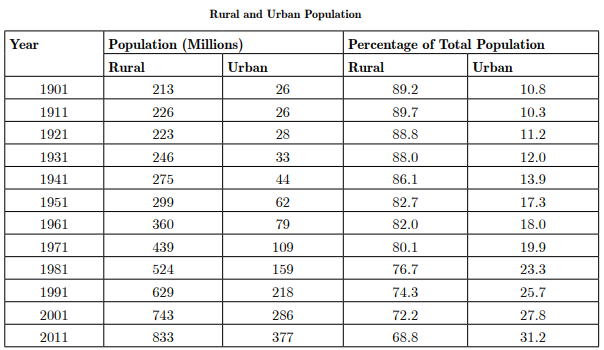
(a) What was the difference between the rural and urban population in the year 2001?
View AnswerAns. Difference between rural and urban population in the year 2001 was 457 million. According to 2001 Census, in India, out of the total population of 1029 million, about 743 million (72.2 per cent) live in rural areas and 286 million (27.8 per cent) live in urban areas.
(b) As per the table, how much the percentage of rural population decreased between the years 2001 and 2011?
View AnswerAns. The 3.4 per cent of rural population decreased between the years 2001 and 2011. According to 2011 Census, the rural population is 833 and 743 in the years 2001 and 2011 respectively.
(c) What is the total rural and urban population in the year 2011?
View AnswerAns. In the year 2011, the total rural and urban population of India is 1210 million. Percentage of rural and urban population in the year 2011 is 68.8 and 31.2 respectively.
34. (a) What do you mean by Westernisation? Explain its different aspects.
(b) Do you think Westernisation is one of the reasons for generation conflict?
View AnswerAns. (i) Westernisation is the spread of the Western cultural traits such as use of new gadgets and technology, cuisine, dress and changes in habits and styles of people. In India, Westernisation has been the result of long period of British colonialism in India. Different aspects of Westernisation are
(a) The impact and influence of Western culture is seen at different levels such as technology, institutions, ideologies, values, cuisine, clothing, etc. For example, many middle class homes in India have a television set, fridge, dining table, sofa set that are very much a part of Western living.
(b) There is a subculture of people and mainly intellectuals in India who not only adopt Western ways of thinking but also support its growth and expansion.
(c) There are also individuals who are Western in clothing and appearances but they do not process democratic, egalitarian and modern thinking of the West.
(ii) Westernisation is one of the reasons for generation conflict, as younger people are faster in adopting Western lifestyle, while older people believe more in Indian cultural ethos and practices.
It leads to differences between them. Old and young generation of people have many things uncommon to them due to Westernisation.
Old people often love Indian classical music or spiritual songs but youth likes pop songs and Western songs. Mutuality between the old and the young is becoming difficult day-by-day.
Sometimes the parents and children become strangers in a family due to different tastes and likings in various areas of life. Therefore, Westernisation is one of the reasons for generation conflict.
35. Explain some of the policies designed to address caste inequality in context of contemporary India.
View AnswerAns. Untouchability is an extreme aspect of the caste system where members of certains castes are considered as untouchable by upper castes. The three main dimensions of untouchability i.e. exclusion, humiliation-subordination and exploitation are equally important in defining the phenomenon of untouchability.
There are some of the policies designed to address caste inequality in context of contemporary India. At the state level, there are special programmes for Scheduled Tribes (ST) and Scheduled Castes (SC). The OBCs have also been added to these special provisions.
Some laws passed to end, prohibit and punish caste discrimination are
(i) Caste Disabilities Removal Act of 1850, disallowed the curtailment of rights of citizens due solely to change of religion or caste. It allowed entry of Dalit to government schools.
(ii) Constitution Amendment (93rd Amendment) Act of 2005, for introducing reservation for OBCs in institutions of higher education.
(iii) Scheduled castes and Scheduled tribes (Prevention of Atrocities) Act of 1989, to abolish untouchability (Article 17) and introduced reservation provisions.
(iv) Prevention of Atrocities of 1989 Act revised and strengthened the legal provisions against Dalits and Adivasis.