Kindly share you feedback about the website – Click here
Time Allowed: 3 hours Maximum Marks: 80
General Instructions:
1. The question paper consists of five sections (A, B, C, D and E) with 30 questions in total.
2. All questions are compulsory.
3. Questions number 1-12 are multiple choice questions of one mark each.
4. Questions number 13-18 are of 2 marks each. Answers to these questions should not exceed 50-60 words each
5. Questions number 19-23 are of 4 marks each. Answers to these questions should not exceed 100-120 words each. There is an internal choice in two of the 4 marks questions
6. Questions number 24-26 are passage, cartoon and map-based questions. Answer accordingly.
7. Questions number 27-30 are of 6 marks each. Answers to these questions should not exceed 170-180 words.
8. There is an internal choice in 6 marks questions.
Section-A
Question 1.
Arrange the following events in chronological order and choose the correct option.
(1) Indo-Soviet Treaty
(2) NATO established
(3) First NAM Conference
(4) Bandung Conference
(A) (1) (2) (3) (4)
(B) (3) (2) (4) (1)
(C) (2) (4) (3) (1)
(D) (4) (3) (2) (1)
View AnswerAns. (C) (2) (4) (3) (1)
Explanation: NATO was established in the year 1949.
Bandung conference was held in 1955.
First NAM conference was held in 1961.
Indo-Soviet Treaty was signed in 1971.
Question 2.
____________ introduced the Marshall plan.
(A) China
(B) EU
(C) US
(D) India
View AnswerAns. (C) US
Explanation: The Marshall Plan was a US-sponsored program aimed at rehabilitating the economies of 17 Western and Southern European countries in order to create stable conditions in which democratic institutions could survive after World War II.
Question 3.
Match the principal organs and agencies of the UN with their functions.
UN organs and agencies: Functions:
1. Security Council (a) Facilitates free trade among member countries
2. World Trade Organisation (b) Preservation of International peace and security
3. International Monetary Fund (c) Debates and discusses global issues
4. General Assembly. (d) Overseas the global financial system
(A) 1. (c). 2.(a). 3. (b). 4.(d)
(B) 1. (b). 2.(a). 3. (d). 4.(c)
(C) 1. (c). 2.(d). 3.(a). 4.(b)
(D) 1. (b). 2(c). 3.(a). 4.(d)
View AnswerAns. (B) 1. (b). 2.(a). 3. (d). 4.(c)
– United Nations Security Council’s main function is preservation of International peace and security.
– World Trade Organisation’s (WTO) main function is to facilitate free trade among member countries.
– International Monetary Fund (IMF) overseas the global financial system.
– United Nations General Assembly’s main feature is to debate and discuss global issues.
Question 4.
In the following question, a statement of Assertion (A) is followed by a statement of Reason (R). Choose the appropriate option as answer.
Assertion (A): India refused to sign the Non-proliferation Treaty (NPT).
Reason (R): India considered the Nuclear Non-proliferation Treaty (NPT) discriminatory.
(A) Both (A) and (R) are true but (R) is not the correct explanation of (A)
(B) Both (A) and (R) are true and (R) is the correct explanation of (A)
(C) Both (A) and (R) are incorrect.
(D) (A) is correct but (R) is incorrect.
View AnswerAns. (A) Both (A) and (R) are true but (R) is not the correct explanation of (A)
Explanation: India refused to sign the Nuclear Non- proliferation Treaty (NPT) because India considered it discriminatory.
Question 5.
Which of the following statements describing the nature of the Soviet economy is false?
(A) Socialism was the dominant ideology.
(B) There was government ownership/control over the company factors of production.
(C) People enjoyed economic freedom.
(D) Every aspect of the economy was planned and controlled by the state.
View AnswerAns. (C) People enjoyed economic freedom.
Explanation: Features of the Soviet economy:
-Socialism was the dominant ideology
– There was government ownership/control over the company factors of production
– Every aspect of the economy was planned and controlled by the state hence this statement is false that People enjoyed economic freedom.
Question 6.
What is globalisation?
(A) Flows of capital
(B) Exchange of goods
(C) Flow of Ideas
(D) All of these
View AnswerAns. (D) All of these
Explanation: Globalisation is the flow of capital, exchange of goods and flow of ideas among the world.
Question 7.
__________ popularly known as the “Indian Milkman”:
(A) PC. Mahalanobis
(B) K.T. Shah
(C) Verghese Kurien
(D) None of these
View AnswerAns. (C) Verghese Kurien
Verghese Kurien is known as the ‘milkman of India’and also as the ‘Father of the White Revolution’ in India.
Question 8.
In India, planning was conceived as a major tool to achieve which of the following?
(A) Political development
(B) Cultural development
(C) Social development
(D) Socio-economic development
View AnswerAns. (D) Socio-economic development
Explanation: In India planning was conceived as a major tool to achieve socio-economic development.
Question 9.
The Architect of Non-alignment is:
(A) Pt. Jawaharlal Nehru
(B) Indira Gandhi
(C) Y. B. Chavan
(D) Rajiv Gandhi
View AnswerAns. (A) Pt. Jawaharlal Nehru
Explanation: Pt. Jawaharlal Nehru is known as the architect of Non-alignment.
Question 10.
In the following question, a statement of Assertion (A) is followed by a statement of Reason (R). Choose the appropriate option as answer.
Assertion (A): The Election Commission of India was set up in 1950.
Reason (R): KVK Sundaram became the first Chief Election Commissioner.
(A) Both (A) and (R) are true but (R) is not the correct explanation of (A)
(B) Both (A) and (R) are true and (R) is the correct explanation of (A)
(C) Both (A) and (R) are incorrect.
(D) (A) is correct but (R) is incorrect.
View AnswerAns. (D) (A) is correct but (R) is incorrect.
Explanation: The Election Commission of India was set up in January 1950.
Hence, Assertion (A) is correct.
Sukumar Sen became the first Chief Election Commissioner.
Hence, Reason (R) is not correct.
Question 11.
Who established the Mandal commission in 1979?
(A) Morarji Desai
(B) V.P Singh
(C) Narasimha Rao
(D) None of these
View AnswerAns. (A) Morarji Desai
Explanation: During Janta party government Prime Minister Morarji Desai established the Mandal commission in 1979 to study about backward classes.
Question 12.
The founder of Bahujan Samaj party was:
(A) Mayavati
(B) Atal bihari
(C) Kanshi Ram
(D) None of these
View AnswerAns. (C) Kanshi Ram
Explanation: The founder of Bahujan Samaj party was Kanshi Ram.
Section-B (12 Marks)
Question 13.
How many permanent and non-permanent members are there in the United Nations Security Council?
View AnswerAns. The UN Security Council has five permanent members and ten non-permanent members.
Question 14.
Describe any two political consequences of globalization?
View AnswerAns. Political consequences of Globalization:
• Globalization has shifted the power to regulate certain activities from government to international institutions.
• International organizations such as the World Trade Organization have created rules and regulations for all countries. So, as a result of globalization, the market now determines the social and economic priorities of the state.
Question 15.
When was the ASEAN Regional Assembly established? What was its main purpose?
View AnswerAns. The ASEAN Regional Assembly was established in 1967 by five Southeast Asian countries. It’s major goals were:
• ASEAN’s main goal was to accelerate economic growth and thereby promote social progress and cultural development.
• Promoting regional peace and stability based on the rule of law and the principles of the United Nations Charter.
Question 16.
Mention any two aspects of India’s foreign policy which were largely influenced by Pt. Jawaharlal Nehru.
View AnswerAns. • One of the main features of India’s foreign policy is
Non-alignment. “As much as possible, we want to avoid the power groups that caused two possible world wars in the future,” Jawaharlal Nehru said.
• Union of African-Asian countries: Nehru seeked to unite the Asian and African countries to strengthen economic and political ties.
Question 17.
Name any two problems faced by the Indian government after 1971-72.
View AnswerAns. • Economic crisis: In December 1971 there was a war between India and Pakistan and Pakistan was defeated in the war. However, this war took a heavy toll on the Indian economy. More than eight million people crossed the eastern Pakistani border into India. Oil prices rose on the international market, leading to an all-round rise in other commodity prices.
• Railway strike: In April 1974, there was a strike by railway workers that affected the Indian economy.
Question 18.
Which political party emerged as the single largest party in the 1996 Parliamentary elections?
View AnswerAns. The Bharatiya Janata Party (BJP).
Section-C (20 Marks)
Question 19.
Explain four reasons for the collapse of the Soviet Union
View AnswerAns. The major problems within the Soviet system were:
• The Soviet regime recognised the existence of only the Communist Party in the Soviet Union. The Communist Party was considered as the “pioneer of the working people in the struggle to strengthen and develop the socialist system.” No other political parties were allowed in the Soviet Union.
• The Soviet system became highly bureaucratic and authoritarian. Enemies of socialism were dealt with mercilessly. There was a communist dictatorship.
• In the Soviet Union, emphasis was placed more on social and economic rights than on political rights. There was no freedom of speech and expression. Any opinion expressed against the “party line” was considered a matter of treason and was therefore severely punished.
• Federalism was adopted in the Soviet system, but the Union Republic of the U.S.S.R. was completely under the control of the Communist Party. The Soviet federal structure was like a pyramid, with the Communist Party at the top and controlling the primary party organs at the base.
Question 20.
Name four common features of the European Union.
View AnswerAns. The main features of the European Union are:
• The European Union has its own flag. National Anthem, Day of Establishment, Currency.
• Its currency, the euro, could threaten the dominance of the US dollar.
• The European Union has economic, political, diplomatic and military influence.
• Its economic power affects not only Asia and Africa, but also its closest neighbors.
Question 21.
“The people of South Asian countries are supportive of the aspirations of democracy”. Explain this statement.
View AnswerAns. • There was opposition to constitutional monarchy in Nepal and Bhutan and the demand for democracy was raised many times. There was opposition to military rule in Bangladesh and Pakistan and the demand for democracy remains constant. India. and Sri Lanka have remained democratic countries since their independence. In short, the record of democracy in South Asia has been mixed.
• Despite this, the people of South Asian countries share the aspirations of democracy. A survey was recently conducted in five large countries in the region. The survey revealed that democracy has widespread public support in these five countries.
• The common citizens of these countries, whether rich or poor and irrespective of their religion, consider democracy good and support the institutions of representative democracy.
• People of these countries give preference to democracy over any other system of governance and believe that democracy is best for their country.
OR
What do you know about ‘Shock Therapy’? Describe any three consequences of Shock Therapy.
View AnswerAns. Most of the Communist countries changed from an authoritarian system to a democratic capitalist system. The process of transition from an authoritarian socialist system to a democratic capitalist system is called ‘Shock Therapy’. Following were the main consequences of Shock Therapy:
• Each of these countries had to make a total change from a socialist economy to a capitalist economy.
• Each of these countries had to adopt private ownership as a dominant pattern of ownership of property.
• All these countries had to privatize all state assets and establish corporate ownership patterns.
• Collective farming was replaced by capitalist (private) farming.
Question 22.
‘India’s first general election proved to be a milestone in the history of the country’s democracy’. Explain this statement.
View AnswerAns. • The first general elections of independent India had to be postponed twice and finally the elections were held from October 1951 to February 1952. Whatever be the case, this election is generally called the ‘election of 1952’ because voting took place in most parts of the country in 1952 only. wad The election campaign, voting and counting took a total of six months.
• There was also competition between the candidates in the elections. On an average, four candidates were in the fray for each seat. People participated enthusiastically in this election. More than half of the total voters cast their votes on the polling day.
• When the results of the elections were declared, even the losing candidates described these results as fair. This use of Universal Adult Franchise silenced the critics. The Times of India acknowledged that the elections “have put to rest the doubts of all those critics who considered the introduction of universal suffrage a threat to the country.”
• Even observers outside the country were surprised. Hindustan Times wrote “It is being accepted everywhere that the Indian people successfully carried out the biggest experiment of democracy in the history of the world. The general elections of 1952 proved to be a milestone in the history of democracy in the whole world. It is no longer possible to argue that democratic elections cannot be conducted in an environment of poverty or illiteracy. It has now been proved that democracy can be implemented anywhere in the world.
OR
In what four ways has China’s new economic policy benefited the economy?
View AnswerAns. China’s new economic policy benefitted the economy in the following ways:
• China’s economy, including industry and agriculture, grew at a faster rate.
• China became a member of the W.T.O. in 2001. China has become an economic superpower in Asia.
• China has become the most important destination for foreign direct investment anywhere in the world.
Question 23. Give two reasons why the 1971 election made Indira Gandhi popular.
View AnswerAns. Major reasons that made Indira Gandhi so popular in the 1971 elections:
• Charismatic personality: Mrs. Indira Gandhi was very popular because of her charismatic personality. Like Pt. Mrs. Jawaharlal Nehru, India Gandhi hada unique personality. According to Frank Morris, “Mrs. Gandhi was not only the undisputed leader of the Nationalist Congress Party, and could control it as no one else could.” Colleagues who were her assistants also and trembled and obeyed before her. In the fourth Lok Sabha election held in 1971, people mostly voted for the Congress because it was headed by Mrs. Indira Gandhi.
• Socialist policies of Indira Gandhi’s government: The socialist policies of Indira Gandhi’s government made her very popular among the masses. Mrs. Indira Gandhi started a series of initiatives to give a new direction to government policy. These include the nationalization of the insurance, coal mining, and oil industries. Many labor intensive products were intended for small industries. Not only urban land ownership but also imports and exports were monitored. Public food distribution, land reform, and housing for the rural poor.
Section-D (12 Marks)
Question 24. Read the passage given below and answer the questions that follow.
Pakistan and Bangladesh have experienced both civilian and military rulers, with Bangladesh remaining a democracy in the post-Cold War period. Pakistan began the post-Cold War period with successive democratic governments under Benazir Bhutto and Nawaz Sharif respectively. But it suffered a military coup in 1999. It has been run by a civilian government again since 2008. Till 2006, Nepal was a constitutional monarchy with the danger of the king taking over executive powers. In 2008, the monarchy was abolished and Nepal emerged as a democratic republic.
1. Which countries have experienced both civilian and military rulers?
(A) Pakistan and Nepal
(B) India and Nepal
(C) Pakistan and Bangladesh
(D) Bangladesh and Nepal
View AnswerAns. (C) Pakistan and Bangladesh
Explanation: Pakistan and Bangladesh have experienced both civilian and military rulers.
2. Which country had practiced constitutional monarchy?
(A) Pakistan
(B) Nepal
(C) Bangladesh
(D) India
View AnswerAns. (B) Nepal
Explanation: Till 2006, Nepal was a constitutional monarchy with the danger of the king taking over executive powers.
3. Pakistan began the post Cold War period with successive democratic governments under___.
(A) Benazir Bhutto
(B) Nawaz Sharif
(C) both A and B
(D) None of these
View AnswerAns. (C) both A and B
Explanation: Pakistan began the post Cold War period with successive democratic governments under Benazir Bhutto and Nawaz Sharif respectively.
4. In ____________ Nepal emerged as a democratic republic.
(A) 1999
(B) 2006
(C) 2008
(D) 2005
View AnswerAns. (C) 2008
Explanation: In 2008, the monarchy was abolished and Nepal emerged as a democratic republic.
Question 25.
In the given outline map of India, five states are represented by A, B, C, D, and E. Identify these five states on the basis of the information given below and write their correct names, serial numbers of the information used and related alphabets in your answer sheet.
(i) The state which opposed the merger with Indian Union.
(ii) The state which was carved out of Assam in 1972.
(iii) The state where the Communist Party of India formed the government in 1957.
(iv) A state created in 1966.
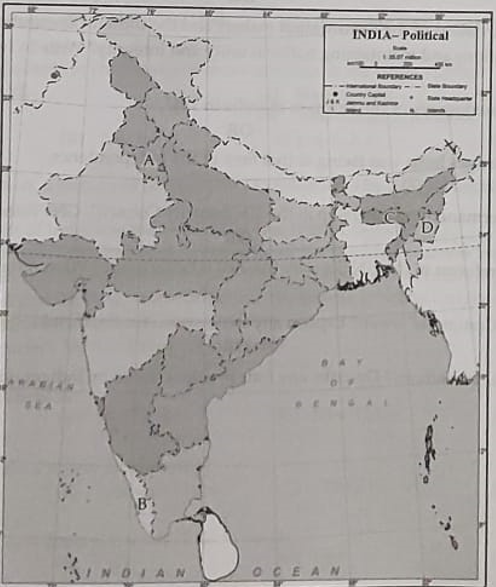
| Sr. No. of the Information used | Concerned Alphabet | Name of the State |
| (i) | ||
| (ii) | ||
| (iii) | ||
| (iv) |
Ans.
| Sr. No. of the Information used | Concerned Alphabet | Name of the State |
| (i) | D | Manipur |
| (ii) | C | Meghalaya |
| (iii) | B | Kerala |
| (iv) | A | Haryana |
Question 26.
Study the given cartoon and answer the questions that follow.
(1) What was the slogan of Janata Party to campaign in elections?
(2) Identify the person who is sitting on ground holding the slogan.
(3) Against which practices Jaya Prakash Narayan agitated?
View AnswerAns. “Save Democracy”
• Jaya Prakash Narayan
• Corruption, lawlessness, violence and most importantly against imposition of Emergency.
Section-E (24 Marks)
Question 27.
Describe the reasons why regionalism must be checked for the success of Indian democracy.
View AnswerAns. Regionalism must be checked for a successful democracy because:
– It causes constraints in the balance and development of the country.
– It leads to bitter relations between the central and state governments.
– It causes fissures in the mutual relations of states.
– Encourage jerky movements.
– It hinders overall economic progress of the country.
OR
Which steps and provisions of the Constitution makers and the Indian Constitution are conducive to pacifying your regional aspirations and maintaining national unity and integrity? Write in two paragraphs.
View AnswerAns. • We come to know about the vision of our Constitution makers from matters of regional aspirations. They were very careful about dealing with differences. The provisions of our constitution are proof of this. The federal system that India has adopted is very flexible as most states have equal rights. Also, special provisions have been made for certain states like Jammu and Kashmir and some North-Eastern states.
• In the Sixth Schedule of the Constitution, various tribes have been given complete autonomy to preserve their customs and traditional rules. These provisions proved to be very decisive in solving some complex political problems of the North- East. The constitutional structure of India is quite flexible and all-inclusive. The way challenges came in India, similar challenges came in some other countries too, but India’s constitutional structure makes India unique compared to other countries.
• Regional aspirations did not get a chance to take the path of separatism here. Indian politics has accepted that regionalism is an integral part of democratic politics.
Question 28.
Describe any six consequences of the Partition of India in 1947.
View AnswerAns. On 14-15th August 1947, not one but two nation- states came into existence-India and Pakistan. This was due to the partition of British India into India and Pakistan. Following were the consequences of the partition of India:
• Transfer of Population and Killings of People. The first consequence of partition was the largest unplanned and tragic transfer of population that human history has known. On both sides of the border, there were large-scale killings and atrocities. In the name of religion, people of one community killed the people of another community.
• Refugees Problem. Another consequence of the partition was the ‘Refugees Problem’. The people who crossed the border found that they had no home. For lakhs of people independence meant life in ‘refugee camps’. The Indian leadership b and the Government of India had to face, this immediate and unexpected problem. The refugee problem was so serious that the Government took many years to solve it.
• Division of Properties and Financial Assets. Partition also meant the division of properties, liabilities, and financial assets. The employees of the government and railways were also divided.
• Problems of Minorities. Even after large- scale migration of Muslims to Pakistan, about 12 percent of the total population of India were Muslims. Hence, relocation of the several religious minorities and the upliftment of the downtrodden sections was a challenge at that time.
• Disruption of trading networks. In spite of all the awareness about the economic fall out of the partition and all the precautionary measures proposed, the creation of India and Pakistan disrupted the existing trading networks. The impact of partition, for instance, was disastrous for the jute industry.
• Re-organisation of states. Due to the partition, Bengal was divided into East Bengal (now Bangladesh) and West Bengal. Similarly, Punjab was divided into the Punjab province of West Pakistan and the Indian state of Punjab.
OR
Describe three challenges India was facing at that time of the Independence.
View AnswerAns. Between August 14 and 15, 1947, not one, but two nation-states were born India and Pakistan. At the time of the independence, India faced three major challenges:
• The first and most important task was to form a nation that was united but accepted social diversity. India consists of people with different languages, different religions, different cultures
and different customs. The common fear was if India could survive as a united country.
• The second challenge was to establish democracy. Under the new constitution, universal adult franchise was introduced in India. The Constitution guaranteed basic rights to citizens. India adopted a representative democracy based on parliamentary government. However, the task was to draw up democratic conventions in accordance with the constitution.
• The third challenge was the development and well- being of the whole society and not the privileged sections of the society. The Constitution emphasized on the principle of equality and special protections are provided to Scheduled Castes and Scheduled Tribes. The real challenge was to eliminate poverty and unemployment. Another challenge was to bring economic development in India.
Question 29.
“India should get permanent membership in the UN Security Council”. Give reasons to support this claim.
View AnswerAns. The reasons by we believe that India should get permanent membership at the UNSC are:
– India is the most populous country in the world and also one of the leading economies.
– It is the world’s largest democracy.
– India has participated in all the UN initiatives.
– Regular financial contribution.
– India has participated in the peacekeeping missions several times.
– India’s economic rise on the world stage.
OR
Why a demand for reforms in the UN Security Council is being made? What reforms are being suggested?
View AnswerAns. Due to the five big countries having veto in the UN Security Council, many countries like Vietnam, China etc. could not get membership for a long time. Apart from this, the Security Council was established to maintain world peace and security, but due to the right of veto, the resolution cannot be implemented if one of the five major powers vetoes it. Iraq has been invaded by the US and British forces in March 2003, but this action is not being taken under the rules of the United Nations because there is a conflict in the interests of the big powers. For such reasons, demands have been raised from time to time that the Security Council should be reformed. There are many proposals for reform, one of which is that no one should be given the right of veto in the Security Council. The number of permanent members of the Second Security Council should be increased from the present five. India, Japan and Germany should also be made permanent members of the Security Council because the constructive cooperation of these countries has always been there in the United Nations Age and these countries have played an important role in giving direction to international politics.
Question 30.
What does “Global Commons” mean? Explain any two reasons for the shrinking global wealth.
View AnswerAns. Meaning of Global Commons: Global Commons are areas, objects, or resources of the world that are not part of the exclusive jurisdiction of any state. Examples of Global Commons are Earth’s atmosphere, ocean floor, airspace, outer space, the Antarctica. The Global Commons is also called world heritage because it is handed down from one generation to the next and so on. The global environment is also a global common and world heritage.
Cooperation over the Global Common is very difficult due to a lack of consensus on common environmental agendas. Generally, countries use Global Commons ruthlessly and never think of their obligations to protect it also.
Reasons for the dwindling of Global Commons:
• Generally, the countries use the global commons ruthlessly and never think of their obligation to protect it. For example, commercial ships, warships, passenger ships, boats, etc., freely use seawater and sealine communications. The seawater is polluted by these ships because these are driven by diesel power. Moreover, the developed countries dump their toxic wastes into the sea. The people living on the banks of rivers also throw their wastes in the rivers.
• The developed and nuclear countries pollute the environment by dumping nuclear waste into the water.
OR
Who are the original inhabitants? Describe any four problems faced by indigenous people.
View AnswerAns. The United Nations defines an indigenous people as consisting of the descendants of people who inhabited the current territory of a country at a time when people of a different culture or ethnic origin arrived there from other parts of the world and overcame them. Indigenous peoples today live more in accordance with their particular social, economic and cultural customs and traditions than with the institutions of the country of which they are now a part.
The following are some of the issues faced by the Indigenous People:
• Capitalists and multinational corporations drain their natural resources by illegal means.
• Destroying and disturbing the rights of indigenous peoples.
•Creating insecurity and fear of unemployment livelihood of indigenous people.
• Indigenous people are also compelled to immigrate from their native places.