Political Science (028)
Time : 3 Hours Max. Marks : 80
General Instructions :
Read the following instructions very carefully and follow them:
1. This question paper contains 30 questions. All questions are compulsory.
2. Question paper is divided into five sections A, B, C, D and E.
3. Section A questions number 1 to 12 are Multiple Choice type questions. Each question carries 1 mark.
4. Section B questions number 13 to 18 are Short Answer type questions. Each question carries 2 marks. Write answer to each question in 50 to 60 words.
5. Section C questions number 19 to 23 are Long Answer Type-I question. Each question carries 4 marks. Write answer to each question in 100 to 120 words.
6. Section D questions number 24 to 26 are Passage, Cartoon and Map-based questions. Answer each question accordingly.
7. Section E questions number 27 to 30 are Long Answer Type-II questions. Each question carries 6 marks. Write answer to each question in 170 to 180 words.
8. There is no overall choice in the question paper. However, an internal choice has been provided in few questions. Only one of the choices in such questions has to be attempted.
9. In addition to this, note that a separate question has been provided for Visually Impaired candidates in lieu of questions having visual inputs, map etc. Such questions are to be attempted by Visually Impaired candidates only
SECTION-A
1. The breakup of the Soviet Union had profound impacts on global politics. Which of the following statements is NOT correct about the Causes and Consequences of disintegration of the Soviet Union?
(A) Economic stagnation and political unrest contributed to the Soviet collapse.
(B) The disintegration led to the emergence of 15 independent republics.
(C) The end of the Soviet Union resulted in the immediate stabilization of Eastern Europe.
(D) The power vacuum post-disintegration influenced global geopolitical dynamics.
View AnswerAns. (C) The end of the Soviet Union resulted in the immediate stabilization of Eastern Europe.
2. Assertion (A): ASEAN stands for the Association of Southeast Asian Nations.
Reason (R): ASEAN members have completely abolished all trade barriers among themselves.
Options:
(A) Both A and R are true, and R is the correct explanation of A.
(B) Both A and R are true, but R is not the correct explanation of A.
(C) A is true, but R is false.
(D) A is false, but R is true.
View AnswerAns. (C) A is true, but R is false.
3. Match the terms given in column ‘A’ correctly with their meaning given in column ‘B’ and choose the appropriate code as the correct answer:
Column A
1. Peace and Cooperation
2. India and its Neighbours
3. Monarchy in Nepal
4. Democracy in Pakistan
Column B
(i) Efforts to maintain harmonious relations and collaborative efforts among South Asian countries.
(ii) India’s diplomatic, economic, and strategic relationships with neighboring countries like Bangladesh, Nepal, etc.
(iii) The historical form of government that Nepal transitioned from to become a democratic republic.
(iv) The challenges faced in establishing stable democratic governance amidst military influence.
Codes:
(A) 1-(i), 2-(ii), 3-(iii), 4-(iv)
(B) 1-(ii), 2-(i), 3-(iv), 4-(iii)
(C) 1-(iii), 2-(iv), 3-(i), 4-(ii)
(D) 1-(iv), 2-(iii), 3-(ii), 4-(i)
View AnswerAns. (A) 1-(i), 2-(ii), 3-(iii), 4-(iv)
4. Given below are two statements:
Statement I: The United Nations has undergone significant reforms to enhance its efficiency post-Cold War.
Statement II: All proposed reforms to the United Nations have been successfully implemented. In the light of the above statements, choose the correct answer from the options given below:
(A) Both Statement I and Statement II are true
(B) Both Statement I and Statement II are false
(C) Statement I is true, but Statement II is false
(D) Statement I is false, but Statement II is true
View AnswerAns. (C) Statement I is true, but Statement II is false
5. Arrange the following components of India’s security strategy in the order they were emphasized:
I. Nuclear Deterrence
II. Economic Security
III. Cybersecurity
IV. Counter-Terrorism
Choose the correct option:
(A) I, II, IV, III
(B) II, I, IV, III
(C) I, IV, II, III
(D) II, I, III, IV
View AnswerAns. (B) II, I, IV, III
6. Identify and write the Incorrect pair:
(A) Global Commons – Areas like atmosphere and oceans
(B) Rights of Indigenous Peoples – Legal and moral rights to ancestral lands
(C) Common but Differentiated Responsibilities – All countries have the same responsibilities
(D) Resource Geopolitics – Strategic importance and competition over natural resources
View AnswerAns. (C) Common but Differentiated Responsibilities – All countries have the same responsibilities
7. The movement for Punjabi suba, a separate Punjabi-speaking state, was led by __________.
(A) All India Anna Dravida Munnetra Kazhagam
(B) Shiromani Akali Dal
(C) Asom Gana Parishad
(D) Mizo National Front
View AnswerAns. (B) Shiromani Akali Dal
8. Which alliance formed in 1998 led to Atal Bihari Vajpayee becoming the Prime Minister?
(A) National Front
(B) United Front
(C) National Democratic Alliance (NDA)
(D) United Progressive Alliance (UPA)
View AnswerAns. (C) National Democratic Alliance (NDA)
9. In which year did the princely state of Manipur hold its first elections, marking an important step toward democratic governance?
(A) 1947, soon after the British announced their departure
(B) 1948, marking the beginning of political self-governance for Manipur
(C) 1949, around the time of Manipur’s official merger with India
(D) 1950, setting an example of democratic participation in the Northeast
View AnswerAns. (B) 1948, marking the beginning of political self-governance for Manipur
10. During the “Era of One-Party Dominance,” opposition parties in India primarily served to ____________.
(A) Provide a balanced representation in government
(B) Support the Congress in policy-making
(C) Prevent authoritarian tendencies in the Congress
(D) Seek foreign alliances for development
View AnswerAns. (C) Prevent authoritarian tendencies in the Congress
11. The First Five Year Plan included large-scale investments in __________, which were seen as essential for India’s agrarian economy.
(A) Heavy machinery
(B) Dams and irrigation projects
(C) Transportation networks
(D) Export industries
View AnswerAns. (B) Dams and irrigation projects
12. What was the primary goal of India’s foreign policy in the early years after independence?
(A) To become a member of the Western bloc
(B) To gain economic aid from colonial powers
(C) To maintain territorial integrity, sovereignty, and promote economic development
(D) To join military alliances to counter regional threats
View AnswerAns. (C) To maintain territorial integrity, sovereignty, and promote economic development
SECTION-B
13. When was the reorganisation of North-East India completed and how?
View AnswerAns. The reorganisation of North-East India was completed by 1970s. In 1972, Meghalaya was carved out from Assam, Meghalaya and Tripura which became separate states in the same year.
14. What is economic planning and its importance in the Indian context?
View AnswerAns. Planning always play a crucial role in the economic development of the country. Economic planning is a strategy to achieve the goal of economic development by pursuing a policy of planned economy. Planning opens new opportunities for development for people and also enhance the standard of living.
15. What do you mean by alliance politics?
View AnswerAns. During the period of 90s, many powerful political parties emerged which played an important role in the formation of government at centre.
During this period any government could be formed only with the participation or support of several regional parties. This phase of politics is called Alliance Politics.
16. Explain the term Environmental Movement or activism.
View AnswerAns. Environmental movements or activism refers to the coming together of various groups of individuals and organisations that work in collaboration in social, scientific, political and conversational fields with the main purpose of addressing environmental concerns.
17. What is the relationship between traditional security and co-operation?
View AnswerAns. Traditional security is closely related with co- operation as it recognises the need for co-operation to limit violence. This limit directly relates to both means and ends of the war. It has been universally accepted that countries should go to war for the genuine reasons, say self-defence as to protect other people from genocide.
18. In your opinion, how far is India justified in choosing the policy of non-alignment?
View AnswerAns. In my opinion, India is justified in choosing the policy of non-alignment as it served India’s interest directly in two ways
(i) Non-Alignment allowed India to take international decisions and stances that served its interests rather than the interests of superpowers and their allies.
(ii) India was able to balance one superpower against the other. If India felt ignored or unduly pressurised by one superpower, it could shift towards the other.
SECTION – C
19. What is WTO? When was it set up and what are its functions?
View AnswerAns. The full form of WTO is World Trade Organisation which sets the rules for global trade. It is an International Organisation. WTO replaced GATT (General Agreement on Trade and Tariffs) in 1995. It includes 157 members. Major economic powers such as EU, US and Japan have managed to use the WTO to work in favour of them.
Functions of WTO:
(i) The WTO facilitates trade negotiations among countries by providing a framework to structure
the agreements, as well as providing dispute resolution mechanism.
(ii) It creates an international legal framework that ensures the smooth exchange of goods and services among the member countries.
(iii) WTO also acts as a disputes settlement body when there is trade conflict between its member states.
20. Explain the term ‘Privy Purse’? What was the reason behind it being abolished in 1970 by Indira Gandhi?
View AnswerAns. At the time of dissolution of Princely States, the rulers of Princely States had been assured that their families would get the right to retain certain private property based on heredity and government allowances would also be given by the extent of revenue and potential of the merging states. This was called as Privy Purse. Indira Gandhi insisted on abolition of Privy Purse because
• According to Indira Gandhi such privilege to them goes against the essence of Constitution. It was against Right to Equality, even Nehru had shown his dissatisfaction against such privilege. After she won in 1967 elections, she put her demand to abolish Privy Purse.
• This hereditary privilege was against the ideas of equality and social and economic justice, which is embedded in Indian Constitution.
• In 1970, demand to amend Privy Purse was rejected by Rajya Sabha and ordinance was put down by Supreme Court. It was in 1971 after she won with great majority, she was able to amend the Constitution to abolish Privy Purse.
21. How can the Euro pose a danger to the US dollar?
View AnswerAns. European Union has a great economic influence in the world market including the market of United States. Euro is the currency of EU.
Euro can pose a danger to US dollar through
(i) The EU is the world’s biggest economy with GDP of more than $ 17 trillion in 2016 next to that of the United States of America.
(ii) Share of EU in world trade is much larger than that of US and this is the reason why EU can be more assertive in trade disputes with US and China. Economic power of EU provides great influence over Asia, Africa and its close neighbours.
(iii) Many countries have joined EU who are directly linked with US and carry Dollar as their currency. These countries can take economic programmes which are against interest of US.
22. How has globalisation enhanced the position of a state?
View AnswerAns. Globalisation has enhanced the position of a state in the following ways
(i) Globalisation refers to the integration of national economy with world economy by means of trade.
It is not only confined to products, finances and services, but also influenced ideas and cultures.
(ii) It will increase in the flow of investment.
(iii) It has power to decide essential functions like law and order and national security.
(iv) The state voluntarily can withdraw from certain domains at its will.
(v) The state can collect information about its citizens more quickly and in real time than before.
(vi) The restrictions on imports and movement of capital have also been reduced.
(vii) It has set international standards that have to adhered to in order to keep up with the wave of economic growth through assistance from organisations such as the World Bank and IMF.
23. Explain any three lessons learnt from the Emergency of 1975.
View AnswerAns. The three lessons of Emergency were
(i) Though many observers who thought that India ceased to be democratic during the Emergency but it, proved wrong and normal democratic functioning reduced within a short span of time and in this context it is said that it is extremely difficult to do away with democracy in India.
(ii) It highlighted some ambiguities regarding ale Emergency provision in the constitution that have been corrected. Now ‘internal’ Emergency can be proclaimed only on the grounds of ‘armed rebellion’ and advice to President to proclaim Emergency must be given in writing by the Council of Ministers.
(iii) Emergency made everyone realised the value of the civil liberties. The court too has become active after the Emergency in protecting the civil liberties of the individuals.
SECTION-D
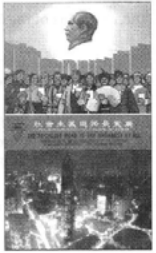
24. Observe the picture given below and answer the following questions.
(i) In which year did the bipolar structure of world politics end?
(A) 1989
(B) 1990
(C) 1991
(D) 1992
View AnswerAns. (B) 1990
(ii) Name two associations of nations that emerged in Europe and Asia:
(A) NATO and ASEAN
(B) European Union and SAARC
(C) European Union and ASEAN
(D) G20 and SCO
View AnswerAns. (C) European Union and ASEAN
(iii) What is indicated by the first picture?
(A) The end of Cold War
(B) The history of Red China or Communist China
(C) The rise of Soviet economy
(D) The foundation of European Union
View AnswerAns. (B) The history of Red China or Communist China
(iv) When did the Chinese revolution take place?
(A) 1945
(B) 1947
(C) 1949
(D) 1950
View AnswerAns. (C) 1949
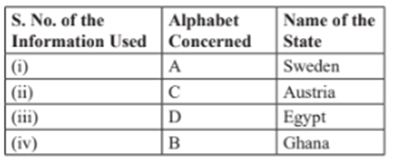
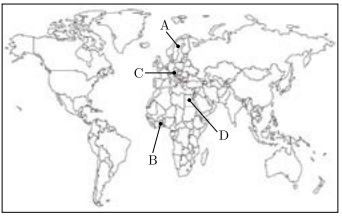
25. In the given outline political map of world, four countries have been marked as A, B, C and D. Identify these on the basis of the information given below and write the correct names in your answer book along with the respective serial number of the information used and the concerned alphabets as per format that follows.
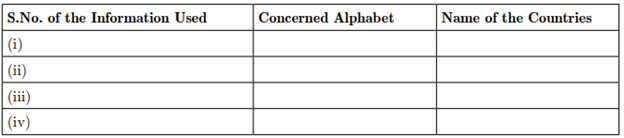
(i) To which country the UN Secretary General Dag Hammarskjold-Annan belonged?
(ii) To which country the UN Secretary General Kurt Waldheim belonged?
(iii) To which country the UN Secretary General Bourtoros Boutros-Ghali belonged?
(iv) To which country the UN Secretary General Kofi Annan belonged?
View AnswerAns.
26. Read the passage given below and answer the questions that follow. The interim government took a firm stance against the possible division of India into smaller principalities of different sizes. The Muslim League opposed the Indian National Congress and took the view that the states should be free to adopt any course they liked. Sardar Patel, India’s Deputy Prime Minister and the Home Minister during the crucial period, immediately after Independence, played a historic role in negotiating with the rulers of Princely States in bringing most of them into the Indian Union.
(i) Which government has been referred to as the interim government?
(A) Regional Parties Government
(B) State Government
(C) Indian National Congress Government
(D) None of these
View AnswerAns. (C) Indian National Congress Government
(ii) How the leader played a historic role in the integration of states?
(A) By not trying to control through army rule
(B) By skill-fully negotiating
(C) By forcefully convincing
(D) None of the above
View AnswerAns. (B) By skill-fully negotiating
(iii) Why did the Muslim League oppose the Indian National Congress?
View AnswerAns. The Muslim League opposed the Indian National Congress because it believed that the Congress primarily represented Hindu interests and neglected the political and cultural rights of Muslims. The League feared domination by the Hindu majority in a unified India and sought separate electorates and greater political safeguards for Muslims.
SECTION –E
27. Was the declaration of emergency in 1975 necessary? Support your answer with three suitable arguments.
View AnswerAns. The declaration of emergency, according to the Indian Constitution can be made on the ground of threat to India due to external aggression or armed rebellion. Emergency imposed in 1975 was on ground of internal instability.
This emergency was justified by the following points
(i) The social and economic condition in the country did not improve much after 1971-72. India was under grip of economic crisis due to the Bangladesh crisis, war with Pakistan, the US Government stopped all aid to India, crop-failure of 1972-73, oil prices increased manifold which led to a high level of inflation. So, emergency was imposed to stabilise the situation.
(ii) There was also an increased in the activities of Marxist groups who did not believe in parliamentary politics. These groups had taken to arms and insurgent techniques to over throw the capitalist order and established political system known as the Marxist Leninist (new Marxist) groups or Naxalite. This was another reason for the declaration of emergency in 1975.
(iii) Strike of railway employees in 1974, Bihar Movement led by students to protest against rising prices, food scarcity, unemployment and corruption. Gujarat movement also led by student against rising prices of food grains, cooking oil and other essential commodities and against corruption which led to instability, distracts and disorder in the nation.
Thus, government thought that it was essential to implement emergency to maintain law and order.
OR
What are the three democratic upsurges that emerged in the post-independence history of India? Explain.
View AnswerAns. The increasing participation of the people in the democratic politics of the country is broadly characterised as democratic upsurge. The three democratic upsurges that emerged in the post-independence era are discussed below
(i) The first democratic upsurge could be attributed from the 1950s till 1970s which was based on the participation of Indian adult voters to the democratic politics both at the centre and states. The successful holding of elections to both Lok Sabha and Legislative Assemblies all across the states on the principle of parliamentary democracy were the testimony of India’s first democratic upsurge.
(ii) During the 1980s, the increasing political participation of the lower classes of the society such as SCs, STs and OBCs has been interpreted as ‘Second Democratic upsurge’. The participation of these classes into the organisational and political platforms gave them the opportunity to strengthen their self-respect and ensure empowerment in the democratic politics of the country.
(iii) The era of liberalisation, privatisation and globalisation from the early 1990s is attributed to the emergence of a competitive market society encompassing all important sectors of economy, society and polity. Thus, paving the way for the Third Democratic Upsurge’, this upsurge represents a competitive electoral market which is based not on the principle of survival of the best but rather the survival of the ablest.
28. Analyse the First Gulf War. Why was it called a computer war and a video game war?
View AnswerAns. In August 1990, Iraq invaded Kuwait, rapidly occupying and subsequently annexing it. After a series of diplomatic attempts failed at convincing Iraq to quit its aggression, the United Nations mandated the liberation of Kuwait by force. For the UN, this was a dramatic decision after years of deadlock during the cold war. The US President George HW Bush hailed the emergence of a ‘new world order”.
(i) A massive coalition force of 660,000 troops from 34 countries fought against Iraq and defeated it in what came to be known as the First Gulf War. However, the UN Operation, which was called Operation Desert Storm’ was overwhelmingly American.
(ii) An American General, Norman Schwarzkopf, led the coalition and nearly 75 per cent of the coalition forces were from the US.
(iii) The First Gulf War was called a computer war as it revealed the vast technological gap that had opened up between the US Military capability and that of other states. Another reason was the highly publicised use of so-called ‘smart bombs’ by the US led some observers to called this a ‘Computer War’.
(iv) Widespread television coverage also made it a ‘video game war’, with viewers around the world watching the destruction of Iraqi forces live on TV in the comfort of their living rooms.
Thus, the US may actually have made profit from the First Gulf War as per the reports. It has received more money from countries like Japan, Germany and Saudi Arabia than that it had spent on the war.
OR
Explain any six outcomes of the disintegration of the Soviet Union.
View AnswerAns. The disintegration of the Soviet Union as the second world power and the collapse of socialist systems in Eastern Europe had profound outcomes for world politics in general and Asian countries like India in particular. The outcomes of the disintegration can be analysed by way of six kinds of enduring changes like
(i) The disintegration of the Soviet Union meant the end of the Cold War confrontation. The end of the Cold War signifies the collapse of the ideological conflict between the socialists and the capitalists. Now, there was no alliances system bases on ideology. As the alliance system led to formation of military blocs, the end of confrontations demanded the end of the arms race and restoration of possible peace.
(ii) The disintegration of the USSR and the end of the cold war left open only two possibilities like either the remaining superpower would dominate and create a unipolar system’ of different countries of groups of countries could become important players in the international system, thereby bringing in a ‘multipolar system’, where no one power could dominate.
(iii) As it turned out, the US became the sole super power. Backed by the power and prestige of the US, the ‘capitalist economy’ was now the dominant economic system internationally.
(iv) Institutions like the World Bank and the International Monetary Fund became powerful advisors to all these countries since they gave them loans for their transition to capitalism. Politically, the nation of liberal democracy emerged as the best way to organise political life.
(v) The end of the Soviet Bloc meant the emergence of many new countries because at the dawn of the disintegration of USSR, Soviet Union was divided into 15 independent countries. All these countries had their own independent aspirations and choices.
(vi) The Central Asian countries wanted to take advantage of their geographical location and continue their close ties with Russia and also to establish ties with the US, China and others.
29. Describe any six issues of consensus to show that in the midst of severe competitions and conflicts a consensus has appeared among most political parties.
View AnswerAns. Sometimes the period after 1989 is seen as a period of decline of Congress and rise of BJP. Despite severe competition and many conflicts, a broad consensus emerged on many crucial issues. These were
(i) First agreement was on new economic policies.
(ii) Most political parties have consensus about the new economic policies despite the fact many groups opposed this. As it was believed that these policies will bring prosperity and help the country to be an economic power in the world.
(iii) Second was the acceptance of political and social claims of the backward castes.
(iv) Most of the political parties accepted and supported the reservation of seats for the backward classes in education and employment. Political Parties also ensure that the OBC’s get adequate share of power.
(v) The third acceptance was the role of regional parties.
(vi) The role of state level parties in governance of the country is accepted by all major parties. Regional parties are sharing power at the national level and has been playing central role in the politics of the country for twenty years.
(vii) The fourth emphasis was on pragmatic considerations rather than the ideological.
(viii) Most of the political parties’ emphasis on practical considerations rather than ideological positions. The coalition politics has shifted the focus of political parties from ideological differences to power sharing arrangements. For instance, most parties of NDA didn’t agree with the Hindutva ideology of BJP but they came together to form government.
OR
Analyse the rise and fall of any two coalition governments from the year 1989 to 2004.
View AnswerAns. With the elections of 1989, a long phase of coalition politics began in India. Since then, there have been nine governments at the Centre. All of them have either been coalition governments or minority governments supported by other parties which did not join the government. In this new phase, any government could be formed only with the participation of support of many regional parties. For example
(i) Nation Front Government in 1989
(ii) The United Front Government in 1996 and 1997
(iii) National Democratic Alliance (NDA), BJP led coalition in 1997, 1998, 1999
(iv) United Progressive Alliance (UPA) in 2004
United Front Government Some parties had Congress support and formed alliance in 1996 called United Front. In 1989, BJP and Left supported National Front. In 1989, BJP and Left wanted to keep the Congress out of power, hence, both supported National Front and later in 1996, Congress and Left both wanted to keep out BJP from the power. Therefore, both supported United Front in 1996.
United Progressive Alliance In 1996, BJP was invited to form the government, but most of the political parties, opposed its policies, consequently it could not secure a majority in the Lok Sabha. In 2004 elections, the Congress party came to power with the new alliance known as United Progressive Alliance. This was a coalition. in a big way. NDA was defeated and installation of another coalition led by Dr Manmohan Singh occurred. The UPA received support from DMK, PMK, AIADMK, RJD, NCP, TRS and Left from Andhra Pradesh, etc. The 2004 election also saw the partial revival of Congress party as it increased its seats in comparison to 1996 elections.
30. Explain the contribution of Jawaharlal Nehru in formulating the Foreign Policy of India.
View AnswerAns. India formulated its Foreign Policy with an aim to respect the sovereignty of all other nations and to achieve security through the maintenance of peace. The major principles of India’s Foreign Policy are
(i) Non-Alignment It means not to join any of the power blocks or enter into military alliance, having an independent Foreign Policy and working for peaceful co-existence. Non-Alignment stands for disarmament, development, decolonisation, democratisation of international organisations, protection of the environment, etc.
(ii) Panchsheel It is a guideline in our relation with other countries that was signed between India and China in 1954. Its five principles are
(a) Respect for each other’s territorial integrity and sovereignty.
(b) Mutual non-aggression.
(c) Mutual non-interference in each other’s internal affairs.
(d) Equality and mutual benefit.
(e) Peaceful co-existence.
(iii) Opposition to Colonialism Since we have been the victims of colonial rule and exploitation, we stand for the right of self-determination and anti- imperialism. We supported the cause of freedom of the colonies of Africa and Asia, as colonialism is a violation of fundamental human rights. India cooperated with Indonesia in its efforts for freedom and also supported the freedom struggles in Malaya, Algeria, Tansia and Namibia, etc. India’s concern for Bangladesh and of Iraq’s invasion of Kuwait reflects our opposition to colonialism.
(iv) Disarmament It means cutting down on production of arms and their stockpiles so as to make the world a more secure place to live in. An arms race leads to wasteful expenditure, mutually assured destruction, environmental pollution and a lopsided economy. The same money could be used for welfare and constructive purposes. We signed the Chemical Weapons Ban Treaty and also supported disarmament talks like SALT-I, SALT-II, START-I, etc.
OR
Discuss the strained relationship between India and China which led to the Chinese invasion of 1962?
View AnswerAns. The strained relationship between India and China which led to Chinese invasion of 1962 because of the following reasons
- In 1950, China annexed Tibet which removed a historical buffer between two countries. Initially, India didn’t oppose it openly, but later it resented this issue when information regarding Tibetan culture suppression came up.
- Dalai Lama, the Tibetan spiritual leader sought and obtained political asylum in India in 1959. China opposed this move by declaring that India is supporting anti-China activities.
China and India were involved in a border conflict in 1962 over competing territorial claims principally in Arunachal Pradesh and in the Aksai Chin region of Ladakh. The conflict of 1962, in which India suffered military reverses, had long- term implications for India-China relations.