Class XII Session 2025-26
Subject – History
Time Allowed: 3 hours Maximum Marks: 70
General Instructions:
1. Question paper comprises five Sections – A, B, C, D and E. There are 34 questions in the question paper. All questions are compulsory.
2. Section A – Question 1 to 21 are MCQs of 1 mark each.
3. Section B – Question no. 22 to 27 are Short Answer Type Questions, carrying 3 marks each. The answer to each question should not exceed 60-80 words.
4. Section C – Question no 28 to 30 are Long Answer Type Questions, carrying 8 marks each. The answer to each question should not exceed 300-350 words
5. Section D – Question no.31 to 33 are Source based questions with three sub-questions and are of 4 marks each
6. Section-E – Question no. 34 is Map based, carrying 5 marks that include the identification and location of significant test items. Attach the map with the answer book.
7. There is no overall choice in the question paper. However, an internal choice has been provided in a few questions. Only one of the choices in such questions has to be attempted.
8. In addition, separate instructions are given with each section and question, wherever necessary.
Section A
1. What is James Prinsep’s contribution to the development of the Indian epigraphy?
i. He deciphered the Brahmi script used in most of the Ashokan inscriptions.
ii. He deciphered the Kharoshthi script used in most of the Ashokan inscriptions.
iii. Both (i) and (ii)
iv. None of these
a) Option (iv)
b) Option (i)
c) Option (ii)
d) Option (iii)
View AnswerAns. b) Option (i)
2. Abu’l Fazl was a court historian of which Mughal emperor?
a) Humayun
b) Jahangir
c) Akbar
d) Babur
View AnswerAns. c) Akbar
3. Karaikkal Ammaiyar was the greatest figure of ________ tradition.
a) Puaravar
b) Nayanars
c) Alvars
d) Mayunar
View AnswerAns. b) Nayanars
4. Who resigned from the presidentship of the Congress in 1922 after the Gaya Congress?
a) C.R. Das
b) Subhash Chandra Bode
c) Jinnah
d) Motilal Nehru
View AnswerAns. a) C.R. Das
5. Match the following:
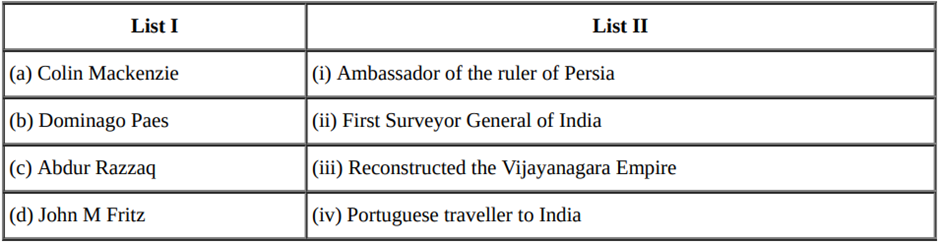
a) (a) – (ii), (b) – (iv), (c) – (i), (d) – (iii)
b) (a) – (i), (b) – (iii), (c) – (iv), (d) – (ii)
c) (a) – (i), (b) – (ii), (c) – (iii), (d) – (iv)
d) (a) – (iii), (b) – (i), (c) – (ii), (d) – (iv)
View AnswerAns. a) (a) – (ii), (b) – (iv), (c) – (i), (d) – (iii)
6. Look at the figure given below and identify the structural feature marked as A of the Sanchi stupa from the following options:
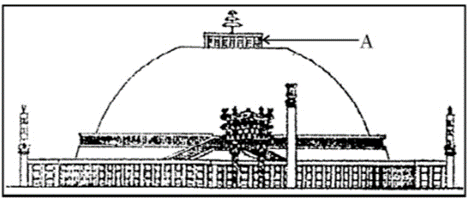
a) Harmika
b) Yashti
c) Anda
d) Chhatri
View AnswerAns. a) Harmika
7. What was created after Santhals revolt?
a) Dikus
b) Damin-i-koh
c) Santhal Pargana
d) Ryotwari
View AnswerAns. c) Santhal Pargana
8. Which of the following was not an objective of the revolt of 1857?
a) Attacking every symbol of British rule
b) Search for alternative power
c) To revive Islamic rule
d) Vision of Unity
View AnswerAns. c) To revive Islamic rule
9. Assertion (A): Hidimba was the sister of a man-eating rakshasa to capture the Pandavas.
Reason (R): The Pandavas had to flee to the forest due to the conspiracy led by their cousin Duryodhana against them.
a) Both A and R are true and R is the correct explanation of A.
b) Both A and R are true but R is not the correct explanation of A.
c) A is true but R is false.
d) A is false but R is true.
View AnswerAns. b) Both A and R are true but R is not the correct explanation of A.
10. Which of the following countries did Marco Polo belong to?
a) Italy
b) Spain
c) France
d) Portugal
View AnswerAns. a) Italy
11. ________ was the congress President at Lahore Session.
a) Mahatma Gandhi
b) Sardar Patel
c) Subhash Chandra Bose
d) Jawahar Lal Nehru
View AnswerAns. d) Jawahar Lal Nehru
12. The national Anthem was adopted by the constituent Assembly on which of the following day?
a) 24 January, 1947
b) 29 August, 1947
c) 26 November, 1949
d) 22 July, 1947
View AnswerAns. a) 24 January, 1947
13. Which of the following pairs is correctly matched?
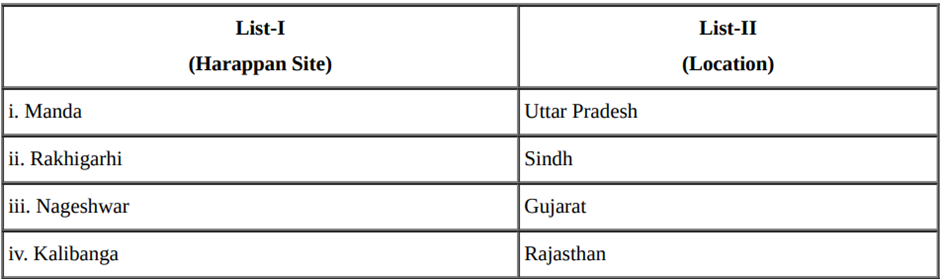
a) iii and iv
b) ii and iv
c) i and iv
d) ii and iii
View AnswerAns. a) iii and iv
14. Which of the following category of society of ancient Persia was not recognised by the Al-Biruni?
a) Monks and fire-priests
b) Knights and princes
c) Peasants and artisans
d) Children and women
View AnswerAns. d) Children and women
15. Which one of the following is the major anthology or composition of Alvars?
a) Tevaram
b) Surya Siddhanta
c) Nalayira Divyaprabandham
d) Mahabhashya
View AnswerAns. c) Nalayira Divyaprabandham
16. Consider the following statements regarding the life of Paharis.
i. Their main occupations were hunting, shifting agriculture, food gathering, charcoal production, etc,
ii. They lived in permanent houses made up of stones.
iii. They considered the entire region as their land, the basis of their identity as well.
iv. Their chiefs maintained the unity of the group, settled disputes and led the tribe in the battles.
Which of the above statement(s) is/ are correct about the Paharis.
a) i and ii
b) i, iii and iv
c) ii and iii
d) i Only
View AnswerAns. b) i, iii and iv
17. Sir Huge Rose described whom as the best and bravest military leader of the rebel?
a) Kuwar Singh
b) Begum Hazrat Mahal
c) Rani Laxmi Bai
d) Bahadur Shah Zafar
View AnswerAns. c) Rani Laxmi Bai
18. Complete the following with the correct option: Muqaddam : Panchayat headman, Patwari : ________.
a) Panchayat Secretary
b) Panchayat Accountant
c) Panchayat Police
d) Panchayat Farmer
View AnswerAns. b) Panchayat Accountant
19. Other name of Vijayanagara city was-
a) Nagalparam
b) Fatehpur Sikri
c) Hastinapur
d) Hampi
View AnswerAns. d) Hampi
20. Who among the following is said to be the founder of the Pashupati cult?
a) Kusika
b) Lakulisa
c) Basava
d) Gprakhratha
View AnswerAns. b) Lakulisa
21. Which of the following is not correctly matched in respect of Buddha’s life?
a) Where he gave his first sermon – Sarnath
b) Where he attained enlightenment – Sursen
c) Where he was born – Lumbini
d) Where he attained nibbana – Kusinagara
View AnswerAns. b) Where he attained enlightenment – Sursen
Section B
22. Explain how the forest dwellers earned their livelihood during the 16th and 17th centuries.
View AnswerAns. i. Forest dwellers were termed jangali in contemporary texts.
ii. Their livelihood came from the gathering of forest produce, hunting and shifting agriculture.
iii. These activities were largely season specific.
iv. Among the Bhils, for example, spring was reserved for collecting forest produce, summer for fishing, the monsoon months for cultivation, and autumn and winter for hunting.
v. Such a sequence presumed and perpetuated mobility, which was a distinctive feature of tribes.
vi. For the state, the forest was a subversive place – a place of refuge (mawas) for troublemakers.
OR
Why did Abu’l Fazl describe the land revenue as remuneration of sovereignty?
View AnswerAns. Revenue from the land was the economic mainstay of the Mughal empire. It was, therefore, vital for the state to created an administrative apparatus to ensured control over agricultural production and to fixed and collected revenue from across the length and breadth of the empire. In his work, Abul Fazl also mentioned land revenue as the remuneration of sovereignty because it was like a social contract between kings and the public. The king had to protect the life property, honours, and faith of his, subjects and in return, he demanded land revenue as a resource and obedience. Only those sovereigns who had divine guidance and power could honour the contract this was according to the divine light concept prevailed that times.
23. Critically examine the Deccan Riots Commission Report.
View AnswerAns. The Deccan Riots Commission Report can be examined through the following points:
i. A report was prepared by the commission which was presented to the British Parliament in 1878.
ii. Proper enquiries were held in the Riot affected districts and the statement of the Ryots, Sahukars and eyewitnesses were recorded.
iii. Statistical data on revenue Rates, Prices and Interest rates were compiled in various regions.
iv. The Deccan Riots Commission Report shows the official sources and reflects concerns and interpretations of events. this commission was specifically asked to judge whether the level of the government revenue demand was the cause of the Revolt. After presenting all the evidence, the commission reported that the government demand was not the cause of peasants anger. It was the moneylenders who were to blame.
24. How did Chola rulers provide support to Bhakti traditions? Explain.
View AnswerAns. i. Support for Religious Traditions:
- Chola rulers supported Brahmanical and bhakti traditions.
- They made land grants and constructed temples dedicated to Vishnu and Shiva.
ii. Temple Construction:
- Magnificent Shiva temples were constructed under Chola patronage.
- Notable examples include temples at Chidambaram, Thanjavur, and Gangaikondacholapuram.
iii. Artistic Achievements:
- The period saw the production of spectacular bronze sculptures of Shiva.
- The visions of the Nayanars, who were Shaiva saints, inspired these artistic creations.
iv. Proclamation of power:
– The Chola kings claimed divine support and proclaimed their own power by building temples.
25. What does Al-Biruni wrote about the administration of justice in India?
View AnswerAns. Administration of Justice in India was as follows:
i. Crude and primitive in many ways, but also liberal and humane.
ii. Written complaints, cases were decided on the testimony of witnesses according to code of laws
iii. Criminal Laws was mild.
iv. Brahmanas were exempted from capital punishment.
v. Punishments were given according to laws set in religious texts.
26. Why did the rebel proclamations in 1857 appeal for unity to all sections of the population? Explain.
View AnswerAns. The rebel proclamations of 1857 appealed for unity among all sections of the population for several reasons:
Religious Unity: The proclamations emphasized the need for Hindus and Muslims to unite against the British. For example, the Azamgarh Proclamation of 25 August 1857 called upon both “Hindus and Mohammedans” to join forces in the struggle against the British.
Regional Unity: The proclamations sought to bring together people from different regions. Leaders like Nana Sahib appealed to regional identities, urging people from the Deccan to support the rebellion.
Social Unity: The proclamations called for social cohesion, urging people of all castes and social classes to unite. Rani Lakshmi Bai of Jhansi, for instance, appealed to all social groups to join the fight against the British.
Common Grievances: The proclamations highlighted shared grievances such as economic exploitation, heavy taxation, and disrespect for traditional rulers and customs. By focusing on these common issues, the rebels aimed to create a sense of shared purpose.
Strength in Numbers: The rebels understood that a united front would significantly increase their chances of success. Mobilizing a large and diverse group of people provided the necessary manpower and resources to sustain the rebellion.
27. What was the position of those people in society whose social practices were not influenced by Brahmanical ideas?
View AnswerAns. Due to diversity in the sub-continent, there were many people whose social practices were not influenced by Brahmanical ideas. Their mention has been found in many Sanskrit texts. They are often described as odd, uncivilised and beastly people. They are also considered forest dwellers who hunted to survive. The Nishada, Eklavya was one of them and belonged to this category of people.
The others who were suspected included nomadic pastoralists. They did not adjust themselves in the framework of settled agriculturists. The people who did not speak Sanskrit were often termed as Mlechchhas. They were looked down upon in society. There are many stories about such people in the Mahabharata.
OR
Who was V.S. Sukthankar? What was his contribution in understanding the Mahabharata.
View AnswerAns. V.S. Sukthankar was the most famous Sanskritist.
i. Under the V.S. Sukthankar, a team of dozens of scholars initiated the task of preparing a critical edition of the Mahabharata.
ii. The team Collected the Sanskrit Manuscripts of the text. Written in a variety of scripts from different parts of the country.
iii. The team worked out a method of comparing verses from each manuscript. Ultimately they selected the verses that were common to most versions and published these in several volumes running into 13,000 pages. The project took 47 years to complete.
Section C
28. Examine the role of the Congress party in making of the Constituent Assembly.
View AnswerAns. The members of the Constituent Assembly were not elected on the basis of the universal franchise rather they were elected on the basis of the provincial elections of 1946. The Constituent Assembly that came into being was dominated by one party: the Congress. The Congress swept the general seats in the provincial elections, and the Muslim League captured most of the reserved Muslim seats. But the League chose to boycott the Constituent Assembly, pressing its demand for Pakistan with a separate constitution. The Socialists too were initially unwilling to join, for they believed the Constituent Assembly was a creation of the British, and therefore incapable of being truly autonomous. The Constituent Assembly had 300 members. Out of which 82 percent of the members of the Constituent Assembly were members of Congress. The Congress however was not a party with one voice. Its members differed in their opinion on critical issues. Some members were inspired by socialism while others were defenders of landlordism. Some were close to communal parties while others were assertively secular. Through the national movement, Congress members had learnt to debate their ideas in public and negotiate their differences. Within the Constituent Assembly too, Congress members did not sit quiet.
Jawahar Lal Nehru, Vallabh Bhai Patel and Rajendra Prasad were the members of Congress who played important roles in the Constituent Assembly. Nehru moved ‘Objective Resolution’ and ‘Tricolour National Flag’. Patel played a key role in drafting reports and reconciling views. Dr. Prasad was the President of the Assembly. Dr. B.R. Ambedkar served as Chairman of the Drafting Committee. KM Munshi and Alladi Krishnaswamy Aiyar gave crucial inputs. The discussions within the Constituent Assembly were also influenced by the opinions expressed by the public.
OR
Explain the views of Govind Vallabh Pant and Begam Aizaz Rasul on Separate Electorates.
View AnswerAns. i. Views of Govind Ballabh Pant on ‘Separate Electorates’ are examined as under:
a. Govind Ballabh Pant was a staunch critic of the demand for separate electorates. He clearly declared that this demand was not only injurious to the nation but also for the minorities.
b. G. B. Pant supported Bahadur’s analysis that the success of democracy was to be deftly examined and judged by the confidence it evoked amongst various sections of people.
c. G. B. Pant also maintained that every citizen in a free state should be treated in a way that satisfied “not only his material wants but also his spiritual sense of self-respect.” The majority community should understand the problems faced by minorities.
d. Yet, G. B. Pant vehemently opposed the idea of “Separate Electorates”. During the debate on 27 August 1947, he said, “I believe separate electorates will be suicidal to the minorities and will do them tremendous harms …. The minorities if they are returned by separate electorates can never have any effective voice.”
ii. Views of Begam Aizaz Rasul on “Separate Electorates”:
a. The demand for separate electorates was not supported by all Muslims. Begam Aizaz Rasul maintained that separate electorates were self-destructive.
b. She further said that the idea of a separate electorate would isolate the minorities from the majority.
c. However, by 1949 most Muslim members of the constituent assembly were of this opinion that the notion of separate electorates was against the interests of the minorities.
d. She opined that the Muslim community should take an active and vibrant part in the democratic process to ensure that they had an effective and decisive voice in the political system of the country.
Conclusion: The concept of a separate electorate was outrightly condemned by G. B. Pant and Begam Aizaz Rasul. Pant said that it was a suicidal demand and would permanently isolate the minorities.
29. Quit India Movement challenged the British rule and shaped the course of Indian Independence. Justify the statement.
View AnswerAns. Quit India Movement: Challenging British Rule and Shaping Indian Independence:
Against Cripps Mission and Government Acts: The movement gained momentum as a direct response to the failure of the Cripps Mission, dissatisfaction with the Government of India Act 1935, the threat of Japanese aggression, and the forced inclusion of India in World War II without Indian consent.
Youth Activism: Younger activists played a crucial role by organizing strikes and acts of sabotage across the country. Their actions disrupted the normal functioning of the British administration and demonstrated widespread discontent.
Underground Resistance: Socialist members of the Congress, like Jai Prakash Narayan, led underground resistance efforts. These activities kept the spirit of the movement alive even when many leaders were imprisoned.
Independent Governments: The establishment of independent governments in districts like Satara in the west and Medinipur in the east showcased the Indian people’s ability to self-govern and resist colonial rule.
Unity Among Masses: The movement fostered unity among the Indian masses, cutting across regional, religious, and social lines. This unity was crucial in presenting a united front against British rule.
Mass Participation: The Quit India Movement saw active participation from all states and was truly a mass movement. It involved people from all walks of life, making it a nationwide struggle.
Disruption of British Administration: The movement significantly disrupted the functioning of the British colonial government. Strikes, protests, and acts of sabotage created administrative chaos and demonstrated the untenability of British rule in India.
Political Awakening and Empowerment: The movement brought about a political awakening and empowerment among the Indian populace. It instilled a sense of agency and the belief that they could overthrow colonial rule.
British Suppression Efforts: The British took more than a year to suppress the movement, indicating its intensity and the widespread support it garnered. The prolonged struggle highlighted the determination of the Indian people to achieve independence.
OR
Mahatma Gandhiji’s role was vital in the Non-Cooperation Movement. Support the statement.
View AnswerAns. Mahatma Gandhiji’s Vital Role in the Non-Cooperation Movement
1. Response to Rowlatt Act:
Gandhiji called for a countrywide campaign against the Rowlatt Act, leading to widespread protests and strikes.
2. Campaign of Non-Cooperation:
Emboldened by the success of the Rowlatt satyagraha, Gandhiji called for a campaign of non-cooperation with British rule, asking Indians to boycott schools, colleges, courts, and to not pay taxes.
3. Broadened Struggle:
To widen the movement, Gandhiji joined hands with the Khilafat Movement, aiming to unite Hindus and Muslims against colonial rule.
4. Popular Action:
The Non-Cooperation Movement unleashed unprecedented popular action, with students, lawyers, workers, and peasants all participating in various forms of protest.
5. Empathy and Identification with the Poor:
Gandhiji’s simple lifestyle, dress, and daily use of the charkha resonated with the common people, helping him to empathize with and mobilize them effectively.
6. Breaking Social Boundaries:
By advocating spinning and manual labor, Gandhiji broke traditional caste boundaries, promoting equality and selfreliance among Indians.
7. Shaking the British Raj:
The Non-Cooperation Movement was so effective that it shook the foundations of the British Raj for the first time since the Revolt of 1857.
8. International Recognition:
Gandhiji’s leadership and the movement’s impact were acknowledged globally, with significant appreciation and tributes from international figures and media.
9. Calling Off the Movement:
After the Chauri Chaura incident, where violence erupted, Gandhiji called off the movement, emphasizing the importance of non-violence and moral integrity.
10. Arrest and Trial:
Gandhiji was arrested and charged with sedition in 1922. During his trial, even the judge acknowledged his high ideals and saintly life, recognizing his leadership and patriotism.
11. Building Organizational Structure:
Gandhiji’s success in broadening nationalism was also due to his organizational efforts, setting up new Congress branches and “Praja Mandals” across India, promoting the nationalist message in local languages.
12. Transformation of Indian Nationalism:
By 1922, Gandhiji had transformed Indian nationalism into a mass movement involving diverse social groups, thereby fulfilling his promise of making the freedom struggle inclusive and widespread.
30. What was the role of Nayakas and Amara-Nayakas in the admi-nistration of Vijayanagara?
View AnswerAns. The Nayakas and the Amara-Nayakas exercised considerable power in the Vijayanagara Empire. Nayakas: They were the military chiefs in the Vijayanagara Empire and usually controlled forts. They had armed supporters and often moved from one area to another. In many cases, they were accompanied by peasants who looked for fertile land for their settlement. They were called Nayakas as their role was quite significant. They usually spoke in Telugu or Kannada language. They were mostly submissive to the authority of the kings of Vijayanagara. But sometimes they also rose in rebellion and had to be controlled by military action.
Amara-Nayakas: The Amara-Nayakas were a major political innovation of the rulers of the Vijayanagara Empire. They were the military commanders who governed the territories given by the kings of Vijayanagara. They collected taxes and other dues from peasants, traders and craft-persons in their areas. A part of the revenue was kept for their personal use and maintaining their horses and elephants. They provided an effective fighting force to the rulers of Vijayanagara. They also kept some of the collected revenue for the maintenance of temples and irrigation works.
The Royal Control over the Amara-Nayakas: At times when Nayakas and Amara-Nayakas revolted, the kings asserted their control on them and made them submit to the royal authority.
The kings adopted the following means to control them:
i. They transferred Amara-Nayakas from one place to another.
ii. They accepted an annual tribute from the Amara-Nayakas.
iii. All the Amara-Nayakas had to appear in the royal court personally. They had to present gifts to the king to express their loyalty.
OR
Explain how the fortification and road in the city of Vijayanagara were unique and impressive.
View AnswerAns. Abdur Razzaq, a Persian ambassador in the court of Devaraja-II was much impressed by the fortification of the Vijayanagara Empire. He mentioned the seven lines of forts. These encircled not only the city but also the agricultural hinterland and forests. In the construction of the fortification of walls, no cementing agent was used. The wedge-shaped stone block which held them in place and the inner portion of the wall was earth packed with rubble. The fortification started with the enclosing of agricultural tracts. The objective of medieval sieges was to starve the defenders into submission. These sieges could last for several months and sometimes even years. Normally rulers tried to be prepared for such situations by building large granaries within the fortified area. The rulers of Vijayanagara adopted a more expensive and elaborated strategy of protecting the agricultural belt itself. The enclosure had its own features. Abdur Razzaq further elaborates that between the first, second and third walls lie the cultivated fields, gardens and houses. According to Paes, “From this first circuit until you enter the city there is a great distance, in which field they saw rice and have many gardens and much water, in which water comes from two lakes.” The second fortification was done around the inner core of the urban complex while the third was around the royal centre. In it, most of the important buildings were encircled by the high walls that were well-guarded gateways were constructed here to enter the fort. These gateways were constructed in Indo-Islamic style. The arch on the gateway leading into fortified settlements as well as some over the gate is regarded as architecture introduced by Turkish sultans. These gateways were linked to city and roads. These roads have been identified by the archaeologist by tracing paths through gateways as well as by finds of pavements. These roads were mainly built in valleys avoiding rocky terrain. The most important roads were extended from temple gateways. Bazars were also situated on both sides of the roads.
Section D
31. Read the following source carefully and answer the questions that follow:
The Therigatha
This unique Buddhist text, part of the Sutta Pitaka, is a collection of verses composed by bhikkhunis. It provides an insight into women’s social and spiritual experiences. Punna, a dasi or slave woman, went to the river each morning to fetch water for her master’s household. There she would daily see a Brahmana performing bathing rituals. One morning she spoke to him. The following are verses composed by Punna, recording her conversation with the Brahmana:
I am a water carrier:
Even in the cold
I have always gone down to the water
frightened of punishment
Or the angry words of high-class women.
So what are you afraid of Brahmana, That makes you go down to the water (Though) your limbs shake with the bitter cold? The Brahmana replied:
I am doing good to prevent evil;
anyone young or old
who has done something bad
is freed by washing in water.
Punna said:
Whoever told you
You are freed from evil by washing in the water? …
In that case all the frogs and turtles
Would go to heaven, and so would the water snakes
and crocodiles!
(Instead) Don’t do that thing,
the fear of which
leads you to the water.
Stop now Brahmana!
Save your skin from the cold …
i. Explain the ideas of Punna with two examples.
View AnswerAns. Punna said that washing with water does not get one rid of evil. If that may be the case, then, turtles and crocodiles who live in water must be enjoying heaven. Also, one should not do that thing the fear of which leads one to bathe in holy water.
ii. What justification did the Brahmana give for his daily dip in the river?
View AnswerAns. The Brahmana said that he takes a daily dip in water to prevent evil. He also advised everyone of any age must take a holy dip if he or she had done some evil.
iii. Explain the core of Buddhist philosophy that is being conveyed through their Gatha.
View AnswerAns. The excerpt provides an insight into women’s social and spiritual experience.
32. Read the following text carefully and answer the questions that follow:
The One Lord
Here is a composition attributed to Kabir:
Tell me, brother, how can there be
No one lord of the world but two?
Who led you so astray?
God is called by many names:
Names like Allah, Ram, Karim, Keshav, Hari and Hazrat.
Gold may be shaped into rings and bangles.
Isn’t it gold all the same?
Distinctions are only words we invent…. ’
Kabir says that are both mistaken.
Neither can find the only Ram. One kills die goat, the other cows.
They waste their lives in disputation.
i. How has Kabir laid emphasis on the attainment of oneness with the divine? Explain.
View AnswerAns. According to Kabir, the distinctions between Gods are artificially created by people and that God is one for all. He discarded such differences by laying emphasis on the attainment of oneness with the divine. For this, he used words to refer to the Ultimate Reality in different traditions., like pir, khuda, alakh, shunya, etc.
ii. How do you think people waste their lives in disputation?
View AnswerAns. People waste their lives in disputation by creating a divide between Allah and Ram that actually does not exist. They foster this divide by pursuing these distinctions instead of understanding that they are artificial and invented in nature. Instead of focusing on love, they focus on hate. Oneness with the divine can only be attained through love.
iii. How has the lyrical beauty of his poem made him a figure of inter-religious harmony? Explain.
View AnswerAns. Kabir’s poetry draws its lyrical beauty from the fact that he seeks to explain that we need not create an artificial distinction between Gods. He uses Gold as a symbol of God which remains the same be it in any form and shows how people waste time in disputation and religious chauvinism. He appreciates the interconnectedness of all religions by calling his readers ‘brother’, and by seeking oneness with the Divine. His poem makes him a figure of inter-religious harmony.
33. Read the following text carefully and answer the questions that follow:
From the Fifth Report
Referring to the condition of zamindars and the auction of lands, the Fifth Report stated: The revenue was not realised with punctuality, and lands to a considerable extent were periodically exposed to sale by auction. In the native year 1203, corresponding with 1796-97, the land advertised for sale comprehended a Jumma or assessment of sicca rupees 28,70,061, the extent of land actually sold bore a Jumma or assessment of 14,18,756, and the amount of purchase money sicca rupees 17,90,416. In 1204, corresponding with 1797-98,” the land advertised was for sicca rupees 26,66; 191, the quantity sold was for sicca rupees 22,74,076, and the purchase money sicca rupees 21,47,580. Among the defaulters were some of the oldest families of the country. Such were the rajahs of Nuddea, Rajeshaye, Bishenpore (all districts of Bengal)… and others, the dismemberment of whose estates at the end of each succeeding year, threatened them with poverty and ruin, and in some instance presented difficulties to the revenue officers, in their efforts to preserve undiminished the amount of public assessment.
i. Explain the significance of the Fifth Report.
View AnswerAns. a. The Fifth Report was the main period of intense parliamentary debates on the nature of the East India Company’s rule in India.
b. The Fifth Report gave a clear picture of what happened in rural Bengal in the late 18th century. It had invaluable evidence.
ii. With reference to the above report, explain the condition of zamindars in India.
View AnswerAns. a. The Zamindars were facing high revenue demand and a possible auction of their estates.
b. The Zamindars devised many methods of surviving the pressures,
c. The dismemberment of estates at the end of each succeeding year made the Zamindars poorer and almost ruined them.
iii. The Fifth Report exaggerated the collapse of the traditional zamindari system. Support the statement with two arguments.
View AnswerAns. a. After having carefully examined the archives of many Bengal Zamindars, the researchers indicate that intent on criticising the mal-administration of the East India Company, the Fifth Report exaggerated the collapse of traditional Zaminidari power.
b. The scale on which zamindar was losing their land was also overestimated. Zamindaris were auctioned however, Zamindars were not always displaced. On the basis of clever methods, Zamindars used to retain their Zamindaris.
Section E
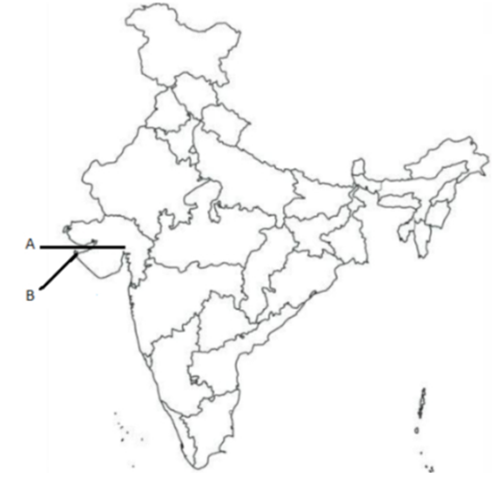
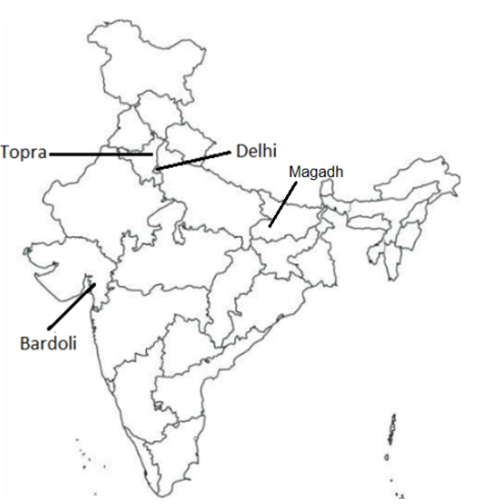
34. i. On the given political outline map of India, locate and label the following:
a. Topra, Pillar inscription
b. Delhi, a Mughal territory
c. Bardoli, a centre of National Movement.
OR
Magadha, a Mahajanapada
Ans.
ii. On the same outline map, two places have been marked as A and B which are Mature Harappan sites. Identify them and write their correct names.
View AnswerAns. A – Lothal B – Nageshwar