Class XII Session 2025-26
Subject – History
Time Allowed: 3 hours Maximum Marks: 70
General Instructions:
1. Question paper comprises five Sections – A, B, C, D and E. There are 34 questions in the question paper. All questions are compulsory.
2. Section A – Question 1 to 21 are MCQs of 1 mark each.
3. Section B – Question no. 22 to 27 are Short Answer Type Questions, carrying 3 marks each. The answer to each question should not exceed 60-80 words.
4. Section C – Question no 28 to 30 are Long Answer Type Questions, carrying 8 marks each. The answer to each question should not exceed 300-350 words
5. Section D – Question no.31 to 33 are Source based questions with three sub-questions and are of 4 marks each
6. Section-E – Question no. 34 is Map based, carrying 5 marks that include the identification and location of significant test items. Attach the map with the answer book.
7. There is no overall choice in the question paper. However, an internal choice has been provided in a few questions. Only one of the choices in such questions has to be attempted.
8. In addition, separate instructions are given with each section and question, wherever necessary.
Section A
1. Who among the following was the Emperor at Delhi during the 1857 Revolt?
a) Bahadur Shah
b) Farukh Siyar
c) Birjis Qadr
d) Aurangzeb
View AnswerAns. a) Bahadur Shah
2. Who proposed Britishers to adopt the policy of Pacification with Paharias?
a) Augustus Cleveland
b) Lord Cornwallis
c) William Hodges
d) Francis Buchanan
View AnswerAns. a) Augustus Cleveland
3. What does the symbol of “empty seat” symbolize?
a) First Sermon of the Buddha
b) Meditation of the Buddha
c) Wisdom of the Buddha
d) An event in the life of Buddha
View AnswerAns. b) Meditation of the Buddha
4. Identify the picture from the given options:
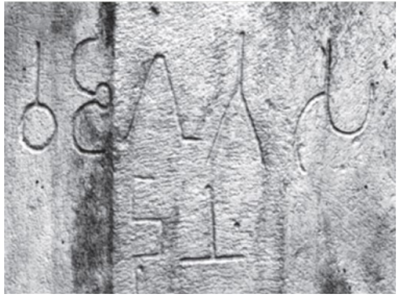
a) An inscription, Sarnath
b) An inscription, Rajgir
c) An inscription, Sanchi
d) An inscription, Lothal
View AnswerAns. c) An inscription, Sanchi
5. The land which was annually cultivated for each crop in succession was called ________ in the Mughal Empire.
a) Chachar
b) Banjar
c) Parauti
d) Polaj
View AnswerAns. d) Polaj
6. Consider the following statements regarding the Lotus Mahal:
i. Lotus Mahal of the most beautiful buildings in the royal centre is the Lotus Mahal, so named by British travellers in the nineteenth century.
ii. One suggestion, found in a map drawn by Mackenzie, is that Lotus mahal may have been a council chamber, a place where the king met his advisers.
iii. Lotus Mahal had nine towers – a high central one, and eight along the sides. Which of the following statement(s) is/are correct?
a) i and ii
b) Only i
c) i and iii
d) All of these
View AnswerAns. d) All of these
7. Assertion (A): There was occasionally a situation of conflict among Vedic traditions and Tantric practices.
Reason (R): Those who valued the Vedic tradition often condemned practices beyond sacrifices and mantras whereas those engaged in Tantric practices frequently ignored the authority of the Vedas.
a) Both A and R are true and R is the correct explanation of A.
b) Both A and R are true but R is not the correct explanation of A.
c) A is true but R is false.
d) A is false but R is true.
View AnswerAns. a) Both A and R are true and R is the correct explanation of A.
8. Identify the disciple of Shaikh Nizamuddin Auliya with the help of the following information: He was a great poet and musician of medieval period. He gave a unique form to Chishti sama. He introduced qawwali.
a) Data Ganj Bakhsh
b) Baba Farid
c) Amir Khusrau
d) Ziyauddin Barani
View AnswerAns. c) Amir Khusrau
9. Awadh was annexed into the British empire in ________
a) 1854
b) 1855
c) 1856
d) 1853
View AnswerAns. c) 1856
10. Arrange the following dynasties of Vijayanagara Empire in chronological order:
i. Sangama
ii. Aravidu
iii. Tuluva
iv. Saluva
Choose the correct option.
a) iv, i, ii and iii
b) ii, i, iii and iv
c) i, iii, iv and ii
d) i, iv, iii and ii
View AnswerAns. d) i, iv, iii and ii
11. Identify the name of the person from the information given below.
i. He was one of the Buddha’s closest and dearest disciples.
ii. He played a crucial role in persuading the Buddha to admit women into the sangha.
iii. Through his mediation, women, including the Buddha’s foster mother Mahapajapati Gotami, were allowed into the sangha as bhikkhunis.
iv. His efforts enabled women to become teachers of dhamma and attain liberation, earning the respected title of theris.
a) Rahula
b) Mahakasyapa
c) Sariputra
d) Ananda
View AnswerAns. d) Ananda
12. Who among the following in the Constituent Assembly proposed ‘horizontal tricolour National flag of saffron, white and green in equal proportion’?
a) Jawahar Lal Nehru
b) Rajendra Prasad
c) Mahatma Gandhi
d) K.M. Munshi
View AnswerAns. a) Jawahar Lal Nehru
13. Match Column I with Column II and choose the correct option:
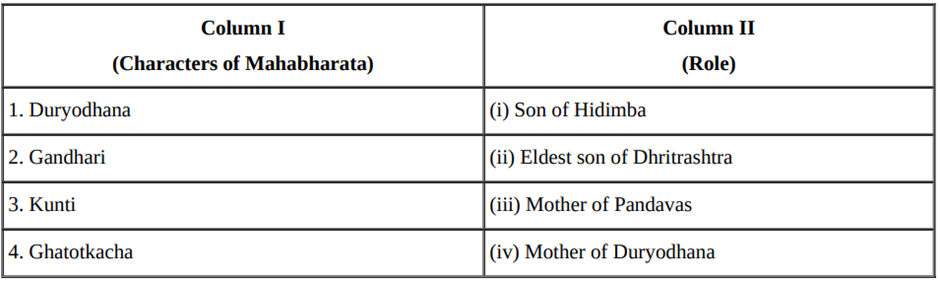
a) 1 – (ii), 2 – (iv), 3 – (iii), 4 – (i)
b) 1 – (ii), 2 – (i), 3 – (iv), 4 – (iii)
c) 1 – (iv), 2 – (iii), 3 – (ii), 4 – (i)
d) 1 – (ii), 2 – (i), 3 – (iii), 4 – (iv)
View AnswerAns. a) 1 – (ii), 2 – (iv), 3 – (iii), 4 – (i)
14. Female Figurines were known as
a) Altamira
b) Vestonice
c) Sahana
d) Venuses
View AnswerAns. d) Venuses
15. On the advice of ________, Gandhiji spent a year travelling around British India, getting to know the land and its peoples.
a) Naoroji
b) Nehru
c) Gokhale
d) Tilak
View AnswerAns. c) Gokhale
16. Who among the following was the President of the Constituent Assembly?
a) Mahatma Gandhi
b) Sardar Patel
c) Dr. Rajendra Prasad
d) Dr. B.R. Ambedkart
View AnswerAns. c) Dr. Rajendra Prasad
17. Which was the most important Chronicle written during Akbar’s reign gave the details of administration and agrarian society?
a) Alamgiri
b) Akbarnama
c) Ain-i-Akbari
d) Baburnama
View AnswerAns. c) Ain-i-Akbari
18. Choose the correct place from the given options: The round Persian Gulf seal found in ________ sometimes carries Harappan motifs
a) Oman
b) Kuwait
c) Bahrain
d) Qatar
View AnswerAns. c) Bahrain
19. Who Introduced Permanent Settlement in Bengal?\
a) Lord Curzon
b) Lord William Bentick
c) Lord Dalhousie
d) Lord Cornwallis
View AnswerAns. d) Lord Cornwallis
20. Read the following statements carefully and identify the most important settlement of the Vijayanagar Empire from the given options.
i. It was located in the south-western part of the settlement.
ii. It included over 60 temples.
a) Urban core
b) Mahanavami dibba
c) Royal Centre
d) Gopuram
View AnswerAns. c) Royal Centre
21. Which one of the following is the oldest dynasty?
a) Maurya
b) Kanva
c) Gupta
d) Kushana
View AnswerAns. a) Maurya
Section B
22. What do you know about the authors and the period when Mahabharata was compiled? Explain.
View AnswerAns. The Mahabharata was composed over a period of about 1000 years between 500 BCE and 400 CE. The original story of the Mahabharata was composed of charioteer bards popularly called Sutas. They generally accompanied the kshatriya warriors to the battle-field and composed poems celebrating their victories and other achievements.these compositions circulated orally. Then, from the 5th century BCE, the tradition of writing down the oral traditions started.
The various stages were:
i. Brahmanas began to unite its story from the 500 BCE.
ii. During this period, the chiefdoms of the Kurus and Panchalas were becoming kingdoms step by step.
iii. Between 200 BCE and 200 CE, the worship of Vishnu was becoming important.
iv. Krishna was one of the important figures of the Mahabharata and was coming to be identified with Vishnu between 200 C and 400 CE.
v. Between 200 and 400 CE, several didactic sections resembling the Manusmriti were added. This epic had about one lakh verses and this enormous composition is attributed to a sage named Vyasa.
OR
Explain any five elements considered by the historians while analyzing the texts.
View AnswerAns. While analysing a book or a literary source, the historians should keep different aspects in their mind such as follows:
i. They should examine in which language the book has been written. They should see if the book has been written in Pali, Prakrit or Tamil which were usually spoken by the people. They should also see if the book has been written in Sanskrit which was used by a particular section of the society.
ii. The historians also paid attention to the kind of text. They tried to analyse if the text contained mantras or the stories which could be read or heard by the people.
iii. The historians also wanted to know the authors whose views and perceptions gave a concrete shape to the text.
iv. The historians also examine the audience because every author keeps in mind the audience.
v. They also analyse the possible period of the creation of the book. Thus, every historian completely analyses the issues involved in the text. By examining the subject matter, he can recreate history. This task becomes all the more intricate and complicated in texts like Mahabharata.
23. Describe the results of India’s overseas trade under the Mughals.
View AnswerAns. The Mughal Empire was considered one of the largest territorial empires in Asia which consolidated power and resources during the 16th and 17th centuries. The political stability achieved by China, Iran and Turkey helped to created vibrant networks of overland trade from China to the Mediterranean Sea. Voyages of discovery and the opening up of the New World resulted in a large expansion of Asia’s, particularly India’s trade with Europe. An expanding trade brought in huge amounts of silver bullion to India which was good for India as it did not have natural resources of silver. In this period, there was remarkable stability in the availability of silver currency (Rupya) in India. It facilitated a large scale expansion of minting coins and circulation of money which helped Mughal state to extract taxes and revenue in cash.
24. Explain why did the Paharias of Rajmahal hills regularly raid the settled agriculturists on the plains during the 18th century.
View AnswerAns. With their base in the hills, the Paharias regularly raided the plains where settled agriculturists lived:
The raids were necessary for survival.
The zamindars in the plains paid them regular tribute and the traders paid a toll tax in order to use the passes controlled by them. Once the toll was paid, the Paharia chiefs protected the traders and ensured that their goods were not plundered by anyone.
Thus raids were a way of asserting power over settled communities; and they were a means of negotiating political relations with outsiders.
25. Why was the Revolt of 1857 specially widespread in Awadh? Explain.
View AnswerAns. The Revolt of 1857 was particularly widespread in Awadh due to several reasons:
The British annexed Awadh, wrongly assuming the Nawab was unpopular, but his departure caused widespread grief.
The annexation led to the dissolution of the court and its culture, affecting musicians, dancers, poets, and artisans.
Taluqdars, who had enjoyed autonomy and maintained armed retainers, were dispossessed, disarmed, and their forts destroyed.
The British land revenue policy further undermined their position, with many losing a significant number of villages.
Peasants’ grievances, including low wages, ill-treatment, and the issue of greased cartridges, were carried into the sepoy lines, as many sepoys were recruited from Awadh.
The problems faced by sepoys’ families were quickly transmitted to the sepoy lines. Thus, a chain of grievances linked peasants, sepoys, and common people, making the revolt in Awadh a significant expression of popular resistance.
26. Why was the ‘Mahanavami Dibba’ considered important for the people of Vijayanagara? Explain.
View AnswerAns. The Mahanavami Dibba was a symbol of Vijayanagara’s power and glory. It hosted the grand Mahanavami festival, showcasing the empire’s wealth, military prowess, and cultural splendor. The elaborate rituals and processions attracted people from far and wide, boosting the region’s economy. The Dibba thus served as a unifying and inspiring center for the people of Vijayanagara.
27. How were Harappa seals and sealings used to facilitate long distance communication? What did the sealings convey?
View AnswerAns. Harappa seals and sealings were used to facilitate long-distance communication as follows:
a. Imagine a bag of goods being sent from one place to another, its mouth was tied with a rope and on the knot was affixed some wet clay on which one or more seals were pressed, leaving an impression. If the bag reached, with its sealing intact, it meant that it had not tampered.
b. The sealing also conveyed the identity of the sender. Seals were used to make a sealing, or positive imprint, like this modern resin one made from the original seal.
Sealings were used in ancient times for trade. They would be made on ceramics or the clay tags used to seal the rope around bundles of goods.
OR
Who was R.E.M Wheeler? Mention any one of his contributions in the field of archaeology?
View AnswerAns. R.E.M Wheeler was the Director General of the Archaeological Survey of India in 1944. The following are his contributions in the field of archaeology:
He was the first person who recognised that it was necessary to follow the stratigraphy of the mound rather than dig mechanically along the uniform horizontal line.
It rectified the previous problems faced by the archaeologists.
Moreover, as an ex-army brigadier, he brought with him a military precision to the practice of archaeology.
28. Travellers who left written accounts were generally men who were interested in and sometimes intrigued by the condition of women in the subcontinent. Sometimes they took social inequities for granted as a natural state of affairs. Discuss about the condition of slaves and women in subcontinent.
View AnswerAns. Many travellers have written about the condition of slaves and women in their travel accounts. These are discussed below:
Slaves were openly sold in markets, like any other commodity, and were regularly exchanged as gifts. Ibn Battuta himself purchased horses, camels and slaves when he reached Sind, to gift to Sultan Muhammad bin Tughlaq. He gifted a slave along with horse, raisins and almonds to Multan’s Governor.
Muhammad bin Tughlaq was so happy with the sermon of a preacher named Nasiruddin that he gave him a hundred thousand tankas and two hundred slaves. He also kept his slaves to spy on his nobles. He also appointed female scavengèrs to whom slave girls communicate all the information they possess.
According to Ibn Battuta, there was considerable differentiation among slaves. Some female slaves in the service of the Sultan were experts in music and dance. They were generally used for domestic labour, and Ibn Battuta found their services very important for carrying women and men on palanquins or dola.
Price of female slaves required for domestic labour was very low, and most families who could afford to do so kept at least one or two of them.
Bernier described about the practice of sati and said that while some women embraced death cheerfully, others were forced to die.
In reality, there was much more that happened in women’s lives. For instance, their labour was crucial in both agricultural and non-agricultural production. Women from merchant families participated in commercial activities, sometimes even taking mercantile disputes to the court of law.
OR
The conception of social pollution intrinsic to the caste system was contrary to the law of nature. Examine AlBiruni’s statement on Indian caste system.
View AnswerAns. Al-Biruni wrote the voluminous text ‘Kitab-ul-Hind’ in which he elaborately discussed the social life of India. According to him, the conception of the pollution intrinsic to the caste system in India was contrary to the law of nature. Al-Biruni tried to explain the caste system by looking for parallels in other societies. He noted that in ancient Persia, four social categories were recognised. These were kings and princes; monks, fire-priests and lawyers; physicians, astronomers and other scientists and peasants and artisans. He further explained the following points to support the fact that social pollution intrinsic to the caste system was not unique in India.
i. Social Divisions not Unique to India In other words, he attempted to suggest that social divisions were not unique to India. The caste system existed in other parts of the world also. At the same time, he pointed out that within Islam all men were considered equal, differing only in their observance of piety (deep respect for God).
ii. Rejection of the Notion of Pollution In spite of his acceptance of the Brahmanical description of the caste system, Al-Biruni disapproved of the notion of pollution. He remarked that everything which falls into a state of impurity strives and succeeds in regaining its original condition of purity, e.g. the sun cleanses the air, and the salt in the sea prevents the water from becoming polluted. By explaining the phenomenon of this continuous change in nature.Al- Biruni tried to explain that in every society, everyone was continuously striving to gain the perfection and searching for the survival and the division of the caste system created a vast gap between rich and poor, upper and lower.
iii. The cycle of Purification Important for Life on Earth Al-Biruni believed that if there were no phenomenon of removing impurity, then life on Earth would have been impossible. Hence, the conception of social pollution intrinsic to the caste system, was according to him, contrary to the laws of nature.
Al-Biruni’s description of the caste system was deeply influenced by his study of normative Sanskrit texts, thus he described the caste system from the point of view of Brahmanas. But in real life, the caste system was not so rigid. The categories defined as Antyaja (means born outside the system) were often expected to provide inexpensive labour to both peasants and Zamindars. In other words, while they were often subjected to social oppression. They were included within economic networks.
29. Explain the main features of the Mauryan administration.
View AnswerAns. Features of Mauryan Administration:
i. Capital and provisional centres: There were five major political centres in the empire i.e. the capital Pataliputra and the provincial centres of Taxila, Ujjayini, Tosali, and Suvarnagiri, that are all mentioned in Asokan inscriptions.
ii. Due to the Vastness of the empire’s administrative system of this empire was not uniform. It is likely that administrative control was strongest in areas around the capital and the provincial centres. These centers were carefully chosen, both Taxila and Ujjayini being situated on important long-distance trade routes, while Suvarnagiri (literally, the golden mountain) was possibly important for tapping the gold mines of Karnataka.
iii. Structure of the military: Megasthenes mentions a committee with six subcommittees for coordinating military activity. Of these, one looked after the navy, the second managed to transport and provisions, the third was responsible for foot-soldiers, the fourth for horses, the fifth for chariots and the sixth for elephants. The activities of the second subcommittee were rather varied-arranging for bullock carts to carry equipment, and recruiting servants and artisans to look after the soldiers.
iv. Dhamma: Ashoka was the first ruler who inscribed his messages to his subjects and officials on stone surfaces- natural rocks as well as polished pillars. He tried to hold his empire together by propagating Dhamma, the principles of which were simple and virtually universally applicable. This, according to him, would ensure the well-being of people in this world and the next. Special officers, known as the Dhamma Mahamatta, were appointed to spread the message of Dhamma.
OR
What does Asokan inscriptions tell about the Mauryas? Describe the limitations of the inscriptional evidences.
View AnswerAns. Asoka was the first ruler who inscribed his messages on stone surfaces i.e. natural rocks and polished pillars. The major rock edicts explain the Mauryans’ administration, especially about Asoka.
Some of the important inscriptions are discussed:
i. The Ashokan inscriptions give us a lot of information about the Mauryas. Mauryan kings engraved their orders and doctrines on rocks and stones.
ii. The inscriptions were written in Pali and Sanskrit so that common person can easily understand. In northwestern parts of the subcontinent, the inscription was in the Kharoshti script. Thus, the local languages of the people were valued.
iii. Ashoka proclaimed the principle of dhamma according to which included respect towards elders, generosity towards Brahmanas and those who renounced worldly life, treating slaves and servants kindly, and respect for religions and traditions other than one’s own.
Limitations of inscriptional evidence are:
i. Technical Limitations: Sometimes letters are very faintly engraved and thus doubts arise for inscriptions may be damaged or letters missing.
ii. Damaged or Missing letters: Sometimes important letters are damaged or missing in the inscription. It makes the work for epigraphists more difficult.
iii. Lack of Clarity: It is not always easy to be sure about the exact meaning of the words used in the inscriptions, some of which may be specific to a particular place or time. So, scholars are constantly debating on alternative ways to read inscriptions.
iv. Undeciphered Inscriptions: Thousands of inscriptions have been discovered, but not all have been deciphered, published and translated. Many inscriptions were destroyed and what we have today, probably a fraction of it.
v. Non-relevance of Inscriptions: Inscriptions were composed in praise of kings and patrons in general. Not everything that is economically or politically important was recorded in the inscriptions, e.g. routine agricultural practice, the joys, and sorrow of common man were not mentioned in the inscriptions. Thus, it is difficult for the epigraphists to give the complete picture of society by relying on inscriptions only.
30. There are different kinds of sources that historians use in reconstructing the career of Mahatma Gandhi and of the social movements that he associated with. Elucidate the statement with suitable examples.
View AnswerAns. Historians use different kinds of sources in reconstructing the career of Mahatma Gandhi and of the social movements that he associated with. The different kinds of sources from which we can reconstruct the political career of Gandhiji and the history of the nationalist movement are:
Public voice and private scripts: Important sources of the writings and speeches of Mahatma Gandhi and his contemporaries, including both his associates and his political adversaries. Speeches, for instance, allow us to hear the public voice of an individual, while private letters give us a glimpse of his or her private thoughts. Mahatma Gandhi regularly published in his journal, ‘Harijan’, letters that others wrote to him. Nehru edited a collection of letters written to him during the national movement and published ‘A Bunch of Old Letters’.
Framing a picture: Autobiographics similarly give us an account of the past that is often rich in human detail. But these are retrospective accounts written very often from memory. They tell us what the author could recollect and thought as important to write and be viewed by others.
Through police eyes: Another vital source is government records. The letters and reports written by policemen and other officials were secret at the time, but now can be accessed in archives. For instance, the fortnightly reports that were prepared by the Home epartment from the early twentieth century. These reports were based on police information from the localities, but often expressed what the higher officials saw, or wanted to believe. The march was seen as a an antic, a desperate effort to mobilise people who were unwilling to rise against the British and pleased with the British Raj.
From newspapers: One more important source is contemporary newspapers, published in English as well as in the different Indian languages, which tracked Mahatma Gandhi’s movements and reported on his activities, and also represented what the people thought of hin. However, newspaper accounts can too be prejudiced politically. The accounts that were published in a London newspaper would be different from the report in an Indian nationalist paper.
OR
Historians have used different kinds of sources in reconstructing the political career of Gandhiji and the history of social and nationalist movements. Substantiate the statement with examples.
View AnswerAns. Historians utilize various sources to reconstruct Mahatma Gandhi’s political career and the broader context of social and nationalist movements in India.
i. Primary Sources: Gandhi’s own writings, such as Hind Swaraj and The Story of My Experiments with Truth, provide insight into his philosophy of non-violence and civil disobedience.
ii. Government Records: Official correspondence and reports from the British colonial administration reveal how Gandhi’s actions were perceived, particularly during the Non-Cooperation Movement and the Salt March.
iii. Newspapers: Publications like Young India and The Hindustan Times capture public sentiment and the political climate, offering commentary on Gandhi’s campaigns.
iv. Oral Histories: Interviews with freedom fighters and contemporaries provide personal anecdotes about Gandhi’s influence, highlighting grassroots perspectives on his leadership.
Section D
31. Read the given source carefully and answer the questions that follow:
What the silk weavers did Here is an excerpt from the inscription, which is in Sanskrit: Some are intensely attached to music (so) pleasing to the ear; others, being proud of (the authorship of ) a hundred excellent biographies, are conversant with wonderful tales; (others), filled with humility, are absorbed in excellent religious discourses; … some excel in their own religious rites; likewise by others, who were selfpossessed, the science of (Vedic) astronomy was mastered.
i. How was love for music expressed in the inscription?
View AnswerAns. It was pleasing to the ear, and attachment to music.
ii. How did individuals demonstrate their mastery in the science of Vedic astronomy?
View AnswerAns. Through self-possession, the science of (Vedic) astronomy was mastered.
iii. In what ways did the various talents mentioned in the inscription contribute to the overall fabric of society?
View AnswerAns. Development of different skills.
Development of different occupations.
The intermixture of tradition/culture
Promoting a sense of tolerance and harmony
Development of the social values.
Mastery of Vedic astronomy contributed to the advancement of science and timekeeping, essential for agricultural and religious practices.
32. Read the following text carefully and answer the questions that follow: Declining a royal gift
This excerpt from a Sufi text describes the proceedings at Shaikh Nizamuddin Auliya’s hospice in 1313: I (the author, Amir Hasan Sijzi) had the good fortune of kissing his (Shaikh Nizamuddin Auliya’s) feet … At this time a local ruler had sent him the deed of ownership to two gardens and much land along with the provisions and tools for their maintenance. The ruler had also made it clear that he was relinquishing all his rights to both the gardens and land. The master … had not accepted that gift. Instead, he had lamented: ‘What have I to do with gardens and fields and lands? … None of… our spiritual masters had engaged in such activity.” Then he told an appropriate story: “… Sultan Ghiyasuddin, who at that time was still known as Ulugh Khan, came to visit Shaikh Fariduddin (and) offered some money and ownership deeds for four villages to the Shaikh, the money being for the benefit of the dervishes (Sufis), and the land for his use. Smiling, Shaikh al Islam (Fariduddin) said: ‘Give me the money’. I will dispense it to the dervishes. But as for those land deeds, keep them. There are many who long for them. Give them away to such persons.”
i. What did the local ruler send to Shaikh Nizamuddin Auliya and why? Explain.
View AnswerAns. The local ruler sent to Shaikh Nizamuddin Auliya the deed of ownership to two gardens and much land along with the provisions and tools for their maintenance. The ruler sent it to Shaikh to make it clear that he was relinquishing all his rights to both the gardens and land.
ii. What did Ulugh Khan offer to Shaikh Fariduddin when he visited him?
View AnswerAns. Ulugh Khan when visited the shaikh. He offered some money and ownership deeds for four villages when he visited Shaikh.
iii. Why did Nizamuddin Auliya refuse to accept the offer of Amir Hasan Sijzi and what did he say to him?
View AnswerAns. Nizamuddin Auliya refused to accept the offer as those things had no place in spiritualism. The Masters did not engage in those earthly activities. Spirituality has no relation to worldly pleasures and things. It is totally a devotional way to connect with gods. Thus, he refused all the gifts of Ulugh Khan.
33. Read the following text carefully and answer the questions that follow:
We have never asked for privileges Hansa Mehta of Bombay demanded justice for women, not reserved seats, or separate electorates. We have never asked for privileges. What we have asked for is social justice, economic justice, and political justice. We have asked for that equality which alone can be the basis of mutual respect and understanding, without which real cooperation is not possible between man and woman.
i. How can women be empowered economically?
View AnswerAns. a. By equal right to property and access to education to hold jobs to empower them economically.
b. Equal opportunities for jobs and equal pay.
ii. What could be the basis of mutual respect among men and women?
View AnswerAns. a. Equality and cooperation between genders.
b. Women being treated at par with men.
iii. Why did Hansa Mehta not demand separate electorate for women?
View AnswerAns. a. Hansa Mehta did not demand reserved seats and separate electorates for women because she realised not only would it be divisive in nature but create resentment.
b. She did not went privileges for women but to empower them by their own efforts.
c. The saying goes not to give them fish but should teach them to catch the fish so that they could become self-sufficient and not dependent.
Section E
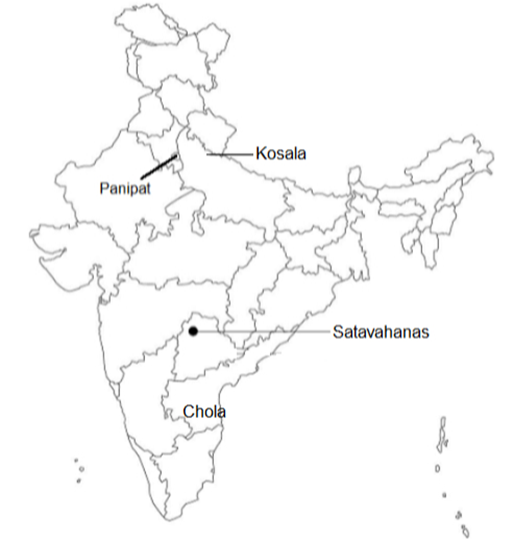
34. i. On the given political outline map of India, locate and label the following:
a. Satavahanas, Important kingdoms and towns
b. Kosala, a Mahajanapada
c. Chola Kingdom
OR
Panipat, a Mughal territory
View AnswerAns.
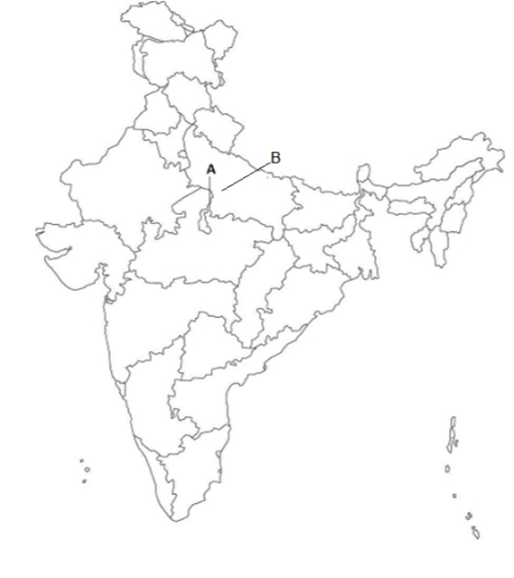
ii. On the same outline map, two places have been marked as A and B which are under the Revolt of 1857. Identify them and write their correct names.
View AnswerAns. A – Jhansi
B – Kanpur