Class XII Session 2025-26
Subject – History
Time Allowed: 3 hours Maximum Marks: 70
General Instructions:
1. Question paper comprises five Sections – A, B, C, D and E. There are 34 questions in the question paper. All questions are compulsory.
2. Section A – Question 1 to 21 are MCQs of 1 mark each.
3. Section B – Question no. 22 to 27 are Short Answer Type Questions, carrying 3 marks each. The answer to each question should not exceed 60-80 words.
4. Section C – Question no 28 to 30 are Long Answer Type Questions, carrying 8 marks each. The answer to each question should not exceed 300-350 words
5. Section D – Question no.31 to 33 are Source based questions with three sub-questions and are of 4 marks each
6. Section-E – Question no. 34 is Map based, carrying 5 marks that include the identification and location of significant test items. Attach the map with the answer book.
7. There is no overall choice in the question paper. However, an internal choice has been provided in a few questions. Only one of the choices in such questions has to be attempted.
8. In addition, separate instructions are given with each section and question, wherever necessary.
Section A
1. Who led the revolt at Kanpur?
a) Nana Saheb
b) Bahadur Shah
c) Maulavi Ahmadulla Shah
d) Shah Mai
View AnswerAns. a) Nana Saheb
2. Who among the following proposed a Policy of Pacification with the Paharias in 1770 in Bhagalpur?
a) Augustus Cleveland
b) George Chinray
c) Captain Cook
d) William Hodge
View AnswerAns. a) Augustus Cleveland
3. Which one of the following texts contains the teachings of Mahavira or Jaina Philosophy?
a) Dipavamsa
b) Sutta Pitaka
c) Uttaradhyayana Sutta
d) Mahavamsa
View AnswerAns. c) Uttaradhyayana Sutta
4. Identify the ancient dynasty with the help of the following information:
They issued spectacular gold coins. Their history can be reconstructed through Prashastis. Harisena was the court poet of one of its rulers.
a) Kushana dynasty
b) Gupta dynasty
c) Chola dynasty
d) Satavahana dynasty
View AnswerAns. b) Gupta dynasty
5. One of the most important chronicles was the ________ authored by Akbar’s court historian Abu’l Fazl.
a) Babarnama
b) Akbarnama
c) Ain-i Akbari
d) Rihla
View AnswerAns. c) Ain-i Akbari
6. Consider the following statements regarding the Virupaksha temple:
i. The Virupaksha temple was built over centuries while inscriptions suggest that the earliest shrine dated to the ninth-tenth centuries, it was substantially enlarged with the establishment of the Vijayanagara Empire.
ii. The hall in front of the main shrine was built by Krishnadeva Raya to mark his accession which was decorated with delicately carved pillars.
iii. The halls in the temple were used for a variety of purposes like some were spaces in which the images of gods were placed to witness special programmes of music, dance, drama, etc.
Which of the following statement(s) is/are correct?
a) All of these
b) i and iii
c) Only i
d) i and ii
View AnswerAns. a) All of these
7. Assertion (A): There were instances of conflict between the Sultans and the Sufi. Reason (R): Both wanted specific rituals, like prostration and foot kissing, to be performed in order to demonstrate their authority.
a) Both A and R are true and R is the correct explanation of A.
b) Both A and R are true but R is not the correct explanation of A.
c) A is true but R is false.
d) A is false but R is true.
View AnswerAns. a) Both A and R are true and R is the correct explanation of A.
8. Identify a poet-saint from the given information.
He emerged as a prominent figure in the fourteenth to fifteenth centuries. His life and times have been reconstructed through his attributed compositions and later hagiographies
a) Tulsidas
b) Kabir
c) Kalidas
d) Ramanuja
View AnswerAns. b) Kabir
9. At which of the following places the mutiny broke out on 10th day of May 1857?
a) Lucknow
b) Delhi
c) Barrackpore
d) Meerut Cantt
View AnswerAns. d) Meerut Cantt
10. Consider the following statements regarding the discovery of Hampi:
i. The ruins at Hampi were brought to light in 1800 by an engineer and antiquarian named Colonel Colin Mackenzie.
ii. As early as 1836 epigraphists began collecting several dozen inscriptions found at this and other temples at Hampi.
iii. In an effort to reconstruct the history of the city and the empire, historians collated information from these sources with accounts of foreign travellers and other literature written in Telugu, Kannada, Tamil and Sanskrit.
Which of the following statement(s) is/are correct?
a) i and ii
b) Only i
c) All of these
d) i and iii
View AnswerAns. c) All of these
11. Identify the given image of ancient temple from the given options:
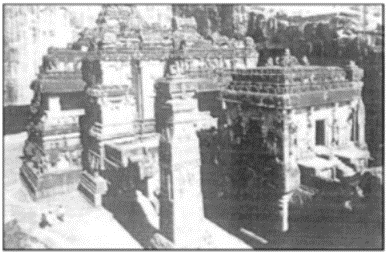
a) Mahabalipuram Temple
b) Kailashnath Temple
c) Brihedeshwara Temple
d) Deogarh Temple
View AnswerAns. b) Kailashnath Temple
12. Who among the following demanded justice for women in the Constituent Assembly?
a) Jaipal Singh
b) Hansa Mehta
c) T.A. Ramalingam Chettiar
d) H.J. Khandekar
View AnswerAns. b) Hansa Mehta
13. With reference to the terms for family and kin, match Column B with Column A, by using the codes given below.
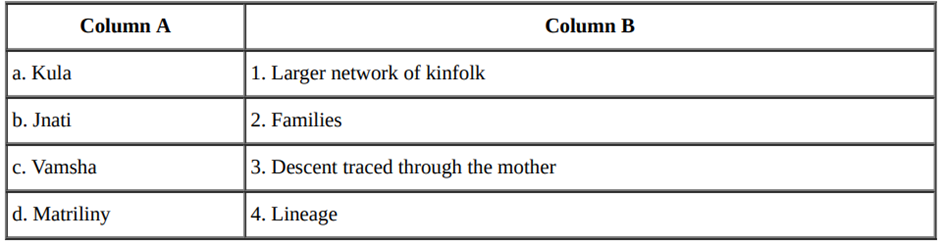
a) 4, 3, 2, 1
b) 3, 1, 4, 2
c) 2, 1, 4, 3
d) 3, 4, 1, 2
View AnswerAns. c) 2, 1, 4, 3
14. Who among the following wrote It seems to me a suicidal and indefensible policy to allow the country to be looted of original works of ancient art?
a) Walter Elliot
b) H.H. Cole
c) James Fergusson
d) John Marshall
View AnswerAns. b) H.H. Cole
15. In the end of December 1929, the Congress held its annual session in the city of Lahore. The meeting was significant for two things: the election of ________ as President, signifying the passing of the baton of leadership to the younger generation; and the proclamation of commitment to “Purna Swaraj”, or complete independence.
a) Subhash Chandra Bose
b) Moti Lal Nehru
c) Bal Gangadhar Tilak
d) Jawaharlal Nehru
View AnswerAns. d) Jawaharlal Nehru
16. Who represented Tribals in the Constituent Assembly?
a) Jaipal Singh
b) NG Ranga
c) BR Ambedkar
d) Buddhu Bhagat
View AnswerAns. a) Jaipal Singh
17. Which of the following crops were considered as jins-i kamil in the Mughal Empire?
a) Rice and Wheat
b) Maize and Bajra
c) Cotton and Sugarcane
d) Chillies and Potatoes-
View AnswerAns. c) Cotton and Sugarcane
18. The Harappan site of ________ is located in present day Rajasthan.
a) Rakhigarhi
b) Lothal
c) Manda
d) Kalibangan
View AnswerAns. d) Kalibangan
19. What was the source of cotton after American Civil War break out?
a) Africa
b) Australia
c) Sri Lanka
d) India
View AnswerAns. d) India
20. Identify the person with the help of following information: He was a famous engineer, surveyor and cartographer. He was appointed the first Surveyor General of India in 1815.
a) Colin Mackenzie
b) John Marshall
c) Alexander Greenlaw
d) R.E.M. Wheeler
View AnswerAns. a) Colin Mackenzie
21. Not all families are identical. Which of the following is/are the distinguishing feature(s)?
a) Number of members
b) All of these
c) Kind of activities they indulge in
d) Their relationship with one another varies
View AnswerAns. b) All of these
Section B
22. In what ways was the Buddhist theory of a social contract different from the Brahmanical view of the society derived from the Purusha Sukta?
View AnswerAns. i. According to the Brahmans, society was based on the four-fold caste system. The Brahmans ranked at the top of the social order and the Sudras and untouchables at the bottom. They followed texts like Manusmriti etc.
ii. This division was divinely ordained as the four social categories were supposed to have come from the body of Purusha.brahmanas from the head, kshatriya from arms, vaishyas from thigh and Sudras from the foot. This division could not be changed nor the position of the Brahmans or Kshatriyas challenged.
iii. . According to Sutta Pitaka, humans initially lived in a state of contentment, happy with their lot and taking from nature only what they needed.
iv. Sutta Pitaka suggested that originally human beings did not have fully evolved bodily forms nor were the world of plants fully developed .all things lived in an idyllic state of peace
OR
Explain, why we call Mahabharata a Dynamic Text.
View AnswerAns. Mahabharata is a dynamic text and it contains a vivid description of battles, forests, palaces, and settlements. It was originally written in Sanskrit. The growth of Mahabharata did not stop with the Sanskrit version. Over the centuries, versions of epic were written in a variety of languages. Today it is available in various languages. It depicts an on-going dialogue between the people and communities between hand and on another hand with those who wrote the texts. Several stories originated in the specific regions that have been incorporated in it, thus, it becomes a big epical text. The main story of the novel has been narrated in different ways. episodes have depicted in the painting and sculptures. They also provided themes for a wide range of performing arts- play, dance and other kinds of narration.
23. Discuss briefly about jajmani system.
View AnswerAns. It was a system where artisans and individual peasant households entered into a mutually negotiated system of remuneration, most of the time goods for services. For example, eighteenth century records suggested that zamindars in Bengal payed blacksmiths, carpenters, goldsmiths for their work by paying them a small daily allowance and diet money. The term jajmani was not popular during sixteenth and seventeenth centuries.
24. Why was the permanent settlement of land revenue rarely extended to any region beyond Bengal? Give two reasons.
View AnswerAns. The permanent settlement of land revenue rarely extended to any region beyond Bengal because:
i. The increased price of agriculture products made the landlord’s income high. But it also made no change in income of East India company. Thus, the colonial government wanted to maximise its land revenue by introducing temporary revenue settlements instead of permanent settlements.
ii. When British officials devised permanent settlements, they were influenced by the economic theories at that time. But on a view of economist Ricardo, it stated that it needed to tax the surplus agricultural produce to enhance its revenue. So the British officials thought that permanent settlement was not a proper method to collect the tax.
25. Discuss Summary Settlement. What was its impact?
View AnswerAns. The British introduced a land revenue policy known as Summary Settlement in 1856 . It was believed that the taluqdars had established their hold over land through force and fraud with no permanent stakes in land. The Summary Settlement proceeded to remove the taluqdars wherever possible.
The result was the taluqdars who hold 67 % of the total number of villages in Awadh in pre-British times had come down to 38 % after the Summary Settlement. The taluqdars of Southern Awadh was the hardest hit and some lost more than half of the total number of villages they held previously.
26. Discuss the features of Hazara Rama Temple. What happened to different buildings after Vijayanagara kings?
View AnswerAns. Hazara Rama Temple is one of the most beautiful temples of the Vijayanagara Empire. It was constructed by Krishnadeva Raya at Hampi in 1520. This was probably meant to be used only by the king and his family. It was constructed by using both bricks and stones. The temple was divided into various sections like Garvagriha, Mandapas, Vimana etc. All are stones curved and impressive. The hall was full of pillars as a base, as depicting the scenes of Ramayana are engraved on the wall and pillars. The scene related to Mahanavami were also engraved on the outer wall of the Temple. When the Vijayanagara city was looted and destroyed, many of the structures or buildings were destroyed. Later, the practice of building large structures were continued by the nayakas. Now many of these buildings have survived.
27. Describe briefly how the centres of craft production are identified.
View AnswerAns. These can be understood through following points:
i. In order to identify centres of craft production, archaeologists usually look for the raw materials, like stone nodules, whole shells, copper ore, unfinished objects, rejected and waste materials.
ii. Both Nageshwar and Balakot are near coast and shell objects are found here. These areas were specialised centre for making shell objects, including bangles, ladles and inlay, which were taken to other settlement.
iii. Similarly, some finished products like different pots and beads are found in Lothal and Chanhudaro, which were taken to the large urban centres such as Mohenjodaro and Harappa.
iv. For making beads, stones like carnelian, jasper, crystal, quartz, steatite and metals like copper, bronze, gold, and other materials like shell, faience, terracotta were used. For making beads, grinding, polishing and drilling were done.
v. In order to identify the craft production centre, archaeologists look for raw materials and tools. Large waste pieces of raw materials indicated the specialised craft production centres.
OR
Discuss the terms Places and Times of Harappan culture.
View AnswerAns. The Indus valley civilisation is also called the Harappan culture. Archaeologists use the term culture for a group of objects, distinctive in style, that are usually found together within a specific geographical area and period of time. In the case of the Harappan culture, these distinctive objects include seals, beads, weights, stone blades and even baked bricks. These objects were found from areas as far apart as Afghanistan, Jammu, Baluchistan (Pakistan) and Gujarat. Named after Harappa the first site where this unique culture was discovered, the civilisation is dated between C. 2600 and 1900 BCE. There were earlier and later cultures often called Early Harappan and Late Harappan, in the same area. The Harappan civilisation is sometimes called the Mature Harappan culture to distinguish it from these cultures.
Section C
28. Examine Bernier’s perceptions about ownership of landed property in Mughal India.
View AnswerAns. Francois Bernier, a Frenchman, was a doctor, political philosopher and historian. Like many others, he came to the Mughal Empire in search of opportunities. Bernier travelled to several parts of the country and wrote an account of what he saw, frequently comparing what he saw in India with the situation in Europe.
The question of land ownership or landed property:
i. According to Bernier, one of the fundamental differences between Mughal India and Europe was the lack of private property in land in the former. He was a firm believer in the virtues of private property and saw crown ownership of land as being harmful to both the state and its people. As an extension of this, Bernier described Indian society as consisting of undifferentiated masses of impoverished people, subjugated by a small minority of a very rich and powerful ruling class.
ii. Bernier’s descriptions influenced Western theorists from the eighteenth century onwards. The French philosopher Montesquieu, for instance, used this account to develop the idea of oriental despotism, according to which rulers in Asia (the Orient or the East) enjoyed absolute authority over their subjects, who were kept in conditions of subjugation and poverty, arguing that all land belonged to the king and that private property was non-existent. As in the case of the question of landownership, Bernier was drawing an oversimplified picture. There were all kinds of towns: manufacturing towns, trading towns, port towns, sacred centres, pilgrimage towns, etc.
OR
Discuss the extent to which Bernier’s accounts enables historians to reconstruct contemporary rural society.
View AnswerAns. Bernier’s assessment of Indian rural society was not correct. It was far away from the truth, but it is not acceptable. There is some truth in his description which is evident from the following facts.
i. According to his account, the Mughal empire was the owner of the land and distributed among its nobles. It had a disastrous impact on society.
ii. According to him the system of a crown of ownership of land was not good. It was because the landholders could not pass on their land to their children. They did not make any long-term investment on the land.
iii. As there was no private property in land, there was not any improvement in the landlord class. This system ruins agriculture and led to the opinion of peasants.
iv. Peasants didn’t work because of the bad treatment received by the higher authorities.
Bernier’s view regarding Indian society had the following features:
i. The rich people were in the minority.
ii. It had the poorest of the poor and the richest of the rich, no middle class existed there.
iii. Bernier considered the Mughal emperor as the king of Beggars and Barbarians. All the cities and towns were ruined and had contaminated with polluted air. All the fields were covered with bushes and unwanted plants. It means the Mughal empire was at the verge of decline and the King exploited the subjects. Crown ownership was the root cause of all these happenings.
29. Discuss the causes of the decline of the Gupta Empire.
View AnswerAns. The following causes were responsible for the downfall of Gupta dynasty:
i. Weak successors: There was no other strong successor in the Gupta dynasty to manage the vast empire after Samudragupta. Hence, as soon as the central power got weakened, many independent kingdoms were established.
ii. Lack of any law of succession: There was no definite law of succession during the Gupta reign. Hence, as soon as some king died, the situation got so tense as in the civil war. Whosoever was mighty managed to become the ruler. ‘Might is Right’ was the order of the day. War had become inevitable to ascend the throne.
iii. Negligence of frontiers: No other ruler made any arrangements for the defence of the frontiers after Chandragupta-II. Hence the doors for the foreign invaders were always open.
iv. Effects of Buddhism: The principle of non-violence crippled military power. Hence, those Gupta rulers whoever adopted Buddhism had invited the enemies to their empire indirectly.
v. Vast Empire: Keeping in view the vast empire, it was quite essential to have able administrators. But the rulers were now weak and incapable. They were incompetent to bear the burden of the administration.
vi. Military weakness: Now the rulers no longer paid attention to the military discipline and re-organization.
vii. The Hunas’ invasions: The invasions of the Hunas broke the backbones of the Gupta empire. Lawlessness and disorder became rampant all over.
viii. Internal revolts: The rebellions became a common feature in the event of the weakness of the central power which could not be quelled by the incompetent rulers. Hence, they sought independence.
OR
Discuss the development of new technologies in agriculture in the Indian sub-continent from the 6th century BCE to 400 A.D.
View AnswerAns. Following are the development of new technologies in agriculture in the Indian sub-continent from the 6th century BCE to 400 A.D:
i. Agriculture in the subcontinent has a long and richly diverse history, evident in the archaeological record. From the sixth century BCE, we can trace certain developments that had a long-term significance in some parts of the subcontinent. One was the growing spread of plough agriculture in fertile alluvial river valleys such as those of the Ganga and the Kaveri.
ii. The iron-tipped ploughshare, in particular, led to a growth in productivity as it allowed the farmer to turn the soil very effectively.
iii. The production of paddy was dramatically increased by the introduction of transplantation in some parts of the Ganga Valley. Transplantation is a process used for paddy cultivation in areas where water is plentifully available. Here, seeds are the first broadcast; when the saplings have grown they are transplanted in waterlogged fields. This ensures the survival of many more plants and higher yields.
iv. During the first millennium, CE plough agriculture spread to other parts of the subcontinent as well. It is, however, important to remember that plough agriculture was no uniformly or automatically beneficial. It was not suited to hilly terrains and was most effective in alluvial soils.
v. Another strategy adopted to increase agricultural production was the use of irrigation, using wells and tanks, and less commonly, canals. Construction was organised by communities as well as by individuals. The latter, usually powerful men including kings often recorded such activities in inscriptions.
vi. Historians had tried to find out some new aspects of agricultural technology through tools and texts. For instance, in some cases, archaeologists find iron agricultural tools in an excavations-an obvious indication that new technologies were being adopted. But what about transplantation? Here historians depend on vivid descriptions of agricultural activities in Buddhist texts.
30. Examine the reasons and outcomes of the Salt Satyagraha.
View AnswerAns. Salt-Satyagraha: Background
Gandhiji concentrated on his social reform activities for many months following the Non-Cooperation Movement (1920- 22). In 1928, though, he began to consider returning to politics.
An all-India movement was launched at that time to oppose the all-White Simon Commission, ]dispatched from England to explore constitutional amendments and give suggestions to the administration.
Gandhiji chose not to participate in this struggle, but he did give his endorsement, as he did with a farmer’s satyagraha in Bardoli in 1928 (Bardoli Satyagraha).
The Congress met in Lahore at the end of December 1929 for its annual session.
The appointment of Jawaharlal Nehru as President signaled the handover of power to the next generation and the declaration of adherence to “Purna Swaraj,” or complete freedom.
“Independence Day” was marked on January 26, 1930, including the national flag being displayed in various locations and nationalist tunes being performed.
Gandhiji gave specific directions on how the occasion would be commemorated.
The Congress Working Committee (CWC) was permitted by the Lahore Congress in 1929 to undertake a campaign of civil disobedience, notably non-payment of taxes.
The CWC meeting at Sabarmati Ashram in February 1930 gave Gandhiji the authority to initiate the Civil Disobedience Campaign at any moment and location he wanted.
Gandhiji’s deadline to the Viceroy of India, Lord Irwin (1926-31), in which he stated that the minimal demands had been neglected and that the only alternative option forward was civil disobedience.
Salt Satyagraha: Consequences
On 2nd March 1930, Lord Irwin was informed about the Salt March by Gandhi.
On 12th March 1930, he lead a group of people from Sabarmati Ashram. He decided to walk through the villages of Gujarat.
The March started with 80 people but as the March went on more than 50,000 people joined Gandhi in the protest.
When the group of people reached the coastal Village of Dandi on 6th April 1930, Gandhi made salt from seawater breaking the salt act against the government.
Throughout the protest, the people in March were strictly instructed to not get involved in any kind of violence.
Gandhi addressed the crowd and gave a speech against the government.
Salt-Satyagraha: Outcome
The twenty-four-day-long civil disobedience movement led to the Gandhi-Irwin Pact which favored the Indian freedom struggle. In the pact it was decided that civil disobedience would be ended by Indians, the salt will be allowed for domestic use for everyone, the arrested Indians for breaking the salt law were released and Gandhi was allowed to attend the second round table conference.
OR
The Non-Cooperation Movement was one of Gandhiji’s first organized acts of large scale Satyagraha for Swaraj. Explain the statement with suitable examples.
View AnswerAns. The Non-Cooperation Movement was one of Gandhiji’s first organized acts of large-scale Satyagraha for Swaraj because according to Gandhiji if noncooperation was effectively carried out, India would win swaraj within a year. Following are the events that this movement involved.
Emboldened by the success of Rowlatt Satyagraha Gandhiji called for a campaign of Non-Cooperation with British Rule. Gandhiji coupled Non-Cooperation with Khilafat and adjoined Hindus and Muslims to end colonial rule.
These movements unleashed a surge of popular action that was altogether unprecedented in colonial India. Indians did not cooperate with the government at any level.
Boycott of schools, college, and law courts. The working class went on strike. National schools, and colleges were opened.
Non-payment of taxes by farmers of Awadh and peasants in Kumaun refused to carry loads for colonial officials.
Renunciation of titles and voluntary association with the government. The movement entailed denial, renunciation and self-discipline. It was training for and t was training for self-rule.
Gandhiji encouraged the communication of the nationalist message in the mother tongue, rather than in the language of the rulers, English.
This movement changed the course of Indian history. Poor peasants, workers, artisans, students, lawyers and industrialists joined the movement. Indian entrepreneurs were quick to recognise that, in a free India, the favours enjoyed by their British competitors would come to an end.
Gandhiji promoted home-spun cloth (khadi) because on the economic front Indians had to learn to become self-reliant – hence his stress on the significance of wearing khadi rather than mill-made cloth imported from overseas.
Section D
31. Read the following text carefully and answer the questions that follow: Verses from the Upanishads Here are two verses from the Chhandogya Upanishad, a text composed in Sanskrit c. sixth century BCE: The nature of the self This self of mine within the heart is smaller than paddy or barley or mustard or millet or the kernel of a seed of millet. This self of mine within the heart is greater than the earth, greater than the intermediate space, greater than heaven, greater than these worlds. The true sacrifice This one (the wind) that blows, this is surely a sacrifice… While moving, it sanctifies all this; therefore, it is indeed a sacrifice.
i. When were the above-given verses composed?
View AnswerAns. The above given verses in excerpt were composed in 6th century BCE.
ii. What is the source of these verses?
View AnswerAns. The source of these verses was Chhandogya Upanishad.
iii. What ideology is given in the Upanishads?
View AnswerAns. The ideology of Upanishads was the rebirth of human depended on his deeds. Human was always searched for ultimate reality which can be attained by following Upanishad.
32. Read the following text carefully and answer the questions that follow: Shastras or devotion? This is a verse composed by Appar, a Nayanar saint: O rogues who quote the law books, Of what use are your gotra and kula? Just bow to Marperu’s lord (Shiva who resides in Marperu, in Thanjavur, Tamil Nadu) as your sole refuge.
i. What do you know about Appar?
View AnswerAns. Appar was born in the middle of the 7th century to Thiru Pukalanar and Mathiniyar as their second child in a village called Thiruvamur in Tamil Nadu. It is believed that Appar was relieved of his pain instantly. Understanding the extent of Lord Shiva’s power. He started visiting other Shiva temples. Appar sanctified all these temples by his verses and was also involved in the cleaning of the dilapidated temples.
ii. Name the book in which his teachings were compiled.
View AnswerAns. Appar teachings are compiled in a book named Tevaram.
iii. Do you notice any similarities between Appar and Tondaradippodi towards Brahamans.
View AnswerAns. Both of them opposed the domination of Brahmins in society. The Brahmins were the ultimate power and regulate the socioreligious norms. They hated the lower caste people and treated them very badly. Both Appar and Tondaradippodi opposed these phenomena. According to them, all are equal and should be treated equally.
33. Read the following text carefully and answer the questions that follow: Ambedkar on separate electorates In response to Mahatma Gandhi’s opposition to the demand for separate electorates for the Depressed Classes, Ambedkar wrote: Here is a class that is undoubtedly not in a position to sustain itself in the struggle for existence. The religion, to which they are tied, instead of providing them with an honourable place, brands them as lepers, not fit for ordinary intercourse. Economically, it is a class entirely dependent upon the high-caste Hindus for earning its daily bread with no independent way of living open to it. Nor are all ways closed by reason of the social prejudices of the Hindus but there is a definite attempt all through our Hindu Society to bolt every possible door so as not to allow the Depressed Classes any opportunity to rise in the scale of life. In these circumstances, it would be granted by all fair-minded persons that as the only path for a community so handicapped to succeed in the struggle for life against organised tyranny, some share of political power in order that it may protect itself is a paramount necessity….
i. Examine the arguments given in favour of separate electorates for depressed classes, by Dr. Ambedkar and give your reactions.
View AnswerAns. Dr. Ambedkar felt that separate electorates were essential to protect the depressed classes from the tyranny of the upper castes and give them much needed social status.
ii. Describe the position of economically depressed classes.
View AnswerAns. Society used the labour and services of the depressed classes but kept them at a social distance. They were not allowed entry into temples. Intermixing and inter-dining with other castes was not allowed. They had no access to education.
iii. Suggest some other ways to provide an honourable position to depressed classes.
View AnswerAns. Education should be made free for them so that they can compete equally with other castes. They should be given access to public places.
Section E
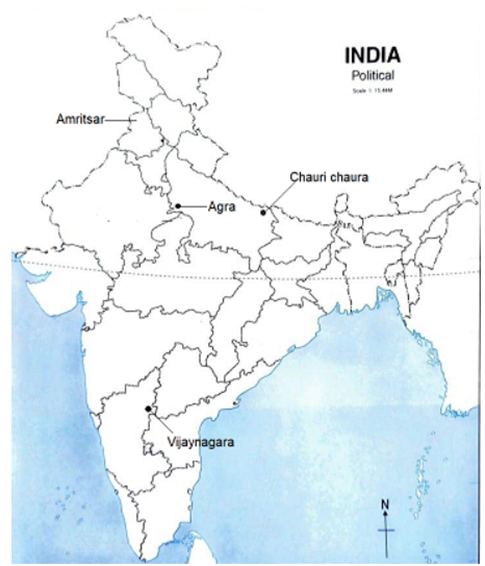
34. i. On the given political outline map of India locate and label any three from the following with appropriate symbols:
a. Amritsar – an important centre of the National Movement.
b. Chauri-Chaura – The place where Gandhiji called off Non-Cooperation Movement.
c. Vijaynagara – City ruled by the Tuluva dynasty.
OR
Agra, a centre of the Revolt of 1857.
Ans.
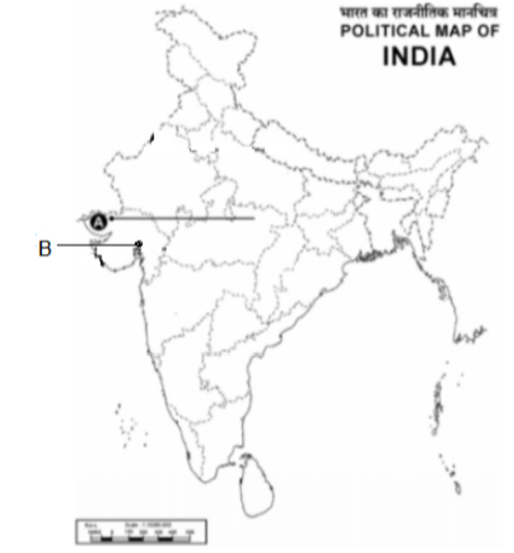
ii. On the same outline map, two places related to Matured Harappan sites have been marked as A, and B. Identify them and write their correct names on the lines marked near them.
View AnswerAns. A – Dholavira B – Lothal