SAMPLE QUESTION PAPER (2021-22)
ENTREPRENEURSHIP
TERM II
CLASS 12
Time: 2 Hrs Max. Marks: 35
GENERAL INSTRUCTIONS
1. The paper is divided into 3 Sections
2. Section-wise overall choice is given to the students.
3. Section A (2 markers) has 6 questions. Attempt any 4 out of 6
4. Section B (3 markers) has 5 questions. Attempt any 4 out of 5
5. Section C (5 markers) has 4 questions. Attempt any 3 out of 4
SECTION – A
1. ‘The Fancy Store’ a readymade garments retail shop sold 8,000 shirts at ₹400 per shirt during the year ended 31st March, 2014. Cost of placing an order and receiving goods is ₹2,000 per order. Inventory holding cost is ₹500 per year. Calculate the ‘Economic Ordering Quantity’ for ‘The Fancy Store’
Ans. 252.98 units
Economic Ordering Quantity = √(2PD/C)
= √(2 x 2,000 x 8,000)/500
= √64,000
= 252.98 units (253)
2. What is the most popular method of floatation of new issues?
Ans. Public issue is the most popular method of raising capital these days by the entrepreneurs. This involves raising of funds directly from the public through the issue of prospectus. An enterprise organizing itself as a public limited company can raise the required funds commonly by preparing a prospectus. When an entrepreneur offers shares to the public for subscription he/she is required to comply with all the restrictions and formalities pertaining to the initial issues, prospectus drafting and launch.
3. Coal Ltd. is a public company and running its business on the terms defined by government. Stones Ltd. is a private firm owned by Sunny Stone and his brother, Rocky Stone. Stone brothers are planning to expand the business. For that, Sunny wants to merge the company with another private company in order to increase production and earn more profits. But, Rocky wants to acquire a public limited company in order to expand their business to the government market as well. Identify and give the meaning of this type of enterprise growth opportunity.
Ans. Reverse acquisition: In case of reverse acquisition, a private company takes over a public company. Acquisition is a corporate action in which a company buys most, if not all, of the target company’s ownership stakes in order to assume control of the target firm. Acquisitions are often made as part of a company’s growth strategy whereby it is more beneficial to take over an existing firm’s operations and niche compared to expanding on its own. Acquisitions are often paid in cash, the acquiring company’s stock or a combination of both. An acquisition, also known as a takeover, is the buying of one company (the target) by another.
4. What are the various types of brand names from the entrepreneur’s perspective? Give any two.
Ans. Various types of brand names available are:
(i) Individual brand name: Here, every product is promoted by the entrepreneur on the basis of a separate brand name, like:
Liril – brand name with the “freshness” concept.
Lux – brand name for “beauty soap for film stars”
(ii) Family brand name – (Umbrella branding): Here, the entrepreneur’s name or the company’s name is used for all the products, like:
Kissan, is brand name for jam, sauces, etc.
Amul, has been used to market a large variety of dairy products viz. milk, ghee, butter, chocolates, etc.
(iii) Corporate names: Here, entrepreneur can choose their corporate name or logo together with some brand names of individual products for example, Godrej, Tata, Bajaj, etc.
(iv) Alpha-numeric names: In many industrial products, an alpha-numeric name often signifies its physical characteristics, thus creating a distinctive identify of the product. Entrepreneur has an option available to brand his/her products alpha-numerically too. For example, SX4, Lviv52, ANX Grindlay, i10, i20, etc.
5. Explain the types of acquisition.
Ans. There are four types of acquisitions:
(i) Friendly acquisition: Here, both the companies approve of the acquisition under friendly terms. There is no use of force or pressure and everything gets over cordially.
(ii) Reverse acquisition: Here, a private company takes over a public company.
(iii) Back flip acquisition: Here, the purchasing company becomes a subsidiary of the purchased company
(iv) Hostile acquisition: Here, as the name suggests, the entire process is done by force. The smaller company is either driven to such a condition that it has no option but to say yes to the acquisition to save its skin or the bigger company just buys off all its shares, thereby establishing majority and hence initiating the acquisition.
6. Enlist any two typical sales promotion activities.
Ans. Following are the typical sales promotion activities:
(i) Consumer sales promotions:
(a) Point of purchase display material
(b) In-store demonstrations, sampling and celebrity appearances
(c) Competitions, coupons, sweepstakes and games
(d) On-pack offers, multi-packs and bonuses
(e) Loyalty reward programmes
(ii) Business promotions:
(a) Seminars and workshops
(b) Conference presentations
(c) Trade show displays
(d) Telemarketing and direct mail campaigns
(e) Newsletters
(f) Event sponsorship
(g) Capability documents.
(iii) trade promotions:
(a) reward incentives linked to purchases or sales
(b) Reseller staff incentives
(c) Competitions
(d) Corporate entertainment
(e) Bonus stock
(iv) Sales force promotions:
(a) Commissions
(b) Sales competitions with prizes or awards
(c) Product samples, freebies
SECTION – B
7.
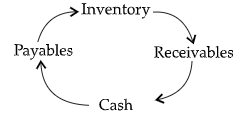
(i) Identify the type of business whose operating cycle is represented above?
Ans. The type of business whose operating cycle is represented is Trading Business
(ii) Analyse the working capital requirement for the type of business identified in (i)
Ans. The cash conversion cycle (CCC or Operating cycle) is the length of time between a firm’s purchase of inventory and the receipt of cash from accounts receivable. It is the time required for a business to turn purchases into cash receipts from customers. CCC represents the number of days a firm’s cash remains tied up within the operations of the business. Different products will have different operating cycles. If the conversion takes longer then the cycle will be longer. For trading, where there is no manufacturing (or conversion), the operating cycle will be shorter. Longer the operating cycle, working capital quantum is more; shorter the cycle, less working capital is needed.
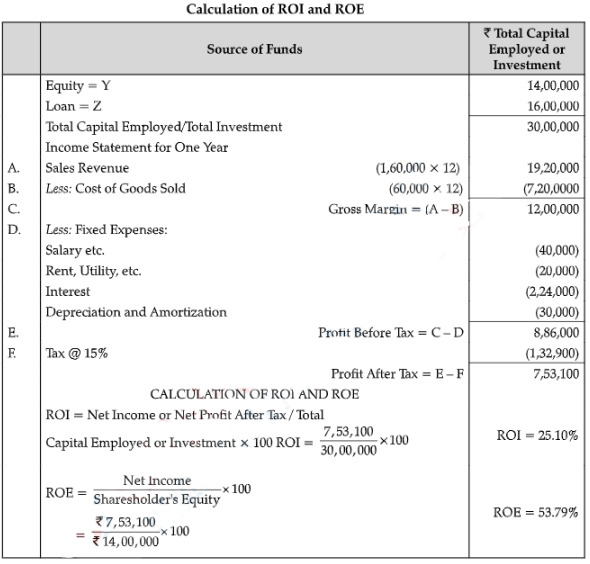
8. Aditi started a beauty parlour business. She spends ₹30,00,000 to open the parlour of which she invested ₹14,00,000 of her own money and borrowed a loan for ₹16,00,000. Interest rate per annum is 14%. Sales revenue per month is ₹1,60,000. Cost of goods sold is ₹60,000 per month. Fixed expenses for that month are ₹60,000 (salary ₹40,000, rent and utility ₹20,000), depreciation ₹30,000 and tax @15%. Calculate ROI and ROE.
9. Explain in detail any two pricing strategies.
Following are the various pricing strategies:
(i) Variable pricing technique: Variable pricing is a marketing approach that permits different rates to be extended to different customers for the same goods or services. The approach is often employed in cultures where dickering over the price of goods is considered the norm, or potential buyers are allowed to participate in a bidding situation, such as in an auction. Even in countries where fixed pricing is the standard, variable pricing may come into play when the customer is committing to the purchase of large volumes of goods or services. When this is the case, the customer must usually comply with specific criteria in order to enjoy pricing that varies from the standard cost.
(ii) Skimming pricing method: Skimming price method is the method of pricing in which the product is introduced in the market with a very high price. Selling a product at a high price, sacrificing high slaes to gain a high profit is therefore “skimming: the market. Skimming is usually employed to reimburse the cost of investment of the original research into the product commonly used in electronic markets when a new range, such as smart phones, are firstly dispatched into the market at a high price. This strategy is often used to target “early adopters” of a product or service. Early adopters generally don’t have a relatively lower price-sensitivity. This strategy is employed only for a limited duration to recover most of the investment made to build the product. To gain further market share, a seller must use other pricing tactics such as economy or penetration. This method can have some setbacks as it could leave the product at a high price against the competition.
(iii) Cost plus pricing method: In this method the cost of production of one unit of the product is calculated. This cost covers all the types of costs including explicit cost, variable cost, fixed cost, etc. To this is now added the pre-planned profit margin. This method of pricing is a very simple method. It can easily be used for determining the price. Any changes in the cost of production or the margin of profit change the price in the same direction. It automatically gets adjusted to the change. Profit margin is not to be calculated. It is already fixed. Thus, by multiplying the profit per unit with the volume of the product, the total profit can be determined. Any upward rise in cost is easily visible. This provides an idea to the entrepreneur to adjust his production or keeping the cost as low as possible. Comparatively less calculations are involved, which makes the implementation of this method simple. This method can easily be implemented because of its simplicity to understand and easy calculations.
(iv) Penetration pricing: Penetration pricing is a pricing strategy where the price of a product is initially set at a price lower than the eventual market price to attract new customers. The strategy works on the expectations that customers will switch to the new brand because of the lower price. Penetration pricing is most commonly associated with a marketing objective of increasing market share or sales volume, rather than to make profit in the short term. This price will be raised later once this market share is gained. For example, toothpaste sold in a remote rural area.
10. Elaborate on any three types of franchising.
Types of franchising:
(i) Product franchise business opportunity: Manufacturers use the product franchise to govern how a retailer distributes his products. The manufacturer grants a store owner the authority to distribute goods by the manufacturer and allow him to use the name and trademark owned by the manufacturer. The store owner must pay a fee or purchase a minimum inventory of stock in return for these rights. Some tyre stores are good examples of this type of franchise.
(ii) Manufacturing franchise opportunity: These types of franchises provide an organization with the right to manufacture a product and sell it to the public, using the franchisor’s name and trademark. This type of franchise is found most often in the food and beverage industry. Most bottlers of soft drinks receive a franchise from a company and must use its ingredients to produce, bottle and distribute the soft drinks.
(iii) Business franchise opportunity ventures: these ventures typically require that a business owner purchases and distributes the products for one specific company. The company must provide customers or accounts to the business owner, and in return, the business owner pays a fee or other consideration as compensation. Examples include vending machine routes and distributorships.
(iv) Business format franchise opportunity: This is the most popular form of franchising. In this approach, a company provides a business owner with a proven method for operating a business using the name and trademark of the company. The company usually provides a significant amount of assistance to the business owner in starting and managing the company. The business owner pays a fee or royalty in return. Typically, a company also requires the owner to purchase supplies from the company.
11. Identify and explain the type of marketing strategies used in the given situations:
(i) Vipul found a worm crawling out of newly opened tetra pack of juice manufactured by a reputed company, Juices Ltd. He went back to the shopkeeper from whom the pack was purchased who directed him to call up the customer care centre. When all his efforts fell free, he went to a consumer activist group to seek advice. The group decided to help Vipul and take measures to impose restrictions on the sales of the firm’s products of the particular batch and urge customers to refrain from buying the products of the company. Juices Ltd. lost its image in the market. The CEO gave the responsibility of bringing back the lost image of the company to the Manager.
Ans. Public relations: Public relations helps to create a positive image about the company in the eyes of various interest holder like consumers, government, suppliers, etc. It helps in launching new products as they may be accepted easily because of good reputation of business, It helps the business to reinstate itself in wake of controversies or prejudices, etc. Public relations is the deliberate, planned and sustained effort to establish and maintain mutual understanding between an organisation and its public. Public relations is about building good relations with the stakeholders (public) of the business by obtaining favourable publicity, building a good corporate image and handling or heading off unfavourable rumours, stories and events. By building good relationships with the stakeholders, particularly customers, we can generate positive word of mouth and referrals from satisfied customers.
(ii) Ritu, Vimla and Swapna are three women entrepreneurs who are engaged in dealing with handicraft goods under the brand name ‘craftworks’ through a chain of retail outlets at five different places in Mumbai. They outsource all their products from tribal and rural women in the state of Maharashtra. Ritu is of the opinion that in order to increase the sale of their products. They should advertise about it on television. But, Swapna is arguing that advertisement expenses will add to cost of operation. Whereas Vimla is insisting that they should set up an online portal to market their products across the globe.
Ans. Advertising: Advertising is a paid form of communication designed to persuade potential customers to choose the product or service over that of a competitor. Successful advertising involves making the products or services positively known by that section of the public most likely to purchase them. It should be a planned, consistent activity that keeps the name of the business and the benefits of products or services uppermost in the mind of the consumer.
(iii) Sohan has decided to set up a small factory to manufacture hand wash and toilet soaps in a rural area in Haryana. In order to promote the product initially, he plans to distribute small sachets of the hand wash as free samples, besides deploying a team of salesmen to sell the product door to door in the different parts of the city. Moreover, he has decided to conduct a hygiene camp in rural areas wherein he will distribute a kit comprising of hand wash and soap and also plans to organize street plays to highlight the importance of hygiene and sanitation in our daily lives.
Ans. Personal selling: It means selling products personally. It involves oral presentation of message in the form of conversion with one or more prospective customers for the purpose of making sales. Companies appoint salesperson to contact prospective buyers and create awareness about the company’s product. Thus, a salesperson plays three different roles:
(a) Be persuasive
(b) A service provider
(c) Be informative
SECTION – C
12. What is capital market? Explain how capital markets are the most important source of raising finance for an entrepreneur.
Ans. A capital market may be defined as an organized mechanism meant for effective and smooth transfer of money capital or financial resources from the investors to the entrepreneurs. Here, productive capital is raised and made available for industrial purposes.
Capital markets are the most important source of raising finance for the entrepreneurs as this market can:
(i) Mobilize the financial resources on a nation-wide scale.
(ii) Secure the required foreign capital and know-how to promote economic growth at a faster rate.
(iii) Ensure the most effective allocation of the mobilized financial resources by directing the same either to such projects which are capable of the highest yield or to the underdeveloped priority areas where there is an urgent need to promote balanced and diversified industrialization.
(iv) The needs of entrepreneurs who actually use the savings for productive purposes are varied. The capital market satisfied the tastes of savers and the needs of investors through its various financial instruments and institutions.
13. Nishtha, a professionally qualified entrepreneur decided to start ‘kids furniture’ a website of designer furniture. It was relatively an untried area involving high risk. She lacked the necessary funds and experience to give shape to her idea. She knew that if she failed to get investment from the public her idea would lie down before it is tried. So, she made a detailed business plan and presented her idea to ‘Fifa Finance Ltd’ a company run by a group of professional investors. They were impressed by her business plan and decided to fund her start up in exchange for an equity stake in the business. Identify the source of finance used by Nishtha. Also explain how this source of finance is different from raising debt.
Ans. Source of finance used by Nishtha is Venture Capital Venture Capital is a type of private equity capital provided as seed funding to early-stage, high potential, high risk growth up companies/entrepreneurs who lack the necessary experience and funds to give shape to their ideas. Venture capital is an equity based investment in a growth-oriented small to medium business to enable the investors to accomplish objectives, in return for minority shareholding in the business or the irrevocable right to acquire. It is more accurate to view venture capital broadly as a professionally managed pool of equity capital. Venture capital is a way in which investors support entrepreneurial talent with finance and business skills to exploit market opportunities and obtain long-term capital gains.
This source is different from debt in the following ways:
(i) It is a permanent capital in business where as debt capital is to be repaid on maturity.
(ii) To pay regular dividend of fixed amount is not compulsory whereas in debt, a fixed rate of interest has to be paid regularly irrespective of profits or losses.
14. Read the following article from a Business Newspaper and answer the questions:
“Kamal Ltd, are manufacturers of textiles, having their plant in Surat, a city of Gujarat. Vastra Ltd. are the manufacturers of readymade garments and sell their products throughout the country. They also export their products to America and European countries. Vastra Ltd. source their textile from Kamal Ltd. The management of the two companies decided to merge to have economies of large scale production. The logic behind the merger is to increase synergies created by both the firms that would be more efficient operating as one.”
(i) Quoting the lines from the passage identify and explain the types of merger entered into by Kamal Ltd and Vastra Ltd.
Ans. Vertical Merger: A merger between two companies producing different goods or services for one specific finished product. A vertical merger occurs when two or more firms, operating at different levels within an industry’s supply chain, merge operations. Most often the logic behind the merger is to increase synergies created by merging firms that would be more efficient operating as one. Example: A vertical merger joins two companies that may not compete with each other, but exist in the same supply chain.
Lines: “The logic behind the merger is to increase synergies created by both the firms that would be more efficient operating as one.”
(ii) Also explain any two types of merger other than the one identified in (i) above
Ans. Types of mergers:
(a) Conglomerate merger: A merger between firms that are involved in totally unrelated business activities. There are two types of conglomerate mergers: pure and mixed. Pure conglomerate mergers involve firms with nothing in common, while mixed conglomerate mergers involve firms that are looking for product extensions or market extensions. Example: A leading manufacturer of athletic shoes merges with a soft drink firm. The resulting company is faced with the same competition in each of its two markets after the merger as the individual firms were before the merger. One example of a conglomerate merger was the merger between the Walt Disney Company and the American Broadcasting Company.
(b) Horizontal merger: A merger occurring between companies in the same industry. Horizontal merger is a business consolidation that occurs between firms which operate in the same space, often as competitors offering the same goods or service. Horizontal mergers are common in industries with fewer firms, as competition tends to be higher and the synergies and potential gains in market share are much greater for merging firms in such an industry. Example: A merger between Coca-Cola and the Pepsi beverage division, would be horizontal in nature. The goal of a horizontal merger is to create a new, larger organization with more market share. If the merging companies’ business operations are very similar, there may be opportunities to join certain operations, such as manufacturing and reduce costs.
(c) Market extension merger: A market extension merger takes place between two companies that deal in the same products but in separate markets. The main purpose of the market extension merger is to make sure that the merging companies can get access to a bigger market and that ensures a bigger client base. Example: A very good example of market extension merger is the acquisition of Eagle Bancshares Inc. by the RBC Centura.
(d) Product extension merger: A product extension merger takes place between two business organizations that deal in products that are related to each other and operate in the same market. The product extension merger allows the merging companies to group together their products and get access to a bigger set of consumers. This ensures that they earn higher profits. Example: The acquisition of Mobilink Telecom Inc. by Broadcom is a proper example of product extension merger.
15. What is marketing mix? How does market mix play an important role in enhancing the sale?
Ans. Marketing mix refers to the ingredients or the tools or the variables which the marketing mixes in order to interact with a particular market. Marketing mix is the term used to describe the combination of the four inputs which constitute the core of a company’s marketing system: the product, the price structure, the promotional activities, and the distribution system.
Marketing mix plays an important role in enhancing the sales of the enterprise. Its following companies help in raising the sale:
(i) Peoduct: If various features and characteristics of the product are of the liking of majority of the potential customers, the sales is automatically going to be higher. Effective after sale service, efficient utilization of know-how, full capacity production will create good rapport of the product. Consequently sales will be enhanced.
(ii) Price: Price refers to the value of that is put on a product. It depends on cost of production, segment targeted, ability of the market to pay, supply – demand and a host of other direct and indirect factors. There can be several types of pricing strategies, each tied in with an overall business plan. Pricing can also be used as a demarcation, to differentiate and enhance the image of a product. Favourable and adequate pricing depends upon the paying capacity of the customers. The loyalty towards the product is also enhanced which ensures maximum sales and also attracts new customers. Various pricing methods are available at the disposal of the entrepreneur. Selection of appropriate method can be used as a tool for raising sales.
(iii) Promotion: This refers to all the activities undertaken to make the product or service known to the user and trade. This can include advertising, word or mouth, press reports, incentives, commissions and awards to the trade. It can also include consumer schemes, direct marketing, contests and prizes. Publicity plays a leading role in promoting sales. Depending on the nature of the product the advertisement mode can be selected. Door to door selling, newspaper, radio, pamphlet, etc are the various methods which can be used for increasing the number of customers.
(iv) Place: Place refers to the point of sale. In every industry, catching the eye of the consumer and making it easy for her to buy is the main aim of a good distribution or ‘place’ strategy. Retailers pay a premium for the right location. In fact, the mantra of a successful retail business is ‘location, location, location’. A channel of distribution or trade channel is defined as the path or route along which goods move from producers or manufacturers to ultimate consumers or industrial users. In other words, it is a distribution network through which the producer puts his products in the market and passes it to the actual users. This channel consists of: producers, consumers or users and the various middlemen like wholesalers, selling agents and retailers (dealers) who intervene between the producers and consumers. Various channels of distribution can be effectively used by entrepreneur depending on nature of market, preference of consumers and nature of the products. Shorter is the channel of distribution more efficient is distribution.