Sample paper 1
English Core (301)
Class-XII exam 2025-26
Time Allowed: 3 hrs. Maximum Marks: 80
General Instructions:
Read the following instructions very carefully and follow them :
i. This question paper has 13 questions. All questions are compulsory.
ii This question paper contains three sections :
Section A: Reading Skills
Section B: Creative Writing Skills
Section C: Literature.
iii. Attempt all questions based on specific instructions for each part. Write the correct question number and part thereof in your answer sheet.
iv Seperate instructions are given with each question/part, wherever necessary.
v. Adhere to the prescribed word limit while answering the questions.
SECTION A – READING SKILLS 22
1. Read the following passage. 12
1. The human brain is one of the most intricate and powerful organs in the body, containing approximately 86 billion neurons. These neurons form complex networks through which they communicate using electrical impulses. The cerebral cortex is responsible for higher cognitive functions such as memory, reasoning, and problem-solving. Meanwhile, the cerebellum coordinates voluntary movement and balance, while the brainstem controls essential functions like breathing and heart rate. Each region of the brain plays a distinct role, allowing the body to function properly.
2. The brain, despite being well-protected by the skull and cerebrospinal fluid, is still susceptible to injuries and diseases. Traumatic brain injuries (TBIs) can result from accidents, leading to anything from mild concussions to life-threatening damage. Stroke, caused by interrupted blood flow to the brain, can result in permanent impairments, depending on the area affected. Neurodegenerative diseases like Alzheimer’s and Parkinson’s further complicate the brain’s health by causing gradual loss of neurons, which results in cognitive decline and motor dysfunction.
3. One of the brain’s most fascinating characteristics is its plasticity, or the ability to change and adapt. Neuroplasticity refers to the brain’s capacity to reorganize itself in response to new experiences, learning, or injury. For example, after a stroke, some parts of the brain can take over functions that were lost due to damage. This capacity for adaptation allows humans to learn new skills, retain memories, and recover from injuries.
4. Advances in neuroscience have been pivotal in understanding how the brain works. Techniques such as functional MRI (fMRI) and PET scans allow researchers to visualize brain activity and understand how different areas are involved in tasks like language, emotion, and movement. Additionally, researchers are exploring ways to enhance brain health through diet, exercise, and mental stimulation, with the goal of preventing cognitive decline and promoting recovery after injuries.
5. As research continues, the mysteries of the brain, such as how consciousness arises or how memory is stored, remain largely unsolved. However, ongoing studies in neuroscience offer hope for developing new treatments for brain-related diseases and injuries. The future of brain research holds great promise for improving our understanding of this remarkable organ.
Answer the following questions, based on the passage above.
i. According to paragraph 1, what role does the cerebral cortex play in brain function? 1
View AnswerAns. The cerebral cortex is responsible for higher cognitive functions like memory, reasoning, and problem-solving.
ii. How does the author describe the brain’s vulnerability to injury, as mentioned in paragraph 2? 1
View AnswerAns. The brain is vulnerable to traumatic injuries and diseases like strokes and neurodegenerative disorders, which can cause cognitive and motor impairments.
iii. Read and complete the following sentence suitably. 1
The phrase “neuroplasticity” in paragraph 3 refers to the brain’s ability to change and adapt.
Choose the correct response from the two options to complete the sentence.
Neuroplasticity is important because _____.
(A) it allows the brain to recover from injury and adapt to new experiences.
(B) it prevents all neurodegenerative diseases from progressing.
View AnswerAns. (A) it allows the brain to recover from injury and adapt to new experiences.
iv. Complete the following with ONE example, with reference to paragraph 3 :
Neuroplasticity is demonstrated when _____.
View AnswerAns. Neuroplasticity is demonstrated when stroke patients recover lost functions by retraining their brains through therapy.
v. Why does the writer emphasize brain imaging techniques in paragraph 4? Because
(A) They allow researchers to observe brain activity in real-time.
(B) They help cure diseases like Alzheimer’s and Parkinson’s.
(C) They provide immediate treatments for traumatic brain injuries.
(D) They make surgery safer.
View AnswerAns. (A) They allow researchers to observe brain activity in real-time.
vi. Provide ONE textual evidence with reference to paragraph 4, to support the following : 1
Brain imaging techniques have significantly advanced our understanding of brain functions.
View AnswerAns. Textual evidence: “Technique such as functional MRI (fMRI) and PET scans allow reserachers to visualize brain activity and understand how different areas are involved in tasks.”
vii. In the line, ‘The brain’s plasticity allows it to reorganize itself’ (Paragraph 3), what does the word ‘reorganize’ suggest about the brain’s response to injury? 2
View AnswerAns. The word ‘reorganize’ suggests that the brain has the ability to form new neural pathways after injury or damage, enabling it to adapt and compensate for lost functions, which facilitates recovery or adjustment to new tasks.
viii. Complete the analogy with ONE word from paragraph 1 :
neurons: brain :: cells: _____
(A) blood
(C) tissues
(B) muscles
(D) organs
View AnswerAns. (C) tissues
ix. Why is it fair to say that the statement ‘The future of brain research holds great promise’ in paragraph 5 uses descriptive language? 1
(A) It highlights the potential breakthroughs in neuroscience.
(B) It explains the limitations of current brain research
(C) It describes the complexity of brain diseases.
(D) It focuses on the brain’s vulnerability to injury.
View AnswerAns. (A) It highlights the potential breakthroughs in neuroscience.
x. Assess the potential challenges or benefits of enhancing brain health through diet, exercise, and mental stimulation, as suggested in paragraph 4. 2
View AnswerAns. One benefit of enhancing brain health through diet, exercise, and mental stimulation is preventing cognitive decline. A challenge could be ensuring access to these resources for all individuals, particularly those affected by age or disease.
2. Read the following carefully. 10
1. The Municipal Corporation of Gurugram recently admitted to the National Green Tribunal that untreated sewage mixes with treated wastewater as it flows into the Yamuna. This is not unique to Delhi, as 80% of India’s surface water is estimated to be contaminated, largely from untreated sewage.
2. The onset of the monsoon worsens water contamination. Reports of water-borne diseases such as diarrhoea and cholera increase during this time as broken pipes and flooding allow sewage to mix with drinking water in cities like Delhi, Pune, Varanasi, and Chennai.
3. According to a 2009 Central Pollution Control Board (CPCB) report, India’s major cities and towns generate more than 38 billion litres of sewage daily, yet only 30% is collected and less than 20% treated due to limited treatment capacity. The rest is discharged into water bodies untreated.
4. A forthcoming report from WaterAid India reveals that 17 million urban households lack sanitation facilities. Of those with sanitation, only 32% are connected to a sewage system. Additionally, more than 9 lakh toilets directly drain into open water bodies, and over 12% of urban households practice open defecation.
5. Many septic tanks are left uncleaned for years, causing fecal sludge to leak into groundwater. When these tanks are finally cleaned, the waste is dumped into fields and water bodies, worsening water contamination.
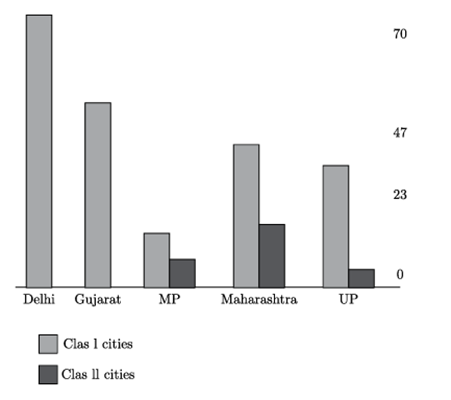
6. The WaterAid report details how much wastewater is left untreated in cities. Delhi treats only 61% of the 4,346 million litres of wastewater it generates. In Maharashtra, class I cities treat less than half of their total wastewater, with statistics for class II cities being far worse, as shown in the accompanying chart.
7. Despite the introduction of the National Urban Sanitation Policy (2008) and substantial government investment in sewage infrastructure, the problem has only worsened in the past five years. WaterAid recommends decentralized sewage treatment plants and public promotion campaigns to address the crisis.
Answer the following questions, based on given passage.
i. Complete the following suitably. 1
In the introduction, the researcher links untreated sewage in urban areas with water contamination to highlight _____.
View AnswerAns. The significant contribution untreated sewage makes to water pollution in urban areas.
ii. What would the following be classified as? 1
To investigate the impact of untreated sewage on water bodies in India. Select the appropriate response.
(A) Secondary objective
(C) Method of analysis
(B) Research outcome
(D) Primary objective
View AnswerAns. (D) Primary objective
iii. Give two points to support why decentralized sewage treatment is considered an important solution, based on the passage. 2
View AnswerAns. Two points to support why decentralized sewage treatment is considered an important solution:
1. Decentralized treatment reduces the burden on centralized systems, ensuring more sewage is treated at the source and lowering the risk of untreated wastewater being discharged into water bodies.
2. It helps address gaps in urban areas where sewage infrastructure is lacking or overloaded, thus reducing overall contamination.
iv. Paragraph 3 includes words – ‘sewage’ and ‘treatment capacity.’ Classify the following sentences as ‘sewage’ or ‘treatment capacity’:
Sentence 1: India’s major cities produce over 38 billion litres of wastewater every day.
Sentence 2: Limited infrastructure means only 20% of this sewage is treated.
View AnswerAns. Sentence 1: Sewage
Sentence 2: Treatment capacity
v. Read the following : 1
Ravi lives in Delhi, where only 61% of wastewater is treated, while Priya, who lives in Maharashtra, faces worse conditions as less than half of the wastewater in her city is treated. Arjun, in Uttar Pradesh, is impacted by untreated wastewater mixing with surface water.
Select the option that identifies the correct wastewater management issues faced by Ravi, Priya, and Arjun.
(A) Ravi – 61% treated; Priya – less than half treated; Arjun – untreated wastewater
(B) Ravi – less than half treated; Priya – 61% treated; Arjun – fully treated wastewater
(C) Ravi – fully treated wastewater; Priya – untreated wastewater; Arjun – 61% treated
(D) Ravi – untreated wastewater; Priya – fully treated; Arjun – 61% treated
View AnswerAns. (A) Ravi – 61% treated; Priya – less than half treated; Arjun – untreated wastewater
vi. Although sewage treatment infrastructure exists, why is untreated sewage still a major problem in urban areas? 1
View AnswerAns. Although sewage treatment infrastructure exists, untreated sewage remains a problem due to insufficient capacity and improper maintenance of existing systems.
vii. Analyse how broken sewage systems contribute to groundwater contamination. (Paragraph 5) 2
View AnswerAns. Broken sewage systems allow fecal sludge to leak into groundwater when septic tanks are not cleaned for years. Overflows and leaks from these systems further contaminate fields and water bodies, leading to the spread of waterborne diseases and widespread groundwater contamination.
viii. What is the ultimate goal for stakeholders, based on the insights from the study?
(A) Promote the use of septic tanks
(B) Increase water consumption to clean surface water
(C) Implement decentralized sewage treatment plants
(D) Encourage the construction of more dams
View AnswerAns. (C) Implement decentralized sewage treatment plants
SECTION B – CREATIVE WRITING SKILLS 18
All the names and addresses used in the questions are fictitious. Resemblance, if any, is purely coincidental.
3. Attempt any one of the two, (A) or (B), in about 50 words. 1 x 4 = 4
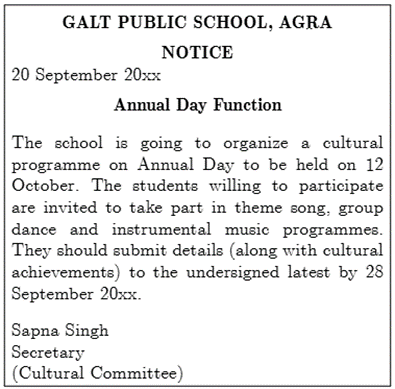
A. You are Sapna Singh, the Secretary of Cultural Committee of your school. Write a notice in about 50 words inviting students to participate in the Annual Day of the school to be organized next month. 1 x 4 = 4
View AnswerAns.
or
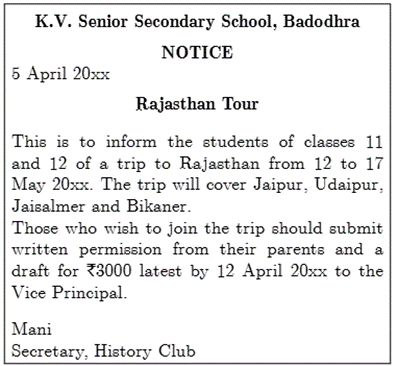
B. You are Man/Mani, secretary of the History Club of K.V. Sr. Sec. School, Badodhra. Draft a notice in not more than 50 words informing the students of class XI and XII about a proposed tour to Rajasthan during the coming summer vacations.
View AnswerAns.
4. Attempt any one of the two, (A) or (B), in about 50 words. 1 x 4 = 4
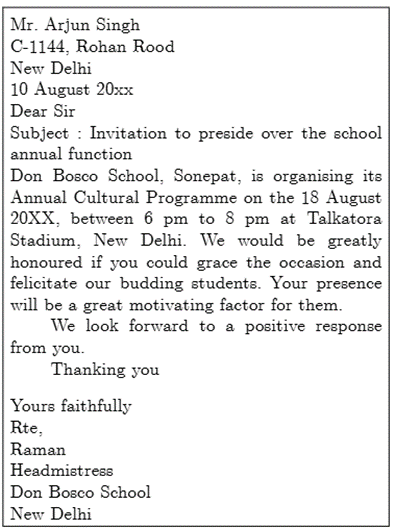
A. Your school is going to hold its Annual Day celebrations on 18th August at Talkatora Stadium, New Delhi. You want Mr. Arjun Singh, a noted playback singer to be the chief guest on this occasion. Write a formal invitation in about 50 words requesting him to preside over the function. You are Raman/Rani, Headmistress, Don Bosco School, New Delhi. 1 x 4 = 4
View AnswerAns.
or
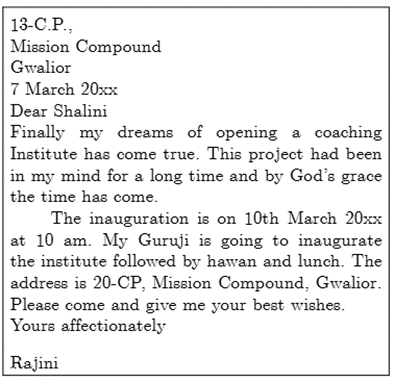
B. You are opening a coaching institute for students of classes IX-XII. Write an informal invitation, inviting your best friend for its inauguration. Do not exceed more than 50 words. Invent necessary details.
View AnswerAns.
5. Attempt any one of the two, (A) or (B), in 120-150 words. 1 x 5 = 5
A. You are Pushpit/Pushpa Pandey of 62 B, Mayur Vihar, Delhi. Write a letter to the editor of the Hindustan Times about ‘Misuse of Computers, TV and Mobile Phones by Children’.
View AnswerAns.
62 13, Mayur Vihar
Delhi
26 May 20xx
The Editor
The Hindustan Times Bahadur Shah Zafar Marg
New Delhi
Dear Sir,
Subject: Misuse of Computers, TV and Mobile Phones by Children
I wish to draw the attention of your readers to an important issue of our times. That we are in the age of electronics, is fortunate, but at the same time we should make sure that the electronic gifts are not misused, especially by our children.
Computers, TV and mobile phones are inevitable in modern life but their uncontrolled use can be disastrous. We are all aware of the harm TV can cause to the values, culture preferences and even morals of our youngsters. All kinds of entertainments and information is available on TV.
We have to be judicious in what we allow our children to watch.
Similarly, if computers are used only for playing games, social networking and visiting forbidden websites, they can have disastrous effects on children.
We all know how mobile phones are being used for wrong purposes like cheating in exams, criminal activities and even for making objectionable video clips. The common element in these gadgets is that they distract children from the right course and lead to wastage of time.
Controlled and guided use of electronic gadgetry is essential, and that is the message I wish to convey to your readers.
Yours faithfully
Pushpit Pandey
or
B. You are Rohini/Rohit. You have seen an advertisement for the post of an English Teacher in Khetan Public School, Raipur. Write a letter in response to the advertisement applying for the post. Give your detailed resume. Invent necessary details.
View AnswerAns.
130 Tandon Road
Sadar Bazar
Raipur Chattisgarh
17 March 20xx
The Principal
Khetan Public School
Raipur Dear Sir,
Subject: Application for the post of TGT English In response to your advertisement in the Danik Jagran dated 15th March, 20xx, for the post of TGT English, I would like to apply for the same. I have the requisite qualifications and experience and possess good communication skills. If given an opportunity to serve your esteemed Institute I assure you I will work to your satisfaction. I am enclosing my resume for your perusal and consideration.
Yours faithfully
Rohini Mittal
Bio-Data
Name : Rohini Mittal
Gender : Female
Father’s Name : Shri O.P. Mittal
Date of Birth : 12th April 19xx
Marital Status : Unmarried
Current Add : 130, Tandon Road, Sadar Bazar, Raipur
Contact No. : 89283535xx
Languages known : Fluent in English, Hindi and German
Extra Skills : Well versed in computers
Educational Qualifications
- XII, CBSE 85%
- BA (Hons), Delhi University, 70%
- Bed, Delhi University, 75%
- MA English, Delhi University, 74%
Work Experience
- 7 years as a TGT English in S.K Public School, Raipur
References
- Mr. S.P. Rai, Director, Himalaya Public School, Raipur
- Mr. Leela Kaul, Professor K.K College, Raipur
6. Attempt any one of the two, (A) or (B) in 120-150 words. 1 x 5 = 5
A. You are extremely disturbed by the growing crime against the elderly people in your city. Write an article commenting upon the reasons for such crimes and how one can prevent them. Sign yourself as Khoshali Bhardwaj.
View AnswerAns.
Growing Crime against Elderly People-
Reasons and Prevention
By Khoshali Bhardwaj
Almost daily we come across reports about the murder of elderly people. About 17% of our population comprises elderly people. Changing family structures and withering away of the joint family system have forced most of the senior citizens to live alone-unprotected and uncared for. They are left alone to fend for themselves in their old age when they are in utmost need of care, love and support. They are generally left alone at the mercy of domestic servants. The infirmity and sickness associated with old age makes them hapless dependents on servants.
Criminals take advantage of this and other shortcomings and make them their soft targets. With the motive of theft and robbery, they break into their houses and murder them.
Unverified entries of plumbers, electricians, domestic help, etc. make the elderly soft targets as their routine is easy to track.
These crimes can be prevented. The police and Residents’ Welfare Associations should keep a strict watch in residential areas. Neighbourhood Watch Scheme should be encouraged. Each entry should be maintained and verified through intercom system. A record of domestic helps should be kept by the police. Elderly people should be taught certain safeguards. Their main doors should be equipped with the magic-eye, door chain and wire mesh. I think with the help of these measures we can secure them, and support them in their twilight years.
or
B. Write a report in 120-150 words for your school magazine describing the prize distribution ceremony that was held to honour the academic achievers of class XII of the previous year.
View AnswerAns.
A Glorious Moment
By Tara
It was a moment of pride and pleasure for Kendriya Vidyalaya Noida Sr. Secondary School, when the alumni batch of 2019 was welcomed on September 18, 2019. Beside the normal welcome and get-together planned for the students, it was an important occasion for many academic achievers as the school had decided to felicitate them for their brilliant class XII Board results. Himanshu Bhagat, the district topper of commerce stream was awarded scholarship for next three years, while the other achievers were given merit certificates and medals for their hard work and success.
The chief quests for the occasion were none other than the parents of all the achievers. The Principal in his address thanked the parents for their guidance and contribution to shape the future of the students. The day was also remarkable as the current class XII students presented medley of songs and dance, and a video presentation, captured by the juniors, highlighting the pranks played by them in their school campus. That was thoroughly enjoyed by the audience.
The achievers in unison reiterated that the glory was achieved by the leadership, inspiration and motivation of the Principal and teachers who exhorted them to show grit, determination and tireless effort. They also admitted that there is no substitute for hard work. The proud parents openly and candidly expressed their gratitude to the school authority, Principal and teachers for their guidance and support to their wards. The function left many potential achievers quite motivated and determined to follow the footsteps of their achievers.
SECTION C- LITERATURE 40
7. Read the following extracts and solve any one of the given two, (A) or (B). 1 x 6 = 6
A. “The hurt to the scenery wouldn’t be my complaint
So much as the trusting sorrow of what is unsaid:
Here far from the city we make our roadside stand
And ask for some city money to feel in hand
To try if it will not make our being expand,
And give us the life of the moving-pictures’ promise
That the party in power is said to be keeping from us.”
(A Roadside Stand)
i. Select the correct option from those given in brackets, to fill in the blank.
The roadside stand was made by the poor people and it was _____ (near/far) from the city.
View AnswerAns. far
ii. Select the phrase that suggests the following.
The poet does not want to accuse the rustics of spoiling the beauty of the landscape.
View AnswerAns. ‘The hurt to the scenery wouldn’t be my complaint’ is the phrase from the extract that suggests that the poet does not want to accuse the rustics of spoiling the beauty.
iii. Read the assertion and the reason below, with reference to the given extract.
Assertion: The poet is more concerned with the emotional pain of unfulfilled promises to rural people than with the damage to the landscape.
Reason: The rural people believe that money from the city will improve their lives and fulfill the promises made by the party in power.
Choose the correct option regarding their relationship:
(A) Both the assertion and the reason are true, and the reason is the correct explanation of the assertion.
(B) Both the assertion and the reason are true, but the reason is not the correct explanation of the assertion.
(C) The assertion is true, but the reason is false.
(D) The assertion is false, but the reason is true.
View AnswerAns. (C) The assertion is true, but the reason is false.
iv. Complete the following suitably.
The promise made by the government was that to give _____.
View AnswerAns. A comfortable life to the poor people
v. Do you think that the promise made by the government was fulfilled?
View AnswerAns. No, I don’t think that the promise made by the government was fulfilled.
vi. What wouldn’t be the poet’s complaint?
(A) The hurt to the scenery
(B) The beauty of people
(C) The beauty of nature
(D) The hurt to the buildings
View AnswerAns. (A) The hurt to the scenery
OR
B. Perhaps the Earth can teach us
as when everything seems dead
and later proves to be alive.
Now I’ll count up to twelve
and you keep quiet and I will go.
(Keeping Quiet)
i. Which poetic device has been used in the second line of the extract?
(A) Metaphor
(B) Transferred epithet
(C) Alliteration
(D) Paradox
View AnswerAns. (B) Transferred epithet
ii. Identify the tone of the poem in the first line of the extract.
View AnswerAns. The tone of the poem in the first line of the extract is uncertain, yet hopeful about the possibility.
iii. Select the correct option from those given in brackets, to fill in the blank. The poet uses a conversational style and personal pronouns ‘you’, ‘we’ and ‘I’ because he wants us to be _____ (friendly/cruel) with the whole mankind.
View AnswerAns. friendly
iv. Read the assertion and the reason below, with reference to the given extract.
Assertion: The poet believes that silence and stillness can help us understand the cycles of life.
Reason: The Earth teaches us that even when everything seems dead, it can later prove to be alive, symbolizing renewal and continuity.
Choose the correct option regarding their relationship:
(A) Both the assertion and the reason are true, and the reason is the correct explanation of the assertion.
(B) Both the assertion and the reason are true, but the reason is not the correct explanation of the assertion.
(C) The assertion is true, but the reason is false.
(D) The assertion is false, but the reason is true.
View AnswerAns. (A) Both the assertion and the reason are true, and the reason is the correct explanation of the assertion.
v. Select the phrase that suggests the following:
The poet thinks that he has said what he intended to say.
View AnswerAns. ‘You keep quiet’ and ‘I will go’ are the phrases from the extract that suggest that the poet things that he has said what he intended to say.
vi. Complete the following suitably.
The poet wants to convey the message that there is life even in the moment of total inactivity. This moment of total inactivity leads one to _____.
View AnswerAns. Grow and become a better version of oneself.
8. Read the following extracts and solve any one of the given two, (A) or (B). 4 x 1 = 4
A. DERRY: How could I? You pass people in the street and you might even speak to them, but you never see them again. It doesn’t mean they’re friends.
MR LAMB: Doesn’t mean they’re enemies, either does it?
DERRY: No, they’re just… nothing. People. That’s all.
MR LAMB: People are never just nothing. Never.
DERRY There are some people I hate.
MR LAMB: That’d do you more harm than any bottle of acid. Acid only burns your face.
(On the Face of It)
i. Complete the sentence appropriately.
The author’s purpose in using contractions, is to _____.
View AnswerAns. Make words smaller, which makes them easier and faster to say.
ii. In the given extract, select the option that best summarises Derry’s attitude towards others.
(A) His pessimism was hurting him more than acid.
(B) His optimism was hurting him more than acid.
(C) His acid was hurting him more than his optimism.
(D) His acid was hurting him more than his pessimism.
View AnswerAns. (A) His pessimism was hurting him more than acid.
iii. Derry says, ‘I won’t change’. Why does Derry say so?
View AnswerAns. He says so because he thinks that his face will remain the same as before and people will make fun of him, as they always criticise his face.
iv. How is the line, “DERRY : No, they’re just…nothing. People. That’s all.” How would you describe Derry and Mr Lamb in the extract?
View AnswerAns. The given line describes Derry as confused and Mr. Lamb as practical.
or
B. My elder brother was there. I told him the story in all its comic detail. I fell about with laughter at the memory of a big man, and an elder at that, making such a game out of carrying the parcel. But Annan was not amused. Annan told me the man wasn’t being funny when he carried the package like that. He said everybody believed that they were upper caste and therefore must not touch us.
(Memories of Childhood)
i. Complete the sentence appropriately, with reference to the extract. The story referred in the extract is about _____.
View AnswerAns. The way in which the old man was carrying the parcel.
ii. Why was Annan not amused?
Ans. Annan was not amused because Bama had told him about an incident that depicted the unjust practice of untouchability.
[/expand]iii. Select the most suitable title for the given extract.
(A) The Wise Brother
(B) The Unsuspecting Girl
(C) The Caste System
(D) The Reality of Castes
View AnswerAns. (C) The Caste System
iv. Bama’s innocence was lost when she came face to face with the ugly truth of racial discrimination. Do you agree?
View AnswerAns. Yes, I agree with the statement that Bama’s innocence was lost when she came face to face with the ugly truth of racial discrimination.
9. Read the following extracts and solve any one of the given two, (A) or (B). 1 x 6 = 6
A. I swam the crawl, breast stroke, side stroke, and back stroke. Only once did the terror return. When I was in the middle of the lake, I put my face under and saw nothing but bottomless water. The old sensation returned in miniature. I laughed and said, “Well, Mr Terror, what do you think you can do to me?” It fled and I swam on. Yet I had residual doubts. At my first opportunity I hurried west, went up the Tieton to Conrad Meadows, up the Conrad Creek Trail to Meade Glacier, and camped in the high meadow by the side of Warm Lake. The next morning I stripped, dived into the lake, and swam across to the other shore and back – just as Doug Corpron used to do. I shouted with joy, and Gilbert Peak returned the echo. I had conquered my fear of water. (Deep Water)
i. List what theme is followed in the given extract?
View AnswerAns. The theme followed in the given extract is victory in facing the fear. The themes of power of determination and perseverance are also followed.
ii. What do you think the given extract dealt with?
(A) Doug Corpron
(B) Deep Water
(C) Conquering over fear
(D) Gilbert Peak
View AnswerAns. (C) Conquering over fear
iii. Complete the sentence appropriately.
The lesson focused on the fact that _____ must never be treated lightly.
View AnswerAns. Childhood fear
iv. Pick out an evidence from the text that helps one infer that the protagonist has overcome his fear.
View AnswerAns. I laughed and said, “Well, Mr. Terror, what do you think you can do to me?” It fled and I swam on.
v. What does the term ‘Mr Terror’ refer to?
View AnswerAns. Mr. Terror refers to ‘lake’.
vi. Which of the following best suggests the appropriateness of the title?
(A) He even took the services of an instructor.
(B) The author’s fear was a deep-rooted one.
(C) To overcome his fear, he visited oceans.
(D) He was once nearly drowned.
View AnswerAns. (B) The author’s fear was a deep-rooted one.
OR
B. “The official inquiry assembled a crushing mountain of evidence against the big planters, and when they saw this they agreed, in principle, to make refunds to the peasants. “But how much must we pay?” They asked Gandhi. They thought he would demand repayment in full of the money which they had illegally and deceitfully extorted from the sharecroppers. He asked only 50 per cent. “There he seemed adamant,” writes Reverend JZ Hodge, a British missionary in Champaran who observed the entire episode at close range. “Thinking probably that he would not give way, the representative of the planters offered to refund to the extent of 25 per cent, and to his amazement Mr. Gandhi took him at his word, thus, breaking the deadlock”
(Indigo)
i. Why did the servants consider Gandhiji to be another peasant?
View AnswerAns. The servants considered Gandhiji to be another peasant because Gandhiji went with Shukla for the first time.
ii. The line, “They thought he would demand repayment in full of the money which they had illegally and deceitfully extorted from the sharecroppers,” can be classified as:
(A) a research
(B) an opinion
(C) a fact
(D) a theme
View AnswerAns. (B) an opinion
iii. Explain any one inference that can be drawn from the line, “The official inquiry assembled plenty of traces against the big planters, and when they saw this they agreed, in principle, to make refunds to the peasants.”
View AnswerAns. The official inquiry assembled a crushing mountain of evidence against the big planters, and when they saw this they agreed, in principle, to make refunds to the peasants.
iv. Rationalize to support the given opinion, “There he seemed adamant,” writes Reverend J. Z. Hodge, a British missionary in Champaran who observed the entire episode at close range.
View AnswerAns. He asked only 50 percent. There he seemed adamant writes Reverent JZ Hodge, a British Missionary in Champaran.
v. What did the officials think about the refunds to the peasants?
(A) Gandhiji would demand repayment in full of money.
(B) Gandhiji would demand nothing.
(C) Gandhiji would demand repayment in 25%.
(D) Gandhiji would take strict action.
View AnswerAns. (A) Gandhiji would demand repayment in full of money.
vi. Complete the sentence with ONE word.
The big planters were agreed to refund _____ share.
View AnswerAns. 25%
10. Answer any five of the following six questions in 40-50 words each : 5 x 2 = 10
i. What, according to M. Hamel, was the outcome of the neglect of the French language in the region? (The Last Lesson)
View AnswerAns. The children treated their French primers as a nuisance, and the elders realized painfully that their neglect had raised doubts about their patriotism among their occupiers, who thereby rationalised the imposition of German on the region. The teacher’s lackadaisical attitude of declaring holidays to go fishing or sending students on errands, had denigrated the standard of French among the community.
ii. What are the differences in the ambitions of Saheb and Mukesh? (Lost Spring)
View AnswerAns. When Saheb becomes a tea-stall boy, he is suspicions and disillusioned by the opportunities his salary throws open, but Mukesh, a bangle maker’s son, unfazed by his misery, continues to dream about driving a car and becoming a motor mechanic. Mukesh shows resilience and determination. Saheb, bonded to the work, has snuffed out his ability to think beyond and was content to live in penury.
iii. What are the beauties of nature that the poet mentions in ‘A Thing of Beauty’? Why are they an everlasting source of joy?
View AnswerAns. Nature’s beauty consists of the sun and moon, shade providing old and young trees, grazing sheep, a clear and shady stream, as also the smell of musk rose. They will bring joy because the intensity, nature increases their loveliness that leaves a trail of quietude making our minds feel restful, our dreams sweet, and inviting hope and inspiration dispelling gloom.
iv. Aunt Jennifer’s fingers fluttering through her wool find even the ivory needle hard to pull. Why? (Aunt Jennifer’s Tigers)
View AnswerAns. Aunt Jennifer’s fingers fluttering through her wool find even the ivory needle hard to pull because she was so feeble that she had trouble manipulating the needle “through her wool”. It implies her fear of uncle.
v. Why is Rajkumar Shukla described as being ‘resolute’? (Indigo)
View AnswerAns. Rajkumar was a man with a strong will power and determination. He had come all the way from Champaran district to Lucknow to speak to Gandhiji. He accompanied Gandhi everywhere, even to the Ashram near Ahmedabad. For weeks he never left Gandhiji’s side till he asked him to meet him at Calcutta.
vi How would the innocent be soothed out of their wits? (A Roadside Stand)
View AnswerAns. The selfish good-doers would outwit the simple innocent people into believing that their intentions and efforts were for their improvement, while they would be seeking their own profits from the labour of these folks.
11. Answer any two of the following three questions in 40-50 words each: 2 x 2 = 4
i. What kind of relationship did Dr. Sadao Hoki share with his father? (The Enemy)
View AnswerAns. Dr. Sadao Hold’s father had a very motivating influence on him as his father always told him that nobody could limit one’s future. He never joked or played with him, but took infinitive pains on his only son. Thus he was sent to America at the age of twenty-two to study medicine.
ii. Why did the Maharaja order the Dewan to double the land tax? (The Tiger King)
View AnswerAns. When the Maharaja could not find the 100th tiger, he grew very angry and frustrated. In his anger, he ordered the Dewan to double the land tax and let the people suffer. Though the Dewan knew it was unreasonable, he couldn’t do anything.
iii. What happened to the narrator’s psychiatrist friend Sam Weiner? What do you deduce from it? (The Third Level)
View AnswerAns. One day the narrator’s psychiatrist friend Sam Weiner disappeared. He was a city boy. He always said that he liked Galesburg very much and its sound. From this I deduce that even Sam was affected by the stress of modern living and sought temporary refuge by travelling through time.
12. Answer any one of the following two questions, in about 120-150 words. 1 x 5 = 5
A. What does the poet want to convey through the poem, ‘My Mother at Sixty-six’?
View AnswerAns. Through this poem, the poet wants to convey that the youngsters do feel for their elders but they don’t communicate it properly. The poet recalls the day when she was driving from her parent’s home to Cochin where she was to catch a flight. Her mother was also sitting beside her. She was going to the airport to see off the poet. When the poet turned to look at her mother, she found her dozing. Her mouth was open and her face looked very pale like that of a corpse. A painful thought came to the poet’s mind. She realised that her mother had grown very old and would not live for long. But soon she drove that painful thought away from her mind. She started looking out at the young trees that seemed to be running fast. She saw children running out of their houses in joy. After reaching the airport, the poet went through the security check. Standing a few yards away, she looked at her mother once again. The mother looked pale and weak. The poet felt in her body an old familiar ache. It was like she used to feel in her childhood when some fear overpowered her. Still the only thing she said was: “See you soon, Amma.” All she did was smile and smile and smile.
OR
B. “The Rattrap” is a lesson which shows that basic human goodness can be brought out by understanding and love. Do you think this is practical in approach? Imagine yourself to be a motivational speaker who has to address high school students. Write this address in about 120-150 words.
View AnswerAns. Good morning teachers, principal and my dear friends!
The Rattrap’ is a story of a peddler who used to earn his living by selling small rattraps. But since his business was not profitable, he very often indulged in stealing and thefts. He stole thirty Kronor from a crofter who extended his hospitality to him.
Later he was given a place to stay by a young girl against her father’s wishes. She was a noble girl who showered affection on the peddler and convinced her father to let him stay with them for Christmas. The peddler was highly touched by her behavior and before leaving the house returned the stolen thirty Kronor and a small rattrap as a gift.
The story shows that the peddler was not a bad man by heart, but only forced by his unfortunate circumstances to steal things and do thefts. And, the love, trust and understanding shown by the girl revived his basic human goodness.
13. Answer any one of the following two questions, in about 120-150 words. 1 x 5 = 5
A. Dr. Sadao was compelled by duty as a doctor to help the enemy soldier. What made Hana, his wife, sympathetic to him in the face of open defiance from the domestic staff? You wish to include a cameo for the above statement’s explanation in your upcoming blog post. (A short description that neatly encapsulates someone or something). As a part of the research, discuss the statement in relation to ‘The Enemy’ in about 120-150 words. (The Enemy)
View AnswerAns. Dr. Sadao and his wife Hana knew that their decision to save the enemy soldier would be questioned by everyone. However, they firmly followed their sense of duty. For him, this sense of duty came from the profession he was in; but for her, the duty was purely humanitarian. Despite getting no cooperation from her domestic staff, she did all the household work herself with grace and dignity. Her loving, considerate and sympathetic nature blossomed out when she washed and fed the soldier which helped the soldier to recover fast. It was also apparent from the story that she respected her husband which was evident from the fact that she came back to the room and did whatever was told by her husband during the operation.
or
B. The title “Journey to the End of the Earth” is quite justified. Imagine yourself Tishani Doshi, and express your thoughts about its justification.
View AnswerAns. The title, “Journey to the end of the Earth” is quite justified by the narrator. A visit to Antarctica thrilled the whole troop and made them realized that Antarctica is the world’s coldest, driest and windiest continent. Their visit seemed to be very fruitful because without reaching there physically, one cannot experience the immensity and importance of Antarctica and its great role in balancing the ecosystem.
Narrator found Antarctica still undisturbed by human beings and tried to understand where we’ve come from and where we could possibly be heading; through the deep study of this island. The narrator presumed that without controlling the rapidly increasing global warming, we can’t stop the melting of ice specially glaciers and as it is known that Antarctica covers ninety percent of the Earth’s ice, its sustainment is mandatory. In near future, the continent would be responsible for the ruination of the Earth’s lives and in this way, the end of the Earth would be brought by Antarctica.