ENGLISH CORE (Code No. 301)
CLASS-XII-(2024-25)
Time allowed: 3 Hrs. Maximum Marks: 80
General Instructions Read the following instructions very carefully and strictly follow them:
i. This question paper has 13 questions. All questions are compulsory.
ii. This question paper contains three sections:
Section A: Reading Skills,
Section B: Creative Writing Skills
Section C: Literature.
iii. Attempt all questions based on specific instructions for each part. Write the correct question number and part thereof in your answer sheet.
iv. Separate instructions are given with each question/part, wherever necessary.
v. Adhere to the prescribed word limit while answering the questions.
SECTION A
READING SKILLS
1. Read the following passage carefully:
(1) In a room filled with people, each face illuminated by the soft glow of their smartphones, moments drift away like autumn leaves in the wind. The constant hum of notifications fills the air, punctuating conversations like an incessant drumbeat. Every vibration or ping sends fingers flying to screens, a response ingrained by years of digital conditioning. The once reliable tick-tock of analog timepieces has been overshadowed by the constant flicker of notifications on the wrist watch, blurring the boundaries between the virtual and the real.
(2) Anxiety gnaws at the edges of consciousness when the phone is out of reach, a phantom limb syndrome that leaves us feeling incomplete without our digital appendage. The fear of missing out permeates every moment spent away from the screen, driving us to constantly check for updates and notifications.
(3) Thumbs move with the speed and precision of skillful pianists, tapping out messages and scrolling through feeds with practiced ease. Yet amidst the flurry of activity, the true rhythm of life remains unheard, drowned out by the dissonance of digital noise. The weight of constant connectivity forms a hunch upon our shoulders, a physical manifestation of the burden we carry in an age of information overload. Our minds are perpetually on high alert, scanning for the next wave of excitement that comes with each like, share, or comment.
(4) And yet, for all our efforts to stay connected, we find ourselves increasingly isolated in a sea of digital faces. Genuine connections are fleeting, drowned out by the constant clamour for attention. In the pursuit of digital validation, we sacrifice the wealth of lived experience, trading meaningful moments for fleeting glimpses of connection. The true essence of life lies not in the pixels on a screen, but in the depth of human connection and the richness of shared experiences.
(5) As we navigate this brave new world of constant connectivity, let us not forget the value of presence and the beauty of being fully engaged in the moments that matter most. For in the end, it is not the number of likes or followers that defines us, but the depth of our connections and the richness of our experiences that truly matter.
Created for Academic Usage / 421 words
Answer the following questions, based on the passage above.
I. According to paragraph 1, what effect do smartphone notifications have on the people in the room?
View AnswerAns. They lead to instant interruptions in conversations.
[language / expression may vary but the idea should remain relevant]
II. How does the author use the metaphor of ‘autumn leaves in the wind’ to interpret the passing of time in the setting described?
View AnswerAns. It illustrates how moments are fleeting and unnoticed, lost amid the distractions of digital interactions / it illustrates how easily significant moments can drift away when overshadowed by the focus on technology
[language / expression may vary but the idea should remain relevant]
III Read and complete the following sentence suitably. The phrase ‘a phantom limb syndrome that leaves us feeling incomplete without our digital appendage’ suggests that just as an amputee might feel pain in a limb they no longer have, individuals can feel a sense of loss or incompleteness when they are separated from their digital devices.
Choose the correct response from the two options to complete the sentence. The concern this analogy points towards is about ______________.
A. a deep (psychological) dependence on technology for a sense of wholeness or connection
B. excessive physical damage that can be caused due to constant use of digital devices
View AnswerAns. A. a deep (psychological) dependence on technology for a sense of wholeness or connection
IV Complete the following suitably with ONE advantage, with reference to paragraph 2. Designating specific hours each day to intentionally avoid checking digital devices can help __________________.
View AnswerAns. reduce the anxiety associated with the need to constantly be connected
V Why does the writer refer to digital noise as ‘dissonance’ in paragraph 3? Because
A. It creates a jarring and chaotic environment that disrupts focus.
B. It contributes to a sense of overload, overwhelming the senses.
C. It interferes with our ability to engage with meaningful aspects of our life.
D. It induces stress by interrupting with regular updates about the device.
View AnswerAns. C. It interferes with our ability to engage with meaningful aspects of our life.
VI. Provide ONE textual evidence with reference to paragraph 3, to prove the following: The need to be perpetually engaged with digital notifications manifests in the body.
View AnswerAns. Yes it does – develop a hunch / mind is constantly alert (any one)
VII. In the line, ‘Yet amidst the flurry of activity, the true rhythm of life remains unheard…,’ what does the phrase ‘true rhythm of life’ refer to? (Paragraphs 3-4)
View AnswerAns. The phrase refers to the natural, meaningful, and often quieter moments that make up human existence and relationships—those that occur away from the digital chaos. The writer draws our attention towards the genuine life experiences, such as face-to-face conversations, quiet contemplation, enjoying nature, and real-world interactions, that are overlooked or drowned out by the constant noise of digital activity. [language / expression may vary but the idea should remain relevant]
VIII Complete the analogy with ONE word from paragraph 4.
Whisper : quietly: _______: loudly
A. validation
B. fleeting
C. essence
D. clamour
View AnswerAns. D. clamour
IX Why is it fair to say that the statement ‘And yet, for all our efforts to stay connected, we find ourselves increasingly isolated in a sea of digital faces’ from paragraph 4, employs irony?
A. Despite the intent to connect more effectively, the result is the opposite.
B. The writer mocks the seriousness with which people approach digital connectivity.
C. The writer exaggerates the effects of digital connectivity to highlight its impact.
D. Use of ‘a sea of digital faces’ to symbolically represent digital platforms.
View AnswerAns. A. Despite the intent to connect more effectively, the result is the opposite.
X Assess the potential challenges OR benefits of relying on survey outcomes for designing health interventions, as outlined in paragraph 5.
View AnswerAns. They are – (2 points to be elaborated for either) Benefits: Survey outcomes can offer a detailed understanding of the specific needs and preferences of various demographic groups, which can enhance the effectiveness of health interventions by making them more targeted and relevant. Additionally, using these data-driven insights can foster a sense of collaboration among stakeholders, promoting a unified approach towards health and sustainability.
Challenges: Relying on survey outcomes may present challenges such as the risk of biases in the data collection process, which can twist results and lead to ineffective interventions. There’s also the issue of survey fatigue among participants, potentially reducing engagement and the accuracy of the data gathered. Moreover, translating survey findings into practical interventions requires resources and continuous stakeholder commitment, which might not always be feasible
2. Read the following carefully.
(1) Introduction:
In the hasty lifestyle of today’s world, the choice of snacks can greatly impact one’s health and well-being. This case study aims to analyse the preference for seasonal fruits compared to packaged snacks among different age groups and the implications for overall health.
(2) Methodology:
A survey was conducted among individuals across various age groups, ranging from children to seniors, to determine their snacking preferences. Participants were asked to indicate their preferred snack choices and provide reasons for their preferences. The data was then analysed to identify trends and patterns among different age demographics.
(3) Survey Examination:
The survey encompassed a comprehensive examination of snacking habits, including not only preferred snack choices but also delving into the underlying motivations and influences guiding these choices. Beyond mere preference, participants were encouraged to articulate the reasons behind their selections, providing invaluable insights into the multifaceted nature of snacking behavior.
(4) Results:
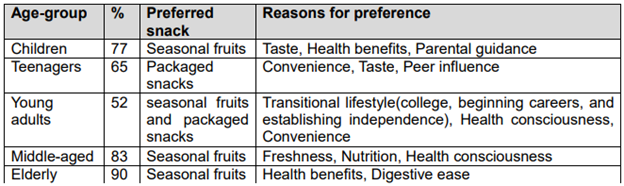
The survey results revealed interesting insights into snacking preferences among different age groups:
(5) Implications for Interventions:
By discerning the diverse preferences among different age groups, policymakers and health practitioners can tailor interventions to address specific demographic needs. For instance, targeting educational campaigns towards parents could empower them to instill healthy eating habits in their children from an early age. Concurrently, efforts to mitigate the influence of advertising and peer pressure on teenagers could involve regulatory measures and educational initiatives aimed at promoting critical thinking and informed decision-making. Furthermore, the prominence of seasonal fruits as a preferred snack choice among middle aged adults and senior’s points towards the importance of promoting access to fresh produce and nutritional education across all age demographics.
(6) Conclusion: The survey outcomes serve as a roadmap for designing targeted interventions that not only cater to diverse demographic needs but also nurture a culture of health and well-being. By harnessing the insights gleaned from this study, stakeholders can collaboratively work towards building healthier communities and promoting sustainable practices for generations to come.
Created for Academic Usage / 315 words
Answer the following questions, based on given passage.
I. Complete the following suitably.
In the introduction, the researcher links a hasty lifestyle with the choice of snacks in the study to highlight__________.
View AnswerAns. how busy daily routines influence people to opt for quick and convenient eating options, often at the expense of nutritional value
II. What would the following be classified as?
To examine snacking preferences across various age groups in detail, and assess health implications.
Select the appropriate response.
A. Primary purpose
B. Secondary objective
C. Method of analysis
D. Research outcome
View AnswerAns. A. Primary purpose
III. Give two points to support why it is likely that fresh fruits were given as an option to the survey participants to choose from in the study on snacking preferences.
View AnswerAns. The TWO points are –
a) Health focus, as fruits are widely recognised for their health benefits, and this aligns with the study’s goal to analyse snacking habits and their implications for health (making fresh fruits a relevant choice for understanding healthy snacking behaviours).
b) Comparative analysis, as the study aims to compare the health implications of seasonal fruits versus packaged snacks. Including fresh fruits allows researchers to directly evaluate preferences between natural, healthier choices and processed, potentially less healthy alternatives.
IV. Paragraph 3 includes words – ‘motivations’ and ‘influences.’ Classify the following sentences as ‘influence’ or ‘motivation’:
Sentence 1: Peer pressure leads teenagers to prefer packaged snacks over healthier options.
Sentence 2: The drive to maintain health as one ages makes middle-aged adults to choose seasonal fruits.
View AnswerAns. Influence – sentence 1 ; Motivation – sentence 2
V. Read the following:
Seema regularly enjoys snacking on chips and cool drinks while watching movies. Mohan, her neighbour, prefers to snack on oranges and also some nuts occasionally. Arindam, who lives across, often tends to eat a mix of carrot sticks and instant noodles, in between meals.
Select the option that identifies the correct demographic Seema, Mohan and Arindam belong to.
A. Seema – young adult; Mohan – teenager; Arindam -middle-age
B. Seema – teenager; Mohan – middle-age; Arindam -child
C. Seema – young adult; Mohan – child; Arindam – teenager
D. Seema – teenager; Mohan – elderly; Arindam -young adult
View AnswerAns. D. Seema – teenager; Mohan – elderly; Arindam -young adult
VI. Although children, middle-aged, and elderly groups all prefer seasonal fruits, why is the preference percentage highest among the elderly?
View AnswerAns. Due to their increased health needs and focus on foods that are easier to digest and nutritionally beneficial.
VII. Analyse how targeted interventions based on the diverse snacking preferences of different age groups can lead to improved health outcomes. (Paragraph 5)
View AnswerAns. Targeted interventions can effectively address specific health needs by focusing on the unique factors influencing each demographic’s snacking choices. For example, educational campaigns for parents can foster early healthy eating habits in children, while initiatives for teenagers can reduce the impact of advertising and peer pressure, promoting wiser food choices. Also, ensuring that middle-aged and older adults have access to fresh produce supports ongoing health maintenance, directly contributing to overall improved health outcomes across the lifespan.
VIII What is the ultimate goal for stakeholders, based on the insights from the study?
A. Increase profitability through enhanced snack marketing
B. Building healthier communities
C. Reducing the cost of healthcare services
D. Expanding the range of available snack product
View AnswerAns. B. Building healthier communities
SECTION B
CREATIVE WRITING SKILLS (18 marks)
3. Attempt any one of the two, (A) or (B), in about 50 words
A. Your school is planning to conduct an inter-class seminar on the topic-The Importance of Mental Health-to create awareness in adolescents. As the head of the organising committee, write a notice to inform all students about the seminar and invite registrations from classes XI-XII. Include other necessary details. Put your notice in a box.
OR
B. Your school is organising an inter-House webinar on enhancing coding skills, As the President of the Computer Club, write a notice to inform all House members from IX-XII about the webinar and specify the number of registrations invited per House. Include other necessary details. Put your notice in a box.
4. Attempt any one of the two, (A) or (B), in about 50 words.
A. Draft an invitation in not more than 50 words from Vani Gopalan, Chief Project Officer of an NGO, for the launch of the ‘Each One Teach One’ programme, addressed to school Principals and Coordinators. Mention a compelling highlight of the programme along with other necessary details
OR
B. An invitation had been issued by Mr. Cherian, the HR Head of your company inviting you for the company picnic. As Joseph Vijayan, Asst. Manager, Operations, draft a reply in not more than 50 words, consenting to attend.
5. Attempt any one of the two, (A) or (B), in 120 150 words
A. Financial literacy is increasingly recognised as a crucial 21st-century skill for young individuals. Write a letter to the editor of a local daily discussing the benefits of providing financial literacy education to children. Also, suggest effective ways to raise awareness about the importance of this education among parents and guardians. You may use some of the given cues along with your own ideas to draft the letter. You are a counsellor, Chitra Mahapatra from Puri, Odisha.

OR
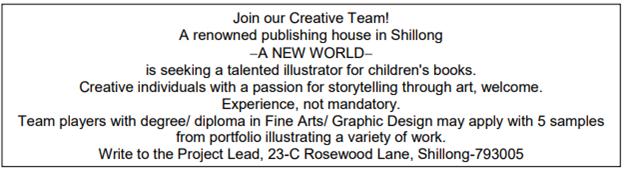
B. You are Maya Syiem from Shillong. You read the given advertisement and wish to apply for the post advertised. Write this job application along with your bio-data.
6. Attempt any one of the two, (A) or (B), in 120 150 words
A. In an era of rapid globalisation and technological advancement, the preservation of cultural heritage remains a vital challenge, particularly for the youth. India continues to navigate the complexities of maintaining tradition alongside modernity. Write an article exploring the role of cultural heritage in shaping the identities of today’s Indian youth. Provide examples to illustrate your points wherever necessary. You may use some of the given cues along with your own ideas. You are Arti Nirula of Class XII-A.

OR
B. You are Hina Aziz, student of Class XII-D and a member of the school magazine editorial board. Write a comprehensive report detailing the activities undertaken by students as part of the celebrations on Yoga Day. Include descriptions of the events, participation details, and the overall impact of these activities on the school community. You may organise your report by following – Who – What – When – Where – Why – How
SECTION C
LITERATURE
7. Read the following extracts and answer the questions for any one of the given two-A or B
A Those who prepare green wars,
wars with gas, wars with fire,
victory with no survivors,
would put on clean clothes
and walk about with their brothers
in the shade, doing nothing.
(poem – Keeping Quiet)
I. What is a common outcome of all the wars described?
View AnswerAns. Gaining victory with no survivors
II What does the imagery of ‘walking about with their brothers in the shade’ primarily represent?
A. The readiness for further conflicts.
B. A return to normal activities post-conflict.
C. A moment of unity and peaceful reflection.
D. The physical environment of a typical war zone.
View AnswerAns. C. A moment of unity and peaceful reflection.
III. Complete the following suitably.
The putting on of ‘clean clothes’ by the warmongers, symbolizes _________
View AnswerAns. …a potential for change and renewal / a moment of pause and reflection / an act of cleansing of their actions /embracing a peaceful existence/ the possibility of transformation
IV. Select the correct option from those given in brackets, to fill in the blank.
The excerpt tells us that the speaker ________ (condemns / glorifies) the destructive nature of modern warfare.
View AnswerAns. condemns
V. Read the assertion and the reason below, with reference to the given extract. Assertion: The poet advocates for ‘doing nothing’ as a way to prevent the devastation of war
Reason: ‘Doing nothing’ refers to a time for stopping any action for a few moments.
Choose the correct option regarding their relationship.
A. Both the assertion and the reason are true, and the reason is the correct explanation of the assertion.
B. Both the assertion and the reason are true, but the reason is not the correct explanation of the assertion.
C. The assertion is true, but the reason is false.
D. The assertion is false, but the reason is true.
View AnswerAns. B. Both the assertion and the reason are true, but the reason is not the correct explanation of the assertion.
VI. How can the message in the excerpt, about the outcome of wars be applied to promote peace?
View AnswerAns. Global leaders and communities can work toward more sustainable and peaceful solutions – Can be used to advocate for non-violent resolutions / peace negotiations in contemporary conflicts / Can be used to promote dialogue and understanding over aggression and warfare
OR
B While greedy good-doers, beneficent beasts of prey,
Swarm over their lives enforcing benefits
That are calculated to soothe them out of their wits,
And by teaching them how to sleep they sleep all day,
Destroy their sleeping at night the ancient way.
(poem-The Roadside Stand)
I Select the phrase that suggests the following:
The so-called aids are not offered out of genuine care or consent but are imposed in a controlling and perhaps unwelcome manner.
View AnswerAns. enforcing benefits
II What does the imagery of ‘swarm’ NOT represent in the given extract?
A. Coordinated help
B. Overwhelming force
C. Discomfort and chaos
D. Neglect of individual needs
View AnswerAns. A. Coordinated help
III Complete the following suitably.
In the line, ‘destroy their sleeping at night the ancient way,’ the phrase ‘the ancient way’ refers to________.
View AnswerAns. the traditional and longstanding sleeping patterns and nighttime rituals that have been part of the rural community’s lifestyle for generations (deeply rooted cultural practices)
[The speaker suggests that the modern practices, possibly influenced by external forces such as urbanisation or industrialisation, disrupt the natural sleep patterns of the rural inhabitants – dilute their time-tested ways.]
IV. Select the correct option from those given in brackets, to fill in the blank.
The poet has used phrases like ‘greedy good-doers’ and ‘beneficent beasts of prey’ to illustrate the ________ (irony/satire) in the situation where those claiming to help the rural poor actually impose self-serving and detrimental actions on them.
View AnswerAns. irony
V. Read the assertion and the reason below, with reference to the given extract.
Assertion: The poet criticizes the way the rural poor are treated by benefactors, suggesting it instills ambition.
Reason: The interventions are overwhelmingly calming and lead to a loss of critical thinking among the rural poor.
Choose the correct option regarding their relationship:
A. Both the assertion and the reason are true, and the reason is the correct explanation of the assertion.
B. Both the assertion and the reason are true, but the reason is not the correct explanation of the assertion.
C. The assertion is true, but the reason is false.
D. The assertion is false, but the reason is true.
View AnswerAns. D. The assertion is false, but the reason is true.
VI. State in one sentence, what cautionary advice your address to the rural poor from the extract, is most likely to include.
View AnswerAns. Be wary of involvements by outsiders that might appear benevolent but could ultimately undermine your autonomy and dull your critical thinking abilities. [language / expression may vary but the idea should remain relevant]
8. Read the following extracts and answer the questions for any one of the given two, (A) or (B)
A. To visit Antarctica now is to be a part of that history; to get a grasp of where we’ve come from and where we could possibly be heading. It’s to understand the significance of Cordilleran folds and pre-Cambrian granite shields; ozone and carbon; evolution and extinction. When you think about all that can happen in a million years, it can get pretty mind-boggling. Imagine: India pushing northwards, jamming against Asia to buckle its crust and form the Himalayas; South America drifting off to join North America, opening up the Drake Passage to create a cold circumpolar current, keeping Antarctica frigid, desolate, and at the bottom of the world.
(Journey to the End of the Earth)
I. Complete the following suitably.
The passage suggests that visiting Antarctica offers insight into geological processes and Earth’s history by ______________.
View AnswerAns. … exploring Cordilleran folds, granite shields, and environmental factors like ozone and carbon
II. How does the author imply the role of geological knowledge in understanding the Earth’s past and potential future changes?
View AnswerAns. The author does so by linking geological events to Antarctica’s environmental conditions, highlighting the significance of geological processes in shaping the planet’s history and future trajectories
III. The writer says, ‘When you think about all that can happen in a million years, it can get pretty mind-boggling.’
What is the most likely impact on the writer?
A. Feels overwhelmed by the vastness of geological time scales.
B. Is uneasy about the rapid pace of geological changes.
C. Feels indifferent towards geological phenomena.
D. Is surprised by the lack of significant geological events over a million years.
View AnswerAns. A. Feels overwhelmed by the vastness of geological time scales.
IV. How might understanding the geological processes mentioned in the passage help scientists in predicting and mitigating future environmental changes, particularly in polar regions?
View AnswerAns. By providing insights into how geological events impact polar regions and influence global climate patterns.
OR
B. I cried aloud, shaking my head all the while until I felt the cold blades of the scissors against my neck, and heard them gnaw off one of my thick braids. Then I lost my spirit. Since the day I was taken from my mother I had suffered extreme indignities. People had stared at me. I had been tossed about in the air like a wooden puppet. And now my long hair was shingled like a coward’s! In my anguish I moaned for my mother, but no one came to comfort me. Not a soul reasoned quietly with me, as my own mother used to do; for now, I was only one of many little animals driven by a herder.
(Memories of Childhood: The Cutting of My Long Hair)
I. Complete the following suitably.
Zitkala-Sa’s description of her experience at the boarding school conveys a sense of abandonment through her portrayal of __________
View AnswerAns. …isolation and lack of support / absence of any solace or reassurance from others / being an animal to a herder thereby suggesting a loss of identity
II. List any one emotion that Zitkala-Sa experiences as her hair is being cut.
View AnswerAns. anguish/ sense of loss/ turmoil ( any other relevant)
III. Select the suitable option to complete the following.
The metaphor of being ‘tossed about in the air like a wooden puppet’ contribute to the reader’s understanding of Zitkala-Sa’s feelings of being ________.
View AnswerA. forced to interact with others
B. manipulated and controlled
C. preached at and insulted
D. made to exist like toy animals
View AnswerAns. B. manipulated and controlled
IV In what ways does the imagery of her ‘long hair shingled like a coward’s’ symbolise the erasure of Zitkala’s cultural heritage and the imposition of Western norms?
View AnswerAns. The imagery symbolises the forced assimilation and suppression of Indigenous culture, portraying the cutting of her hair as an act of cultural violence and the imposition of Western ideals of appearance and behaviour.
9. Read the following extracts and answer the questions for any one of the given two, A or B.
A. What a thunderclap these words were to me! Oh, the wretches; that was what they had put up at the town-hall! My last French lesson! Why, I hardly knew how to write! I should never learn anymore! I must stop there, then! Oh, how sorry I was for not learning my lessons, for seeking birds’ eggs, or going sliding on the Saar! My books, that had seemed such a nuisance a while ago, so heavy to carry, my grammar, and my history of the saints, were old friends now that I couldn’t give up. And M. Hamel, too; the idea that he was going away, that I should never see him again, made me forget all about his ruler and how cranky he was.
(The Last Lesson)
I. What was the writer’s purpose in using the metaphor of a ‘thunderclap’?
View AnswerAns. To emphasise the suddenness and shock of Franz’s understanding about the importance of his education./ To conveys the urgency and deep impact of this moment / To dramatically highlight how unexpected and jarring the realisation was to him – like the startling and instant nature of a thunderclap / To effectively captures the emotional intensity of the moment of deep regret and abrupt awakening experienced by Franz
II. Select the correct option from those given in brackets to fill in the blank.
The use of exclamatory marks in the first five sentences of the extract serves to express the speaker’s _______ (hidden/ intense) emotions.
View AnswerAns. intense
III. Complete the following suitably.
The activities of seeking birds’ eggs and sliding on the Saar reveal two things about Franz’s character before his change in perspective. First, his youthful carefree nature and second, his preference for _________________.
View AnswerAns. …preference for play over study
IV. What is reflected through the shift in the speaker’s perception of Mr. Hamel, conveyed through his readiness to forget the ruler?
View AnswerAns. It reflects a newfound respect and appreciation, overshadowing past fears of discipline and strictness.
V. Select the textual option that is closest to indicating a sense of panic.
A. Oh, how sorry I was for not learning my lessons…
B. Why, I hardly knew how to write!
C. Oh, the wretches; that was what they had put up at the town-hall!
D. And M. Hamel, too;
View AnswerAns. B. Why, I hardly knew how to write!
VI. What does the following line from the extract, showcase?
My books, that had seemed such a nuisance a while ago, so heavy to carry, my grammar, and my history of the saints, were old friends now that I couldn’t give up.
A. realization
B. confusion
C. expectation
D. affirmation
View AnswerAns. A. realization
OR
B. And survival in Seemapuri means rag-picking. Through the years, it has acquired the proportions of a fine art. Garbage to them is gold. It is their daily bread, a roof over their heads, even if it is a leaking roof. But for a child it is even more “I sometimes find a rupee, even a ten-rupee note,” Saheb says, his eyes lighting up. When you can find a silver coin in a heap of garbage, you don’t stop scrounging, for there is hope of finding more. It seems that for children, garbage has a meaning different from what it means to their parents. For the children it is wrapped in wonder, for the elders it is a means of survival.
(Lost Spring – Stories of Stolen Childhood)
I. What does Saheb’s statement about finding money in the garbage reveal about his daily life and aspirations?
View AnswerAns. It highlights his precarious economic situation and his dependence on chance finds for small joys and possibly essential income, reflecting the dire poverty and limited opportunities available to him.
II. Select the correct option from those given in brackets to fill in the blank.
Describing garbage as ‘gold’ metaphorically elevates its value to the children, helping the reader understand the _______ (dynamic / desperate) conditions under which these children live, where even garbage can represent crucial economic resources.
View AnswerAns. desperate
III. Complete the following with a suitable reason.
Children continue to scrounge in the garbage because _______.
View AnswerAns. …finding valuable items like coins gives them hope of finding more
IV. How does the perception of garbage differ between children and adults in Seemapuri?
View AnswerAns. For children, garbage represents a source of wonder and potential treasure, whereas for adults, it is primarily a means of survival
V. What is implied by the description of rag-picking as having ‘acquired the proportions of a fine art’ in the excerpt?
A. Rag-picking is an undesirable and simple task that anyone can do without effort.
B. Rag-picking has evolved into a complex skill that is valued within the community.
C. Rag-picking is a temporary activity that does not significantly impact the community.
D. Rag-picking has the status of an artistic hobby that children pursue for enjoyment.
View AnswerAns. B. Rag-picking has evolved into a complex skill that is valued within the community.
VI. What is the reason for Saheb’s eyes ‘lighting up’?
A. The immediate experience of finding something valuable.
B. Discussing his findings with others.
C. Reminiscing about past findings in the garbage.
D. Planning future scavenging expeditions
View AnswerAns. C. Reminiscing about past findings in the garbage.
10. Answer any five of the following six questions in 40 50 words each :
I. Identify an instance of hope or resilience in ‘Lost Spring’ and analyse how it reflects one of the story’s themes.
View AnswerAns. An instance of hope or resilience – Saheb’s continued search in the garbage, driven by the occasional discovery of a rupee or a ten-rupee note, symbolises his hope and resilience against the overwhelming odds of his harsh life. This reflects the theme of enduring hope amidst poverty and destitution – the human spirit’s capacity to dream and hope, even in the terribly dire circumstances — suggesting that the desire for a better life can exist independent of one’s current state of poverty
II. Interpret the use of visual imagery by Kamala Das in her poem to depict the passage of time.
View AnswerAns. (Any one)
§ The image of her aging mother – ‘pale as a late winter’s moon,’ — conveys the fragility and the inevitability of aging — highlights the physical changes brought by time and evokes a sense of gentle, serene decline rather than abrupt decay
§ The image with the vivid, lively description of young trees sprinting and merry children spilling out of their homes — contrasts sharply with her mother’s stillness and silence — enhances the sense of her mother’s isolation in her old age / the relentless passage of time that spares no one — life’s transient nature
III. What does the contrasting imagery of the church clock and the Prussian trumpets represent, in ‘The Last Lesson’?
View AnswerAns. Represents — the tension between local traditions and foreign occupation
The church clock — symbol of local, everyday life and continuity — in stark opposition to the Prussian trumpets, which symbolise disruption, military power, and the enforcement of foreign rule Highlights the theme of loss and the struggle to preserve one’s cultural heritage against overwhelming odds
IV. How does the author’s writing style in ‘The Interview’ affect the reader’s understanding of the story?
View AnswerAns. The author’s writing style – often blends a conversational tone with introspective moments — deeply affects the reader’s engagement and understanding of the narrative. Use of direct dialogues interspersed with reflective commentary – this approach not only makes the interactions more dynamic and engaging but enhances the reader’s insight into the complexities of personalities and themes being explored
V. Explain how the rattrap symbolises the dual aspects of human nature. (The Rattrap)
View AnswerAns. Dual –
§ The tendency towards greed and deceit – society, driven by wealth and gain, ensnares individuals, reducing their existence to a constant struggle to escape from materialistic enticements
§ The potential for redemption through empathy and kindness –kindness and trust by the ironmaster’s daughter, Edla, inspires the peddlar to reclaim his essential humanity and escape the identity of a thief – signified by his decision to return the stolen money and leaving a note explaining his thoughts about the world being a rattrap
VI What factor/s were largely instrumental in the victory of the peasants in ‘Indigo’?
View AnswerAns. Largely due to the leadership and advocacy provided by Mahatma Gandhi — his involvement brought national attention to their plight –highlighted the importance of civil rights and nonviolent resistance
Gandhi’s strategic approach to negotiations & his insistence on nonviolent protest — empowered the peasants to stand up against oppressive landlords — led to their immediate victory — inspired a broader movement for social and economic justice across India
11. Answer any two of the following three questions in 40 50 words each :
I. Discuss the significance of the toy tiger in the climax of ‘The Tiger King.’
View AnswerAns. The significance of the toy tiger lies in its stark contrast to the dangerous live tigers the Maharaja had been hunting throughout his life. Its role in his death brings up the themes of irony and fate central to the story. It illustrates — despite human efforts to control or escape destiny, it can manifest in the most unexpected and trivial forms. The toy tiger symbolises — the ultimate futility of the Maharaja’s efforts — points to the folly of those who believe they can master fate through power or violence
II. Interpret the significance of both literal and metaphorical journeys in the story, ‘The Third Level.’
View AnswerAns. The literal journey involves Charley, discovering a supposed ‘third level’ at the Grand Central Station–a portal to the year 1894. The metaphorical journey– Charley’s inner longing for a simpler, more reassuring past—a common human desire to retreat to a time perceived as better or less complicated. The significance – their portrayal of the universal quest for happiness and fulfillment — together, these journeys explore themes of escapism, the subjective nature of reality, and the deep-seated human need for connection and comfort in familiar but idealised, settings.
III. How does Susan Hill subtly portray a blend of pessimism and optimism in ‘On the Face of It’?
View AnswerAns. Derry is of the pessimistic view whereas Mr. Lamb is of the optimistic view point. Both are disabled but still view life from different perspectives.
Both protagonists challenges with disfigurement are depicted with a stark realism that leans towards pessimism, yet interactions that offer genuine connection hint at underlying optimism — suggest the possibility of emotional survival despite physical and social barriers
12. Answer any one of the following two questions, in about 120-150 words.
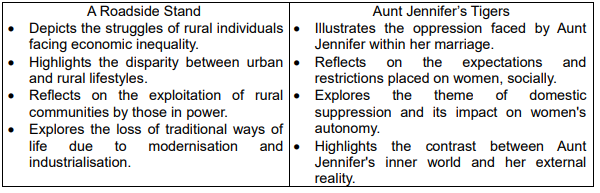
A Analyse the poems, A Roadside Stand and Aunt Jennifer’s Tigers for the theme of inequality and its impact on the bearers.
View AnswerAns. ‘A Roadside Stand’ focuses on the economic disparities between rural and urban areas, and ‘Aunt Jennifer’s Tigers’ delves into the gender-based inequalities within marriage and society
Impact on Bearers:
§ A Roadside Stand — rural folk are portrayed as struggling to make ends meet due to economic disparities, leading to feelings of frustration and helplessness.
§ Aunt Jennifer’s Tigers – Aunt experiences oppression and suppression within her marriage
§ Both sets of bearers face the psychological and emotional toll of their respective inequalities, resulting in a longing for freedom and empowerment.
§ Despite their challenges, the bearers in both poems demonstrate a desire to assert themselves through small acts of defiance or dreams of liberation.
OR
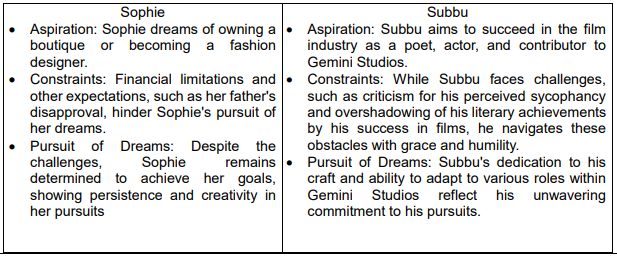
B How do the characters of Sophie from ‘Going Places’ and Subbu from ‘Poets and Pancakes’ compare and contrast in terms of their aspirations, constraints, and the pursuit of their dreams?
View AnswerAns. While both Sophie and Subbu share aspirations for success in their respective fields, they encounter different constraints and demonstrate distinct approaches in pursuing their dreams.
13. Answer any one of the following two questions, in about 120-150 words
A The influence of belief in traditions such as religion, family bonds, or patriotism can be used to develop narrative techniques like setting, motivation, sources of conflict, and pacing. Analyse how the writer has incorporated such influences to good effect in the story, The Enemy. Support your answer with valid textual evidence.
View AnswerAns. § Incorporation of Traditions:
® Religion – how religious beliefs influence character actions and decisions.
For example, Sadao’s internal conflict may be influenced by his moral beliefs shaped by religious teachings.
® Family Bonds – how relationships in the family impact character interactions and motivations.
For example, Hana’s concern for the safety of her family and the potential repercussions of harbouring an enemy soldier could drive her actions.
® Patriotism – how national loyalty and patriotism create tension and conflict in the story.
For example, Sadao’s duty as a citizen and as a doctor may conflict with his compassion towards the wounded soldier, highlighting the complexities of wartime allegiances.
§ Narrative Techniques:
® Setting – how the wartime setting amplifies the moral dilemmas faced by the characters.
The backdrop of war intensifies the stakes and adds urgency to their decisions.
® Motivation – how cultural influences shape character motivations and drive the plot forward.
The characters’ actions may be guided by deeply ingrained cultural values and beliefs.
® Sources of Conflict – the key conflicts stemming from cultural differences, expectations, and wartime circumstances.
These conflicts drive the narrative forward and heighten the tension.
® Pacing – how the pacing of the story reflects the characters’ internal struggles and external conflicts.
The pacing may fluctuate to convey moments of tension, reflection, and resolution.
OR
B Discuss the narrative techniques used by the author in The Third Level. How do these techniques effectively convey the themes of escapism and nostalgia? Provide specific examples from the text to support your analysis.
View AnswerAns. (Any two narrative techniques)
[The examples may be references and not direct quotes]
a) First-Person Narrative:
® Technique – The story is narrated from the first-person perspective of Charley, which creates an intimate and personal recounting of his experiences and thoughts.
® Effect – This technique allows readers to directly engage with Charley’s desires and fears, making his longing for escape and the nostalgia for a simpler past more tangible.
® Textual Evidence – Charley states, “But that’s the reason, he said, and my friends all agreed. Everything points to it, they claimed. My stamp collecting, for example; that’s a ‘temporary refuge from reality.’”
This personal reflection shares his internal justifications and how others perceive his escapism.
b) Detailed Descriptive Language:
® Technique – The use of vivid and specific descriptions of settings and times, particularly Charley’s descriptions of the third level of Grand Central Station.
® Effect on Themes – These descriptions not only build a believable world but also vividly paint the past, stressing the theme of nostalgia and the allure of escapism to a seemingly better and simpler time.
® Textual Evidence – “Then I saw why; they were open-flame gaslights.” and “everyone in the station was dressed like eighteen-ninety-something; I never saw so many beards, sideburns, and fancy mustaches in my life.”
These details highlight the historical setting Charley escapes to, filled with elements from the past.
c) Symbolism:
® Technique – The story uses the ‘third level’ as a symbol, representing not just a physical place but a mental escape into another time.
® Effect on Themes – The third level serves as a metaphor for the psychological refuge one seeks from the modern world’s anxieties, underlining the theme of escapism.
® Textual Evidence – Charley mentions, “Grand Central has been an exit, a way of escape—maybe that’s how the tunnel I got into.”
This line explicitly connects the physical space of the third level to the concept of escaping reality
d) Contrast and Irony:
® Technique – The stark contrast between Charley’s mundane, modern life and his adventures on the third level introduces a layer of irony.
® Effect on Themes – This contrast enhances the nostalgic appeal of the third level while ironically pointing out the impracticalities of such escapism.
® Textual Evidence – “The clerk figured the fare—he glanced at my fancy hatband, but he figured the fare—and I had enough for two coach tickets, one way. But when I counted out the money and looked up, the clerk was staring at me.”
This shows how out of place modern elements are in the past, highlighting the nostalgic yet challenging nature of his escape