Class XII Session 2025-26
Subject – Economics
Time Allowed: 3 hours Maximum Marks: 80
General Instructions:
1. This question paper contains two sections: Section A – Macro Economics Section B – Indian Economic Development
2. This paper contains 20 Multiple Choice Questions type questions of 1 mark each.
3. This paper contains 4 Short Answer Questions type questions of 3 marks each to be answered in 60 to 80 words.
4. This paper contains 6 Short Answer Questions type questions of 4 marks each to be answered in 80 to 100 words.
5. This paper contains 4 Long Answer Questions type questions of 6 marks each to be answered in 100 to 150 words.
SECTION A – MACRO ECONOMICS
1. What can be the maximum value of Marginal Propensity to Save?
a) 2
b) 1
c) 3
d) 0
View AnswerAns. b) 1
2. Which one of the following is an intermediate product?
a) Purchase of pulses by consumers
b) Machine purchased by a firm
c) Wheat used by a flour mill
d) Wheat used by households
View AnswerAns. c) Wheat used by a flour mill
3. In a hypothetical economy, Mr. Neeraj has deposited ₹100 in the bank. If it is assumed that there is no other currency circulation in the economy, then the total money supply in the economy will be ________.
a) ₹120
b) ₹100
c) not defined
d) zero
View AnswerAns. b) ₹100
4. Statement 1: Currency Depreciation makes the domestic currency less valuable and more of it is required to buy the foreign currency.
Statement 2: Currency Depreciation leads to an increase in National Income.
a) Both the Statements are true.
b) Statement 2 is true and Statement 1 is false.
c) Statement 1 is true and Statement 2 is false.
d) Both the Statements are false.
View AnswerAns. a) Both the Statements are true.
5. In a two sector economy, firms depend on the households for supply of:
a) Money
b) Goods and Services
c) Both Goods and Services and Factor Inputs
d) Factor Inputs
View AnswerAns. d) Factor Inputs
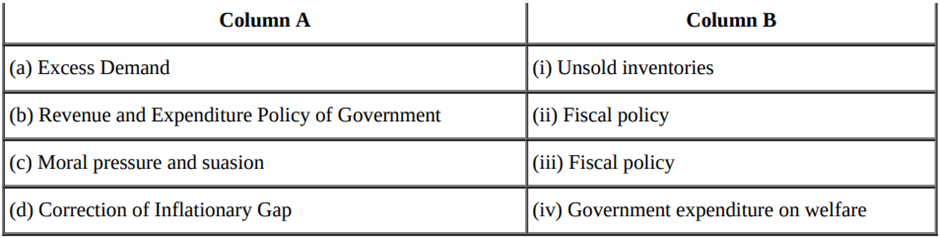
6. Identify the correctly matched pair from Column A to that of Column B:
a) (c) – (iii)
b) (d) – (iv)
c) (a) – (i)
d) (b) – (ii)
View AnswerAns. d) (b) – (ii)
7. Statement I: A part of the capital goods produced this year goes for maintenance or replacement of existing capital goods, called capital loss.
Statement II: Depreciation does not take into account unexpected/unforeseen obsolescence or sudden destruction or disuse of capital as can happen with accidents, natural calamities or other such extraneous circumstances.
a) Statement I is true, Statement II is false.
b) Statement II is true, Statement I is false.
c) Both the statements are false.
d) Both the statements are true.
View AnswerAns. b) Statement II is true, Statement I is false.
8. Demand deposits include:
a) Saving account deposits and current account deposits
b) All types of deposits
c) Saving account deposits and fixed deposits
d) Current account deposits and fixed deposits
View AnswerAns. a) Saving account deposits and current account deposits
9. Assertion (A): Trade deficit is always a great cause of worry for an economy.
Reason (R): Trade deficit is a lesser cause of worry if it reflects a rise in investment which will build the capital stock and increase the future output in an economy.
a) Both A and R are true and R is the correct explanation of A.
b) Both A and R are true but R is not the correct explanation of A.
c) A is true but R is false.
d) A is false but R is true.
View AnswerAns. d) A is false but R is true.
10. Himanshu approached a bank for taking loan. The head of the Loan department told that there will be a difference between the amount of loan granted to him and the market value of the security offered by him against the loan. From the following, choose the correct alternative which specifies the concept explained by head of the Loan department.
a) Statutory Liquidity Ratio
b) Bank Rate
c) Margin Requirements
d) Repo Rate
View AnswerAns. c) Margin Requirements
11. Using a suitable example, distinguish between positive externalities and negative externalities.
View AnswerAns. Positive externalities refer to benefits caused by one entity to another, without being paid for it. Whereas, negative externalities refer to the harms caused by one entity to another, without being penalised for it. For example: A new park developed by the municipal corporation raises the welfare of the locality, is an example of positive externalities. In case, the same park is used by people for anti-social activities, which leads to insecurity among the residents, is an example of negative externalities.
12. Explain the medium of exchange function of money.
View AnswerAns. The most important function of money is that it serves as a medium of exchange between two parties involved in a transaction. In the barter economy, great difficulty was experienced in the exchange of goods as the exchange in barter system required a double coincidence of wants. Money avoids the practical problems of wastage of time and resources, involved in the barter system of an exchange and it improves the transactional efficiency. It also promotes allocational efficiency in the trade and production of goods and services. Hence, it can be said that money has separated the acts of sales and purchases.
OR
Explain the process of money creation by commercial banks, giving a numerical example.
View AnswerAns. It is one of the most important activities of commercial banks. Through the process of money creation, commercial banks are able to create credit, which is in far excess of the initial or Primary Deposits. let us now understand the process of Money Creation through an example:
Suppose, initial or primary deposits in banks is ₹ 1,000 and LRR is 20 %. It means, banks are required to keep only ₹ 200 as cash reserve and are free to lend ₹ 800. Suppose they lend ₹ 800. Banks do not lend this money by giving amount in cash. Rather, they open the accounts in the names of borrowers, who are free to withdraw the amount whenever they like. Refer the following table:
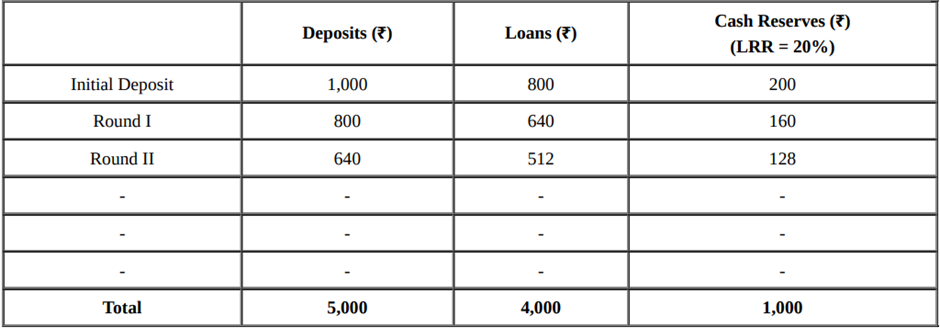
As seen in the table, banks are able to create total deposits of ₹ 5,000 with the initial deposit of just ₹ 1,000. It means, total deposits become ‘five times’ of the initial deposit. Five times is nothing but the value of ‘Money Multiplier’.
13. How will you treat the following while estimating domestic factor income of India? Give reason for your answer.
i. Remittances from non-resident Indians to their families in India.
View AnswerAns. Such remittance is not earned within domestic territory of India hence, it is not a part of domestic factor income of India.
ii. Rent paid by the Embassy of Japan in India to a resident Indian.
View AnswerAns. It is a part of NFIA as the Japanese embassy is not within our domestic territory and hence, it is not a part of the domestic factor income of India as such income is not accrued from the domestic territory
iii. Profits earned by branches of foreign bank in India.
View AnswerAns. It is a factor income paid abroad and therefore not a part of domestic factor income of India.
OR
Suppose the Gross Domestic Product (GDP) of Nation X was ₹ 2,000 crores in 2018-19, whereas the Gross Domestic Product of Nation Y in the same year was ₹ 120,000 crores. If the Gross Domestic Product of Nation X rises to ₹ 4,000 crores in 2019-20 and the Gross Domestic Product of Nation Y rises to ₹ 200,000 crores in 2019-20. Compare the rate of change of GDP of Nations X and Y, taking 2018-19 as base year.
View AnswerAns. The rate of change of GDP of Nations X and Y, taking 2018-19 as base year is as follows:

Nation X has registered a GDP growth rate of 100% and has performed better on the front of GDP rise as compared to Nation Y that has registered a GDP growth rate of 66.67%.
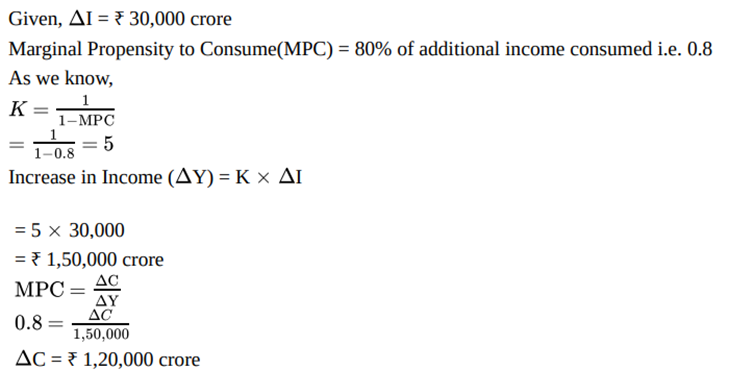
14. For a hypothetical economy, assume the government increased an infrastructural investment by ₹ 30,000 crore. 80% of additional income is consumed in the economy. Estimate the increase in income and the corresponding increase in consumption expenditure in the economy.
View AnswerAns.
OR
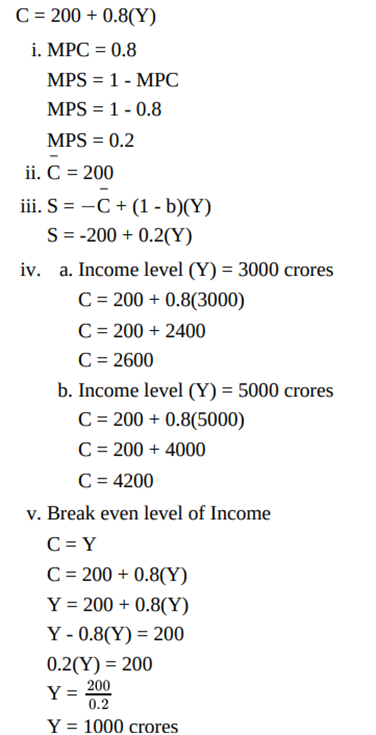
The consumption function for an economy is given as: C= 200 + 0.8Y.
i. Determine the value of MPC and MPS
ii. Autonomous Consumption
iii. Derive the corresponding saving function
iv. Calculate consumption at the income levels of ₹ 3,000 crores and ₹ 5,000 crores.
v. Determine the break-even level of income.
View AnswerAns.
15. Elaborate the Bankers Bank function of the Central Bank of a nation.
View AnswerAns. As the banker to the banks, the central Bank is the custodian of the cash reserves of commercial banks. From these reserves it lends to commercial banks when they are in need of funds. Central bank also provides cheque clearing and remittance facilities to the commercial banks. Central bank is the lender of last resort.
16. Answer the following questions:
(a) What are two alternative ways of determining equilibrium level of income? How are these related?
View AnswerAns. Two alternative ways of determining equilibrium level of income are:
i. Aggregate Demand-Aggregate Supply Approach (AD-AS Approach)
ii. Saving-Investment Approach (S-I Approach).
Interrelation between the two approaches:
AD = AS (AD – AS approach)
C + I = C + S
I = S (S – I approach).
(b) Explain the meaning of investment multiplier. What can be its minimum value and why?
View AnswerAns. an initial increment in investment increases the final income by many times. Multiplier expresses the relationship between an initial increment in investment and the resulting increase in aggregate income. The minimum value of multiplier is one when the value of MPC is zero. MPC = 0 indicates that the economy decides to save the whole of its additional income and nothing is spent as consumption expenditure. So, there will be no further increase in income. As a result, the total increase in income (ΔY) will be equal to the increase in investment (ΔI), i.e., ΔY = ΔI. Here, the value of multiplier is equal to 1
17. i. Distinguish between direct tax and indirect tax with the help of examples.
View AnswerAns. Direct taxes are those taxes whose impact and incidence lies on the same entity. In other words, the liability of paying direct taxes can’t be shifted. For example: income tax.
Whereas; Indirect taxes are those taxes whose impact and incidence may lie on different entities. In other words, the liability of paying indirect taxes can be shifted. For example: GST
ii. Explain the reallocation of resources objective of Government Budget.
View AnswerAns. Reallocation of resources- Government through its budgetary policies tries to reallocate resources to ensure fulfillment of various socio-economic objectives.
The government may influence the allocation of resources through:-
- Taxation policy – Heavy taxes may be imposed on harmful products to discourage their production and subsidies may be provided on the production of socially useful products to encourage their production.
- Government may directly undertake production of certain goods and services in the areas where private sector may not be willing to participate in production activities.
SECTION B – INDIAN ECONOMIC DEVELOPMENT
18. _____ means the excess of anticipated expenditures over estimated revenue.
a) Loss
b) Deficit
c) Profit
d) Surplus
View AnswerAns. b) Deficit
19. After Independence, in order to bring equity in agriculture, land reforms/policies were introduced by the government that includes ________.
i. Abolition of Zamindari System
ii. Green Revolution
iii. Land Ceiling
a) (i), (ii) and (iii)
b) Only (i)
c) Only (ii)
d) Both (i) and (iii)
View AnswerAns. d) Both (i) and (iii)
20. The Tapas Majumdar Committee, appointed by the government of India in 1998, estimated an expenditure of around ________ over 10 years (1998-99 to 2006-07) to being all Indian children in the age group of 6-14 years under the purview of school education.
a) ₹ 1.73 lakh crore
b) ₹ 1.45 lakh crore
c) ₹ 1.54 lakh crore
d) ₹ 1.37 lakh crore
View AnswerAns. d) ₹ 1.37 lakh crore
21. Assertion (A): Rural and agricultural credit means credit for farming. Credit is the lifeline of the farming activity in rural areas. The need for such credit is avoidable in India.
Reason (R): Most farming families in India are small and marginal holders producing just enough for subsistence. They seldom generate a surplus.
a) Both A and R are true and R is the correct explanation of A.
b) Both A and R are true but R is not the correct explanation of A.
c) A is true but R is false.
d) A is false but R is true.
View AnswerAns. d) A is false but R is true.
22. Hired worker can be categorised into two parts, they are
I. self worker
II. skilled worker
III. regular salaried worker
IV. unskilled worker
V. casual wage labour
a) Both II and IV
b) Both III and V
c) Both I and III
d) Both III and IV
View AnswerAns. b) Both III and V
23. In which of the following type of unemployment, is the marginal productivity of the worker zero?
a) Involuntary Unemployment
b) Disguised Unemployment
c) Structural Unemployment
d) Seasonal Unemployment
View AnswerAns. b) Disguised Unemployment
24. In an economy, when the rate of resource extraction is lower than the rate of regeneration of the resource, the environment may operate ________. (Fill up the blank with correct alternative)
a) within its carrying capacity
b) beyond its aesthetic capacity
c) beyond its absorptive capacity
d) beyond its carrying capacity
View AnswerAns. a) within its carrying capacity
25. Write the correct sequence of alternatives given in Column II by matching them with respective terms in Column I:
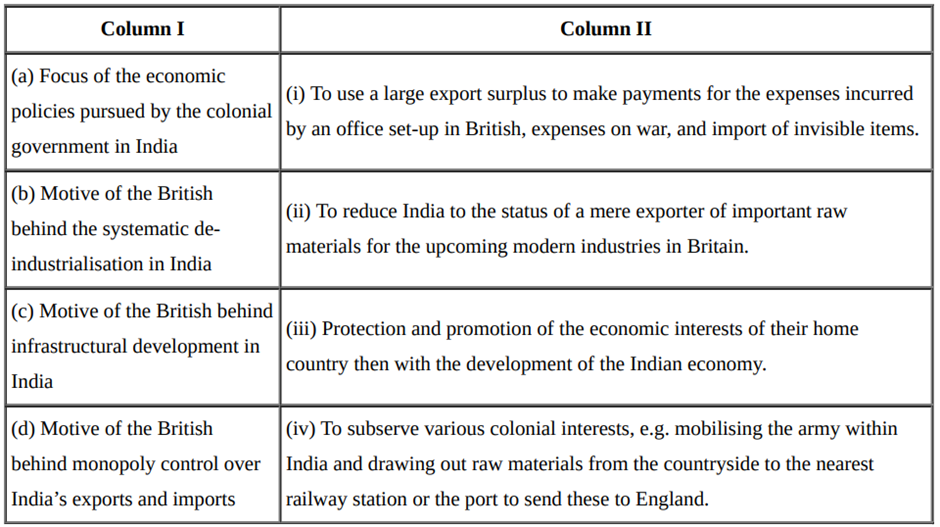
a) (a) – (iii), (b) – (ii), (c) – (iv), (d) – (i)
b) (a) – (iv), (b) – (i), (c) – (ii), (d) – (iii)
c) (a) – (i), (b) – (ii), (c) – (iii), (d) – (iv)
d) (a) – (ii), (b) – (i), (c) – (iv), (d) – (iii)
View AnswerAns. a) (a) – (iii), (b) – (ii), (c) – (iv), (d) – (i)
26. The colonial government made no sincere attempts to estimate India’s national and per capita income, but most studies found that India’s national income growth in the pre-Independence era was ________ and per capita income growth was ________.
a) less than 2 per cent, close to half per cent
b) close to 5 per cent, more than 2 per cent
c) less than 3 per cent, more than 1 per cent
d) close to half per cent, almost 0 per cent
View AnswerAns. a) less than 2 per cent, close to half per cent
27. Statement 1: Density of population of India is more than that of China and Pakistan.
Statement 2: In all the three countries (India, China and Pakistan), service sector contributes highest share of GVA.
a) Both the statements are true.
b) Both the statements are false.
c) Statement 1 is true and Statement 2 is false.
d) Statement 2 is true and Statement 1 is false.
View AnswerAns. a) Both the statements are true.
28. Why are regional and economic grouping formed?
View AnswerAns. The regional and economic grouping are formed to strengthen the relationship between the nations. To increase the trade through close cooperation so that it helps their economies to develop. The nations in these groups share their knowledge These groups are considered important especially for developing countries. Examples of regional and economic grouping are European union, ASEAN, SAARC etc.
This is particularly considered essential by developing countries as they are all facing competition not only from developed nations but also amongst themselves in the relatively limited economic space enjoyed by the developing world. Besides, cooperation with other economies in our neighbourhood is also required, as all major common economic activities in the region have an impact on overall human development in a shared environment.
29. Explain how the use of Non-conventional sources of energy can have a favourable impact on the environment?
View AnswerAns. Thermal and hydro power plants on which India depends for its power needs have and adverse impact on the environment. Non-conventional sources like wind power and solar rays are greener energy resources and are also cleaner. Latest technological devices like wind mills should be provided in areas where the wind speed is high so that these sources can be used to generate electricity with putting the environment at risk.
OR
Discuss any one current environmental challenge.
View AnswerAns. Global warming is a gradual increase in the average temperature of the earth’s lower atmosphere. It is caused by increases in carbon dioxide and other greenhouse gases. Burning of fossil fuels and deforestation are the major causes of Global Warming. Global warming is responsible for the melting of polar ice, leading to rising sea levels and coastal flooding, etc.
30. Discuss briefly the rationale behind choosing self-reliance as a planning objective for Indian economy.
View AnswerAns. The rationale behind choosing Self-reliance as a planning objective for the Indian economy are as follows:-
i. To reduce foreign dependence: Planning objective of Self-reliance targeted to promote economic growth and modernization, the Indian five-year plans in the early years of the post-independence era stressed the use of domestic resources in order to reduce our dependence on foreign countries.
ii. To avoid foreign interference: In the post-independence era, it was feared that the dependence on imported food supplies, foreign technology, and foreign capital may increase foreign interference in the policies of our country.
OR
Agriculture sector appears to be adversely affected by the economic reform process. Explain the given statement.
View AnswerAns. The statement suggests that the process of economic reform has had a negative impact on the agriculture sector. This could be due to various reasons. Economic reforms, such as liberalization and globalization, often prioritize industrial and service sectors, leading to reduced government support and investment in agriculture. This can result in limited access to credit, inadequate infrastructure, and a lack of modern technology and resources for farmers. As a result, the agriculture sector may face challenges in terms of productivity, competitiveness, and income generation, thus adversely affecting its overall performance.
31. Distinguish between:
i. Tariff and non-tariff Barriers,
View AnswerAns. The barriers which are imposed on imports of goods and services to make them relatively costlier and to protect the domestic producers from the stiff international competition are known as tariff barriers e.g. Import Duties, custom duties etc. Where as; Non-tariff barriers are those barriers which are imposed on quantity of import and export of goods and services e.g. quota and import licensing. to reduces the quantity of imported or exported goods.
ii. Bilateral and multilateral trade.
View AnswerAns. The trade (export and import) between two countries is known as bilateral trade. Whereas, The trade (export and import) among more than two countries is known as multi-lateral trade.
32. a. Name any one prominent economist who estimated India’s National Income during the Colonial period.
View AnswerAns. V.K.R.V. Rao
b. Discuss any two causes of India’s agricultural stagnation during the Colonial period.
View AnswerAns. Two causes of India’s agricultural stagnation during the Colonial period were:
i. The system of land settlement that was introduced by the colonial government particularly the zamindari system.
ii. Lack of irrigation facilities is causes of stagnation of agriculture sector.
33. Answer the following questions:
i. In your opinion, what are the advantages of privatisation to the economy?
View AnswerAns. Advantages of privatisation are as under:
i. It will introduce efficiency and profitability in Public Sector Undertakings (PSUs).
ii. It promotes consumer’s sovereignty. High degree of consumer’s sovereignty implies wider choice and better quality of goods and services.
iii. It will reduce budgetary deficits which result from expenditure on loss making PSUs.
iv. It promotes diversification of production. Also, unlike PSUs, private enterprises invariably generate high profits.
v. Often privatisation of state owned monopolies occurs alongside deregulation – i.e. policies to allow more firms to enter the industry and increase the competitiveness of the market.
ii. State the main objectives of liberalisation policy.
View AnswerAns. The main objectives of liberalisation policy are as under:
i. To increase competition among domestic industries by giving them freedom regarding the decisions pertaining to production.
ii. To increase foreign capital formation and improve technology.
iii. To decrease the debt of the country.
iv. To encourage cross border trade.
v. To expand the size of the market by reducing the limit on the quantity of output produced.
Since the NEP aims to achieve all the above stated objectives, therefore it is said that NEP is liberal.
OR
i. Indian economy was a stagnant economy on the eve of independence. Comment.
View AnswerAns. A stagnant economy means an economy where the growth rate of income does not change or changes very little. Such an economy has a prolonged period of slow economic growth. The stagnation of the Indian economy can be seen from the slow annual compound rate of growth which was not more than 0.5% during 1860-1945. The trends in agricultural output are also evidence of stagnation. Total agricultural output increased by only 10% while the per capita output of foodgrains declined by 32%. The main cause of the stagnation was that economic policies of Britishers were for the benefit of their industries and not for the Indian economy. Our economy had been a victim of enormous exploitation. Our natural resources, iron ores, gold mines, wealth and manpower was subject to intense exploitation. Due to these atrocities, the Indian economy on the eve of independence showed low economic growth.
ii. State with reason whether the following statements are True or False:
i. India’s Economy was poor and backward before the Colonial Rule.
View AnswerAns. False. India’s Economy was independent, self-reliant and prosperous before the Colonial Rule.
ii. India was well known for its handicraft industries before the advent of British Rule.
View AnswerAns. True. Indian handicraft industries enjoyed worldwide reputation.
iii. Primary motive of de-industrialisation by the British Rule was to promote India’s economy.
View AnswerAns. False. Their primary motive was:
a. To get raw materials from India at cheap rates; and
b. To sell finished products of British industries in Indian market at higher prices.
34. a. In the recent past the Government of India has taken vital steps to revive and popularise Indian System of Medicine (ISM). Do you agree with the given statement? Justify your answer with valid reasons.
View AnswerAns. This statement is true, to promote the education of Indian system of medicines and Ayurveda globally, ministry has signed 13 MoUs for setting up AYUSH academic chairs with foreign universities under which AYUSH experts are deputed in reputed universities to undertake teaching activities.
b. Casualization of workforce has became a perennial problem of the Indian economy. Justify the given statement with valid arguments.
View AnswerAns. The term “casualization of the workforce” means the transition of a workforce that is engaged in permanent jobs to one that is engaged on a temporary or casual basis. Due to the increase in the number of workers engaged on a temporary basis, this has become a concern for the Indian economy. This might occur as a result of migration to metropolitan regions where people only work as daily-wage or casual workers and disguised unemployment in rural areas. With India’s informal workforce, a rise in GDP is accompanied by a decline in job security. Daily wage workers are not get the same privileges or status as permanent employees in India.