Class XII Session 2025-26
Subject – Economics
Time Allowed: 3 hours Maximum Marks: 80
General Instructions:
1. This question paper contains two sections: Section A – Macro Economics Section B – Indian Economic Development
2. This paper contains 20 Multiple Choice Questions type questions of 1 mark each.
3. This paper contains 4 Short Answer Questions type questions of 3 marks each to be answered in 60 to 80 words.
4. This paper contains 6 Short Answer Questions type questions of 4 marks each to be answered in 80 to 100 words.
5. This paper contains 4 Long Answer Questions type questions of 6 marks each to be answered in 100 to 150 words.
SECTION A – MACRO ECONOMICS
1. If the initial increase in the investment is Rs 1000 and MPC=0.8, there is a total increase in the income by
a) Rs. 1000
b) Rs. 500
c) Rs. 6000
d) Rs. 5000
View AnswerAns. d) Rs. 5000
2. Out of the following, which is the only macroeconomic variable?
a) Fall in the price of oil
b) Pricing decision by Maruti Suzuki
c) Measurement of the general price level
d) Production of foodgrains in India
View AnswerAns. c) Measurement of the general price level
3. Which function of money is highlighted in the given statement: It has separated the acts of sale and purchase?
a) Store of Value
b) Medium of Exchange
c) Measure of value
d) Standard of Deferred Payments
View AnswerAns. b) Medium of Exchange
4. Statement 1: There is complete government control in case of flexible exchange rate system.
Statement 2: Foreign exchange reserves are not required to be kept under flexible exchange rate system.
a) Both the Statements are true.
b) Statement 2 is true and Statement 1 is false.
c) Statement 1 is true and Statement 2 is false.
d) Both the Statements are false.
View AnswerAns. b) Statement 2 is true and Statement 1 is false.
5. Which of the following is a phase of circular flow of income?
a) Disposition Phase
b) Generation Phase
c) All of these
d) Distribution Phase
View AnswerAns. c) All of these
6. ________ is exercised through discussions, letters and speeches to banks.
a) Moral suasion
b) Margin Requirements
c) Selective Credit Controls
d) Open Market Operations
View AnswerAns. a) Moral suasion
7. Read the following statements carefully:
Statement 1: Gross Domestic Product (GDP) is the sum total of the gross market value of all the final goods and services added by all the sectors in the economy during a fiscal year.
Statement 2: Gross Value Added at Market Price (GVAMP) is equal to the excess of value of output over intermediate consumption. In the light of the given statements, choose the correct alternative from the following:
a) Statement 1 is true and Statement 2 is false.
b) Both Statements 1 and 2 are false.
c) Both Statements 1 and 2 are true.
d) Statement 1 is false and Statement 2 is true.
View AnswerAns. c) Both Statements 1 and 2 are true.
8. The primary function of Commercial Bank is:
a) Advancing Loans
b) Accepting Deposits
c) Credit Creation
d) All of these
View AnswerAns. d) All of these
9. Assertion (A): In balance of payments, repayment of loans by Indian government to US Government will be recorded on the credit side of current account.
Reason (R): It will be recorded in the capital account since loan from US Government is an international liability. The repayment of loans results in outflow of foreign exchange. Therefore, it will be recorded on the debit side.
a) Both A and R are true and R is the correct explanation of A.
b) Both A and R are true but R is not the correct explanation of A.
c) A is true but R is false.
d) A is false but R is true.
View AnswerAns. d) A is false but R is true.
10. Which of the following is not correct for Reserve Bank of India?
a) It acts as a bank to the Commercial Banks
b) It lends money to public at a very low interest
c) It acts as a banker to the government
d) It controls money supply of the country
View AnswerAns. b) It lends money to public at a very low interest
11. Gross National Product at market prices of an economy is ₹ 65,000 crores. The capital stock of the economy is valued at ₹ 1,20,000 crores, which depreciates at the rate of 10% per annum. Indirect taxes amount to ₹ 6,000 crores and subsidies amount to ₹ 1,000 crores. Estimate National Income of the economy.
View AnswerAns. NNPFC = GNPMP – Depreciation – Net Indirect tax
NNPFC = 65,000 – 12,000 – (6,000 – 1,000)
NNPFC = 48,000 crores
12. How does the use of money overcome drawbacks of barter?
View AnswerAns. i. By separating the act of sale and purchase, money has overcome the problem of double coincidence of wants.
ii. Money serves as a medium of exchange. Accordingly, the scope of exchange has greatly widened.
iii. Money facilitates storage of value which is difficult in the barter system.
iv. Money facilitates satisfaction of wants even in the smaller units which is not possible in the barter system.
OR
Explain the distinction between Statutory liquidity ratio and Legal reserve ratio
View AnswerAns. Legal reserve ratio consists of both CRR and SLR. However, SLR is the percentage of liquid assets as a ratio of total deposits at a bank to be maintained by the bank with itself.
13. Distinguish between Real Gross Domestic Product and Nominal Gross Domestic Product, using a suitable numerical example.
View AnswerAns. Nominal Gross Domestic Product (GDP) – It refers to GDP at current prices. It is the market value of the final goods and services produced within the domestic territory of a country during an accounting year, as estimated using the current year prices. Nominal GDP = Q x P
Real Gross Domestic Product (GDP) – On the other hand, is measured as a product of current year output (Q1 ) and base year price (P0 ). Real GDP will increase if the output of goods and services produced in an economy increases.
Real GDP = Q x P*
For Example: Suppose the current year’s production in a hypothetical economy is 1,000 units at a price of Rs 500, the GDP at current year price is 1000 500 = ₹ 5,00,000, so the nominal GDP is ₹ 5,00,000.
Suppose base year price is ₹ 400, the GDP at base year prices is 1000 400 = ₹ 4,00,000. So the Real GDP is ₹ 4,00,000.
OR
Giving valid reasons explain, which of the following will not be included in the estimation of National Income of India?
a. Purchase of shares of Sethi Ltd. by an investor in the Bombay Stock Exchange.
View AnswerAns. Purchase or sale of financial assets like shares is not included while calculating national income. As such transactions are mere paper claims and do not lead to any value edition.
b. Salaries paid by Indian Embassy situated at Japan, to the local workers.
View AnswerAns. It will be included in the domestic income as Indian embassy is a part of domestic territory of India. However it will not be included in the national income as it is a part of factor income paid abroad. It is subtracted from domestic income to get national income.
c. Depreciation on capital assets charged by firms.
View AnswerAns. It is not taken into consideration while calculating national income because it is not a financial expense that a producer has to bear.
14. Describe the adjustment mechanism if Aggregate Demand (AD) is less than Aggregate Supply (AS).
View AnswerAns. When Aggregate Demand is less than Aggregate Supply, it means that households are planning to consume less than what the firms expect them to. This will lead to unintended rise in inventories. To restore the desired /intended level of inventories, producers may reduce production, As a result, there may be a decrease in the output, employment and income level of the economy.
OR
Briefly describe the components of current account.
View AnswerAns. (i) Merchandise: It refers to all such items of exports and imports which are visible and therefore also called ‘Visible Trade’ relating to exports and imports. Current account showing export and import of visible is often referred to balance of trade account.
(ii) Invisible: It refers to all such items which are rendered to rest of the world or received from the rest of the world in the form of services. They can be either factor or non-factor services. Factor services involve payments in terms of factor income (investment income + compensation of employees). Non-factor services include following principal services like travel, transport, insurance,banking and services rendered to the rest of the world are treated like exports and the services received from the rest of the world are treated like imports.
(iii) Current transfers: It refers to unilateral transfers i.e., gifts or donations. These are broadly divided as (a) Official transfers (b) private transfers.
15. Explain the credit creation role of Commercial Banks with the help of a numerical example.
View AnswerAns. The process of money creation by the commercial banks starts as soon as people deposit money in their respective bank accounts. After receiving the deposits, as per the central bank guidelines, the commercial banks maintain a portion of total deposits in form of cash reserves. The remaining portion left after maintaining cash reserves of the total deposits is then lent by the commercial bank to the general public in form of credit, loans and advances. Now assuming that all transactions in the economy are routed through the commercial banks, then the money borrowed by the borrowers again comes back to the banks in form of deposits. The commercial banks again keep a portion of the deposits as reserves and lend the rest. The deposit of money by the people in the banks and the subsequent lending of loans by the commercial banks is a never-ending process. It is due to this continuous process that the commercial banks are able to create credit money a multiple time of the initial deposits. Money created by commercial banks can be ascertained by using the given formula:
Money Creation = Initial Deposits x 1/LRR
The process of creation of money is explained with the help of the following numerical example :
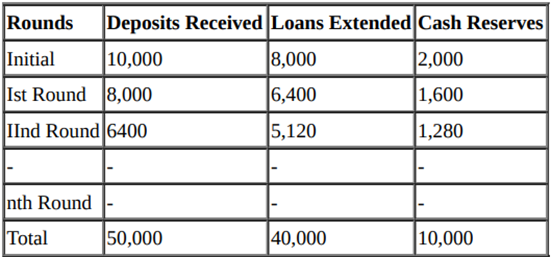
Suppose, initially the public deposited Rs 10,000 with the banks. Assuming the Legal Reserve Ratio to be 20%, the banks keep Rs 2,000 as minimum cash reserves and lend the balance amount of Rs 8,000 (Rs 10,000 – Rs 2,000) in form of loans and advances to the general public.
Now, if all the transactions taking place in the economy are routed only through banks then, the money borrowed by the borrowers is again routed back to the banks in form of deposits. Hence, in the second round, there is an increment in the deposits with the banks by Rs 8,000 and the total deposits with the banks now rise to Rs 18,000 (that is, Rs 10,000 + Rs 8,000). Now, out of the new deposits of Rs 8,000, the banks will keep 20% as reserves (that is, Rs 1600) and lend the remaining amount (that is, Rs 6,400). Again, this money will come back to the bank and in the third round, the total deposits rise to Rs 24,400 (i.e. Rs 18,000 + Rs 6,400).
The same process continues and with each round the total deposits with the bank’s increases. However; in every subsequent round, the cash reserves diminish. The process comes to an end when the total cash reserves (aggregate of cash reserves from the subsequent rounds) become equal to the initial deposits of Rs 10,000 that were initially held by the banks. As per the above schedule, with the initial deposits of Rs 10,000, the commercial banks have created money of Rs 50,000.
[/expand]16. Answer the following questions:
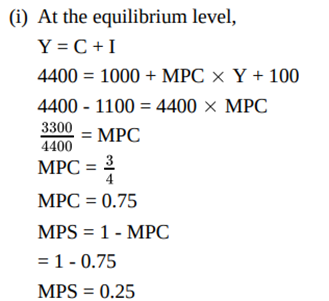
(a) An Economy is in equilibrium, calculate the Marginal Propensity to Save (MPS) from the following:
i. National Income (Y) = ₹ 4,400
ii. Autonomous Consumption ( ) = ₹ 1,000
iii. Investment Expenditure (I) = ₹ 100
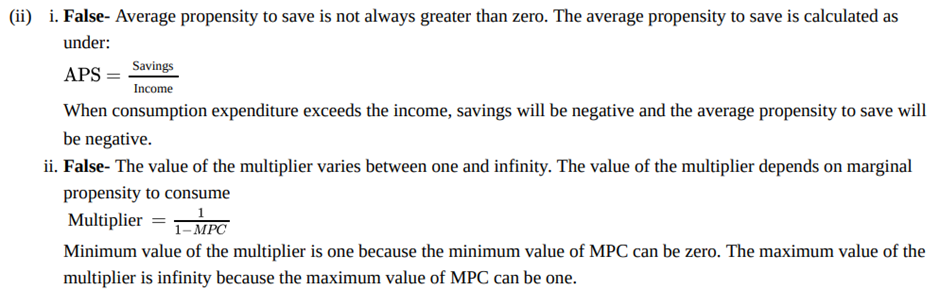
(b) Giving reasons, state whether the following statements are true or false:
i. Average propensity to save is always greater than zero.
ii. Value of investment multiplier varies between zero and infinity.
View AnswerAns.
17. Classify the following as Revenue receipts or Capital receipts. Give valid arguments in support of your answer:
i. Interest received on loan.
ii. Disinvestment receipts from the sale of a government company.
iii. Financial assistance by the Government of USA for promoting girl education in India.
View AnswerAns. i. Interest received on loan is a revenue receipt because it neither creates any liability nor causes a reduction in assets of the government.
ii. Disinvestment receipts from sale of a government company are capital receipts as it causes a reduction in assets of the government.
iii. Financial assistance by the Government of USA for promoting girl education in India is a revenue receipt as it neither creates any liability nor causes a reduction in assets of the government.
SECTION B – INDIAN ECONOMIC DEVELOPMENT
18. Government taxation and expenditure policy is known as
a) Monetary policy
b) Taxation policy
c) Trade policy
d) Fiscal policy
View AnswerAns. d) Fiscal policy
19. Inward looking trade strategy aimed at protecting domestic industries from ________ competition.
a) Both National and International
b) National
c) International
d) Commercial
View AnswerAns. a) Both National and International
20. The education commission (1964-66) had recommended that at least ________ of GDP be spent on education so as to make a noticeable rate of growth in educational achievements.
a) 5%
b) 4%
c) 7%
d) 6%
View AnswerAns. d) 6%
21. Assertion (A): India will find organic farming an attractive proposition.
Reason (R): Organic farming requires more labour input than conventional farming.
a) Both A and R are true and R is the correct explanation of A.
b) Both A and R are true but R is not the correct explanation of A.
c) A is true but R is false.
d) A is false but R is true.
View AnswerAns. a) Both A and R are true and R is the correct explanation of A.
22. Employment in India is facing the problems related to
a) informalisation of workforce
b) All of the given
c) Casualisation of workforce
d) jobless growth
View AnswerAns. b) All of the given
23. In an economy, labour force is equal to work force when:
a) Growth rate of population is more than growth rate of employment
b) The number of persons usually employed or willing to be employed
c) There is no unemployment
d) Growth rate of population is less than growth rate of employment
View AnswerAns. c) There is no unemployment
24. The function of Central Pollution Control Board is to control:
a) Deforestation
b) Global Warming
c) Water Pollution
d) Air Pollution
View AnswerAns. d) Air Pollution
25. From the set of information given in Column A and Column B, choose the correct pair of options:
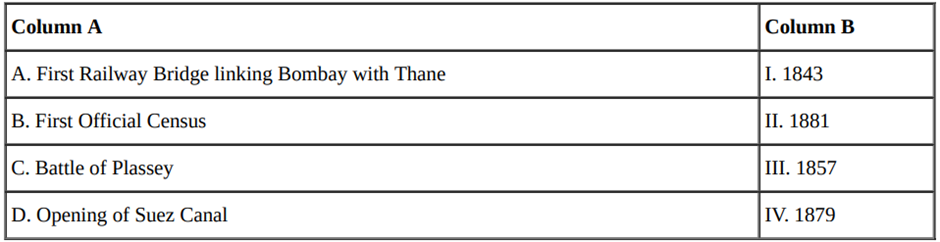
a) D – IV
b) B – II
c) C – III
d) A – I
View AnswerAns. b) B – II
26. Prior to India’s independence, the stagnation in the agricultural sector was mainly caused by ________.
a) investment in technology
b) advanced infrastructural facilities
c) land settlement system
d) investment in agriculture facilities
View AnswerAns. c) land settlement system
27. Read the following statements carefully:
Statement 1: Great Proletarian Cultural Revolution was introduced in China in 1950’s.
Statement 2: China’s growth is mainly contributed by the manufacturing sector. In the light of given statements, choose the correct alternative from the following:
a) Both statements 1 and 2 are false.
b) Both statements 1 and 2 are true.
c) Statement 1 is false and Statement 2 is true.
d) Statement 1 is true and Statement 2 is false.
View AnswerAns. a) Both statements 1 and 2 are false.
28. From the data given below, compare and contrast India’s and China’s sectoral contribution towards GVA/GDP.
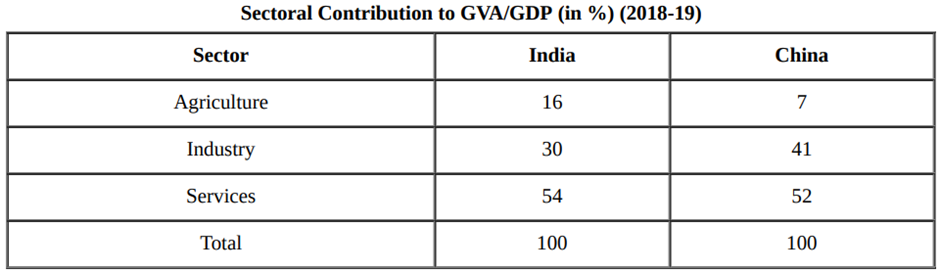
Ans. In both nations, the contribution of the agricultural sector to GDP is the least of the three sectors. Whereas; the service sector is the highest contributor to GDP in both nations.
The contribution of the agriculture sector to the GDP in India stands at 16% which is approximately more than double of China, i.e. 7%.
In China, the contribution of the industrial sector (41%) is way ahead of India (30%), owing to technological upliftment and rapid industrial growth in China in the 1970s. The service sector contributes more than half to the GDP in both India (54%) and China (52%) indicating the scale of economic growth in the two nations.
29. If the rate of resource extraction exceeds the rate of regeneration, it leads to reduction in carrying capacity of the environment. Discuss the rationale of the given statement with valid reasons.
View AnswerAns. If the rate of resource extraction exceeds the rate of regeneration, it leads to reduction in carrying capacity of the environment. The environment is able to perform its functions uninterruptedly so long as the demand for these functions is within the carrying capacity of the environment. This means that the resources are not extracted beyond the rate of their regeneration. If there is a disequilibrium (i.e. demand being more than supply), the environment fails to replenish itself, which will lead to environmental crisis. Therefore, to maintain a healthy environment, the carrying capacity of the environment must be valued and respected.
OR
Pesticides are chemical compounds designed to kill pests. Many pesticides can also pose health risks to people even if exposed to nominal quantities. In the light of the above statement, suggest any two traditional methods for replacement of the chemical pesticides.
View AnswerAns. Pesticides are chemical compounds designed to kill pests. Many pesticides can also pose health risks to people even if exposed to nominal quantities. The traditional practices can help in controlling contamination without the use of chemical fertilizers, as follows:
i. Neem trees and its by products are a natural pest-controller, which has been used since ages in India. Recently, the government promoted the sale of Neem coated urea as a measure of natural pest control.
ii. Large variety of birds should be allowed to dwell around the agricultural areas. They can clear large varieties of pests including insects.
30. What is Planning Commission? What are its functions?
View AnswerAns. Immediately after the adaptation of new constitution on January 26, 1950, the Planning commission came in to existence. Planning Commission is a constitutional body. Prime Minister is ex-officio chairman of this commission. The broad functions of Planning Commission are:
i. Assessment of material, capital and human resources
ii. Formulation of plan for their most effective and balanced utilization
iii. Determination of priorities and allocation of resources etc.
iv. To execute suitable policies for the economic development of India.
OR
What do you mean by privatisation? What are the objectives of privatisation?
View AnswerAns. Privatization refers to a process that reduces the participation of the government/public sector in the economic activities of a country.
The following are the objectives of privatisation:
i. To make use of privately owned resources for the collective welfare of the people.
ii. To reduce the role of the state in economic activities.
iii. To improve the efficiency and performance of government undertakings.
iv. To reduce the budgetary deficit of the country.
v. To promote the inflow of foreign direct investment.
31. Give an account of report published by World Bank on Indian economy as a knowledge economy.
View AnswerAns. Recently World Bank has published a report called ‘India and the Knowledge economy-Leveraging Strengths and opportunities’. The report states that India should continue to leverage its strengths to become a leader in knowledge creation and use. To get the benefits from knowledge revolution, the country needs to implement the various policy and institutional changes. The report further states that if it uses its knowledge economy as much as Ireland does, then the per capital income of India will increase from a little over US $ 1000 in 2002 to US $ 3000 in 2020. It also claims that Indian economy has all the key ingredients required for making this transition like a critical mass of skilled workers, a well functioning democracy, and a diversified science and technology infrastructure.
32. Discuss any two factors that lead to stagnating Indian agriculture sector during British rule.
View AnswerAns. During British rule, the agriculture sector experienced stagnation due to the following factors:
The colonial government introduced the Land Settlement system. The zamindars used to exploit cultivators by extracting a major portion of the produce in the form of rent leading to misery among the farmers.
Lack of irrigation facilities and low level of technology contributed to the dismal level of agricultural productivity, which aggravated the plight of the farmers.
33. Answer the following questions:
i. Why are women paid fewer wages for the same work as compared to men?
View AnswerAns. Women are paid fewer wages for the same work as compared to men because:
(a) There are rules but these are not followed especially in informal sector.
(b) There is a social prejudice which claims that males are more productive than females.
(c) Males are more committed to their work life. Females have dual responsibility which reduces their commitment to their work life.
(d) Since females do not have complete financial responsibility, they agree to work for lower wages.
(e) Males have better physical abilities as compared to females
ii. Analyse the recent trends in sectoral distribution of workforce in India:
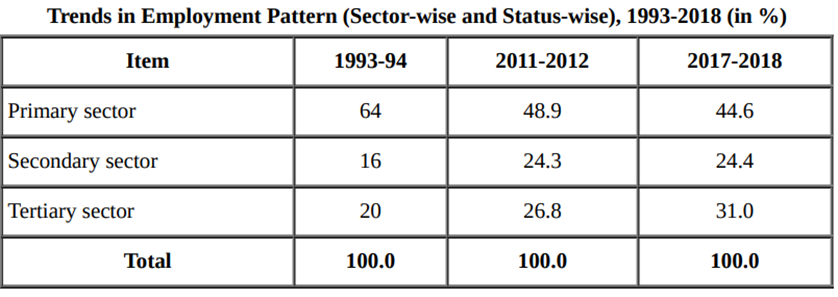
Ans. The given data indicates that over the given period, the proportion of workforce in primary sector has gone down from 64% in 1993-94 to 44.6% in 2017-18, this account to nearly a fall of 20% over the years. Whereas, the employment share of both secondary and the services sector has increased in India. The share of secondary sector has gone up by approximately 9% (from 16% in 1993-94 to 24.4% approximately in 2017-18), the corresponding figure for services sector has gone up by 11% (from 20% in 1993-94 to 31% approximately in 2017-18).
These sectoral changes have been very significant in the growth journey of India, showing the gradual shift of the workforce from primary sector to the secondary and tertiary sector.
(b) OR
i. Demand for Indian Handicrafts in Indian market as well as foreign market was systematically destroyed by Britishers Defend or refute.
View AnswerAns. The given statement is defended
- Demand in the Foreign markets was destroyed by imposing heavy duty on the exports of Indian Handicrafts.
- Demand in the Domestic Market (i.e.Indian Market) was destroyed by allowing duty-free import of British goods in the Indian market.
ii. Explain the ‘Ryotwari’ and ‘Mahalwari’ System of collecting land revenue prevalent under the British rule.
View AnswerAns. Ryotwari System: It was the way of collecting tax revenue (in British controlled areas in India) directly from cultivators of farmland.
- In Ryotwari System the ownership rights were handed over to the peasants. British Government collected taxes directly from the peasants.
– The revenue rates of Ryotwari System were 50% where the lands were dry and 60% in irrigated land
Mahalwari System: This system consisted of landlords or zamindars representing an entire village or even a group of villages. Along with the tillers, they were jointly as well as individually responsible for the payment of revenues. The land under this system included the land of the villages as well as adjoining forestland and pastures.
– The Mahalwari system had many provisions of both the Zamindari System and Ryotwari System.
– In this system, the land was divided into Mahals. Each Mahal comprises one or more villages.
– Ownership rights were vested with the peasants
34. Agricultural sector appears to be adversely affected by the reform process. Why?
View AnswerAns. Due to following reasons, agricultural sector appears to be adversely affected by the reform process:
i. Public investment in agricultural sector, especially in infrastructure which includes irrigation, power, roads, market linkages and research and extension has been reduced in the reform period. Investment on research and development was reduced considerably as compared to the Green Revolution time.
ii. The removal of fertiliser subsidy has led to increase in the cost of production, which has severely affected the small and marginal farmers.
iii. Due to adherence to WTO commitments, various changes in policies like reduction in import duties on agricultural products, removal of Minimum Support Price (MSP) and lifting of quantitative restrictions on agricultural products have increased the threat of international competition to the Indian farmers. Tough competition in the international market along with traditional techniques of farming adversely affected the poor farmers.
iv. Export-oriented policy strategies in agriculture have marked a shift from production for the domestic market towards production for the export market which has led to more focus on cash crops like cotton, jute etc. as compared to production of foodgrains. This led to reduced availability of food grains.
v. The shift towards the production of cash crops exerted an inflationary pressure on the prices of food grains. This resulted in and adverse effect on the agricultural sector’s performance as the cost of producing food grains became more expensive.