Class XII Session 2025-26
Subject – Economics
Time Allowed: 3 hours Maximum Marks: 80
General Instructions:
1. This question paper contains two sections: Section A – Macro Economics Section B – Indian Economic Development
2. This paper contains 20 Multiple Choice Questions type questions of 1 mark each.
3. This paper contains 4 Short Answer Questions type questions of 3 marks each to be answered in 60 to 80 words.
4. This paper contains 6 Short Answer Questions type questions of 4 marks each to be answered in 80 to 100 words.
5. This paper contains 4 Long Answer Questions type questions of 6 marks each to be answered in 100 to 150 words.
SECTION A – MACRO ECONOMICS
1. In the Saving Function: S = -100 + 0.6Y, the value of autonomous consumption will be:
a) 0.6
b) -100
c) 100
d) 0.4
View AnswerAns. c) 100
2. That part of NNP which actually accrues to the owners of factors of production is called ________.
a) Mixed Income
b) National Income
c) National Disposable Income
d) Domestic Factor Income
View AnswerAns. b) National Income
3. In a hypothetical economy, Mr. Niranjan has deposited ₹100 in the bank. If it is assumed that there is no other currency circulation in the economy, then the total money supply in the economy will be ________.
a) ₹100
b) ₹120
c) Not defined
d) Zero
View AnswerAns. a) ₹100
4. Which of the following will lead to an appreciation of domestic currency?
P. increased demand for foreign exchange
Q. decreased demand for foreign exchange
R. increased supply of foreign exchange
S. decreased supply of foreign exchange
a) P and S
b) Q and R
c) P and R
d) Q and S
View AnswerAns. b) Q and R
5. Which of the following sector is not included in a two-sector economy?
a) Foreign sector
b) Households
c) Firms
d) Government
View AnswerAns. d) Government
6. The government encourages exports to correct excess capacity in the economy. This may lead to:
a) rise in aggregate demand to match aggregate supply
b) rise in voluntary unemployment
c) inflation in the local market
d) fall in voluntary unemployment
View AnswerAns. a) rise in aggregate demand to match aggregate supply
7. Statement I: That part of final output which comprises of capital goods constitutes gross investment of an economy.
Statement II: Depreciation is an annual allowance for normal wear and tear and foreseen obsolescence of a fixed capital asset.
a) Both the statements are true.
b) Both the statements are false.
c) Statement II is true, Statement I is false.
d) Statement I is true, Statement II is false.
View AnswerAns. a) Both the statements are true.
8. High Powered Money is also called:
a. Reserve Money
b. Monetary Base
c. Bank Money
d. Credit Money
a) (a) and (b)
b) (a) and (c)
c) (c) and (d)
d) (b) and (c)
View AnswerAns. a) (a) and (b)
9. Assertion (A): If total receipts are ₹ 500 crores and total payments are also ₹ 500 crores, then in the accounting sense balance of payments balances.
Reason (R): Total receipts are equal to total payments.
a) Both A and R are true and R is the correct explanation of A.
b) Both A and R are true but R is not the correct explanation of A.
c) A is true but R is false.
d) A is false but R is true.
View AnswerAns. a) Both A and R are true and R is the correct explanation of A.
10. Which of the following is the central bank.
a) SBI
b) LIC
c) Reliance
d) RBI
View AnswerAns. d) RBI
11. Government incurs expenditure to popularise yoga among the masses. Analyse its impact on gross domestic product and welfare of the people.
View AnswerAns. Government expenditure on popularising yoga raises GDP because it is governments final consumption expenditure. It also raises welfare of the people because yogic exercises improve health and thus, raise efficiency of the people.
12. Is credit card a form of money?
View AnswerAns. Credit card is not money because there is a difference between money and credit. Money is what we pay for goods and services. Credit is the store of wealth lent to the borrowers. If you use your credit card to buy a shirt, you are not buying a shirt with your money. You are taking a loan from the bank that issued the credit card in order to buy the shirt, Moreover, money is a financial asset of its holder &nd financial liability of banks. Credit card is not a financial asset of individuals. It creates a financial liability for its holders.
OR
Discuss any one of the following functions of a Central Bank
a. As Government’s Bank.
b. Open Market Operations.
View AnswerAns. Open Market Operations: Open market operations (OMO) refer to buying and selling of government securities by the Central Bank from/to the public and commercial banks. RBI is authorised to sell or purchase treasury bills and government securities. It does not matter whether the securities are bought or sold to the public or banks because ultimately the amounts will be deposited in or transferred from some bank.
13. Giving valid reasons, explain how the following would be treated while estimating domestic income?
i. Payment made by a Japanese tourist for goods purchased in India.
View AnswerAns. The goods purchased by foreign tourists are manufactured in the country. As a result, it will be included in domestic income.
ii. Broker’s commission on the sale of second hand goods.
View AnswerAns. It would be included in his domestic income because he earned the commission by providing a productive service.
OR
Calculate ‘Net Domestic Product at Factor Cost’.
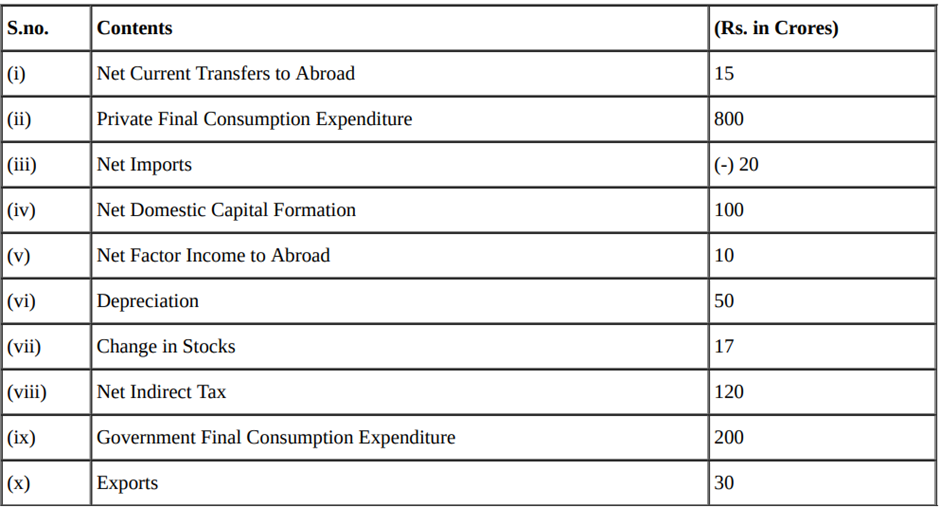
Ans. Net Domestic Product at Market Price is calculated as:
(NDPmp)= Private Final Consumption Expenditure + Government Final Consumption Expenditure + Net Domestic Capital Formation – Net Imports
NDPmp = 800 + 200 + 100 – (-20)
= Rs. 1,120 crores
Net Domestic Product at Factor Cost is calculated as:
(NDPfc) = NDPmp– Net Indirect Tax
NDPfc = 1,120 – 120
= Rs. 1,000 crores.
Therefore Net Domestic Product at factor Cost is termed as the Domestic Income.
14. Using the Saving and Investment approach explain how is the equilibrium level of national income determined? Also, explain what will happen if the equilibrium condition is not fulfilled.
View AnswerAns. The equilibrium level of national income is determined where investment equals saving. At equilibrium, it is ex-ante savings which should be equal to ex-ante investment. If ex-ante savings are more than ex-ante investment, it implies a situation when a fall in expenditure through S is more than the rise in expenditure through I. Aggregate demand is more than aggregate supply and income level falls. Similarly, if ex-ante savings are less than the ex-ante investment, it implies a situation when a fall in expenditure through S is less than the rise in expenditure through I. Aggregate demand is less than aggregate supply and income level will go up. The adjoining figure shows the equilibrium level of national income.
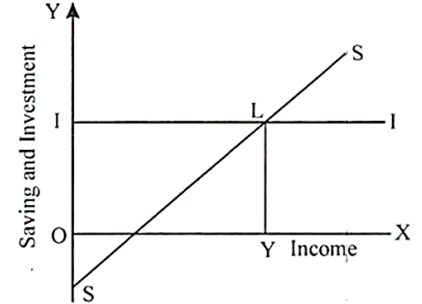
In the adjoining diagram, the equilibrium level of income is determined at L where saving and investment are equal. If the equilibrium condition is not fulfilled there will be either deficient demand or excess demand. Deficient demand will lead to a deflationary gap which implies the build-up of inventories of unsold goods. Excess demand will lead to an inflationary gap which implies a rise in the price level.
OR
There is increase in investment of ₹ 100 crore in an economy. MPC is 1. What can you say about the total increase in income? Calculate.
View AnswerAns.
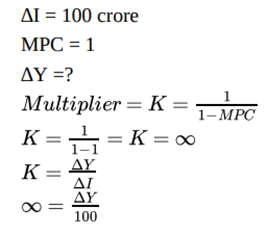
Total increase in income will be infinite.
15. Elaborate the Government’s Bank and Advisor function of the Central Bank of a nation.
View AnswerAns. The Central Bank acts as a banker to both central as well as state governments. The Central Bank maintains account, accepts receipts and makes payments for the government and carries out exchange, remittance and other banking operations. It advances credit/loan to the government to meet its requirements in case of crisis. As a financial advisor, the Central Bank advises the government on various financial and economic matters.
16. Answer the following questions:
(a) Explain the distinction between voluntary and involuntary unemployment.
View AnswerAns. Voluntary unemployment refers to a situation when people who are able to work but are not willing to work although suitable work is available for them. In other words, they are voluntarily unemployed. Involuntary unemployment is a situation in the economy when even if people are able and willing to work at existing wage rates, they are not getting work. Hence, they are unemployed against their wishes.
(b) Discuss the working of the adjustment mechanism if, Aggregate Demand (AD) is greater than Aggregate Supply (AS).
View AnswerAns. When Aggregate Demand is greater than Aggregate Supply (AD>AS), buyers are planning to, buy more goods and services than what producers are planning to produce. It will lead to a fall in planned inventories below the desired level. The producers in turn will produce more, which will raise the income level i.e. AS, till AD becomes equal to AS. Thus equilibrium is achieved.
17. What is the difference between revenue expenditure and capital expenditure? Explain how taxes and government expenditure can be used to influence distribution of income in the society.
View AnswerAns. Differences between revenue expenditure and capital expenditure are given below:
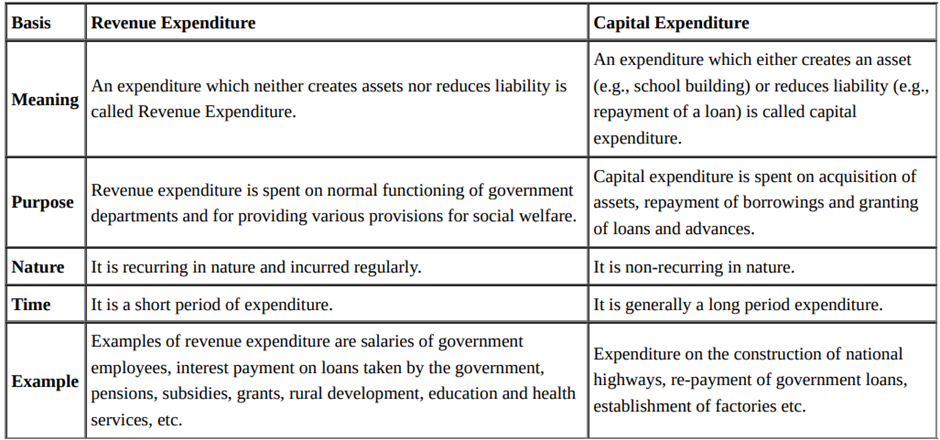
Distribution of income in society: Reducing inequality is a major objective of government’s budget especially in developing country like India, where inequality of income and wealth is very high. Government uses its financial tools of taxation and subsidies to enhance equal distribution of income and wealth. In order to ensure equity of income, the progressive tax structure is followed in India, which imposes a higher burden of taxes on higher income group and a lesser burden on lower income group. Also, those who earn below a substantial limit are exempted from payment of taxes. The additional income generated from the higher income group is re-distributed by the government in the form of subsidies to the poor sections of the society, to ensure the objective of welfare. LPG subsidy is a good example of such redistribution of income.
SECTION B – INDIAN ECONOMIC DEVELOPMENT
18. The major reason for simplification of tax procedure post-1991 is
a. to avoid the cascading effects of taxation
b. to encourage better compliance on part of the taxpayers
c. to rationalise the tax structure and computing taxes with more clarity
d. All of these
a) Option (b)
b) Option (d)
c) Option (c)
d) Option (a)
View AnswerAns. b) Option (d)
19. Gross Domestic savings as a proportion of GDP has risen from ____ in 1950-51 to ____percent in 1990-91
a) 10, 28
b) 8.5, 34.6
c) 8.9, 23.1
d) 7.4, 22.6
View AnswerAns. c) 8.9, 23.1
20. The Government of India enacted the Right to Education as a fundamental right for all children in the age group of ________ years.
a) 6-12
b) 5-14
c) 5-13
d) 6-14
View AnswerAns. d) 6-14
21. Assertion (A): Rural development in India is a core element for overall development of the nation.
Reason (R): More than two-third of India’s population depends on agriculture.
a) Both A and R are true and R is the correct explanation of A.
b) Both A and R are true but R is not the correct explanation of A.
c) A is true but R is false.
d) A is false but R is true.
View AnswerAns. a) Both A and R are true and R is the correct explanation of A.
22. If a person is absent from her duty due to maternity leave, will she be considered a worker?
a) Cannot say
b) Not always.
c) No
d) Yes
View AnswerAns. d) Yes
23. More than 50% of workforce in India belongs to the category of:
a) Self-Employed
b) Both Regular Workers and Casual Workers
c) Regular Workers
d) Casual Workers
View AnswerAns. a) Self-Employed
24. Which of the following is a consequence of ozone layer depletion?
a) Skin cancer in humans
b) Hampers growth of terrestrial plants
c) All of these
d) Lower production of phytoplankton
View AnswerAns. c) All of these
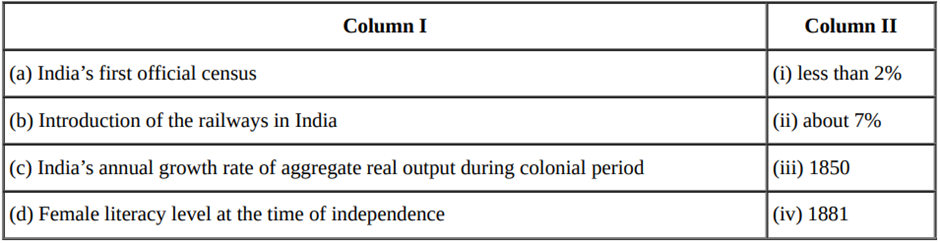
25. Write the correct sequence of alternatives given in Column II by matching them with respective terms in Column I:
a) (a) – (i), (b) – (ii), (c) – (iii), (d) – (iv)
b) (a) – (iv), (b) – (iii), (c) – (i), (d) – (ii)
c) (a) – (iii), (b) – (ii), (c) – (i), (d) – (iv)
d) (a) – (ii), (b) – (i), (c) – (iv), (d) – (iii)
View AnswerAns. b) (a) – (iv), (b) – (iii), (c) – (i), (d) – (ii)
26. The country’s growth rate of aggregate real output during the first half of the twentieth century was only (i) ________ and per capita real output was (ii) ________.
a) (i) less than 1% per year (ii) about 1% per year
b) (i) less than 3% per year (ii) about 0.25% per year
c) (i) less than 4% per year (ii) about 5% per year
d) (i) less than 2% per year (ii) about 0.5% per year
View AnswerAns. d) (i) less than 2% per year (ii) about 0.5% per year
27. Statement 1: In the agricultural sector, communes were established, where land holdings were allocated to individual households for ownership.
Statement 2: Special Economic Zones (SEZs) were established to attract foreign investments and technology.
a) Both Statements 1 and 2 are false.
b) Statement 1 is false and statement 2 is true.
c) Both Statements 1 and 2 are true.
d) Statement 1 is true and statement 2 is false.
View AnswerAns. b) Statement 1 is false and statement 2 is true.
28. Compare and contrast India and China’s sectoral contribution towards GDP in 2003. What does it indicate?
View AnswerAns. According to the data of India’s and China’s sectoral contribution towards GDP in 2003, the contribution of agriculture to GDP in China was 15% while in India it was 23%.On the other hand, manufacturing contributes the highest to GDP in China at 53% whereas it contributes the highest to GDP in India at around 51%. The process of economic growth has lead to tremendous shift in the sectoral share of output and employment. Thus, it indicates that both economies are developing. In the last two decades, the growth of agriculture sector has declined in both countries. In the industrial sector, China has maintained a double-digit growth rate whereas for India industrial growth rate has declined. In the case of the service sector, China has been able to raise its rate of growth n manufacturing sector while service sector growth in India has stagnated. China’s growth is mainly contributed by the manufacturing sector and India’s growth by the service sector.
29. Green revolution has led to increase in the use of chemical pesticides which in turn pollutes the environment. What measures can be taken to resolve this problem?
View AnswerAns. The chemical pesticides contaminates food products and it also leads to pollution of water bodies. We can use better methods of pest control like neem based pesticides. These are environment friendly and does not cause any side effects. Animals and birds like snakes, lizards, owl and peacock are natural pest controllers. Farmers can also opt for mixed cropping and growing different crops in consecutive years to reduce the ill effects posed by chemical pesticides.
OR
Looking at the current crisis of air pollution in northern India, what measures would you suggest to improve the environment?
View AnswerAns. The following measures can help in reducing air pollution: –
a) Use of public transport like buses and metro so as to reduce vehicular pollution.
b) Use of CNG instead of petrol or diesel.
c) The government should take immediate steps to educate the farmers about the ill effects of stubble burning and also provide alternate methods to dispose off the farm stubble.
d) The inspection and maintenance system should be strengthened so that erring individuals/firms are fined.
30. Explain the modernisation as a long-term objective of planning in India.
View AnswerAns. Modernisation refers to the advancement of technology and institutional innovations in the process of development. The objective of modernisation is to transform the traditional and backward economy into a modern and forward economy. The following are the components of modernisation:
i. The shift in the composition of production.
ii. Development of a diversified economy that produces a large variety of goods as in developed economies.
iii. Provision of a progressive framework for the development of the economy by using new technology.
iv. Change in social outlook such as recognition that women should have the same rights as men.
Modernisation would result in the reduction of cost of production and ensuring large scale production of goods. Green revolution in Indian agriculture is a well-known example of how technology can transform a country from the net importer of food grains to net exporter of food grains. Global it revolution has redefined the concept of domestic production through the BOP.
OR
State industrial sector reforms included in the policy of liberalisation under economic reforms.
View AnswerAns. Following were the changes made in the industrial policy under economic reforms:
i. Industrial Licensing- Industrial licensing was abolished for all industries except five industries viz., alcohol, cigarettes, hazardous chemicals, industrial explosives and defence equipment.
ii. Public sector- Almost the whole of the economy was left open to the private sector. The number of industries exclusively reserved for the public sector has been reduced to three e.g., defence equipment, atomic energy and rail transport.
iii. Small scale sector- The investment limit of small scale industries has been increased to one crore with a view to modernise them.
iv. Competition Act- MRTP Act was replaced by the competition Act which scrapped the threshold limit of assets in delicensed industries. Mergers and acquisitions were allowed.
31. Besides privatisation and disinvestment what attempts have been made by the government to improve the efficiency of PSUs?
View AnswerAns. In order to improve efficiency of PSUs and enable them to compete more effectively in the liberalised global environment, the government has given them greater operational, financial and managerial autonomy in taking various decisions to run the company efficiently and thus increase their profits. For instance, some PSUs have been granted a special status such as maharatnas, navratnas and miniratnas. Besides privatisation and disinvestment some attempts have been made by the government to improve the efficiency of PSUs.
A few examples of PSUs with their status are as follows:
i. Maharatnas: • Indian Oil Corporation Limited • Steel Authority of India Limited
ii. Navratnas: • Hindustan Aeronautics Limited • Mahanagar Telephone Nigam Limited
iii. Miniratnas: • Airport Authority of India • Bharat Sanchar Nigam Limited • Indian Railway Catering and Tourism Corporation Limited.
The granting of special status resulted in better performance of these companies.
32. Due to its quality, Indian indigo was in great demand in Britain. In 1810, almost 95% of the indigo imported into Britain was from India. Indigo production became a very profitable business and many Britishers became indigo planters. They advanced loans to peasants at high rate and forced them to cultivate indigo in 25% of their land. They paid a low price for the indigo. As the indigo plant had deep roots, it exhausted the soil fertility and the land was unfit for rice cultivation. Do you think that the above practices of the British were justified?
View AnswerAns. No, I don’t think that the above practices of the British are justified. The factors which disturb me in above scenario are as follows:
i. The Britishers exploited Indian peasants by advancing them loans at a high rate of interest and by paying a low price for their produce.
ii. The Britishers forced Indian peasants to cultivate indigo on 25% of their land holding. Since indigo plant exhausted the soil fertility, therefore the peasants had less land to cultivate in subsequent years.
33. Answer the following questions:
i. How do you find the co-existence of malls and jhuggis in an economy? Had you been the person with authority, what policy changes you would have brought?
View AnswerAns. There is co-existence of malls and jhuggis because globalisation has given birth to dual economy. Globalisation has led to misallocation of resources. An economy like India which has 26% people living below poverty line need housing, education, health and not malls, chips, chocolates and cosmetics etc. But what we have seen is that investments are made on those items which increase the profits of the companies, and not on the things which increase the welfare of the people. Had I been a person with the authority, I would have made it compulsory to invest in one of the strategic fields if an MNC wants to invest in any other industry or sector. As a result of which people living below poverty line would be benefited.
ii. Navratan Policy of the government has helped in improving the performance of Public Sector Undertakings in India. Do you agree with the given statement? Justify your answer with valid arguments.
View AnswerAns. Yes. In order to improve efficiency, infuse professionalism and enable Public Sector Undertakings (PSUs) to compete more effectively in the liberalised global environment, the government identified profit making PSUs. Government declared them as Maharatnas, Navratnas and Miniratnas. PSUs were given greater managerial and operational autonomy, in taking various decisions. As a result, over the years these Maharatnas, Navratnas and Miniratnas have performed exceedingly well and established themselves as market leaders.
OR
(b)
i. India became exporter of primary products and importer of finished goods during the British Rule. Comment.
View AnswerAns. The given statement is correct. British Government systematically destroyed Indian handicraft industries and their primary motive behind this de-industrialisation was two-fold:
i. To get raw materials from India at cheap rates to be used by upcoming modern industries in Britain.
ii. To sell finished products of British industries in Indian market at higher prices. As a result, India became an exporter of primary products such as raw silk, cotton, wool, etc. and an importer of finished consumer goods like cotton, silk, woollen clothes, etc. produced in the British Industries.
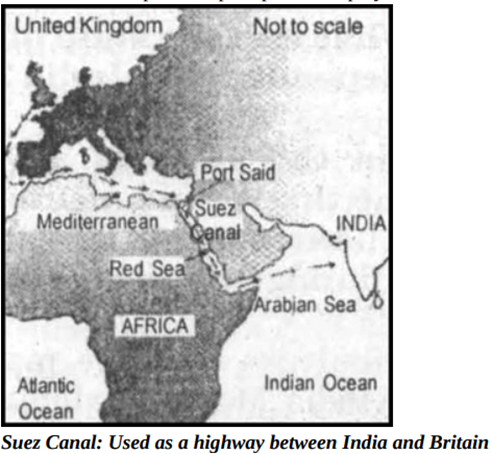
ii. When was the Suez Canal opened? How did it affect the Indian economy?
View AnswerAns. Suez Canal was opened in 1869. Suez Canal is an artificial waterway running from North to South across the Isthmus of Suez in North-Eastern Egypt. It connects Port Said on the Mediterranean sea with Gulf of Suez-an arm of the Red sea. Strategically and economically it is one of the most important waterways in the world. Its opening reduced the cost of transportation and made access to the Indian market easier and economical. A significant reduction in transport cost prompted monopoly control of India’s foreign trade by the British Government.
34. i. Discuss the need for promoting women’s education in India.
View AnswerAns. The need to promote education for women in India is imminent. It helps in improving economic independence and social status of women. Women education makes a favourable impact on fertility rate and health care of women and children.
ii. Explain absorptive capacity of environment with example.
View AnswerAns. Absorptive capacity means the ability of the environment to absorb degradation. For instance, high population and the affluent consumption in the developing countries and production standards of the developed nations have placed a huge stress on the environment. Many resources are becoming extinct and the wastes generated are beyond the absorptive capacity of the environment.