CHEMISTRY THEORY (043)
Max. Marks:70 Time: 3 hours
GENERAL INSTRUCTIONS:
Read the following instructions carefully.
(a) There are 33 questions in this question paper with internal choice.
(b) SECTION A consists of 16 multiple-choice questions carrying 1 mark each.
(c) SECTION B consists of 5 short answer questions carrying 2 marks each.
(d) SECTION C consists of 7 short answer questions carrying 3 marks each.
(e) SECTION D consists of 2 case-based questions carrying 4 marks each.
(f) SECTION E consists of 3 long answer questions carrying 5 marks each.
(g) All questions are compulsory.
(h) Use of log tables and calculators is not allowed.
SECTION A
The following questions are multiple-choice questions with one correct answer. Each question carries 1 mark. There is no internal choice in this section.
1. Ammonolysis of ethyl chloride followed by reaction of the amine so formed with 1 mole of methyl chloride gives an amine that
a. reacts with Hinsberg reagent to form a product soluble in an alkali.
b. on reaction with Nitrous acid, produced nitrogen gas.
c. reacts with Benzenesulphonyl chloride to form a product that is insoluble in alkali.
d. does not react with Hinsberg reagent.
View AnswerAns. c. reacts with Benzenesulphonyl chloride to form a product that is insoluble in alkali.
2. Which one of the following has the highest dipole moment?
a. CH3F
b. CH3Cl
c. CH3
d. CH3Br
View AnswerAns. b. CH3Cl
3 Match the properties given in column I with the metals in column II
Column I Column II
(i) Actinoid having configuration [Rn] 5f 76d17s2 (A) Ce
(ii) Lanthanoid which has 4f14 electronic (B) Lu
configuration in +3 oxidation state.
(iii) Lanthanoid which show +4 Oxidation state (C) Cm
a. (i)-(C), (ii)-(B), (iii)-(A)
b. (i)-(C), (ii)-(A), (iii)-(B)
c. (i)-(A), (ii)-(B), (iii)-(C)
d. (i)-(B), (ii)-(A), (iii)-(C)
View AnswerAns. a. (i)-(C), (ii)-(B), (iii)-(A)
4. Study the graph showing the boiling points of bromoalkanes and identify the compounds.
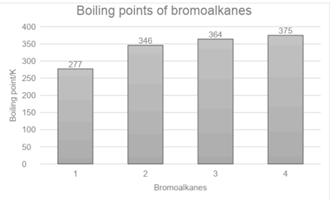
a. 1 = Bromomethane, 2= 2-Bromobutane, 3= 1-Bromobutane, 4= 2-Bromo-2-methylpropane
b. 1 =1-Bromobutane, 2= 2-Bromo-2-methylpropane, 3= 2-Bromobutane, 4= Bromomethane
c. 1 = Bromomethane, 2=1-Bromobutane, 3= 2-Bromo-2-methylpropane, 4= 2-Bromobutane,
d. 1 =Bromomethane, 2= 2-Bromo-2-methylpropane, 3=2- Bromobutane, 4= 1-Bromobutane
View AnswerAns. d. 1 =Bromomethane, 2= 2-Bromo-2-methylpropane, 3=2- Bromobutane, 4= 1-Bromobutane
(for visually challenged learners)
Which of the following haloalkanes has the highest boiling point?
a. 2-Bromo-2-methylpropane
b. 2-Bromobutane
c. Bromomethane
d. 1-Bromobutane
View AnswerAns. d. 1-Bromobutane
5. The initial concentration of R in the reaction RP is 4.62 x 10⁻² mol/L. What is the half life for the reaction if k = 2.31x 10⁻² molL-1s -1
a. 30 s
b. 3 s
c. 1 s
d. 10 s
View AnswerAns. c. 1 s
6 When C6H5COOCOCH3 is treated with H2O , the product obtained is :
a. Benzoic acid and ethanol
b. Benzoic acid and ethanoic acid
c. Acetic Acid and phenol
d. Benzoic anhydride and methanol
View AnswerAns. b. Benzoic acid and ethanoic acid
7.
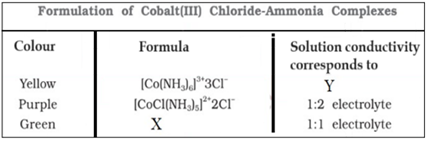
‘X’ and ‘Y’ in the above table are:
a. X=[Co(NH3 )6 ] 2+3Cl– , Y= 1:3
b. X= [Co(NH3 )4Cl2 ] +Cl,–Y= 1:3
c. X=[Co(NH3 )4Cl2 ] +Cl– , Y= 1:1
d. X=[Co(NH3 )4Cl2 ] 3+3Cl– , Y= 1:1
View AnswerAns. b. X= [Co(NH3 )4Cl2 ] +Cl,–Y= 1:3
8. Which of the following contains only β-D- glucose as its monosaccharide unit:
a. Sucrose
b. Cellulose
c. Starch
d. Maltose
View AnswerAns. b. Cellulose
9. Which one of the following sets correctly represents the increase in the paramagnetic property of the ions?
a. Ti 3+< Fe2+ < Cr3+ < Mn2+
b. Ti 3+< Mn2+< Fe2+ < Cr3+
c. Mn2+< Fe2+< Cr3+< Ti3+
d. Ti3+< Cr3+< Fe2+ < Mn2+
View AnswerAns. d. Ti3+< Cr3+< Fe2+ < Mn2+
10. A first-order reaction is found to have a rate constant, k = 5.5 × 10⁻¹⁴ s -1 . The time taken for completion of the reaction is:
a. 1.26 x 10¹³ s
b. 2.52 x 10¹³ s
c. 0.63 x 10¹³ s
d. It never goes to completion
View AnswerAns. d. It never goes to completion
11. A student was preparing aniline in the lab. She took a compound “X” and reduced it in the presence of Ni as a catalyst. What could be the compound “X”
a. Nitrobenzene
b. 1-Nitrohexane
c. Benzonitrile
d. 1-Hexanenitrile
View AnswerAns. a. Nitrobenzene
12. Which of the following compound gives an oxime with hydroxylamine:
a. CH3COCH3
b. CH3COOH
c. (CH3CO)2O
d. CH3COCl
View AnswerAns. a. CH3COCH3
13 Assertion (A): [Mn(CN)6 ] 3– has a magnetic moment of two unpaired electrons while [MnCl6 ] 3– has a paramagnetic moment of four unpaired electrons.
Reason (R): [Mn(CN)6 ] 3– is inner orbital complexes involving d 2sp3 hybridisation,on the other hand, [MnCl6 ] 3– is outer orbital complexes involving sp3d 2 hybridisation.
Select the most appropriate answer from the options given below:
a. Both A and R are true and R is the correct explanation of A
b. Both A and R are true but R is not the correct explanation of A.
c. A is true but R is false.
d. A is false but R is true.
View AnswerAns. a. Both A and R are true and R is the correct explanation of A
14 Assertion (A): For strong electrolytes, there is a slow increase in molar conductivity with dilution and can be represented by the equation

Reason (R): The value of the constant ‘A’ for NaCl, CaCl2 , and MgSO4 in a given solvent and at a given temperature is different.
Select the most appropriate answer from the options given below:
a. Both A and R are true and R is the correct explanation of A
b. Both A and R are true but R is not the correct explanation of A.
c. A is true but R is false.
d. A is false but R is true.
View AnswerAns. d. A is false but R is true.
15. Assertion (A) Glucose does not form the hydrogensulphite addition product with NaHSO3 .
Reason (R): Glucose exists in a six-membered cyclic structure called pyranose structure.
Select the most appropriate answer from the options given below:
a. Both A and R are true and R is the correct explanation of A
b. Both A and R are true but R is not the correct explanation of A.
c. A is true but R is false.
d. A is false but R is true.
View AnswerAns. b. Both A and R are true but R is not the correct explanation of A.
16 Assertion (A): The half- life for a zero order reaction is independent of the initial concentration of the reactant.
Reason (R): For a zero order reaction, Rate = k Select the most appropriate answer from the options given below:
a. Both A and R are true and R is the correct explanation of A
b. Both A and R are true but R is not the correct explanation of A.
c. A is true but R is false.
d. A is false but R is true.
View AnswerAns. d. A is false but R is true.
SECTION B
This section contains 5 questions with internal choice in one question. The following questions are very short answer type and carry 2 marks each.
17. a. Nitrogen gas is soluble in water. At temperature 293 K, the value of KH is 76.48 kbar . How would the solubility of nitrogen vary (increase, decrease or remain the same) at a temperature above 293 K , if the value of KH rises to 88.8 kbar.
View AnswerAns. Solubility of gas is inversely proportional to the value of Henry’s constant KH. On increasing temperature nitrogen gas becomes less soluble because its KH value increases.
b. Chloroform (b.p. 61.2oC) and acetone (b.p. 56oC ) are mixed to form an azeotrope. The mole fraction of acetone in this mixture is 0.339. Predict whether the boiling point of the azeotrope formed will be (i) 60oC (ii)64.5 oC or (iii)54 oC. Defend your answer with reason.
View AnswerAns. (ii) 64.5 oC Chloroform and acetone mixture show negative deviation from Raoult’s law therefore, they form maximum boiling azeotrope at a specific composition. The boiling point of the mixture so obtained will be higher than the individual components.
OR
a. A soda bottle will go flat (loose its fizz) faster in Srinagar than in Delhi. Is this statement correct? Why or why not?
View AnswerAns. At higher altitudes i.e. in Srinagar the atmospheric pressure is lower. The solubility of a gas in a liquid is directly proportional to the partial pressure of the gas over the solution, therefore, the carbon dioxide dissolved in water will be lesser at Srinagar making the soda go flat faster.
b. How does sugar help in increasing the shelf life of the product?
View AnswerAns. Preservation of fruits by adding sugar/salt protects against bacterial action. Through osmosis, a bacterium on canned fruit loses water, shrivels and dies.
18. a. Write the IUPAC name of the following complex: K[Cr(H2O)2 (C2O4 )2 ]H2O
View AnswerAns. Potassium diaquadioxalatochromate(III) hydrate
b. Name the metal present in the complex compound of (i) Haemoglobin (ii) Vitamin B-12
View AnswerAns. (i) Haemoglobin: Iron (ii) Vitamin B-12: Cobalt
19. Observe the following cell and answer the questions that follow:
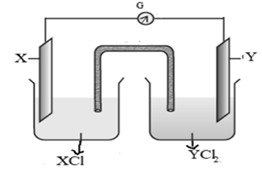
a. Represent the cell shown in the figure.
View AnswerAns. Y(s)|Y2+(aq) || X + (aq)| X(s)
b. Name the carriers of the current in the salt bridge
View AnswerAns. ions are carrier of current in salt bridge
c. Write the reaction taking place at the anode.
View AnswerAns. Y(s) → Y 2+(aq) + 2e–
(for visually challenged learners)
For the cell represented as:
Mg(s)/Mg2+ (aq)//Ag+ (aq)/Ag(s)
a. Identify the cathode and the anode
View AnswerAns. Cathode: silver , Anode: Magnesium
b. Write the overall reaction
View AnswerAns. Mg + 2Ag+ -> Mg2+ + 2Ag
20. Complete the following reactions by writing the major and minor product in each case (any 2)
a. CH3CH2Br + KCN →
View AnswerAns. CH3CH2CN (major), CH3CH2NC (minor)
b. CH3CH2CH = CH2 + HBr →
View AnswerAns. CH3CH2CHBrCH3 (major) CH3CH2CH2CH2Br (minor)
c. (CH3 )2CHCHClCH3 + alc KOH →
View AnswerAns. (CH3)2C=CHCH3 (major) (CH3)2CHCHCH2 (minor)
21. The presence of Carbonyl group in glucose is confirmed by its reaction with hydroxylamine. Identify the type of carbonyl group present and its position. Give a chemical reaction in support of your answer.
View AnswerAns. The carbonyl group present in glucose is aldehyde and the C1 atom. Glucose gets oxidised to six-carbon carboxylic acid (gluconic acid) with COOH group at the C1 atom on reaction with a mild oxidising agent like bromine water. This indicates that the carbonyl group is present as an aldehydic group
SECTION C
This section contains 7 questions with internal choice in one question. The following questions are short answer type and carry 3 marks each.
22. a. Write down the reaction occurring on two inert electrodes when electrolysis of copper chloride is done. What will happen if a concentrated solution of copper sulphate is replaced with copper chloride?
View AnswerAns. Product of electrolysis of Copper Chloride
Cathode(-)
Cu2+ + 2e– → Cu(s)
anode(+) 2Cl– → Cl2 + 2e–
Product of electrolysis of concentrated Copper Sulphate
Anode(+) SO4 2- → S2O8 + 2e–
Cathode (-) Cu2+ + 2e– → Cu(s)
b. Write an expression for the molar conductivity of aluminium sulphate at infinite dilution according to Kohlrausch law.
View AnswerAns. ٨0 m[Al2(SO4)3] = 2 λ0 m (Al3+) + 3 λ0 m (SO4 2- )
23. Account for the following:
a. The lowest oxide of transition metal is basic, and the highest is acidic.
View AnswerAns. In the case of a lower oxide of a transition metal, the metal atom has some electrons present in the valence shell of the metal atom that are not involved in bonding. As a result, it can donate electrons and behave as a base whereas in higher oxide of a transition metal, the metal atom does not have an electron in the valence shell for donation. As a result, it can accept electrons and behave as an acid
b. Chromium is a hard metal while mercury is a liquid metal
View AnswerAns. Chromium has unpaired electrons which result in strong metallic bonding which results in it being a hard solid and the absence of unpaired electrons in Hg results in it being a liquid.
c. The ionisation energy of elements of the 3d series does not vary much with increasing atomic number.
View AnswerAns. The increase in effective nuclear charge responsible for steady increase in ionisation energy is counterbalanced by shielding effect of (n-1)d electrons
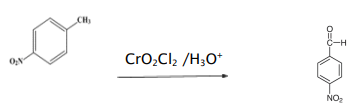
24. a. Give the chemical reaction involved when p-nitrotoluene undergoes Etard reaction.
View AnswerAns.
b. Why does Benzoic acid exist as a dimer in an aprotic solvent?
View AnswerAns. Benzoic acid undergoes extensive intermolecular hydrogen bonding , leading to the formation of dimer.
c. Benzene on reaction with methylchloride in the presence of anhydrous AlCl3 forms toluene. What is the expected outcome if benzene is replaced by benzoic acid? Give a reason for your answer.
View AnswerAns. Benzoic acid does not undergo reaction with CH3Cl i.e Friedel Craft reaction because the carboxyl group is deactivating and the catalyst aluminium chloride (Lewis acid) gets bonded to the carboxyl group
OR
An organic compound ‘X’, does not undergo aldol condensation. However ‘X’ with compound ‘Y’ in the presence of a strong base react to give the compound 1,3-diphenylprop-2-en-1-one.
a. Identify ‘X’ and ‘Y’
View AnswerAns. Compound ‘X’ = Benzaldehyde , Compound Y = Acetophenone
b. Write the chemical reaction involved.
View AnswerAns.
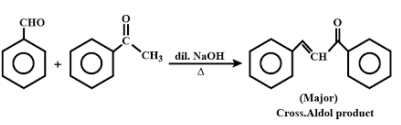
c. Give one chemical test to distinguish between X and Y.
View AnswerAns. Chemical test to distinguish between X and Y is the Tollen Test. Benzaldehyde undergoes SIlver mirror test with Tollen reagent and forms silver mirror. However Acetophenone does not react with Tollen Reagent.
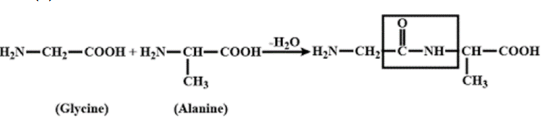
25. a. Give the structure of all the possible dipeptides formed when the following two amino acids form a peptide bond.
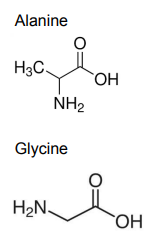
Ans.
b. Keratin, insulin, and myosin are a few examples of proteins present in the human body. Identify which type of protein is keratin and insulin and differentiate between them based on their physical properties.
View AnswerAns. (i) Keratin is a fibrous protein. fibre– like structure is formed. Such proteins are generally insoluble in water.
(ii) Insulin is a globular protein. This structure results when the chains of polypeptides coil around to give a spherical shape. These are usually soluble in water.
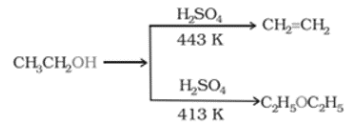
26. Neeta was experimenting in the lab to study the chemical reactivity of alcohols. She carried out a dehydration reaction of propanol at 140oC to 180oC. Different products were obtained at these two temperatures.
a. Identify the major product formed at 140oC and the substitution mechanism followed in this case.
View AnswerAns. Ethanol undergoes a dehydration reaction. At 140oC, diethyl ether is formed. The formation of ether is a nucleophilic SN2 substitution bimolecular reaction
b. Identify the major product formed at 180oC and the substitution mechanism followed in this case.
View AnswerAns. When the temperature exceeds 170oC, ethene is the major product.
Elimination E1 reaction
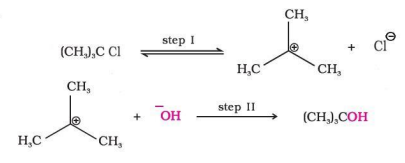
27 Various isomeric haloalkanes with the general formula C4H9Cl undergo hydrolysis reaction. Among them, compound “A” is the most reactive through SN 1 mechanism. Identify “A” citing the reason for your choice. Write the mechanism for the reaction.
View AnswerAns. “A” is (CH3)3CCl, the carbocation intermediate obtained in tertiary alkyl halide is most stable, making A most reactive of all possible isomers.
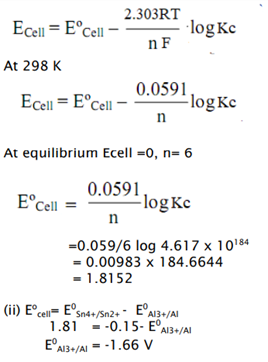
28. The equilibrium constant of cell reaction :
Sn4+ (aq) + Al(s) → Al3+ + Sn2+ (aq) is 4.617 x 10184 , at 25 oC
a. Calculate the standard emf of the cell.
(Given: log 4.617 x 10184 = 184.6644)
b. What will be the E o of the half cell Al3+ /Al , if E o of half cell Sn4+ /Sn2+ is 0.15 V.
View AnswerAns.
SECTION D
The following questions are case-based questions. Each question has an internal choice and carries 4 (2+1+1) marks each. Read the passage carefully and answer the questions that follow.
29. Dependence of the rate of reaction on the concentration of reactants, temperature, and other factors is the most general method for weeding out unsuitable reaction mechanisms. The term mechanism means all the individual collisional or elementary processes involving molecules (atoms, radicals, and ions included) that take place simultaneously or consecutively to produce the observed overall reaction. For example, when hydrogen gas reacts with bromine, the rate of the reaction was found to be proportional to the concentration of H2 and to the square root of the concentration of Br2 . Furthermore, the rate was inhibited by increasing the concentration of HBr as the reaction proceeded. These observations are not consistent with a mechanism involving bimolecular collisions of a single molecule of each kind. The currently accepted mechanism is considerably more complicated, involving the dissociation of bromine molecules into atoms followed by reactions between atoms and molecules:
It is clear from this example that the mechanism cannot be predicted from the overall stoichiometry.
(source: Moore, J. W., & Pearson, R. G. (1981). Kinetics and mechanism. John Wiley & Sons.)
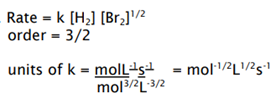
a. Predict the expression for the rate of reaction and order for the following:
H2 + Br2 → 2HBr
What are the units of rate constant for the above reaction?
View AnswerAns.
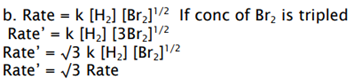
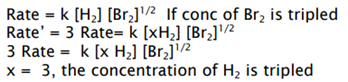
b. How will the rate of reaction be affected if the concentration of Br2 is tripled?
View AnswerAns.
OR
What change in the concentration of H2 will triple the rate of reaction?
View AnswerAns.
c. Suppose a reaction between A and B, was experimentally found to be first order with respect to both A and B. So the rate equation is:
Rate = k[A][B]
Which of these two mechanisms is consistent with this experimental finding? Why?
Mechanism 1
A → C + D (slow)
B + C → E (fast)
Mechanism 2
A + B → C + D (slow)
C → E (fast)
View AnswerAns. The slowest step is the rate-determining step. From mechanism 2, Rate = k [A] [B] while from mechanism 1 Rate = k [A] Therefore mechanism 2, is consistent with the experimental finding
30. Amines are basic in nature. The pKb value is a measure of the basic strength of an amine. Lower the value of pKb , more basic is the amine. The effect of substituent on the basic strength of amines in aqueous solution was determined using titrations. The substituent “X” replaced “-CH2 ” group in piperidine ( compound 1) and propylamine CH3CH2CH2NH2 , (compound 2).

Compound 1: Compound 2: HXCH2CH2NH2
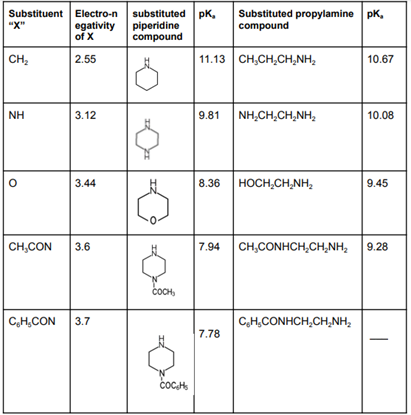
(source: Hall Jr, H. K. (1956). Field and inductive effects on the base strengths of amines. Journal of the American Chemical Society, 78(11), 2570-2572.)
Study the above data and answer the following questions:
a. Plot a graph between the electronegativity of the substituent vs pKb value of the corresponding substituted propyl amine (given that pKa + pKb =14). Is there any relation between the electronegativity of the substituent and its basic strength?
View AnswerAns.
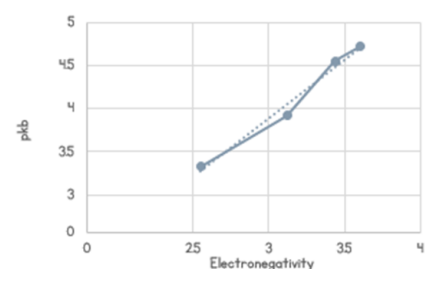
……. Is the line of best fit The pKb increases with an increase in the electronegativity of the substituent, therefore the basic strength decreases with an increase in the electronegativity of the substituent.
b. The electronegativity of the substituent “C6H5CON” is 3.7, what is the expected pKa value of compound C6H5CONHCH2CH2NH2?
(i) 9.9 (ii) 9.5 (iii) 9.3 (iv) 9.1
View AnswerAns. (iv) 9.1
c. The pKa value of the substituted piperidine formed with substituent “X” is found to be 8.28. What is the expected electronegativity of “X”
(i) 3.5 (ii) 3.4 (iii) 3.8 (iv) 3.1
View AnswerAns. (i) 3.5
OR
What is the most suitable pKa value of the substituted propylamine formed with substituent “X” with electronegativity 3.0
(i) 10.67 (ii) 10.08 (iii) 10.15 (iv) 11.10
View AnswerAns. (iii) 10.15
(for visually challenged learners)
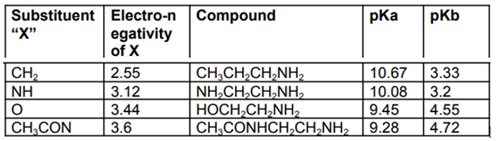
a. How does the electronegativity of the substituent affect the pKb value and the basic strength of the substituted propyl amine (given that pKa + pKb =14).? Give a reason to support your answer.
View AnswerAns. The pKb increases with an increase in the electronegativity of the substituent, therefore the basic strength decreases with an increase in the electronegativity of the substituent
b. The electronegativity of the substituent “C6H5CON” is 3.7, what is the expected pKa value of compound C6H5CONHCH2CH2NH2?
(i) 9.9 (ii) 9.5 (iii) 9.3 (iv) 9.1
View AnswerAns. (iv) 9.1
c. The pKa value of the substituted piperidine (compound 1) formed with substituent “X” is found to be 8.28. What is the expected electronegativity of “X”
(i) 3.5 (ii) 3.4 (iii) 3.8 (iv) 3.1
View AnswerAns. (i) 3.5
OR
What is the most suitable pKa value of the substituted propylamine formed with substituent “X” with electronegativity 3.0
(i) 10.67 (ii) 10.08 (iii) 10.15 (iv) 11.10
View AnswerAns. (iii) 10.15
SECTION E
The following questions are long answer types and carry 5 marks each. All questions have an internal choice.
31. a. A purple colour compound A, which is a strong oxidising agent and used for bleaching of wool, cotton, silk and other textile fibres was added to each of the three test tubes along with H2SO4 . It was followed by strong heating.
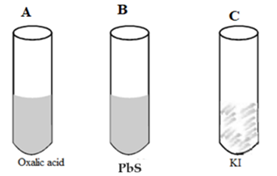
In which of the above test tubes; A,B or C:
(i) Violet vapours will be formed
View AnswerAns. Test tube C
10I– + MnO4– +16 H+ → 5I2 + 2Mn2+ + 8 H2O
(ii) The bubbles of gas evolved will extinguish a burning matchstick. Write an equation for each of the above observations.
View AnswerAns. Test tube A
C2O4 2- + 2MnO4– +16 H+ → 10CO2 + 2Mn2+ + 8 H2O
b. A metal ion Mn+ of the first transition series having d 5 configuration combines with three didentate ligands. Assuming ∆0 < P:
(i) Draw the crystal field energy level diagram for the 3d orbital of this complex.
View AnswerAns.
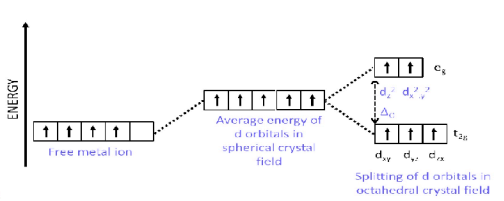
(ii) What is the hybridisation of Mn+ in this complex and why?
View AnswerAns. Sp3d 2, Since ∆0 > P it will form an outer orbital complex as the electrons in the 3d orbital will not pair up.
(iii) Name the type of isomerism exhibited by this complex.
View AnswerAns. Optical isomerism.
OR
a. Using, Valence Bond Theory identify A, B, C, D, E and F in the following table

Ans. A = Co2+
B = 3
C = 𝑑2 𝑠𝑝3
D = Paramagnetic
E= 𝑠𝑝3
F = tetrahedral
b. Write the ionic equations for the reaction of acidified K2Cr2O7 with
(i) H2S and
View AnswerAns.

(ii) FeSO4
View AnswerAns.

32. a. Give reasons for the following:
(i)The reaction of ethanol with acetyl chloride is carried out in the presence of pyridine.
View AnswerAns. The reaction of ethanol with acetyl chloride is carried out in the presence of pyridine. Pyridine is a strong organic base. The function of pyridine is to remove HCl formed in the reaction.
(ii) Cresols are less acidic than phenol.
View AnswerAns. The electron releasing groups, such as alkyl groups, in general, do not favour the formation of phenoxide ion resulting in decrease in acid strength. Cresols, for example, are less acidic than phenol.
b. Williamson’s process is used for the preparation of ethers from alkyl halide.
Identify the alkyl bromide and sodium alkoxide used for the preparation of 2- Ethoxy-3-methylpentane
View AnswerAns. C2H5Br and CH3CH2CH(CH3)CH2CH2ONa yields 2- ethoxy-3-methylpentane
c. Convert:
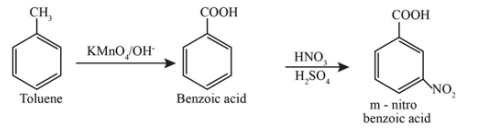
(i) Toluene to 3-nitrobenzoic acid.
View AnswerAns.
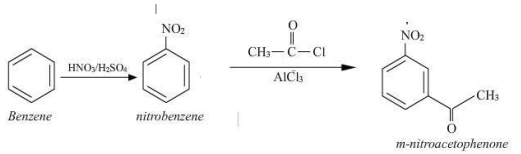
(ii) Benzene to m-nitroacetophenone.
View AnswerAns.
OR
a. Out of formic acid and acetic acid, which one will give the HVZ reaction? Give a suitable reason in support of your answer and write the chemical reaction involved.
View AnswerAns. Acetic acid will give HVZ reaction. Carboxylic acids having an α-hydrogen are halogenated at the α-position on treatment with chlorine or bromine in the presence of a small amount of red phosphorus to give α-halo carboxylic acids.

b. Alcohols are acidic but they are weaker acids than water. Arrange various isomers of butanol in the increasing order of their acidic nature. Give a reason for the same.
View AnswerAns. Isomers of butanol are: Butan-1-ol, butan-2-ol, 2-methylpropanol, 2-methylpropan-2-ol. Acidic strength in isomeric alcohols varies as follows
The acidic character of alcohols is due to the polar nature of O–H bond. An electron-releasing group (–CH3 , –C2H5 ) increases electron density on oxygen tending to decrease the polarity of O-H bond 2-methylpropan-2-ol< 2-methylpropanol < butan-2-ol <Butan-1-ol
c. An organic compound A which is a Grignard reagent is used to obtain 2-methylbutan-2-ol on reaction with a carbonyl compound ‘B’. Identify A’ and ‘B’. Write the equation for the reaction between A and B.
View AnswerAns. An organic compound A is a Grignard reagent : RMgX
B is a ketone RCOR’
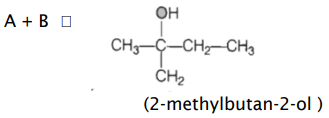
Ketones lead to the formation of tertiary alcohol, so the compound B is a ketone B – Butan-2-one and A ‘ is CH3 MgBr

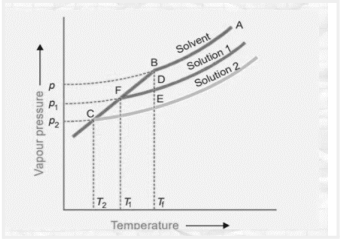
33. a. An experiment was carried out in the laboratory, to study depression in freezing point. 1M aqueous solution of Al(NO3)3 and 1 M aqueous solution of glucose were taken. From the given figure identify solution 1 and solution 2. Give a plausible reason for your answer.
b. The osmotic pressure of a solution of cane sugar was found to be 2.46 atm at 300 K. If the solution was diluted five times, calculate the osmotic pressure at the same temperature.
How can the osmotic pressure of the given cane sugar solution be decreased without changing its volume? Give a reason for your answer.
View AnswerAns. Depression in the freezing point is a colligative property. In dilute solutions the depression of freezing point (ΔTf) is directly proportional to the molal concentration of the solute in a solution. From the graph it is interpreted that Solution 2 shows more depression in freezing point
1 M Al(NO)3 has higher i value (i=3) than 1 M glucose (i=1)
1 M Al(NO)3 will have higher depression, hence solution 2 is Al(NO)3 solution and solution 1 is glucose solution.
OR
a. While giving intravenous injections to the patients, the doctors take utmost care of the concentration of the solution used. Why is it necessary to check the concentration of the solution?
View AnswerAns. While giving intravenous injection to the patients, utmost care of concentration of the solution is to be taken . The solution must have same concentration as that of blood cells.
If the solution becomes more concentrated than the concentration of the blood it will lead to the shrinking of blood cells and fluid will start flowing out because of endosmosis.
If concentration is less concentrated than the concentration of the blood it will lead to swelling of blood cells will take place. Both situations are life-threatening.
b. A solution of phenol was obtained by dissolving 2X 10⁻² kg of phenol in 1 kg of benzene. Experimentally it was found to be 73 % associated. Calculate the depression in the freezing point recorded.
(for visually challenged learners)
a. Which of the two solutions : 1M aqueous solution of Al(NO3)3 or 1M aqueous solution of glucose will show a greater depression in freezing point? Give a plausible reason for your answer.
b. The osmotic pressure of a solution of cane sugar was found to be 2.46 atm at 300 K. If the solution was diluted five times, calculate the osmotic pressure at the same temperature.
How can the osmotic pressure of the given cane sugar solution be decreased without changing its volume? Give a reason for your answer.
OR
a. While giving intravenous injections to the patients, the doctors take utmost care of the concentration of the solution used. Why is it necessary to check the concentration of the solution?
b. A solution of phenol was obtained by dissolving 2 X 10⁻² kg of phenol in 1 kg of benzene. Experimentally it was found to be 73 % associated. Calculate the depression in the freezing point recorded.