Class XII Session 2025-26
Subject – Business Studies
Time Allowed: 3 hours Maximum Marks: 80
General Instructions:
1. This question paper contains 34 questions.
2. Marks are indicated against each question.
3. Answers should be brief and to the point.
4. Answers to the questions carrying 3 marks may be from 50 to 75 words.
5. Answers to the questions carrying 4 marks may be about 150 words.
6. Answers to the questions carrying 6 marks may be about 200 words.
7. Attempt all parts of the questions together.
1. A manager in a conscious manner has to ensure that even where members of a department willingly cooperate, coordination gives direction to the willing spirit. The characteristic of coordination being highlighted above is:
a) Coordination is the responsibility of all managers.
b) Coordination is a deliberate function.
c) Coordination integrates group efforts.
d) Coordination is a continuous process.
View AnswerAns. b) Coordination is a deliberate function.
2. Which of the following is the example of Dunlop?
a) Brand Name
b) Brand
c) Branding
d) Brand Mark
View AnswerAns. a) Brand Name
3. Assertion (A): Plans ensure clarity of thoughts and action. Reason (R): Planning process forces the managers to think differently.
a) Both A and R are true and R is the correct explanation of A.
b) Both A and R are true but R is not the correct explanation of A.
c) A is true but R is false.
d) A is false but R is true.
View AnswerAns. b) Both A and R are true but R is not the correct explanation of A.
4. Which function of management is controlling?
a) Third
b) Second
c) First
d) Last
View AnswerAns. d) Last
5. Instruments with a maturity period of less than one year are traded in ________.
a) Stock Exchange
b) NSEI
c) Money market
d) Capital Market
View AnswerAns. c) Money market
6. Statement I: Sales promotions include only those activities that are used to provide short term incentives to boost the sales of a firm.
Statement II: Public relations involve a variety of programmes designed to promote or protect a company’s image and its individual products in the eyes of the public.
a) Both the Statements I and II are correct.
b) Statement II is correct and Statement I is not correct.
c) Statement I is correct and Statement II is not correct.
d) Both the Statements I and II are not correct.
View AnswerAns. a) Both the Statements I and II are correct.
7. Identify the principle of general management depicted in this pictorial representation.

a) Unity of command
b) Unity of direction
c) Esprit De corps
d) Orders
View AnswerAns. c) Esprit De corps
8. Assertion (A): Responsibility arises from superior-subordinate relationships.
Reason (R): Subordinate is bound to perform the duty assigned by his superior.
a) Both A and R are true and R is the correct explanation of A.
b) Both A and R are true but R is not the correct explanation of A.
c) A is true but R is false.
d) A is false but R is true.
View AnswerAns. a) Both A and R are true and R is the correct explanation of A.
9. Manish, a Chief Manager in a company using highly sophisticated machines and equipments, and wants that every employee should be fully trained before using the machines and equipment. Suggest the best method of training that Manish can use for training of the employees.
a) All of these
b) Autocratic leadership
c) Democratic/Participative leadership
d) Free-rein leadership
View AnswerAns. d) Free-rein leadership
10. Which of the following statements is incorrect?
i. Financial planning is the process of estimating the fund requirement of a business and specifying the sources of funds.
ii. The objective of financial planning is to ensure that enough funds are available at right time.
iii. Financial planning is a substitute of Financial Management.
iv. None of the above
a) Option (i)
b) Option (iii)
c) Option (iv)
d) Option (ii)
View AnswerAns. b) Option (iii)
11. Which of the following statements is incorrect?
a) Secondary market is the market where securities are sold by the company to the investor directly or through an intermediary.
b) Capital Market refers to facilities and institutional arrangements through which long-term funds, both debt and equity are raised and invested.
c) Money Market is a market for short term funds which deals in monetary assets whose period of maturity is upto one year.
d) Primary Market is the Market where only buying of securities takes place. Securities can not be sold there.
View AnswerAns. a) Secondary market is the market where securities are sold by the company to the investor directly or through an intermediary.
12. ABC Ltd. has Debt Equity ratio of 3:1 whereas XYZ Ltd. has Debt Equity ratio of 1:1. Name the advantage ABC Ltd will have over XYZ Ltd, when the rate of interest is lower than the rate of return on investment of the company.
a) Greater flexibility
b) Trading on equity
c) Low risk
d) Low cost of equity
View AnswerAns. b) Trading on equity
13. Statement I: The National Commission has territorial jurisdiction over the whole country.
Statement II: National Commission has a jurisdiction to entertain complaints where value of goods or services paid as consideration exceeds one crore rupees.
a) Statement I is correct and Statement II is not correct.
b) Statement II is correct and Statement I is not correct.
c) Both the Statements I and II are not correct
d) Both the Statements I and II are correct.
View AnswerAns. a) Statement I is correct and Statement II is not correct.
14. Match the columns.
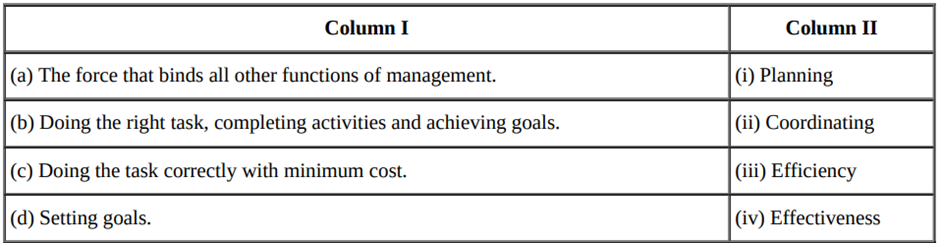
Identify the correct option.
a) (a) – (ii), (b) – (iii), (c) – (iv), (d) – (i)
b) (a) – (iv), (b) – (ii), (c) – (iii), (d) – (i)
c) (a) – (i), (b) – (ii), (c) – (iv), (d) – (iii)
d) (a) – (i), (b) – (iv), (c) – (iii), (d) – (ii)
View AnswerAns. c) (a) – (i), (b) – (ii), (c) – (iv), (d) – (iii)
15. Super Fine Rice Ltd. has the largest share of 55% in the market. The company’s policy is to sell only for cash. In 2015, for the first time, the company’s number one position in the industry has been threatened because other companies started selling rice on credit also. But the managers of Super Fine Rice Ltd. continued to rely on its previously tried and tested successful plans which didn’t work because the environment is not static. This led to a decline in sales of Super Fine Rice Ltd. The above situation indicates a limitation of planning which led to a decline in its sales. Identity the limitation. a. Planning leads to rigidity
b. Planning may not work in a dynamic environment
c. Planning does not guarantee success
d. Planning involves hu
a) (a) and (b)
b) (c) and (d)
c) (a) and (d)
d) (b) and (c)
View AnswerAns. d) (b) and (c)
16. Which of the following statement is false? a. A higher Debt service coverage Ration (DSCR) indicates better ability of a company to increase debt component in its capital structure.
b. If the ROI of company is higher its ability to use debt is greater.
c. More debt can be used if cost of debt is lower.
d. None of these
a) option (d)
b) option (b)
c) option (a)
d) option (c)
View AnswerAns. a) option (d)
17. Amaya wants to start her own cafe. Her long-term goal is to get 40% of the market share. For this she gathered information and made forecasts about the potential demand, purchasing power of the consumers as well as preferences of the consumers and government policy towards this business, etc. By doing this, Amaya had completed some steps in the process of planning. Choose the step in the planning process that Amaya has to follow next:
a) Evaluating alternative courses
b) Developing premises
c) Setting objectives
d) Identifying alternatives courses of action
View AnswerAns. d) Identifying alternatives courses of action
18. Statement I: Packaging refers to designing and developing the label to be put on the package.
Statement II: Customer support services include after sales services, handling customer complaints and adjustments, procuring credit services, maintenance services, technical services and consumer information.
a) Both the Statements I and II are correct.
b) Statement I is correct and Statement II is not correct.
c) Statement II is correct and Statement I is not correct.
d) Both the Statements I and II are not correct.
View AnswerAns. c) Statement II is correct and Statement I is not correct.
19. Other things remaining the same if the fixed operating cost is high the firm would opt to raise finance from:
a) Bills receivable
b) Equity shares
c) Debentures
d) Commercial paper
View AnswerAns. b) Equity shares
20. Statement I: The Consumer Protection Act 2019 has replaced the Act 1986 and seeks to widen its scope in addressing consumer concerns.
Statement II: The Consumer Protection Act 2019 provides for Setting up of Consumer Mediation Cell to ensure faster dispute settlements by respective commissions.
a) Both the Statements I and II are not correct.
b) Both the Statements I and II are correct.
c) Statement I is correct and Statement II is not correct.
d) Statement II is correct and Statement I is not correct.
View AnswerAns. b) Both the Statements I and II are correct.
21. How is management all pervasive?
View AnswerAns. Activities involved in management are applicable to every type of organisation whether economic, social or economic, social or political. Either in hospital or a small hawker who sale fruits they all have to use management Thus it can be said that management is all pervasive.
OR
a. How does coordination ensure unity of action in Management? .
View AnswerAns. Coordination acts as the binding force between departments and ensures that all actions are aimed at achieving the goals of the organisation. Coordination is the process of uniting, integrating and synchronising the efforts of group members to achieve unified action in pursuit of a common goal. It is a hidden force that connects all other management functions.
b. At which level of management coordination takes place in an organisation?
View AnswerAns. At the top level management It has to take care that there is coordination between organisational goals and the goals of the units and sub-units formed for achieving these goals.in general coordination is take place in a organisation in all three levels.
c. How does coordination integrate group efforts?
View AnswerAns. Coordination integrates group efforts by combining unrelated or diverse interests into purposeful work activity. It gives a common focus to group effort by ensuring that the performance and the objective goes in the same direction.
22. Give one example of employee recognition.
View AnswerAns. Employee recognition is an element of Non-Financial Incentives. Recognition means acknowledgement with a show of appreciation. When such appreciation is given to the work performed by employees, they feel motivated to perform at higher level. Example- Congratulating the employee for good performance.
OR
Explain briefly any three personal barriers to communication.
View AnswerAns. The three personal barriers to communication are:
i. Lack of confidence of superior in his subordinates: Superiors often consider the subordinates as less competent. Such perception stand against the free flow of communication.
ii. Lack of incentives: If there is no incentive for communicating new ideas, then subordinates may not take initiatives to give suggestions, e.g. if there is no reward given for giving some good suggestion, then employees will take no initiative to give good suggestions.
iii. Unwillingness to communicate: The personal characteristic of an individual also influences the free flow of communication. Sometimes the superiors may not be prepared to communicate with the subordinates. These superiors may have selfish intentions and may prevent any negative information that threatens their reputation.
23. Mr. Abeer Dahiya, finance manager of Nidhi Logistics Ltd. has a proposal to replace Pentium III computers with Pentium V computers. Which decision of financial management is highlighted in these lines? How are investment decisions crucial for the business?
View AnswerAns. The given lines highlight the investment decision. Investment decisions are crucial for business because of the following reasons:
i. Investment decisions are long-term investments and, therefore, considered irreversible.
ii. Investment decisions generally involve commitment of huge funds.
iii. Investment decisions are very significant from the point of view of profitability and future of the company
24. Jolly bought an Anti-dandruff Shampoo of a reputed company which claimed to contain zinc pyrithione (ZPTO) to control dandruff. When the product did not show the promised results even after regular use for two months she discussed the problem with his aunt Dolly who is a dermatologist. Dolly told him ZPTO is an anti-fungal agent, meaning that only dandruff caused by a fungal infection could be ‘cured.’ But to Jolly’s surprise, this condition was not mentioned in the shampoo case. In the context of the above case:
a. Identify and explain the consumer right being violated in the above case.
View AnswerAns. Right to information is being violated in the above case. The Consumer Protection Act, 1986 (CPA) protects the interests of the consumers in the widest range possible. According to the Right to information, the consumer has the right to get complete information about the product that he/she may propose to buy including its contents, date of manufacture and expiry, maximum retail price, quantity, directions for use etc. Moreover, as per law, it is mandatory for marketers to provide complete information about the product/service to buyers. Though CPA came into force in 1986 it had the provision empowering consumers to seek information regarding goods or services under proper legislation.
b. List any two other consumer rights.
View AnswerAns. The two other consumer rights are:
i. Right to be Heard
ii. Right to Seek Redressal.
25. A company is manufacturing garments. The manager wants to increase the profits by purchasing new high-speed machines or increasing the sale price or using waste material in manufacturing stuffed toys. He decided that using waste material to increase the profit is the best solution for him.
i. Identify the concept of management involved.
View AnswerAns. The concept involved here is “Planning.”
ii. Mention the steps involved in the above process by quoting the lines from the question.
View AnswerAns. The steps involved are:
a. Setting objectives: Quoted in the line, “The manager wants to increase the profits.”
b. Identifying and evaluating alternative courses of action: Quoted in the line, “By purchasing new high-speed machines, or increasing sale price, or using waste material in manufacturing stuffed toys.”
c. Selecting the Best alternative: Quoted in the line, “Using waste material in manufacturing stuffed toys.”
iii. To complete the process of the concept identified, what further steps does the manager have to take?
View AnswerAns. The manager is further required to complete the following steps:
a. Formulating and Implementing the plan.
b. Follow-up action.
26. Describe briefly the steps in the process of controlling.
View AnswerAns. Controlling Process consists of following systematic steps: 1. Setting Performance Standards: The first step in the process of controlling is concerned with setting performance standards. These standards are the basis for measuring the actual performance.
Thus, standards act as a lighthouse that warns & guides the ships at sea. Standards are the benchmarks towards which efforts of entire organisation are directed. These standards can be expressed both in quantitative and qualitative terms.
2. Measurement of Actual Performance: Once the standards have been determined, the next step is to measure the actual performance. The various techniques for measuring are sample checking, performance reports, personal observation etc. However, in order to facilitate easy comparison, the performance should be measured on same basis that the standards have.
3. Comparing Actual Performance with Standards: This step involves comparing the actual performance with standards laid down in order to find the deviations. For example, performance of a salesman in terms of unit sold in a week can be easily measured against the standard output for the week.
4. Analyzing Deviations: Some deviations are possible in all the activities. However, the deviation in the important areas of business needs to be corrected more urgently as compared to deviation in insignificant areas. Management should use critical point control and management by exception in such areas.
5. Taking Corrective Action: The last step in the process of controlling involves taking corrective action. If the deviations are within acceptable limits, no corrective measure is required. However, if the deviations exceed acceptable limits, they should be immediately brought to the notice of the management for taking corrective measures, especially in the important areas.
OR
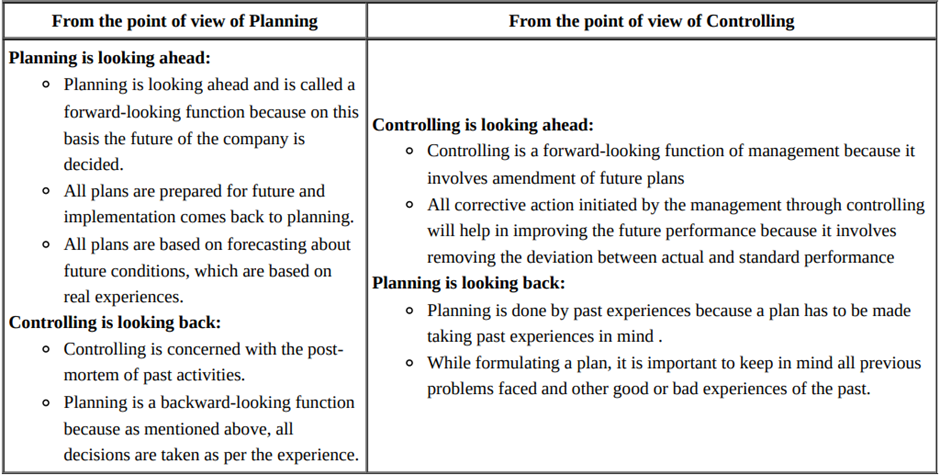
“Planning is looking ahead and controlling is looking back”. Comment.
View AnswerAns. The given statement is not fully correct.
27. Dinesh works as a head mechanic in M/s Apex Industries (machine assembling industry). He requires a number of tools while assembling the machine. Forgetting the tools, Ajay has to move frequently to the tool room, which is situated away from the workplace. Such frequent movements lead to wastage of a lot of time and no steps are taken by the factory manager to eliminate such unnecessary movements of Dinesh and his co-workers.
i. Which technique of Taylor is overlooked by the factory manager?
View AnswerAns. Motion Study.
ii. How can the frequent movements be avoided?
View AnswerAns. The frequent movements can be avoided either by having workplace next to tool room or by keeping the necessary toolbox at the workplace.
iii. What kind of benefits will accrue to M/s Apex Industries after avoiding such unnecessary movements?
View AnswerAns. Elimination of unnecessary movements will help to increase the productivity of workers and will also improve the efficiency level.
28. State any four financial incentives.
View AnswerAns. Financial incentives are as follows:
i. Pay and allowances: For every employee, salary is the basic monetary incentive. It includes basic pay, dearness allowance and other allowances. Salary system consists of regular increments in the pay every year and enhancement of allowances from time-to-time. In some business organisations, pay hike and increments may be linked to performance.
ii. Productivity linked wage incentives: Several wage incentive plans aims at linking payment of wages to increase in productivity at individual or group level.
iii. Bonus: Bonus is an incentive offered over and above the wages/salary to the employees.
iv. Profit Sharing: Profit sharing is meant to provide a share to employees in the profits of the organisation. This serves to motivate the employees to improve their performance and contribute to increase in profits.
OR
Explain the following as Semantic barriers to communication:
i. Badly Expressed message
View AnswerAns. Sometimes intended meaning may not be conveyed by a manager to his subordinates.
These badly expressed messages may be on account of inadequate vocabulary, usage of wrong words etc.
ii. Symbols with different meanings
View AnswerAns. A word may have several meanings and the receiver has to perceive one such meaning for the word used by communicator.
Wrong perception leads to communication problems which reduces the effective communication.
29. Be Natural is one of the top-selling organic food brands in India. It has more than a hundred products in over 16 categories including Rice & Millets, spices, Pastas, Seeds & Nuts, Soaps and Detergents etc. The company sells its products through a person who is either an online store entreprenuer or a physical store owner or an organic/speciality store owner to sell their products. In the context of the above case:
a. Identify the components of the marketing mix being discussed above.
View AnswerAns. Product mix is also known as product assortment, refers to the total number of product lines a company offers to its customers. The four dimensions to a company’s product mix include width, length, depth and consistency and Place mix which consists of decisions relating to channels of distribution and physical distribution. Channels of distribution refer to the individuals and organizations which facilitates in moving the goods from manufactures to consumers are the two components of the marketing mix is discussed above.
b. Name the important decisions related to both of these components.
View AnswerAns. The important decisions related to product mix are branding, labelling and packaging. The important decisions related to place mix/ physical distribution are:
i. Decision regarding channels of distribution (Direct/Indirect)
ii. Physical movement of the product from its place of production to a place where it can be made available to the consumers for sale.
c. Do you think the company has adopted an appropriate channel of distribution? Give any two reasons in support of your answer.
View AnswerAns. Yes, the company has adopted an appropriate channel of distribution i.e. indirect channel because of the following reasons:
i. The unit value of the products is less.
ii. The products are non-perishable in nature.
iii. The number of buyers is large.
iv. The buyers are widely spread over a large geographical area.
30. Explain how the District Commission helps the consumers in redressing their grievances.
View AnswerAns. The District Forum consists of a President and two other members, one of whom should be a woman. They all are appointed by the State Government concerned. A complaint can be made to the appropriate District Forum when the value of the goods or services in question, along with the compensation claimed, does not exceed ₹ 20 lakhs. On receiving the complaint, the District Forum shall refer the complaint to the party against whom the complaint is filed. If required, the goods or a sample thereof, shall be sent for testing in a laboratory. The District Forum shall pass an order after considering the test report from the laboratory and hearing to the party against whom the complaint is filed. In case the aggrieved party is not satisfied with the order of the District Forum, he can appeal before the State Commission within 30 days of the passing of the order. As the Forum receives the complaint, it refers it to the concerned party against whom the compliant is registered. After considering the tests and reports and on hearing both the concerned parties, the forum passes a judgement order.
31. Race Tech Ltd. is one of the top IT companies in India. The company does mass recruitment each year from different colleges offering fresher level job to the final year students. This helps in recruiting the brightest and the best available talent in the educational institutions. In context of the above case:
a. Identify the source of external recruitment adopted by the company.
View AnswerAns. Direct Recruitment is the source of External Recruitment adopted by the company: The direct recruitment also called as factory gate recruitment is an important source of hiring, especially the unskilled workers or badli workers who are paid on a daily-wage basis. Here, the company puts up a notice on a notice board or on the factory gate regarding the jobs available, such that the applicant sees it and apply for the job directly.
b. Explain briefly any three advantages of using the external sources of recruitment
View AnswerAns. As with any recruiting method, hiring from outside an organization instead of promoting from within the company carries both advantages and disadvantages. Let’s explore some of the advantages:
a. When an organization recruits externally, it opens the organization up to a larger pool of applicants, which increases its chance of finding the right person for the job.
b. External recruitment provides an opportunity for a fresh outlook on the industry that a company may need to stay competitive. Bringing in fresh talent from the outside can help motivate the current employees to produce and achieve more in hopes of obtaining the next promotional opportunity. Looking outside the organization also allows a company to target the key players that may make its competition successful. Hiring a candidate with a proven track record for the competition allows the company to get an insider’s view as to what the competition is doing to be successful. This gives the organization a chance to stay a step ahead of the competition.
c. Hiring an external candidate also opens up many opportunities to find experienced and highly-qualified and skilled candidates who will help a company meet its diversity requirements.
32. State the advantages or positive impact of demonetisation.
View AnswerAns. Following are the advantages of demonetisation:
i. Curbing black money – Demonetisation has helped the government in tracking black money kept hidden by tax evaders. Demonetisation has helped in uncovering a huge amount of unaccounted cash. People had deposited more than 3 lakh crores worth of black money in bank accounts.
ii. Increase in tax revenue – As a result of demonetisation, people deposited their money in their bank accounts. The number of tax payers has considerably increased. As a result, the government got a good amount of tax revenue which could be used by the government towards the betterment of society.
iii. Cashless economy – Demonetisation pushed the Indian economy towards becoming cashless. The government succeeded in encouraging people to use digital means for making transactions. According to an estimate, the economy has witnessed a 20% decline in currency in circulation.
OR
What is micro environment? Explain any four components of it.
View AnswerAns. The microenvironment of the organization consists of those elements which are controllable by the management. Normally the microenvironment does not affect all the companies in an industry in the same way, because the size, capacity, capability, and strategies are different. The four components of the microenvironment are:
i. Competitors: In the original business world, a company encounters various forms of competition. The most common competition which a company’s product now faces is from differentiated products of other companies.
ii. Customers: According to Peter. F. Drucker, “There is only one valid definition of business purpose, that is to create a customer.” Business enterprises aim to earn profit by serving customer demand.
iii. Suppliers: Regarding the suppliers, the organization can think of availing the required material or labour according to its manufacturing program. It can adopt such a purchase policy which gives bargaining power to the organization.
iv. Public: Literally word ‘public’ refers to people in general. According to Philip Kotler, “A public is any group that has an actual or potential interest in or impact on a company’s ability to achieve its objectives.” The environmentalists, consumer protection groups, media persons and local people are some of the well-known examples of the public.
33. One of the questions that needs to be answered in the organizing function is At what level are decisions made? Decision making authority in an organization can be pushed down to the lower levels or it may lie with the top management. However it is not an either or concept. When an organization grows in size or complexity, there is a tendency towards sharing decision making authority with the lower levels. This is because in large organizations, employees who are closely involved with certain operations tend to have more knowledge about them than the top management. An important concept of organizing function is discussed above. Identify the concept and state any three points of its importance.
View AnswerAns. Decentralisation
- Decentralisation is a type of organisational structure in which authority is delegated by top management to middle and lower levels of management in an organisation.
– In this organisational structure, daily operations and minor decision-making capabilities are delegated to the middle and lower levels, allowing top-level management to focus on major decisions such as business expansion, diversification, and so on.
Importance of decentralisation
i. Rapid decision making- Most decisions are made on the spot, with no need for approval from higher ups. The ability to make quick decisions allows an organisation to operate efficiently and effectively.
ii. Administrative development- When managers are given responsibility and challenges to develop solutions, the decentralisation process calls into question their judgement and techniques. This questioning method builds confidence, encourages self-reliance, and makes them good decision-makers, resulting in the organization’s growth.
iii. Development of executive skills- It allows the employee to perform tasks on their own, providing them with invaluable experience. Individual performance creates an environment in which an individual can improve their expertise, take ownership and more significant responsibilities, and be considered for advancement.
Hence, decentralisation refers to the division of a set of functions and activities into relatively autonomous units, with overall authority and responsibility for their operation delegated to the time of cacti unit. In this type of organisation structure, the duty of daily operations and minor decision-making capabilities are transferred to the middle and lower levels which allow top-level management to focus more on major decisions like business expansion, diversification etc.
34. Explain the steps in the trading and settlement procedure?
View AnswerAns. Trading procedure :
Selection of a Broker: The first step is to select a broker, who will buy/sell securities on behalf of the speculator/investor. This is necessary because trading of securities can only be done through SEBI registered brokers, who are members of the stock exchange. Brokers may be individuals, partnership firms and corporate bodies.
Opening Demat Account with Depository: The next step is to open a demat account. Demat (Dematerialised) account refers to an account which an Indian citizen must open with the depository participant (banks and stockbrokers) to trade in listed securities in “electronic form. The securities are held in the electronic form by a depository. ‘Depository’ is an institution/organization which holds securities (e.g. shares, debentures, bonds, mutual funds, etc) in electronic form, in which trading is done.
Placing the Order: The next step is to place the order with the broker. The order can be communicated to the broker either personally or through telephone, cell phone, e-mail, etc.
The instructions should specify the securities to be bought or sold and the price range within which the order is to be executed.
Only the securities of listed companies can be traded on the stock exchange.
Executing the Order: According to the instructions of the investor, the broker buys or sells securities. The broker then issues a contract note. A copy of the contract note contains the name and the price of securities, names of the parties, brokerage charges, etc. It is duly signed by the broker.
Settlement: This is the last stage in the trading of securities done by the brokers on behalf of their clients. The mode of settlement depends upon the nature of the contract. Equity spot markets follow a T + 2 rolling settlement. This means that any trade taking place on Monday gets settled by Wednesday. Stock, exchange operates from Monday to Friday between 9:55 am and 3:30 pm. Each exchange has its own clearing house, which assumes all settlement risk.
OR
Explain the two main segments of the NSE.
View AnswerAns. The exchange provides trading in the following two segments:
i. Capital Market Segment: This segment refers to the trading platform for a wide range of fixed income securities like central government securities, bonds issued by public sector undertakings, zero coupon bonds, treasury bills, commercial papers, certificates of deposit, mutual funds, corporate debentures etc.
ii. Whole Sale Debt Market Segment: The main role of this segment is to provide a trading platform for a wide range of fixed income securities. It includes:
Treasury Bill.
Commercial Paper.
Central Government Securities.
Certificate of deposit.
Mutual Funds.
Bonds issued by public sector undertakings.
Debentures.