CLASS: XII
SUBJECT: BUSINESS STUDIES (054)
TIME:3 HOURS M.M.–80
General instructions:
1. This question paper contains 34 questions.
2. Marks are indicated against each question.
3. Answers should be brief and to the point.
4. Answers to the questions carrying 3 marks may be from 50 to 75 words.
5. Answers to the questions carrying 4 marks may be about 150 words.
6. Answers to the questions carrying 6 marks may be about 200 words.
7. Attempt all parts of the questions together.
1. Roshan is working as marketing manager in a company. He has been given the task of selling 1,00,000 units of a product at the cost of Rs. 100 per unit within 20 days. He is able to sell all the units within the stipulated time, but had to sell last 1,000 units at 20% discount in order to complete the target. In such a situation, he will be considered to be
(a) An efficient manager
(b) An effective manager
(c) Both effective and efficient manager
(d) None of the above
View AnswerAns. (b) An effective manager
2. Identify the correct order in the following steps of controlling process.
1. Analysing deviations
2.Setting Performance Standards
3.Comparison of Actual performance with standards
4.Measurement of actual performance
5. Taking corrective action
Options:
(a) 4-3-2-1-5
(b)1-2-3-4-5
(c)1-4-5-3-2
(d)2-4-3-1-5 1
View AnswerAns. (d)2-4-3-1-5 1
Q3 Which of the following statements is correct for ‘Short term investment decisions’?
(a) They affect the earning capacity of a business in the long run.
(b) These decisions normally involve huge amounts of investment.
(c) These decisions affect the liquidity as well as profitability of a business.
(d) They are irreversible except at a huge cost.
View AnswerAns. (c) These decisions affect the liquidity as well as profitability of a business.
4. Read the following statements carefully:
Statement I: Secondary Market directly promotes capital formation.
Statement lI: Capital market deals in medium and long term securities such as equity shares and debentures. In thelight of given statements, choose the correct alternative from the following:
(a) Both the statements are true.
(b) Both the statements are false.
(c) Statement I is true, Statement II is false.
(d) Statement II is true; Statement I is false
View AnswerAns. (d) Statement II is true; Statement I is false
5 Coordination is considered to be the essence of management because ______.
(a) It is a common thread that runs through all the activities within the organisation.
(b) It is implicit and inherent in all functions of the organisation.
(c) It is a force that binds all the functions of management.
(d) All of the above.
View AnswerAns. (d) All of the above.
6. Due to the increasing presence of women in the workforce, ‘Muskan Mart’ comes out every Friday with big discount offers on daily use items to attract office-going women to shop on weekends. Which dimension of the business environment is being highlighted in the above case?
(a) Social environment
(b) Legal environment
(c) Political environment
(d) Technological environment
View AnswerAns. (a) Social environment
7. Statement- (i) Delegation of authority is inevitable and decentralisation is voluntary.
Statement- (ii) Scope of delegation of authority is limited and the scope of decentralisation is broad. Both the above statements are:
(a) True
(b) False
(c) Statement(i) is True and Statement (ii) is False
(d) Statement(i) is False and Statement (ii) is True
View AnswerAns. (a) True
8. Read the following statements: Assertion (A) and Reason (R). Choose the correct alternative from those given below:
ASSERTION (A):Controlling is also a forward looking function.
REASON (R):The corrective action initiated by control function aims to improve future performance.
(a) Both Assertion (A) and Reason (R) are true and Reason is the correct explanation of Assertion.
(b) Both Assertion (A) and Reason(R) are true and Reason is not the correct explanation of Assertion.
(c) Assertion (A) is true, Reason(R) is false.
(d) Assertion(A) is false, Reason(R) is true
View AnswerAns. (a) Both Assertion (A) and Reason (R) are true and Reason is the correct explanation of Assertion.
9. The increase in the demand for many ayurvedic medicines, health products and services in the past few months is related to the need for building immunity and an increased awareness for health care due to the spread of Coronavirus. Identify the feature of the business environment being described above.
(a) Specific and general forces
(b) Interrelatedness
(c) Relativity
(d) None of the above
View AnswerAns. (b) Interrelatedness
10. State Commission has the jurisdiction to entertain complaints where value of goods and services paid as consideration is ________
(a) More than ₹1 crore and not more than ₹ 5 crore
(b) More than ₹10 crore.
(c) Less than ₹1 crore
(d) More than ₹1 crore and not more than ₹10 crore
View AnswerAns. (d) More than ₹1 crore and not more than ₹10 crore
11. Identify the incorrect statement with respect to Consumer Protection in India.
(a) It not only includes educating consumers about their rights and responsibilities but also helps in getting their grievances redressed
(b) It not only requires judicial machinery for protecting the interest of consumers but also requires the consumers to get together and form themselves into Consumer associations for protection and promotion of their interests.
(c) It is the moral duty of any business to take care of consumer’s interest and avoid any form of exploitation.
(d) The provisions of Consumer Protection Act came into force from 1981.
View AnswerAns. (d) The provisions of Consumer Protection Act came into force from 1981.
12. Match the Marketing Management philosophies given in Column I with their main focus given in Column II:
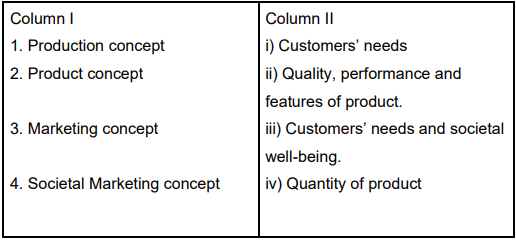
Choose the correct option from the following:
(a) 1-(i), 2-(ii), 3-(iii), 4-(iv)
(b) 1-(ii), 2-(iii), 3-(i), 4-(iv)
(c)1-(iv), 2-(ii), 3-(i), 4-(iii)
(d) 1-(ii), 2-(iv), 3-(i), 4-(iii)
View AnswerAns. (c)1-(iv), 2-(ii), 3-(i), 4-(iii)
13. Good Living Ltd. manufactures mosquito repellent tablets. These tablets are packed in strips of 12 tablets each. Each of these strips are packed in a cardboard box. 48 such boxes are then placed in a big corrugated box and delivered to various retailers for sale. State the purpose of packaging the tablets in a corrugated box.
(a) Storage
(b) Identification
(c) Transportation
(d) All the above
View AnswerAns. (d) All the above
14 __________as an element of marketing mix includes the activities which provide information about the product to the target customers.
(A) Promotion
(B) Place
(C) Product
(D) Price
View AnswerAns. (A) Promotion
15. In a marketing firm, the financial manager pay more attention towards an increase of 3% in the marketing cost as compared to a 15% increase in the courier expenses. Identify the concept being used by the manager.
(a)Management by exception
(b) Critical point control
(c) Corrective action
(d) None of the above.
View AnswerAns. (b) Critical point control
16 For holding securities in an electronic form, the investor has to open a demat account with an organization called __________.
(A) Depository
(B) Securities and Exchange Board of India
(C) Stock Exchange
(D) Mutual Fund
View AnswerAns. (A) Depository
17 The concept which makes sure the availability of right amount of finance at the right time is called
(a) Financial Planning
(b) Capital Structure.
(c) Working Capital
(d) Fixed Capital
View AnswerAns. (a) Financial Planning
18. Rahul has joined as a creative head in an entertainment company. He always ensures that the work divided into small manageable activities and of similar nature are grouped together. Identify the related step in organizing process being mentioned in the above lines.
(a) Identification and division of work
(b) Departmentalization
(c) Assignment of duties
(d) Establishing reporting relationship.
View AnswerAns. (b) Departmentalization
19 On the successful completion of two years in a company, Harsh received a letter confirming his job as a permanent employee. Identify the need of Harsh being fulfilled as per Maslow’s Need Hierarchy Theory.
(a) Esteem Needs
(b) Security Needs
(c) Self Actualisation Needs
(d) Basic Physiological Needs
View AnswerAns. (b) Security Needs
20. From the following pictorial presentation identify the objective violated by the management

(a) Organisational Objective
(b) Social Objective
(c) Personal Objective
(d) Economic Objective
View AnswerAns. (b) Social Objective
21. Explain how planning
(I) Reduces creativity
(II) Leads to rigidity
View AnswerAns. Rigidity
Once a plan is created, managers may not be able to change it, even if circumstances change. Following a pre-decided plan in a changed environment may not be in the organization’s best interest.
Reduces creativity
Planning is usually done by top management, and others implement the plans. This can lead to middle management and decision makers not being able to deviate from the plan or act on their own. This can reduce creativity and initiative.
OR
State the meaning of single use plans and standing plans.
View AnswerAns. Single Use plans- A single-use plan is developed for a one-time event or project. Such a course of action is not likely to be repeated in future, i.e., they are for nonrecurring situations. The duration of this plan may depend upon the type of the project. It may span a week or a month or a day.
Standing plans-A standing plan is used for activities that occur regularly over a period of time. It is designed to ensure that internal operations of an organization run smoothly. Such a plan greatly enhances efficiency in routine decision-making. It is usually developed once but is modified from time to time to meet business needs as required.
22. Name and explain the method of recruitment in the following cases:
(a) A company gets applications on and off even without declaring any vacancy. However, as and when the vacancy arises, the company makes use of such applications.
View AnswerAns. Casual caller’s method. In this method, company makes use of database of unsolicited applicants which are kept in file. Company recalls them to fill the current vacancies.
(b) Recruitment by which most of the senior positions of the industry are filled.
View AnswerAns. Advertisement method. This method is used to fill the most of the senior positions of the industry.
(c) Casual vacancies of unskilled or semi-skilled jobs when there is a rush of order or when some permanent workers are absent.
View AnswerAns. Direct recruitment method. Through direct recruitment, casual vacancies of unskilled or semi-skilled jobs are filled, when there is a rush of order or when some permanent workers are absent.
OR
Srija runs an NGO under the name ‘Sarthak’ in Delhi. The organisation is engaged in offering waste paper recycling services to all kinds of institutions in the Delhi NCR region. It also manufactures custom made paper stationery out of recycled paper on order for the interested institutions at a very competitive price. The website of ‘Sarthak’ provides a link to a Careers site wherein the people desirous of joining the NGO can use simple Job Search to find the right opportunity for themselves. The NGO also keeps a database of unsolicited applicants in its office so that job seekers may be notified of future opportunities when they arise.
In context of the above case:
Identify the two sources of external recruitment being used by the NGO ‘Sarthak’ by quoting lines from the paragraph.
View AnswerAns. The two sources of external recruitment being used by the NGO ‘Sarthak’ are as follows:
i) Web Publishing: Lines- “The website of ‘Sarthak’ provides a link to a Careers site wherein the people desirous of joining the NGO can use simple Job Search to find the right opportunity for themselves”
ii) Casual Callers: Line- “The NGO also keeps a database of unsolicited applicants in its office so that job seekers may be notified of future opportunities when they arise.”
23. Yogesh, a businessman, is engaged in purchasing and selling of ice-creams. Further he is willing to start his own ice-cream factory.
1. Identify the working capital requirement of Yogesh giving reason in support of your answer.
View AnswerAns. Working capital requirements to Yogesh would be less as it is a trading business. There is no processing
2. Explain any two factors that will affect his working capital requirement.
View AnswerAns. Any 2 factors affecting working capital requirement with correct explanation Credit policy, Inventory management, Operating efficiency, Size of business
24. Mr Vivek Vaswani, a foodpreneur combined his passion for food with his Entrepreneurial skills and started his innovative fast food outlet OH CHILLI! in 2021. He had started his career as a food blogger and had noticed that numerous Indian consumers were looking for reasonable and pure vegetarian fast food options for dining out. The high end restaurants were not opted by many as they were exorbitantly priced. Though many global fast food chains were running across the country, yet not many outlets offered reasonable and healthy pure vegetarian fast food options to consumers. OH CHILLI! became a pioneer in offering a healthy and delicious variety of food.
What came as a surprise for consumers was that even without using onion or garlic in the pasta sauce, marinade and ketchup ,the food could actually taste great. The company witnessed an increase in net profit of 26% in its second financial year and became a market leader.
(I) State the concept of business environment.
View AnswerAns. Business Environment means the sum total of all individuals, institutions and other forces that are outside the control of a business enterprise but that may affect its performance.
(II) Identify and explain in what way, a good understanding of business environment enabled Mr.Vivek Vaswani to improve the performance of the enterprises,
View AnswerAns. It enables the firm to identify opportunities and getting the first mover advantage: Opportunities refer to the positive external trends or changes that will help a firm to improve its performance. Environment provides numerous opportunities for business success. Early identification of opportunities helps an enterprise to be the first to exploit them instead of losing them to competitors.
25. Identify the level of management whose basic task is to integrate diverse element and coordinate the activities of different departments according to the overall objectives of the organization. State any three functions of the level of management identified
View AnswerAns. Top level management Functions of top-level management: (any 3)
i) The Top-level managers are responsible for the welfare and survival of the organisation.
ii) They analyse the business environment and its implications for the survival of the firm.
iii) They formulate overall organisational goals and strategies for their achievement.
iv) They are responsible for all the activities of the business and for its impact on society
26. In order to streamline the selection procedure, so as to minimise the margin of errors, certain tests are carried out that attempt to measure the characteristics of individuals. Explain any four such tests.
View AnswerAns. Selection tests (Any four):
i) Intelligence Tests: This is one of the important psychological tests used to measure the level of intelligence quotient of an individual. It is an indicator of a person’s learning ability or the ability to make decisions and judgments.
ii) Aptitude Test: It is a measure of an individual’s potential for learning new skills. It indicates the person’s capacity to develop.
iii) Personality Tests: Personality tests provide clues to a person’s emotions, her reactions, maturity and value system etc. These tests probe the overall personality. Hence, these are difficult to design and implement.
iv) Trade Test: These tests measure the existing skills of the individual. They measure the level of knowledge and proficiency in the area of professions or technical training. The difference between aptitude test and trade test is that the former measures the potential to acquire skills and the later the actual skills possessed
OR
Since jobs have become more complex, the importance of employee training has increased. Training programmes provide numerous benefits to workers. Explain any four points that support this statement.
View AnswerAns. Benefit of training to workers:
i) Improved skills and knowledge due to training lead to better careers for the individual.
ii) Increased performance by the individual helps him to earn more.
iii) Training makes the employee more efficient to handle machines. Thus, less prone to accidents.
iv) Training increases the satisfaction and morale of employees
27. Abhilasha is a student of class XIl of a well-known school. She has a preconceived notion that her teacher always finds fault in her work. One day while checking the project work of class XII, her teacher wanted to appreciate Abhilasha for her hard work and good performance, but before she could complete her sentence, Abhilasha left the room without listening to her teacher.
(a) Identify the ‘barrier to communication’ and also the type of barrier to which it is related.
View AnswerAns. Premature Evaluation and Psychological Barriers
(b) Explain two other communication barriers of the type identified in (a) above.
View AnswerAns. Any two of the following:
(i) Lack of Attention: The pre-occupied mind of receiver and the resultant non listening of message acts as a major psychological barrier.
(ii) Loss by transmission and poor retention :
When communication passes through various levels, successive transmissions of the message results in loss of, or transmission of inaccurate information.
(iii) Distrust :
Distrust between communicator and communicate acts as a barrier. If the parties do not believe each other, they cannot understand each other’s message in its original sense.
28. Explain the first four steps in the process of controlling.
View AnswerAns. The first four steps in the process of controlling are
i) Setting performance standards: The first step in the controlling process is setting up of performance standards. Standards are the criteria against which actual performance would be measured. Standards can be set in both quantitative as well as qualitative terms.
ii) Measurement of Actual Performance: Once performance standards are set, the next step is measurement of actual performance. It is generally believed that measurement should be done after the task is completed.
iii) Comparing actual performance with standards: This step involves comparison of actual performance with the standard. Such comparison will reveal the deviation between actual and desired results. Comparison becomes easier when standards are set in quantitative terms.
iv). Analysing deviations: Some deviation in performance can be expected in all activities. After identifying the deviations that demand managerial attention, these deviations need to be analysed for their causes. These causes may be unrealistic standards, defective process, inadequacy of resources, structural drawbacks, etc. It is necessary to identify the exact cause of deviation, failing which an appropriate corrective action might not be possible.
OR
Which function of management is concerned with the process of ensuring that all plans are effectively implemented? Write any two points of importance of the function identified.
View AnswerAns. Controlling
Any two points of importance of controlling
29. Having transformed 2500 Kirana stores across eight cities in to virtual super markets, the startup Quick Bizz further decided in advance, to collaborate with 15,000-20,000 store owners in top 30 cities of the country by the end of this year. The company has set its eye on digitizing over 1,00,000kirana stores over next 18-24 months.
(i) Identify and explain the step in the process of one of the functions of management discussed above.
View AnswerAns. Following is the step in the process of Planning:
Setting objectives: The first and foremost step is setting objectives. Objectives may be set for the entire organization and each department or unit within the organization. Objectives or goals specify what the organization wants to achieve. Objectives should be stated clearly. Management must contribute ideas and participate in the objective-setting process. If the end result is clear it becomes easier to work towards the goal.
(ii) Also explain the last step to be performed by Quick Bizz as part of the process.
View AnswerAns. Following is the last step in the process of Planning:
Follow up action: To see whether plans are being implemented and activities are performed according to schedule is also part of the planning process. Monitoring the plans is equally important to ensure that objectives are achieved.
30. Give any four points of difference between Production and Selling concept.
View AnswerAns. (A) Meaning:
Selling Concept: The selling concept of marketing management philosophy emphasizes aggressive sales techniques and promotional efforts to convince customers to buy a company’s products or services, regardless of their actual needs or preferences.
Production Concept: The production concept focuses on producing high volumes of goods or services at low costs, assuming that consumers will prefer products that are widely available and affordable.
(B) Main focus:
Selling Concept: The main focus of the selling concept is on selling and pushing products onto customers, often through persuasive advertising and sales techniques.
Production Concept: The main focus of the production concept is on maximizing production efficiency and output to meet the demand for products in the market.
(C) Means: Selling Concept: The means employed in the selling concept include aggressive advertising, personal selling, and promotional campaigns to stimulate demand and generate sales.
Production Concept: The means employed in the production concept involve streamlining production processes, minimizing costs, and achieving economies of scale to produce goods or services efficiently and affordably.
(D) Ends: Selling Concept: The end goal of the selling concept is to generate sales revenue and profits by persuading customers to buy the company’s products or services, often through short-term transactional relationships.
Production Concept: The end goal of the production concept is to maximize production output and efficiency, assuming that increased production will lead to higher sales and profitability, often through a focus on long-term cost reduction and economies of scale.
31. Hitesh Ltd.’ is a well-known company in the cement industry since 1999. The company has an authorized capital of $100 crore and is listed with a reputed stock exchange. The value of its shares is increasing day-by-day due to increase in the demand for cement. Now the company wants to enter into car manufacturing business. For this it requires $200 crore. The Finance Manager of the company decides to raise this capital by a public issue.
(a) Identify the market in which the company’s existing securities are being traded.
View AnswerAns. Secondary Market
(b) Name the market through which the company wants to raise its capital of Rs.200 crore for its new business.
View AnswerAns. Primary Market
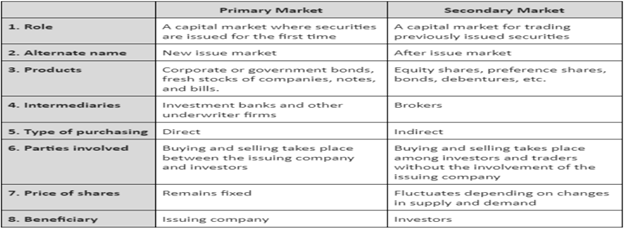
(c) Distinguish between the markets identified in (a) and (b) above on the basis of any four points.
View AnswerAns. Difference between Primary Market and Secondary Market
32. Unsparked Limited started off as an electric wire manufacturer. After a few years, it also started manufacturing other electric appliances like electric bulbs, tube lights, and fans. The decision-making authority rested in the hands of a few top executives. Now, Unsparked Limited is planning to diversify its operations and start the manufacture of other household appliances like food processors, washing machines, and air fryers. For this, they want to change their organisational structure and introduce new levels of management which will be responsible for different functions for each of these products. It also wants to empower its middle management with the decision-making authority to help in the smooth operations of the organisation.
(i) Which organisational structure should Unsparked Limited choose?
View AnswerAns. Organizational Structure for Unsparked Limited:
(i) Divisional Structure: Unsparked Limited should consider adopting a divisional structure for its diversified operations. This structure groups employees and resources by product or service lines, creating semi-autonomous divisions for each product category (e.g., electric wires, electric appliances, household appliances). Each division would have its own dedicated management team responsible for all aspects of its product line, from development and production to marketing and sales.
(ii) Write any two advantages of that organisational structure.
View AnswerAns. Advantages of a Divisional Structure:
(a) Increased Focus and Expertise: Each division develops deep expertise in its specific product category, leading to improved product development, marketing, and operational efficiency.
(b) Faster Decision-Making: Decisions are made within individual divisions, eliminating delays and bureaucratic hurdles that can plague centralized structures. This allows for quicker responses to market opportunities and challenges.
(iii) What should be done to empower the middle management with the decision-making authority?
View AnswerAns. For empowering the middle-level management, Organisation should choose decentralisation. In other words, actively delegate decision-making authority to the middle management and trust their expertise. They should have the autonomy to make decisions related to their specific product lines or divisions without constant oversight from top executives.
OR
Distinguish between formal organisation and informal organisation basis of any six points.
View AnswerAns. Formal and informal organizations differ in several ways, including:
Structure
Formal organizations have a hierarchical structure with a clear chain of command, while informal organizations lack a formal structure.
Rules
Formal organizations have established rules and procedures, while informal organizations are more flexible and operate based on shared norms and mutual trust.
Communication
Formal organizations follow predefined channels and protocols, while informal organizations often rely on informal communication.
Decision-making
Formal organizations follow a structured process and established rules, while informal decision-making is less structured and often consensus-based.
Authority and responsibility Formal organizations have a clear delegation of authority and responsibility, while informal power dynamics often exist without clear accountability.
Origin
Formal organizations are deliberately created with specific goals and objectives, while informal organizations emerge spontaneously based on social interactions and relationships.
33. Sanju, after completing his entrepreneurship course from Sweden returned to India and started a perfume shop ‘Dew Drops “in a famous mall in Delhi. The speciality of the perfume shop was the special fragrance of perfumes and a wide variety to choose from. Somehow, the business was neither profitable nor popular. Sanju was keen to find out the reason. He appointed Sandhya, an MBA from a reputed college, as a Manager to find out the causes for the same. Sandhya took feedback from the clients and found out that though they loved the special unique fragrance of perfumes but were not happy with the long waiting time being taken to process the order. She analysed and found out that there were many unnecessary obstructions in between which could be eliminated. She fixed a standard time for processing the order. She also realised that there were some fragrances whose demand was not enough. So, she also decided to stop the sale of such fragrances. As a result, within a short period Sandhya was able to attract the customers.
1 Identify and explain any two techniques of scientific management used by Sandhya to solve the problem
View AnswerAns. Sandhya has used the following two techniques of scientific management:
• Time Study. Time study aims at determining the standard time taken by a worker of reasonable skill to perform a well-defined job. For this purpose, time measuring devices are used and standard time is fixed for the task after taking several readings. The main idea behind this is to determine the number of workers to be employed, frame appropriate incentive schemes and determine labour cost.
• Simplification of Work. Simplification of work aims at eliminating superfluous varieties, sizes and dimensions. The main idea behind is to eliminate unnecessary diversity of products. It saves cost of labour, machines and tools. It leads to reduction in stock and helps in fuller utilisation of equipment. Moreover, it leads to an increase in turnover
2 Explain any other 2 techniques of Scientific Management
View AnswerAns. Explanation of any other 2 techniques of Scientific Management (Functional foremanship, Motion study, Differential Piece Rate Plan, Fatigue Study)
34. Maharana’ is a famous take-away food outlet in Meerut. It is quite popular among local people and travellers on the national highway. It offers a wide variety of ‘paranthas’ and ‘sandwiches’ packed in special containers which are designed and developed by them to keep the food hot and fresh. Considering the tough competition in the nearby area, the prices have been set reasonably low.
The owner Nirmal Singh spends huge sums of money to put large hoardings and kiosks in the vicinity, to inform the people about the outlet’s location and the special items on its menu. The firm is performing various marketing functions to achieve its marketing objectives.
On the basis of the information given in the above case identify and explain any three marketing functions.
View AnswerAns. The three marketing function as per the above extract are:
(i) Packaging: It is the process of designing and producing appropriate packages for product. It protects the goods from spoilage, breakage, leakage, etc. In this case, Maharana packs the paratha and sandwiches in special containers designed to keep the food hot and fresh.
ii) Pricing: Pricing refers to the process of fixing the price in terms of money. It depends on many factors like degree of competition, market conditions, government regulations, etc. Success of business mainly depends on the sound pricing policy. In this case, due to competition the prices have been kept reasonably low.
(iii) Promotion: Promotion refers to all such activities of the manufacturer like advertising, personal selling, sales promotion and publicity, where are intended to influence buyers behaviour. In the general case promotion is done the through advertisement via hoardings and kiosks.
OR
There are some characteristics that should be kept in mind while choosing a brand name. Explain any six such characteristics that a good brand name should have.
View AnswerAns. Characteristics that should be kept in mind while choosing a good brand name: i) Short and easy to pronounce, (ii) Suggestive, iii) Distinctive, (iv) Adaptable to packaging and labelling requirements, (v) Versatile, (vi) Capable of being registered and protected legally, (vii) Appealing power