Business Studies (054)
Time: 3 Hours Max. Marks: 80
General Instructions:
1. This question paper contains 34 questions.
2. Marks are indicated against each question.
3. Answers should be brief and to the point.
4. Answers to the questions carrying 3 marks may be from 50 to 75 words.
5. Answers to the questions carrying 4 marks may be about 150 words.
6. Answers to the questions carrying 6 marks may be about 200 words.
1. PrimeTextiles Ltd., under the leadership of CEO Mr. Sameer Desai, is a prominent player in the textile industry. To enhance operational efficiency, Mr. Desai adopted Henri Fayol’s Principles of Management. The company implemented the division of work by assigning specialized roles to employees, which significantly boosted productivity and product quality. Clear authority and responsibility were established, empowering managers to make decisions while holding them accountable for their outcomes.
PrimeTextiles strictly adhered to the unity of command principle, ensuring that each employee reported to only one supervisor, thereby reducing confusion and conflicts. A well-defined scalar chain facilitated smooth communication from top management to lower levels, ensuring that information flowed seamlessly throughout the organization. The company promoted equity, treating all employees fairly, which enhanced morale and reduced turnover rates. By encouraging initiative, managers were motivated to take proactive steps and innovate without waiting for directives.
These principles fostered a disciplined and motivated workforce, leading to significant improvements in production efficiency, product quality, and client satisfaction. PrimeTextiles’ commitment to Fayol’s principles solidified its reputation as a reliable and forward-thinking textile manufacturer.
Which of Fayol’s principles is reflected when PrimeTextiles Ltd. ensures that each employee reports to only one supervisor?
(A) Division of work
(B) Unity of command
(C) Scalar chain
(D) Esprit de corps
View AnswerAns. (B) Unity of command
2. TechWave Solutions stays ahead by embracing the technological dimension of the business environment. The company invests in cutting-edge software development tools and artificial intelligence to enhance its product offerings. By adopting the latest technologies, TechWave improves efficiency, reduces costs, and delivers innovative solutions that meet the evolving needs of its clients, thereby maintaining a competitive edge in the tech industry.
In what way does TechWave Solutions respond to the technological dimension of the business environment?
(A) By avoiding new technologies
(B) By investing in cutting-edge software and artificial intelligence
(C) By reducing research and development
(D) By focusing only on traditional methods
View AnswerAns. (B) By investing in cutting-edge software and artificial intelligence
3. Which type of plan provides a broad guideline for decision-making in routine situations?
(A) Strategy
(B) Policy
(C) Method
(D) Budget
View AnswerAns. (B) Policy
4. GlobalFoods Ltd. employs a divisional structure by creating separate divisions for different product lines such as beverages, snacks, and dairy. This structure offers advantages like enhanced flexibility, better product focus, and quicker decision-making within each division. Each division operates semi-autonomously, allowing GlobalFoods to respond swiftly to market changes and consumer preferences, thereby maintaining competitiveness and driving growth in diverse markets.
What is one advantage GlobalFoods Ltd. gains from using a divisional structure for different product lines?
(A) Centralized decision-making
(B) Enhanced flexibility and product focus
(C) Reduced accountability
(D) Limited responsiveness to market changes
View AnswerAns. (B) Enhanced flexibility and product focus
5. Which recruitment source involves advertising job openings in newspapers, online portals, and other media?
(A) Employee referrals
(B) Internal job postings
(C) External advertisements
(D) Campus recruitment
View AnswerAns. (C) External advertisements
6. GlobalTech Ltd. emphasizes both formal and informal communication to enhance organizational efficiency. Formal communication is structured through official channels like meetings, reports, and emails, ensuring clear and documented information flow. Informal communication occurs through social interactions, fostering a collaborative and friendly work environment. By balancing both types of communication, GlobalTech ensures that important information is effectively conveyed while also building strong interpersonal relationships among employees.
What type of communication involves structured channels like meetings and reports at GlobalTech Ltd.?
(A) Informal communication
(B) Non-verbal communication
(C) Formal communication
(D) Electronic communication
View AnswerAns. (C) Formal communication
7. Assertion (A): Feedback control is applied before the commencement of activities.
Reason (R): Feedback control helps in preventing potential problems by anticipating them. Which of the following is correct?
(A) Both A and R are true and R is the correct explanation of A
(B) Both A and R are true but R is not the correct explanation of A
(C) A is true but R is false
(D) A is false but R is true
View AnswerAns. (D) A is false but R is true
8. AlphaRetail Ltd., a growing retail chain, faces important financial decisions as it plans to open new stores. The investment decision involves determining the amount to invest in new store locations. The financing decision requires choosing between issuing new shares or taking loans to fund the expansion. Additionally, the company must decide on the dividend policy, whether to distribute profits to shareholders or retain earnings for further growth. These decisions are influenced by factors such as cost of capital, market conditions, and shareholder expectations. What financial decision is AlphaRetail Ltd. making by choosing between issuing new shares or taking loans to fund expansion?
(A) Investment decision
(B) Financing decision
(C) Dividend decision
(D) Budgeting decision
View AnswerAns. (B) Financing decision
9. Assertion (A): Economic indicators are crucial for investors in financial markets.
Reason (R): They provide insights into the overall health of the economy.
(A) Both A and R are true, and R is the correct explanation of A.
(B) Both A and R are true, but R is not the correct explanation of A.
(C) A is true, but R is false.
(D) A is false, but R is true.
View AnswerAns. (A) Both A and R are true, and R is the correct explanation of A.
10. Fresh Farm Organics, a company selling organic vegetables, decided to segment its market based on consumers’ lifestyles and values. They targeted health-conscious customers who prefer organic over conventional produce. Their marketing campaigns highlighted the benefits of organic living and sustainability.
Which type of market segmentation is Fresh Farm Organics employing?
(A) Demographic Segmentation
(B) Geographic Segmentation
(C) Psychographic Segmentation
(D) Behavioral Segmentation
View AnswerAns. (C) Psychographic Segmentation
11. Read the following statements carefully:
Statement I: Management is a multidimensional activity that includes management of work, people, and operations.
Statement II: Management is applicable only to large organizations and not to small enterprises. In light of the given statements, choose the correct alternative:
(A) Both statements are true.
(B) Both statements are false.
(C) Statement I is true, Statement II is false.
(D) Statement II is true, Statement I is false.
View AnswerAns. (C) Statement I is true, Statement II is false.
12. Read the following statements carefully:
Statement I: Division of work leads to specialization and efficiency in operations.
Statement II: According to Taylor, there should be no standardization of work. In light of the given statements, choose the correct alternative:
(A) Both statements are true.
(B) Both statements are false.
(C) Statement I is true, Statement II is false.
(D) Statement II is true, Statement I is false.
View AnswerAns. (C) Statement I is true, Statement II is false.
13. Arrange the following in the correct order when conducting a SWOT analysis:
1. Identify strengths.
2. Identify weaknesses.
3. Identify opportunities.
4. Identify threats.
(A) 1, 2, 3, 4
(B) 3, 4, 1, 2
(C) 2, 1, 4, 3
(D) 4, 3, 1, 2
View AnswerAns. (A) 1, 2, 3, 4
14. Match the list I with list II and select correct option.
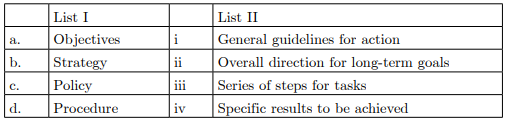
Options:
(A) a-i, b-ii, c-iii, d-iv
(B) a-iii, b-i, c-ii, d-iv
(C) a-ii, b-iv, c-iii, d-i
(D) a-iv, b-ii, c-i, d-iii
View AnswerAns. (D) a-iv, b-ii, c-i, d-iii
15. Which of the following statements is/are correct regarding the importance of organizing?
1. Organizing ensures efficient allocation of resources.
2. Organizing helps in coordinating activities to achieve goals.
3. Organizing eliminates the need for controlling activities.
4. Organizing provides a structured framework for the organization.
Which of the following statements is/are correct?
(A) 1 and 2 only
(B) 1, 2 and 4 only
(C) 2 and 3 only
(D) All 1, 2, 3 and 4
View AnswerAns. (B) 1, 2 and 4 only
16. Identify the responsibility of consumers from the picture above in which the doctor is suggesting the surgery to his patient.

(A) Be honest in your dealings
(B) Learn about the risk associated with product and services
(C) Respect the environment
(D) Assert yourself to ensure that you get a fair deal.
View AnswerAns. (B) Learn about the risk associated with product and services
17. Which of the following statements about financial incentives is correct?
(A) Financial incentives do not affect employee motivation.
(B) Financial incentives include recognition awards.
(C) Financial incentives directly increase an employee’s take-home pay.
(D) Financial incentives are the only way to motivate employees.
View AnswerAns. (C) Financial incentives directly increase an employee’s take-home pay.
18. Which of the following is a correct step in the controlling process?
(A) Ignoring deviations from standards
(B) Establishing standards
(C) Increasing resource allocation without assessment
(D) Delegating all control responsibilities
View AnswerAns. (B) Establishing standards
19. Which of the following statements about working capital is not correct?
(A) Working capital is calculated as current assets minus current liabilities.
(B) Adequate working capital ensures smooth day-to-day operations.
(C) Working capital is invested in long-term assets like machinery.
(D) High working capital can indicate good liquidity.
View AnswerAns. (C) Working capital is invested in long-term assets like machinery.
20. Which of the following statements is NOT correct?
(A) An index fund aims to replicate the performance of a specific market index.
(B) Bonds are always safer than stocks.
(C) The primary market allows companies to raise capital.
(D) The capital market includes both stocks and bonds.
View AnswerAns. (B) Bonds are always safer than stocks.
21. Rozar Electricals Limited recently proposed to issue commercial paper of ₹ 10,00,000 and equity shares of ₹ 140 each for meeting its capital requirements of diversification.
(i) Quoting the lines, identify the markets from where they, would procure the necessary funds.
(ii) Distinguish between the markets identified in (i), on the basis of duration and investment outlay.
View AnswerAns. (i) Money market “Rozar Electricals Limited recently proposed to issue commercial paper of ₹ 10,00,000.”
Capital market “Equity shares of 140 cach for meeting its capital requirements of diversification.”
(ii) Differences between money market and capital market are.
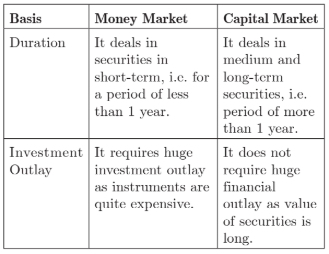
22. If planning involves working out details for the future, why does it not ensure success?
View AnswerAns. The success of an enterprise is possible only when plans are properly made and then implemented. In order to achieve goals, plans need to be translated into action or else, they become meaningless. Managers usually rely on previously tried and tested successful plans and like to use them in every similar condition/situation. It is not necessary that just because the plan has worked before, it will work again. There are so many unknown factors to be considered. The kind of complacency and false sense of security that plans provide, may actually lead to failure instead of success.
OR
Explain how
(i) Adaptation to change, and
(ii) Effective administration, make organising important.
View AnswerAns. (i) Adaptation to change Organising facilitates modification in organisation structure and revision of inter-relationships among people in order to adapt to environmental changes.
(ii) Effective Administration Organising gives a clear description of duties and responsibilities of each individual. This helps to avoid confusion regarding work and avoids duplication of activities. This helps in bringing efficiency in administration.
23. Jairaj is a well-known businessman. He decided to send both his children Viraj and Saroj abroad to acquire a degree in management of business. He is of the opinion that there is a growth in management as discipline, but still it is not considered to be a full-fledged profession.
(i) Why Jairaj considers management as a discipline?
(ii) Why management is not considered to be a full-fledged profession?
View AnswerAns. (i) Jairaj considers management as a discipline because there exist number of theories and principles on management which can be taught in various colleges.
(ii) It is not considered to be a full-fledged profession because
(a) Restricted Entry Unlike management, the entry to other professions is restricted through an examination or eligibility criteria like specific percentage in a particular degree or diploma.
(b) Professional Association Unlike managers, all working professionals have to be a member of an affiliated professional association which regulates their entry, grant certificates of practices and formulates code of conduct.
24. “Selection is a negative process.” Do you agree? Give reason to support your answer.
View AnswerAns. Yes, selection is a negative process, as it is choosing from among the candidates, the ones who best meet a position’s requirements and eliminating the ones who are not suitable, To achieve this target, candidates are required to take a series of tests and interviews in different stages. At each stage, many candidates are eliminated and only a few candidates move to the next stage.
The process of elimination continues till the most suitable candidates are finalised. The above scenario clearly establishes the fact that selection is the process through which unsuitable candidates are rejected and suitable ones are chosen. Therefore, it is regarded as a negative process.
OR
“Directing is the heart of management process.” Do you agree? Give reason in support of your answer.
View AnswerAns. Yes, directing is the heart of management process. It is the executive function of management related to leading, influencing, guiding, supervising and motivating people towards the attainment of planned targets.
It is concerned with the execution of plants and policies framed by top management. It initiates action in the organisation and helps in adapting to changes too. So, it is known as heart of management process.
25. “Packaging has acquired great significance in the marketing of goods.” Explain any three functions of packaging.
View AnswerAns. Packaging refers to the act of designing and producing the container or wrapper of a product. Three functions of packaging are as follows
(i) Product Identification Packaging helps a product to be identified by the customer. e.g. Maggi Noodles in yellow colour, Lays in blue, green and red colour can be identified easily.
(ii) Product Protection Packaging protects the contents of a product from spoilage, breakage, leakage, damage, etc. e.g. Air tight containers and packets are used for biscuits, tea, etc.
(iii) Product Promotion Packaging promotes the sales of the product. Package is the buyer’s first encounter with the product and is capable of attracting or repulsing the buyer. The colourful. attractive packing of the product may induce the customer to buy it. e.g. Ferrero Rocher Chocolates, Calcium Sandoz, etc.
26. “Management is skillful and personal application of existing knowledge to achieve desired results.” Explain.
View AnswerAns. The above statement highlights the nature of management as an art.
This can be clarified with the help of following points
(i) There is a lot of literature available in various areas of management like marketing, finance, etc, which the manager needs to specialise in.
(ii) A manager applies scientific methods and body of knowledge to a given situation, issue or problem in his own unique manner.
(iii) A successful manager practices the art of management in the day-to-day activities of managing an enterprise based on studies, observation and experience.
Thus, we can conclude that management is an art.
27. Suhasini purchased some household goods from a general store. After reaching home, she found a face cream in her merchandise,. for which she has not been billed. After checking the date of expiry and other details, she started using it. Her face burnt due to the use of cream.
(i) Can Suhasini file a complaint? Justify your answer.
(ii) Under Consumer Protection Act, 2019, who can file a complaint?
View AnswerAns. (i) No. Suhasini cannot file a complaint, as she is not a consumer under the Consumer Protection Act, 2019 because she has not paid any consideration for the face cream.
(ii) Under Consumer Protection Act, 2019, a complaint can be filed by
(a) Any consumer.
(b) Any registered consumer association.
(c) Central or State Government.
(d) One or more consumers on behalf of numerous consumers.
(e) Legal heir or representative of deceased consumer.
28. You are a management guru. In your opinion, is controlling the last function or the beginning of the process of management?
View AnswerAns. Controlling should not be misunderstood as the last function of management. It is a function that brings the management cycle back to the planning function. In general, the process of management begins with planning and ends at controlling, but when a manager performs the function or steps of controlling, it is observed that the first step of controlling is setting standards.
The controlling function finds out how far actual performance deviates from standards and analyses the corrective actions to be taken.
This process helps in formulation of future plans, thus becomes the premise of setting plans. Therefore, we can say that it is the beginning of management process. Thus, it can be stated that, controlling function is both the beginning as well as the end of the management process.
OR
RLT Global Auto Limited is setting-up a new plant in India, for manufacturing auto components. India has a highly competitive and cost effective production base in this sector. Many reputed car manufacturers source their auto components from here.
RLT Global is planning to capture about 40% of the market share in. India and also export to the tune of atleast $5 million in about 2 years of its planned operations. To achieve these targets, it requires a highly trained. and motivated work force. You have been asked by the company to advise it in this matter. Which function of management helps in obtaining right people and putting them on the right place/jobs? Explain any three benefits of this function.
View AnswerAns. Staffing is that function of management which helps in obtaining right people and putting them on the right jobs.
Proper staffing ensures the following three benefits to the organisation
(i) Obtaining Competent Personnel It helps in discovering and obtaining competent personnel for various job positions in an organisation.
(ii) Higher Performance Staffing ensures high performance by putting right person on the right job.
(iii) Continuous Survival and Growth Proper staffing ensures continuous survival and growth of the enterprise through succession planning of managers.
29. Discuss any two features of planning function of management.
View AnswerAns. Features of planning are as follows (any two) (i) Planning is a Primary Function of Management
It lays down the base for all other functions of management. All other managerial functions. are performed within the framework of the plans drawn. Thus, it can be said that planning precedes other functions. This is also called the ‘primacy’ of planning.
(ii) Planning is Pervasive It is required at all levels of management as well as in all the departments of the organisation. It is not a function restricted to top level but it is performed by managers at every level.
While the top management forms organisational plans, middle level does departmental planning, and the lower level makes plans for the day-to- day working of the organisation.
(iii) Planning is Continuous Plans are made for a specific time period. At the end of such time period, new plans have to be drawn. When plans are objective-based and goals are achieved, new plans are drawn with new objectives.
On the other hand, if goals are not achieved, plans are revised to achieve success in future.
OR
Discuss the benefits of organising function of management.
View AnswerAns. The organising function helps in the growth and survival of an enterprise in a dynamic environment by providing the following benefits
(i) Benefits of Specialisation Systematic allocation of work reduces the workload as well as enhances productivity. As each task is repetitively performed by a worker, it helps him to gain experience and attain specialisation.
(ii) Clarity in Working Relationships The establishment of working relationships clarifies the lines of communication and specifies who is accountable to whom. Thus, there is no confusion regarding performance of work, fixation of responsibility and communication. (iii) Optimum Utilisation of Resources It leads to proper usage of all materials, financial and human resources by proper assignment of jobs. Assignment of jobs to workers reduces duplication of work, prevents confusion, minimises wastages and allows the best possible use of resources.
(iv) Adaptation to Change It facilitates modification in organisational structure and revision of inter- relationships among people in order to adapt to environmental changes.
It also helps to provide stability and growth, despite of external changes occurring in business environment.
30. Thermex Cookware Private Limited is a manufacturer of premium utensil. The company has been doing extremely well and has been able to carve a niche in the market. The company recently decided to go global.
To achieve the above objective, the company decided to increase its production to 30,000 units per month. But, after two months, the management observed that only 45,000 units were manufactured. Company is opting for a good control system in order to achieve the targets on time. In context to this, give some of the advantages of controlling.
View AnswerAns. Some advantages of good control system are as follows
(i) Accomplishing Organisational Goals: Controlling function measures progress towards the organisational goals and involves taking corrective actions in case of any deviation. It helps to keep the activities on right track, so that goals could be achieved efficiently and effectively.
(ii) Motivation to the Employees: It is a source of motivation to the employees, who knows the standards against which their performance will be evaluated.
(iii) Optimum Utilisation of Resources: By allocating the resources according to the requirements of the different departments, it helps in optimum utilisation of resources.
(iv) Facilitating Coordination in Action: It provides direction to all activities and cach department and employee is governed by predetermined standards, which helps in establishing coordination among them.
31. Motivation refers to the way in which urges, desires, aspirations, strivings or needs direct, control and explain the behaviour of human beings. It is something which moves the person to action and continues him in the course of action already initiated. With reference to this, explain the process of motivation.
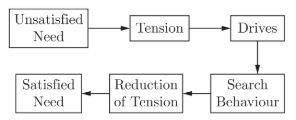
View AnswerAns. Motivation process is based on unsatisfied human needs. It is as follows
(i) An unsatisfied need of an individual creates tension which stimulates his or her drives.
(ii) These drives generate a search behaviour to satisfy such need.
(iii) When such need is satisfied, the individual is relieved from tension.
c.g. An employee has a need for promotion to a higher position. If this need is strong, it creates tension for the employee which stimulates his or her drives. Finally, he/she will fix it as his/her goal and search behaviour to reach the goal. If he/she succeeds in getting promotion (goal achievement), his/her need for promotion would be satisfied. This reduces his/her tension.
This process is explained with the help of a flow chart given below
OR
Formal communication is the communication which flows through scalar chain, i.e. official channels designed in the organisation chart. It may be oral or written and may be upward, downward or even horizontal. With reference to this, write three major merits and three major demerits of formal communication.
View AnswerAns. Merits of formal communication are
(i) It helps in easy fixation of responsibility and exercising control over subordinates.
(ii) The information passed in formal channel is authentic.
(iii) There are very less chances of distortion of information.
Demerits of formal communication are
(i) Since it follows the formal path/scalar chain laid by the management, it tends to be slow.
(ii) It is impersonal form of communication which includes lots of screening of information and narrow route.
(iii) Since deviations are not allowed at all, it tends to be rigid in nature.
32. “The marketing process involves a number of functions or activities to be performed by the marketer to provide goods and services to the customers.” In the light of this statement, explain any six functions of marketing.
View AnswerAns. The functions of marketing are
(i) Gathering and Analysing Market Information/ Market Research In order to identify the needs and wants of customers, the marketer gathers market information. He analyses the strengths, weaknesses, opportunities and threats of the enterprise. Such analysis helps the marketer to take decisions regarding diversification, improvement in product, expanding markets, etc. For this purpose, computers and online sites are increasingly used.
(ii) Marketing Planning After market research, the marketer has to develop an appropriate marketing plan to achieve the marketing objective of the organisation. It involves taking decisions as to what activities will have to be undertaken to achieve a marketing objective.
(iii) Product Designing and Development. The design of a product not only helps to make it attractive, but also helps in improving its performance, providing it a competitive advantage over the other products present in the market.
(iv) Standardisation and Grading. Standardisation refers to the process of setting standards regarding quality, price, packaging, technology, equipment, etc, for the production of a product. This ensures uniformity and consistency in output and reduces the need for inspection, testing and evaluation of the products.
Grading is the process of classifying the products into different groups, on the basis of quality, size, features, etc.
It is necessary for such goods which are not produced according to predetermined specifications, such as agricultural goods. Grading ensures that the goods belong to a particular quality and helps the marketer to fix prices easily.
(v) Packaging and Labelling. Packaging refers to designing and developing the package for a product. Package refers to the wrapper or container, which not only provides protection to the product, but also acts as a promotional tool for it.
Labelling refers to designing and developing the label to be put on the package. A label is a carrier of information. It may be a simple tag or a complex graphic providing details about the product.
(vi) Branding. Branding refers to the process of giving a name, sign, symbol or a combination of all to a product for creating its identification. It helps to differentiate the product from other products available in the market. It also helps to build customer’s loyalty and promoting its sales.
OR
Explain the concept of marketing management along with its functions and objectives.
View AnswerAns. Marketing management is the management (planning, organising, directing and controlling) of activities which facilitate exchange of goods/ services between producers and consumers.
According to Philip Kotler, “The art and science of choosing target markets and getting, keeping and growing customers through creating, delivering and communicating superior customer value of management is called marketing management”. The functions of marketing management include
(i) Analysing and planning the marketing activities.
(ii) Implementing marketing plans.
(iii) Setting control mechanism.
Objectives of marketing management are
(i) Choosing a target market.
(ii) Getting, keeping as well as growing the customers.
(iii) Creating, developing and communicating superior values for the customers.
(iv) Building the reputation or goodwill.
(v) Achieving the long-term goals of profitability, growth and stability.
33. JAY Cloths Limited is a company manufacturing textiles. It has a share capital of ₹ 60 lakh. In the previous year, its earning per share was ₹ 0.50. For diversification, the company requires additional capital of ₹ 40 lakh.
The company raised funds by issuing 10% debentures for the same. During the year, the company earned profit of ₹ 8 lakh on capital employed. It paid tax @ 40%.
(i) State whether the shareholders gained or lost, in respect of earning per share on diversification. Show your calculations clearly.
(ii) Also, state any three factors that favour the issue of debentures by the company as part of its capital structure.
View AnswerAns. Calculation of Earning per Share
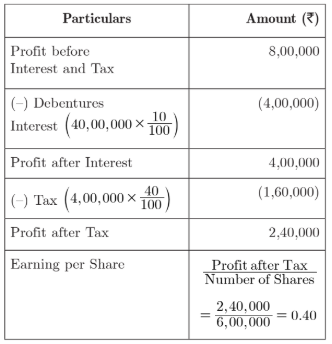
Since, earning per share has fallen from 0.50 to 0.40, therefore the shareholders stand to lose on diversification.
Note: In the absence of any information, shares are assumed to be of ₹10 each.
So,
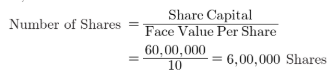
(ii) Three factors that favour issue of debentures by the company as part of its capital structure are
(a) Debenture interest payable is a charge to the profits. Hence, a company stands to gain in terms of tax, benefits.
(b) Issue of debentures help the shareholders of the company to gain through Trading on Equity’.
(c) Debenture is a cheaper source of finance as compared to equity.
34. A company was manufacturing ‘LED bulbs’ which were in great demand. It was found that the target of producing 300 bulbs a day was not met by the employees. On analysis, it was found that the workers were not at fault. Due to electricity failure and shortage of workers, the company was not able to achieve the set targets and alternative arrangements were needed. To meet the increased demand, the company assessed that approximately 88 additional workers were required out of which 8 would work as heads of different departments and 10 would work as subordinates under each head. The required qualifications and job specifications were also enlisted. It was also decided that necessary relaxation should be given to encourage women, persons from backward and rural areas and persons with special abilities to assume responsible positions in the organisation. All efforts were made to match the ability of the applicants with the nature of work:
(a) Identify the functions of management discussed above.
(b) State the two steps in the process of each function discussed in the above para.
(c) List any two values which the company wants to communicate to the society.
View AnswerAns. (a) Staffing and Controlling
(b) Steps in Staffing:
(i) Estimating manpower requirement. It involves knowing how many persons are needed and of what type.
(ii) Recruitment. It is the process of searching for prospective employees and stimulating them to apply for jobs in the organisation.
Steps in Controlling:
(i) Comparing actual performance with standards. It will reveal the deviation between actual and desired results.
(ii) Analysing deviations. Acceptable range of deviations is determined. Deviations in key areas of business need to be attended more urgently as compared to deviations in certain insignificant areas.
(c) The values which the company wants to communicate to the society are:
(i) Respect for women
(ii) Job opportunities to the weaker sections of the society
OR
Dharma Production House is a company engaged in the production and distribution of films. The company is an established name in Bollywood.
Now the company wants to enter in the regional cinemas also and for this, they are now targeting the South Indian Film Industry.
They have launched three films in South with leading actors and actresses and even managed to sign Rajnikanth. To fund its projects, the management takes a decision to raise money for long-term capital needs of business from certain sources.
(i) State the different sources of long-term capital.
(ii) Decision to raise money for long-term capital needs is affected by several factors Discuss any five such factors.
View AnswerAns. (i) Sources of long-term capital are as follows
(a) Equity shares
(b) Preference shares
(c) Debentures
(d) Long-term loans and advances
(e) Retained earnings
(ii) The following factors affect the financing decision
(a) Cost The cost of all the sources of finance is different. The rate of interest on debt, fixed rate of dividend to be paid on preference share capital and the expectations of the shareholders on the equity share capital are in the form of costs.
If the situations happen to be favourable, the benefit of cheap finance can be availed of by choosing debt capital.
(b) Risk Debt capital is most risky and from the point of view of risk, it should not be used.
(c) Floatation Cost From the point of view of floating costs, retained profit is the most
appropriate source. Therefore, its use should be made.
(d) Cash Flow Position If the cash flow position of the company is good, the payment of interest on the debt and the refund of capital can be easily made. Therefore, in order to take advantage of cheap finance, debt can be given priority.
(e) Level of Fixed Operating Costs In business, there are mainly two types of costs which are as follows
Fixed Operating Cost e.g. Rent of the building, payment of salary, insurance premium, etc.
Fixed Financial Cost e.g. Interest on debt, etc.If the level of fixed operating costs is in excess, it is better to keep the fixed financial costs at the minimum. Therefore, debt capital should not be used. On the contrary, if the level of fixed operating cost is low, the use of debt capital is more profitable.