Business Studies (054)
Time: 3 Hours Max. Marks: 80
General Instructions:
1. This question paper contains 34 questions.
2. Marks are indicated against each question.
3. Answers should be brief and to the point.
4. Answers to the questions carrying 3 marks may be from 50 to 75 words.
5. Answers to the questions carrying 4 marks may be about 150 words.
6. Answers to the questions carrying 6 marks may be about 200 words.
1. CapitalGrowth Investments Pvt. Ltd., led by CFO Mr. Vikram Singh, specializes in providing investment solutions to clients. To fund the company’s expansion, CapitalGrowth conducted a thorough financial management process. The finance team evaluated various financing decisions, considering options like issuing new shares, taking bank loans, and using retained earnings. They determined that a balanced mix of debt and equity would minimize the cost of capital while maintaining financial stability. Once the necessary funds were secured, CapitalGrowth allocated resources efficiently across different projects, ensuring optimal utilization of capital. The finance department diligently monitored cash flows to maintain liquidity and managed investments to maximize returns while mitigating risks. Additionally, CapitalGrowth implemented strict working capital management practices to ensure that daily operations were adequately funded without overextending resources. Through informed financial decisions and strategic resource allocation, CapitalGrowth successfully expanded its operations without compromising its financial health. Which function of financial management is demonstrated by CapitalGrowth Investments Pvt. Ltd. evaluating options like issuing shares and taking bank loans to fund expansion?
(A) Investment decision
(B) Financing decision
(C) Dividend decision
(D) Working capital management
View AnswerAns. (B) Financing decision
2. StarFinance Ltd. operates both in the capital market and the money market. In the capital market, StarFinance assists companies in issuing long-term securities like bonds and equity shares to raise capital for expansion projects. Conversely, in the money market, StarFinance provides short-term financial instruments such as commercial papers and Treasury bills to meet immediate liquidity needs of businesses. This dual presence allows StarFinance to cater to both long-term investment needs and short-term financial requirements of its clients.
How does StarFinance Ltd. differentiate its operations in the capital market from the money market?
(A) By issuing short-term securities in the capital market and long-term securities in the money market
(B) By assisting in issuing long-term securities in the capital market and providing short-term instruments in the money market
(C) By focusing solely on stock trading
(D) By avoiding short-term financial instruments
View AnswerAns. (B) By assisting in issuing long-term securities in the capital market and providing short-term instruments in the money market
3. Which function of marketing involves gathering and analyzing information about the target market?
(A) Pricing
(B) Promotion
(C) Market research
(D) Distribution
View AnswerAns. (C) Market research
4. GlobalTrade Ltd., a multinational company, operates with three levels of management. Top-level management, led by CEO Mr. Rajesh Kumar, focuses on strategic planning and long-term goals. Middle-level managers oversee departments like finance, marketing, and operations, translating strategic plans into actionable tasks. Lower-level managers supervise daily activities and ensure tasks are completed efficiently. This hierarchical structure ensures clear communication and effective implementation of company strategies across all levels.
What role does middle-level management play at GlobalTrade Ltd.?
(A) Setting long-term goals
(B) Translating strategic plans into actionable tasks
(C) Supervising daily activities
(D) Making major corporate decisions
View AnswerAns. (B) Translating strategic plans into actionable tasks
5. ‘Harmony, Not Discord’ principle by Taylor emphasizes:
(A) Individualism over teamwork
(B) Conflict is necessary for progress
(C) Peaceful cooperation between management and workers
(D) Ignoring worker grievances
View AnswerAns. (C) Peaceful cooperation between management and workers
6. HealthGuard Pharmaceuticals ensures compliance with the legal dimension by adhering to stringent drug safety regulations and obtaining necessary licenses. The company regularly updates its practices to comply with new laws and industry standards, avoiding legal penalties and maintaining its reputation. By prioritizing legal compliance, HealthGuard builds trust with consumers and regulators, facilitating uninterrupted business operations. How does HealthGuard Pharmaceuticals address the legal dimension of the business environment?
(A) By ignoring regulatory requirements
(B) By adhering to drug safety regulations and obtaining necessary licenses
(C) By reducing product quality
(D) By avoiding legal counsel
View AnswerAns. (B) By adhering to drug safety regulations and obtaining necessary licenses
7. Assertion (A): Advertising is a paid form of personal communication.
Reason (R): Advertising reaches a large audience through mass media without personal interaction.
Choose the correct option:
(A) Both A and R are true, but R is not the correct explanation of A.
(B) Both A and R are false.
(C) A is false, but R is true.
(D) Both A and R are true, and R is the correct explanation of A.
View AnswerAns. (C) A is false, but R is true.
8. Innovatech Manufacturing practices delegation by assigning project leads the authority to make decisions regarding their teams. The elements of delegation include authority, responsibility, and accountability. Project leads are given the autonomy to manage tasks, while being accountable for the outcomes. This delegation empowers employees, improves efficiency, and fosters leadership skills within the organization, leading to enhanced productivity and employee satisfaction.
Which element of delegation is Innovatech Manufacturing implementing by allowing project leads to make decisions?
(A) Authority
(B) Responsibility
(C) Accountability
(D) All of the above
View AnswerAns. (D) All of the above
9. Assertion (A): Training and development are interchangeable terms.
Reason (R): Both training and development aim to enhance employee skills and performance.
(A) Both A and R are correct, and R is the correct explanation of A.
(B) Both A and R are correct, but R is not the correct explanation of A.
(C) A is correct, but R is incorrect.
(D) Both A and R are incorrect.
View AnswerAns. (D) Both A and R are incorrect.
10. During a performance review, Mr. Khan identified that some employees were underperforming due to lack of clear goals. He introduced SMART (Specific, Measurable, Achievable, Relevant, Time-bound) goals for each employee, which provided clarity and direction, leading to improved performance. What method did Mr. Khan use to improve employee performance?
(A) Implementing laissez-faire leadership
(B) Setting SMART goals
(C) Increasing financial incentives
(D) Reducing employee responsibilities
View AnswerAns. (B) Setting SMART goals
11. Read the following statements carefully:
Statement I: Controlling helps in achieving organizational goals by ensuring that activities are as per plans.
Statement II: An effective control system should be economical and cost-effective. In light of the given statements, choose the correct alternative:
(A) Both statements are true.
(B) Both statements are false.
(C) Statement I is true, Statement II is false.
(D) Statement II is true, Statement I is false.
View AnswerAns. (A) Both statements are true.
12. Read the following statements carefully:
Statement I: Factors affecting dividend decisions include earnings, stability of earnings, and growth opportunities.
Statement II: Legal constraints do not influence a firm’s dividend policy. In light of the given statements, choose the correct alternative:
(A) Both statements are true.
(B) Both statements are false.
(C) Statement I is true, Statement II is false.
(D) Statement II is true, Statement I is false.
View AnswerAns. (C) Statement I is true, Statement II is false.
13. Identify the correct sequence of steps in the process of issuing bonds.
1. Determining the bond’s terms
2. Underwriting by investment banks
3. Rating the bond by credit agencies
4. Selling the bonds to investors
(A) 1, 2, 3, 4
(B) 2, 3, 1, 4
(C) 3, 1, 2, 4
(D) 1, 3, 2, 4
View AnswerAns. (A) 1, 2, 3, 4
14. Match the list I with list II and select correct option.
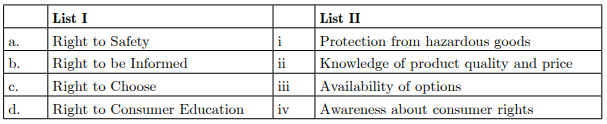
Options:
(A) a-i, b-ii, c-iii, d-iv
(B) a-iii, b-i, c-ii, d-iv
(C) a-ii, b-iv, c-i, d-iii
(D) a-i, b-iii, c-ii, d-iv
View AnswerAns. (A) a-i, b-ii, c-iii, d-iv
15. Regarding ‘Effectiveness’ and ‘Efficiency’ in management, consider the following statements:
1. Effectiveness is concerned with doing the right things to achieve organizational goals.
2. Efficiency means doing tasks correctly with minimum cost and waste.
3. A manager can be efficient but not effective.
4. Effectiveness focuses on resource utilization. Which of the above statement(s) is/are correct?
(A) 1 and 2 only
(B) 1, 2, and 3 only
(C) 2 and 4 only
(D) All of the above
View AnswerAns. (B) 1, 2, and 3 only
16. Identify the function of management illustrated by the picture given above in which the manager Mr. Modi is discussing about taking some remedial plans of action to stop the downfall in sales in the coming financial year.

(A) Directing
(B) Controlling
(C) Planning
(D) Organising
View AnswerAns. (B) Controlling
17. Which of the following statements is correct regarding the economic dimension of the Business Environment?
(A) It only deals with inflation rates.
(B) It includes factors like GDP, inflation, and exchange rates.
(C) It is unrelated to consumer income levels.
(D) It solely focuses on technological advancements.
View AnswerAns. (B) It includes factors like GDP, inflation, and exchange rates.
18. Which of the following statements about strategies is true?
(A) Strategies are short-term plans.
(B) Strategies outline how to achieve long-term objectives.
(C) Strategies are used only at the operational level.
(D) Strategies eliminate the need for planning.
View AnswerAns. (B) Strategies outline how to achieve long-term objectives.
19. Which of the following is NOT a step in the organizing process?
(A) Identifying activities
(B) Assigning tasks
(C) Establishing relationships
(D) Motivating employees
View AnswerAns. (D) Motivating employees
20. Which statement is not correct about external recruitment sources?
(A) They bring in new skills and perspectives.
(B) They are generally less expensive than internal recruitment.
(C) They include job fairs and employment agencies.
(D) They can help increase workplace diversity.
View AnswerAns. (B) They are generally less expensive than internal recruitment.
21. While analyzing their Financial Statements, for the year ended March 31, 2019, Gopal and Nirmala the partners, discovered that in the current year, operating expenses increased by 5% against the expected rate of 3%. The investigations revealed that it was due to the increase in the cost of raw material. They immediately directed their Purchase Manager to find out the alternative sources of raw material.
(a) Which function of management is being performed?
(b) Discuss any two of its features.
View AnswerAns. (a) Controlling
(b) Features of Controlling:
(i) Pervasive function: Controlling is as much required in an educational institution, military, hospital, and a club as in any business organisation. Managers at all levels of management-top, middle and lower-need to perform controlling function.
(ii) Goal-oriented function: Controlling ensures that an organisation’s resources are being used effectively and efficiently for the achievement of predetermined goals.
22. Procter and Gamble’s (P and G) philosophy is that it should lead the industry in implementing a global environmental programme. P&G is one of the first companies in the world to actively study the influence of consumer products on the environment and introduce concentrated products, recycled plastic bottles, and refill packages to the industry. P&G contributes to sustainable development and addresses environmental and social issues connected with its products and services.
Which Marketing Management philosophy is applied by Procter and Gamble. Elaborate.
View AnswerAns. Procter and Gamble is following the Societal marketing concept.
This concept holds that the task of any organisation is to identify the needs and wants of the target market and deliver the desired satisfaction in an effective and efficient manner so that the long-term well-being of the consumers and the society is taken care of. It is the extension of the marketing concept as supplemented by the concern for the long-term welfare of the society. Apart from the customer satisfaction, it pays attention to the social, ethical and ecological aspects of marketing. There are large number of such issues that need to be attended in the long-term interest of the firm.
23. Romila is running a departmental store keeping a wide variety of stock procured from diverse companies. Being a management graduate, she knows the importance of inventory management and hence she follows the system of just-in-time inventory. One day, when the stock of biscuits and wafers arrived from Roz Stores Private Limited, the Purchase Manager informed that most of them were either approaching the expiry date or had a damaged package. They called the Marketing Manager of Roz Stores Private Limited who refused to collect back the stock and blamed the transportation company. The Purchase Manager asked Romila to approach the consumer court to get the matter resolved. Can Romila be called a consumer under the Consumer Protection Act, 2019? Give reason for your answer.
View AnswerAns. No, Romila cannot be called a consumer. According to Consumer Protection Act 2019, a consumer is a person who buys any goods or avails services for a consideration, which has been paid or promised, or partly paid and partly promised, or under any scheme of deferred payment. It includes any user of such goods or beneficiary of services if such use is made with the approval of the buyer. It applies to both offline and online transactions through electronic means or by teleshopping or direct selling or multilevel marketing. However, any person who obtains goods or avails services for resale or commercial purpose is not treated as a consumer and is outside the scope of Consumer Protection Act 2019.
Since Romila purchased the goods for resale purposes, she cannot be called a consumer.
OR
Neel bought an electric kettle from an authorized dealer of Sunrise Appliances Ltd. Being an aware consumer, he also took the cash memo from the seller. The Sunrise Appliances Ltd offered a warranty of six months. After two months of using the kettle, Neel found that its automatic shut off switch has stopped working. He approached the dealer who refused to look into the matter. Neel decided to file a case in the District Commission. State any six remedies that can be made available to Neel.
View AnswerAns. Following are the remedies that can be made available:
(a) To remove the defect in goods or deficiency in service.
(b) To replace the defective product with a new one, free from any defect.
(c) To refund the price paid for the product, or the charges paid for the service.
(d) To discontinue the unfair/restrictive trade practice and not to repeat it in the future.
(e) To pay punitive damages in appropriate circumstances.
(f) Not to offer hazardous goods for sale.
24. Discuss the elements of Delegation.
View AnswerAns. Authority: Authority refers to the right of an individual to command his subordinates and to take action within the scope of his position. It also refers to the right to take decisions inherent in a managerial position. It flows from top to bottom. As we go higher up in the management hierarchy, the scope of authority increases.
Responsibility: Responsibility is the obligation of a subordinate to properly perform the assigned duty. It arises from a superior – subordinate relationship because the subordinate is bound to perform the duty assigned to him by his superior. It flows upwards.
Accountability: It implies being answerable for the final outcome. Once authority has been delegated and responsibility accepted, one cannot deny accountability. It cannot be delegated and flows upwards, i.e., a subordinate will be accountable to a superior for satisfactory performance of work.
OR
Discuss the importance of Decentralization.
View AnswerAns. Following are the points of importance of decentralisation:
Quick decision making: Since decisions are taken at levels which are nearest to the points of action and there is no requirement for approval from many levels, the process is much faster.
Relief to top management: Decentralisation diminishes the amount of direct supervision exercised by a superior over the activities of a subordinate because they are given the freedom to act and decide within the limits set by the superior. Develops managerial talent for the future: Decentralisation gives them a chance to prove their abilities and creates a reservoir of qualified manpower who can be considered to fill up more challenging positions through promotions.
25. Saroj, having an experience of over eight years in the cosmetic industry, joined Beauty Pvt Ltd., a cosmetic manufacturing firm as a Sales Manager. Inspite of its good quality products and aggressive promotion, the sales of Beauty Pvt Ltd. were not picking up. Saroj had a team of highly efficient people working under her. She called a meeting of her team and communicated them that their goal is to find out how to improve the sales of product and the deadline for the task is two weeks. They can design the survey questions, choose the platform, and collect information on their own way. After two weeks, the team will come to her office with the final results. Thereafter with mutual deliberations and discussions they will reach a conclusion about the final steps to be taken.
(a) Which leadership style is depicted by Saroj?
(b) Discuss its features.
View AnswerAns. (a) Democratic or Participative leader
(b) A democratic leader develops action plans and makes decisions in consultation with his subordinates. He will encourage them to participate in decision-making. Such leaders recognise that people perform best if they have set their own objectives. They also need to respect the other’s opinion and support subordinates to perform their duties and accomplish organisational objectives. They exercise more control by using forces within the group.
26. Define the concept of Financial Planning and list any three points highlighting its importance for an organization.
View AnswerAns. Financial planning is the preparation of a financial blueprint of an organisation’s future operations. The objective of financial planning is to ensure that enough funds are available at right time. Financial planning strives to achieve the following twin objectives.
(a) To ensure availability of funds whenever required.
(b) To see that the firm does not raise resources unnecessarily.
Financial planning includes both short-term as well as long-term planning. It focuses on capital expenditure programmes. Short-term planning covers short-term financial plan called budget.
The importance of Financial Planning for an organization is as follows:
(i) It helps in forecasting what may happen in future under different business situations. By doing so, it helps the firms to face the eventual situation in a better way.
(ii) Detailed plans of action prepared under financial planning reduce waste, duplication of efforts, and gaps in planning.
(iii) It provides a link between investment and financing decisions on a continuous basis.
(iv) It tries to link the present with the future.
OR
Discuss any four factors affecting the dividend decision of a firm.
View AnswerAns. Factors affecting the dividend decision of a firm
(a) Amount of Earnings: Dividends are paid out of current and past earning. Therefore, earnings is a major determinant of the decision about dividend. Higher the earnings, more will be the amount of dividend.
(b) Stability Earnings: Other things remaining the same, a company having stable earning is in a better position to declare higher dividends. As against this, a company having unstable earnings is likely to pay smaller dividend.
(c) Growth Opportunities: Companies having good growth opportunities retain more money out of their earnings so as to finance the required investment. The dividend in growth companies is, therefore, smaller, than that in the non- growth companies.
(d) Cash Flow Position: The payment of dividend involves an outflow of cash. A company may be earning profit but may be short on cash. Availability of enough cash in the company is necessary for declaration of dividend.
27. The Hotel and Lodging Industry across the world are focused on meeting leisurely needs of their guests, rather than basic ones, as they are well aware that majority of their guests avails their facilities to refresh themselves physically and mentally. In doing so, the hotels offer a wide range of facilities that includes gourmet dining, luxury spas, full-service health clubs with personal trainers, golf courses, tennis centers, cultural activities and children’s day camps. While this sector can take the vacation of an individual to a totally different level, but it comes at a price. Therefore, before finalizing their bookings, the customer always compares the sacrifice they make in terms of the amount charged by a hotel for the facilities offered by it. By quoting the lines, identify the features of Marketing.
View AnswerAns. Following are the features of marketing:
(a) Needs and Wants: The hotel and lodging industry across the world are focused on meeting leisurely needs of their guests rather than basic ones as they are well aware that majority of their guests avails their facilities to refresh themselves physically and mentally.’
(b) Creating a market offer: In doing so the hotels offers a wide range of facilities that includes gourmet dining, luxury spas, full-service health clubs with personal trainers, golf courses, tennis centers, cultural activities and children’s day camps.
(c) Customer Value: Therefore, before finalizing their bookings, the customer always compares the sacrifice they make in terms of the amount charged by the hotel with the facilities offered by it.
(d) Exchange Mechanism: While this sector can take the vacation of an individual to a totally different level, but it comes at a price.
28. Tez Auto Private Limited, the nation’s largest automobile manufacturer by revenue, had recently seen its market share in passenger vehicles drop to almost 4% from as high as 14% as compared to the previous year. On investigation, it was found that although the workers were quite efficient, but the supervisors who were directly overseeing their activities were not able to plan properly. The supervisors, like workers, had manual dexterity but lacked the skills to formulate the plans.
The Production Manager approached the Vice President to discuss the application of one of the techniques of Taylor that will help them to solve their problem.
Identify and explain the technique that the Production Manager must have suggested.
View AnswerAns. Functional Foremanship is the technique suggested by Production Manager.
Taylor had identified a list of qualities of a good foreman/supervisor and found that no single person could fit them all, so he proposed eight specialists at the shop floor level. Each specialist is to be assigned work according to her/his qualities. In doing so, he advocated separation of planning and execution functions.
Under the factory manager there was a planning in- charge and a production in-charge. Under planning in-charge four personnel namely instruction card clerk, route clerk, time and cost clerk and a disciplinarian worked. These four personnel would draft instructions for the workers, specify the route of production, prepare time and cost sheet and ensure discipline respectively
Under Production in-charge, personnel who would work were speed boss, gang boss, repair boss, and inspector. These respectively were responsible for timely and accurate completion of job, keeping machines and tools etc., ready for operation by workers, ensure proper working condition of machines and tools and check the quality of work. Each worker will have to take orders from these eight foremen in the related process or function of production. This technique is based upon the principle of Division of work but violates the Unity of Command as given by Fayol.
29. Soly Tiles Private Limited having a strong base in India, aims to expand its area of operation overseas in the next two years. For this, it will need an investment of `5,000 crores, half of which will be met through retained earnings and the rest to be arranged from other sources. To decide the most suitable source of finance, the Vice-President (Finance) called for a meeting of his team. Considering the stock market conditions and the recession in the economy, the team knew that it would be difficult to raise funds through equity. Hence, they decided to fulfill it through the borrowings from financial institutions and issuing of debentures.
(a) State the function of management being performed.
(b) State the steps of the process of the function identified above in part (a) being performed.
View AnswerAns. (a) Planning
(b) Steps of Planning Process being performed:
(i) Setting Objectives: Objectives refer to the goals to be achieved in future. They may be set for the entire organisation and each department or unit within the organisation. Objectives should be stated clearly and should be realistic and time bound. Here the company aims to expand its area of operation overseas in the next 2 years.
(ii) Evaluating alternative courses: It is concerned with weighing the pros and cons of each alternative. The positive and negative aspects of each proposal need to be evaluated in the light of the objective to be achieved. Here the lines stating considering the stock market conditions and the recession in the economy, the team knew that it would be difficult to raise funds through equity, relates to evaluating the alternatives.
(iii) Selecting an alternative: This is the real point of decision making. The best plan has to be adopted and implemented. The ideal plan, of course, would be the most feasible, profitable and with least negative consequences. Here the decision to fulfill their financial requirements through the borrowings from Financial Institutions and issuing of Debentures, is related to selecting the best alternative.
30. Name and discuss the concept of the two functions of Marketing that are also called the pillars of marketing.
View AnswerAns. Packaging and Labelling are considered as the pillars of Marketing.
(a) Packaging: It refers to the act of designing and producing the container or wrapper of a product. Plays a very important role in the marketing success or failure of many products, particularly the consumer non-durable products. There can be three different levels of packaging:
Primary Package: It refers to the product’s immediate container.
Secondary Packaging: It refers to additional layers of protection that are kept till the product is ready for use.
Transportation Packaging: It refers to further packaging components necessary for storage, identification or transportation.
(b) Labelling: It refers to the act of putting the label on the products. The label may vary from a simple tag attached to the product (such as in case of local unbranded products like sugar, wheat, pulses, etc.) indicating some information about the quality or price, to complex graphics that are part of the package, like the ones on branded products. Labels are useful in providing detailed information about the product, its contents, method of use, etc.
OR
Ragini received an e-mail from HiFi Pvt Limited, an online retail fashion brand, offering a discount voucher of `999 on purchases of above `4,000 made before 20th December, 2022.
(a) State the promotional tool used by HiFi Pvt Limited.
(b) Also discuss other tools of promotion.
View AnswerAns. (a) Sales Promotion is the tool of promotion used. (b) Other tools are:
(i) Advertisement: It is an impersonal form of communication, which is paid for by the marketers (sponsors) to promote some goods or service. The most common modes of advertising are ‘newspapers”, ‘magazines’, ‘television’, and ‘radio’.
(ii) Personal Selling: Personal selling involves oral presentation of message in the form of conversation with one or more prospective customers for the purpose of making sales. It is a personal form of communication. Companies appoint salespersons to contact prospective buyers and create awareness about the product and develop product preferences with the aim of making sale.
(iii) Public Relation: It involve a variety of programmes designed to promote or protect a company’s image and its individual products in the eyes of the public. The main task under this is to disseminate information and build goodwill about the business. Concrete steps to be taken to monitor the attitude of the general public and generate positive publicity come under it.
31. Airways Carrier Limited, a famous telecommunication company, having its network spread in India and South Asia, is headed by the Chairman, Mr Rohan Sharma and the Managing director Ms. Poonam Agrawal. Their India and South Asia operations are headed by their Chief Operating Officers, Ms. Rohini (India) and Mr. Veer Dua (South Asia). The Chief Operating Officers are responsible for the profits, revenues and costs incurred in their area of operations as they have full authority over their respective unit.
(a) Identify the organizational structure adopted by Airways Carrier Limited.
(b) Name the process through which the organization structure is created.
(c) State the steps Airways Carrier Limited must have followed to create the structure identified in part (a) above.
View AnswerAns. (a) Divisional Structure
(b) Organizing
(c) Steps of Organizing
(i) Identification and division of work: The first step in the process of organising involves identifying and dividing the work that has to be done in accordance with previously determined plans. The work is divided into manageable activities.
(ii) Departmentalisation: Once work has been divided into small and manageable activities then those activities which are similar in nature are grouped together to facilitate specialisation. Departments can be created using several criteria as a basis. Examples of some of the most popularly used basis are territory and products.
(iii) Assignment of duties: It is necessary to define the work of different job positions and accordingly allocate work to various employees. Once departments have been formed, each of them is placed under the charge of an individual. Jobs are then allocated to the members of each department in accordance to their skills and competencies.
(iv) Establishing authority and reporting relationships: Merely allocating work is not enough. Each individual should also know who he has to take orders from and to whom he is accountable. The establishment of such clear relationships helps to create a hierarchical structure and helps in coordination amongst various departments.
32. Debt and equity are the two important sources of finance for the firms. The financing decision taken by the Finance manager is concerned with the decisions about how much funds to be raised and from which source.
Equity, although is risk less but its excessive use may not add to the value of shareholders. Debt, on the other hand, has risk associated with it but it is considered as a cheaper source of finance. Also, the trade-off theory referred to as a balancing act between the cost of debt and benefits of debt suggests that the advantage of financing with debt is to be balanced with its cost. However, with the use of debt also, there is a situation when, the EPS of the company falls with increased use of debt.
(a) What makes debt a cheaper source of finance?
(b) Name and explain the risk that is associated with the use of debt in financing the business.
(c) ‘However, with the use of debt also, there is a situation when, the EPS of the company falls with increased use of debt.’ Which situation is being referred to?
(d) ‘Equity, although is riskless but still its excessive use may not add to the value of shareholders.’ In the context of this statement, State the objective of Financial management that will be violated with excessive use of equity.
View AnswerAns. (a) Debt is a cheaper source of finance as the lender earns an assured return and repayment of capital due to which lender’s risk is less as compared to equity, thereby making it a cheaper source. Also, the tax deductibility feature of debt also makes it cheaper as compared to equity.
(b) The risk that is associated with the use of debt in financing the business is Financial Risk.
It is the risk of default on repayment of the Principal amount or the regular payment of interest.
(c) When the Cost of Debt is more than that of the Return on Investment, the EPS of the company falls with increased use of debt.
(d) Wealth Maximization: It means maximisation of the market value of equity shares. All financial decisions aim at ensuring that each decision is efficient and adds some value to the shareholders in terms of increase in the market value of their shares. Those financial decisions are taken which will ultimately prove gainful from the point of view of the shareholders. Hence the excessive use of equity (when the cost of debt is lower than the return on investment) does not prove beneficial for shareholders as their EPS will be high when optimal amount of debt is combined with equity.
33. Discuss any four points highlighting the importance of that managerial function which is concerned with filling and keeping filled the positions in the organisation structure.
View AnswerAns. Staffing is concerned with filling and keeping filled the positions in the organisational structure. Importance of staffing:
(a) Helps in discovering and obtaining competent personnel for various jobs: Through the process of workload analysis and workforce analysis. the firms get to know whether they are understaffed, overstaffed or optimally staffed. Recruitment and Selection helps to obtain the right personnel.
(b) Makes for higher performance: Through Placement which involves putting right person on the right job, staffing ensures that the performance of the employees is most efficient.
(c) Ensures survival and growth of the enterprise: Staffing plays an important role to ensure the continuous survival of the organization, through the succession planning for managers.
(d) Optimum utilisation of the human resources: By avoiding overmanning, it prevents under -utilisation of personnel and high labour costs. At the same time it avoids disruption of work by indicating in advance the shortages of personnel.
(e) Improves job satisfaction and morale of employees: Staffing involves finding the most suitable source of recruitment, selected the best candidate through objective assessment, continued growth through training and development and ensuring reward for their contribution. This boosts the morale of employees.
OR
Discuss the process of that activity through which the best candidates are chosen out of a pool of applicants for a particular position in an organization.
View AnswerAns. Selection Process helps to choose the best candidate out of pool of applicants.
(a) Preliminary Screening: Preliminary screening helps the manager eliminate unqualified or unfit job seekers based on the information supplied in the application forms.
(b) Selection Tests: It is a mechanism (either a paper and pencil test or an exercise) that attempts to measure certain characteristics of individuals ranging from aptitudes, such as, manual dexterity to intelligence, aptitude to personality.
(c) Employment Interview: Interview is a formal, in-depth conversation conducted to evaluate the applicant’s suitability for the job.
(d) Reference and Background Checks: Many employers request names, addresses, and telephone numbers of references (previous employer, teachers, etc) for the purpose of verifying information and, gaining additional information on an applicant.
(e) Selection Decision: The final decision is made after consulting the concerned manager, from among the candidates who pass the tests, interviews and reference checks.
(f) Medical Examination: The candidate is required to undergo a medical fitness test. The job offer is given to the candidate being declared fit.
(g) Job Offer: Job offer is made to those applicants who have passed all the previous hurdles through a letter of appointment to confirm his acceptance. Such a letter generally contains a date by which the appointee must report on duty.
(h) Contract of Employment: After the job offer has been made and candidate accepts the offer, certain documents need to be executed by the employer and the candidate. One such document is the attestation form which contains certain vital details about the candidate, which are authenticated and attested by him or her and will be a valid record for future reference. Contract of employment is also prepared and signed by both employer and employee.
34. Fast Sports Private Limited, one of the well-known sports brand in the country, wants to be recognized globally. In this endeavour, the management keeps a vigilant eye on the changes taking place in the external environment so that their plans can be easily modified as per the environmental demands. This has ensured success for the organization taking it to great heights.
(a) State the feature of management that is highlighted.
(b) Also discuss three other features of Management.
View AnswerAns. (a) Management is a dynamic function: An organisation interacts with its external environment which consists of various social, economic and political factors. In order to be successful, Management must adapt itself and its goals according to the needs of the environment.
(b) Other features of Management are as follows:
(i) Management is an intangible force: Management is an intangible force that cannot be seen but its presence can be felt in the way the organisation functions. The effect of management is noticeable in an organisation where targets are met according to plans, employees are happy and satisfied, and there is orderliness instead of chaos.
(ii) Management is a continuous process: The process of management is a series of continuous, composite, but separate functions (planning, organising, directing, staffing and controlling). These functions are simultaneously performed by all managers all the time.
(iii) Management is all pervasive: The activities involved in managing an enterprise are common to all organisations whether economic, social or political. A petrol pump needs to be managed as much as a hospital or a school. What managers do in India, the USA, Germany or Japan is the same although their methods may be quite different due to the differences in culture, tradition and history.
OR
Latika, the Chief Operating officer of TIY Concrete Private Limited, a cement manufacturing firm has seen the changes that have come in the goals being pursued by their organization. While in the past two years they were targeting increasing their customer base, at present when the markets are showing recessionary trend, especially in the construction segment, their targets have shifted to managing their expenses and reducing their administrative costs.
(a) State the objective of management that has been referred to in the above case.
(b) Also discuss the other objectives of management.
View AnswerAns. (a) Organisational Objectives is being referred Management is responsible for setting and achieving objectives for the organisation. It has to achieve a variety of objectives in all areas considering the interest of all stakeholders. It is related to fulfilling the economic objectives of a business. These are survival, profit and growth.
(i) Survival: Management must strive to ensure the survival of the organisation by earning enough revenues to cover costs.
(ii) Profit: Profit is essential not only for covering costs and risks of the business but also as an incentive for the continued successful operation of the enterprise.
(iii) Growth: To remain in the industry, management must exploit fully the growth potential of the organisation.
(b) (i) Social objectives: It involves the creation of benefit for society. As a part of society, every organisation whether it is business or non-business, has a social obligation to fulfill by consistently creating economic value for various constituents of society. This includes using environmental friendly methods of production, giving employment opportunities to the under previledged sections of society, etc.(ii) Personnel objectives: In every organisation people with different personalities, backgrounds, experiences and objectives work. These differ in terms of their financial needs such as competitive salaries and perks, social needs such as peer recognition and higher-level needs such as personal growth and development. Management has to reconcile personal goals with organisational objectives for harmony in the organisation.