Business Studies (054)
Time: 3 Hours Max. Marks: 80
General Instructions:
1. This question paper contains 34 questions.
2. Marks are indicated against each question.
3. Answers should be brief and to the point.
4. Answers to the questions carrying 3 marks may be from 50 to 75 words.
5. Answers to the questions carrying 4 marks may be about 150 words.
6. Answers to the questions carrying 6 marks may be about 200 words.
1. Sparkle Cosmetics Ltd., led by CEO Mr. Rajiv Malhotra, is a well-known brand in the beauty industry. To ensure high employee performance and motivation, Sparkle implemented effective directing strategies. The management introduced a recognition program that rewarded employees for outstanding performance with bonuses and public acknowledgments. Clear communication channels were established through regular team meetings and updates, ensuring that all employees were informed about company goals and their roles in achieving them. Supervisors provided guidance and support, addressing any challenges employees faced in their tasks. Additionally, Sparkle Cosmetics conducted leadership training for managers to equip them with skills to inspire and lead their teams effectively. This focus on motivation and communication fostered a positive work environment, increased employee engagement, and improved overall organizational performance. As a result, Sparkle Cosmetics experienced higher productivity, reduced turnover rates, and enhanced customer satisfaction. Which element of directing is demonstrated by Sparkle Cosmetics Ltd.’s recognition program that rewards outstanding performance?
(A) Supervision
(B) Motivation
(C) Communication
(D) Leadership
View AnswerAns. (B) Motivation
2. TechWave Innovations, a leading tech firm, follows a systematic controlling process to ensure project success. The steps include: 1. Setting Standards: Defining benchmarks for project timelines and quality. 2. Measuring Performance: Tracking actual progress using project management tools. 3. Comparing Performance: Analyzing discrepancies between actual progress and standards. 4. Taking Corrective Action: Implementing solutions to address any deviations. 5. Feedback: Reviewing the effectiveness of corrective actions to improve future performance. This structured approach ensures that TechWave consistently meets its project goals and maintains high standards.
Which step in the controlling process involves implementing solutions to address discrepancies at TechWave Innovations?
(A) Setting Standards
(B) Measuring Performance
(C) Comparing Performance
(D) Taking Corrective Action
View AnswerAns. (D) Taking Corrective Action
3. Financial management plays a crucial role in:
(A) Product design
(B) Resource allocation
(C) Hiring employees
(D) Setting up factories
View AnswerAns. (B) Resource allocation
4. The National Stock Exchange (NSE) serves as a pivotal stock exchange where securities like stocks, bonds, and derivatives are traded. NSE’s primary functions include facilitating the buying and selling of securities, ensuring fair and transparent trading practices, and providing a regulated platform for price discovery. Additionally, NSE offers depository services through its subsidiary, NSE Depository Services Ltd. (NDSL), which handles the holding and transfer of securities in dematerialized form, enhancing the efficiency and security of transactions. Which function is NOT performed by the National Stock Exchange (NSE)?
(A) Facilitating the buying and selling of securities
(B) Ensuring fair and transparent trading practices
(C) Manufacturing financial instruments
(D) Providing depository services for securities
View AnswerAns. (C) Manufacturing financial instruments
5. What does the term ‘marketing mix’ refer to?
(A) A combination of marketing philosophies
(B) A blend of production and selling efforts
(C) The set of controllable marketing tools used by a company
(D) The mix of customers in a market
View AnswerAns. (C) The set of controllable marketing tools used by a company
6. BrightFuture Education Pvt. Ltd., led by CEO Mr. Sanjay Gupta, efficiently implements the functions of management. In planning, they set goals for expanding online courses. In organizing, they structure teams for course development, marketing, and support. Through staffing, they hire skilled educators and support staff. In directing, they motivate employees and communicate objectives clearly. For controlling, they monitor course performance and student feedback to ensure quality and achieve educational outcomes. Which function of management is BrightFuture Education Pvt. Ltd. performing by setting goals for expanding online courses?
(A) Organizing
(B) Planning
(C) Staffing
(D) Controlling
View AnswerAns. (B) Planning
7. Assertion (A): Taylor’s Scientific Management focuses on maximizing productivity.
Reason (R): It emphasizes scientific analysis of work processes.
(A) Both A and R are correct, and R is the correct explanation of A.
(B) Both A and R are correct, but R is not the correct explanation of A.
(C) A is correct, but R is incorrect.
(D) A is incorrect, but R is correct.
View AnswerAns. (A) Both A and R are correct, and R is the correct explanation of A.
8. CashFlow Retailers experienced significant changes during the demonetization event. With the sudden withdrawal of high-denomination currency notes, the company had to quickly adapt by enhancing its digital payment systems. CashFlow accelerated the adoption of mobile wallets and online transactions to maintain sales and customer satisfaction. This shift not only helped the company navigate the immediate impact of demonetization but also positioned it for longterm growth in the digital economy. How did CashFlow Retailers respond to the demonetization event?
(A) By increasing cash transactions
(B) By enhancing digital payment systems like mobile wallets and online transactions
(C) By reducing product prices
(D) By closing physical stores
View AnswerAns. (B) By enhancing digital payment systems like mobile wallets and online transactions
9. Assertion (A): The principle of Division of Work leads to specialization.
Reason (R): Specialization decreases efficiency among employees.
(A) Both A and R are correct, and R is the correct explanation of A.
(B) Both A and R are correct, but R is not the correct explanation of A.
(C) A is correct, but R is incorrect.
(D) A is incorrect, but R is correct.
View AnswerAns. (C) A is correct, but R is incorrect.
10. STU Pharmaceuticals noticed that decision-making was slow as all major decisions were centralized at the headquarters. To speed up the process, the company decided to decentralize by empowering branch managers to make decisions related to sales and inventory management. Question: Which management function is primarily enhanced by decentralizing decision-making at STU Pharmaceuticals ?
(A) Planning
(B) Organizing
(C) Leading
(D) Controlling
View AnswerAns. (B) Organizing
11. Read the following statements carefully:
Statement I: External sources of recruitment bring new ideas and skills into the organization.
Statement II: Campus recruitment is an external source of recruitment. In light of the given statements, choose the correct alternative:
(A) Both statements are true.
(B) Both statements are false.
(C) Statement I is false, Statement II is true.
(D) Statement II is false, Statement I is true.
View AnswerAns. (A) Both statements are true.
12. Read the following statements carefully:
Statement I: Barriers to effective communication can be semantic, psychological, organizational, or personal.
Statement II: Feedback is not necessary for effective communication.
In light of the given statements, choose the correct alternative:
(A) Both statements are true.
(B) Both statements are false.
(C) Statement I is true, Statement II is false.
(D) Statement II is true, Statement I is false.
View AnswerAns. (C) Statement I is true, Statement II is false.
13. Identify the correct sequence of steps in variance analysis.
1. Identifying variances
2. Comparing actual performance with standards
3. Analyzing reasons for variances
4. Taking corrective actions Which of the following sequence
(A) 2 – 1 – 3 – 4
(B) 1 – 2 – 3 – 4
(C) 2 – 3 – 1 – 4
(D) 2 – 1 – 4 – 3
View AnswerAns. (A) 2 – 1 – 3 – 4
14. Match the list I with list II and select correct option.
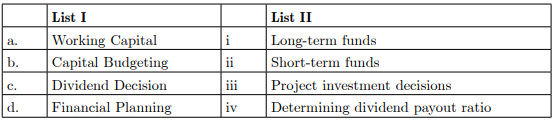
Options:
(A) a-ii, b-iii, c-iv, d-i
(B) a-iii, b-ii, c-i, d-iv
(C) a-i, b-iv, c-iii, d-ii
(D) a-ii, b-i, c-iv, d-iii
View AnswerAns. (A) a-ii, b-iii, c-iv, d-i
15. Statement: Derivatives are complex financial instruments used for various purposes. Which of the following is/are correct?
1. They can be used for hedging risks.
2. They always guarantee high returns.
3. Their value is derived from an underlying asset.
4. They are traded on exchanges or over-the-counter.
(A) 1 and 3 only
(B) 2 and 4 only
(C) 1, 3, and 4 only
(D) All of the above
View AnswerAns. (C) 1, 3, and 4 only
16. Identify the financial decision illustrated by the given picture.

(A) Financing decision
(B) Dividend decision
(C) Investment decision
(D) None of these
View AnswerAns. (C) Investment decision
17. Which of the following statements about the objectives of management is correct?
(A) Management objectives are limited to profit maximization.
(B) Management objectives include organizational, social, and personal goals.
(C) Management does not concern itself with employee development.
(D) Management’s only objective is to control subordinates.
View AnswerAns. (B) Management objectives include organizational, social, and personal goals.
18. Which of the following statements correctly describes the principle of Authority and Responsibility?
(A) Authority should exceed responsibility.
(B) Responsibility should always be avoided.
(C) Authority and responsibility should be balanced for effective management.
(D) Authority is irrelevant in decision-making.
View AnswerAns. (C) Authority and responsibility should be balanced for effective management.
19. Which of the following statements is not correct about the political dimension of the Business Environment?
(A) It includes government stability and policies.
(B) It involves legal regulations like labor laws.
(C) It deals exclusively with economic factors.
(D) It affects taxation and trade policies.
View AnswerAns. (C) It deals exclusively with economic factors.
20. Which of the following statements is not correct regarding the steps in the planning process?
(A) Setting objectives is the first step.
(B) Developing premises comes after setting objectives.
(C) Implementing the plan is the first step.
(D) Evaluating alternatives follows developing premises.
View AnswerAns. (C) Implementing the plan is the first step.
21. What do you mean by business environment scanning?
View AnswerAns. Environment scanning means a process by which organisations monitor their relevant environment to identify its strengths, opportunities and threats affecting their business. By monitoring the environment through environmental scanning, an organisation can consider the impact of the different events, trends, issues and expectations on its strategic management process. This helps it in deciding what opportunities can best be pursued by it and the future course of action.
22. Ramawatar works as superwiser at Rozar electronics Private Limited. He is given the responsibility of meeting a production target of 500 TV sets in a month. The target can be completed by placing 70 workers under him. Presently, only 50 workers are working under him. Ramawatar is not given the authority to employ 20 more workers. As a result, he failed to meet the target. Explain briefly the reasons for the failure and remedy for it.
View AnswerAns. Ramawatar failed to achieve the target because he was not given sufficient authority to fulfil his responsibility. He could have achieved the production of target units, if he had the authority to employ 20 more workers. This imbalance made the subordinate ineffective.
While giving responsibility to the subordinate, the manager should see that equal authority is given to ensure that the targets are met.
OR
Oasis Pharma Furniture Limited is a leading furniture company in India. The company chooses to diversify its operations to capture a wider market. SK Goel, the Managing Director of the company suggests that it should add handicrafts as an additional product line without interrupting the existing operations.
(a) What kind of organisational framework would you suggest and why?
(b) State any two limitations of this framework.
View AnswerAns. (a) Divisional Structure, because this organisation structure is suitable for those organisations which are concerned with manufacturing of different products of distinctive characteristics.
(b) Two limitations of divisional structure are:
(i) There may be conflicts among different divisions over allocation of funds.
(ii) Similar activities may lead to duplication of work and increase in expenditure.
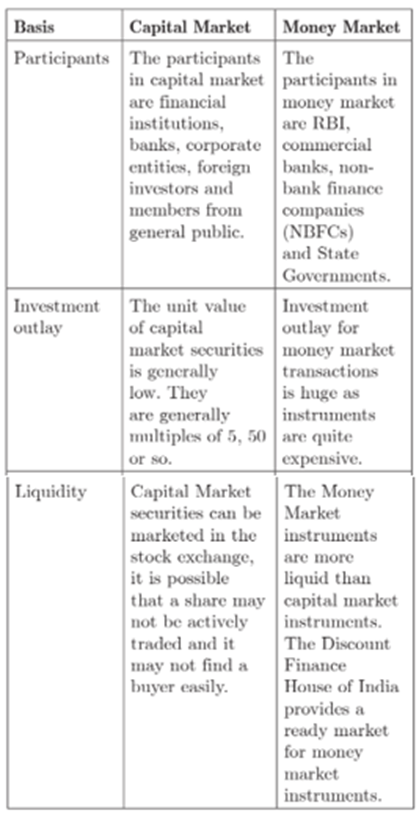
23. Distinguish between capital market and money market on the basis of participants, investment outlay and liquidity.
View AnswerAns.
24. State the steps in the selection procedure, after the employment interview and before the job offer.
View AnswerAns. The steps in the selection procedure after the employment interview and before the job offer are:
(a) Reference and background checking: After the employment interview, the next step is to gather more information about the candidates from indirect personal sources such as previous employer, principal of the college or institution. This investigation is based on references supplied by the candidates and is carried with the objective of verifying information and gaining additional information about the applicant.
(b) Selection decision: After the candidate passes the tests and interviews, final decision for selection is made after considering the views of concerned manager.
(c) Medical Examination: The selection process is not complete without the medical or physical test. A candidate who successfully crosses all the hurdles and passes the medical test, is given job offer.
OR
State ‘Job Enrichment’ and ‘Employee Participation’ as non-financial incentives. How do they motivate employees?
View AnswerAns. Job enrichment: It is concerned with designing job in such a way that it includes greater variety of work content, require higher level of knowledge and skill. It aims at allocating more autonomy and responsibility to the employees. It motivates the employees as the job provide meaningful work experience and opportunity for personal growth. Employee participation: It means forming joint management committees, work committees, canteen committees etc. to ensure that the employees have a say on issues related to them. By doing so, the employees feel motivated as employees feel their authority.
25. Why is organising considered as an important function of management?
View AnswerAns. Organising is considered as an important function of management because of following reasons:
(a) Benefit of Specialisation
(i) In the process of Organising, the activities are grouped very carefully into specialised jobs on the basis of similarity.
(ii) As worker performs a specific task regularly.
(iii) Repetitive performance of a particular task allows him/her to gain experience in that area and it ultimately leads to specialisation.
(b) Clarity of Authority and Responsibility Relationships
(i) The establishment of working relationship clarifies lines of communication and specific who is to report to whom.
(ii) The jobs of managers and non-managers are clearly defined and differentiated.
(iii) It helps to remove duplication of work and fixation of responsibility.
(iv) It minimizes conflict and conflict about the respective powers and privileges of managers.
(c) Optimum utilisation of resources
(i) Organising leads to the proper usage of all materials, financial and human resources.
(ii) The proper assignment of jobs avoids overlapping of work and also makes possible the best use of resources.
(iii) Also, it helps in minimizing the wastage of resources and effects.
(d) Effective management
(i) Organising provides a clear description of jobs and related duties. This helps to avoid confusion and duplication.
(ii) Clarity in working relationship enables proper execution of work. This brings effectiveness in administration.
(e) Adaptation of change.
(i) The process of Organising allows a business enterprise to adapt itself according to changing business environment.
(ii) It allows the organisation structure to be suitably modified and the revision of interrelationships amongst the members of the organisation.
(f) Development of Personnels
(i) Organising stimulates creativity amongst the managers.
(ii) Effective delegation allows the manager reduce their workload by assigning routine jobs to their subordinates.
(iii) The reduction in work load by delegation gives them the time to explore areas for growth and the opportunity to innovate. This strengthens the company’s competitive position.
(g) Expansion and Growth
(i) Organising helps in the growth and diversification of enterprise by enabling it to deviate from existing norms and taking up new challenges.
OR
Explain any four points highlighting the importance of planning function of management.
View AnswerAns. The importance of planning function of management is as follows:
(a) Makes objectives clear and specific: The planning exercise makes the goals clear and specific because it begins with the determination of objectives.
(b) Makes activities meaningful/Provides directions: Due to planning, employees and managers know how their activities relate to organisational goals. Everyone is conscious of his own contribution towards achievement of organisational goals. In this way, planning makes activities meaningful.
(c) Reduces the risks of uncertainty: Planning helps to reduce the risks associated with uncertainties. In the process of planning, attempt is made to look into the future and predict it. Planning helps to identify potential threats of future and help to develop contingency plan to deal with them.
(d) Facilitates decision-making: Planning ensures foreseeing future and choosing the best alternative amongst the various alternatives. The manager evaluates the positive and negative aspect of each alternative and choose the one with least negative consequence, having feasibility and profitability. Through this, a direction is provided to all the activities of the organisation which gives the basic guidelines to the manager for decision making.
(e) Promotes innovative ideas: Planning assists managers in developing new ideas that provide: a platform for building concrete plans. Such innovative ideas provide a direction towards the growth and prosperity of the business.
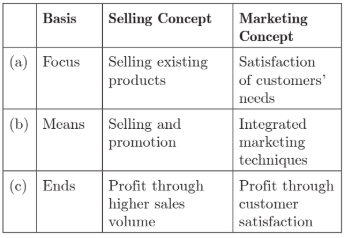
26. ‘Bending the customer according to the product’ and ‘Developing the product according to the customer needs’ are two important concepts of marketing management. Identify the concepts and differentiate between the two.
View AnswerAns. ‘Bending the customer according to the product’ is selling concept and ‘Developing the product according to the customer needs’ is marketing concept. The difference between the two is as follows:
27. It is heartening that the implementation of compliance requirements of the Companies Act, 2013 has progressed substantially with NIFTY 500 companies. Data shows a significant increase in women’s participation in the top management of Indian Companies from 5% few years ago to 13% now. Even companies which are not in NIFTY 500 have undertaken drives to increase women’s participation across different areas of work. The government had also announced that it would support such companies.
Identify and explain the dimensions of business environment discussed above which brought about the change.
View AnswerAns. The dimensions of Business environment discussed in the given paragraph are:
(a) Legal environment: Legal environment includes various legislations passed by the Government, administrative orders issued by government authorities, court judgements, as well as the decisions rendered by various commissions and agencies at every level of government Center, State, Local. Non-compliance of laws can land the business enterprises into legal problems.
(b) Political environment: Political environment includes political conditions such as general stability and peace in the country and specific attitudes that elected government representatives hold towards business. Attitudes of the government officials may have either positive or negative impact upon business.
28. Veer Steels Private Limited is a leading manufacturer of iron and steel in north Delhi. Company decided to open up a new branch in remote areas in Uttar Pradesh so that unemployed youth from the rural areas could get the same opportunities as those available in the urban areas. The company also decided to provide these employees with wage incentive plans linked with payment of wages based on output. For recruitment and selection of persons, for different posts, the company gave an advertisement in the local newspaper of that area.
(a) Which source of recruitment is opted for? State its two benefits.
(b) Briefly explain any two other sources of recruitment under same type.
View AnswerAns. (a) The external source of recruitment is opted for. Its two benefits are:
(i) It brings competitive spirit among employees
(ii) It helps in bringing fresh talent in the organisation.
(b) The two external sources of recruitment are:
(i) Direct recruitment: A notice is placed on the notice board of the enterprise specifying the details of the jobs available. It is followed usually for casual vacancies of unskilled or semi-skilled jobs. Job seekers assemble outside the premises of the organisation on the specified date and selection is done on the spot.
(ii) Casual callers: Unsolicited applicants both at the factory gate or through walk- in interviews constitute an important source of personnel. The qualification of unsolicited applicants will depend on economic considerations, the organisation’s image and the perceived type of jobs that might be available.
(iii) Employment exchange: It was designed both to help the job seekers to find suitable employment and to help the employers find suitable workers. All states provide employment services. The records of employment exchange are often not up to date and many candidates referred by them may not be found suitable.
29. “Management is regarded as an Art by some, as Science or as an inexact Science by others. The truth seems to be somewhere in between.” In the light of this statement, explain the nature of management.
View AnswerAns. Management is considered as a science because it has an organised body of knowledge which contains certain universal truth. It is called an art because managing requires application of certain skills which are the personal possession of a manager. A manager should be an applied scientist. He should possess not only specialised knowledge of management but also the skills to put his knowledge into practice. Management has features of both art and science. The managers work on the basis of principle of management but its application is an art which a manager gains with experience and practice. The art of management cannot be learnt alone from books but needs practice and creative application. Management is an ‘Inexact Science’ because the outcomes of these experiments cannot be accurately predicted. Management deals with human beings and human behaviour and therefore its application cannot be accurately predicated.
Thus, management is a science as well as art, complementing both of them.
OR
Describe any four reasons for the growing importance of management day-by-day.
View AnswerAns. The importance of management may be outlined as follows:
(a) Helps in achieving group goals: It assembles and organises available resources for the accomplishment of the goals of an enterprise. It adds effectiveness to the efforts of a group of persons organised to achieve given objectives.
(b) Increases efficiency/Reduces costs: To secure efficiency of operations, management is concerned with reducing cost of production and increasing the output. Through better planning, organising and control, and the use of various cost reduction techniques, efficient management leads to reduced cost and increased output.
(c) Helps in achieving personal objectives: A manager motivates and leads his team in such a manner that individual members are able to achieve personal goals while contributing to the overall organisational objective.
(d) Helps in the development of society: It helps in providing good quality goods and services, creates employment opportunities, adopts new technology for the greater good of the people and helps in the development of society.
(e) Creates a dynamic organisation: Management helps people to adapt to the constantly changing environment so that the organisation is able to maintain its competitive edge.
30. Explain the following principles of management with the help of an example:
(a) Scalar chain
(b) Discipline
View AnswerAns. (a) Scalar chain: Scalar chain is the formal line of authority and communication from highest to the lowest ranks. Scalar Chain shows the path of flow of authority and communication and in normal course of formal organisation, it should not be violated.
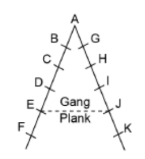
For example, the head. A, has two lines of authority under him. If E wants to communicate with J the communication will flow through the route E-D-C-B-A-G-H-I-J.
However, in case of emergency, E can directly contact J through a Gang Plank. However, they need to inform their superiors about it later on. Gang Plank is a shorter route provided so that communication is not delayed.
(b) Discipline: Discipline means obedience to organisational rules and employment agreement. Fayol considers it necessary for the working of an organisation and advocates that good superiors at all levels, clear and fair agreements and judicious application of penalties will enable discipline in the organisation. Thus, the subordinates must honour their commitment towards the organisation by working efficiently and effectively. Similarly, the management should also keep their promises and fulfil them by giving proper increment, promotion and rewards to its employees.
For example, to revive a company out of loss, its workers agreed to work for extra hours without any additional payment, and the management promised to increase the wages of the workers on successful accomplishment of the targets set, then discipline here means, both the workers and the management should honour their commitments.
31. After completing her studies in product design, Sonal wishes to start her own business to design products to cater to the mobility and communication requirements of persons with special needs. She told her friend that she wanted to focus on supplying high quality and affordable products on “no profit – no loss basis”. The Unique Selling Proposition (U.S.P.) of the products will be sensitivity to the challenges and needs of the differently abled. She has to follow a series of steps to attain her predetermined objectives.
In the above lines, Sonal has discussed about one of the functions of management. Identify the function and state its steps in chronological order other than the one discussed in the above para.
Ans. Sonal has discussed about the Planning function of management. The process of Planning involves taking certain steps which are as follows:
(a) Identifying alternative courses of action:
The next step is finding out the alternative courses of action to achieve objectives. Many innovative ideas and suggestions are considered in this step and alternatives are generated thorough a discussion with the members of the organisation.
(b) Evaluating alternative courses: Planning requires that each alternative should be evaluated taking into account the relevant facts and the pros and cons of each alternative. The merits and demerits as well as consequences of each alternative course of action must be examined before a choice is made.
(c) Selecting an alternative: After evaluation of various available alternative courses, the time comes for selecting the best plan and to implement it practically. The plan will be justified best in terms of feasibility, profitability and with least adverse outcomes. Sometimes a firm may also go for combination of plans instead of selecting one best course. For example, if a play school wants to increase its admissions, it has to choose the best media of advertising in terms of cost effectiveness, vast coverage and better results. It has to select the best medium of advertising out of the following such as television, radio, newspapers, magazines, cables, pamphlets, etc.
(d) Implement the plan/Securing co-operation: Planning is essentially goal-oriented. Hence, the plans formulated must be implemented effectively. For this purpose, co-operation of all the members of the organisation is required.
(e) Follow up action: As planning is a continuous process, existing plans are revised at intervals to ensure their relevance and effectiveness. Review of on-going plans is also necessary to ensure achievement of objectives.
[/expand]32. You are the finance manager of Grover Cloths Private Limited. The Board of directors have asked you to determine the working capital requirements for the company. State four factors that you would take in consideration while determining the requirements of working capital for the company.
View AnswerAns. The factors to be considered while determining the requirements of working capital of the company are:
(a) Nature of business: The basic nature of a business influences the amount of working capital required. A trading concern requires less working capital as there is no processing, i.e., sales are generally made immediately upon receipt of materials.
(b) Scale of operations: The firms, which operate at large-scale require more working capital as their inventory level, debtors, etc. are generally high. However, firms operating at small-scale need less working capital due to low level of activity.
(c) Production cycle: In case of long production cycle, raw material alongwith labour and overheads gets tied up for a long period, whereas firms with shorter production cycle can manage with less working capital.
(d) Credit allowed to customers: Credit policy of the company determines the average time period needed to collect the sale proceeds. It depends on competition level and credit worthiness of customers. A company following liberal credit policy needs more working capital due to more debtors. However, in case of a strict policy, less working capital is needed.
OR
How do the following factors affect the fixed capital requirements of a firm?
(a) Scale of operations
(b) Choice of technique
(c) Technology upgradation
(d) Financing alternative
View AnswerAns. The factors affecting the requirement of fixed capital are:
(a) Scale of operations: A large organisation operating at a higher scale needs bigger plant, more space etc. so, it requires higher investment in fixed assets as compared to smaller organisations operating on a smaller scale.
(b) Choice of technique: A capital intensive organisation needs to invest more in plant and machinery. Labour intensive organisations rely more on manual labour. So, the fixed capital requirement will be more in case of a capital intensive organisation than a labour intensive organisation.
(c) Technology upgradation: An organisation, whose assets are prone to obsolescence, requires more fixed capital as there is a frequent need of upgrading the technology and changing of fixed assets. Thus, the fixed assets requirement is more in this type of organisation.
(d) Financing alternatives: A developed financial market may provide leasing facility to an organisation. A firm can take an asset on lease instead of outright purchase. In such a case, it has to only pay rental for it and by doing so the need of huge sum of funds required to purchase the asset can be avoided. This reduces the fixed capital requirement.
33. Name that element of marketing mix which affects the revenue and profits of a firm. Explain any five factors which help in determining this element.
View AnswerAns. Pricing affects the revenue and profits of a firm. The factors which help in determining price are:
(a) Product cost: One of the most important factors affecting its price is the cost of the product or service. This includes the cost of producing, selling and distributing. The cost set the minimum price of floor price at which the product may be sold. There are broadly three types of costs fixed costs, variable costs and semi-variable costs.
(b) Utility and demand: The utility provided by the product and the intensity of the demand of the buyers sets the upper limit of the product, which a buyer would be prepared to pay. The buyer may be ready to pay upto the point where the utility from the product is equal to the sacrifice made in terms of the price paid.
(c) Extent of competition in the market: The prices will can be set higher if there is lower degree of competition while under higher degrees of competition the prices will tend to set at lowest level.
(d) Government and legal regulations: In order to protect the interest of public against unfair practices in the field of price fixing, government can intervene and regulate the price of commodities. Government can declare a product as essential product and regulate its price.
(e) Marketing methods used: Price fixation process is also affected by other elements of marketing such as quality of salesman employed, product differentiation, credit facility etc.
OR
The Consumer Protection Act, 2019 confers certain rights to consumers with a view to empower them and protect their interests. Explain these rights.
View AnswerAns. The various rights provided by the Consumer Protection Act, 2019 are:
(a) Right to safety: According to this right, a consumer has the right to be protected against goods and services which are hazardous to life and health. For example, electrical goods which are manufactured with substandard products or do not conform to the safety norms might cause serious injury. Thus, consumers are educated that they should use electrical goods which have ISI mark as this would be an assurance for such products in meeting quality specifications.
(b) Right to be informed: According to this right, a consumer has the right to have complete information about the product he intends to buy including its ingredients, date of manufacture, price, quantity, directions for use etc.
(c) Right to be assured: According to this right, consumer has freedom to choose from a variety of products at competitive prices. This implies that the marketers should offer a wide variety of products in terms of quality, brand, prices, size etc. and allow the consumer to make a choice from amongst these.
(d) Right to be heard: According to this right, consumer has the right to file a complaint and to be heard in case of dissatisfaction with a good or a service. It is because of this reason that many enlightened business firms have set up their own consumer service and grievance cells. Many consumer organisations are also working towards this direction and helping consumers in redressing their grievances.
(e) Right to seck redressal: According to this right, a consumer has the right to get relief in case the product or service falls short of his expectations. The Consumer Protection Act provides a number of reliefs to the consumers including replacement of the product, removal of defect in the product, compensation paid for any loss or injury suffered by the consumer etc.
(f) Right to consumer education: According to this right, a consumer has the right to acquire knowledge and to be well informed. He should be aware about his rights and the reliefs available to him in case of a product or service falling short of his expectations. Many consumer organisations and businesses are taking an active part in educating consumers in this respect.
34. Shivani has established a small scale factory after completing a course in textile designing. She has tied up with the big home furnishing retail outlets in the city for supplying to them good quality designer home furnishing products like bed covers, cushions etc. She believes that controlling without planning is blind. So, every time she gets an order, she sets the standards in terms of the number of personnel required, the estimated requirements in man-hours per product, the requirements of direct materials for the projected production and the amount of normal overhead expenses required at the projected workload. She also keeps a close watch on the activities so as to ensure that they conform to plans. Whenever the order size is too large, she hires extra workers by placing a notice on the notice-board of the factory specifying the details of the jobs available.
Identify and explain the steps of the function of management being performed by Shivani.
View AnswerAns. The process of controlling includes the following steps:
(a) Setting performance standards: Standards are the benchmarks which every organisation strives to achieve. These should be set in quantitative terms to make their comparison with actual performance easier.
(b) Measurement of actual performance: The actual performance is measured in an objective and reliable manner. The superior prepares the performance report of an employee. This can be done by personal observation, sample checking, accounting ratios etc. As far as possible, performance should be measured in the same units in which standards are set.
(c) Comparison of actual performance with standards: Comparison of actual performance with standard performance will reveal the deviation between the two.
(d) Analysing deviations: Some amount of deviation can be expected in all activities, therefore, it is important to determine the acceptable range of deviations. Two important concepts, worth discussing here are:
(i) Critical point control: The key result areas are those areas which are critical to the success of an organisation. The deviations in these areas should be dealt with urgently. For example, an increase of 7% in the production cost is more critical than an increase of 17% in the courier cost.
(ii) Management by exception: An effort to control everything may end up in controlling nothing. Only significant deviations that go beyond the permissible limits should be brought to the notice of the management. For example, if the output standards of a factory states defect upto 1% are acceptable, then if the percentage increase in defects is much more than that only, then it should be brought to the notice of the management. The deviations and their causes are then analysed. The causes can be unrealistic standards, defective process, inadequacy of resources and change in environmental factors etc.(e) Taking corrective action: Corrective action might involve revising standards, training of employees, employing more workers, purchasing new machinery, etc. if the deviations go beyond the acceptable limits.