Biotechnology and its Applications
1. Expand GMO. How is it different from a hybrid?
View AnswerAns. GMO stands for Genetically Modified Organism. It differs from a hybrid because in a hybrid, cross is done between total genomes of two species or strains, whereas in a GMO, foreign genes from an entirely different species are introduced in the organism and are usually maintained as extrachromosomal entity or are integrated into the genome of the organism.
2. What is GMO? List any five possible advantages of a GMO to a farmer.
Or
List any four ways by which GMOs have been useful for enhanced crop output.
Or
Why GMOs are so called? List the different ways in which GMO plants have benefitted and have become useful to humans.
View AnswerAns. The plants, bacteria, fungi and animals whose genes have been altered by manipulation are called Genetically Modified Organisms (GMOs).
Advantages of GMOs to a Farmer
(i) Crops become more tolerant to abiotic stresses like cold, drought, salt and heat.
(ii) Dependence on chemical pesticides has reduced, i.e. pest-resistant crops.
(iii) Helped to reduce post-harvest losses.
(iv) Efficiency of mineral usage increased in plants, preventing early exhaustion of fertility of soil.
(v) Enhanced nutritional value of food, e.g. vitamin-A enriched rice.
3. Find out from the internet what is golden rice.
View AnswerAns. Golden rice is a genetically modified rice with high levels of β-carotene and other carotenoids. This rice is modified in order to enhance the quantity of vitamin-A in it. It is called golden due to the gold like colour it gets from β-carotene.
4. What are transgenic bacteria? Illustrate with an example.
View AnswerAns. Bacteria that have had their DNA manipulated to possess and express an extra (foreign) gene are known as transgenic bacteria, e.g. DNA sequences introduced in plasmid of E. coli to produce insulin chains.
5. How has the study of biotechnology helped in developing pest resistant cotton crop? Explain.
Or
One of the major contribution of biotechnology is to develop pest resistant varieties of cotton plants. Explain how it has been made possible.
View AnswerAns. The pests that destroy the cotton balls are cotton bollworms and cotton borer. Bt cotton is created by using some strains of a bacterium, Bacillus thuringiensis (Bt is short form).
This bacterium produces protein that kills certain insects such as lepidopterans (tobacco budworm and armyworm), coleopterans (beetles) and dipterans (flies and mosquitoes).
Bacillus thuringiensis forms protein crystals during a particular phase of their growth. These crystals contain a toxic insecticidal protein. Bt toxin protein exists as inactive protoxins in bacteria, but once an insect ingests this inactive toxin, it is converted into an active form due to the alkaline pH of the gut, which solubilises the crystals.
The activated toxin binds to the surface of midgut epithelial cells and creates pores that cause cell swelling and lysis leading to death of insect.
6. Why certain cotton plants are called Bt cotton?
View AnswerAns. Certain cotton plants are called Bt cotton because they bear specific Bt toxin genes which were isolated from Bacillus thuringiensis and incorporated into certain cotton plants.
7. Why does Bt toxin not kill the bacterium that produces it, but kills the insect that ingests it?
View AnswerAns. Bt toxin is produced by a soil bacterium called Bacillus thuringiensis. This toxin does not kill the bacterium which produces it, because it is present in an inactive and crystalline form. It becomes active and toxic only when it is consumed by insects such as lepidopterans, etc., due to the alkaline pH of their gut.
8. Why do lepidopterans die when they feed on Bt cotton plant? Explain how does it happen.
View AnswerAns. Bt cotton plants are the transgenic plants that express a Bacillus thuringiensis gene called cry gene. This gene, encodes for protein crystals having insecticidal properties against insects of group Lepidoptera, Diptera and Coleoptera. Inside the bacterium, these proteins remain inactive and do not harm the bacteria. However, these inactive crystals can get activated in the alkaline pH of the gut of insects upon ingestion. After activation, these crystals can bind to the receptors present on the membranes of gut epithelial cells. Due to this binding, the membrane swells and pores are created on them. These pores lead to bursting of cell. Hence, the lepidopteran dies.
9. What are Cry proteins? Name an organism that produces it. How has man exploited this protein to his benefit?
View AnswerAns. The proteins encoded by the gene named cry are called Cry proteins. Organism that produces Cry proteins is Bacillus thuringiensis.
Man has exploited this protein for his benefits by incorporating cry genes in several crops such as potato, cotton, corn, etc., due to which they become resistant to pest which can damage the crop, e.g. cryIAc and cryIIAb control the cotton bollworms and cryIAb controls corn borer. They help in high yield of healthy crops.
10. Write the functions of
(i) cry IAc gene
View AnswerAns. (i) cry IAc codes for toxic insecticidal protein as inactive protoxins in Bacillus thuringinesis. This toxin may kill the cotton bollworm.
(ii) RNA interference (RNAi)
View AnswerAns. (ii) RNA interference is associated with silencing of specific mRNA and is a method of cellular defence in eukaryotes.
11. State the consequence when Meloidogyne incognita consumes cells with RNAi gene.
View AnswerAns. If Meloidogyne incognita consumes cells with RNAi, gene silencing of the specific mRNA occurs due to complementary dsRNA molecule formation that binds and prevents translation of mRNA, thus causing death of the nematode.
12. How has RNAi technique helped to prevent the infestation of roots in tobacco plants by a nematode, Meloidogyne incognita?
OR
How has the use of Agrobacterium as vectors helped in controlling Meloidogyne incognita, infestation in tobacco plants? Explain in correct sequence.
View AnswerAns. RNA interference is a gene-silencing process that blocks the expression of genes in the parasite when it enters the host’s body. RNAi takes place in all eukaryotic organisms as a method of cellular defence.
13. Write the difference between the proinsulin and mature insulin.
View AnswerAns. Insulin is a hormone secreted by pancreas. It consists of two short polypeptide chains, i.e. chains A and B, linked together by disulphide bridges. Chain-A contains 21 amino acids, while chain-B contains 30 amino acids.
In mammals, insulin is synthesised as a prohormone, i.e. it needs to be processed before it becomes fully mature and functional hormone. This prohormone contains an extra stretch called the C-peptide of 33 amino acids. This is known as proinsulin.
The insulin that lack C-peptide is called mature insulin.
14. How did an American Company, Eli Lilly use the knowledge of rDNA technology to produce human insulin?
Or
How did Eli Lilly synthesise the human insulin? Mention one difference between this insulin and the one produced by the human pancreas.
Or
How did American company Eli Lilly produce human insulin using rDNA technique?
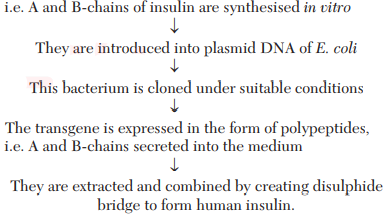
View AnswerAns. In 1983, Eli Lilly, an American company prepared two DNA sequences corresponding to A and B-chains of human insulin and introduced them in plasmids of E. coli to produce insulin chains. These chains (A and B) were produced separately, extracted and combined by creating disulphide bonds to form human insulin called humulin.
The insulin in human pancreas is synthesised as a prohormone containing the C-peptide which is removed in mature hormone. But the insulin synthesised by recombinant DNA technology did not contain C-peptide and was prepared in the mature form.
15. Recombinant DNA technology is of great importance in the field of medicine. With the help of a flow chart, show how this technology has been used in preparing genetically engineered human insulins.
View AnswerAns. An American company Eli Lilly produced insulin via recombinant DNA technology in 1983. Insulin production by using recombinant DNA technology is shown in flow chart below DNA sequences corresponding to the two polypeptides,
16. Name the source used to produce hepatitis-B vaccine using rDNA technology.
View AnswerAns. Recombinant DNA technology has allowed the production of antigenic polypeptides of pathogen in bacteria or yeast. Vaccines produced using this approach allow large scale production and hence, greater availability for immunisation, e.g. source of hepatitis-B vaccine is yeast.
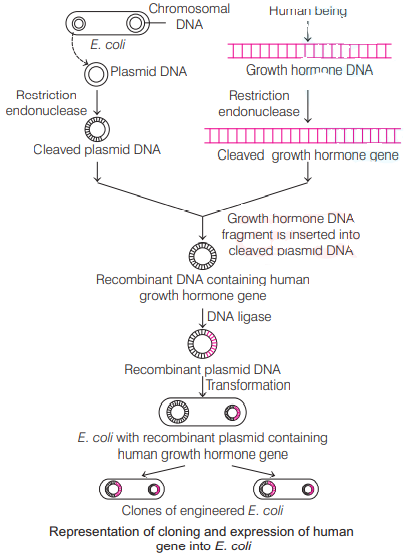
17. Diagrammatically represent the experimental steps in cloning and expressing a human gene (say the gene for growth hormone) into a bacterium like E. coli.
View AnswerAns. The multiple identical copies of specific template DNA can be produced by DNA cloning. It can be carried out by the use of a vector to carry specific foreign DNA fragment into the host cell. The mechanism of cloning and transfer of a gene for human growth hormone into E. coli is diagrammatically represented below.
18. What is gene therapy? Name the first clinical case in which it was used.
OR
What is gene therapy? Illustrate using the example of Adenosine Deaminase (ADA) deficiency?
View AnswerAns. Gene therapy is a collection of methods which allow the correction of a genetic defect diagnosed in a child or embryo. The first clinical case in which gene therapy was used in 1990 on a 4 years old girl with ADA deficiency. ADA is an autosomal recessive inherited disorder which occurs due to a defective ADA enzyme that causes Severe Combined Immunodeficiency or SCID Syndrome. It can be cured by bone marrow transplantation and by enzyme replacement therapy. For this process, an engineered retrovirus having a functional ADA gene is made use of for transferring functional ADA gene into the patients stem cells and the modified cells with good ADA gene are then reintroduced into the patient’s body.
19. Write the function of adenosine deaminase enzyme. State the cause of ADA deficiency in humans. Mention a possible permanent cure for an ADA deficiency patient.
View AnswerAns. Adenosine Deaminase or ADA enzyme is important for the proper functioning of the immune system of a person. The disorder is caused due to the deletion of the gene for adenosine deaminase. ADA deficiency can be cured by bone marrow transplantation and in, others by enzyme replacement therapy.
However, both of these curative. Gene therapy is a permanent cure if the gene isolated from marrow cells producing ADA is introduced into cells at early embryonic stage.
20. Two girls, A and B aged 4 and 5 years respectively visited a hospital with a similar genetic disorder. The girl A was provided enzyme-replacement therapy and was advised to revisit periodically for further treatment. The girl B was, however, given a therapy that did not require revisit for further treatment.
(i) Name the ailments the two girls were suffering from?
View AnswerAns. Both girls were suffering from Adenosine Deaminase (ADA) deficiency due to probable deletion of gene that codes for ADA production.
(ii) Why did the treatment provided to girl A require repeated visits?
View AnswerAns. Girl A was treated with injections of functional ADA or bone marrow transplant. These techniques are not completely curative as these lymphocytes are not immortal and require repeated treatment.
(iii) How was the girl B cured permanently?
View AnswerAns. Girl B was treated using gene therapy where the gene isolated from marrow cells producing ADA was introduced into cells at an early embryonic stage for a possible permanent cure. Hence, she did not require revisit for further treatment.
21. Explain enzyme replacement therapy to treat adenosine deaminase deficiency. Mention two disadvantages of this procedure.
View AnswerAns. In enzyme replacement therapy, the patient is given functional ADA (Adenosine Deaminase) by injection.
Steps involved in ADA gene therapy are
(i) The lymphocytes from the blood of the patient are grown in a culture outside the body.
(ii) A functional ADA cDNA (using a retroviral vector) is then introduced into these lymphocytes which are subsequently returned to the patient.
Disadvantages
(i) The patient does not completely recover from the disease.
(ii) It needs periodic injections of the enzyme to the patients.
22. Why are certain animals called ‘transgenic’? Give an example of such an animal that is being used for testing the vaccine safety for a specific human disease. Name the disease.
View AnswerAns. Certain animals are called transgenic because their DNA is manipulated to possess and express a useful and extra (foreign) gene. Transgenic mice are being used for testing the vaccine safety for the polio disease, before being used in humans. It can replace the use of monkeys to test the safety of the batches of the vaccine.
23. With respect to understanding diseases, discuss the importance of transgenic animal models.
View AnswerAns. Transgenic animals are important in the following fields
(i) They are being used in basic science research to elucidate the role of genes in the development of diseases like cancer, cystic fibrosis, rheumatoid arthritis and Alzheimer’s.
(ii) They are valuable tools in the drug development process itself.
(iii) Milk producing transgenics can produce medicines or human proteins (insulin, growth hormone, etc.) in large quantities.
(iv) Transgenics can be a source of transplant organs as well.
24. Explain alpha lactalbumin. Where is it produced in human body?
View AnswerAns. Alpha lactalbumin is a human milk protein which helps to increase the production of lactose in the body. It is produced in human milk.
25. Describe how biotechnology has helped in producing more nutritionally balanced milk.
View AnswerAns. Biotechnology leads to production of transgenic cow, Rosie that produced around 2.4 g/L human protein enriched milk. This milk contained the human alpha lactalbumin and was nutritionally more balanced than a natural cow’s milk.
26. While creating genetically modified organisms, genetic barriers are not respected. How can this be dangerous in the long run?
View AnswerAns. Genetic modification of organisms can have unpredictable results when such organisms are introduced into the ecosystem. Because the real effects of gene manipulation are visible only when such organisms react with other components and organisms of the ecosystem.
27. Write a short note on biopiracy highlighting the exploitation of developing countries by the developed countries.
View AnswerAns. Biopiracy refers to the use of bioresources by multinational companies and other organisations without proper authorisation from the countries and people concerned without compensatory payment.
The majority of industrialised nations are financially rich but poor in biodiversity and traditional knowledge, in comparison to developing and underdeveloped countries hence exploit them both morally and financially.
Some examples of biopiracy are
(i) In 1995, US patent office granted patent for medicinal use of turmeric to University of Mississippi Medical Center.
(ii) In 1996, WR Grace and Co. got patent for fungicidal uses of neem by European Patent Office Munich.
28. Describe the responsibility of GEAC setup by the Indian Government.
View AnswerAns. Genetic Engineering Approval Committee (GEAC) makes decision regarding the validity of GM research and the safety of introducing GM organisms for public services.
29. What is biopiracy? State the initiative taken by the Indian Parliament against it.
View AnswerAns. Biopiracy is the unauthorised use of biological resources by multinationals or other organisations, i.e. without proper permissions from relevant authorities or people concerned with it.
Indian parliament has recently passed the 2nd amendment of Indian patents bill, which considers various issues related with biopiracy. For example, terms of patent, emergency provisions, research and development initiative.
30. Compare and contrast the advantages and disadvantages of the production of genetically modified crops.
View AnswerAns. Advantages of GM crops are
(i) More tolerance to abiotic stresses (cold, drought, salt and heat).
(ii) Reduced reliance on chemical pesticides (pest-resistant crops).
(iii) Increased efficiency of mineral usage prevents early exhaustion of fertility of soil.
Disadvantages of GM crops are
(i) Transgenic genes in genetically modified crops endanger native species.
(ii) They cause damage to the natural environment by reducing biodiversity.
(iii) They may also cause human health problems due to altered genes and transferred antibiotic resistance.
31. (i) Name the insect that attacks cotton crops and causes lot of damage to the crop. How has Bt cotton plant overcome this problem and saved the crop? Explain.
View AnswerAns. The insect that attacks cotton crops is cotton bollworms. Bt cotton is made by using a bacterium called as Bacillus thuringiensis. This bacterium produces a protein that kills certain insects. B. thuringiensis forms protein crystals (Cry) during a phase of its growth. These crystals contain a toxic insecticidal protein. Specific Bt toxin genes were isolated from Bacillus thuringiensis and incorporated into cotton. This Bt toxin does not kill the Bacillus because it exists as inactive protoxins in its body. However, when an insect ingests the inactive toxin, it gets exposed to the alkaline pH of the gut, which solubilises the crystals and converts it into active form. The activated toxin binds to the surface of midgut epithelial cells and create pores that cause cell swelling and lysis and eventually causes death of the insect. In this manner, the crop is saved from insects and a large yield is obtained.
(ii) Write the role of gene cry IAb.
View AnswerAns. Gene cry IAb secretes a protein that inhibits the growth of corn borer insects.
32. Discuss transgenic animals. Explain any four ways in which such animals can be beneficial for humans.
View AnswerAns. Animals that have had their DNA manipulated to possess and express an extra (foreign) gene are known as transgenic animals, e.g. transgenic rats, rabbits, pigs, sheep, cows and fishes.
There are several benefits of transgenic animals
1. Normal physiology and development: Transgenic animals can be specifically designed to allow the study of how genes are regulated and how they affect the normal functioning of the body and its development. For example, the study of complex factors involved in growth such as insulin like growth factors.
2. Study of disease: Many transgenic animals are specially made to serve as models for human diseases, so that the investigation of new treatments for diseases is made possible.
3. Biological products Human diseases can be treated by medicines that contain biological products.
(i) Transgenic animals that produce useful biological products can be created by the introduction of the portion of the DNA or genes that code for a particular product such as human protein (α -1-antitrypsin) which is used to treat emphysema. Similar attempts are being made for the treatment of Phenylketonuria (PKU) and cystic fibrosis.
(ii) The first transgenic cow, Rosie produced human protein enriched milk (2.4 g/L) in 1997. The milk contained the human alpha lactalbumin and was nutritionally a more balanced product for human babies than natural cow’s milk.
4. Vaccine safety: Transgenic mice are being used for testing the safety of vaccines before they are used on humans, e.g. polio vaccine. If found reliable and successful they could replace the use of monkeys in order to test the safety of batches of the vaccine.