Class XII Session 2024 – 25
Subject – Biology
Time Allowed: 3 hours Maximum Marks: 70
General Instructions:
1. All questions are compulsory.
2. The question paper has five sections and 33 questions. All questions are compulsory.
3. Section–A has 16 questions of 1 mark each; Section–B has 5 questions of 2 marks each; Section– C has 7 questions of 3 marks each; Section– D has 2 case-based questions of 4 marks each; and Section–E has 3 questions of 5 marks each.
4. There is no overall choice. However, internal choices have been provided in some questions. A student has to attempt only one of the alternatives in such questions.
5. Wherever necessary, neat and properly labeled diagrams should be drawn.
Section A
1. Source of energy in an ecosystem is:
a) Decomposition of plants and animals by bacteria
b) Fermentation of sugars
c) Sunlight
d) Photosynthesis by plants
View AnswerAns. c) Sunlight
2. Name the spermicidal cream developed by Central Drug Research Institute (Lucknow), India.
a) Corovira
b) Sapindus
c) Spermacid
d) Consap
View AnswerAns. d) Consap
3. A river with an inflow of domestic sewage rich in organic waste may result in:
a) An increased production of fish due to biodegradable nutrients.
b) Death of fish due to lack of oxygen.
c) Increased population of aquatic food web organisms.
d) Drying of the river very soon due to algal bloom.
View AnswerAns. b) Death of fish due to lack of oxygen.
4. Growth curve is normally:
a) C-shaped
b) J-shaped
c) S-shaped
d) V-shaped
View AnswerAns. c) S-shaped
5. In transgenics, expression of transgene in target tissue is determined by:
a) Enhances
b) Reporter
c) Transgene
d) Promoter
View AnswerAns. b) Reporter
6. Which of the following is included in bioinsecticide?
a) Viruses and bacteria
b) Viruses, bacteria, fungi, protozoans and mites
c) Viruses, bacteria, fungi and protozoa
d) Viruses, bacteria and fungi
View AnswerAns. d) Viruses, bacteria and fungi
7. XO type of sex determination is found in:
a) Elephant
b) Human beings
c) Dog
d) Grasshopper
View AnswerAns. d) Grasshopper
8. What was the resultant found in the place marked E?
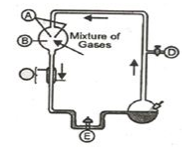
a) Glucose, fatty acids and lipids
b) Some fatty acids and organic acids
c) Some amino acids as glycine and alanine
d) Organic esters only
View AnswerAns. c) Some amino acids as glycine and alanine
9. Flow of energy in our ecosystem takes place
a) only in one direction
b) possible in two directions
c) in three dimensions
d) may occur in multiple directions
View AnswerAns. a) only in one direction
10. Study the pedigree chart of a certain family given below and select the correct conclusion which can be drawn for the character
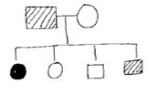
a) The trait under study could not be colour blindness
b) The female parent is heterozygous
c) The male parent is homozygous dominant
d) The parent could not have had a normal daughter for this character
View AnswerAns. b) The female parent is heterozygous
11. Crop rotation is used by farmers to increase:
a) Soil fertility
b) Nitrogenous content of soil
c) Breeding
d) Organic content of soil
View AnswerAns. a) Soil fertility
12. Study the DNA profiles obtained as a result of DNA fingerprinting of a child X and three individuals 1, 2 and 3. Which one of the following options shows the possible parents of the child X?
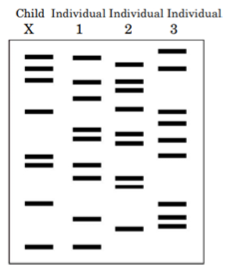
a) Only individual 3
b) 1 and 2
c) 1 and 3
d) 2 and 3
View AnswerAns. c) 1 and 3
13. Assertion (A): Ormeloxifene, also known as centchroman, is used as a nonsteroidal oral contraceptive.
Reason (R): It causes an asynchrony in the menstrual cycle between ovulation and the development of the uterine lining.
a) Both A and R are true and R is the correct explanation of A.
b) Both A and R are true but R is not the correct explanation of A.
c) A is true but R is false.
d) A is false but R is true.
View AnswerAns. a) Both A and R are true and R is the correct explanation of A.
14. Assertion: The use of fertilizers greatly enhances crop productivity.
Reason: Irrigation is very important in increasing crop productivity.
a) If both Assertion & Reason are true but the reason is not the correct explanation of the assertion
b) If both Assertion & Reason are true and the reason is the correct explanation of the assertion,
c) If Assertion is true statement but Reason is false
d) If both Assertion and Reason are false statements
View AnswerAns. a) If both Assertion & Reason are true but the reason is not the correct explanation of the assertion
15. Assertion (A): Epiphytes grow on other plants.
Reason (R): They grow only in humid areas.
a) Both A and R are true and R is the correct explanation of A.
b) Both A and R are true but R is not the correct explanation of A.
c) A is true but R is false.
d) A is false but R is true.
View AnswerAns. b) Both A and R are true but R is not the correct explanation of A.
16. Assertion (A): The earliest organisms that appeared on the earth were non-green and presumably anaerobes.
Reason (R): The first autotrophic organisms were the chemo-autotrophs that never released oxygen.
a) Both A and R are true and R is the correct explanation of A.
b) Both A and R are true but R is not the correct explanation of A.
c) A is true but R is false.
d) A is false but R is true.
View AnswerAns. a) Both A and R are true and R is the correct explanation of A.
Section B
17. What are transgenic animals? How was the first transgenic cow found to be more useful than the normal cow, for humans?
View AnswerAns. Transgenic animals that produce useful biological products can be created by the introduction of the portion of DNA. Rosie was the first transgenic cow and it was produced in 1997. The gene for human protein alpha-lactalbumin was introduced in this cow. Thus, the cow could produce protein-enriched milk. This milk was nutritionally more balanced than natural cow milk.
18. Read the sequence of the nucleotides in the given segment of mRNA and the respective amino acid sequence in the polypeptide chain.
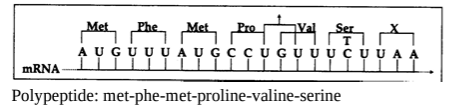
i. Provide the triplet of bases (codon) for
a. valine
b. proline
View AnswerAns. Valine: GUU, Proline: CCU
ii. Write the nucleotide sequence of the DNA strand from which this mRNA was transcribed
View AnswerAns. Nucleotides of DNA strand: TAC AAA TAC GGA CAA AGA ATT
iii. What does the last codon of this RNA stand for?
View AnswerAns. UAA: Stop
19. These pictures show the gynoecium of (A) Papaver and (B) Michelia flowers. Write the difference in the structure of their ovaries.
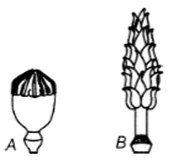
Ans. A. represents the multi carpellary and syncarpous pistil of Papaver.
B. represents the multi carpellary and apocarpous gynoecium of Michelia.
20. Name the labels A, B, C, D, E and F in the diagram of seminiferous tubule.
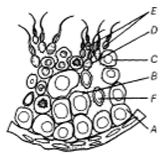
Ans. A-Spermatogonium
B-Primary spermatocyte
C-Secondary spermatocyte
D-Spermatid
E-Spermatozoa
F-Sertoli cell
21. Name the microbes that help production of the following products commercially:
(a) Statin
(b) Citric acid
(c) Penicillin
(d) Butyric acid
View AnswerAns. a. Monascus purpureus
b. Aspergillus niger
c. Penicillium notatum
d. Clostridium butylicum.
OR
Arrange the following in the decreasing order (most important first) of their importance, for the welfare of human society. Give reasons for your answer.
Biogas, Citric acid, Penicillin and curd
View AnswerAns. The order of arrangement of products according to their decreasing importance is: Penicillin- Biogas − Citric acid – Curd
Penicillin is the most important product for the welfare of human society. It is an antibiotic, which is used for controlling various bacterial diseases.
The second most important product is biogas. It is an eco-friendly source of energy.
The next important product is citric acid, which is used as a food preservative.
The least important product is curd, a food item obtained by the action of lacto bacillus bacteria on milk.
Section C
Look at the figure below depicting lac operon of E.coli.
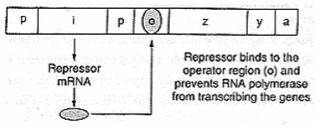
i. What could be the series of events when an inducer is present in the medium in which E.coli is growing?
View AnswerAns. When the inducer is present, it combines with the repressor, coded by i gene.
After reacting with repressor it inactivates the repressor.
The repressor now cannot bind to the operator, hence the pathway for RA polymerase is open. The structural genes (z, y, a) are transcribed and the metabolism continues.
ii. Name the inducer.
View AnswerAns. Lactose is inducer.
23. F1 progeny of pea plant bearing violet flowers and snapdragon plant bearing red flowers were selfed to produce their respective F2 progeny. Compare the phenotypes, the genotypes and the pattern of inheritance of their respective F2 progeny.
View AnswerAns. The snapdragon flower shows dominance. If a plant with red coloured flowers (RR) is crossed with a plant with white coloured flower (rr), the F1 progeny shows (Rr) the plant with pink coloured flowers. Hence, in the condition in which the selfing of the plant bearing red flower, they have RR genotype.
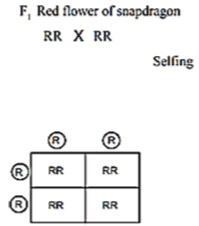
Phenotype: All plants are bearing red coloured flowers.
Phenotypic ratio: 100%
Genotype: RR
Genotypic ratio: RR (100%)
24. Egrets are often seen along with grazing cattle. How do you refer to this interaction? Give reason.
View AnswerAns. – Commensalism
– As egrets move, the cattle stir up and flush out from the vegetation the insects which otherwise might be difficult for the egrets to find and catch. Thus, the egrets are benefited while the cattle are neither benefited nor harmed.
25. The below image shows is the headquarter of Eli Lilly company. Eli lily is one of the first pharmaceutical companies to produce human insulin using RDT technology by cell-based fermentation method.

i. How did Eli Lilly synthesize human insulin?
View AnswerAns. Eli Lilly company prepares proinsulin chain A and B using separate DNA sequences corresponding to A and B, chains of human insulin and introduced them in the plasmid of E. coli to prepare insulin chains, chains A and B produced separately, extracted and combined by disulphide bond produces mature insulin.
ii. Mention one difference between this insulin and the one produce by the human pancreas.
View AnswerAns. The one important difference between the insulin produced by human pancreas and the one produced by Eli Lilly is that human insulin has an additional C peptide.
26. Briefly classify the extinction processes.
View AnswerAns. Extinction of species: The extinction of species is a natural process. Many species have disappeared and new ones have evolved to take over their place. There are three types of extinction processes:
i. Natural extinction: When there is a change in environmental conditions, certain species disappear and others, (which are more adapted to changed conditions) take their place. This loss of species that occurred in the geological past at a very slow rate is known as natural (background extinction).
ii. Mass extinction: There have been several periods in the earth’s geological history when a large number of species became extinct due to catastrophes.
iii. Anthropogenic extinction: Recently more number of species is disappearing from the face of the earth due to human activities. Man-made mass extinction represents a very severe depletion of biodiversity.
OR
Give three hypothesis for explaining why tropics show greatest levels of species richness.
View AnswerAns. Biodiversity is not uniformly distributed throughout the world. Polar regions have very little biodiversity whereas South America has the greatest biodiversity on the earth. There are many hypothesis for higher biodiversity in tropics:
1. There are no unfavourable seasons or harsh climatic conditions in tropics. Continued favourable environmental condition has helped tropical organisms to flourish more.
2. There is more solar energy available in the tropics due to which productivity is higher and this contribute to greater diversity in both plants and animal species.
3. The tropical environment is older than other types of habitats. This has provided more time for the evolution of greater number of plants and animals.
27. What data support that the evolutionary history of man is like that of any other organism?
View AnswerAns. It is a true and confirmed fact that the evolutionary history of man is similar to that of any other organism. Following are some of the points which support this theory.
i. Evolution continues from a simple form to complex form and this is true for human evolution as well as other organisms’ evolution.
ii. Evidence from fossils and embryological studies suggest the similarity in the development of different species including humans.
iii. Evidence from molecular studies shows similarities in the sequence of blood proteins and nucleic acids indicate a relationship with apes.
iv. Evidence from the banding pattern in a chromosomal study of man and apes confirm the ancestral relationship between the two.
v. Evidence from structural comparisons of haemoglobin from different species supports the evolution in humans being similar to other species.
28. Differentiate between vaccination and immunization. Describe the two types of vaccines with suitable examples?
View AnswerAns. Vaccination is the phenomenon of injection of killed or inactivated microbe to trigger the immune system to produce antibodies against a particular disease. Vaccination is the process of administering vaccines. Diseases can be prevented by vaccination. During vaccination inactivated or weakened microbes called as vaccines are introduced into the body. They trigger the production of antibodies. When disease-carrying microbes enter our body, self-protecting proteins called antibodies fight against the invader. Immunisation is the protection of individuals from communicable diseases by administration of a suspension of dead microorganisms. This is the stimulation of immune system in the body to produce memory cells which further can detect disease causing pathogens and immediately eliminate them before causing the disease. Generally vaccines are of two types:
(a) Attenuated Vaccines: They are prepared from live organisms (generally pathogen is made weak to make it non virulent). Examples : BCG and influenza vaccine.
(b) Killed Vaccines: They are prepared by killing the pathogenic organisms by heat or UV rays. Examples: Polio and Rabies vaccines.
Section D
29. Read the following text carefully and answer the questions that follow:
Study the given table
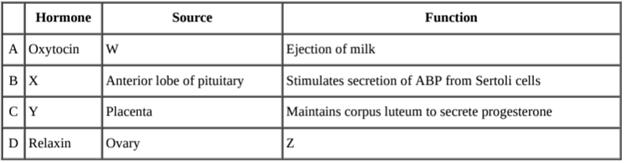
i. Identify the hormones X and Y respectively.
View AnswerAns. X-FSH, Y-hCG
ii. Label W and Z.
View AnswerAns. W- Hypothalamus but released through Posterior lobe of Pituitary.
Z- Contraction of smooth muscles during parturition.
iii. Name the hormones produced only during pregnancy in human female. Mention their source organs.
View AnswerAns. The hormones produced only during pregnancy in human female are human Chorionic Gonadotropin (hCG), human Placental Lactogen (hPL) and relaxin.
The source of hCG and hPL is placenta and that of relaxin is ovary and placenta.
OR
Name any two hormones which are secreted by placenta and are also present in a non-pregnant woman.
View AnswerAns. The two hormones secreted by placenta that are also present in a non-pregnant woman are oestrogen and progesterone.
30. Read the following text carefully and answer the questions that follow:
When a microorganism invades a host, a definite sequence of events usually occur leading to infection and disease, causing suffering to the host. This process is called pathogenesis. Once a microorganism overcomes the defense system of the host, development of the disease follows a certain sequence of events as shown in the graph. Study the graph given below for the sequence of events leading to appearance of a disease and answer the questions that follow:
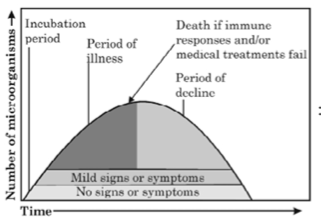
i. In which period, according to the graph there are maximum chances of a person transmitting a disease/infection and why?
View AnswerAns. Period of illness: The number of disease-causing microorganisms reaches its maximum during the period of illness so, there are maximum chances of a person transmitting a disease/infection at this stage.
ii. Study the graph and write what is an incubation period. Name a sexually transmitted disease that can be easily transmitted during this period. Name the specific type of lymphocytes that are attacked by the pathogen of this disease.
View AnswerAns. Time period between infection and appearance of its symptoms is known as incubation period. AIDS/any other correct example
T lymphocytes are attack by the pathogen of this disease.
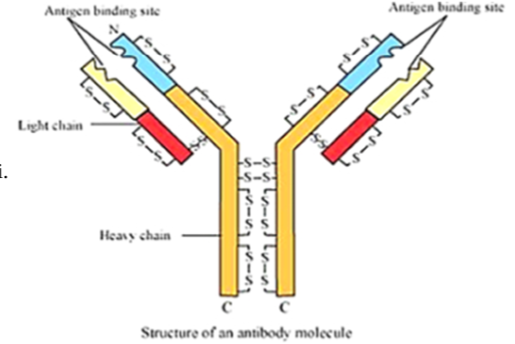
iii. Draw a schematic labelled diagram of an antibody.
View AnswerAns.
OR
In which period, the number of immune cells forming antibodies will be the highest in a person suffering from pneumonia?
View AnswerAns. Period of illness
Name the immune cells that produce antibodies.
View AnswerAns. B lymphocytes/B cells produces antibodies.
Section E
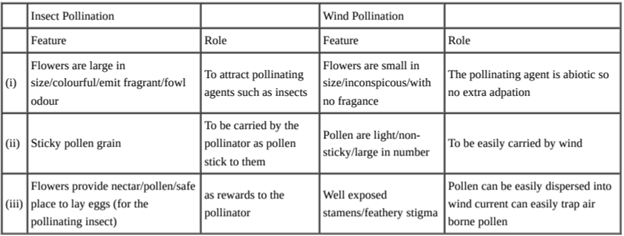
31. Compare the characteristic features of insect pollinated and wind pollinated flowers. Explain how the respective features assist in pollination.
View AnswerAns.
OR
Differentiate between:
a. hypocotyol and epicotyl
View AnswerAns. Hypocotyl – The portion of embryonic axis between the radical and cotyledon
Epicotyl – The portion of embryonic axis between the plumule and cotyledon
b. coleoptile and coleorrhiza
View AnswerAns. Coleoptile – It is a conical protective sheath over the plumule in monocot seeds.
Coleorrhiza – It is a protective sheath over the radical and root tip.
c. integument and testa
View AnswerAns. Integument is the covering of ovule, while testa is the outer seed coat developed from the outer integuments.
d. perisperm and pericarp
View AnswerAns. Perisperm is the residual persistent nucellus, while the pericarp is the fruit wall derived from the ovary wall.
32. Give an account of the methods used in sequencing the human genome.
View AnswerAns. Two approaches were involved in sequencing the human genome.
Using Expressed Sequence Tags (ESTs): In this approach, all the genes that are expressed as RNA are identified and then sequenced.
Blind Approach: This approach involved sequencing the whole set of the genome and then assigning different regions in the sequence with functions. This is referred to as sequence annotation. This approach is comprised of the following steps:
i. Total DNA from a cell is isolated and converted into random fragments of smaller sizes.
ii. These fragments are cloned in a suitable host by using specialized vectors. The cloning results in the amplification of each fragment and makes it easy to sequence the fragment. Bacteria and yeast are the commonly used hosts for this purpose. The vectors were called BAC (bacterial artificial chromosomes) and YAC (yeast artificial chromosomes).
iii. Automated DNA sequencers were used to sequence the fragments. Then these sequences were arranged on the basis of some overlapping regions present in them.
iv. For generating overlapping fragments in these sequences; help of computer programmes was taken because it was not possible for humans to do so.
v. Then the sequences were annotated and assigned to each chromosome.
vi. Genetic physical mapping of the genome was done on the basis of polymorphism in some segments of the DNA.
OR
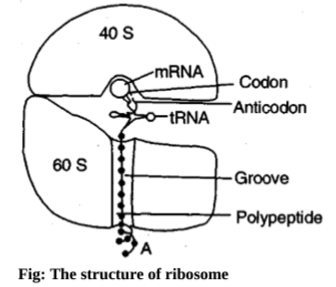
Describe the structure of a ribosome, taking into consideration, its role in protein synthesis.
View AnswerAns. Ribosomes are also called as protein factories as they help in the protein synthesis.
Each ribosome has two unequal subunits named as small (40 s) and large (60 s) subunits.
The larger subunit of the ribosome has a groove for pushing out the newly formed polypeptide and protecting the same from cellular enzymes.
The smaller subunit fits over the larger one like a cap but leaves a tunnel for mRNA.
The two subunits come together only at the time of protein formation during the phenomenon known as association in which Mg2+ plays an important role.
Soon after the completion of protein synthesis, the two subunits separate by the process called dissociation.
The different parts of ribosome connected with protein synthesis are:
A tunnel for mRNA which lies between the two subunits.
A groove which is a part of large subunit; for the passage of newly synthesized polypeptide.
There are two reactive sites – P and A.
P-site (peptidyl transfer or donor site) is jointly contributed by two ribosomal subunits.
A-site (amino-acyl or acceptor site) is located on the larger subunit of the ribosome and faces the tunnel between the two subunits.
Smaller sub-unit of the ribosome has a point for recognizing mRNA and binding area for initiation factors.
33. The melding of a technique for repeated rounds of DNA synthesis with the discovery of a thermostable DNA polymerase has given scientists the very powerful technique known as polymerase chain reaction (PCR). PCR is based on three simple steps required for any DNA synthesis reaction: (1) denaturation of the template into single strands; (2) annealing of primers to each original strand for new strand synthesis; and (3) extension of the new DNA strands from the primers.
In the given figure, one cycle of polymerase chain reaction (PCR) is shown:
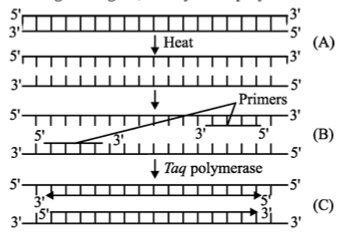
i. Name the steps A, B and C.
View AnswerAns. (A) Denaturation, (B) Annealing, (C) Thermus aquaticus.
ii. Give the purpose of each of these steps.
View AnswerAns. Denaturation: Heat denatures DNA to separate complementary strands.
Annealing: Primers hybridizes to the denatured DNA strands.
Thermus aquaticus: This enzyme induces denaturation of double-stranded DNA at high temperature.
Extension: Extension of primers resulting in the synthesis of copies of the target DNA sequence.
iii. State the contribution of Thermus aquaticus in this process.
View AnswerAns. Denaturation: Heat denatures DNA to separate complementary strands. Annealing: Primers hybridizes to the denatured DNA strands. Thermus aquaticus: This enzyme induces denaturation of double-stranded DNA at high temperature. Extension: Extension of primers resulting in the synthesis of copies of the target DNA sequence.
OR
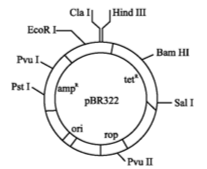
Study the figure of vector pBR322 given below in which foreign DNA is ligated at the Bam HI site of tetracyline resistance gene.
Answer the following questions:
i. Mention the function of rop.
View AnswerAns. ‘Rop’ codes for the proteins involved in the replication of plasmid.
ii. What will be the selectable marker for this recombinant plasmid and why?
View AnswerAns. Selectable marker: Ampicillin resistance gene. It will help distinguishing transformants from non-transformants after plating them on ampicillin containing medium.
iii. Explain transformation.
View AnswerAns. Transformation: It is the phenomenon by which the DNA isolated frond one type of cell and introduced into another type, is able to bring about some of the properties of former to the later.