Class XII Session 2024 – 25
Subject – Biology
Time Allowed: 3 hours Maximum Marks: 70
General Instructions:
1. All questions are compulsory.
2. The question paper has five sections and 33 questions. All questions are compulsory.
3. Section–A has 16 questions of 1 mark each; Section–B has 5 questions of 2 marks each; Section– C has 7 questions of 3 marks each; Section– D has 2 case-based questions of 4 marks each; and Section–E has 3 questions of 5 marks each.
4. There is no overall choice. However, internal choices have been provided in some questions. A student has to attempt only one of the alternatives in such questions.
5. Wherever necessary, neat and properly labeled diagrams should be drawn.
Section A
1. Energy transfer from one trophic level to another is:
a) 50%
b) 100%
c) 10%
d) 5%
View AnswerAns. c) 10%
2. In a population, the condition at which the rate of addition of new members is more than the rate of individuals lost indicates:
a) Zero population growth
b) Fluctuating growth
c) Exponential growth
d) Declining growth
View AnswerAns. c) Exponential growth
3. Hot spots are places where:
a) High degree of habital loss
b) All of these
c) High degree of endemism
d) High degree of species richness
View AnswerAns. b) All of these
4. Which of the following is a hormone releasing Intra-Uterine Device (IUD)?
a) Multiload- 375
b) Vault
c) LNG-20
d) Cervical cap
View AnswerAns. c) LNG-20
5. Among the following stem cells, which are found in umbilical cord:
a) Adult stem cells
b) Cord blood stem cells
c) Embryonic stem cells
d) All of these
View AnswerAns. c) Embryonic stem cells
6. Mycorrhiza is an example of:
a) Parasitism
b) Saprophytism
c) Thyroxine
d) Symbiosis
View AnswerAns. d) Symbiosis
7. In a test-cross involving F1 dihybrid flies, more parental-type offspring were produced than the recombinanttype offspring. This indicates:
a) Chromosomes failed to separate during meiosis
b) The two genes are located on two different chromosomes
c) Both of the characters are controlled by more than one gene.
d) The two genes are linked and present on the same chromosome
View AnswerAns. d) The two genes are linked and present on the same chromosome
8. The diagram represents miller’s experiment. Choose the correct combination of labelling.
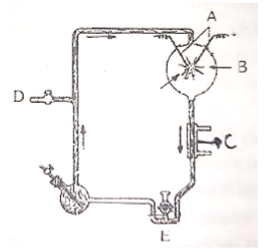
a) A-electrodes, B-NH3 + H2O, C-hot water, D-tap, E-U trap
b) A-electrodes, B-NH4 + H2 + CO2 +CH3, Chot water, D-vacuum, E-U trap
c) A-electrodes, B-NH3 + H2 + H2O +CH2, Ccold water, D-vacuum, E-U trap
d) A-electrodes, B-NH3 + H2 + H2O +CH4, Csteam, D-vacuum, E-U trap
View AnswerAns. c) A-electrodes, B-NH3 + H2 + H2O +CH2, Ccold water, D-vacuum, E-U trap
9. In a particular climatic condition, decomposition rate is slower if:
a) Detritus is rich in sugars.
b) Detritus is rich in lignin and chitin.
c) Detritus is rich in humus.
d) Detritus is rich in nitrogen.
View AnswerAns. b) Detritus is rich in lignin and chitin.
10. Given below is a pedigree chart of a family with five children. It shows the inheritance of attached ear lobes as opposed to the free ones. The squares represent the male individuals and circles the female individuals. Which one of the following conclusions drawn is correct?
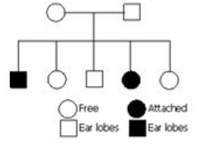
a) The parents are homozygous recessive
b) The parents are heterozygous
c) The trait is Y-linked
d) The parents are homozygous dominant
View AnswerAns. b) The parents are heterozygous
11. α – interferon acts as
a) Allergen
b) Carcinogen
c) Sedative
d) Biological response modifier
View AnswerAns. d) Biological response modifier
12. An interesting property of restriction enzymes is molecular cutting and pasting. Restriction enzymes typically recognize a symmetrical sequence of DNA.

Notice that the top strand is same as the bottom strand, but reads backward. When the enzyme cuts the strand between G and A, it leaves overhanging chains:
a) Jointed end
b) Both sticky & blunt ends
c) Sticky ends
d) Blunt ends
View AnswerAns. d) Blunt ends
13. Assertion (A): Generally, a woman does not conceive during the lactation period.
Reason (R): The hormone ‘prolactin initiates and maintains lactation in a postpartum woman
a) Both A and R are true and R is the correct explanation of A.
b) Both A and R are true but R is not the correct explanation of A.
c) A is true but R is false.
d) A is false but R is true.
View AnswerAns. b) Both A and R are true but R is not the correct explanation of A.
14. Assertion: Organ transplantation patients are given immunosuppressive drugs.
Reason: Transplanted tissue has antigens, which stimulate the specific immune response of the recipient.
a) Assertion and reason both are correct statements and reason is correct explanation for assertion.
b) Assertion and reason both are correct statements but reason is not correct explanation for assertion.
c) Assertion is correct statement but reason is wrong statement.
d) Assertion is wrong statement but reason is correct statement.
View AnswerAns. a) Assertion and reason both are correct statements and reason is correct explanation for assertion.
15. Assertion (A): The rate of decomposition is controlled by the chemical composition of detritus and climatic factors.
Reason (R): Warm and moist environment does not favour decomposition.
a) Both A and R are true and R is the correct explanation of A.
b) Both A and R are true but R is not the correct explanation of A.
c) A is true but R is false.
d) A is false but R is true.
View AnswerAns. c) A is true but R is false.
16. Assertion: Gene flow increases genetic variations.
Reason: The random introduction of new alleles into the recipient population and their removal from the donor population affects allele frequency.
a) Assertion and reason both are correct statements and reason is correct explanation for assertion.
b) Assertion and reason both are correct statements but reason is not correct explanation for assertion.
c) Assertion is correct statement but reason is wrong statement.
d) Assertion is wrong statement but reason is correct statement.
View AnswerAns. b) Assertion and reason both are correct statements but reason is not correct explanation for assertion.
Section B
17. Sangeeta has developed a transgenic crop. She wants to grow this crop directly into the field. Will you allow her to do so? What will you suggest her?
View AnswerAns. No, as GMO may pose some threat to environment or living organism. I will ask her to approach GEAC as GEAC is responsible for approval of proposals relating to release of genetically engineered organisms and products into the environment including experimental field trials.
Values
• Sense of responsibility.
• Understanding.
18. Read the sequence of the nucleotides in the given segment of mRNA and the respective amino acid sequence in the polypeptide chain.

Polypeptide: met-phe-met-proline-valine-serine
i. Provide the triplet of bases (codon) for
a. valine
b. proline
View AnswerAns. Valine: GUU, Proline: CCU
ii. Write the nucleotide sequence of the DNA strand from which this mRNA was transcribed
View AnswerAns. Nucleotides of DNA strand: TAC AAA TAC GGA CAA AGA ATT
iii. What does the last codon of this RNA stand for?
View AnswerAns. UAA: Stop
19. In the diagram given below, show the path of a pollen tube from the pollen on the stigma into the embryo sac. Name the components of egg apparatus.
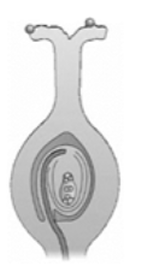
Ans.
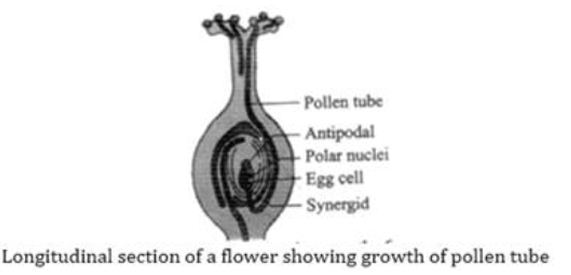
Synergids and egg cell are the components of egg apparatus.
20. Identify A, B, C and D with reference to gametogenesis in humans, in the flow chart given below.
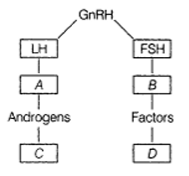
Ans. A- Leydig’s cell
B- Sertoli cell
C- Spermatogenesis (Formation of sperms)
D- Spermiogenesis (Transformation of spermatid into sperm)
21. How has the bacterium Bacillus thuringiensis helped us in controlling caterpillars of insect pests?
View AnswerAns. Bacillus thuringiensis produces an endotoxin which when ingested and released in the gut of the larvae of insect pest disrupts its gut lining and thus caterpillars are killed. By killing the caterpillars, it helps in pest control.
OR
What is LAB? What is its role in human stomach?
View AnswerAns. Lactic Acid Bacteria (LAB) or Lactics constitute a diverse group of microorganisms associated with plants, meat, and dairy. They are used in the manufacture of dairy products such as acidophilus milk, yogurt, buttermilk, and cheeses.
Role of LAB in human stomach:
lactic acid bacteria have a number of well-established benefits. They can improve lactose digestion, play a role in preventing and treating diarrhea and act on the immune system, helping the body to resist and fight infection. It play a very beneficial role in checking disease-causing microbes
Section C
Observe the diagram of Genetic code and answer the following questions:
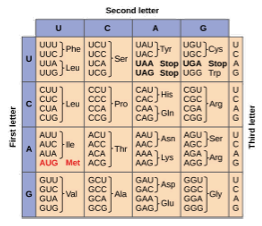
i. How many codons codes for amino acids and how many do not?
View AnswerAns. Out of 64 codons 61 code for amino acids and rest 3 codons do not code for any amino acids. These function as stop codons.
ii. Explain the following giving one example of each.
a. Unambiguous and specific codon
View AnswerAns. Unambiguous and specific codon These code for only one amino acid, thus, making the genetic code unambiguous and specific e.g. UUU
b. Degeneration codon
View AnswerAns. Some amino acids are coded by more than one codon, so the code is degenerate, e.g. serine is coded by 6 codons.
c. Universal codon
View AnswerAns. The codon is nearly universal. Some exceptions to the rule are mitochondrial codon and in some protozoans, e.g. UUU.
d. Initiator codon
View AnswerAns. Initiator codon AUG has a dual function. It codes for methionine and also acts as an initiator.
23. Define and design a test cross.
View AnswerAns. Test cross: A cross in which an individual with an unknown dominant phenotype is crossed with a recessive individual for that trait. So it is helpful in knowing the genotype (whether it is homozygous or heterozygous for the dominant trait) of an unknown individual.
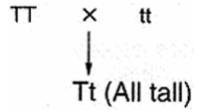
Condition I: If the unknown is homozygous tall (TT) then crossing with dwarf recessive (tt) gives all tall offsprings (Tt).
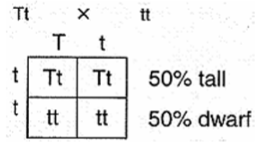
Condition II: If the unknown is heterozygous tall (Tt), then crossing with dwarf results in 50% tall (Tt) and 50% dwarf (tt) progeny.
24. Define the following terms and give one example for each:
a. Commensalism
View AnswerAns. Commensalism: In ecology, commensalisms is a class of relationship between two organisms where one organism benefits but the other is unaffected.
b. Parasitism
View AnswerAns. Parasitism: It is a relationship between two organisms where the larger animal is at harm and the smaller animal is benefited.
c. Camouflage
View AnswerAns. Camouflage: Camouflage is a method of crypsis – avoidance of observation – that allows an otherwise visible organism or object to remain indiscernible from the surrounding environment through deception. The best example of camouflage is shown by the garden lizard which changes its colour as per its surroundings.
d. Mutualism
View AnswerAns. Mutualism: It is relationship between two organisms where both organisms are benefited. For example, some birds pick worms and insects from big animals skin to get food. This helps the bigger animal to get rid of insects and worms.
e. Interspecific competition
View AnswerAns. Interspecific competition: Interspecific competion, in ecology, is a form of competition in which individuals of different species compete for the same resource in an ecosystem (e.g. food or living space).
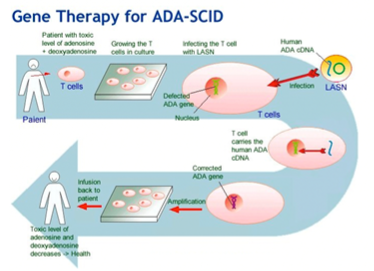
25. This image highlights the process of Gene Therapy of ADA-SCID.
i. Mention the cause of ADA deficiency in humans.
View AnswerAns. Deletion of the gene for ADA in an individual leads to ADA deficiency disorder Adenosine Deaminase (ADA) enzyme is crucial for immune system to function.
ii. How has genetic engineering helped patients suffering from it?
View AnswerAns. Gene therapy is helpful in the treatment of ADA deficiency. The treatment involves the following steps:
a. Lymphocytes from the blood of patient are grown on a culture outside the body.
b. A functional ADA, cDNA (using a retroviral vector) is then introduced into these lymphocytes.
c. Such genetically engineered lymphocytes are returned to the blood of patient.
d. Periodic infusion of such genetically engineered lymphocytes is required by the patient.
26. A species-area curve is drawn by plotting the number of species against the area. How is it that when a very large area is considered the slope is steeper than that for smaller areas?
View AnswerAns. When we consider a large area to assess the species-area curve, we need to understand the advantages offered by the large areas. A larger area means more resources and a higher number of plants. This will provide more food to sustain more individuals. Thus, species richness increases with an increase in the explored area. This explains the occurrence of the steeper slope when we draw the species-area curve for a large area.
OR
What does the term genetic diversity refer to? What is the significance of large genetic diversity in a population?
View AnswerAns. The term genetic diversity refers to the diversity of genes within a species. It is important for the following reasons:
(i) Greater the genetic diversity among organisms of a species, the more chances it has in surviving environmental perturbations.
(ii) Species with higher genetic variations tend to be more resistant to diseases. They also show greater adaptibility to changing environmental conditions. On the other hand, genetically uniform populations are highly prone to diseases and harsh environment.
27. i. Why is the collection of white-winged moths and dark-winged moths made in England between 1850 – 1920 considered a good example of natural selection?
View AnswerAns. During the pre-industrialisation all the white-winged moths survived due to white coloured lichens on trees, but during postindustrialisation, white-winged moths were unable to survive as predators could spot the moth against contrasting background, and the dark-winged moths survived, this showed that in a mixed population of white and dark-winged moths those who can adapt better will survive.
ii. Evolution is based on chance events in nature and chance mutations in organisms. Justify the statement.
View AnswerAns. The excess use of herbicides and pesticides has resulted in the selection of resistant varieties that developed due to the chance or random mutation.
28. Prabha has seen huge garbage dumps outside your school which are not being regularly disposed of by MCD. Prabha discusses the problems with school mates and decide to organize rally to spread awareness among local people about public hygiene.
• Prepare two slogans for rally
• Name any two infectious diseases which may spread due to such unhygienic conditions at public place
View AnswerAns. 1) (i) Brush your teeth every day, To keep the doctor away.
(ii) Take care of your body, it’s the only place you have to live.
2) Diseases like typhoid and amoebiasis.
Values
• Responsibility.
• Sensitivity towards public. Hygiene
• Problem solving.
Section D
Read the following text carefully and answer the questions that follow:
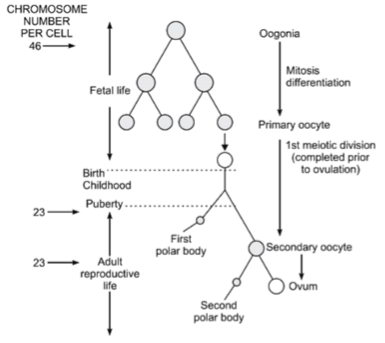
The process of formation of a mature female gamete is called oogenesis which is markedly different from spermatogenesis. A schematic representation of Oogenesis is shown below study the flow chart carefully.
i. How is a primary oocyte different from a secondary oocyte?
View AnswerAns. The primary oocyte is a diploid cell whereas secondary oocyte is a haploid cell. The primary oocyte is formed when oogonia are at the prophase-I of the meiotic division in the foetal ovary whereas secondary oocyte is formed from primary oocyte after meiosis – I division to produce ova in females during the stage of puberty.
ii. Mention the changes taking place during the transition of a secondary follicle to Graafian follicle in the oogonia.
View AnswerAns. The secondary follicle is then transformed into a tertiary follicle characterized by antrum, which is a fluid-filled cavity. At this phase, the primary oocyte grows in size inside the tertiary follicle to complete the first meiotic division. The tertiary follicle finally transitions to form the Graafian follicle.
iii. How many primary follicles are left in each ovary in a human female at puberty?
View AnswerAns. large number of primary follicles degenerate in females during the period from birth to puberty by the process called follicular atresia. As a result, about 60000-80000 primary follicles are left in each ovary at puberty.
OR
What happen to graafuan follicle after ovulation?
View AnswerAns. After ovulation, the remaining cells of Graafian follicle are stimulated by LH to develop corpus luteum (an endocrine gland which secrete progesterone hormone).
30. Read the following text carefully and answer the questions that follow:
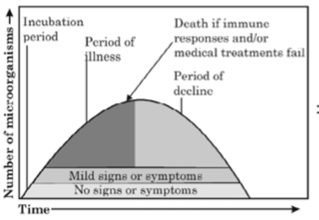
When a microorganism invades a host, a definite sequence of events usually occur leading to infection and disease, causing suffering to the host. This process is called pathogenesis. Once a microorganism overcomes the defense system of the host, development of the disease follows a certain sequence of events as shown in the graph. Study the graph given below for the sequence of events leading to appearance of a disease and answer the questions that follow:
i. In which period, according to the graph there are maximum chances of a person transmitting a disease/infection and why?
View AnswerAns. Period of illness: The number of disease-causing microorganisms reaches its maximum during the period of illness so, there are maximum chances of a person transmitting a disease/infection at this stage.
ii. Study the graph and write what is an incubation period. Name a sexually transmitted disease that can be easily transmitted during this period. Name the specific type of lymphocytes that are attacked by the pathogen of this disease.
View AnswerAns. Time period between infection and appearance of its symptoms is known as incubation period. AIDS/any other correct example T lymphocytes are attack by the pathogen of this disease.
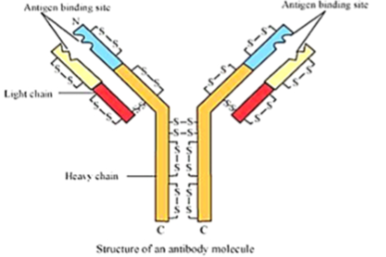
iii. Draw a schematic labelled diagram of an antibody.
View AnswerAns.
OR
In which period, the number of immune cells forming antibodies will be the highest in a person suffering from pneumonia? Name the immune cells that produce antibodies.
View AnswerAns. Period of illness
B lymphocytes/B cells produces antibodies.
Section E
31. Draw a labelled diagram of the sectional view of a mature pollen grain of angiosperms. Explain the function of any two of its parts.
View AnswerAns.
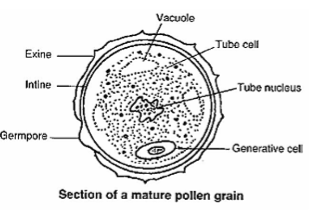
OR
Study the diagram given below showing the modes of pollination. Answer the questions that follow.
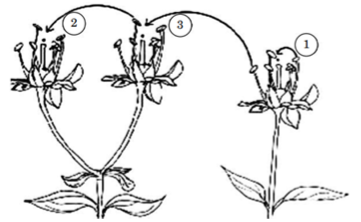
i. The given diagram shows three methods of pollen transfer in plants. What are the technical terms used for pollen transfer methods 1, 2 and 3?
View AnswerAns. The three method of pollen transfer in plant are
1. Autogamy
2. Geitonogamy
3. Xenogamy
ii. How do the following plants achieve pollination successfully?
View AnswerAns. 1. Water lily: achieve successfully pollination by insects/wind.
2. Vallisneria: Female flowers on long stalks reach water surface male flowers or pollen released on water and carried by water current to female flowers to achieve pollination.
iii. Flowering plants have developed many devices to avoid inbreeding depression. Explain one hereditary and one physiological device which helps plants to achieve this target.
View AnswerAns. Genetic: Self-incompatibility/prevents self-pollen (same flower or other flowers of same plant) from fertilizing the ovules by inhibiting pollen germination, pollen tube growth in pistil. Physiological: Pollen release and stigma receptivity are not synchronized, either pollen matures earlier and stigma later or pollen matures later than stigma.
32. Define an operon. Giving an example, explain an Inducible operon.
View AnswerAns. Ans. A functioning unit of genomic DNA containing a cluster of genes under the control of a single promoter is called an operon. An operon is generally transcribed into polycistronic mRNA. A single mRNA which codes for more than one protein is called polycistronic mRNA. An operon is made up of 3 basic DNA components:
i. Promoter: A nucleotide sequence that enables a gene to be transcribed is called a promoter. It is recognized by RNA polymerase, which then initiates transcription.
ii. Operator: A segment of DNA to which a repressor binds is called the operator.
iii. Structural genes: The genes that are co-regulated by the operon are called structural genes. Inducible Operon: When the operon is regulated by an inducer, it is called an inducible operon. An inducer can switch on or off the operon. Lac operon is an example of an inducible operon. Lactose is a substrate of enzyme beta-galactosidase and is the inducer of the lac operon.
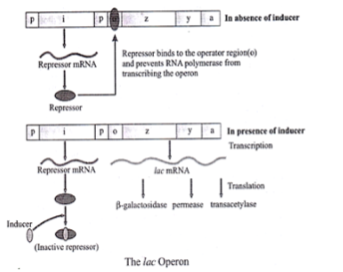
The given diagram shows the working of the lac operon. In the absence of an inducer, the repressor binds to the operator region and prevents transcription.
In the presence of an inducer, repressor becomes inactive. This allows transcription in the operator region which results in the release of mRNA. Subsequently, mRNA promotes translation and protein synthesis is accomplished.
[/expand]OR
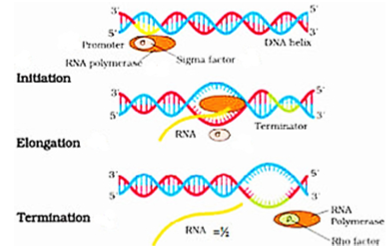
Explain the process of transcription in prokaryotes.
View AnswerAns. Process of transcription in Prokaryotes are as follows
DNA – dependent RNA polymerase that catalyses the process of transcription, three steps: initiation, elongation, and termination, Initiation: RNA polymerase binds to promoter, associated with initiation – factor ( ) at 5’ end of DNA, Elongation: nucleoside phosphates serve as substrate following the rule of complementarity, RNA polymerase help in opening the helix and continuous elongation, Termination: Terminator factor ( ), nascent RNA falls off along with RNA polymerase
33. Recombinant DNA (rDNA) is a technology that uses enzymes to cut and paste together DNA sequences of interest. The recombined DNA sequences can be placed into vehicles called vectors that ferry the DNA into a suitable host cell where it can be copied or expressed.
i. A bacterial cell is shown in the figure given below. Label the part ‘A’ and ‘B’. Also, mention the use of part A in rDNA technology.
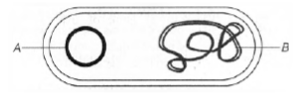
Ans. In the above bacterial cell, i.e. A is plasmid B is chromosomal DNA. The plasmid is used as a vector in rDNA technology.
ii. Suppose a linear DNA fragment and a plasmid has three restriction sites for EcoRl. How many fragments will be produced from linear DNA and plasmid, respectively?
View AnswerAns. If the enzyme EcoRl acts on both linear DNA and plasmid DNA, each having three recognition sites, the restriction enzyme will generate 3 fragments from plasmid DNA (as it is circular) and 4 fragments from linear DNA.
OR
For the selection of recombinants, insertional inactivation of the antibiotic marker has been superseded by insertional inactivation of a marker gene coding for a chromogenic substrate. Give reasons.
View AnswerAns. Selection of recombinants due to inactivation of antibiotics is a laborious process as it requires:
i. a vector with two antibiotic resistance marker. ii. preparation of two kinds of media plate with one antibiotic each. Transformed cells are first plated on that antibiotic plate which has not been insertional inactivated (ampicillin) and incubated overnight for growth of transformants. For the selection of recombinants, these transformants are Replica plated on second antibiotic (tetracycline) plate (which got inactivated due to insertion of a gene). Non-recombinants grow on both the plates (one carrying ampicillin and the other carrying tetracycline) while recombinants will grow only on ampicillin plate. This entire exercise is laborious and takes more time (two overnight incubation) as well. However. if we choose the second option (insertional inactivation of a marker that produces colour in the presence of a chromogenic compound), we can distinguish between the recombinants and nonsubstrate recombinants on a single medium plate (containing one antibiotic and the chromogenic compound) after overnight growth.