Class XI
Physical Education
General Instructions:
1. The question paper consists of 5 sections and 37 Questions.
2. Section A consists of questions 1-18 carrying 1 mark each and are multiple choice questions. All questions are compulsory.
3. Section B consists of questions 19-24 carrying 2 marks each and are very short answer types and should not exceed 60-90 words. Attempt any 5.
4. Section C consists of questions 25-30 carrying 3 marks each and are short answer types and should not exceed 100-150 words. Attempt any 5.
5. Section D consists of questions 31-33 carrying 4 marks each and are case studies. There is internal choice available.
6. Section E consists of questions 34-37 carrying 5 marks each and are long answer types and should not exceed 200-300 words. Attempt any 3.
SECTION— A
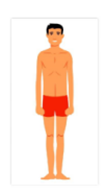
1. Identify the type of personality in figure:
(a) Mesomorph
(b) Endomorph
(c) Ectomorph
(d) None of these
Ans. (c) Ectomorph
2. Which term is used to describe alternate nostril breathing in yoga ?
(a) Kapalabhati
(b) Anulom-Vilom
(c) Bhramari Pranayama
(d) Sheetali Pranayama
Ans. (b) Anulom-Vilom
3. In which of the sports is LED lights technology is used in stumps?
(a) Tennis
(b) Cricket
(c) Badminton
(d) Football
Ans. (b) Cricket
4. Which of the following is not Disability etiquette ?
(a) Avoid asking personal questions
(b) Use a normal tone of voice
(c) Listen attentively
(d) Pretending to understand
Ans. (d) Pretending to understand
5. Given below are the two statements labeled Assertion (A) and Reason (R) :
A: Endurance isthe ability to do physical movements with desired quality and speed under conditions of fatigue.
R: It is very important component for games and sports like middle and long distance races. In the context of above two statements, which one of the following is correct ?
(a) Both (A) and (R) are true and (R) is the correct explanation of (A).
(b) Both (A) and (R) are true, but (R) is not the correct explanation of (A).
(c) (A) is true, but (R) is false.
(d) (A) is false, but (R) is true.
Ans. (a) Both (A) and (R) are true and (R) is the correct explanation of (A).
6. The term flexion refers to :
(a) bending
(b) turning
(c) twisting
(d) straightening
Ans. (a) bending
7. Which of the following is NOT a part of the Pre-Planning for Test Administration ?
(a) Warm up
(b) Define the purpose of the test
(c) Availability of necessary equipment and facilities
(d) Selecting the appropriate test
Ans. (a) Warm up
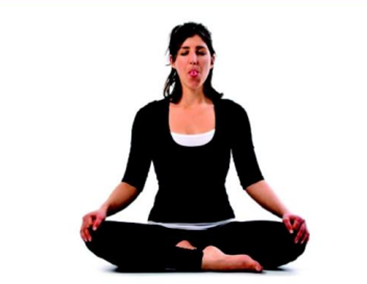
8. Identify the Pranayama as shown in figure :
(a) Sheetali Pranayama
(b) Sitkari Pranayama
(c) Surya Bhedi Pranayama
(d) Bhramari Pranayama
Ans. (a) Sheetali Pranayama
9. Match the following :
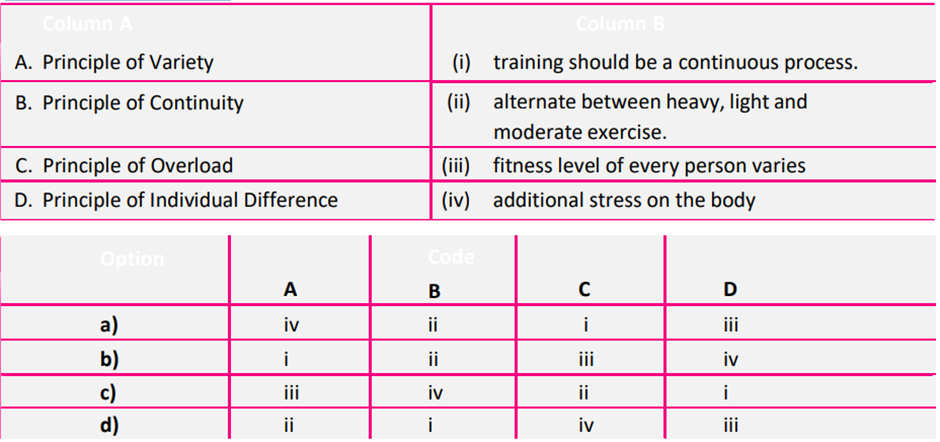
Ans. (d)
10. Given below are the two statements labeled Assertion (A) and Reason (R) : .
A : Adolescence is a period through which a growing person makes a transition from childhood to maturity.
R : It is also a period which leads to turbulence and it is often seen in behavioral changes. In the context of above two statements, which one of the following is correct ?
(a) Both (A) and (R) are true and (R) is the correct explanation of (A).
(b) Both (A) and (R) are true, but (R) is not the correct explanation of (A).
(c) (A) is true, but (R) is false.
(d) (A) is false, but (R) is true.
Ans. (a) Both (A) and (R) are true and (R) is the correct explanation of (A).
11. Which of the following is considered as characteristic of team cohesion?
(a) Members seeing themselves as one rather than collection of individuals
(b) Members of group having their own objectives
(c) Members hold hidden agenda
(d) Members quarrelling with each other
Ans. (a) Members seeing themselves as one rather than collection of individuals
12. When was Fit India Movement launched ?
(a) On 28th August 2018
(b) On 29th August 2019
(c) On 28th August 2020
(d) On 29th august 2021
Ans. (b) On 29th August 2019
13. SAI Stands for ……………. .
(a) Sports Appointment of India
(b) Sports Academic of India
(c) Sports Authority of India
(d) Sports Accreditation of India
Ans. (c) Sports Authority of India
14. The performance enhancement drug generally used by boxers and judo players to reduce their weight is :
(a) Diuretic
(b) Peptide hormone
(c) Anabolic steroid
(d) Beta-2 agonist
Ans. (a) Diuretic
15. There are currently………………NOCs.
(a) 204
(b) 205
(c) 206
(d) 207
Ans. (c) 206
16. The kinematics analyses motion in terms of :
(a) Time
(b) Displacement
(c) Velocity
(d) All of the above
Ans. (d) All of the above
17. The principal organ of respiration is :
(a) Nose
(b) Larynx
(c) Trachea
(d) Lungs
Ans. (d) Lungs
18. Which of the following is NOT a component of Wellness ?
(a) Physical
(b) Cosmetic
(c) Mental
(d) Occupational
Ans. (b) Cosmetic
SECTION—B
19. What is the full form of NCTE ?
Ans. The full form of NCTE is National Council of Teacher Education (NCTE)
20. What do you mean by yoga sutra ?
Ans. The Yoga Sutra is widely regarded as the authoritative text on yoga. It is a collection of aphorisms, outlining the eight limbs of yoga. Yoga Sutra was written by sage Patanjali. These sutras offer guidelines for living a meaningful and purposeful life.
21. What do you mean by Intellectual Disability ?
Ans. The term intellectual disability generally refers to a reduced capacity of a person to learn tasks or process information. An intellectual disability is characterised by an IQ below 70 (the median IQ is 100). On the basis of IQ, children with intellectual disabilities can be classified as mild (IQ 50-55 to 70-75), moderate (IQ 35-40 to 50-55), Severe (IQ 20-25 to 35-40) and profound (IQ below 20-25).
22. What are Endomorphs ?
Ans. The endomorph body type is solid and generally soft. Endomorphs gain fat very easily. Endomorphs are usually of a shorter build with thick arms and legs. Muscles are strong, especially the upper legs. When it comes to training endomorphs find it very easy to gain weight.
23. Define Angular movement.
Ans. Angular Movement occurs between the long bones causing a change in the angle between the two bones. The angle either increases or decreases. Various angular movements are flexion, extension, abduction and adduction.
24. Write one basic difference between Task Cohesion and Social Cohesion.
Ans.
| Task Cohesion | Social Cohesion |
| It refers to the level of unity of a team in task performance. | It refers to the level of unity of a team in social aspects |
| Example : Teamwork and task completion within sports such as working together to win a championship. | Example : Social support and friendships outside of sports. |
SECTION—C
25. What is the aim of Physical Education ?
Ans. Aims of Physical Education
Physical Education means “education through movement”. It aims to maximize our physical ability, leading us to be healthy, knowledgeable, skillful, creative, productive and influential in all areas of life.
According to the Ministry of Education and National Planning of Physical Education and Recreation, “The aim of PE must be to make every child physically, mentally and emotionally fit and also to develop in him such personal and social qualities as will help him to live happily with others and build him up a good citizen.”
According to Thomas Wood, “Physical education must have an aim as broad as education itself and as noble and inspiring as human life.”
According to J.R. Sherman, “The aim of physical education is to influence the experiences of persons to the extent that each individual within the limits of his capacity may be helped to adjust successfully in society, to increase and improve his wants and to develop the ability to satisfy his wants.”
All the above definitions of physical education emphasize the holistic concept of wholesome development of human personality for complete living as it would lead to their physical, mental, social, intellectual and emotional development. Thus, the aim of physical education and sports is the overall development of human personality so that he is able to withstand the ups and downs of human life & become a respectable citizen of the society.
26. Describe technique of any 2 Yogic Kriyas.
Ans. (i) Kapalabhati
Kriya : Technique :
1. Sit comfortably in Sukhasana.
2. Draw your navel to your spine in a quick motion, forcefully expelling all the air from your lungs. The primary movement is from your diaphragm.
3. Allow your lungs to fill naturally, with no effort.
4. Perform this cycle ten times, then allow your breathing to return to normal and observe the sensations in your body. Repeat these cycles of ten movements three to four times.
(ii) Trataka
Kriya : Technique :
1. Sit in Sukhasana, or in any comfortable position.
2. Sit calmly and breathe normally with your waist, back and neck erect.
3. Keep a lighted candle on a stool or table at a distance of 2 feet from you.
4. The candle should be at eye level.
5. Now, fix your gaze upon the flame and continue to gaze non-stop, without blinking until you feel the strain in your eyes and they start to water.
6. Once this happens, close your eyes.
7. Now rub the palms of both hands vigorously, until warm and place them on your eyes.
8. Visualize the flame at the centre of your eyebrows.
27. Write a short note on traditional games.
Ans. Various traditional games are part and parcel of Indian tradition. India is considered as a place of origin for a number of traditional games which are well-known throughout the world in present time. Traditional Sports and Games provide unique opportunities that mainstream sports may not. They are often based on fun and participation, not competition and provide a link to something bigger than sports and physical activity alone. A number of leading traditional games which had Indian origin are Teerandaji, Kabaddi, kho-kho, Polo, shatranj and Martial Art etc. All these games require technical and tactical skills along-with other physiological components like speed, strength, stamina, agility and coordinative abilities.
28. Differentiate Physiology and anatomy.
Ans. Anatomy examines and describes the structures of living things. Anatomy studies the form, while physiology looks at the function – anatomy looks at what it is, while physiology looks at what it does. For example, an anatomist is concerned with the shape, size, position, structure, blood supply and innervation of an organ such as the liver while a physiologist will be interested in the production of bile and the role of the liver in nutrition and regulating body functions.
Physiology and anatomy are very closely related disciplines; they are intrinsically linked.
29. Write any four points highlighting the importance of Biomechanics in sports.
Ans. Importance of Biomechanics in Sports
1. Analyze and improve the efficiency of competitive performance : Biomechanics provides a systematic approach to understanding the mechanics of human movement, which is essential for analyzing and improving the efficiency of athletic performance. Biomechanics helps coaches and athletes understand the underlying principles of efficient movement and how they can be applied to optimize performance.
2. Better development of motor abilities : Biomechanics plays a crucial role in the development of motor abilities in athletes. By providing a scientific basis for understanding movement, biomechanics helps coaches and trainers design effective training programs that target specific areas for improvement.
3. For diagnostic teaching : Biomechanics is an important tool for teaching and coaching, as it provides a scientific basis for understanding movement and identifying areas for improvement. This information can be used to design and implement effective training programs, which can lead to improved athletic performance.
4. For diagnostic coaching : Biomechanics is also important for diagnostic coaching, as it provides a scientific approach to understanding movement patterns and identifying areas for improvement. By analyzing movement patterns, coaches and trainers can develop effective training programs that target specific areas for improvement.
30. Explain the factorsthat affect Cohesion.
Ans. Factors that affect Cohesion Many factors affect the cohesion that will develop on a team. Such factors include the environment (e.g. social and physical), personal factors (e.g. personality), team factors (e.g. norms) and leadership factors (e.g. styles; Carron, Widmeyer & Brawley, 1985).
1. Similarities of Attitudes and Values : One of the main factors affecting team cohesion is the similarity in attitudes and values among team members. People enjoy and get attached to the people who have similar opinions, beliefs and code of conduct.
2. Size of the Group : Cohesiveness is affected by the size of the group. It decreases as the size of the group increases. When the size of the group increases the interaction with the members becomes more difficult and hence the goal is hampered.
3. Time : When people spend time with each other the more they will get close and hence it strengthens the degree of cohesiveness. By interacting more often, the members are able to learn about each other’s strengths, weaknesses and skills.
4. Inter Dependency : When each member has autonomous action, the cohesiveness between the members of such a group would be less as opposed to the group whose members are doing the procedure and are relying upon each other.
5. Coach Behaviour : Coach’s behaviour plays a major role in team cohesiveness. When a coach develops a close relationship with a few in groups that may cause unhealthy competition amongst members of the group. It is important that coaches reward cooperative behaviour so that the bond grows amongst the team members.
SECTION—D
31. Case Study BMI is considered a very useful test for body composition. People with high BMI are advised to workout and pay attention to their weight with the help of workout and improvement in their dietary habits. Based on this answer the following questions :
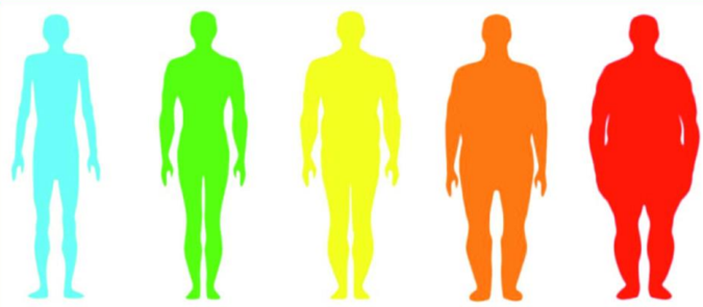
(a) The range for Normal BMI is ……………….. .
Ans. 18.5 – 24.9
(b) 30-34.5 is the range for ……………….. .
Ans. Class I Obesity
(c) A person with BMI 26 is ……………….. .
Ans. Over Weight
(d) A male whose weight is 90kg and height is 1.7m his BMI is ……………………. .
Ans. 31.14
Or
(d) 25.0—29.9 is the range for ………. .
Ans. Over Weight.
32. India is considered as a place of origin for a number of traditional games which are well-known throughout the world in present time. Traditional Sports and Games provide unique opportunities that mainstream sports may not. They are often based on fun and participation, not competition and provide a link to something bigger than sports and physical activity alone.
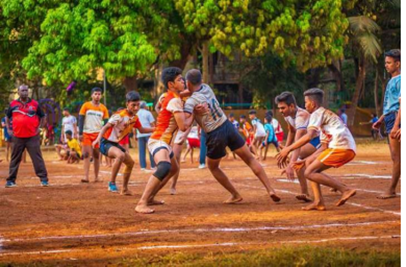
Based on the above, answer the following questions:
(a) is an ancient Indian version of Gymnastics where a gymnast performs aerial yoga and gymnastic posture atop or with a standing pole.
Ans. Mallakhamb
(b) is one of the oldest forms of Indian martial art from Kerala.
Ans. Kalaripayattu
(c) is played between two teams which involves a single player from each team trying to touch down and break into the area of the opponent team.
Ans. Kabaddi
(d) The game of………………. originated in India and in the beginning was called as Ashtapada (sixty-foursquares).
Ans. Chess
Or
(d) ……………….is believed to have originated in India in the 6th century. The game was originally called Pachisi or Chaupar.
Ans. Ludo
33. In Ayurveda, according to tridosha theory, the human body is made up of three basic constituents called tridoshas, which are Vata, Pitta and Kapha. Any imbalance in the constituents in the body leads to diseases. Yoga recommends various purification processes to get and keep the equilibrium of these tridoshas.
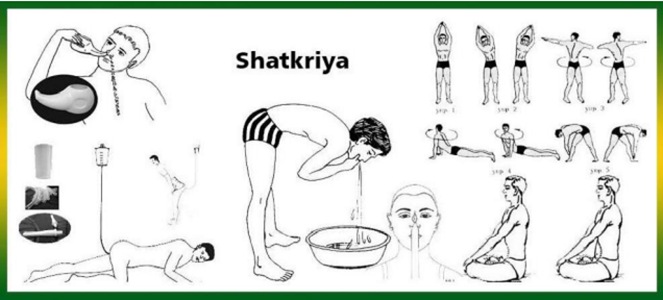
Based on the above, answer the following questions:
(a) The Shat Kriyas or Shatkarma Kriyas are ……………… cleansing techniques typically used in Hatha yoga to balance the three doshas and prepare the mind and body for practice.
Ans. six
(b) is a process of cleaning and purifying the nasal passage.
Ans. Neti Kriya
(c) The word Kapalabhati is made up of two words : kapal meaning “ …………….. ” and bhati meaning “shining, illuminating.
Ans. skull
(d) is the practice of intense gazing at one point or object which develops the power of concentration.
Ans. Trataka
Or
(d) In…………….., the practitioner rinses out the nasal cavity with salted water using a neti pot. It is also known as “nasal irrigation”.
Ans. Jalaneti
SECTION—E
34. Explain what etiquette should one keep in mind while communicating with a person with special needs ?
Ans. Etiquettes for Communicating with People with Disabilities
1. Positive and Energetic Attitude –
• One should approach a person with special needs with positive energy and attitude.
• Approach should be warm and friendly.
• Use a normal tone of voice when welcoming a person with disability.
• One should not show sympathy.
2. Communication –
• Communication should be two way – speaking to the person directly, and not to the person accompanying her/him.
• When introduced to a person with a disability, it is appropriate to offer to shake hands. If the person cannot shake hands, acknowledge them with a smile and a spoken greeting.
• Avoid asking personal questions about someone’s disability.
• Establish a rapport with her/him.
• If necessary, use a communication aid such as a communication book or communication device, if required.
• Keep your tone low.
• Communicate with the individual slowly and clearly.
3. Social Etiquette –
• Make surroundings disabled-friendly and comfortable for people with special needs.
• Do not make assumptions about what they can or cannot do.
• The impact of a specific disability can vary widely from person to person, so help only if it appears to be needed. Just because someone has a disability, don’t assume she needs help.
• If the setting is accessible, people with disabilities can usually get around fine. Adults with disabilities want to be treated as independent people. Offer assistance only if the person appears to need it.
• Never play with their equipment.
• Ask them before offering any help.
• Only ask question about their disability if you know the person.
• Develop a culture of inclusion in surroundings.
4. Physical Etiquette
• The height difference between a person in a wheelchair and an able-bodied person can create an unspoken feeling of superiority and inferiority. Place yourself at eye level in front of the person to facilitate the conversation. To be safe, sit or stand at eye-level with the person who has a disability when it is appropriate and possible.
• Make eye contact; never avoid someone with a disability.
• Some people with disabilities depend on their arms for balance. Grabbing them, even if your intention is to assist, could knock them off balance.
• Avoid patting a person on the head or touching his wheelchair, or cane. The equipment is part of the personal body space of the person who uses it.
35. Explain in detail about the concept of test, measurement and evaluation in physical education and sports.
Ans. Test
Testing is an important element in the field of games and sports. It is an attempt to assess the needs and capacities of the athlete or player, with a view to help and improve the performance. With the help of test, teaching can be determined and progress can be known. But for accurate results from a test, a teacher, coach or trainer must know the present abilities of the athlete or player. A test should be valid, meaning it measures what it is supposed to measure and it should be reliable, meaning it is repeatable. According to Webster’s Dictionary, “ A test is a tool to evaluate the skill, knowledge, capacities or aptitudes of an individual or a group.”
Measurement
Measurement is the use of tests and techniques to get the information about a particular skill or fitness level of an athlete or player. In other words, measurement is a process with the help of various types of tests through which the fitness level, knowledge, ability, behaviour, interest and personality traits etc. of an athlete or player can be measured. Measurements generally result in quantitative data. According to H.M. Barrow, “Measurement refers to the process of administrating a test to obtain quantitative data.”
Evaluation
An evaluation is an appraisal or examination of something to determine its worth or fitness. For example, before you start an exercise programme, get a medical evaluation, to make sure you’re able to handle the activity. According to Tuckman, “Evaluation is a process where in the parts, processes or outcomes of a programme are examined to see whether they are satisfactory, particularly with reference to the programmes stated objectives our own expectations or our own standards of excellence.” Example : A physical education teacher records that a student completes in 20 pushups in 1 minute and reports the score as Good. In this example, Test is Pushups, Measurement is 20 pushups and Evaluation is Good.
36. “Warm up is important for optimum performance”. Justify the statement.
Ans. Warming up does produce physiological changes in the working of a muscle and warming up helps in building a strong and efficient formation for the working of muscles.
The Physiological basis of Warming Up are as follows :
1. Increases the Body Temperature : A proper warming-up increases the body and muscle temperature which helps in the efficiency of contractions and relaxation of muscles. So it has a lot of benefits for the sportspersons. Researches point that if the muscles have been slightly warmed-up just before the beginning of activity the performance is greatly improved. If one fails to do warm-up exercises before vigorous activity it may lead to tearing of muscle fibres
2. Decreases the Resistance in Muscle Capillaries : Researches reveal that warming up decreases the resistance in muscle capillaries and brings the muscles in a state of readiness.
3. Decreases the Viscosity of Muscles : Warming-up decreases the viscosity of muscles. Researches indicate that if a previously inactive muscle is stimulated repeatedly, the first few contractions are often small and irregular and relaxation is incomplete. But once the contractions become stronger, relaxation is complete. It takes place due to decrease in the viscosity of muscles. This leads to faster and efficient rate of muscular contraction and relaxation. It also reduces the occurrence of injury or wear and tear of muscles and ligaments.
4. Increases the Speed of Nerve Impulses : Warming-up increases the speed of nerve impulses, which improves and sharpens the reaction time of sportspersons. Improvement in reaction time is important to sportspersons in most of the games and sports.
5. Increases Metabolic Rate : Warming-up increases the metabolic rate which ultimately improves energy level. In fact, the metabolic rate increases due to rise in core temperature. If there is an increase in temperature by 0.5°C, the metabolic rate increases by 7%. A high metabolic rate leads to higher production of energy.
6. Increases the Speed of Oxygen and Fuel Transfer to Tissues : A proper warming-up increases the speed of oxygen and fuel transfer to tissues. Its occurrence takes place due to the enhancement of blood flow through the muscles by dilating the small blood vessels. Increase in oxygen supply improves the functionality of muscles.
7. Reduces the Blood Lactic Acid : Researches indicate that heart rate and consumption of oxygen are directly related to muscle temperature. If the temperature increases, the heart rate also increases and the consumption of oxygen is also high which reduces the blood lactic acid.
8. Increase in Working Capacity : The above mentioned physiological adaptations increase the capacity of a person to do physical work. All the systems of body become efficient to do their related work.
37. Explain in detail the career options in Physical Education.
Ans. The following career opportunities are available in the field of physical education :
(A) Teaching Career In Physical Education : For choosing teaching as a profession, one must be well qualified with a certified bachelor’s or master’s degree/diploma in physical education from a recognised university. One can become a teacher at Elementary School level, Middle School level, High School and Senior Secondary School level and at the College and University level. The NationalCouncil of Teacher Education (NCTE) hasrecognised the courses which prepare teachers of Physical Education for school system in India. NCTE recognises only three courses for Physical Education Teachers.
1. Diploma in Physical Education (D.P.Ed.).
2. Bachelor of Physical Education (B.P.Ed).
3. Master of Physical Education (M.P.Ed.).
(B) Coaching Career in Physical Education : Coaching career is also a traditional career in physical education. There are a lot of job opportunities which are provided by government organisations like Sports Authority of India (SAI), National Institute of Sports (NIS), Universities, Schools, Colleges etc. Coaches must be responsible enough to conduct practice sessions, matches etc. To become a coach one should obtain :
1. A diploma course in concerned game or sports.
2. Master of Sports (M.S.) degree is an additional qualification for higher level of coaching.
3. One can also have a one year National diploma in sports from N.I.S & a six week certificate course.
(C) Health Related Careers In Physical Education : Nowadays, people have become very health conscious. They want to be healthy & fit. Thus, the opportunities in the Health related careers have grown in the recent years. In the health-related careers one can open up the health clubs, work as a fitness trainer, athletic trainer, yoga trainer, physiotherapist etc. One can also enter into the field of sports medicines, sports nutrition, cardiac rehabilitation etc. To choose this as career one must possess :
1. Certified diploma after 12th class & good fitness abilities.
2. Diploma course in Sports Medicine.
3. D.Y.Ed. —Diploma in Yoga Education.
(D) Administration Related Careers : Owing to increased sports participation & sports related business, there is a need for individuals trained in sports management. For administration related careers one can go for sports administration, management & organisation, sports club management, community recreation management & health club management. One can become the Director of Sports, Assistant Director of Sports, D.S.O (District Sports Officer), A.E.O. (Sports) [Assistant Education Officer (sports)] etc. In India there is no need for separate management qualifications for such post, because it is based on seniority.
(E) Performance Related Careers : Performance related careers are also expanding in India. These careers are as follows :
1. As Players : A large number of sportspersons participate at various levels such as inter school or college level, district level competitions, state level competitions, national level competitions and international level competitions etc.
2. As Officials : There are various officials who are concerned with tournament such as referee/umpire, timekeeper, recorder, scorer etc. The sportspersons can pursue the career as an official for conducting or coaching in the concerned games.
3. As Recorders : One can also start his/her career as a recorder to maintain the record of any sports event.
(F) Careers in Communication Media : A lot of career opportunities are also available in the communication media i.e. television, radio, newspaper, magazines, marketing, selling, event management etc. One can opt for the career in the following fields :
1. Sports Journalism for commentator.
2. Sports Photography.
3. Book Writing.
4. Book Publishing.
5. Sports Industry.
6. Sports Marketing