Class XI Session 2025-26
Subject – English Core
Time Allowed: 3 hours Maximum Marks: 80
General Instructions:
Read the following instructions very carefully and strictly follow them :
1. This question paper has 15 questions. All questions are compulsory.
2. This question paper contains three sections –
Section A : Reading Skills,
Section B : Grammar and Creative Writing Skills
Section C : Literature.
3. Attempt all questions based on specific instructions for each part. Write the correct question number and part thereof in your answer sheet.
4. Separate instructions are given with each question/part, wherever necessary.
5. Adhere to the prescribed word limit while answering the questions.
SECTION A : READING SKILLS (26 marks)
1. Read the text carefully and answer the questions:
It is hard to think of an Indian snack that is not fried. However, we need to be aware of what happens to oil when it is heated. When oil begins to smoke, it is a good indicator that it has been heated too much. At this temperature, chemical changes begin to take place, which has many health risks. Of course, this tricky. It the oil is not hot enough, then more of it is absorbed, and the resultant product is quite soggy and unfit to eat. Further, prolonged heating of oil at high temperature, i.e. at its smoking point, leads to it degradation. A substance called acrolein is formed which can irritate the stomach lining. The oil that has decomposed to acrolein to dark and viscous. Normally this does not happen when food is fried at home. But as oil is expensive we are not willing to put it down the drain after having used it only once. The common tendency is to set aside any oil that is left over to use another time. And repeated use of the same oil guarantees the formation of acrolein with all its undesirable effects.
In fact, some experts suggest that oil should not be held at its smoking temperature for more than 15 minutes at a time. This time span, as everyone knows, is hardly sufficient to prepare poor is for even a small family of four. Sadly, olive and corn oils are not widely available in our markets. Both these oils can be heated to higher temperatures before they start smoking.
Even heart-friendly oils, like those made from sunflower, are also not spared from these effects. Another problem arises when oil is stored under less than satisfactory conditions. If the oil is not stored in an airtight container which, additionally, allows light to pass through, then it will deteriorate further because of the effect of oxygen and light on the oil.
By and large, these undesirable effects result when food is deep-fried. So, eat deep-fried food occasionally. This does not mean we can no longer enjoy the flavour and palatability of fried foods. Some food like tikkis land themselves to both deep and shallow frying. Since every batch of frying requires fresh oil, there is no problem with leftover oil.
The practice of heating small amounts of mustard, black grams chillies and the like in a little oil, before they are added to vegetables and curries, is called tempering. Tempering is not meant solely for flavour but has a nutritional benefit as well.
(a) Complete the sentence by choosing an appropriate option.
________ is a substance that irritates the stomach lining.
i. Acrolein
ii. Sunflower oil
iii. Acetic acid
iv. Corn oil
View AnswerAns. i. Acrolein
(b) Comment on the degradation of oil due to prolonged heating as referred to in paragraph two.
View AnswerAns. Prolonged heating of oil at high temperature, i.e. at its smoking point, leads to it degradation. A substance called acrolein is formed which can irritate the stomach lining. The oil that has decomposed to acrolein to dark and viscous. A repeated use of the same oil guarantees the formation of acrolein with all its undesirable effects.
(c) List any two ways one can opt to delish the flavours of deep-fried foods.
View AnswerAns. Prepare the items in a limited quantity of oil and (ii) eat deep-fried food occasionally.
(Clue: Think about the alternatives to curb its harmful effects)
(d) Select the option that conveys the opposite of ‘undesirable’, from words used in paragraph five.
i. flavour
ii. tempering
iii. palatability
iv. occasional
View AnswerAns. iii. palatability
(e) What is the other consequence of improper storage of oil?
i. Oxidisation of Oil when left in open/improperly stored
ii. Not storing it in air-tight container reduces freshness
iii. Oil used for Deep-frying is super unhealthy
iv. Light passes through it as Oil is transparent
View AnswerAns. i. Oxidisation of Oil when left in open/improperly stored
(f) Based on your understanding of paragraph six, list one major reason as to why tempering is done.
View AnswerAns. i. To add flavours to curries
ii. To bring in nutritional benefits (any one)
(g) Why do we have a tendency of reusing the oil once used?
View AnswerAns. Since oil is expensive we are not willing to put it down the drain after having used it only once. The common tendency is to set aside any oil that is left over to use another time.
(h) Complete the given sentence with an appropriate inference, with respect to the following:
According to the writer, a few healthy oils that can be heated to higher temperatures before they start smoking are not widely available in our markets. These oils are ________.
Ans. live and corn oils
(i) What happens to oil when it is heated?
i. It begins to smoke
ii. Chemical Changes start taking place
iii. If not heated enough, more of it is absorbed
iv. Over-heating leads to its degradation
View AnswerAns. ii. Chemical Changes start taking place
(j) Select the most suitable title for the above passage.
i. Fried Food and its effects
ii. Effect of Oil in Indian Snacks
iii. Indian snack – A Story Fried Food
iv. Oil in Junk Food
View AnswerAns. ii. Effect of Oil in Indian Snacks
2. Read the text carefully and answer the questions:
1. January 26 is celebrated as Republic Day in our country. It was on this day, in 1950, the new constitution of independent India came into force and India became a democratic republic. The Constituent Assembly headed by Dr. Rajendra Prasad, with Dr. B.R. Ambedkar as the Chairman of the Drafting Committee, took more than two years to bring the world’s lengthiest constitution to its final shape.
2. The enormous task before the Constituent Assembly was to frame the basic law that would formalize India as a truly democratic nation. Democracy is aptly defined as a system of Government by the people, for the people and of the people. The founding fathers of the Constitution, therefore, had to ensure that the basic law of the land contained sufficient provisions for the fulfilment of the democratic aspirations of the people of India not only in the political sphere but also in the social and economic spheres. That explains the inclusion of a separate part in the Constitution, called the Directive Principles of State Policy.
3. These principles signify the fact that the framers of the Constitution were well aware of the wide gaps and inequalities that existed among the various sections of the Indian population. The Constitution makers had the wisdom to appreciate that political democracy is meaningless when an overwhelming majority of the population is historically trapped in poverty, illiteracy, ill-health and superstition. The Central and State Governments were expected to frame policies so that every citizen is assured of a decent living standard irrespective of sex, caste, religion, language and region.
4. The makers of our Constitution describe India as a Union of States and not as a federation. Being well conversant with the diversity of the nation in terms of the language, religion, caste and region, and its implications on the intended socio-economic development of the country as a whole, the makers of the Constitution opted for a political system in which the Central Government is equipped with overwhelming administrative, legislative and financial muscle. Most of the nations’ policies and programmes for socioeconomic development originate at the Central Government, and the responsibility for their successful implementation is entrusted to the states.
(a) Infer one reason for the following, based on information in paragraph 1.
26 January was chosen as the date for Republic day.
View AnswerAns. January 26 is celebrated as Republic Day in our country because it was on this day, in 1950, the new constitution of independent India came into force and India became a democratic republic.
(b) Select the appropriate option to fill in the blanks. From paragraph 4, we can infer that our Constitution refers to India as a _________ rather than a __________.
(1) Democratic
(2) Federation
(3) Nation-state
(4) Union of States
(5) Secular
a. 2,4
b. 3,1
c. 4,2
d. 4,5
View AnswerAns. c. 4,2
(c) Complete the following analogy correctly with a word/ phrase from paragraph 1. Constituent Assembly: Dr. Rajendra Prasad :: Drafting Committee: ____________.
(Clue: Dr. Rajendra Prasad was the head of Constituent Assembly, similarly ____________ was the chairperson of Drafting Committee)
View AnswerAns. Dr. B.R. Ambedkar
(d) Select the correct option to complete the following sentence. _______________________were well aware of the wide disparities and inequalities that existed among the various sections of the Indian population. (Paragraph 3)
a. Indian Constitution demonstrates that the framers of the Directive Principles of State Policy
b. Universal Adult Franchise demonstrates that the framers of the voting laws
c. January 26 demonstrates that the framers of the Indian Constitution
d. Directive Principles of State Policy demonstrate that the framers of the Indian Constitution
View AnswerAns. d. Directive Principles of State Policy demonstrate that the framers of the Indian Constitution
(e) Which of the following pictures is associated with the Constituent Assembly?
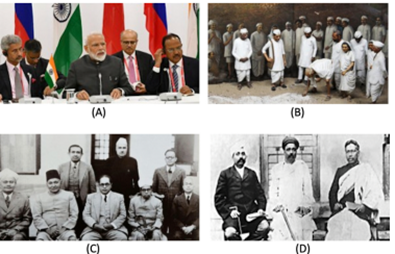
Ans. (c)
(f) Fill in the blank by selecting the correct option. ________ is equipped with overwhelming administrative, legislative and financial muscle.
a. State Government
b. Constitution
c. Central Government
d. Supreme Court
View AnswerAns. c. Central Government
(g) Substitute the word ‘enormous’ with ONE WORD similar in meaning, in the following, sentence from paragraph 2:
The enormous task before the Constituent Assembly was to frame the basic law that would formalize India as a truly democratic nation.
View AnswerAns. vast, huge, immense, large, extensive. (Any other relevant meaning)
(h) In Paragraph 3, why do you think the founding fathers had the foresight to realize that political democracy is meaningless?
View AnswerAns. The Constitution makers had the wisdom to appreciate that political democracy is meaningless when an overwhelming majority of the population is historically trapped in poverty, illiteracy, ill health, and superstition.
3. Read the following passage carefully:
I. On the evening of 8th November 2016, Prime Minister Narendra Modi made an unprecedented speech on national television which opened the floodgates of Facebook memes and WhatsApp jokes before making way for more serious discussions.
II. All currency notes of denominations Rs.500 and Rs.1000 were to lose legal sanction from midnight. While currency notes of Rs.500 are now to be re-issued, Rs.1000 currency notes will be completely done away with. Additionally, technologically advanced currency notes of denomination Rs.500 and Rs.2000 will be introduced in limited numbers from November 10. However, all notes in lower denomination will remain unaffected. The objective is to curb black money, corruption and terrorism.
III. In his 40-minute address, Modi said that notes of Rs.500 and Rs.1000 would merely be “just worthless pieces of paper”. Modi talked about how India has become the “bright spot” in the global economy and the government’s dedication to fighting against poverty and initiatives towards the participation of the poor in the benefits of economic progress.
IV. The Reserve Bank of India, later in its press conference, said that India remains a cash-based economy Hence the circulation of Fake Indian Currency Notes continues to be a menace. In order to contain the rising incidence of fake notes and black money, the scheme to withdraw these currency notes has been introduced. Several impacts of this decision can be ascertained.
V. Although people with black money obviously stands the most affected, there are several implications that have to be faced by the average middle-class person, farmers, banks and the economy as a whole.
VI. Although there will be an apparent inconvenience to the common man initially, given the short span of time to get these currency notes exchanged or deposited in banks and post offices, he/she is expected to adapt to the new currency system in a reasonable time.
VII. The banks, however, are expected to experience two types of problems. One is the logistical problem of handling all the money in case a large number of people choose the easier way of depositing all their cash in their bank accounts or of providing smaller denomination currency notes in case there is a huge demand for withdraw or exchange.
VIII. The other problem is the managerial difficulty of handling long queues and the overburden of work in the next couple of days. This expectation gave rise to the government’s decision of shutting down banks for public dealings for one day and instead let them deal exclusively with issues relating to deposit or exchange the demonetized currency notes.
IX. In terms of the impact on the economy, there has been speculation about deflation in the economy by one set of people due to expected fall in corruption and black money while the other expects inflation to take place due to speculated increase in investment of Gold, real estate and foreign currency.
X. Narendra Modi’s decision has also had its share of criticisms and concerns already. These span from the inconvenience caused to the common man to the assertion that the plan does not solve the problem at all. The obvious concern raised is of the impending inconvenience which will be caused to common man due to the operation of this decision.
Questions: (5 +3 = 8)
i. On the basis of your understanding of the above passage make notes on it using headings and sub-headings. Use recognizable abbreviations wherever necessary. Give an appropriate title.
View AnswerAns. TITLE: The Objectives of Demonetn.
NOTES:
I. Demonetn. of currency notes
i. Notes of denominations. Rs.500 and Rs.1000 to lose legal sanction.
ii. The abolition of Rs.1000 notes.
iii. Introdn. of Rs.500 and Rs.2000 notes.
iv. The continuation of all notes in lower denomination.
II. Prime minister’s opinion.
i. Notes of Rs.500 and Rs.1000 will prove worthless.
ii. India being a bright spot in the global economy.
iii. Govt, dedicated to fight against poverty.
iv. Paticipn. of people in economic progress.
III. RBI’s opinion
i. The control of fake notes and black money.
IV. Implin. of this decision
i. inconvenience to the common man
ii. adaptation of new currency system
iii. logistical probls. of handling money for banks
iv. huge demand for withdraw or exchange
V. Other probls.
i. Handling long queues
ii. deposit or exchange of demonetized notes
VI. Objectives
i. Fall in
(a) inflation
(b) corruption
(c) black money
Key to Abbreviations
demoneth. Demonetization
introdn. introduction
Govt. Government
paticipn. participation
implin. implication
probls. problems
ii. Write a summary of the above passage in about 80 words.
View AnswerAns. SUMMARY
The notes of denominations Rs.500 and Rs.1000 will lose legal sanctions. The new notes of denominations Rs.500 and Rs.2000 will be introduced very soon. But all notes in lower denominations will remain in circulation. The Prime Minister said that India is a bright spot in the global economy. The government is dedicated to fight against poverty and expects people’s participation in economic progress. RBI thinks that this decision will cheek the fake notes and black money. However, the common men are bound to face some problems, and it will create the logistical problems of handling huge money deposited for banks also. But the govt, is hopeful that this decision will cheek inflation, corruption and black money in the country.
Section B : Grammar (7 Marks)
4. Answer any SEVEN of the following questions: [7]
(a) Sarah _______ (brush) her teeth twice a day. (Fill tense correctly)
View AnswerAns. brushes
(b) He ________ (want) to become an IAS officer. (Fill tense correctly)
View AnswerAns. wants
(c) I didn’t know _________ train to board so I went to the clerk. (where/when/whose/which)
View AnswerAns. which
(d) I was very happy __________ I won a prize. (where/when/whose/which)
View AnswerAns. when
(e) You will be served lunch on the plane by the cabin crew. (Active voice)
View AnswerAns. The cabin crew will serve lunch to you on the plane.
(f) Gold is more expensive than any other metal. (use superlative degree)
View AnswerAns. Gold is the most expensive metal.
(g) disciplined/the/firmly/teacher/the/students (reorder correctly)
View AnswerAns. The teacher firmly disciplined the students.
(h) errors/have/the/they/solved (reorder correctly)
View AnswerAns. They have solved the errors.
Section – B Creative Writing Skills (16 Marks)
5. You are Anil Verma of 257, Moti Nagar, New Delhi. You have just passed B.E. (Electrical) in first division from a prestigious Engineering College. You are in need of a job in or around Delhi. Write an advertisement for the ‘Situation Wanted’ column of The Times of India.
View AnswerAns.

OR
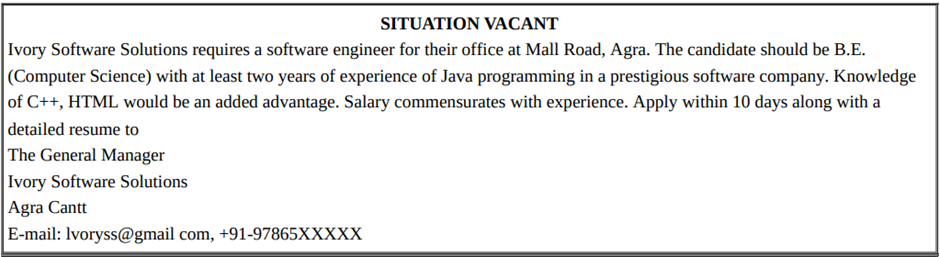
You are General Manager of Ivory Software Solutions, Agra Cantt, Agra. You need a software engineer for your organisation. Draft an advertisement in not more than 50 words to be published in ‘The Times of India’ under the classified columns
View AnswerAns.
6. As President of Lion’s Club of Vasundhra City, design a poster in not more than 50 words for promoting good health through ‘Health Mela’ to be held at Central Community Hall of the city. Mention some of its attractions.
View AnswerAns.

OR
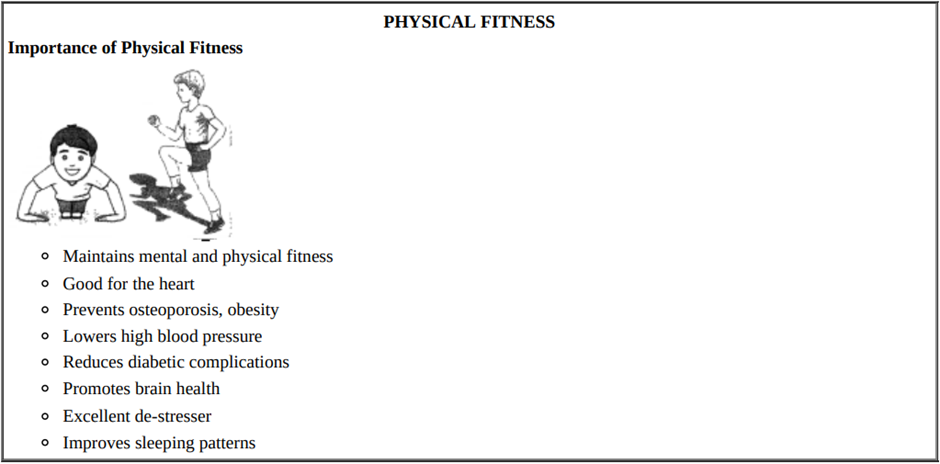
You are a fitness trainer in a health club. Design a poster in not more than 50 words, to emphasise the importance of exercise in maintaining mental and physical fitness. You are Prem/Priya.
View AnswerAns.
7. Mobile phone of today is no longer a mere means of communication. Music lovers are so glued to it that they don’t pay attention even to the traffic while crossing the roads. This leads to accidents, sometimes even fatal ones. Write a speech in 150-200 words to be delivered in the morning assembly advising the students to be careful in the use of this otherwise very useful gadget. Imagine you are Principal of your school.
View AnswerAns.
Don’t Let the Mobile Kill You!
Good morning everyone. Dear teachers, staff members and students, today, I want to advise you to be careful in using your mobile phones, particularly when using headphones or earphones with them.
You might feel silly to think about how a small device such as the mobile phone can kill you. Using such a useful device at the wrong time or wrong place can sometimes lead to disastrous accidents. You might have read in the newspapers last week about the pedestrian who was mowed down by a truck in the city, because he was listening to music on the headphones connected to his mobile handset while crossing the road. He was so absorbed by the music that he did not look on both the sides while crossing and also did not hear the horn of the truck. Similarly, a young man was killed by a train while crossing the tracks, as his headphones shut out the sound and whistle of the approaching train.
I by no means have any intention to scare you all. But what do we learn from these accidents? We learn the simple and easy-tounderstand fact that never use mobile phones, especially with earphones or headphones, when crossing any road, railway line or during regular traffic and driving.
I hope all of you will ensure your own safety in this regard by being careful in the use of this otherwise very useful gadget and spread this word of advice to others too.
Thank you!
OR
A recent health check-up in your school revealed that many among your classmates were suffering from weak eyesight. You feel concerned. Write a speech in 150-200 words to be delivered in the morning assembly on how to protect your eyesight. Make use of the following clues
- reading in bad light
- bad posture
- wrong direction, from which light is coming
- excessive TV viewing
- regular washing of eyes
- eat more green vegetables
- enough sleep
Ans.
Protecting Our Eyesight
Good morning everyone! Honourable Principal Sir, respected teachers and all my dear friends! I, XYZ, have come before you all to remind you about the importance of protecting our eyesight.
Our eyes are two of the most sensitive parts of our body, and we should never take our eyes for granted. But unfortunately, most of us don’t take care of our eyesight unless something drastic happens.
A recent health check-up in our school has revealed that many of our fellow students are suffering from weak eyesight. Reading in bad light, bad posture, wrong direction from which light is coming, excessive TV/computer viewing etc. are some of the factors that can be attributed to it. It is high time we understand the imperative need for protecting our eyes. It starts with the food on our plate. Eating a well-balanced diet and including more green vegetables in our diet is very essential.
To improve our vision is a matter of changing the way we see and use our eyes i.e. bringing a change in our habits. We must make sure never to read in bad light and also that we do not sit in the wrong direction from the source of light. One must avoid watching television excessively, and not spend a long time in front of the computer screen. Regular washing of eyes with filtered water keeps them fresh. Besides, enough sleep and some simple exercises of the eyes are also of much help. By following these simple but necessary steps, we can protect our eyesight and thus show some respect for the wonderful gift of sight which God has bestowed upon us.
Thank you!
8. Some people feel that electronic media (TV news) will bring about the end of print media (newspapers). What are your views on the issue? Write a debate in 150-200 words either for or against this view.
– use of visuals on TV
– not enough news for 24 hours telecast
– become repetitive and dull
– print media-time tested
– editorial comments
– authentic and fast
– may fabricate news
– even scandals become news
– cater to all interests
– analysed, verified news
View AnswerAns.
For the Motion
Respectable jury members, my fellow opponents and the esteemed audience,
Today, I Priyanka, will speak in favour of the motion, ‘Electronic media will bring about the end of print media’. Over the last century, the world has seen a paradigm shift in the means of obtaining news from newspapers to television. Today, the reception of news is constant and on the go due to the arrival of the 24-hour news format. The entire news landscape has changed as we are subjected to the concept of breaking news, i.e. receiving news about an event or occurring, immediately as it happens, and without waiting for the newspaper to arrive the next day with an account of events that would have already been telecasted by then.
The power of visuals on TV has a far wider reach and a more direct impact on the audience, whereas, the print media (newspapers) still depends on some amount of education and comprehension on the part of readers. An image being a direct message which does not need to be read or deciphered hints towards the power and influence of the television medium. TV news strives towards authenticity, covering all vantage points for maximum coverage, and it is delivered fresh and fast. In such a case, it contributes towards the redundancy of the print media.
Thank you!
Against the Motion
Respectable jury members, my fellow opponents and the esteemed audience,
Today, I Priyanka, will speak against the motion, ‘Electronic media will bring about the end of print media’. I am sure everybody must have read the report on the spread of swine flue across the country in this morning’s newspaper. It gave the details of the latest tally of the affected and deaths, besides giving a number of personal stories which are truly heart-rending. Many TV channels, despite covering such items of news, have become repetitive and dull today. All the TV news channels have the same source. There is not enough news to telecast during all the 24 hours of a day. Consequently, some channels of electronic media may even take the liberty to fabricate news on their own, create artificial visuals etc. They even air scandals of Bollywood and politicians to fill their time, labelling them as ‘news’.
In contrast, the print media will only publish the news that has been verified and analysed. Newspapers and magazines also have editorial comments and quotes from eminent people in the field. Thus, they are able to cater to a spectrum of interests. Hence, the print media has its own market and will never die out. Besides, it has taken the test of time and has proved its authenticity, reach to wider audience and trust among the audience time and again.
Thank you!
OR
‘Private cars should be banned in the congested commercial areas of the cities.’ Write a debate in 150- 200 words either for or against the motion.
View AnswerAns.
For the Motion
Respected judges, honorable opponents and friends,
I will speak for the motion, “Private cars should be banned in the congested commercial areas of the cities.’’
The commercial areas of the cities are prone to traffic jams during working hours. This causes problems like incidents of road rage, increase of pollution due to vehicle exhausts, wastage of precious time and congestion etc. Thus, I am in favour of private cars being banned from entering such areas.
Most private cars emit carbon dioxide, various nitrogen oxides and particulate matter from their exhausts as they run on petrol or diesel. These emissions, besides being hazardous to human health, contribute to global warming also. The continuous honking in these areas due to the jams leads to noise pollution. Vehicles of traders as well as their customers occupy the limited parking space in such areas, leading to illicit parking also. This leads to further traffic jams. If private cars are banned from entering commercial complexes, their lands can be put to better use e.g. opening more shops or food outlets for visitors etc.
Thank you!
Against the Motion
Respected judges, honorable opponents and friends,
I will speak against the motion, “Private cars should be banned in the congested commercial areas of the cities”
Our public transport system in cities is not efficient enough to satisfy the needs of the daily commuters in the cities. Freedom of travelling is inhibited when one is at the mercy of public vehicles. Public vehicles have their stops fixed and times of arrival and departure scheduled in way that may not meet the needs of all the commuters. Thus, I am not in favour of banning private cars from entering the congested commercial areas.
Moreover, if traders and their customers use taxis or autos, it will become a very costly affair. Therefore, trade and business will suffer. Retail prices will increase, causing difficulties for the common man.
Thus, both business and the economy will be adversely affected due to such a measure, which we cannot afford. So government should think over some other strategy to overcome the problem of pollution like odd-even rule, which was tried earlier with limited success.
Thus, our economy will blossom and environmental pollution can be contained without putting a ban on cars being plied in congested commercial areas.
Thank you!
Section C : Literature (31 Marks)
9. Read the text carefully and answer the questions:
Yet have I killed
The seed I spent or sown it where
The land is his and none of mine?
We speak like strangers, there’s no sign
Of understanding in the air.
This child is built to my design
Yet what he loves I cannot share.
(a) What does the father feel in the given lines?
a) That he himself should correct the situation
b) That his son is responsible for the situation
c) That he is responsible for the situation
d) That no one can be blamed for the situation
View AnswerAns. c) That he is responsible for the situation
(b) The child is built to my design means that
a) they resemble each other
b) they share their likes and dislikes
c) they share an unbreakable bond
d) their opinions are the same
View AnswerAns. a) they resemble each other
(c) What is the rhyme scheme of the given lines?
a) Ababacc
b) Aabbaac
c) Abcabca
d) Abccbcb
View AnswerAns. d) Abccbcb
OR
Read the text carefully and answer the questions:
And make pure and beautify it;
(For the song, issuing from its birthplace, after fulfilment, wandering
Reck’d or unreck’d, duly with love returns.)
(a) The last two lines are in parentheses. It is so because:
a) It is the poet’s comment on rain’s reply
b) It is different from the rest of the poem
c) It does not to the poem directly
d) The poet had added it later so kept it aloof
View AnswerAns. a) It is the poet’s comment on rain’s reply
(b) Which word from the given extract can be used as a synonym of origin/born?
a) Reck’d
b) Wander
c) Issue
d) Return
View AnswerAns. c) Issue
(c) What is the birthplace of the song?
a) Poet’s mind
b) Poet’s soul
c) Poet’s muse
d) Poet’s heart
View AnswerAns. d) Poet’s heart
10. Read the text carefully and answer the questions:
Further on, where the plains became more stony than grassy, a great herd of wild ass came into view. Tsetan told us we were approaching them long before they appeared. “Kyang,” he said, pointing towards a far-off pall of dust. When we drew near, I could see the herd galloping en masse, wheeling and turning in tight formation as if they were practising manoeuvres on some predetermined course. Plumes of dust billowed into the crisp, clean air.
(a) The pile of dust has been referred in the above extract as
a) Pall
b) Herd
c) Kyang
d) Stony
View AnswerAns. c) Kyang
(b) The phrase more stony than grassy means
a) Terrain had become hilly and terrain now had less greenery
b) Terrain had become hilly
c) Terrain now had less greenery
d) Terrain had become slippery
View AnswerAns. a) Terrain had become hilly and terrain now had less greenery
(c) The synonym of the word manoeuvres is
a) ignorance
b) inactivity
c) stoppage
d) movement
View AnswerAns. d) movement
OR
Read the text carefully and answer the questions:
People said that she had once been young and pretty and had even had a husband, but that was hard to believe. My grandfather’s portrait hung above the mantelpiece in the drawing room. He wore a big turban and loosefitting clothes. His long, white beard covered the best part of his chest and he looked at least a hundred years old.
(a) Who is the author of the above extract?
a) James Harriot
b) Kushwant Singh
c) Gordon Cook
d) Alan east
View AnswerAns. b) Kushwant Singh
(b) Which word in the extract means picture of face?
a) beard
b) portrait
c) turban
d) mantelpiece
View AnswerAns. b) portrait
(c) Which of the following has not been depicted in the portrait?
a) clothes
b) beard
c) ornaments
d) turban
View AnswerAns. c) ornaments
11. Read the given extracts and answer the questions for ANY ONE of the two, given.
(a) Read the following extract and answer the questions that follow:
As he gazed at the still form a shiver of horror passed over Andrew. After all that he had promised! His face, heated with his own exertions, chilled suddenly. He hesitated, torn between his desire to attempt to resuscitate the child, and his obligation towards the mother, who was herself in a desperate state. The dilemma was so urgent he did not solve it consciously. Blindly, instinctively, he gave the child to the nurse and turned his attention to Susan Morgan who now lay collapsed, almost pulseless, and not yet out of the ether, upon her side. His haste was desperate, a frantic race against her ebbing strength. It took him only an instant to smash a glass ampule and inject the medicine. Then he flung down the hypodermic syringe and worked unsparingly to restore the flaccid woman. After a few minutes of feverish effort, her heart strengthened; he saw that he might safely leave her. He swung round, in his shirt sleeves, his hair sticking to his damp brow.
i. What is the “still form” referred to in the extract? Why did ‘a shiver of horror’ pass through Andrew?
View AnswerAns. The “still form” is referred to in the lifeless child. When Susan gave birth to the child, it looked lifeless, and she was in devastating condition. That made a shiver of horror pass through Andrew as he couldn’t decide whom to assist first
ii. Based on your understanding of the given extract, select the option that is NOT true about the doctor.
a. He was confused.
b. He was devasted.
c. His face turned cold.
d. He couldn’t make a conscious decision.
View AnswerAns. c. His face turned cold.
iii. The analogy of Robert Frost’s ‘Road Not Taken’ is an appropriate analogy for Andrew’s state of mind because ________.
View AnswerAns. .. like Frost, Andrew too was in a state of dilemma. The doctor was torn between his two obligations, whether to resuscitate the child or to save the failing mother.
iv. Give one reason why the doctor chose to attend mother first instead of the lifeless child.
View AnswerAns. The doctor’s moral dilemma did not allow him to solve this problem with a conscious decision. With blind instinct, he first gave the child into the nurse’s custody and went on to tend to Susan whose health was deteriorating fast. There was no specific reason for this.
(b) Read the following extract and answer the questions that follow:
That year we lived at the edge of town, on Walnut Avenue. Behind our house was the country: vineyards, orchards, irrigation ditches, and country roads. In less than three minutes we were on Olive Avenue, and then the horse began to trot. The air was new and lovely to breathe. The feel of the horse running was wonderful. My cousin Mourad who was considered one of the craziest members of our family began to sing. I mean, he began to roar.
i. Complete the sentence appropriately.
The phrase ” he began to roar” suggests that ________.
View AnswerAns. The phrase ” he began to roar” suggests that he sang very loudly and cheerfully.
ii. List ant two sensory details present in the extract.
View AnswerAns. Two sensory details present in the extract are:
I. Sense of smell – The air was new and lovely to breathe.
II. Sense of touch – The feel of the horse running was wonderful
iii. Identify a line from the extract that supports the fact that the narrator and his cousin resided in a rural area.
View AnswerAns. A line from the extract that supports the fact that the narrator and his cousin resided in a rural area is, ” Behind our house was the country: vineyards, orchards, irrigation ditches, and country roads.”
iv. What is the central idea of this extract?
A. A boy’s joyful ride with his cousin
B. A boy’s dark secret
C. A boy’s school picnic
D. A boy’s narrow escape from a fatal accident
View AnswerAns. A. A boy’s joyful ride with his cousin
12. Answer the questions from either (a) or (b) in 40-50 words:
(a) i. How advanced technology gives us conclusive evidence of past events?
View AnswerAns. Today technology is so advanced that we can reconstruct the past. For example, we know how Pompeii was destroyed. But now we have reconstructed the whole city. We know precisely how the people lived.
ii. How is the tree transformed during the birds visit? Write the line that shows this transformation.
View AnswerAns. The tree suddenly starts trembling and moving as if a machine has started up. This is due to the arrival of the goldfinch in her nest in order to feed her young ones. The young ones start their chitterings. There is a tremor of wings. The line that shows the transformation is ‘a machine starts up, of chitterings, and a tremor of wings, and trillings-the whole tree trembles and thrills.
(b) i. What did the narrator think of while landing at lie Amsterdam? Why? Answer in context of We are Not Afraid to Die.
View AnswerAns. He thought of his companions. Larry and Herb had remained cheerful and optimistic under the most serious tension. His wife Mary had stayed at the wheel during the crucial hours. His daughter Suzanne did not bother him about her head injury. His son Jonathan was not afraid to die
ii. How did the speaker realize the hypocrisy of the adults? Answer in the context of Childhood
View AnswerAns. The speaker noticed a wide gulf between what adults appeared to be and what they actually were in real life. There was an apparent contradiction between their words and deeds. They talked of love and advised others to love, but they never acted lovingly.
13. Answer ANY ONE of the following three questions, in about 40-50 words
(a) What makes the narrator to Mrs. Dorlings house twice? What was her experience there? Answer in the context of The Address.
View AnswerAns. Mrs. Dorling had taken away all the valuables of her mother for safe-keeping. The narrator wanted to see and touch those things once. In the first visit to Marconi Street, Mrs. Dorling refused to recognise her. In the second visit, it was Mrs. Dorling’s daughter who opened the door. But this time the sight of her ill-arranged things distressed her.
(b) How does Mrs. Pearson teach her children to be responsible adults?
View AnswerAns. First, she scolds them for their guffawing and giggling. Then she has a dig at their lifestyle. They just come in, ask for something, go out again and then return as there’s nowhere else to go. When Doris and Cyril boast of doing their work all day, Mrs. Pearson tells them that she has also done her eight hours. She threatens to have two days off at the weekend.
14. Answer ANY ONE of the following two questions, in about 120-150 words.
(a) How did Rajendra Deshpande apply his theory of catastrophic experience regarding the Battle of Panipat?
View AnswerAns. Gangadharpant narrated to Rajendra his experience at the Azad Maidan meeting. For two days he was in a coma. He had met with an accident. He had now returned to the world he was familiar with. He asked Rajendra to explain where he had spent those days.
He admitted that just before the collision he had been thinking of the catastrophic theory and how it could change the course of history. He produced a page from the Bakhar to prove that his mind was working normally. The page described that Vishwasrao had not escaped the bullet, he had rather been hit and killed by the bullet. It was just contrary to what his own history book said. And he wanted to know the facts.
(b) Why does the poetess compare her mother’s laughter too and why? Answer in the context of A Photograph.
View AnswerAns. The mother’s laughter that used to echo in the house when she was alive has now become the poet’s past. The comparison is given in order to remember the mother with fondness while looking at her photograph.
15. Answer ANY ONE of the following two questions, in about 120-150 words.
(a) Suggest a few instances in The Tale of Melon which highlights humour and irony.
View AnswerAns. The poem is full of humour and irony from the beginning to the end. There is a king who has a triumphal arch built on the major road of his city. But the same triumphal arch bangs his crown off. The king wants to punish the guilty but in the end, gets himself hanged. The king is dead but the ministers make proclamations in the name of the king. All of these are examples of irony. And there is humour in the description of each character. The king, the ministers, the wisest man of the city, the councillor and ‘melon idiot’ are all fools. In fact, it is a kingdom of fools. Nothing could be more humorous than a melon being crowned and carried to the throne reverently.
(b) Today a woman shoulders all the responsibilities at home as well as outside, but she is still exploited. Write your views on the Need for Woman Empowerment.
View AnswerAns. Today’s woman shoulders all the responsibilities, at home as well as outside as she is educated, responsible, and can take independent decisions. But still, the subject of empowerment of women is a burning issue all over the world, including in India.
Inequality between the two genders and discrimination against women are age-old issues. But women are still exploited, as men refuse to accept the rising status of women. They try to find ways to demoralize women and degrade them. People still treat women as a commodity and not as an individual who ought to be respected. Orthodox think that they are good enough for doing domestic chores only. Today’s woman is strong enough to handle both fronts. Financial independence has given her the power to take a stand for herself and fight injustice against herself. Laws are there to protect women. But unless everyone is taught to respect and treat each other equally, woman empowerment seems to be a distant dream.