Class XI Session 2025-26
Subject – English Core
Time Allowed: 3 hours Maximum Marks: 80
General Instructions:
Read the following instructions very carefully and strictly follow them :
1. This question paper has 15 questions. All questions are compulsory.
2. This question paper contains three sections –
Section A : Reading Skills,
Section B : Grammar and Creative Writing Skills
Section C : Literature.
3. Attempt all questions based on specific instructions for each part. Write the correct question number and part thereof in your answer sheet.
4. Separate instructions are given with each question/part, wherever necessary.
5. Adhere to the prescribed word limit while answering the questions.
SECTION A : READING SKILLS (26 marks)
1. Read the text carefully and answer the questions:
Read the passage given below:
1. I know many friends of mine who drink coffee regularly but do not know that coffee exists in different forms other than instant coffee. There are many who swear by Flora café classic or Coco gold, which they consider premium coffee. I may sound offensive but instant coffee is not the only way; in fact it’s a very bad way of making coffee! Instant coffee cannot match up to brewed coffee’s flavour nor does it have Arabica beans. It uses Robusta beans that are lower in flavour. Don’t know the difference?! Read on …
2. That plant might be a genius! It created a chemical that would keep pests away. Fortunately for us and unfortunately for the plant – that plan did not work the way it was intended to. The chemical might have averted a few pest attacks, but attracted a far greater threat human beings. The plant I am talking about is coffee and the chemical is caffeine.
3. To begin from the beginning – coffee is from a more mature part of the tree – the seed – unlike other stimulants. The ripe berry is picked and de-pulped leaving us with a seed called ‘green bean’ or ‘green coffee’. Green bean is uncharacteristically bland with a taste nowhere close to that of coffee, but it is valued for its higher antioxidant levels.
4. It’s an interesting phenomenon to see how this bland green bean turns to a flavourful coffee bean. Coffee bean is a seed and like any other seed is rich in proteins, fats and all necessary ingredients for giving birth to a new plant. When exposed to heat, the fats and carbohydrates in the bean turn into essential oils, which give the characteristic taste and aroma to the coffee bean. The degree of roasting depends on the need or purpose of use.
5. These beans are ground so that the surface area of the bean is increased, which makes extraction easier. The bean can be ground or crushed but making the particles uniform will ensure equal extraction, or else the smaller particle will get over extracted and the larger one under extracted. Hence, the burr grinder is used to ensure that the coffee bean gets ground in a uniform way in which all particles are of similar sizes.
6. Does under extraction give a lighter coffee and over extraction a stronger one? No. For a lighter or stronger coffee less or more coffee powder has to be used. Why? Under extraction will not get all the flavours of the coffee as the water runs too quickly. It will not get what you want – it will taste sour. Over-extraction will bring out all unnecessary flavours rendering the taste bitter.
(a) Complete the sentence by choosing an appropriate option.
The author complained that his friends ________.
a) considered Coco gold as premium coffee.
b) were not aware of different forms of coffee.
c) were severely addicted to drinking coffee.
d) consumed only Flora classics.
View AnswerAns. b) were not aware of different forms of coffee.
(b) Comment on the writer’s reference to the unique feature of coffee plant. (paragraph)
View AnswerAns. The writer’s reference to the coffee plant is simultaneously hilarious and sarcastic. By referring to plants as organisns with thought and showing coffee-drinkers as “pests”, the author has successfully gained a few laughs from the audience.
(c) List the reason why the author refers to humans as great threat to coffee plants.
View AnswerAns. The author refers humans as a great threat to coffee plants because the chemical that the plants had originally produced to ward off pests, is the same chemical that humans call coffee and chug happily. So, in the end, the real “threat” to the plants came not from the pests, but from humans, who mass-manufactured plants for coffee.
(d) Select an option that conveys the same meaning as energiser from words used in paragraph 3
a) mature
b) antioxidant
c) bland
d) stimulants
View AnswerAns. d) stimulants
(e) Complete the given sentence with an appropriate inference with respect to the following: Fats and carbohydrates turn into essential oils leading to ________.
View AnswerAns. the characteristic taste and aroma of the coffee bean
(f) Comment on the writer’s reference to the interesting phenomenon in paragraph 4.
View AnswerAns. The writer does an excellent job of describing the interesting phenomenon of the green bean turning into a flavorful coffee bean. They explain that when the bean is exposed to heat, the fats and carbohydrates turn into essential oils, which give the characteristic flavor and aroma to the coffee bean. They also touch on the importance of uniform grinding so that all particles are of similar sizes in order to ensure equal extraction. This is a great explanation and wellreferenced to the process of making coffee
(g) Over extraction does not give a stronger coffee. Based on your understanding of paragraph 6, list one method to get stronger coffee.
View AnswerAns. One method to get stronger coffee is to use more coffee powder. This will ensure that the water has enough time to extract all the flavours from the coffee beans, giving you a stronger cup of coffee.
(h) The writer would not agree with the given statements based on paragraph five EXCEPT
a) Grinding gives stronger aroma.
b) The burr grinder grinds coffee beans uniformly.
c) Less surface area makes extraction easier.
d) Good coffee is a mix of smaller and bigger particles.
View AnswerAns. c) Less surface area makes extraction easier.
(i) Why is it fair to say that the right degree of extraction of coffee is important?
View AnswerAns. The right degree of extraction of coffee is important because it will determine the flavor, aroma and overall taste of the coffee. If the extraction is done incorrectly, the coffee will either taste sour and under-extracted or bitter and overextracted. The right degree of extraction requires precise control over the amount of coffee and the time it is exposed to water. Only then can you create the perfectly balanced cup of coffee.
(j) Select the most suitable title of the above passage.
a) The Art of Coffee Making
b) The Coffee Addict
c) Benefits of Consuming Coffee
d) Green Coffee – The perfect antioxidant
View AnswerAns. a) The Art of Coffee Making
2. Read the text carefully and answer the questions:
1. The North-East of India is a melting pot of variegated cultural mosaic of people and races, an ethnic tapestry of many hues and shades. Yet, these states are lesser explored as compared to the rest of the country. The new generations of travellers who are ‘money rich and time poor’ are increasingly looking for unique experiences – a phenomenon being called the emergence of the ‘experience economy’. For this new and growing breed of tourists, the North-East with its variety and uniqueness holds immense attraction.
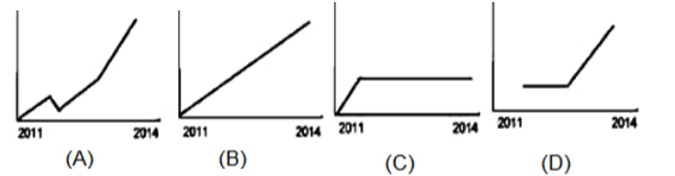
2. A study conducted in 2020 by Dr. Sherap Bhutia, revealed that the foreign tourist arrival in the North-East increased from 37,380 persons in 2005 to 118,552 in 2014. The overall growth rate of tourist (both domestic and foreign) in the North-East was as high as 26.44% during 2005-06. A high and positive growth of 12.53% was registered in foreign tourist visits to North-East States of India during 2012 from 2011, which further rose to register a growth of 27.93% during 2013 from 2012. Foreign tourist arrivals in the North-East witnessed a growth of 39.77% during 2014 from 2013, according to data provided from the Ministry of Tourism, Government of India.
3. The study recommendations for tourism planners included the need to concentrate on some key areas like enhancement of tourist facilities, tourism financing, focus on community involvement and others for the formulation of a sustainable tourism strategy in the North-East States of India.
(a) Infer one reason for the following, based on information in paragraph 1.
View AnswerAns. This is so because these states are lesser explored as compared to the rest of the country, in spite of having lots to offer.
The rate of tourism in the North-East of India puzzles tourism officials
(b) Select the appropriate option to fill in the blanks. From paragraph 1, we can infer that the ________ and ________ of the North-Eastern states aid attracting the ‘money rich and time poor’ tourists.
i. distinctiveness
ii. conventionality
iii. diversity
iv. uniformity
v. modernity
A. i & iii
B. ii & iv
C. ii & v
D. i & iv
View AnswerAns. A. i & iii
(c) Complete the following analogy correctly with a word/ phrase from paragraph 1:
aroma : cooking :: ________ : painting
(Clue: Just like aroma is integral to cooking, similarly ________ is/are integral to painting)
View AnswerAns. hues and shades
(d) Select the correct option to complete the following sentence:
Travellers advocating the ‘experience economy’ seek a holiday package with (Paragraph 1)
A. grand facilities, expensive hotels and excellent services to pamper them.
B. a wholesome experience within the budget they have planned for.
C. places and cities to buy things from and opportunities spend money.
D. cost-effective services, affordable accommodation and many days of touring
View AnswerAns. B. a wholesome experience within the budget they have planned for.
(e) Select the chart that appropriately represents the trend of foreign tourist travels in the North-East, from 2011-2014, as per paragraph 2.
A. Option 1
B. Option 2
C. Option 3
D. Option 4
View AnswerAns. B. Option 2
(f) Fill in the blank by selecting the correct option.
The study of tourist travel statistics in the North-East, from 2005 to 2014 showed ________ results.
A. expected
B. encouraging
C. inconsistent
D. questionable
View AnswerAns. B. encouraging
(g) Substitute the word ‘witnessed’ with ONE WORD similar in meaning, in the following, sentence from paragraph 2:
View AnswerAns. observed/ recorded/ showed/ displayed (Any other similar relevant)
Foreign tourist arrivals in the North-East witnessed a growth of…
(h) List any 2 examples of tourist facilities as referred to, in Paragraph 3
View AnswerAns. accommodation- hotels, hostels, camps
Recreation- Parks, Gardens, Museums, Shopping areas
Essential- eating outlets, toilets, water points, kiosks for maps/currency exchange (if needed), certified travel guide availability
Transport- dedicated shuttle service, sight-seeing buses, cards or passes, car hiring stations
Digital upgrades- WiFi availability, websites, ticketing, forums (Any other relevant)
3. Read the following passage carefully: People tend to amass possessions, sometimes without being aware of doing so. They can have a delightful surprise when they find something useful which they did not know they owned. Those who never have to change house become indiscriminate collectors of what can only be described as clutter. They leave unwanted objects in drawers, cupboards, and attics for years in the belief that they may one day need them. Old people also accumulate belongings for two other reasons, lack of physical and mental energy, and sentiment. Things owned for a long time are full of associations with the past, perhaps with the relatives who are dead, and so they gradually acquire a sentimental value. Some things are collected deliberately in an attempt to avoid wastage. Among these are string and brown paper, kept by thrifty people when a parcel has been opened. Collecting small items can be mania. A lady cuts out from newspapers sketches of model clothes that she would like to buy if she had money. As she is not rich, the chances are that she will never be able to afford such purchases. It is a harmless habit, but it litters up her desk. Collecting as a serious hobby is quite different. Do you sometimes find yourself accumulating items that you say “one day” just might be useful? Well, if that day fails to materialize, in time you will likely discard things that serve no practical purpose. Interestingly, though, many take delight in collecting things that may never be useful in a practical way. These are individuals who have made a hobby of collecting. Some hobbyists work along traditional lines, collecting such items as rocks, stamps, or old coins. Others have a passion for collecting dolls, stuffed animals, spoons, medals, postcards, antiques, music recordings, or vacation memorabilia. The possibilities are endless! One U.S. attorney, for example, has a collection of some 200,000 railroad nails! He is one of the hundreds of hobbyists who scour the countryside looking for old railroad nails that have a date stamped on the head. Harper’s Magazine observes: “It is amazing the things people collect —teeth and toupees, skulls and cookie jars, trolley-car tickets, hair and fans and kites and forceps, dogs and coins, canes, canaries and shoes, . . . buttons and bones, hatpins and forged signatures and first editions and gas masks.” Then there are collectors who have a taste for the bizarre. It has many advantages. It provides relaxation for leisure hours, as just looking at one’s treasure is always a joy. One doesn’t have to go out for amusement as the collection is housed at home. Whatever it consists of – stamps, records, first editions of books, China – there is always something to do in connection with it, from finding the right place for the latest addition to verifying facts in reference books. This hobby educates one not only in the chosen subject but also in general matters which have some bearing on it. There are other benefits also. One gets to meet like-minded collectors to get advice, compare notes, exchange articles, to show off one’s latest find. So one’s circle of friends grows. Soon the hobby leads to travelling, perhaps a meeting in another town, possibly a trip abroad in search of a rare specimen, for collectors are not confined to one country. Over the years one may well become an authority on one’s hobby and will probably be asked to give informal talks to little gatherings and then, if successful, to larger audiences. An article in Australia’s Canberra Times newspaper further suggests that a hobbyist’s collection “can bring back memories of places and people that the mind had consigned to some almost lost region. When the collection is of antiques, a bridge is built between the skill and aspirations of previous generations and the appreciation of our own.” Yes, collecting things can be enlightening and educational. Another reason for the popularity of collecting may simply be that many people believe collectables are a sound financial investment. Collecting can also occupy too much time, energy, and money. One woman collector described her habit as “an unbearable restlessness.” Alastair Martin, a lifelong collector, even admitted that some collectors “are on the eccentric side.”
Should a person allow his fascination with any hobby to become so consuming that he goes to unwise or embarrassing extremes? How can you prevent your interest in collecting from overshadowing more important concerns? Remember that the time involved does not end with just acquiring the desirable object. Looking after your collectables, cleaning them regularly, displaying them, admiring them, and securing them —all of that takes time. And what about money? Will the hobby drain you of resources that you need to use in caring for your family responsibilities? Do you have the self-control to say no to making a purchase when you really cannot afford it? For that matter, try as you may, you simply cannot collect everything there is to own. As noted earlier, collecting has been called “an unruly passion.” But it does not have to be. If collecting is kept in its place and done with balance and moderation, it can be a relaxing, enjoyable, and perhaps even educational pastime. It is wise to count the cost of pursuing a hobby, considering both the time and the expense involved.
1. On the basis of your understanding of the above passage, make notes on it using headings and sub-headings.
Use recognizable abbreviations (wherever necessary-minimum four) and a format you consider suitable. Also supply an appropriate title to it.
View AnswerAns. Title: The Fascination of Collection
I. General accumulation of things
i. amass possessions sometimes without being aware
ii. leave unwanted objects in drawers & attics for years for possible future use
iii. old people – accum. due to lack of physical & mental energy;
iv. sentimental values
v. some things associated with past, dead relatives
vi. some things collected to avoid wastage
vii. some just to belong to socialising
viii. other collectables are just to show off your knowledge
II. Collection as hobby
i. collecting items like
– stamps, records, first editions of books, old coins
– dolls, stuffed animals, spoons, medals, postcards, antiques, music recordings, vacation memorabilia
– teeth & toupees, skulls & cookie jars, trolley-car tickets, hair & fans
– kites & forceps, dogs & shoes, buttons & bones.
– US Attorney for eg. has 200000 railroad nails
ii. some have taste for bizarre items
III. Advantage of collection
i. provides relaxation for leisure hours
ii. meet like-minded collectors;
iii. one’s circle of friends grows
iv. travelling
v. memories of places & people
vi. bridge built between skill & aspirations
vii. enlightening & edu.
viii. financial investment
ix. enhances your knowledge
x. makes you popular among groups
IV. Need for balance
i. occupy too much time, energy & money
ii. unbearable restlessness;
iii. eccentric side
iv. overshadowing more imp. concerns
v. should be balanced for relaxing, enjoyable
vi. edu. pastime
vii. should not go to extreme levels
viii. embarrass others
ix. drain your resources
x. self control
xi. don’t make it unruly passion
Abbreviations used:
gen. – general
accum. – accumulation
& – and
adv. – advantages
edu. – educational
imp. – important
2. Write a summary of the passage in about 80 words.
View AnswerAns. Summary:- People have this strange habit of collecting things that may or may not be of any use and tend to amass possessions, sometimes without being aware of the clutter they are creating around them. Somethings are collected deliberately to avoid wastage and will not be ever used again. For example, we leave unwanted objects in drawers and attics for years for possible future use. Accumulation can be done for sentimental reasons, avoid wastage and as a hobby too. The fascination of the collection ranges from stamps, records, first editions of books, old coins to stuffed animals to buttons and bones. Advantages of the collection include providing relaxation for leisure hours, as looking at those items can just give you pleasure or revive your old memories, meeting like-minded collectors, travelling, enlightening and educational. Passion for collection could occupy too much time, energy and money and overshadow more important concerns and sometimes can be embarrassing too. So it should be balanced for a relaxing, enjoyable and educational pastime just for your personal use and not for the public.
Section B: Grammar (7 Marks)
4. Answer any SEVEN of the following questions: [7]
(a) This poem _________ (write) by me when I was seven years old. (Fill tense correctly)
View AnswerAns. is written
(b) We are _______ (wait) for you. (Fill tense correctly)
View AnswerAns. waiting
(c) __________ the rain stopped, we started our journey. (where/when/whose/which)
View AnswerAns. When
(d) An educated man is one _________ expression is educated. (where/when/whose/which)
View AnswerAns. whose
(e) The words are too difficult to understand. (use so … that)
View AnswerAns. The words are so difficult that they cannot be understood.
(f) We will not admit children under ten. (Passive voice)
View AnswerAns. Children under ten will not be admitted by us.
(g) The/is/book/table/on/the (reorder correctly)
View AnswerAns. The book is on the table.
(h) bird/beautiful/how/is/the/! (reorder correctly)
View AnswerAns. How beautiful the bird is!
Section – B Creative Writing Skills (16 Marks)
5. You are a businessman who wants to set up a small garment shop in your city. Draft an advertisement seeking a suitable space for rent, to be published in the ‘Wanted Accommodation’ column of a local newspaper. Write the advertisement in not more than 50 words.
View AnswerAns.

OR
You are Shirish Saxena of 47, Mall Road, Shimla. You are a young man of 35 with seven years of experience as an expert executive. You seek an immediate change to some prestigious export house in Mumbai/Bangalore. Draft a suitable advertisement for the Situation Wanted column of a National Daily.
View AnswerAns.

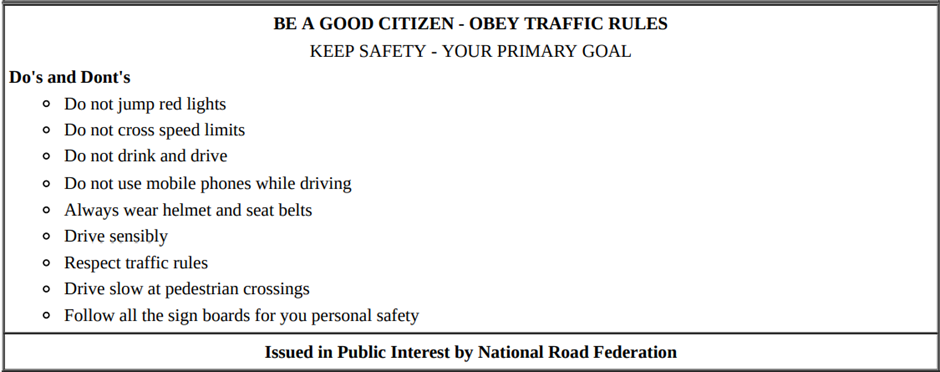
6. Design a poster in about 50 words to create awareness among the people of your city on the importance of following traffic rules.
View AnswerAns.
OR
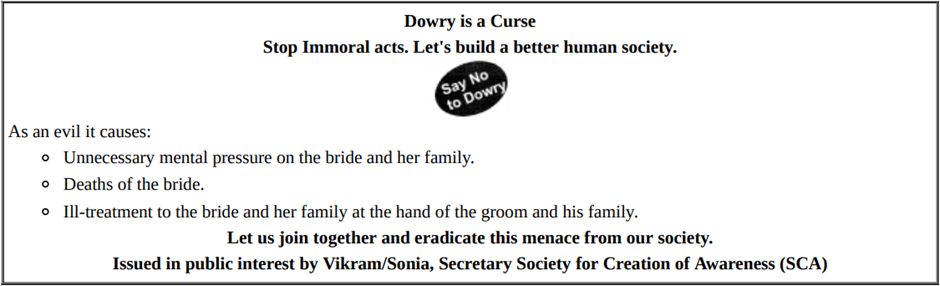
Publicly we proclaim that dowry is an evil. Privately we want our sons to fetch good dowries. Right from our school days we should be taught that demanding and even giving dowry is not only illegal but immoral too. Draw a poster in about 50 words highlighting dowry as a curse. You are Vikram/Sonia.
View AnswerAns.
7. You are Navneet, a member of the school Literacy Club, which has organized literacy classes in villages and city slums under the adult education program. Draft a speech in 150- 200 words highlighting the importance of educating the illiterates.
View AnswerAns.
ADULT EDUCATION
Respected Chairperson, distinguished guest and dear friends! Education provides all-round development of our personality—body, mind and soul. Unfortunately, a vast number of our population remain uneducated. The rate of school drop-outs is increasing fast. To overcome the ever-increasing number of illiterates Adult Education programs have been launched by the Ministry of Education. Many voluntary and social organization have also come forward to render service.
The National Literacy Mission is an organization engaged in Adult Education. It has helped to eradicate illiteracy in India to a great extent. School and college students can also help in the noble mission. They can offer voluntary service during their free period, that is, vacation. They can organize adult literacy classes in their streets or villages. It is hoped that these educated villagers will prove helped in the development of the nation. Education will give them awareness and knowledge. They will gain information, dignity and self-respect. They will become good citizens of the nation. They will become free from the social bondage, exploitation and humiliation. Education will not remain ornamental. It will become a part of their personality.
Thank you.
OR
Rising incomes of the middle class families are leading to obesity among their children. Poring over books for hours coupled with the lure of TV and the internet has led to a sedentary lifestyle. Addiction to junk food is another cause of obesity. Write a speech in 150-200 words on obesity, its causes and how to prevent it.
View AnswerAns.
Obesity-A Severe Problem
Good morning everyone! I, XYZ, have come before you all to draw your attention towards the problem of obesity in children, its causes and how it can be prevented.
Obesity has become a major concern among children in the recent years. Rising income levels of the middle-class families coupled with the sedentary lifestyle of children and addiction to junk food has aggravated the problem of child obesity. This trend of overweight children is most common and prevalent in the metro cities where kids spend most of their time indoors in schools, tuitions, watching TV or sitting in front of the computer. In addition to this, their food intake comprises a variety of junk food that is not beneficial for their health. We need to take some strong steps to prevent children from leading this kind of unhealthy lifestyle.
It is very important for parents to cultivate healthy eating habits in their children and increase the time for physical activities. Children should be encouraged to play outdoor games and take up activities like yoga, dancing, karate etc. The use of computers and time spent indoors should be regulated. Along with an increase in the physical activity levels, it is important to bring a significant change in the diet of children by decreasing the junk food quotient to a great level. Children should be encouraged to eat nutritious food like fruits and vegetables and avoid fatty-food and aerated drinks. I am sure that a little effort on the part of the parents can ensure a healthy and disease-free life for their children.
Thank you!
8. ‘The policy of reservation of seats for admission to the professional courses is good for the deprived sections of society.’ Write a debate in 150-200 words either for or against the motion.
View AnswerAns.
For the Motion
Worthy Chairperson, Secretary and Dear Students,
Today, I Sameer, stand before you to speak in favour of the motion, “The policy of reservation of seats for admission to the professional courses is good for the deprived sections of society”. The fact that the Indian society still remains a caste based hierarchical system is not unknown to anyone. The lower caste people have always been exploited by the high caste ones and have suffered the demerits of socio-economic underdevelopment to the maximum extent. The aim of reservations in admission to the professional courses is to bring the backward castes at par with the other sections of the society. Though it appears as a violation of the principle of equality, yet its justification is sustained by the obligation of a social welfare state. The backward classes suffer from huge issues, ranging from poverty to unemployment, without any fault of their own. And as citizens of the country, it’s our responsibility to help them overcome the barriers. Article 46 of the Indian Constitution says that the state shall promote with special care the educational and economic interests of the weaker sections of the people. Further, the clause 4 of the Article 15, added in the first Constitutional Amendment Act of 1951, clearly says that nothing shall prevent the state from making any special provision for the advancement of any socially and educationally backward class of citizens.
The Constitution was designed to help the deprived sections of society, and thus, the policy of reservation is justified.
Thank you!
Against the Motion
Worthy Chairperson, Secretary and Dear Students,
Today, I Kaveri, stand before you to speak against the motion, “The policy of reservation of seats for admission to the professional courses is good for the deprived sections of society”.
There is no denying to the fact that the Indian Constitution provides reservation to the socially, culturally and economically backward citizens of the country. However, the policy of reservation stated in the Constitution was initially designed as an ad-hoc policy for ten years. But it never saw an end and continued to get extensions at the end of every ten years. The other people, who are deprived of opportunities to take admission in professional courses due to the reservation policy, thus get frustrated and angry and rightly so. In addition, the policy of reservation contradicts the principle of equality. Equality means equal treatment to all the people. Everyone has the right to avail equal and fair opportunities. But, special privileges and extra protection to certain classes of people based on reservation not only violates the policy of equality but also violates the very spirit of democracy. Further, the reservation policy has actually created a new class of vested interests in Indian society. These people permanently continue to earn the benefits of the reservation policy even after getting ample resources and opportunities. Thus, the policy has created the psychology of dependency among them.
Thus, this policy will actually harm the deprived sections in the long run and so it needs immediate suspension.
Thank you!
OR
Write a debate in 150 – 200 words either for or against the motion: A person himself is his own best career counsellor.
View AnswerAns.
For the Motion: A Person Himself is His Own Best Career Counsellor
Ladies and Gentlemen,
Today, I stand in favor of the motion that a person himself is his own best career counsellor. Who knows us better than ourselves? We are the ones who understand our passions, strengths, and aspirations.
External counsellors, no matter how experienced, can only provide guidance based on general assessments and trends. They cannot fully grasp the unique intricacies of our personal experiences and desires. Self-reflection allows us to align our career choices with our true interests and values, leading to greater satisfaction and success. Moreover, in today’s digital age, we have access to a plethora of resources and information that can aid in making informed career decisions. Trusting oneself fosters independence and confidence, essential traits for navigating the ever-evolving job market.
Thank you
Against the Motion: A Person Himself is His Own Best Career Counsellor
Ladies and Gentlemen,
I stand before you to argue against the motion that “A person himself is his own best career counsellor.” While self-awareness is important, professional career counsellors bring a wealth of knowledge and experience that individuals often lack. They are trained to identify strengths and weaknesses objectively and can provide insights into career paths that one might not have considered. Counsellors have access to tools and resources that help in making informed decisions, reducing the risk of career missteps. They can also offer valuable networking opportunities and industry-specific advice. In conclusion, while self-reflection is important, the guidance of a career counsellor is invaluable. Their expertise, objectivity, and resources can help individuals make well-informed decisions and achieve their career goals more effectively.
Thank you
Section C : Literature (31 Marks)
9. Read the text carefully and answer the questions:
Silence surrounds us. I would have
Him prodigal, returning to
His father’s house, the home he knew,
Rather than see him make and move
His world. I would forgive him too,
Shaping from sorrow a new love
(a) What does the father want from his son?
a) To leave his ego
b) To forgive him
c) To talk to him
d) To come back home
View AnswerAns. d) To come back home
(b) Why does the father call his son prodigal?
a) As he is successful
b) As he is a professional
c) As he is wasting his time
d) As he is a runaway
View AnswerAns. c) As he is wasting his time
(c) The literary device used in the given lines is
a) Anaphora
b) Simile
c) Alliteration
d) Hyperbole
View AnswerAns. c) Alliteration
OR
Read the text carefully and answer the questions: And who art thou? said I to the soft-falling shower, Which, strange to tell, gave me an answer, as here translated: I am the Poem of Earth, said the voice of the rain,
(a) What is strange in the given extract?
a) The rain calling itself the Poem of Earth
b) The rain is answering the question
c) That the poet could translate the voice
d) The poet asking question to the rain
View AnswerAns. b) The rain is answering the question
(b) Why does the rain call itself the Poem of Earth?
a) As it travels back to its origin
b) As it has a purpose
c) As it beautifies the Earth
d) As it is beautiful
View AnswerAns. a) As it travels back to its origin
(c) As here translated indicates that
a) he was translating these lines for his readers
b) the rain was talking in our language
c) someone was translating these lines for him
d) the poet was making up these lines on his own
View AnswerAns. a) he was translating these lines for his readers
10. Read the text carefully and answer the questions: My headache soon cleared as we careered down the other side of the pass. It was two o’clock by the time we stopped for lunch. We ate hot noodles inside a long canvas tent, part of a work camp erected beside a dry salt lake. The plateau is pockmarked with salt flats and brackish lakes, vestiges of the Tethys Ocean which bordered Tibet before the great continental collision that lifted it skyward.
(a) Which word in the extract mean moved quickly
a) careered
b) stopped
c) erected
d) lifted
View AnswerAns. a) careered
(b) What did they have for their lunch?
a) Chinese food
b) Salt flats
c) Continental food
d) Noodles
View AnswerAns. d) Noodles
(c) Which of the following is not true about the place where they took lunch?
a) none of these
b) a canvas tent
c) work camp
d) by the side of a dry salt lake
View AnswerAns. a) none of these
OR
Read the text carefully and answer the questions: When I decided to go abroad for further studies, I was sure my grandmother would be upset. I would be away for five years, and at her age one could never tell. But my grandmother could. She was not even sentimental. She came to leave me at the railway station but did not talk or show any emotion. Her lips moved in prayer, her mind was lost in prayer.
(a) What is meant by the phrase one could never tell.
a) author did not want to tell about his destination
b) author did not want to leave his grandmother
c) author was afraid his grandmother
d) author feared his grandmother may die before his return
View AnswerAns. d) author feared his grandmother may die before his return
(b) Which word in the extract is synonym of higher?
a) further
b) upset
c) emotional
d) even
View AnswerAns. a) further
(c) Why did author think that his grandmother would be upset?
a) he was going abroad
b) he was going broke
c) he was going away for five years
d) he was going for higher studies
View AnswerAns. a) he was going abroad
11. Read the given extracts and answer the questions for ANY ONE of the two, given.
(a) Read the following extract and answer the questions that follow:
Still kneeling, Andrew stared at the child with a haggard frown. The whiteness meant only one thing: asphyxia, pallida, and his mind, unnaturally tense, raced back to a case he once had seen in the Samaritan, to the treatment that had been used. Instantly he was on his feet.
“Get me hot water and cold water,” he threw out to the nurse. “And basins too. Quick! Quick!” “But, Doctor-” she faltered, her eyes on the pallid body of the child.
i. What instructions did Andrew give to the nurse? How did the doctor try to revive the child?
View AnswerAns. Andrew asked the nurse to bring hot and cold water. He plunged the baby into hot and cold water and rubbed its chest with a towel. Though the nurse lost hope, Andrew continued the process, and the baby revived.
ii. When the doctor instructed the nurse why did she hesitantly say, “But, Doctor-” in the extract provided? This is so, because she ________.
a. was sure about the treatment.
b. thought the efforts were useless.
c. did not trust the doctor.
d. was in utter amazement.
View AnswerAns. b. thought the efforts were useless.
iii. The analogy of whiteness of the child is an appropriate analogy for a case in Samaritan because ________.
View AnswerAns. Andrew had witnessed a similar case in Samaritan which was a case of oxygen deprivation. He quickly tried to recall its mode of treatment.
iv. Give one reason why the medical condition mentioned in the extract can be considered true in the case.
View AnswerAns. Asphyxia pallida is a rare medical condition that occurs in babies due to complexities during birth. In this, the patient collapses due to suffocation or unconscious condition caused by lack of oxygen and excess carbon dioxide in the blood, accompanied by paleness of the skin, weak pulse, and loss of reflexes. The newborn was showing a similar symptom. Therefore, it can be considered true in the context of the given case.
(b) Read the following extract and answer the questions that follow:
Before him was our uncle Khosrove, an enormous man with a powerful head of black hair and the largest moustache in the San Joaquin Valley, a man so furious in temper, so irritable, so impatient that he stopped anyone from talking by roaring. It is no harm; pay no attention to it.
That was all, no matter what anybody happened to be talking about. Once it was his own son Arak running eight blocks to the barber’s shop where his father was having his moustache trimmed to tell him their house was on fire.
i. What effect does the narrator’s use of statements such as “It is no harm; pay no attention to it,” have on the reader’s perception of Uncle Khosrove’s behaviour?
View AnswerAns. The narrator’s use of the statement “It is no harm; pay no attention to it” downplays Uncle Khosrove’s explosive temper, creating an ironic and somewhat humorous tone that contrasts with the seriousness of his behaviour, thus highlighting its extremeness.
ii. Which aspect of Uncle Khosrove’s character in the passage contributes to the family’s dismissal of his behaviour?
A. His enormous physical stature
B. His powerful black hair
C. The size of his moustache
D. His furious temper and impatience
View AnswerAns. D. His furious temper and impatience
iii. Complete the sentence appropriately.
The narrator portrays Uncle Khosrove’s imposing physical appearance in great detail because _______________.
View AnswerAns. The narrator’s portrayal of Uncle Khosrove’s imposing physical appearance, including his large moustache and powerful black hair, accentuates his dominant presence and reinforces the notion of him as an authoritative and formidable figure within the family.
iv. Who was considered to be a natural descendant of Uncle Khusrove in the plot?
View AnswerAns. Mourad resembled his uncle in many ways, so, he was considered to be the descendant of that crazy streak in the family.
12. Answer the questions from either (a) or (b) in 40-50 words:
(a) i. Who did point out that the mummy was in bad condition? Who was held responsible for it?
View AnswerAns. Zahi Hawass, Secretary General of Egypt’s Supreme Council of Antiquities, bent over the mummy and watched it very carefully. Then he said the mummy is in a very bad condition because of what Carter did in the 1920s. It was in 1922, Carter discovered king Tut’s tomb.
ii. ‘She launches away, towards the infinite’. Explain the given line. (The Laburnum Top)
View AnswerAns. ‘She’ stands for the goldfinch whose arrival on the tree has suddenly transformed it into a noisy place. After having fed her young ones and having made the tree active and full of life, the goldfinch flies away towards the infinitely vast sky.
(b) i. How did the narrator respond to little Jons words? What do his actions reveal about his character? Answer in context of We are Not Afraid to Die.
View AnswerAns. He could not find proper words respond. However, he felt inspired to fight the sea with everything he had. He decided to stop the ship and protect the weakened starboard side. He did so with an improvised anchor of heavy nylon ropes and two 22 litre plastic barrels of paraffin. This shows his resourcefulness and determination.
ii. Why does the poet think that he had lost his childhood? Answer in the context of Childhood.
View AnswerAns. The poet, Markus Natten, believes that he has lost his childhood. He believes so because he has lost the innocence and purity of his childhood. When he was a child, he used to believe in the existence of Hell and Heaven. He also believed that adults had real love. In his childhood, he didn’t have any egoistic attitude.
13. Answer ANY ONE of the following three questions, in about 40-50 words
(a) How did Mrs. Dorling behave when the narrator visited her address?
View AnswerAns. When the narrator visited Mrs. Dorling’s address and informed the lady that she was Mrs. S’ daughter, at first Mrs. Dorling behaved as if she didn’t recognize her and tried to avoid her. Dorling said that she had hoped no one from the author’s house would come to claim her possessions.
(b) What course of action does Mrs. Fitzgerald suggest to Mrs. Pearson to tackle the situation?
View AnswerAns. Mrs. Fitzgerald tells Mrs. Pearson to decide firmly and stick to her decision. She must assert her position and become the real mistress of the house. Her own initiative can help her. She must let them wait or look after themselves for once.
14. Answer ANY ONE of the following two questions, in about 120-150 words.
(a) You neither travelled to the past nor the future. You were in the present experiencing a different world. Briefly explain in the context of the plot, The Adventure.
View AnswerAns. The statement is from the text, The Adventure written by Jayant Vishnu Narlikar. The statement was made by Rajendra Deshpande who was a mathematical and scientific expert in the plot. It meant that Professor Gaitonde made a transition from one world to another and back again. Professor Gaitonde had read the history book which revealed a different version of the outcome of the Battle of Panipat. According to that version, the Marathas emerged victorious in the battle, which was contrary to the facts mentioned in our present day History books. The statement meant that one could experience an altogether different world without travelling to the past or the future. Prof. Gaitonde was witnessing a different set of events while he remained in the present. It was not a matter of fantasy or imagination on the part of Prof. Gaitonde but a different reality as projected to him. Such alternative realities occur due to bifurcation that leads to a different course of events simultaneously. In the present context, the bifurcation took place as a result of the Battle of Panipat, so that in one course of the events the Marathas emerged victoriously and in the other, they lost the battle. Rajendra Deshpande explained that Professor Gaitonde had been to another parallel world. The time was present but its history was quite different. He did not travel either to the past or the future.
(b) Both wry with the laboured ease of loss. The poet Shirley Toulson is missing her mother. What is the role of the mother in forming the personality of a child?
View AnswerAns. A mother’s role in shaping the personality of a child is of paramount importance. The child watches his/her mother intently and learns about the world and how to react to it at the initial stages. The mother can play an important role by making the child deal constructively with mistakes, forgive others, handle frustration, show kindness and share love. When a mother is nurturing and caring the child, it develops a healthy bond with not only the mother but will be willing to form new relationships with others.
Children and adults both want a sense of independence and autonomy. It is very important on a mother’s part to offer choices to the child. This makes the child feel that he/she is smart enough to make choices. The mother’s thoughts nourish a child’s mind and soul as her personal attention nourishes a child’s body. She is a child’s first teacher. She tries to imbibe such values that may help a child lifelong
15. Answer ANY ONE of the following two questions, in about 120-150 words.
(a) It is essential to possess intelligence and common sense to rule over others. Comment in the context of the chapter The Tale of Melon City.
View AnswerAns. It is a fact that a ruler must possess common sense and intelligence to judge things with the correct perspective. He ought to have the ability to differentiate between right and wrong. People tend to fool others to save themselves, which is very well reflected in the plot ‘The Tale of Melon City’. The king was so foolish that he was not able to see through the excuses made by others and eventually paid heavily by losing his own life. The architect or the people who set the noose were far more intelligent than the king and they managed to easily trap him in an unavoidable situation. A king should be witty enough to analyse and rationalise the situation, otherwise, he would land in a difficult situation that might be life-threatening.
(b) What impression do you form for Mrs. Annie Pearson?
View AnswerAns. Mrs. Pearson is the main character in the play Mother’s Day’ She is a pleasant but worried-looking woman in her forties. She speaks in a light, flurried sort of tone, with a touch of suburban cockney. She loves her husband and children very much and runs after them all the time. Her excessive love and care have spoilt them and they have become thoughtless and selfish. She feels neglected and lonely but lacks the courage to discuss things with them. Perhaps she hates any unpleasantness as well. She is not willing to act like a tough mom as she is nervous and fluttering by nature. She is so tender-hearted that she is shocked to see the rough treatment meted out to her children. She decides to change back to her original personality to deal with her family herself. She is indeed a loving and affectionate mother and a devoted wife.