Business Studies (054)
Class XI (2024-25)
Time Allowed: 3 hours Maximum Marks: 80
General Instructions:
1. This question paper contains 34 questions.
2. Marks are indicated against each question.
3. Answers should be brief and to the point.
4. Answers to the questions carrying 3 marks may be from 50 to 75 words.
5. Answers to the questions carrying 4 marks may be about 150 words.
6. Answers to the questions carrying 6 marks may be about 200 words.
7. Attempt all parts of the questions together
1. Which of the following document is prepared by the exporter and includes details of the cargo in terms of the shipper’s name, the number of packages, the shipping bill, port of destination, name of the vehicle carrying the cargo?
a) Shipping bill
b) Mates receipt
c) Packaging list
d) Bill of exchange
View AnswerAns. a) Shipping bill
2. Which of the following is the main problem for small business?
a) Finance
b) Managerial skill
c) Raw material
d) All of these
View AnswerAns. d) All of these
3. A proposed name of the Company is considered undesirable if:
A. It resembles closely with an existing company the name of an existing company.
B. It is an emblem of Government.
C. It is identical with the name.
a) Only C
b) Only B
c) Only A
d) All of these
View AnswerAns. d) All of these
4. Which of the following is come under Fixed Shop Small Retailers?
a) Malls
b) General stores
c) Multiple stores
d) Departmental stores
View AnswerAns. b) General stores
5. When does SFURTI was set up by the Central Government of India?
a) 2005
b) 2002
c) 2003
d) 2004
View AnswerAns. a) 2005
6. PayPal is a good example of ________.
a) B2C activities
b) C2C activities
c) B2B activities
d) C2B activities
View AnswerAns. b) C2C activities
7. A government company is any company in which the paid-up capital held by the government is not less than
a) 49 percent
b) 51 percent
c) 25 percent
d) 50 percent
View AnswerAns. b) 51 percent
8. Expand KVIC
a) King of Village Investment Culture
b) Khadi and Village Industries Commission
c) Khadi and Village Industries Core
d) King of Village Industries Commission
View AnswerAns. b) Khadi and Village Industries Commission
9. Which of the following statements is true regarding preference shares?
A. Preference shares provide an unsteady income in the form of a flexible rate of return.
B. Preference shares are preferably for investors with a high-risk appetite.
C. Preference shareholders have voting rights.
D. Preference shareholders enjoy a preferential position over equity shareholders.
a) Only A is true
b) Only C is true
c) Only D is true
d) Only B is true
View AnswerAns. c) Only D is true
10. Assertion (A): If a person, through his/her own initiative, conduct or behaviour, gives an impression to others that he/she is a partner of the firm, he/she is a partner by Estoppel.
Reason (R): Partner by Estoppel is liable for the debts of the firm.
a) Both A and R are true and R is the correct explanation of A.
b) Both A and R are true but R is not the correct explanation of A.
c) A is true but R is false.
d) A is false but R is true.
View AnswerAns. b) Both A and R are true but R is not the correct explanation of A.
11. The persons who come in between the primary producer and the final consumer to promote trade is called ________.
a) middleman
b) auctioneer
c) Retailer
d) trader
View AnswerAns. a) middleman
12. When does GST has been implemented in India?
a) Jan 1, 2016
b) July 1, 2016
c) Jan 1, 2017
d) July 1, 2017
View AnswerAns. d) July 1, 2017
13. In terms of the continuity of the business organization, which form of organization is the most advantageous?
a) Sole Proprietorship
b) Co-operative Society
c) Partnership
d) Joint Stock Company
View AnswerAns. d) Joint Stock Company
14. Expand DIC
a) District Industries Centers
b) Directorate of Indian company
c) Directorate of Indian Corporation
d) Directorate of Industry Corporation
View AnswerAns. a) District Industries Centers
15. Social interests and business interests are ________.
a) Contradictory
b) Complementary
c) Counteractive
d) Conflicting
View AnswerAns. b) Complementary
16. Assertion (A): Double Insurance means when more than one insurance policy is taken to cover the same amount of risk.
Reason (R): In health insurance, the insurer undertakes to pay medical expenses in case of illness of the insured.
a) Both A and R are true and R is the correct explanation of A.
b) Both A and R are true but R is not the correct explanation of A.
c) A is true but R is false.
d) A is false but R is true.
View AnswerAns. b) Both A and R are true but R is not the correct explanation of A.
17. Limit of investment in small scale industry is ________.
a) ten lakh
b) five crore
c) two crore
d) ten crore
View AnswerAns. d) ten crore
18. Which of the broad categories of industries covers oil refinery and sugar mills?
a) Service industry
b) Secondary industry
c) Tertiary industry
d) Primary Industry
View AnswerAns. b) Secondary industry
19. A maximum investment that is required for equipment in Microenterprises which are engaged in rendering services is
a) ₹ 5 lakhs
b) ₹ 10 lakhs
c) ₹ 20 lakhs
d) ₹ 15 lakhs
View AnswerAns. b) ₹ 10 lakhs
20. Stages in the formation of a public company are in the following order:
A. Promotion, Incorporation, capital subscription, commencement of business
B. Incorporation, Capital of Business, Capital Subscription Commencement of Business, Promotion
C. Promotion, Commencement of business
D. Capital Subscription, Promotion, Incorporation, Commencement of Business
a) D is correct
b) C is correct
c) B is correct
d) A is correct
View AnswerAns. d) A is correct
21. Ramakant is a successful businessman who is engaged in manufacturing of auto spare parts. The products manufactured by him are sold not only in India, but are also exported to various countries like Singapore, Switzerland, Belgium, etc. On the basis of given case, answer the following questions:
a. Identify the two kinds of business in which Ramakant is engaged.
View AnswerAns. The two kinds of business in which Ramakant is engaged are:
i. Domestic Business
ii. International Business
b. Differentiate between the two types of business as identified in part (a) of the question.
View AnswerAns. The two difference between Domestic Business and International Business are:
i. In the domestic business, both buyers and sellers belong to the same country, whereas in the case of international business, buyers and sellers come from two different countries.
ii. Domestic Business involves less degree of risk as people belong to same country whereas International Business involves a high degree of risk.
22. To which Auxiliary to Trade has related the following statement?
i. There is a lot of risk in Business.
ii. Information in business has a special significance.
iii. Business can’t be run without funds.
iv. To do business material has to be purchased from far off places.
View AnswerAns. i. Insurance
ii. Advertisement
iii. Banking
iv. Transport
OR
Pramesh was a successful businessman and owned a departmental store. He was aware of the fact that profit is the reward of risk-bearing. So, in order to earn more profits, he opened two more departmental stores and employed a team of young staff to look after the stores. Initially, the staff was very sincere and Pramesh earned huge profits from his 3 departmental stores. However, over the last two years, his business is running into losses. On close analysis, he found that his staff was not giving much attention to the customers. Moreover, there were many cases of embezzlement (misappropriation of funds) by the employees.
Identify and explain the main cause behind the losses in Pramesh’s Business.
View AnswerAns. Pramesh suffered losses due to the negligence of his employees. Thus, ‘Human Causes’ are the reason for it.
Human causes may include the chance of losses due to human resources employed within the organisation. There maybe carelessness, misunderstanding, dishonesty, ill intentions on the part of human beings or stoppage of work due to strikes, riots, management inefficiency, etc.
23. When we buy some goods from the market the shopkeeper issues us a Trade Document. At the bottom of this document is written E. & O.E. What do you understand from these letters? Explain the justification of these letters.
View AnswerAns. Its full name/form is “Errors and Omissions Excepted”. E. & O.E. (Errors and Omissions Excepted): It refers to that term that is used in trade documents to say that mistakes and things that have been forgotten should be taken into account. This term is used in an attempt to reduce legal liability for incorrect or incomplete information supplied in a document such as a price list, invoice, cash memo, quotation, etc. In legal terms, it seeks to make a statement that information can not be relied upon, or may have changed by the time of use.
24. Mayank has a surplus money of Rs. 25,00,000, which he wants to invest either in equity shares or in preference shares. Two real estate companies (Magic Estate and Skylark Enterprises), with almost the same creditworthiness, are launching their public issue. Magic Estate is coming up with a public issue of preference shares, while Skylark Enterprises is coming up with equity shares. Mayank is confused about the two issues. He consulted his friend Gaurav, who is a portfolio manager and Gaurav convinced him to invest the money in Magic Estate due to ‘Preferential Rights’ of preference shareholders over equity shareholders.
State the ‘Preferential Rights’ stated by Gaurav, which convinced Mayank to invest in Magic Estate.
View AnswerAns. The preference shareholders enjoy two preferential rights over equity shareholders:
i. Right to receive a fixed rate of dividend before any dividend is paid to equity shareholders.
ii. Right to receive repayment of capital on winding up of the company, before the capital of equity shareholders is returned.
OR
Mr. Ankit is a Sole Trader. He runs the ‘Prabhat Medical Store’. He needs some money. For this, he met the Branch Manager of a bank. Ankit told the Manager that he needed some such loan as may have the maximum limit fixed. He should be permitted to withdraw as much money as desired up to that limit from the bank. Also, he wants that the interest charged should not be on the maximum limit fixed but on the actual amount withdrawn. The Bank Manager said that they had got such a scheme under which loan could be granted only when the person availing loan kept some property with the bank by way of security. Mr. Ankit became prepared to fulfil this condition. In this way, the loan agreement was finalised between Mr. Ankit and the bank.
Identify this scheme of the bank and explain it.
View AnswerAns. This scheme of the bank is known as ‘Cash Credit’.
Cash Credit: Under this facility, a bank grants the right to its customer to borrow money up to a certain limit against security. Out of the sanctioned limit, the customer withdraws the amount according to his need. It may be noted that he pays interest on the amount actually withdrawn by him.
25. Explain the types of home trade on the basis of level.
View AnswerAns. Internal trade can be classified into two broad categories viz., (i) wholesale trade and (ii) retail trade.
i. Wholesale trade: wholesale trade refers to buying and selling of goods and services in large quantities for the purpose of resale or intermediate use.
ii. Retail trade: A retailer is a business enterprise that is engaged in the sale of goods and services directly to the ultimate consumers. The retailer normally buys goods in large quantities from the wholesalers and sells them in small quantities to the ultimate consumers.
OR
Geeta recently came across an advertisement of portal weight-reducing equipment in the newspaper. The product is being manufactured by a small trader and is available for sale throughout the country by placing an order through the post. The buyer has been given an option of cash on delivery or e-wallets as a payment option. In the context of the above case answer the following questions:
a. Identify the type of retail trade being described in the above lines.
View AnswerAns. The type of retail trade being described in the above lines is a Mail Order House.
b. List any five conditions under which it may be considered suitable.
View AnswerAns. The five conditions under which mail-house trading may be considered suitable are as follows:
i. The products can be standardized and graded.
ii. The products can be easily transported at low cost.
iii. The products have ready demand in the market.
iv. The products are available throughout the year and in large quantity.
v. The products can be described through pictures.
26. What is business risk? What is its nature?
View AnswerAns. The term ‘business risk’ refers to the possibility of inadequate profits or even losses due to uncertainties e.g. changes in tastes and preferences of consumers, strike, increased competition, change in Government policy etc. It refers to the chance of loss on account of unfavourable or unpredictable happenings. These are of two types
a. Speculative – It involve both the possibility of gain as well as the possibility of loss.
b. Pure – It involve only the possibility of loss. Their occurrence may result in loss whereas non-occurrence may explain absence of loss, instead of gain.
Nature of Business Risks:
i. Business risks arise due to uncertainties: Uncertainties mean when you are not sure of what is going to happen in future. Common examples of uncertainties are: change in demand, government policy, technology etc. Business risk is due to these uncertainties.
ii. Risk is an essential part of every business: A risk is an important characteristic of the business. No business can avoid risk although the degree of risk may vary Risk can be reduced but cannot be eliminated.
iii. Degree of risk depends mainly upon the nature and size of business: For small scale business it is less and for large scale business it is more.
iv. Profit is the reward for risk-taking: The business earns a profit because they are bearing risk. ”No risk no gain” larger the risk more is the profit. An entrepreneur bears
OR
Explain the objectives of business briefly.
View AnswerAns. Objectives represent the purpose for which an organisation has been started. Objectives guide and govern the actions and behavior of businessmen. Business objectives are the ends which a business organisation wants to achieve or accomplish over a specified period of time. These may be to earn profit for its growth and development, to provide quality goods to its customers, to protect the environment, etc.
The objectives of the business are as follows;
a. Economic Objectives are the objectives pursued to achieve the profit motive.
b. Social Objectives are the objectives pursed or desired to be achieved for the benefit of society.
c. Human Objectives refer to the objectives aimed at the well-being as well as the fulfillment of expectations of employees.
d. National Objectives are the objectives in order to serve the nation, business is an important element of the economy should have a goal to fulfill national goals and aspirations of its people.
e. Global Objectives are the aspirations of an entrepreneur to spread business across the borders and supplying quality products at reasonable prices.
f. Global Objectives
27. After completing a course in gemology, Esha joins her father in the family business of fashion jewellery. Her father owns two showrooms at different locations in the city and operates his business through them. However, Esha intends to expand the business by venturing into online retailing. She also intends to introduce flexible manufacturing with the use of computer networks wherein the marketing department can interact constantly with the production department and get the customized products made as per the requirements of the individual customer.
a. How is the mode of business that Esha intends to adopt different from the one that her father has been following over the years?
View AnswerAns. Esha intends to start e-business, whereas her father is following the traditional business.
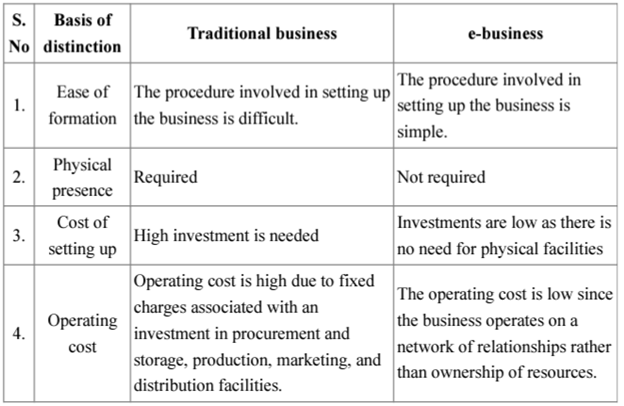
b. Distinguish between the two different modes of business as identified in part (a) of the question by giving any four points.
View AnswerAns. The difference between e-business and traditional business is as follow:
28. Write the merits of statutory corporations.
View AnswerAns. Some of the merits of Statutory corporations are as follows:
i. Operational flexibility: Statutory corporation is able to enjoy a high degree of flexibility in its operations, as it is free from unnecessary government controls and regulations.
ii. Non-interference by the government: Since the funds of these organisations do not come from the central budget, the government generally does not interfere in their financial matters, including their income and receipts.
iii. Autonomous organization: Statutory corporations have the autonomy to frame their own policies and procedures within the authority of the Act granted to them under the Special Act of Parliament or by State or Central Legislature.
iv. A valuable instrument for economic growth: These enterprises are considered to be an effective instrument for economic development because they have the power of the government along with the initiative of private enterprises
29. What are the responsibilities of business towards society (public)?
View AnswerAns. Business should work for the economic and social well-being of the community. The responsibilities of business towards society are as follows:
i. Maximum utilization of natural resources.
ii. To provide opportunities to public for meaningful work.
iii. To preserve social and cultural values.
iv. To uplift the weaker section of the society.
30. Write the meaning and features of the small-scale industry.
View AnswerAns. Small scale industries comprise of small enterprises who manufacture goods or services with the help of relatively smaller machines and a few workers and employees.
Features of the small-scale industry:
i. Both the management and the control generally is with the owner/owners. So the owner is actively involved with the daily running of the business.
ii. These small scale industries tend to use labour and manpower for their production activities. So their dependence on technology is pretty limited.
iii. These units are more adaptable to their changing business environment. So in case of sudden changes or unexpected developments, they are flexible enough to adapt and keep carrying on. Large industries do not have this advantage.
iv. They use local and readily available resources. This also helps the economy with better utilization of natural resources and less wastage.
31. India is considered to be one of the leading exporters of leather goods. The main leather items include leather bags, belts, leather pouches, and handbags. Different kinds of gift items like key rings, leather journals, and leather-covered notebooks also have a huge demand in foreign countries. Numerous small scale and large scale enterprises in India are constantly engaged in exporting leather goods to various foreign countries like Germany, UK, Italy, Hong Kong, France, Spain, Netherlands, UAE, Belgium, and China.
In the context of the above case answer the following:
a. Briefly outline any two benefits available to the business firms who are engaged in leather export.
View AnswerAns. The two benefits available to the business firms engaged in leather export are as follows:
i. Prospects for higher profits for the business firms as they get an opportunity to sell their products in countries where prices are high.
ii. Increased capacity utilization may help the business firms to take advantage of economies of scale, which leads to a reduction in the production cost and increases per-unit profit margin.
b. How do the different countries engaged in international trade of leather goods stand to gain (any two points)?
View AnswerAns. The two ways in which different countries engaged in international trade of leather goods stand to gain are as follows:
i. Improving growth prospects and employment potentials as the scope of production activities increase.
ii. Increased standard of living as it provides access to the products with better technology from other countries.
OR
What do you mean by exporting and importing? Mention its advantages and disadvantages.
View AnswerAns. Selling and sending goods and services from the home country to a foreign country is known as exporting while buying goods and services and bringing them into the home country from a foreign country is known as importing. The import and export of goods can be done either directly or indirectly. When the firm itself approaches the overseas buyers or sellers and performs all the formalities related to import and export of goods, it is referred to as direct importing or exporting. When the firm’s participation in the import and export operations is minimum and most of the formalities are carried out by some middlemen, it is referred to as indirect exporting or importing. In this case, firms don’t directly deal with overseas customers.
Advantages:
i. The easy way: It is the simplest way of gaining entry into international markets and does not involve any complex activity.
ii. Less investment: It does not require much of investment in foreign countries.
iii. Low risk: It does not carry much of the risks and requires less time.
Limitations:
i. Since the goods move from one country to another country, it involves, additional packaging, transportation, and insurance cost is incurred in transferring the goods which increases the cost of the product.
ii. Less knowledge of the foreign market. Basically, the export firms produce goods in the home country and send their goods to foreign countries. Hence, export firms do not have much contact with the foreign market.
iii. No longer feasible when import restrictions exist in a foreign country.
32. What do you understand by a sole proprietorship firm? Explain its merits and limitations.
View AnswerAns. Sole proprietorship refers to a form of business organisation which is owned, managed and controlled by an individual who is the recipient of all profits and bearer of all risks. This single individual has to supply capital owned or borrowed to the business. This form of organisation is also known as ‘Sole Trader’, ‘Individual Proprietorship’ or ‘Individual Entrepreneurship’.
Benefits of Sole Proprietorship:
i. Ease of formation and dissolution: The sole proprietorship is the simplest form of business ownership. No legal formalities required for starting such firm.
ii. Quick decision making: A sole proprietor enjoys a considerable degree of freedom in making business decisions.
iii. Confidentiality of information: Sole decision-making authority enables the proprietor to keep all the information related to business operations confidential and maintain secrecy. A sole trader is also not bound by law to publish the firm’s accounts.
iv. Direct Incentive: A sole proprietor enjoys all the profits of the business as there is no one else to share earnings of the business.
v. Sense of accomplishment: Sole proprietorship provides personal satisfaction to people who want to be self-employed. As the proprietor is himself responsible for the success of the business, it not only provides him satisfaction but also creates a sense of accomplishment and confidence.
Limitations of Sole Proprietorship:
i. Limited resources: Resources of a sole proprietor are limited to his/her personal savings and borrowings from others. He doesn’t have enough security to acquire big loan.
ii. Limited life of a business concern: In the eyes of law, the proprietor and the owner are considered one and the same. Death, insolvency or illness of a proprietor affects the business and can lead to its closure. In most cases, the business collapses when the owner dies.
iii. Unlimited liability: A major disadvantage of the sole proprietorship is that the owner has unlimited liability. If the business fails, the creditors can recover their dues not only from the business assets but also from the personal assets of the proprietor.
iv. Limited managerial liability: The owner has to assume the responsibility of varied managerial tasks, such as purchasing, selling, financing etc. It is rare to find an individual who excels in all these areas.
OR
Amul is an Indian dairy cooperative, based at Anand in the state of Gujarat. It was formed in 1946 and is a brand managed by a cooperative body, the Gujarat Cooperative Milk Marketing Federation Ltd. (GCMMF), which today is jointly owned by 3.6 million milk producers in Gujarat. Amul spurred India’s White Revolution, which made the country the world’s largest producer of milk and milk products. In the process, Amul became the largest food brand in India and has ventured into markets overseas.
In the context of the above case answer the follwoing qustions:
a. What is a cooperative society?
View AnswerAns. The cooperative society is a voluntary association of persons, who join together with the motive of the welfare of the members.
b. Why do you think Amul was promoted in the form of the cooperative? Explain by giving any four merits of a cooperative society form of business organization.
View AnswerAns. Amul was promoted in the form of cooperative by a group of farmers who decided to bring an end to the exploitation of marginal milk producers by traders or agents of the only existing dairy, thereby gaining access to markets and maximizing returns for their efforts. The four merits of a cooperative society form of organization are described below:
i. Equality in Voting Status: Regardless of the amount of capital invested by a member, the principle of ‘one man one vote’ governs the cooperative society.
ii. Limited Liability: The liability of the members of the cooperative society is limited to the extent of capital invested by them. The personal assets of the members cannot be used to settle the claims of the business against outsiders.
iii. Stable Existence: The existence of a cooperative society is not affected by the death, insolvency or insanity of its members. Thus, it is a stable form of business organization
iv. Economy in Operations: The operations of a cooperative society are economical in nature. This is due to multiple factors like the members may work on an honorary basis, elimination of middlemen, etc.
33. Ding Dong Ltd. is planning to float an issue of equity shares in the market in the next four months. The directors of the company are also of the opinion that the company should raise some portion of funds from international capital markets through equity.
In the context of the above case:
a. State any four merits of raising funds through equity shares.
View AnswerAns. The four merits of raising funds through equity shares are as follows:
i. The issue of equity shares does not create any fixed burden on the company as the payment of the dividend is not compulsory.
ii. Generally equity capital is to be repaid only at the time of liquidation of a company after settling the other claims. Therefore, it serves as a source of permanent capital for the company.
iii. Equity capital helps to build up creditworthiness of the company as it is the owner’s fund. Thus, it becomes easier for the company to raise loans.
iv. Equity share capital constitutes the part of owner’s fund. Hence, there is no need to provide any security of assets while raising it.
b. Explain briefly any one source through which Ding Dong Ltd. can raise funds through international capital markets.
View AnswerAns. Ding Dong Ltd. can raise funds through international capital markets through global depository receipts (GDRs).
A global depository receipt (GDR) is a certificate issued by a depository bank, which purchases shares of foreign companies and deposits it on the account. In the Indian context, a GDR is an instrument issued abroad by an Indian company to raise funds in either U.S. dollars or euros. GDRs represent ownership of an underlying number of shares of a foreign company. Normally, one GDR is equal to ten underlying shares, but any ratio can be used. The market price of global depository receipts are based on the values of related shares, but they are traded and settled independently of the underlying share.GDRs are often listed in the Frankfurt Stock Exchange, Luxembourg Stock Exchange, and the London Stock Exchange.
34. Jay owns an event management company in Jaisamaler which provides customized facilities to meet the needs of the customers and ensure a memorable event for them whether they are planning a workshop, a management seminar, marketing or training session. He has a staff of 50 persons. Earlier the salary of the staff members was paid through cheques. The employees had to deposit their cheque in the bank and had to wait for a few days for cheques to be cleared. But now the salary reaches their account on the same day itself with the help of a particular banking service.
In the context of the above case, answer the following questions:
a. What is a cheque?
View AnswerAns. A banker’s cheque is the most convenient and inexpensive medium of exchange and function of banks for the withdrawal of deposits. There are two types of cheques, mainly (a) bearer cheques, which are encashable immediately at bank counters and (b) crossed cheques which are to be deposited only in the payee’s account.
b. How is a cheque different from a bank draft?
View AnswerAns. A bank draft is a cheque provided on nominal commission charges to a customer of a bank or acquired from a bank for remittance purposes, that is drawn by the bank, and drawn on another bank or payable through or at a bank. Unlike a cheque, a draft is a pre-paid negotiable instrument, wherein the drawee bank acts as a guarantor to make payment in full when the instrument is presented.
c. Name the banking service which facilitates the transfer of the salary to the employee’s account on the same day itself.
View AnswerAns. Real-Time Gross Settlement are specialist funds transfer systems where the transfer of money or securities takes place from one bank to another on a ‘real-time’ and on a ‘gross’ basis. It does not require any physical exchange of money. Settlement in ‘realtime’ means a payment transaction is not subjected to any waiting period, with transactions being settled as soon as they are processed. ‘Gross settlement’ means the transaction is settled on a one-to-one basis without bundling or netting with any other transaction. ‘Settlement’ means that once processed, payments are final and irrevocable. RTGS systems are typically used for high-value transactions that require and receive immediate clearing.