Class XI Session 2024-25
Subject – Biology
Time Allowed: 3 hours Maximum Marks: 70
General Instructions:
1. All questions are compulsory.
2. The question paper has five sections and 33 questions. All questions are compulsory.
3. Section–A has 16 questions of 1 mark each; Section–B has 5 questions of 2 marks each; Section– C has 7 questions of 3 marks each; Section– D has 2 case-based questions of 4 marks each; and Section–E has 3 questions of 5 marks each.
4. There is no overall choice. However, internal choices have been provided in some questions. A student has to attempt only one of the alternatives in such questions.
5. Wherever necessary, neat and properly labeled diagrams should be drawn.
Section A
1. International Code of Biological Nomenclature is applied to_______.
a) Plants
b) Both Plants and Animals
c) Virus
d) Animals
View AnswerAns. b) Both Plants and Animals
2. The adult human kidney is metanephric. So, first embryonic tubules formed in vertebrates during embryonic development are:
a) Pronephric
b) Amphinephric
c) Metanephric
d) Mesonephric
View AnswerAns. a) Pronephric
3. Proteins are made up of___________.
a) Nucleosides
b) Monomers
c) Heteropolymers
d) Homopolymers
View AnswerAns. c) Heteropolymers
4. In dicot stems, the cells of cambium present between the primary xylem and primary phloem are:
a) Vascular cambium
b) Interfascicular cambium
c) Medullary cells
d) Intrafascicular cambium
View AnswerAns. d) Intrafascicular cambium
5. Which of the following is not correctly matched?
a) Inspired air = Alveolar air
b) Respiration = Physiochemical process
c) TLC = VC + RV
d) Cutaneous respiration = Breathing via skin
View AnswerAns. a) Inspired air = Alveolar air
6. On excitation, the electrons picked up by an electron acceptor is passed to _______.
a) photons
b) cytochromes
c) reaction centre
d) anntenae
View AnswerAns. b) cytochromes
7. The filtration fraction is the ratio of GFR to RPF where both the values are in ml/min and FF is expressed in percentage. Calculate FF for a normal adult human being, if RPF= 600ml/min:
a) 2.08%
b) 10.38%
c) 20.73%
d) 20.83%
View AnswerAns. d) 20.83%
8. The lymph in frog lacks:
a) RBC and plasma
b) Plasma and WBCs
c) WBCs and few proteins
d) RBCs and few proteins
View AnswerAns. d) RBCs and few proteins
9. Plant growth regulator that is used in delay in leaf senescence is_______.
a) Ethylene
b) Cytokinin
c) Auxin
d) ABA
View AnswerAns. b) Cytokinin
10. Which plant division is known as amphibians _________.
a) Gymnosperms
b) Thallophyta
c) Bryophytes
d) Angiosperms
View AnswerAns. c) Bryophytes
11. Which of the following animals shows ammonotelic excretion?
a) Cat
b) Sparrow
c) Human
d) Rohu
View AnswerAns. d) Rohu
12. Expiration will take place when there is:
A. Positive intrapulmonary pressure
B. Negative intrapulmonary pressure
C. Less pressure within lungs as compared to atmospheric pressure
a) (C)
b) (A)
c) (B) and (C)
d) (B)
View AnswerAns. b) (A)
13. Assertion (A): The mycelium is coenocytic in Zygomycetes.
Reason (R): The gametes are uninucleate.
a) Both A and R are true and R is the correct explanation of A.
b) Both A and R are true but R is not the correct explanation of A.
c) A is true but R is false.
d) A is false but R is true.
View AnswerAns. c) A is true but R is false.
14. Assertion (A): Oxygenation of blood promotes the release of carbon dioxide from the blood in the lungs.
Reason (R): Carbon dioxide is carried as bicarbonates in erythrocytes of blood.
a) Both A and R are true and R is the correct explanation of A.
b) Both A and R are true but R is not the correct explanation of A.
c) A is true but R is false.
d) A is false but R is true.
View AnswerAns. b) Both A and R are true but R is not the correct explanation of A.
15. Assertion (A): Proenzyme is the precursor of an enzyme.
Reason (R): Proenzyme is as active as the enzyme.
a) Both A and R are true and R is the correct explanation of A.
b) Both A and R are true but R is not the correct explanation of A.
c) A is true but R is false.
d) A is false but R is true.
View AnswerAns. c) A is true but R is false.
16. Assertion (A): Excessive inflation of the lungs is prevented by the Hering-Breuer reflex.
Reason (R): On overstretching of the lungs, the stretch receptors send impulses along the vagus nerve to stimulate the expiratory centre.
a) Both A and R are true and R is the correct explanation of A.
b) Both A and R are true but R is not the correct explanation of A.
c) A is true but R is false.
d) A is false but R is true.
View AnswerAns. c) A is true but R is false.
Section B
17. Write one difference between mesophyll of dicot leaf and a monocot leaf.
View AnswerAns. In dicot leaves, mesophyll is differentiated into palisade and spongy parenchyma. In the case of monocot leaves, mesophyll is not differentiated and all cells are like spongy parenchyma.
18. How does a gap junction facilitate intercellular communication?
View AnswerAns. Gap junctions are fine hydrophilic channels between two adjacent animal cells. These are formed with the help of two protein cylinders; called connexions. Gap junctions allow small signaling molecules to pass from one cell to another and thus they facilitate intercellular communication. Movement through gap junctions is controlled by pH and Ca2+ concentration.
19. Comment hormones are called informational molecules.
View AnswerAns. Hormones are known as informational molecules because their synthesis takes place in one part of the body, i.e., the endocrine cells and are carried by the blood to another part of the body, i.e., target organ or tissues where they stimulate or inhibit the specific physiological processes according to the need of the body.
20. What is a taxon?
View AnswerAns. A taxon is a group of (one or more) organisms, which a taxonomist adjudges to be a unit.
Usually, a taxon is given a name and a rank, although neither is a requirement.
It is a level of hierarchy in biological classification. Example: Family is a taxa.
21. What do you understand by biosynthetic phase of photosynthesis?
View AnswerAns. The next phase of photosynthesis after light reaction is the biosynthetic phase. In this, ATP and NADPH are used for synthesizing the food. CO2 is fixed to form CO2 fixation product. This stage is also called the dark phase as it is independent of light, but deals with the products of light reaction.
Since sugar is synthesized in this phase, it is also called as biosynthetic phase.
OR
What is non-cyclic photophosphorylation?
View AnswerAns. It is the process of formation of ATP and NADPH, during which electron emitted by reaction centre P700 is not returned to it but is substituted by the electron emitted by reaction centre P680, which in turn gets the electron released by photolysis of water.
Section C
22. Describe the important characteristics of gymnosperms.
View AnswerAns. Characteristics of Gymnosperms:
The gymnosperms (gymnos: naked, sperma: seeds) are plants in which the ovules are not enclosed by any ovary wall and remain exposed, both before and after fertilization. The seeds that develop post-fertilization are not covered, i.e. are naked. Gymnosperms include medium-sized trees or tall trees and shrubs.
The roots are generally tap roots. Roots in some genera have a fungal association in the form of mycorrhiza while in some others small specialized roots called coralloid roots are associated with N2 fixing cyanobacteria.
The stems are unbranched (Cycas) or branched (Pinus, Cedrus).
The leaves may be simple or compound. In Cycas, the pinnate leaves persist for a few years. The leaves in gymnosperms are well adapted to withstand extremes of temperature, humidity and wind. In conifers, the needle-like leaves reduce the surface area. Their thick cuticle and sunken stomata also help to reduce water loss.
23. Differentiate between:
a. Open and closed circulatory system
View AnswerAns. In open circulatory system, blood flows in spaces called sinuses and cells and tissues are directly bathed in blood. In a closed circulatory system, blood flows through a network of vessels. Arthropods and molluscs have open circulatory system, while annelids and vertebrates have closed circulatory systems.
b. Oviparity and viviparity
View AnswerAns. In oviparity; animals lay eggs and young ones hatch from them after some time, e.g. reptiles, birds and some mammals. In viviparity; animals give birth to young ones, e.g. scoliodon and most of the mammals.
c. Direct and indirect development
View AnswerAns. When the young ones are different from adult animals; this case is called indirect development, e.g. frog, cockroach, silkworm, etc. When the young ones resemble the adult animal; this case is called direct development e.g. birds, mammals, reptiles, etc.
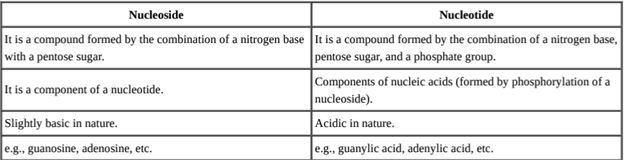
24. Differentiate between nucleosides and nucleotides. Give one example for each.
View AnswerAns.
25. Both animals and plants grow. Why do we say that growth and differentiation in plants is open and not so in animals? Does this statement hold true for sponges also?
View AnswerAns. In animals, once a particular type of tissue is formed it cannot change to any other tissue. Moreover, growth in all the organs stop after a certain age of the animal. On the contrary, growth in the plant is indeterminate because plants retain the capacity for unlimited growth throughout their life. A senescent part is usually replaced in plants. Differentiated cells undergo dedifferentiation in plants if a need arises.
Sponges are exceptions in the animal kingdom. A sponge shows an open type of growth.
26. Write the difference between red and white muscles.
View AnswerAns. Red and White Muscles. Muscle contains a red coloured oxygen storing pigment called myoglobin. Myoglobin content is high in some of the muscles which gives a reddish appearance. Such muscles are called the Red fibres. These muscles also contain plenty of mitochondria which can utilize the large amount of oxygen stored in them for ATP production. These muscles, therefore, can also be called aerobic muscles.
On the other hand, some of the muscles possess very less quantity of myoglobin and therefore, appear pale or whitish. These are the White fibres. Number of mitochondria are also few in them, but the amount of sarcoplasmic reticulum is high. They depend on anaerobic process for energy.
27. What are SA and AV nodes? What are their functions?
View AnswerAns. SA-Node. It is a pacemaker located at the right wall of right auricle/atrium. Its full name is a sinoatrial node.
AV-Node. It is a pacesetter located at the junction of auricle and ventricle. Its full name is an auriculoventricular node.
Functions of SA-Node:
i. Cardiac impulse originates in it.
ii. It determines the rate of heartbeat.
Function of AV-Node:
i. The Cardiac impulse passes to the AV bundle through the AV Node.
ii. Its branches called purkinje fibres conduct impulses to ventricles.
OR
Explain heart sounds.
View AnswerAns. The heart sounds are the noises (sound) generated by the beating heart and the resultant flow of blood through it. This is also called a heartbeat. In cardiac auscultation, an examiner uses a stethoscope to listen for these sounds, the heartbeat sounds like bassdrum, which provide important information about the condition of the heart. In healthy adults, there are two normal heart sounds often described as a lub and a dub (or dup), that occur in sequence with each heart beat. These are the first heart sound (S1) and second heart sound (S2), produced by the closing of the AV valves and semilunar valves respectively. In addition to these normal sounds, a variety of other sounds may be present including heart murmurs, adventitious sounds, and gallop rhythms 33 and 54.
28. Suppose for some reason ATP falls deficient in nerve fibre, how will it affect the conduction of nerve impulse through it?
View AnswerAns. Each neuron has a million or so ATP powered Na+– K+ exchange pumps built into the plasma membrane which enables it to keep conducting action potentials indefinitely. If for some reason ATP falls deficient in nerve fibre, the conduction of nerve impulse is greatly affected. It will affect the amplitude and frequency of nerve impulse and action potential.
Section D
29. Read the following text carefully and answer the questions that follow: The fungi constitute a unique kingdom of heterotrophic organisms. They show a great diversity in morphology and habitat. Fungi are cosmopolitan and occur in air, water, soil, and on animals and plants. They prefer to grow in warm and humid places. Most fungi are heterotrophic and absorb soluble organic matter from dead substrates and hence are called saprophytes. When a fungus reproduces sexually, two haploid hyphae of compatible mating types come together and fuse. In some fungi, the fusion of two haploid cells immediately results in diploid cells (2n). The fungiform fruiting bodies in which reduction division occurs, leading to the formation of haploid spores. Symbionts – in association with algae as lichens and with roots of higher plants as mycorrhiza.
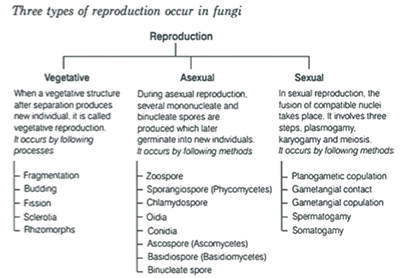
i. Observe the given flow chart of reproduction and mention which steps involves in the sexual cycle of fungi.
View AnswerAns. The sexual cycle of fungi involves the following steps :
a. The fusion of protoplasms between two motile or non-motile gametes is called plasmogamy.
b. The fusion of two nuclei is called karyogamy.
c. Meiosis in zygote results in haploid spores.
ii. What is Rhizopus? Also, mention Rhizopus – wheat rush a correct match?
View AnswerAns. Rhizopus is a fungus that reproduces by spore formation.
No, Rhizopus – wheat rush is not a correct match.
iii. What is Mycorrhiza? And mention its function.
View AnswerAns. – Mutualistic associations between fungi and plant roots are called mycorrhizae.
- Fungi that form mycorrhizal (mycorrhizal fungi) can deliver inorganic nutrients such as phosphate.
- In exchange, the plants supply the fungi with organic nutrients.
OR
In which form Fungi Stores Food Material? Do fungi have food vacuoles?
View AnswerAns. Fungi store food in the form of glycogen, along with oil bodies.
Plants, protists, mammals, and fungi all have vacuoles in their cells. Food vacuoles are sacs enclosed by a membrane and have a digestive function.
30. Read the following text carefully and answer the questions that follow:
Each flower normally has four floral whorls, viz., calyx, corolla, androecium and gynoecium. The calyx is the outermost whorl of the flower and the members are called sepals. Corolla is composed of petals. Petals are usually brightly coloured to attract insects for pollination. The mode of arrangement of sepals or petals in floral bud with respect to the other members of the same whorl is known as aestivation. The main types of aestivation are valvate, twisted, imbricate. The shape and colour of corolla vary greatly in plants. Corolla may be tubular, bell- shaped, funnel-shaped or wheel-shaped and vexillary.
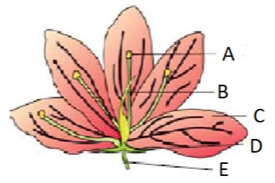
i. Observe the given figure mentioned A, B, C and D. Also mention its function. Identify D and mention its example.
View AnswerAns. A-androecium, B-gynoecium, C-corolla, D-calyx
Androecium: It contains pollen grains, which are responsible for reproduction in the male part of the plant.
Gynoecium: It holds ovary, which is transformed into fruit after fertilization.
Corolla: The corolla promotes pollination and protects the reproductive organs.
Calyx: The main function of the calyx is to protect the floral shoot during the bud stage.
ii. Ganosepalous, Ganopetalous, Polysepalous, Polypetalous, Imbricate.
View AnswerAns. Ganosepalous: Plants with many fused sepals are known as Gamosepalous. Eg, Hibiscus, Periwinkle, etc.
Polypetalous: Polysepalous plants are also categorized based on sepals. Eg, Rose, Southern magnolia, etc.
iii. What is Valvate and twisted aestivation?
View AnswerAns. When the margins of the petals are in contact with each other without overlapping, it is called valvate aestivation. For example, Calotropis.
Contoured or twisted estivation occurs when the margin of one petal overlaps the margin of the next. Example Hibiscus.
OR
Which of the following shows imbricate? Explain imbricate aestivation?
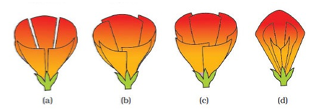
Ans. Figure (c), Imbricate aestivation occurs when the margins of sepals or petals overlap without a clear direction. There is an irregular overlapping of petals by each other in this type of aestivation.
Section E
31. What are the various stages of meiotic prophase-I? Enumerate the chromosomal events during each stage?
View AnswerAns.
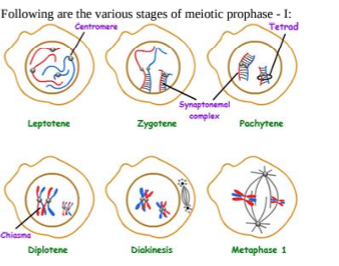
Ans. i. Leptotene: During this stage, chromosomes become gradually visible under the light microscope. The compaction of the chromosome continues through this stage. The sister chromatids are so tightly bound that one cannot be differentiated from another.
ii. Zygotene: At this stage, chromosomes start forming pairs. This process is called synapsis. Formation of synapsis is accompanied by the formation of synaptonemal complex. Each pair is called a bivalent or tetrad.
iii. Pachytene: At this stage, the bivalent chromosomes become distinct. Recombination nodules appear on the tetrads. The recombination nodule is the site at which crossing over takes place. Crossing over takes place between non-sister chromatids of homologous chromosomes. Crossing over facilitates the exchange of genes between two homologous chromosomes.
iv. Diplotene: At this stage, the synaptonemal complex gets dissolved. The recombined chromosomes begin to separate from each other. But they are attached at the site of crossing over. This makes an X-shaped structure called chiasmata.
v. Diakinesis: Chiasmata is terminated at this stage. The nucleolus disappears and so does the nuclear membrane.
OR
Comment on the statement – Meiosis enables the conservation of specific chromosome number of each species even though the process per se, results in reduction of chromosome number.
View AnswerAns. Meiosis is called reduction division because the number of chromosomes in daughter cells becomes half of the number of chromosomes in mother cells. In spite of this, meiosis enables the conservation of specific chromosome number of each species. In fact, has there been no meiosis, organisms would not have been able to evolve to sexual mode of reproduction. We know that fertilization involves fusion of male and female gametes. Thus, zygote gets the chromosome pool from two cells and the number of chromosomes in a zygote becomes double that of the gametes. To ensure conservation of specific chromosome number after fertilization, it is necessary that the gametes should have half the number of chromosomes compared to what it is in somatic cells.
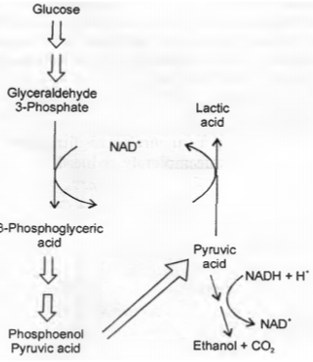
32. Define and explain the process of fermentation in animals, yeast and bacteria.
View AnswerAns. Fermentation: It occurs in some organisms like some bacteria that produce lactic acid from pyruvic acid. In animal cells, such as muscles during exercise, when O2 is inadequate for cellular exercise, the pyruvic acid is reduced to lactic acid by lactate dehydrogenase. Reducing agent is NADH + H+ that is reoxidized to NAD+ in both processes. In both lactic acid and alcohol fermentation not much energy is released; less than seven percent of the energy in glucose released and not all of it is trapped as high energy bonds of ATP. The processes are hazardous: either the acid or alcohol is produced. Yeasts poison themselves to death when the concentration of alcohol reaches the app. 13%.
OR
Enumerate the assumptions that we have undertaken in making the respiratory balance sheet. Are these assumptions valid for a living system?
View AnswerAns. Respiratory Balance Sheet: Some assumptions in preparing respiratory balance sheet are :
i. None of the intermediates produced in this pathway is used to make any other compound.
ii. Only glucose is being respired—no other alternative substrates enter in the pathway at any of intermediary stages in any case.
iii. There seems to be a sequential, orderly pathway that is functioning, with a single substrate forming next as well as with glycolysis. Kreb’s cycle and ETS pathway following one after the other pathway.
iv. NADH synthesised in glycolysis transferred to mitochondria; it undergoes oxidative phosphorylation also.
This assumption is not really valid in a living system since all the pathways work simultaneously; moreover, the substrates enter pathways and also are withdrawn from the pathways as and when required; ATP used when needed and enzymes control the reactions also. It is only useful in the extraction and storing energy; there is a net gain of 36 ATP mols in aerobic respiration for one mol of glucose.
33. What structural and functional attributes must a cell have to be called a living cell?
View AnswerAns. A cell must have the following structural and functional attributes to be called a living cell:
i. Plasma Membrane: A cell should have a plasma membrane. Without the plasma membrane, the contents of the cell cannot get a container and cells won’t be able to maintain its independent existence.
ii. Functional Attributes of Plasma Membrane: The plasma membrane should be selectively permeable so as to facilitate the exchange of materials between the cell and its environment.
iii. Protoplasm: A cell must have a protoplasm to be called a living cell. It is the protoplasm which contains all the materials necessary for life to continue. If protoplasm dries up, the cell becomes dead; as in the case of sclerenchymatous cells.
iv. Endoplasmic Reticulum: Endoplasmic reticulum is necessary for the exchange of materials between nucleoplasm and cytoplasm. It is also necessary for the synthesis of various materials; like protein and lipid. Thus, a cell must have an ER to be considered a living cell.
Mitochondria are not mandatory for all living cells. For example; Red Blood Cells do not have mitochondria yet they are living cells.
The prokaryotes do not have mitochondria but they are living cells. The nucleus is not mandatory for all living cells. For example; mitochondria lack a nucleus. Similarly, prokaryotic cells lack a nucleus. Another important aspect of cells is that a cell is always formed from a pre-existing cell; as proposed in the Cell Theory.
OR
Write the functions of the following
i. Centromere
View AnswerAns. Facilitates proper segregation of chromosomes.
ii. Cell wall
View AnswerAns. It provides structural rigidity to the plant cells. Plants cells need to be rigid because they cannot run for safety in case of any natural stress; unlike animals.
iii. Smooth ER
View AnswerAns. Smooth ER facilitates the synthesis of lipids, metabolism of carbohydrates, regulation of calcium concentration and drug detoxification.
iv. Golgi Apparatus
View AnswerAns. Golgi apparatus is involved in the packaging of various substances that are manufactured in the endoplasmic reticulum.
v. Centrioles
View AnswerAns. They form the basal bodies of cilia and flagella and thus play an important role in the motility of certain cells. They also play an important role in cell division by forming asters. The aster as spindle pole during cell division.