Class XI Session 2024-25
Subject – Biology
Time Allowed: 3 hours Maximum Marks: 70
General Instructions:
1. All questions are compulsory.
2. The question paper has five sections and 33 questions. All questions are compulsory.
3. Section–A has 16 questions of 1 mark each; Section–B has 5 questions of 2 marks each; Section– C has 7 questions of 3 marks each; Section– D has 2 case-based questions of 4 marks each; and Section–E has 3 questions of 5 marks each.
4. There is no overall choice. However, internal choices have been provided in some questions. A student has to attempt only one of the alternatives in such questions.
5. Wherever necessary, neat and properly labeled diagrams should be drawn.
Section A
1. Example of interspecific hybrid is:
a) Tigon and liger
b) Cat and lion
c) Tigon and tiger
d) Liger and dog
View AnswerAns. a) Tigon and liger
2. Which is the functional unit of kidneys?
a) Nephron
b) Glomerulus
c) Loop of Henle
d) Bowman’s capsule
View AnswerAns. a) Nephron
3. Many elements are found in living organisms either free or in the form of compounds. Which of the following is not found in living organisms?
a) Magnesium
b) Silicon
c) Iron
d) Sodium
View AnswerAns. b) Silicon
4. In dicot leaves, stomata are present on which surface of the leaf?
a) On the midrib
b) Ventral surface
c) Both surface
d) Dorsal surface
View AnswerAns. b) Ventral surface
5. What is the name of the membrane covering the lungs?
a) Pleura
b) Oesophagus
c) Gall bladder
d) Liver
View AnswerAns. a) Pleura
6. In sugarcane, CO2 is fixed in malic acid with the help of enzyme _____.
a) PEP carboxylase
b) Ribulose phosphate kinase
c) RuBP carboxylase
d) Fructose phosphotase
View AnswerAns. a) PEP carboxylase
7. Dialysing unit (artificial kidney) contains a fluid which is almost same as plasma except that it has:
a) No urea
b) High uric acid
c) High urea
d) High glucose
View AnswerAns. a) No urea
8. In water, frogs breathe through the skin. What is the name for such kind of respiration?
a) Osmosis
b) Perfusion
c) Percutaneous respiration
d) Cutaneous respiration
View AnswerAns. d) Cutaneous respiration
9. Auxins are mostly produced in:
a) Root
b) Meristematic region
c) Shoot
d) Leaf buds
View AnswerAns. b) Meristematic region
10. Cycas is a gymnosperm as it has:
a) Naked seeds
b) Living fossil status
c) Sieve tubes
d) Vessels
View AnswerAns. a) Naked seeds
11. The filtration fraction is the ratio of GFR to RPF where both the values are in ml/min and FF is expressed in percentage. Calculate FF for a normal adult human being, if RPF= 600ml/min:
a) 2.08%
b) 10.38%
c) 20.73%
d) 20.83%
View AnswerAns. d) 20.83%
12. Mark the incorrect statement in context to O2 binding to Hb:
a) Lower temperature
b) Higher pH
c) Lower pCO2
d) Higher pO2
View AnswerAns. b) Higher pH
13. Assertion (A): The protist feeds on red blood corpuscles.
Reason (R): Amoebiasis is caused by Amoeba
a) Both A and R are true and R is the correct explanation of A.
b) Both A and R are true but R is not the correct explanation of A.
c) A is true but R is false.
d) A is false but R is true.
View AnswerAns. c) A is true but R is false.
14. Assertion (A): Exchange of O2 and CO2 in respiration mainly based on pressure/concentration gradient.
Reason (R): Solubility of the gases as well as the thickness of the membranes involved in diffusion is also can affect the rate of diffusion.
a) Both A and R are true and R is the correct explanation of A.
b) Both A and R are true but R is not the correct explanation of A.
c) A is true but R is false.
d) A is false but R is true.
View AnswerAns. b) Both A and R are true but R is not the correct explanation of A.
15. Assertion (A): Proteins are a heteropolymer.
Reason (R): Dietary proteins are the source of non-essential amino acids.
a) Both A and R are true and R is the correct explanation of A.
b) Both A and R are true but R is not the correct explanation of A.
c) A is true but R is false.
d) A is false but R is true.
View AnswerAns. c) A is true but R is false.
16. Assertion (A): Erythrocytes can carry out anaerobic metabolism only.
Reason (R): In erythrocytes, carbon-dioxide is converted into bicarbonates.
a) Both A and R are true and R is the correct explanation of A.
b) Both A and R are true but R is not the correct explanation of A.
c) A is true but R is false.
d) A is false but R is true.
View AnswerAns. b) Both A and R are true but R is not the correct explanation of A.
Section B
17. What are the characteristic differences found in vascular tissue of gymnosperms and angiosperms?
View AnswerAns. In gymnosperms, vessel elements are not present in xylem, whereas, these are main constituents in angiosperms. In the phloem of gymnosperms, companion cells are not associated with the sieve elements. In angiosperms, companion cells are associated with the sieve elements of phloem.
18. What is the difference between cutaneous and pulmonary respiration?
View AnswerAns. When breathing takes place by diffusion through the skin, it is called cutaneous respiration. When breathing takes place through the lungs, it is called pulmonary respiration. When a frog is underwater, it breathes by cutaneous respiration. When a frog is on land, it breathes by pulmonary respiration.
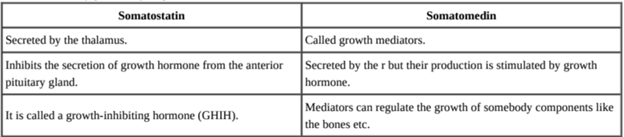
19. Difference between Somatostatin and Somatomedin.
View AnswerAns.
20. Define a taxon. Give some examples of taxa at different hierarchical levels.
View AnswerAns. A taxon is a particular level of hierarchy in the system of classification of living beings. The following figure gives taxa at different hierarchical levels:
Kingdom
Phylum
Class
Order
Family
Genus
Species
21. Why does a green plant start evolving CO2, instead of O2 on a hot summer day? Explain.
View AnswerAns. It is due to photorespiration. With an increase in temperatures as on a hot summer day, the affinity of RuBP carboxylase for CO2 reduces. It increases for O2. Therefore, more and more photosynthetically fixed carbon is lost by photorespiration.
OR
Can girdling experiments be done in monocots? If yes, How? If no, why not?
View AnswerAns. Girdling experiments cannot be done in monocots. The stem of monocot has vascular bundles scatter all over the width of the stem. Hence, we cannot reach a specific band of phloem for girdling.
Section C
22. Bryophytes are found in which diverse habitats. Describe briefly.
View AnswerAns. Bryophytes commonly grow in moist, shaded areas in hills. These are also called amphibians of the plant kingdom because, these can live in soil, but are dependent on water for sexual reproduction.
Some bryophytes grow in diverse habitats, such as
i. Aquatic, e.g. Riccia, Ricciocarpus, Riella
ii. Epiphyte, e.g. Radula, Dendroceros
iii. Saprophyte, e.g. Buxbaumia, Cryptothalius
iv. Dry habitats, e.g. Polytrichum
v. Deserts, e.g., Tortula desertorum
vi. Dry rocks, e.g., Porella
23. Comment upon the habitats and external features of animals belonging to class, amphibia.
View AnswerAns. The amphibians are adapted to dual/ double mode of life that is on land as well as in water called amphibians animals. Adults move on land by the limbs and breath by lungs. There are no marine forms. Aquatic forms e.g. Newt and Salamanders have gills. Frogs and toads are terrestrial. Toad occurs on dry land but the frog is found near water in marshy zones. Tree frogs like Hyla and Rhacophorus are arboreal (live on the trees). They do not have a tail but adhesive discs on toes and web, frog produces in water.
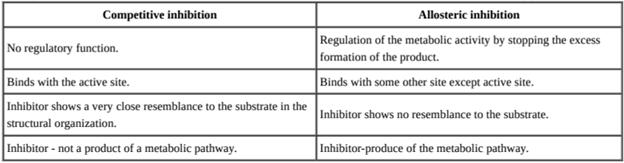
24. Distinguish between Competitive and Allosteric inhibition.
View AnswerAns.
25. i. What is meant by bioassay? Name the two bioassays that are used to examine auxin activity in plants.
View AnswerAns. A bioassay means “the evaluation of the effect of a substance on a living organism under controlled conditions. ” Two bioassays used to examine auxin activity in plants are the following:
a. The avena Curvature Test and
b. Root Growth Inhibition Test.
ii. Name the hormone that acts as an antagonist to abscisic acid. From which microorganism was it extracted initially? List two bioassays of this growth hormone.
View AnswerAns. Abscisic acid (ABA): It is a phytohormone that acts antagonist to gibberellins. Gibberellin was initially extracted from the fungus named Gibberella fujikuroi. Two bioassays of this growth hormone are the following:
a. Shoot elongation is some dwarf stems and
b. Barley Endosperm test.
26. Given below is a diagram of the human cranial bones. Answer the following questions:
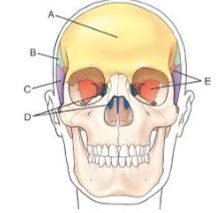
i. Identify the different parts labelled from A to E of cranial bones.
View AnswerAns. The different parts of cranial bones are as follows:
1. A- FRONTAL
2. B-PARIETAL
3. C-TEMPORAL
4. D-OCCIPITAL
5. E-ETHMOID
ii. Name the only movable bone in the skull of man?
View AnswerAns. The mandible is the only movable bone in the skull of the man.
iii. Due to the presence of which pigment skeletal muscles are categorised into red and white muscles?
View AnswerAns. On the basis of the presence or absence of a red pigment called myoglobin, the skeletal muscles are classified into red and white muscles.
27. Write a note on regulation of cardiac activity.
View AnswerAns. The normal activities of the heart are intrinsically regulated, i.e., autoregulated by the specialised muscles, (nodal tissue). Thus, the heart is known as a myogenic heart.
The neurogenic heartbeat is initiated by a nerve impulse, e.g., annelids and most arthropods. The rate of its formation and conduction is regulated by the following
i. Neural Regulation: In medulla oblongata, a special neural centre is present, which can moderate, the cardiac function through the Autonomic Nervous System (ANS).
ii. Hormonal Regulation: Adrenaline and noradrenaline hormones secreted by the medulla of adrenal gland has a significant role in regulating heartbeat and thus increasing the cardiac output. The noradrenaline accelerates the heartbeat, while adrenaline does this function at the time of emergency.
OR
What is hypertension? List its causative factors.
View AnswerAns. Hypertension is another name for high blood pressure which is the force exerted by the blood against the walls of the blood vessels. The pressure depends on the work being done by the heart and the resistance of the blood vessels.
Some of its Causative factors are:
i. Age: The risk of high blood pressure increases as a person becomes older because the blood vessels become less flexible.
ii. Ethnic background: African-American people have a higher risk of developing hypertension than other people. Hypertension also presents more severely in African-American people and is less responsive to certain medications.
iii. Obesity and being overweight: People who are overweight or have obesity are more likely to develop high blood pressure.
28. Examine the following diagram and answer the following questions:
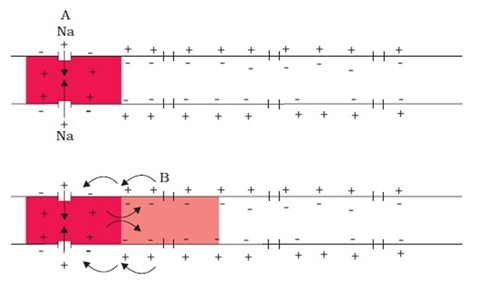
i. What is the diagram representing?
View AnswerAns. It is representing impulse conduction through an axon.
ii. When point A becomes permeable to Na+, what change occurs in the polarity of the membrane.
View AnswerAns. Na+ moves inside the membrane and polarity of the membrane is reversed at point A.
iii. What is the potential difference at point A called?
View AnswerAns. The potential difference at point A is known as the action potential.
Section D
29. Read the following text carefully and answer the questions that follow:
The morphology of the mycelium, mode of spore formation, and fruiting bodies form the basis for the division of the fungi kingdom into various classes which include four sub-division Phycomycetes, ascomycetes, basidiomycetes, Deuteromycetes. Members of Phycomycetes are found in aquatic habitats and on decaying wood in moist and damp places or as obligate parasites on plants, ascomycetes are mostly multicellular. The asexual spores are conidia produced exogenously on the special mycelium called conidiophores. Basidiomycetes are mushrooms, bracket fungi or puffballs. They grow in soil, on logs and tree stumps and in living plant bodies as parasites. The basidiospores are exogenously produced on the basidium.
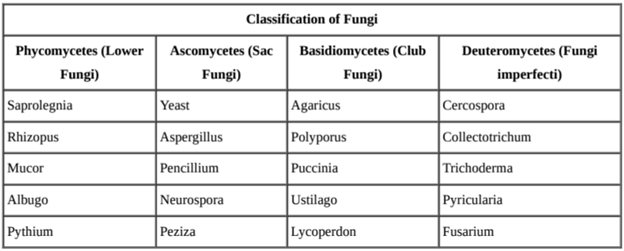
i. Observed given table of Classification of Fungi and identify the class of fungi in which asexual spores are not found, vegetative reproduction occurs by fragmentation, and sexual organs are absent.
View AnswerAns. In basidiomycetes asexual spores are not found, vegetative reproduction occurs by fragmentation, and sexual organs are absent.
ii. Where are Members of Phycomycetes found?
View AnswerAns. i. Aquatic habitats
ii. On decaying wood
iii. What is ascomycetes? What is the characteristic feature of ascomycetes and basidiomycetes?
View AnswerAns. a) Ascomycetes are commonly known as sac-fungi as they are produced in a sac-like structure known as ascus.
b) Dikaryon formation is the characteristic feature of ascomycetes and basidiomycetes.
OR
Identify the figure given below. Also, mention its characteristics.
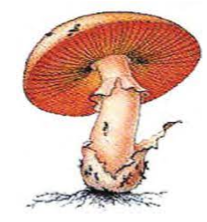
Ans. Agaricus
Agaricus is a fleshy saprophytic fungus with over 300 species and contains both edible and poisonous species. It is found in wet and damp climates. It grows on wood and in humus-rich soil.
30. Read the following text carefully and answer the questions that follow:
Various parts of the plant such as stems leaves, and even fruits are modified into underground parts to perform various functions such as stems, leaves, and even fruits.
The stems in ginger and banana are underground and swollen due to storage of food. They are called rhizome. Rhizome of ginger is a modification of stem because it bears nodes, internodes, terminal buds, scaly leaves and buds, which give rise to aerial shoots. It is not a root because root does not have nodes and internodes. Also, rhizome does not perform the function of roots i.e. anchorage and absorption, rather it serve as reservoir for storage of food. Similarly, corm is an underground stem in Colocasia (jimikand) The tips of the underground stem in potato become swollen due to accumulation of food and forms tuber.
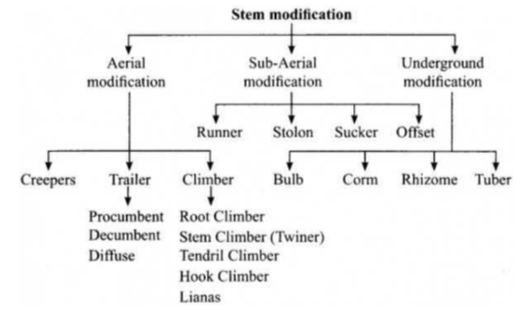
i. Observe the given flow chart and mention what are the four types of Underground stem modification also mention one example of each.
View AnswerAns. Rhizome – Ginger, turmeric. Banana
Bulb – Tulips, Lilies, Daffodils, Onion, Garlic
Corm – Colocasia, Yam, Saffron
Tuber – Potato, Artichokes
ii. Ginger is an underground stem but why it is distinguished from a root?
View AnswerAns. ii. It has nodes and internodes. Such nodes and internodes are not found in the roots.
iii. Why do the tips of modified stems in potatoes become swollen?
View AnswerAns. iii. Modified stem in the potato is underground and it becomes swollen because food gets accumulated to form tubers.
OR
Are all underground parts of a plant roots?
View AnswerAns. No. Many different parts of plants, like the stem, leaves and fruits, get modified to act as underground structures that can perform functions other than those of roots.
Section E
31. Explain, why a pair of homologous chromosomes is genetically different, but a pair of sister chromatids is genetically identical before crossing over in meiosis.
View AnswerAns. A pair of homologous chromosomes are genetically different because in a set of homologous chromosomes, one of the chromosomes belongs to the male parent and the other comes from the female parent. Therefore, one of a pair will contain paternal genes and the other will contain maternal genes.
However, a pair of sister chromatids are genetically identical before crossing over as the chromatids are formed from the replication of DNA during the ‘S’ phase of interphase. DNA replication ensures that the DNA content is doubled with identical genes being copied from the original DNA. Therefore, there is no genetic variation because there is no exchange of genetic material between sister chromatids.
If crossing over occurs, then it would be possible for some genes to be exchanged between the chromatids of homologous chromosomes that have chiasmata, thus leading to genetic variation.
OR
Comment on the statement – Meiosis enables the conservation of specific chromosome number of each species even though the process per se, results in reduction of chromosome number.
View AnswerAns. Meiosis is called reduction division because the number of chromosomes in daughter cells becomes half of the number of chromosomes in mother cells. In spite of this, meiosis enables the conservation of specific chromosome number of each species. In fact, has there been no meiosis, organisms would not have been able to evolve to sexual mode of reproduction. We know that fertilization involves fusion of male and female gametes. Thus, zygote gets the chromosome pool from two cells and the number of chromosomes in a zygote becomes double that of the gametes. To ensure conservation of specific chromosome number after fertilization, it is necessary that the gametes should have half the number of chromosomes compared to what it is in somatic cells.
32. Where is the electron transport system operative in mitochondria? Explain the system highlighting the role of oxygen.
View AnswerAns. Electron Transport System (ETS): The metabolic pathway by which the electrons passes from one carrier to another is known as the electron transport system. It is operative in the inner mitochondrial membrane of mitochondria. The electrons from NADH produced in the mitochondrial matrix during the citric acid cycle are oxidised by an NADH dehydrogenase (Complex I). Electrons are then transferred to Ubiquinone that receives reducing equivalents via FADH, {generated during oxidation of succinate) by the activity of Succinic dehydrogenase (Complex II) in TCA. Reduced ubiquinone is oxidised with the transfer of electrons to cytochrome V via Cytochrome V complex (complex III). Cytochrome V acts carrier for transfer of electrons between complex III and complex IV. Complex IV refers to cytochrome c oxidase complex having cytochromes a and centres.
OR
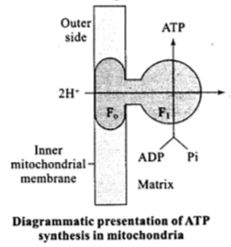
Given below is a diagram showing ATP synthesis during aerobic respiration, replace the symbols A, B, C, D and E by appropriate terms given in the box.
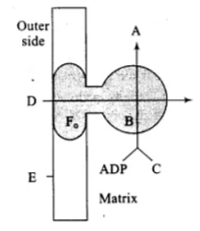
F1, Particle, Pi, 2H+, Inner mitochondrial membrane, ATP, Fo particle, ADP
View AnswerAns. The energy released during the electron transport system is utilized in synthesizing ATP with the help of ATP synthase (complex V). This complex consists of two major components, F1 and F0. The F1 headpiece is a peripheral membrane protein complex and contains the site for synthesis of ATP from ADP and inorganic phosphate. F0 is an integral membrane protein complex that forms the channel through which protons across the inner membrane. The passage of protons through the channel is coupled to the catalytic site of the F1 component for the production of ATP. For each ATP produced, 2H+ passes through F0 from the intermembrane space to the matrix down the electrochemical proton gradient.
33. Describe the structure of the membrane as proposed in fluid mosaic model.
View AnswerAns. Structure of Plasma Membrane: Fluid mosaic model of the plasma membrane was suggested by S. Singer and G. Nicholson in 1972. According to this model, the lipids and proteins are arranged in a mosaic fashion. The matrix is the highly viscous fluid of two layers of phospholipids having two types of protein molecules-extrinsic and intrinsic proteins. The phospholipids layer is bimolecular and their hydrophilic ends are pointed towards top and bottom respectively. Peripheral 0extrinsic) proteins are superficially arranged on either side and can be easily separated. They have enzymatic properties and also make membrane as selectively permeable. Integral (intrinsic) proteins are tightly held in place by strong hydrophilic or hydrophobic interactions or both are difficult to remove from the membranes.
OR
What are the characteristics of prokaryotic cells?
View AnswerAns. Prokaryotic Cells. In prokaryotic cells nuclear membrane is absent. It means that genetic materials are without an envelope. Cell lumen is filled with a fluid called cytoplasm. Cytoplasm contains ribosomes as well. Bacteria, and blue green algae are prime examples of prokaryotes. Cell Envelope. Most prokaryotic cells, particularly the bacterial cells, have a chemically complex cell envelope. The cell envelope consists of a tightly bound three layered structure i.e., the outermost glycocalyx followed by the cell wall and then the plasma membrane. Although each layer of the envelope performs distinct function, they act together as a single protective unit. The plasma membrane is semi-permeable in nature and interacts with the outside world. This membrane is similar structurally to that of the eukaryotes. A special membranous structure is the mesosome which is formed by the extensions of plasma membrane into the cell. These extensions are in the form of vesicles, tubules and lamellae. They help in cell wall formation, DNA replication and distribution to daughter cells. They also help in respiration, secretion processes, to increase the surface area of the plasma membrane and enzymatic content. In some prokaryotes like cyanobacteria, there are other membranous extensions into the cytoplasm called chromatophores which contain pigments.