Sample Paper 5
Class X 2025-26
Social Science (087)
Time Allowed: 3 Hours Maximum Marks: 80
General Instructions:
1. There are 38 questions in the Question paper. All questions are compulsory.
2. The question paper has Four Sections – A-History, B-Geography C- Political Science, and D- Economics.
3. Each Section is of 20 Marks and has MCQs, VSA, SA, LAs and CBQ. 4. Very Short Answer Type Questions (VSA), carry 2 marks each. Answers to each question should not exceed 40 words.
5. Short Answer Type Questions (SA), carry 3 marks each. Answers to each question should not exceed 60 words.
6. Long answer type questions (LA), carry 5 marks each. Answers to each question should not exceed 120 words.
7. There are case based questions (CBQ) with three sub questions and are of 4 marks each. Answers to each question should not exceed 100 words.
8. The map-based questions, carry 5 marks with two parts- Q9. In Section A-History (2 marks) and Q19. In Section B -Geography (3 marks)
9. There is no overall choice in the question paper. However, an internal choice has been provided in few questions. Only one of the choices in such questions must be attempted.
10. In addition to this, NOTE that a separate question has been provided for Visually Impaired candidates in lieu of questions having visual inputs, map etc. Such questions are to be attempted by Visually Impaired candidates only.
SECTION-A
HISTORY (20 marks)
1. Match the following terms/events in Column A with their correct description in Column B.
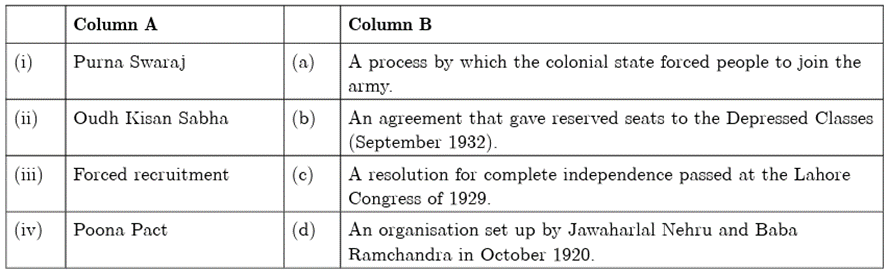
Options:
(A) i-b, ii-a, iii-d, iv-c
(B) i-d, ii-c, iii-b, iv-a
(C) i-c, ii-d, iii-a, iv-b
(D) i-a, ii-b, iii-c, iv-d
Ans. (C) i-c, ii-d, iii-a, iv-b
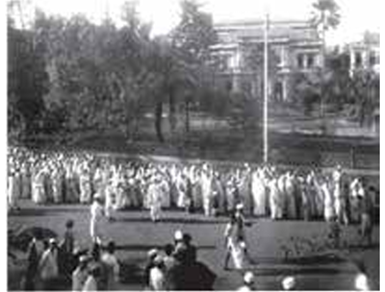
2. The image shows women participating in a nationalist procession. This large-scale public participation of women, including old women and mothers with children, was a significant feature of which movement?
(a) The Rowlatt Satyagraha
(b) The Non-Cooperation Movement
(c) The Civil Disobedience Movement
(d) The Swadeshi Movement
Ans. (c) The Civil Disobedience Movement
3. What was the main demand of the peasant movement in Awadh, led by Baba Ramchandra?
(a) Ownership of the land they cultivated
(b) Abolition of the salt tax
(c) Reduction of revenue and abolition of begar
(d) Separate electorates for peasants
Ans. (c) Reduction of revenue and abolition of begar
4. Who founded the ‘Depressed Classes Association’ in 1930 to organize the dalits?
(a) Mahatma Gandhi
(b) Jawaharlal Nehru
(c) Dr. B.R. Ambedkar
(d) Sardar Vallabhbhai Patel
Ans. (c) Dr. B.R. Ambedkar
5. A. “The First World War led to a huge increase in defence expenditure.” How was this expenditure financed by the British government in India?
Ans. 1. War Loans and Taxes: The British government in India financed the increased defence expenditure during the First World War through war loans and higher taxes on the population.
2. New Taxes Introduced: Customs duties were raised, and income tax was introduced to generate additional revenue for the war effort.
or
B. Briefly describe the key terms of the Gandhi-Irwin Pact of March 1931.
Ans. 1. Gandhiji’s Consent: Under the Gandhi-Irwin Pact of March 1931, Mahatma Gandhi agreed to participate in the Round Table Conference in London, which the Congress had previously boycotted.
2. Government’s Agreement: The British government agreed to release political prisoners arrested during the Civil Disobedience Movement.
6. A. How did the image of Bharat Mata become a powerful symbol of the Indian nation? Explain with three points.
Ans. 1. Visual Identity for the Nation: The image of Bharat Mata gave a visual form to the abstract idea of the nation, allowing people to emotionally identify India as their motherland. 2. Creation and Popularisation: Bankim Chandra Chattopadhyay’s hymn Vande Mataram inspired the image, which was famously painted by Abanindranath Tagore in 1905 during the Swadeshi movement.
3. Cultural Symbol of Nationalism: It became a unifying symbol that evoked patriotism and devotion to the nation.
or
B. Why did Mahatma Gandhi feel the need to launch a more broad-based movement in India after the Rowlatt Satyagraha?
Ans., 1. Limited Reach of Rowlatt Satyagraha: The earlier movement was mostly confined to cities and towns; Gandhi wanted to involve all sections of society, including rural India. 2. Need for Hindu-Muslim Unity: He believed a mass movement required close cooperation between Hindus and Muslims, which had not fully occurred earlier.
3. The Khilafat Issue: Supporting the Ottoman Khalifa provided an opportunity to unite Hindus and Muslims on a common national platform.
7. A. “The industrial working classes did not participate in the Civil Disobedience Movement in large numbers.” Analyse the reasons for their limited participation and describe the nature of their involvement where it did occur.
Ans. The participation of the industrial working classes in the Civil Disobedience Movement was indeed limited and selective.
1. Workers’ Alienation from Congress: As industrialists supported the Congress financially, workers tended to stay aloof. The Congress avoided including workers’ demands to prevent alienating industrialists and dividing anti-imperial forces.
2. Focus on Local Grievances: Where workers participated, they linked Gandhian ideas to their own struggles against low wages and poor working conditions, rather than participating directly for ‘swaraj’.
3. Example of Participation (Nagpur): The Nagpur region was a notable exception, with a significant number of workers actively joining the movement.
4. Symbolic Participation: In other areas, workers showed solidarity through symbolic acts, such as wearing Gandhi caps and joining rallies or boycott campaigns.
5. Strikes and Boycotts: Railway workers (1930) and dockworkers (1932) went on strike, coinciding with the Civil Disobedience Movement and reinforcing the overall atmosphere of anti- colonial protest.
or
B. Explain the process of the reinterpretation of history by Indian nationalists. How did this help in creating a sense of collective belonging?
Reinterpreting Indian history was a crucial cultural process used by nationalists to create a sense of pride and collective belonging.
- Countering the British Perspective: Nationalists began by challenging the colonial portrayal of Indians as backward and incapable of self-governance, which harmed Indian self respect.
- Discovering a Glorious Past: Historians and intellectuals explored India’s ancient achievements in art, architecture, science, mathematics, religion, law, and trade, highlighting a period of greatness.
- Creating a Narrative of Decline: They emphasized that colonization led to India’s decline, fostering a shared sense that the present hardships were abnormal and needed correction.
- Instilling National Pride: By celebrating India’s past achievements, these reinterpretations encouraged pride and helped develop a common national identity across diverse communities.
- A Call to Action: This historical reinterpretation motivated Indians to work towards reclaiming their nation’s glory, linking cultural awareness with active participation in the nationalist movement.
8. Read the source given below and answer the questions that follow.
The Idea of Satyagraha Mahatma Gandhi returned to India in January 1915 from South Africa, where he had successfully fought the racist regime with a novel method of mass agitation called satyagraha. The idea of satyagraha emphasised the power of truth and the need to search for truth. It suggested that if the cause was true and if the struggle was against injustice, then physical force was not necessary to fight the oppressor. Without seeking vengeance or being aggressive, a satyagrahi could win the battle through non-violence. This could be done by appealing to the conscience of the oppressor. People – including the oppressors – had to be persuaded to see the truth, instead of being forced to accept truth through the use of violence. By this struggle, truth was bound to ultimately triumph. Mahatma Gandhi believed that this dharma of non-violence could unite all Indians. After arriving in India, he successfully organised satyagraha movements in various places, starting in 1917 in Champaran, Bihar, to inspire peasants against the oppressive plantation system 12121212.
- According to the passage, what is the core principle of satyagraha?
Ans. The core principle of satyagraha is the power of truth and the idea that if a cause is true and the struggle is against injustice, physical force is not necessary.
- How does a satyagrahi fight against injustice without using physical force?
Ans. A satyagrahi fights against injustice through non-violence by appealing to the conscience of the oppressor, persuading them to see the truth instead of using force.
3. What did Mahatma Gandhi believe this “dharma of non-violence” could achieve, and where did he first organise a satyagraha movement in India?
Ans. Mahatma Gandhi believed that the dharma of non-violence could unite all Indians. He first successfully organised a satyagraha movement in Champaran, Bihar, in 1917.
MAP SKILL-BASED QUESTION (2 marks)
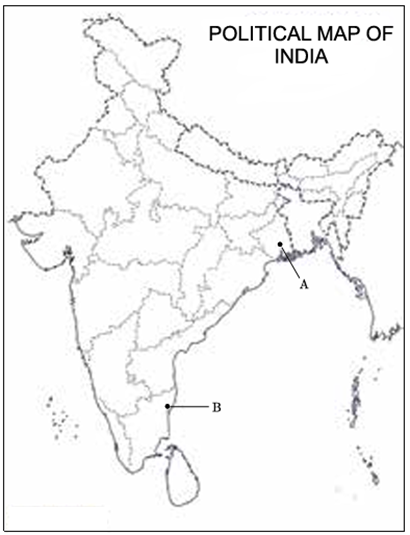
9. Two places A and B have been marked on the given outline map of India. Identify them on the map and write their correct names on the line drawn near them.
A. A place where Congress session was held in 1920.
B. A place where Congress session was held in 1927.
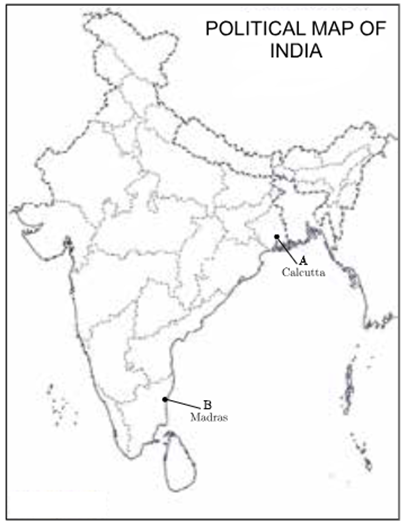
Ans. (A) Calcutta
(B) Madras
SECTION-B
GEOGRAPHY (20 marks)
10. Which of the following best describes the significance of the manufacturing sector for a country’s economic development?
(a) It exclusively helps in modernising agriculture.
(b) It is considered the backbone of development as it creates jobs and adds value to raw materials.
(c) It reduces a country’s dependence on the tertiary sector.
(d) Its main purpose is to export raw materials to other countries.
Ans. (b) It is considered the backbone of development as it creates jobs and adds value to raw materials.
11. Identify the appropriate options to fill in the empty boxes regarding the classification of industries based on the source of raw materials.
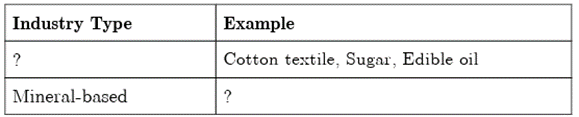
(a) Forest-based, Iron and Steel
(b) Agro-based, Iron and Steel
(c) Marine-based, Cement
(d) Agro-based, Aluminium Smelting
Ans. (b) Agro-based, Iron and Steel
12. Country ‘A’ primarily exports raw cotton and imports finished cloth. Country ‘B’ imports raw cotton but processes it to export high-quality yarn and garments.
Based on the concept of value addition in manufacturing, what can be inferred about the economic prosperity of these two countries?
(a) Country ‘A’ is likely to be more prosperous as it has the raw material.
(b) Country ‘B’ is likely to be more prosperous as it transforms raw materials into higher-value finished goods.
(c) Both countries are likely to be equally prosperous.
(d) The export of raw materials is always more profitable than finished goods.
Ans. (b) Country ‘B’ is likely to be more prosperous as it transforms raw materials into higher-value finished goods.
13. Based on their main role, which of the following industries is considered a ‘basic’ or ‘key’ industry because its finished product is used as a raw material by many other heavy, medium, and light industries?
(a) Sugar Industry
(b) Textile Industry
(c) Iron and Steel Industry
(d) Automobile Industry
Ans. (c) Iron and Steel Industry
14. The first successful textile mill in India was established in 1854 in which of the following cities?
(a) Kolkata
(b) Ahmedabad
(c) Mumbai
(d) Chennai
Ans. (c) Mumbai
15. Which of the following statements best evaluates the primary reason for the concentration of jute mills along the banks of the Hugli river in West Bengal?
(a) The region has a dry climate which is ideal for processing raw jute.
(b) The government of West Bengal does not allow jute mills to be set up anywhere else.
(c) The area offers a unique combination of proximity to raw jute areas, inexpensive water transport, and abundant cheap labour.
(d) The raw material for the jute industry is primarily imported through the Kolkata port.
Ans. (c) The area offers a unique combination of proximity to raw jute areas, inexpensive water transport, and abundant cheap labour.
16. In recent years, sugar mills have been shifting to southern and western states like Maharashtra. Using your understanding of geographical and economic factors, explain two reasons for this migration of the industry.
Ans. This shift is occurring for two main reasons:
1. Higher Sucrose Content: The cane produced in these states has a higher sucrose content, which results in a greater quantity of sugar from the same amount of cane.
2. Longer Crushing Season: The cooler climate in these regions ensures a longer crushing season, allowing the mills to operate for more months in a year.
17. A. “Agriculture and industry are not exclusive of each other; they move hand in hand.” Justify this statement by evaluating five points of interdependence between the two sectors.
Ans. Agriculture and industry are deeply interdependent for the following five reasons:
1. Raw Material Supply: Industries, particularly agro-based industries like textile, sugar, and edible oil, depend on agriculture for their primary raw materials.
2. Market for Industrial Goods: Industry provides key inputs to agriculture, thereby acting as a market. Farmers buy products like tractors, irrigation pumps, fertilisers, and pesticides from industries.
3. Increased Agricultural Productivity: The manufacturing industry has assisted agriculturists in increasing their production. The development of efficient machinery and chemical inputs has made production processes in agriculture very efficient.
4. Employment Shift: Manufacturing industries reduce the heavy dependence of people on agricultural income by providing them with alternative jobs in the secondary and tertiary sectors.
5. Transport and Trade: The development of transport and trade, facilitated by the industrial sector, helps farmers sell their surplus produce in wider markets and connects agricultural regions with industrial hubs.
or
B. “Industrial pollution is a major threat to the environment.” Justify this statement by evaluating five different types of pollution caused by industries and their specific sources.
Ans. Industries are a major source of environmental pollution in five key ways:
1. Air Pollution: Industries cause air pollution by releasing undesirable gases like sulphur dioxide and carbon monoxide. Smoke and particulate matter are emitted by chemical factories, refineries, and the burning of fossil fuels. 2. Water Pollution: Water pollution is caused when organic and inorganic industrial wastes are discharged into rivers. Paper, chemical, and textile industries are major culprits, releasing dyes, detergents, acids, and heavy metals.
3. Thermal Pollution: This occurs when hot water from factories and thermal power plants is drained into rivers and ponds before cooling. This sudden change in water temperature is very harmful to aquatic life.
4. Land Pollution: Land and soil pollution are caused by the dumping of industrial wastes, especially glass, harmful chemicals, and garbage, which renders the soil useless. Rainwater can also carry these pollutants into the groundwater. 5. Noise Pollution: Unwanted sound from industrial and construction activities, machinery, and generators causes noise pollution. This not only results in irritation but can also cause hearing impairment and increased heart rate.
18. Read the given text and answer the following questions:
The iron and steel industry is the basic industry since all other industries—heavy, medium, and light— depend on it for their machinery. Production and consumption of steel are often regarded as the index of a country’s development. It is a heavy industry because all the raw materials as well as the finished goods are heavy and bulky, entailing heavy transportation costs. Iron ore, coking coal, and limestone are required in the approximate ratio of 4:2:1. Some quantity of manganese is also required to harden the steel. In India, the Chhotanagpur plateau region has the maximum concentration of iron and steel industries. This is largely because of the relative advantages this region has for the development of this industry. These include the low cost of high-grade iron ore, the proximity of other raw materials, cheap labour, and the vast growth potential in the home market. The industry has played a crucial role in India’s economic growth, providing the foundational material for construction, defence, engineering goods, and a variety of consumer goods.
- What are the three main raw materials required for the iron and steel industry?
Ans. The three main raw materials are iron ore, coking coal, and limestone.
2. Why is the iron and steel industry called a ‘heavy industry’?
Ans. It is called a ‘heavy industry’ because all its raw materials and finished goods are heavy and bulky, resulting in heavy transportation costs. advantage exists
3. “Chhotanagpur plateau region has the maximum concentration of iron and steel industries.” Analyse the reasons for this specific locational advantage.
Ans. This specific locational because the Chhotanagpur plateau offers a perfect combination of factors. It provides low- cost high-grade iron ore, has other essential raw materials in close proximity, has access to cheap labour, and is near a vast home market with significant growth potential.
MAP SKIlL-BASED QUESTION (3 marks)
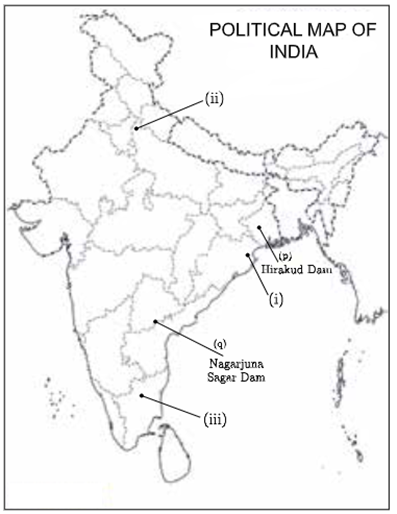
19. On the same outline map of India, locate and label any three of the following with suitable Symbols:
I. (p) The dam built on the Mahanadi River.
OR
(q) A major dam on the Krishna River.
II. Any two of the following:
- Paradwip-Major Seaport
- Noida-Software Technology Park
- Salem-Iron and Steel industry
Ans. I (p) Hirakud Dam
Or
(q) Nagarjuna Sagar Dam
SECTION-C
POLITICAL SCIENCE (20 marks)
20. Which of the following statement(s) are true regarding the functions of political parties?
I. Parties contest elections by putting up candidates.
II. Parties play a decisive role in making laws for a country.
III. Parties provide people access to government machinery and welfare schemes.
IV. Parties do not shape public opinion; this is the exclusive role of the media.
Choose the correct option:
(a) I and II only
(b) I, II and III
(c) II and IV
(d) All of the above
Ans. (b) I, II and III
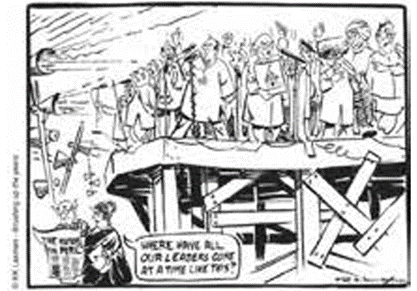
21. The cartoon below depicts a common person reading a newspaper with the headline “THE NATION IN PERIL” while a crowd of politicians is busy on a stage. What does this suggest about the popular perception of political parties?
(a) Parties are highly popular and trusted by the people.
(b) Parties are often seen as self-serving and disconnected from the real problems of the nation.
(c) Parties work together harmoniously to solve the nation’s problems.
(d) The common person has no interest in the activities of political leaders.
Ans. (b) Parties are often seen as self-serving and disconnected from the real problems of the nation.
22. Consider the following case and choose the correct option
In a democracy, after an election, Party ‘X’ secures a majority and forms the government. Party ‘Y’, which won the second-largest number of seats, regularly voices different views and criticises the government for its failures and wrong policies.
What role is Party ‘Y’ playing in this democracy?
(a) The role of the ruling party.
(b) The role of a pressure group.
(c) The role of the judiciary.
(d) The role of the opposition.
Ans. (d) The role of the opposition.
23. Two statements are given below as Assertion (A) and Reason (R). Read the statements and choose the most appropriate option.
Assertion (A): Modern democracies cannot exist without political parties.
Reason (R): Political parties are needed to gather different views, form a responsible government, and provide a mechanism to support or restrain the government.
(a) Both A and R are true, and R is the correct explanation of A.
(b) Both A and R are true, but R is not the correct explanation of A.
(c) A is true but R is false.
(d) A is false but R is true.
Ans. (a) Both A and R are true, and R is the correct explanation of A.
24. What are the three components of a political party?
Ans. A political party consists of three main components: 1. The Leaders: Who formulate policies and choose candidates.
2. The Active Members: Who are involved in different party activities.
3. The Followers: Who believe in the party’s ideology and support it.
25. ‘Lack of internal democracy is the first and a major challenge faced by political parties all over the world.’ Highlight any two ways this challenge manifests within parties.
Ans. The lack of internal democracy manifests within parties in the following ways:
1. Concentration of Power: There is a tendency for power to be concentrated in the hands of one or a few leaders at the top, who make all the decisions.
2. No Regular Elections: Parties often do not keep membership registers, hold organisational meetings, or conduct internal elections regularly, preventing ordinary members from rising to the top.
26. ‘Parties shape public opinion.’ Support this statement with suitable arguments.
Ans. Political parties shape public opinion in these ways:
1. They raise and highlight important issues, bringing them to the forefront of public debate and discussion.
2. They use their large network of members and activists spread across the country to influence people directly at the grassroots level.
3. Often, public opinion crystallises along the lines that parties take, solidifying the public’s stance on key issues.
27. A. ‘Dynastic succession is one of the most serious challenges before political parties.’ Explain the statement with five points.
Ans. Dynastic succession is a major challenge that undermines the functioning of democratic parties.
1. Lack of Transparency: Since most political parties do not have open and transparent procedures, there are very few ways for an ordinary worker to rise to the top.
2. Unfair Advantage to Leaders: Those who happen to be the leaders are in a position of unfair advantage to favour people close to them or even their family members.
3. Control by One Family: In many parties, the top positions are always controlled by members of one family, which is unfair to other members of that party.
4. Inexperienced Leaders: This is also bad for democracy, since people who do not have adequate experience or popular support come to occupy positions of power simply due to their family connections.
5. Present in Older Democracies: This tendency is not just limited to India but is present in some measure all over the world, including in some of the older democracies.
or
B. ‘Several efforts have been made in India to reform political parties and their leaders.’ Analyse any five such efforts and suggestions.
Ans. Several recent efforts and suggestions have been made to reform political parties in India.
1. Anti-Defection Law: The Constitution was amended to prevent elected MLAs and MPs from changing parties (defection). Now, if any MLA or MP changes parties, he or she will lose their seat in the legislature.
2. Affidavit on Criminal/Property Details: The Supreme Court passed an order making it mandatory for every candidate who contests elections to file an affidavit giving details of their property and criminal cases pending against them.
3. Mandatory Organisational Elections: The Election Commission passed an order making it necessary for political parties to hold their organisational elections and file their income tax returns.
4. Law for Internal Regulation (Suggestion): A suggestion often made is that a law should be passed to regulate the internal affairs of political parties, making it compulsory for them to maintain a register of members and hold open elections for the highest posts.
5. State Funding of Elections (Suggestion): Another suggestion is that there should be state funding of elections. The government could give parties money to support their election expenses, either in kind (petrol, paper) or in cash, to reduce their dependence on big money.
28. Read the given text and answer the following questions.
In a democracy, any group of citizens is free to form a political party. Based on the number of effective parties, party systems can be of different types. In some countries, only one party is allowed to control and run the government; these are called one-party systems. In others, power usually changes between two main parties; this is a two-party system. When several parties compete for power and more than two have a reasonable chance of coming to power, either on their own or in alliance with others, it is called a multiparty system. India has a multi-party system. This system allows a variety of interests and opinions to enjoy political representation but can sometimes appear messy and lead to political instability.
1. Why is a one-party system not considered a good option for a democracy?
Ans. A one-party system is not a democratic option because it does not permit free competition for power, which is essential for a democracy.
2. Name one country which is an example of a two-party system.
Ans. The United States of America or the United Kingdom are examples of a two-party system.
3. Explain why India has evolved a multi-party system.
Ans. (i) India has evolved a multi-party system because of its vast social and geographical diversity.
(ii) Such a large and diverse country is not easily absorbed by two or even three parties, and the multi-party system allows a variety of interests and opinions to enjoy political representation.
SECTION-D
ECONOMICS (20 marks)
29. The sector that covers activities that help in the development of the primary and secondary sectors by generating services is known as the:
(a) Primary Sector
(b) Secondary Sector
(c) Tertiary Sector
(d) Organized Sector
Ans. (c) Tertiary Sector
30. What can be inferred about the calculation of Gross Domestic Product (GDP)?
(a) It includes the value of all goods and services, including intermediate goods.
(b) It includes the value of only the final goods and services to avoid double counting.
(c) It only counts the production from the secondary and tertiary sectors.
(d) It is calculated by adding up the income of all the residents of a country.
Ans. (b) It includes the value of only the final goods and services to avoid double counting.
31. Which of the following examples best demonstrates an enterprise from the private sector?
(a) The Indian Post Office
(b) A company like Reliance Industries Limited (RIL).
(c) A government-run hospital.
(d) The National Thermal Power Corporation (NTPC).
Ans. (b) A company like Reliance Industries Limited (RIL).
32. The situation where people are apparently working but are made to work less than their potential is called:
(a) Seasonal Unemployment
(b) Cyclical Unemployment
(c) Disguised Unemployment (Underemployment)
(d) Structural Unemployment
Ans. (c) Disguised Unemployment (Underemployment)
33. The Mahatma Gandhi National Rural Employment Guarantee Act (MGNREGA), 2005, guarantees what to the rural population?
(a) Free healthcare services for 100 days.
(b) 100 days of wage employment in a year.
(c) Free education for all children.
(d) A pension after the age of 60.
Ans. (b) 100 days of wage employment in a year.
34. Recognize and choose the option that correctly matches the term with its description.
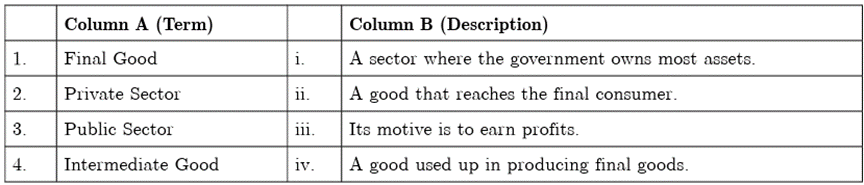
Choose the correct option:
(a) 1-iv, 2-iii, 3-i, 4-ii
(b) 1-ii, 2-iv, 3-i, 4-iii
(c) 1-ii, 2-iii, 3-i, 4-iv
(d) 1-iv, 2-ii, 3-iii, 4-i
Ans. (c) 1-ii, 2-iii, 3-i, 4-iv
35. Evaluate the utility of the primary sector for an economy, giving two examples of its activities.
Ans. The primary sector is of fundamental utility as it forms the base for all other economic activities.
1. Forms the Base: The primary sector forms the base for all other economic activities by supplying essential inputs.
2. Provides Natural Products: It produces goods by exploiting natural resources, for example, cultivation of cotton.
3. Supplies Raw Materials: It provides raw materials for the secondary sector, such as milk from dairy animals, which is used in food processing and other industries.
36. ‘There has been a change in the share of the three sectors in GDP, but a similar shift has not taken place in employment.’ Justify this statement with reference to the Indian economy.
Ans. This statement is justified by the economic data from India.
1. Shift in GDP: In recent decades, the tertiary sector’s share in India’s GDP has grown significantly, while the primary sector’s share has declined.
2. Stagnation in Employment: Despite this, employment has not shifted correspondingly, and workers have not moved out of the primary sector in large numbers.
3. Primary Sector Dominance: Agriculture and other primary activities still employ more than half of India’s workforce.
37. Highlight three significant benefits that workers in the organised sector enjoy that those in the unorganized sector do not.
Ans. Workers in the organized sector enjoy several significant benefits not available to unorganized sector workers.
1. Job Security: Workers in the organized sector enjoy regular employment with assured work, unlike the unorganized sector.
2. Paid Leave and Holidays: They receive paid leave and holiday pay, which is generally absent for unorganized workers.
3. Social Security Benefits: Organized sector employees are entitled to social security benefits like provident fund, gratuity, and pensions, offering long-term financial protection.
38. A. ‘Rules and regulations are required to protect workers in the unorganized sector.’ Support this statement with arguments, explaining the vulnerabilities these workers face.
Ans. This statement is true because workers in the unorganized sector are highly vulnerable and require government protection through rules and regulations.
1. Nature of the Sector: The unorganized sector consists of small, scattered units largely outside government control. Although rules exist, they are often ignored, leaving workers unprotected.
2. Low and Irregular Pay: Employment is low-paid and irregular, with no provision for overtime, leading to financial exploitation and income instability.
3. No Job Security: Workers have no job security and can be dismissed without reason, especially during lean periods, leaving them vulnerable to sudden loss of income.
4. Absence of Benefits: There is no paid leave, holidays, or social security benefits like provident fund or pensions, unlike the organized sector, depriving workers of long-term protection.
5. Vulnerability of Social Groups: Many workers belong to socially disadvantaged groups, facing both economic exploitation and discrimination, making government rules and regulations essential for their welfare.
OR
B. How can we create more employment in a country like India? Suggest five measures to tackle the problem of unemployment, particularly in rural areas.
Ans. Creating more employment in India requires a multi-pronged approach, especially in rural areas where underemployment is widespread.
1. Investment in Rural Infrastructure: The government can create jobs by investing in construction of dams, canals, roads, and other infrastructure, which also boosts agricultural productivity.
2. Providing Cheap Credit: Offering affordable agricultural loans enables farmers to buy
inputs, expand production, and employ more workers on their farms.
3. Promoting Local Industries and Services: Establishing small industries and service units like dal mills or cold storage in semi-rural areas can generate local employment opportunities. 4. Improving Education and Training: Investing in education and vocational training equips youth with skills to work productively and find better jobs.
5. Implementing Employment Guarantee Schemes: Laws like MGNREGA guarantee work for rural households, creating productive assets and providing a direct solution to unemployment in villages.