Sample Paper 3
Class X 2025-26
Social Science (087)
Time Allowed: 3 Hours Maximum Marks: 80
General Instructions:
1. There are 38 questions in the Question paper. All questions are compulsory.
2. The question paper has Four Sections – A-History, B-Geography C- Political Science, and D- Economics.
3. Each Section is of 20 Marks and has MCQs, VSA, SA, LAs and CBQ. 4. Very Short Answer Type Questions (VSA), carry 2 marks each. Answers to each question should not exceed 40 words.
5. Short Answer Type Questions (SA), carry 3 marks each. Answers to each question should not exceed 60 words.
6. Long answer type questions (LA), carry 5 marks each. Answers to each question should not exceed 120 words.
7. There are case based questions (CBQ) with three sub questions and are of 4 marks each. Answers to each question should not exceed 100 words.
8. The map-based questions, carry 5 marks with two parts- Q9. In Section A-History (2 marks) and Q19. In Section B -Geography (3 marks)
9. There is no overall choice in the question paper. However, an internal choice has been provided in few questions. Only one of the choices in such questions must be attempted.
10. In addition to this, NOTE that a separate question has been provided for Visually Impaired candidates in lieu of questions having visual inputs, map etc. Such questions are to be attempted by Visually Impaired candidates only.
SECTION-A
HISTORY (20 marks)
- Match the following figures/publications in Column A with their correct description in Column B.
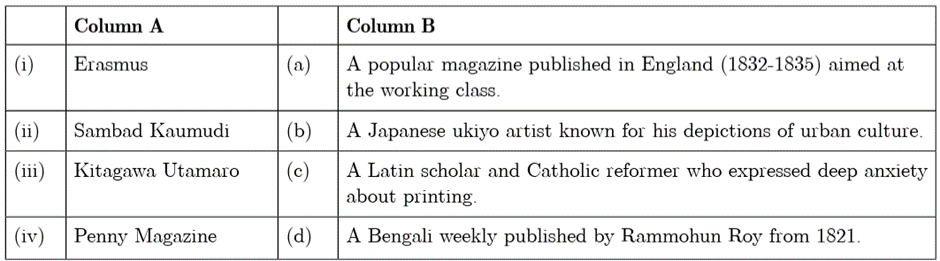
(A) i-b, ii-d, iii-a, iv-c
(B) i-d, ii-a, iii-c, iv-b
(C) i-c, ii-d, iii-b, iv-a
(D) i-a, ii-c, iii-b, iv-d
View AnswerAns. (C) i-c, ii-d, iii-b, iv-a
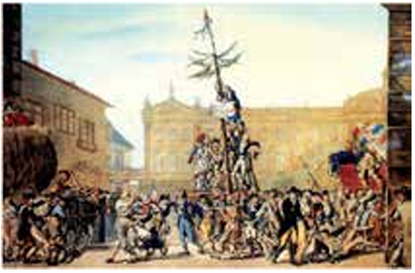
2. What sarcastic reference is being made by the plaque being affixed to the Tree of Liberty in the image below?
(a) It is a genuine celebration of the French as liberators.
(b) It is satirizing the French claim of being liberators while acting as oppressors.
(c) It is a demand for the German people to plant more trees of liberty.
(d) It is a plaque thanking the French soldiers for their support.
View AnswerAns. (b) It is satirizing the French claim of being liberators while acting as oppressors.
3. What was the most powerful weapon used by the Spanish conquerors in the colonization of America?
(a) Superior military firepower and cannons
(b) The use of cavalry in battles
(c) Germs, such as those of smallpox, against which the natives had no immunity
(d) Diplomatic treaties and alliances with native leaders
View AnswerAns. (c) Germs, such as those of smallpox, against which the natives had no immunity
4. The phrase “the world shrank” in the sixteenth century implies that
(a) The physical size of the continents was reducing.
(b) The population of the world was declining rapidly.
(c) Global interconnectedness and awareness between different continents increased significantly.
(d) The importance of world trade was diminishing.
View AnswerAns. (c) Global interconnectedness and awareness between different continents increased significantly.
5. A. What were the ‘Silk Routes,’ and why were they significant in the pre-modern world?
View AnswerAns. 1. The Silk Routes were vibrant pre-modern trade networks linking Asia with Europe and North Africa.
2. They were significant not only for trading goods like silk and spices but also for facilitating cultural exchanges, including the spread of religions like Buddhism and Christianity.
or
B. How did the introduction of new crops from the Americas make a difference to the lives of people in Europe?
View AnswerAns. 1. The introduction of new crops from the Americas, like the potato, improved the diet of Europe’s poor, helping them to eat better and live longer.
2. These crops became so crucial that when disease destroyed the potato crop in Ireland, hundreds of thousands died of starvation.
6. A. “Print and popular religious literature stimulated many distinctive individual interpretations of faith.” Explain this statement with three examples from Europe.
View AnswerAns. Print enabled individuals to access and interpret religious texts on their own:
1. Martin Luther: The religious reformer Martin Luther wrote his Ninety Five Theses criticising the Catholic Church. Print allowed his ideas to be reproduced in vast numbers, leading to the Protestant Reformation.
2. Menocchio the Miller: In Italy, a miller named Menocchio read available books and reinterpreted the message of the Bible, formulating a view of God that angered the Church and led to his execution.
3. Spread of New Ideas: Luther’s translation of the New Testament sold 5,000 copies in a few weeks. This widespread access to religious texts in the vernacular helped create a new intellectual atmosphere and encouraged people to question the authority of the Church.
or
B. How did new forms of publication, like novels and lyrics, change the experience of reading in nineteenthcentury India?
View AnswerAns. New literary forms transformed the reading experience in India:
1. Reflecting Personal Lives: The novel, a literary form that had developed in Europe, catered to a new appetite for reading. It allowed people to see their own lives, experiences, emotions, and relationships reflected in what they read.
2. Opening New Worlds: For readers, novels opened up new worlds of experience and gave a vivid sense of the diversity of human lives, moving beyond purely religious or epic tales.
3. Focus on Intimate Feelings: Other new forms like lyrics, short stories, and essays reinforced a new emphasis on human lives and intimate feelings. They also explored the political and social rules that shaped such things, making reading a more personal and reflective activity.
7. A. “From the early nineteenth century, there were intense debates around religious issues in India, carried out in public and in print.” Elaborate on this statement with examples from both Hindu and Muslim communities.
View AnswerAns. In nineteenth-century India, print became a powerful medium for public debates on religion and social reform.
1. Creation of a Public Sphere: Printed tracts and newspapers not only spread new ideas but also shaped the nature of the debate. A wider public could now participate in these discussions and express their views, leading to clashes of opinions and the emergence of new ideas.
2. Hindu Reform Debates: In Bengal, intense controversies raged between social reformers and the Hindu orthodoxy over matters like widow immolation, monotheism, and idolatry. Reformers like Rammohun Roy published the Sambad Kaumudi (1821) to argue their case, while orthodox groups commissioned the Samachar Chandrika to oppose his opinions.
3. Muslim Concerns and Print: In north India, the ulama (Muslim legal scholars) were anxious about the collapse of Muslim dynasties and feared that colonial rulers would encourage conversion. To counter this, they used cheap lithographic presses to publish Persian and Urdu translations of holy scriptures and religious newspapers.
4. Role of Islamic Seminaries: The Deoband Seminary, founded in 1867, published thousands of fatwas telling Muslim readers how to conduct themselves in their everyday lives and explaining the meanings of Islamic doctrines, using print to consolidate their interpretation of faith.
5. Intra-Community Debates: Print also helped different sects and seminaries within Islam conduct their battles in public. Each group used print to enlarge its following and counter the influence of its opponents, making these debates widely accessible.
or
B. Explain how the relationship between the colonial state and the press in India evolved from before 1798 to the passing of the Vernacular Press Act in 1878.
View AnswerAns. The colonial state’s attitude towards the press in India evolved from relative indifference to stringent control.
1. Early Indifference (Before 1798): Initially, the
East India Company was not too concerned with censorship. Its early control measures were directed not at Indians, but at Englishmen in India who were critical of Company misrule, fearing these criticisms could be used by rivals in England.
2. First Regulations (1820s): By the 1820s, the Calcutta Supreme Court passed certain regulations to control press freedom. The Company also began encouraging the publication of newspapers that would celebrate British rule, showing a growing awareness of the press’s influence.
3. Liberal Interlude (1835): In 1835, following petitions by editors, Governor-General Bentinck agreed to revise press laws. Thomas Macaulay, a liberal official, formulated new rules that restored earlier freedoms, marking a brief liberal phase.
4. Post-1857 Attitude Shift: The attitude towards press freedom changed dramatically after the Revolt of 1857. Enraged Englishmen demanded a clampdown on the ‘native’ press as it became more assertively nationalist and critical of colonial rule.
5. The Vernacular Press Act (1878): This growing hostility culminated in the Vernacular Press Act of 1878. Modelled on the Irish Press Laws, it provided the government with extensive rights to censor reports and editorials in the vernacular press. It allowed the government to warn newspapers and, if the warning was ignored, to seize the press and confiscate the machinery.
8. Read the source given below and answer the questions that follow.
The Reading Mania By the end of the eighteenth century, as literacy and schools spread, there was a virtual ‘reading mania’ in parts of Europe. People wanted books and printers produced them in ever-increasing numbers. New forms of literature appeared, targeting new audiences. In England, penny chapbooks were sold by pedlars, so that even the poor could buy them. By the mid-eighteenth century, there was a common conviction that books were a means of spreading progress and enlightenment. Many believed that books could change the world, liberate society from despotism and tyranny, and herald a time when reason would rule. Louise-Sebastien Mercier, a novelist in France, declared: ‘The printing press is the most powerful engine of progress and public opinion is the force that will sweep despotism away.’ Convinced of the power of print in bringing enlightenment and destroying the basis of despotism, Mercier proclaimed: ‘Tremble, therefore, tyrants of the world! Tremble before the virtual writer!’ In many of his novels, heroes are transformed by the act of reading, becoming enlightened in the process.
1. According to the passage, what was the ‘reading mania’?
View AnswerAns. The ‘reading mania’ refers to a period at the end of the eighteenth century when, due to rising literacy, there was a huge and growing demand for books among the common people of Europe.
2. What was the common conviction about books in the mid-eighteenth century?
View AnswerAns. The common conviction was that books were a means of spreading progress and enlightenment and that they could change the world by liberating society from despotism and tyranny.
3. How did Louise-Sebastien Mercier describe the power of the printing press, and what was his message to the “tyrants of the world”?
View AnswerAns. Mercier described the printing press as the ‘most powerful engine of progress’. His message to the tyrants was to “Tremble before the virtual writer!’, implying that the power of the printed word would ultimately destroy their despotic rule.
MAP SKILL-BASED QUESTION (2 marks)
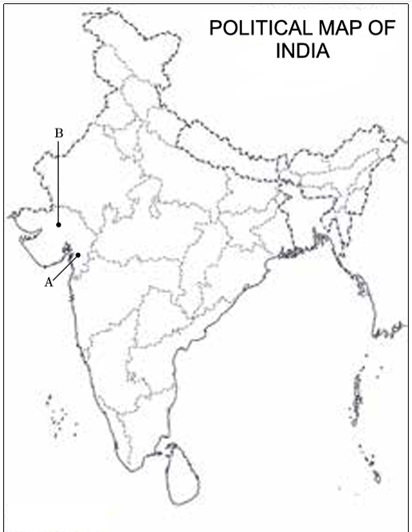
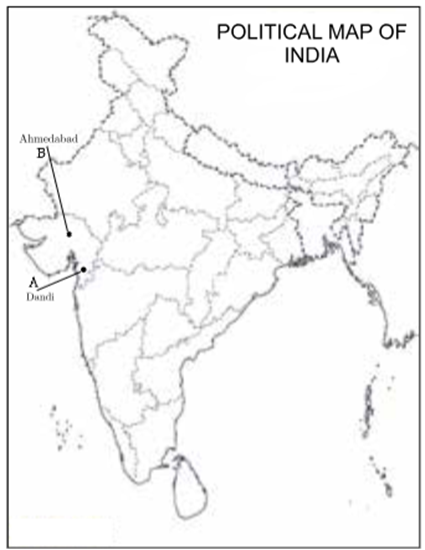
9. Two places A and B are marked on that given outline map of India. Identify them and write their correct names on the lines drawn near them.
(A) A place where Civil Disobedience Movement started.
(B) A place where Gandhiji went to organise a Satyagraha Movement amongst cotton mill workers.
Ans. (A) Dandi
(B) Ahmedabad
SECTION-B
GEOGRAPHY (20 marks)
10. Industries which are jointly run by the state and individuals or a group of individuals, such as Oil India Ltd. (OIL), are known as which of the following?
(a) Public sector industries
(b) Private sector industries
(c) Joint sector industries
(d) Cooperative sector industries
View AnswerAns. (c) Joint sector industries
11. Identify the appropriate options to fill in the empty boxes regarding different types of industrial pollution.

(a) Chemical wastes, Land Pollution
(b) Undesirable gases like SO2, CO, Thermal Pollution
(c) Agricultural runoff, Noise Pollution
(d) Plastic waste, Water Pollution
View AnswerAns. (b) Undesirable gases like SO2, CO, Thermal Pollution
12. Country ‘A’ has a policy to develop its manufacturing industries to transform its abundant raw materials into a wide variety of finished goods of higher value. Country ‘B’ continues to primarily export its raw materials without processing them.
Based on the principles of economic development, what is the most likely long-term outcome for Country ‘A’?
(a) It will become less developed than Country ‘B’.
(b) It will become more prosperous by adding value to its resources.
(c) It will face a severe shortage of raw materials for its own use.
(d) Its economy will become entirely dependent on agriculture.
View AnswerAns. (b) It will become more prosperous by adding value to its resources.
13. Based on your understanding of industrial ownership, which of the following is a key example of a cooperative sector industry, which is owned and operated by the producers or suppliers of raw materials, and is particularly successful in states like Maharashtra?
(a) Iron and Steel industry
(b) Automobile industry
(c) Sugar industry
(d) Cement industry
View AnswerAns. (c) Sugar industry
14. NTPC, a major power-providing corporation in India, has a proactive approach to preserving the natural environment and has received a certification for its effective system. What is this certification for?
(a) Quality Management System (ISO 9001)
(b) Environment Management System (ISO 14001)
(c) Occupational Health and Safety (ISO 45001)
(d) Information Security Management (ISO 27001)
View AnswerAns. (b) Environment Management System (ISO 14001)
15. Which of the following statements best evaluates the primary reason why the economic strength of a country is measured by the development of its manufacturing industries?
(a) Because manufacturing is the only sector that generates employment.
(b) Because manufacturing industries are the primary source of a country’s food supply.
(c) Because manufacturing adds value, modernises agriculture, creates jobs, and earns foreign exchange.
(d) Because a country’s military power depends entirely on its manufacturing industries.
View AnswerAns. (c) Because manufacturing adds value, modernises agriculture, creates jobs, and earns foreign exchange.
16. The chemical industry is often described as its own largest consumer. Using your understanding of its production chain, explain two reasons why this is the case.
View AnswerAns. This is the case for two main reasons:
1. Intermediate Products: Basic chemicals like sulphuric acid undergo further processing to produce other chemicals, such as fertilisers or plastics.
2. Internal Value Chain: The products of one process within the industry become the raw materials for another, creating a complex internal value chain where the industry consumes its own output.
17. A. “The iron and steel industry is the basic industry and the backbone of a country’s development.” Justify this statement by evaluating five ways in which this industry supports the national economy.
View AnswerAns. The iron and steel industry is fundamental to the national economy for these five reasons:
1. Provides Raw Material: It is a basic or key industry because its products, iron and steel, are the primary raw materials for all other industries, including heavy, medium, and light sectors.
2. Foundation for Machinery: All industries depend on it for their machinery and tools. Without a strong iron and steel sector, a country cannot develop a robust industrial base.
3. Infrastructure Development: Steel is needed to manufacture a variety of materials for infrastructure development, such as construction materials for buildings, bridges, and dams.
4. Supports Key Sectors: It provides essential materials for crucial sectors like defence for making equipment, as well as for transport, medical, and scientific equipment.
5. Index of Development: The production and consumption of steel are often regarded as an index of a country’s development, reflecting its level of industrialisation and economic strength.
or
B. “Industries can adopt several measures to control environmental degradation.” Justify this statement by evaluating five different steps that can be taken to reduce the industrial pollution of fresh water.
View AnswerAns. Industries can indeed control water pollution through several measures:
1. Minimising Water Use: Water usage can be minimized by reusing and recycling it in two or more successive stages during the manufacturing process.
2. Rainwater Harvesting: Industries can meet their water requirements by harvesting rainwater, which reduces the pressure on existing freshwater bodies like rivers and groundwater. 3. Treating Hot Water and Effluents: Hot water and industrial effluents must be treated before being released into rivers and ponds. This prevents thermal and chemical pollution of the water bodies.
4. Primary and Secondary Treatment: Industrial effluents can be treated in phases. Primary treatment involves mechanical means like screening and sedimentation, while secondary treatment uses biological processes to remove pollutants.
5. Tertiary Treatment: The most advanced stage, tertiary treatment, involves biological, chemical, and physical processes. This often includes the recycling of wastewater, making the industry more sustainable.
18. Read the given text and answer the following questions:
The automobile industry provides vehicles for the quick transport of goods, services, and passengers. A wide variety of vehicles, such as trucks, buses, cars, motorcycles, and scooters, are manufactured in India at various centres. The major turning point for the industry came after the liberalisation policy in the 1990s. The entry of new and contemporary models from global manufacturers stimulated the demand for vehicles in the market. This led to the healthy growth of the industry, including passenger cars, two-wheelers, and three-wheelers. This industry has a significant presence in industrial hubs located around Delhi, Gurugram, Mumbai, Pune, Chennai, and Kolkata. The growth of the automobile sector has had a multiplier effect on the economy. It has not only attracted foreign investment and created jobs but has also become a major earner of foreign exchange through exports. Its development has also boosted the growth of ancillary industries that manufacture components like tyres, batteries, and auto-electrical parts.
1. According to the passage, what major policy change stimulated demand for vehicles in the market?
View AnswerAns. The major policy change that stimulated demand was the liberalisation policy in the 1990s.
2. Name any one major centre for automobile manufacturing in India.
Ans. A major centre for automobile manufacturing is Gurugram (or Delhi, Mumbai, Pune, Chennai).
[/expand]3. “The automobile industry has witnessed healthy growth in recent decades.” Analyse the impact of this growth on the Indian economy.
View AnswerAns. This statement is accurate because the growth of the automobile industry has had a wide- ranging positive impact on the Indian economy. It has attracted significant foreign investment, created numerous jobs, and boosted the growth of related industries that manufacture auto components. Furthermore, it has become a major earner of foreign exchange through the export of vehicles.
MAP SKILL-BASED QUESTION (3 marks)
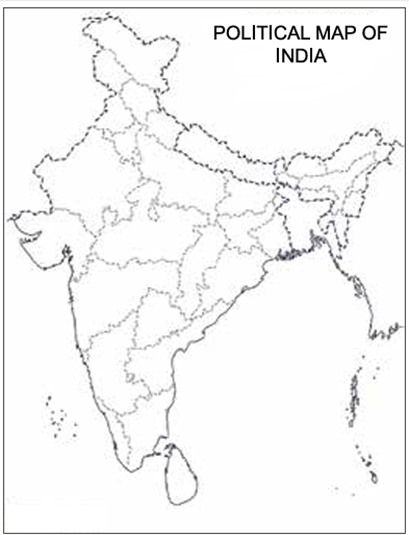
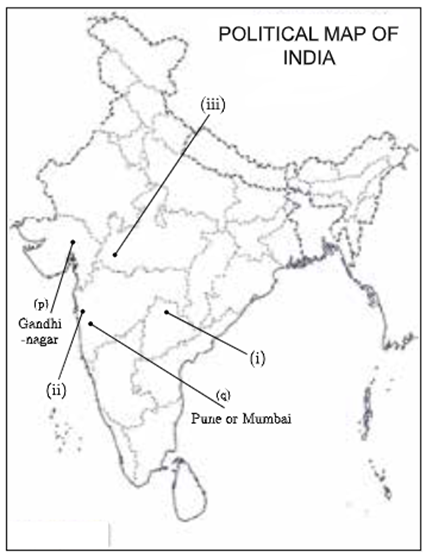
19. On an outline political map of India, locate and label the following with suitable symbols:
I. (p) A software technology park in Gujarat.
or
(q) A software technology park in Maharashtra.
View AnswerAns. (p) Software Technology Park in Gujarat: Gandhinagar.
Or
Ans. (q) Software Technology Park in Maharashtra: Pune or Mumbai.
II. Any two of the following:
- Ramagundan-Thermal power plant
- Tarapur-Atomic power plant
- Indore-Cotton textile Industry center
Ans.
SECTION-C
POLITICAL SCIENCE (20 marks)
20. Which of the following statement(s) are true regarding the recent efforts to reform political parties in India?
I. The anti-defection law was passed to prevent elected MLAs and MPs from changing parties.
II. The Supreme Court made it mandatory for candidates to file an affidavit detailing their property and criminal cases.
III. The Election Commission ordered parties to hold organisational elections and file income tax returns.
IV. A law has now been passed that makes state funding of elections compulsory for all parties.
Choose the correct option:
(a) I and II only
(b) I, II and III
(c) II and IV
(d) All of the above
View AnswerAns. (b) I, II and III
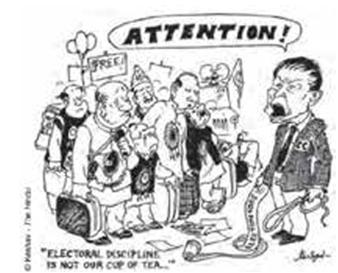
21. The cartoon below portrays the Election Commission’s attempt to enforce the ‘Election Code of Conduct’. What does the politicians’ reaction suggest about their attitude towards such reforms?
(a) Political parties are eager to accept all reforms proposed by the EC.
(b) Political parties believe that electoral discipline is easy to follow.
(c) Political parties are often resistant to being regulated and find such discipline inconvenient.
(d) The Election Commission has no real power to enforce its code of conduct.
View AnswerAns. (c) Political parties are often resistant to being regulated and find such discipline inconvenient.
22. Consider the following case and choose the correct option A political party contests elections only in the state of Odisha. In the recent State Legislative Assembly election, it secured 8% of the total votes and won 5 seats. According to the criteria of the Election Commission, how would this party be classified?
(a) As a National party.
(b) As a State party.
(c) As an unrecognized party.
(d) As a pressure group.
View AnswerAns. (b) As a State party.
23. Two statements are given below as Assertion (A) and Reason (R). Read the statements and choose the most appropriate option.
Assertion (A): In recent years, many major political parties do not seem to offer a meaningful choice to the voters.
Reason (R): This is because the ideological differences among these parties have reduced, and they often agree on fundamental aspects, differing only in details.
(a) Both A and R are true, and R is the correct explanation of A.
(b) Both A and R are true, but R is not the correct explanation of A.
(c) A is true but R is false.
(d) A is false but R is true.
View AnswerAns. (a) Both A and R are true, and R is the correct explanation of A.
24. Differentiate between a ‘ruling party’ and an ‘opposition party’.
View AnswerAns. 1. Ruling Party: A political party that runs the government after winning a majority of seats in an election is called the ruling party.
2. Opposition Party” Parties that lose the election play the role of opposition. They voice different views and criticise the government for its failures.
25. ‘Dynastic succession is unfair to other members of a political party and is also bad for democracy.’ Highlight any two negative consequences of this challenge.
View AnswerAns. Dynastic succession has the following negative consequences:
1. Blocks Ordinary Workers: It prevents ordinary and capable party workers from rising to the top positions, as leadership posts are controlled by one family.
2. Promotes Inexperience: It is bad for democracy because people who may not have adequate experience or popular support come to occupy positions of power.
26. ‘The rise of political parties is directly linked to the emergence of representative democracies.’ Support this statement with suitable arguments.
View AnswerAns. This statement is correct for these reasons:
1. As societies became large, they needed an agency to gather different views on various issues and present them to the government.
2. Parties fulfill the need to bring various representatives together to form a responsible government, which would otherwise be unstable.
3. They provide a mechanism to support or restrain the government, making large-scale representative democracy functional.
27. A. ‘In a democracy, the final decision is made by leaders who represent political parties, making reforms difficult.’ Explain the statement and suggest any five ways in which political parties can be reformed.
View AnswerAns. The statement highlights a key dilemma: since party leaders themselves are the decision-makers, they are often unwilling to pass laws that would regulate them or curb their power. However, several reforms can be implemented.
Suggestions for Reform:
1. Law for Internal Democracy: A law should be made to regulate the internal affairs of political parties. It should be compulsory for them to maintain a member register and hold open elections for the highest posts.
2. Quota for Women: It should be made mandatory for political parties to give a minimum number of tickets, about one-third, to women candidates. There should also be a quota for women in the party’s decision-making bodies.
3. State Funding of Elections: The government should give parties money to support their election expenses. This could reduce the influence of big money and corporate donations on party policies.
4. Pressure from the People: People can put pressure on political parties to reform. This can be done through petitions, publicity, agitations, and the media.
5. Increased Public Participation: Political parties can improve if more good people who want reforms join them. The quality of democracy depends on the degree of public participation, and the problem of bad politics can be solved by more and better politics.
or
B. ‘Political parties perform a series of crucial functions in a democracy.’ Analyse any five of these functions.
View AnswerAns. Political parties are central to a democracy as they perform several essential functions.
1. Contest Elections: Parties select their candidates and put them up in elections. This process gives voters a clear choice between different potential leaders and policies.
2. Put Forward Policies and Programmes: Parties articulate different policies and programmes on major issues. They reduce a vast multitude of opinions into a few basic positions, which helps voters make informed decisions.
3. Make Laws: Parties play a decisive role in making laws for a country. Formally, laws are debated and passed in the legislature, but since most members belong to a party, they follow the party leadership’s direction.
4. Form and Run Governments: The party that wins a majority in elections forms and runs the government. Parties recruit leaders, train them, and then make them ministers to run the government according to the party’s platform. 5. Play the Role of Opposition: Parties that lose elections play the crucial role of opposition. They hold the government accountable by criticising its failures and wrong policies, and they mobilize opposition to the government, ensuring that alternative viewpoints are heard.
28. Read the given text and answer the following questions.
Seema, a resident of a small village, needed to get a government welfare card made for her elderly mother. She spent weeks visiting the local government office, but the officials were unresponsive. Frustrated, she approached Mr. Sharma, the local leader of a major political party. Mr. Sharma, whom she knew from the village, immediately made a phone call to the concerned department. Within a week, an officer visited Seema’s house to complete the formalities, and the card was issued. Seema felt a sense of gratitude towards the political party, even though she didn’t fully trust politicians in general. This experience made her feel more connected to the party than to the government administration.
1. Which function of a political party is illustrated in this case?
View AnswerAns. This case illustrates the function of providing people access to government machinery and welfare schemes.
2. Why was it easier for Seema to approach the local party leader than a government officer?
View AnswerAns. It was easier for Seema because the local party leader was more accessible and personally known to her, unlike a government officer who might seem distant and unresponsive.
3. Explain why this function makes political parties popular and necessary for ordinary citizens.
View Answer3. (i) This function makes parties popular because they act as a responsive link between citizens and the often-slow government bureaucracy, helping people solve their problems quickly.
(ii) It is necessary because, for an ordinary citizen, navigating government procedures can be difficult. Parties fill this gap, making them feel close and connected to the political system.
SECTION-D
ECONOMICS (20 marks)
29. Which of the following is the most appropriate developmental goal for a prosperous farmer from Punjab?
(a) More days of work and better wages.
(b) Assured a high family income through higher support prices.
(c) Freedom to decide what she wants to do in life.
(d) Access to a local school with quality education.
View AnswerAns. (b) Assured a high family income through higher support prices.
30. The World Bank uses Per Capita Income to classify countries. Which of the following is a major limitation of this criterion?
(a) It considers only the agricultural output of a country.
(b) It does not account for the total population of the country.
(c) It provides a clear picture of social equality and justice.
(d) It hides the disparities in the distribution of income.
View AnswerAns. (d) It hides the disparities in the distribution of income.
31. Kerala has a better Human Development ranking than Haryana despite having a lower per capita income. Which of the following factors is primarily responsible for this?
(a) Higher industrial growth in Kerala.
(b) Better provision of public facilities like health and education.
(c) Greater agricultural production in Kerala.
(d) A higher number of urban centres in Kerala.
View AnswerAns. (b) Better provision of public facilities like health and education.
32. Which one of the following organizations publishes the Human Development Report?
(a) The World Bank
(b) World Trade Organisation (WTO)
(c) United Nations Development Programme (UNDP)
(d) International Monetary Fund (IMF)
View AnswerAns. (c) United Nations Development Programme (UNDP)
33. “The Earth has enough resources to meet the needs of all but not enough to satisfy the greed of even one person.” This statement is relevant to the discussion of which developmental concept?
(a) National Development
(b) Human Development
(c) Economic Development
(d) Sustainable Development
View AnswerAns. (d) Sustainable Development
34. Which of the following best demonstrates why public facilities are crucial for a country’s development?
(a) They are always profitable ventures for private companies to invest in.
(b) They ensure that essential services like education and healthcare are accessible to all citizens, not just the wealthy.
(c) They primarily benefit the urban population, leading to faster city growth.
(d) They reduce the government’s financial burden by being self-sufficient.
View AnswerAns. (b) They ensure that essential services like education and healthcare are accessible to all citizens, not just the wealthy.
35. ‘Different persons can have different as well as conflicting notions of development.’ Explain the statement with an example.
View AnswerAns. It is true that different persons have different and often conflicting developmental goals because their life situations are different.
1. An industrialist may want more dams to get more electricity for their factories.
2. This may submerge the land and disrupt the lives of tribal people who live in that area.
3. The tribals would oppose this, preferring small check dams or tanks to irrigate their land.
36. Why do we use averages for comparison? State any two limitations to their use in the context of development.
View AnswerAns. Averages, such as per capita income, are used for comparing different countries or states because total income is not a useful measure as countries have different populations.
Limitations:
1. Averages hide disparities in the distribution of income among people.
2. They do not tell us about other important aspects of development like literacy, health, and security, which are crucial for the quality of life.
37. Why is the issue of sustainability important for development? Explain with three reasons.
View AnswerAns. Sustainability is important for development because our future is linked together.
1. Future Generations: It ensures that the level of development is maintained for future generations and does not decline.
2. Resource Overuse: Many resources are being overused. For instance, overuse of groundwater is a serious threat in many parts of the country.
3. Resource Exhaustion: Non-renewable resources like crude oil will get exhausted after a few years of use, and we need to find sustainable alternatives.
38. A. ‘For development, people look at a mix of goals’. Support this statement by explaining five non-income developmental goals.
View AnswerAns. For development, people seek a mix of goals as income alone cannot ensure a good quality of life.
Non-material goals play a vital role in overall well- being.
1. Equal Treatment: Everyone desires to be treated equally without discrimination based on caste, creed, or gender.
2. Freedom: People value the freedom to make choices about their profession, education, and lifestyle.
3. Security: Job security and a safe living environment are essential for stability and peace of mind.
4. Respect: Gaining respect and dignity from others enhances self-esteem and social worth.
5. Friendship: Good relationships and friendship enrich life and bring happiness, which money cannot buy.
Thus, non-income goals are as important as material ones in achieving true development.
or
B. What is the main criterion used by the World Bank in classifying different countries? What are the limitations of this criterion? Explain any four limitations.
View AnswerAns. The World Bank classifies countries based on Per Capita Income or average income. Countries with higher per capita income are considered developed, while those with lower income are developing. However, this method has several limitations: 1. Hides Disparities: It ignores unequal income distribution within a country.
2. Ignores Quality of Life: Non-material aspects like freedom, respect, and security are not reflected.
3. Neglects Health Status: Indicators like life expectancy and infant mortality are excluded.
4. Overlooks Education Levels: Literacy rate and attendance ratio are not considered.
5. Excludes Public Facilities: Availability of hospitals, schools, and a clean environment is not measured.
Hence, per capita income alone cannot accurately represent a country’s real development.