Sample Paper 2
Class X 2025-26
Social Science (087)
Time Allowed: 3 Hours Maximum Marks: 80
General Instructions:
1. There are 38 questions in the Question paper. All questions are compulsory.
2. The question paper has Four Sections – A-History, B-Geography C- Political Science, and D- Economics.
3. Each Section is of 20 Marks and has MCQs, VSA, SA, LAs and CBQ. 4. Very Short Answer Type Questions (VSA), carry 2 marks each. Answers to each question should not exceed 40 words.
5. Short Answer Type Questions (SA), carry 3 marks each. Answers to each question should not exceed 60 words.
6. Long answer type questions (LA), carry 5 marks each. Answers to each question should not exceed 120 words.
7. There are case based questions (CBQ) with three sub questions and are of 4 marks each. Answers to each question should not exceed 100 words.
8. The map-based questions, carry 5 marks with two parts- Q9. In Section A-History (2 marks) and Q19. In Section B -Geography (3 marks)
9. There is no overall choice in the question paper. However, an internal choice has been provided in few questions. Only one of the choices in such questions must be attempted.
10. In addition to this, NOTE that a separate question has been provided for Visually Impaired candidates in lieu of questions having visual inputs, map etc. Such questions are to be attempted by Visually Impaired candidates only.
SECTION-A
HISTORY (20 marks)
- Match the following events/terms in Column A with their correct description in Column B.
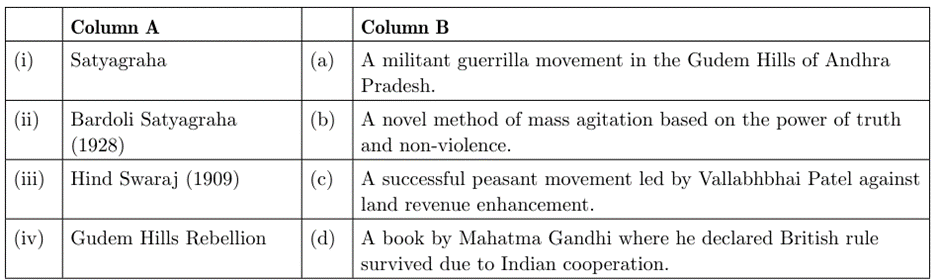
Options:
(A) i-b, ii-c, iii-d, iv-a
(B) i-c, ii-d, iii-a, iv-b
(C) i-d, ii-a, iii-b, iv-c
(D) i-a, ii-b, iii-c, iv-d
View AnswerAns. (A) i-b, ii-c, iii-d, iv-a
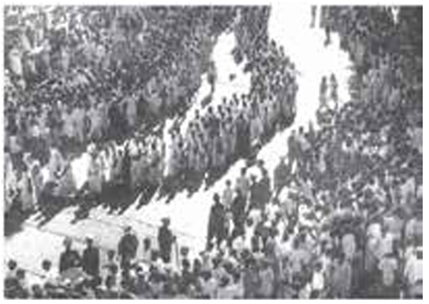
2. The image shows a women’s procession in Bombay. This mass movement, which saw the active participation of thousands of ordinary people including women, was launched in 1942. Which movement is it?
(a) The Non-Cooperation Movement
(b) The Civil Disobedience Movement
(c) The Khilafat Movement
(d) The Quit India Movement
View AnswerAns. (d) The Quit India Movement
3. Why was the Oudh Kisan Sabha set up in October 1920?
(a) To demand ‘Purna Swaraj’ for India
(b) To organize peasants against the oppression of talukdars and landlords
(c) To protest against the Rowlatt Act
(d) To lead the militant tribal movement in Andhra Pradesh
View AnswerAns. (b) To organize peasants against the oppression of talukdars and landlords
4. In 1921, as the Non-Cooperation movement spread, people began discarding imported clothes and wearing only Indian ones. What was the economic effect of this?
(a) A sharp fall in the production of Indian textiles
(b) The import of foreign cloth doubled
(c) The value of cloth imports dropped from Rs 102 crore to Rs 57 crore
(d) British-owned mills in India were shut down
View AnswerAns. (c) The value of cloth imports dropped from Rs 102 crore to Rs 57 crore
5. A. “The sense of being oppressed under colonialism provided a shared bond that tied many different groups together.” Explain this statement.
View AnswerAns. 1. Shared Bond: Experiencing oppression under British colonial rule created a common bond among India’s diverse communities.
2. Basis for Unity: This collective suffering united different groups, fostering the growth of the anti-colonial movement and modern Indian nationalism.
or
B. What was the idea of ‘Satyagraha’ according to Mahatma Gandhi?
View AnswerAns. 1. Power of Truth: Satyagraha emphasized the importance of truth and the constant pursuit of it.
2. Non-Violent Resistance: It advocated winning against injustice without physical force, using non-violence to appeal to the oppressor’s conscience.
6. A. How did the revival of Indian folklore contribute to the growth of nationalism?
View AnswerAns. The revival of Indian folklore fostered nationalism by:
1. Preserving Culture: Nationalists recorded folk tales, songs, and legends to reflect traditional culture untouched by foreign influence.
2. Discovering Identity: Preserving folklore helped Indians reconnect with their past and build a sense of national pride.
3. Role of Leaders: Figures like Rabindranath Tagore and Natesa Sastri promoted folklore as national literature, expressing the people’s true thoughts and strengthening nationalist sentiment.
or
B. Explain three major problems faced by the peasants of Awadh in the 1920s.
View AnswerAns. The peasants of Awadh in the 1920s faced several problems:
1. Exorbitant Rents: Talukdars and landlords demanded very high rents along with multiple additional cesses.
2. Forced Labor (Begar): Peasants had to work on landlords’ farms without any payment.
3. No Tenure Security: Tenants lacked security over the land they cultivated and were often evicted, preventing them from gaining any land rights.
7. A. Why did Mahatma Gandhi launch the Non-Cooperation Movement? Explain its programme and how it unfolded in the towns.
View AnswerAns. Mahatma Gandhi launched the Non-Cooperation Movement to achieve swaraj by withdrawing Indian cooperation from British rule.
1. Rationale: In Hind Swaraj (1909), Gandhi argued that British rule survived only due
to Indian cooperation and would collapse if Indians refused to cooperate.
2. Uniting Communities: He linked the movement with the Khilafat issue to unite Hindus and Muslims.
3. Programme: The movement involved surrendering government titles and boycotting civil services, army, police, courts, legislative councils, schools, and foreign goods.
4. Urban Participation: Middle-class townspeople joined by leaving government schools and colleges, resigning jobs, and lawyers giving up legal practice.
5. Economic Impact: Foreign goods were boycotted, liquor shops picketed, foreign cloth burnt, reducing imports and boosting Indian textile production.
or
B. Explain the Salt March. Why was it an effective symbol of resistance against colonialism?
View AnswerAns. The Salt March was a key event in the Civil Disobedience Movement and a powerful symbol of resistance.
1. Symbol to Unite: Gandhi chose salt because it was essential for all and the British salt tax highlighted colonial oppression, uniting rich and poor against it.
2. The March: On March 12, 1930, Gandhi and 78 volunteers walked 240 miles from Sabarmati Ashram to Dandi over 24 days.
3. Mass Mobilization: Thousands gathered to hear Gandhi, spreading the message of swaraj and encouraging peaceful defiance of British laws.
4. Start of Civil Disobedience: On April 6, Gandhi broke the law by making salt, marking the beginning of nationwide civil disobedience.
5. Nationwide Impact: The march inspired millions to defy the salt law, turning the struggle for freedom into a mass movement.
8. Read the source given below and answer the questions that follow.
The First World War, Khilafat and Non-Cooperation
The First World War created a new economic and political situation in India. It led to a huge increase in defence expenditure, which was financed by war loans and increasing taxes. Customs duties were raised and income tax was introduced. Through the war years, prices increased, doubling between 1913 and 1918, leading to extreme hardship for the common people. Villages were called upon to supply soldiers, and the forced recruitment in rural areas caused widespread anger. Furthermore, in 1918-19 and 1920-21, crops failed in many parts of India, resulting in acute shortages of food. This was accompanied by an influenza epidemic. According to the census of 1921, 12 to 13 million people perished as a result of famines and the epidemic. People hoped that their hardships would end after the war was over, but that did not happen. At this stage, a new leader, Mahatma Gandhi, appeared and suggested a new mode of struggle 30303030.
- According to the passage, what were two economic consequences of the First World War for the common people in India?
Ans. The two economic consequences were
- Increasing taxes, including new income tax and raised customs duties, and
- Doubling of prices for goods, which caused extreme hardship.
2. What was ‘forced recruitment’, and what was its impact on rural areas?
View AnswerAns. ‘Forced recruitment’ was a process by which the colonial state forced people in villages to join the army. This caused widespread anger in rural areas.
3. Besides the war, what two other major crises occurred in India between 1918 and 1921 that led to millions of deaths?
View AnswerAns. The two other major crises were crop failure in many parts of India, which led to acute food shortages, and a severe influenza epidemic.
MAP SKILL-BASED QUESTION (2 marks)
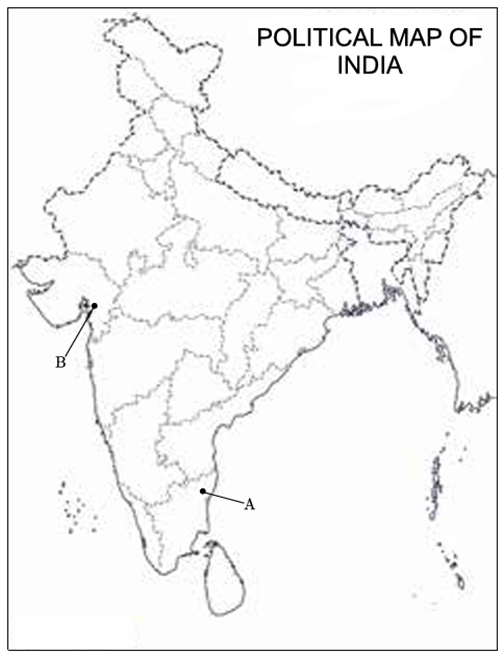
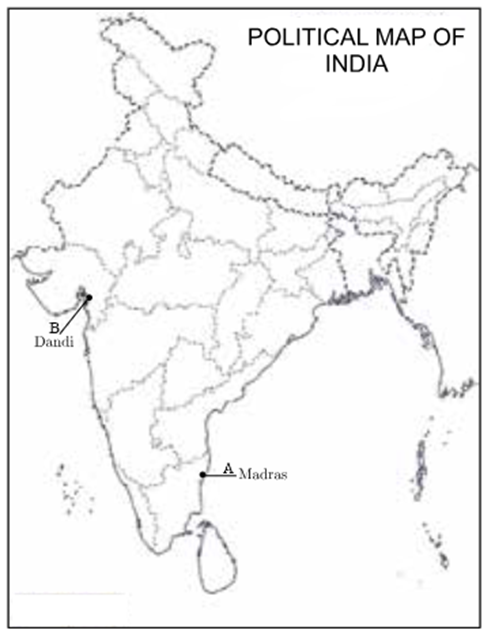
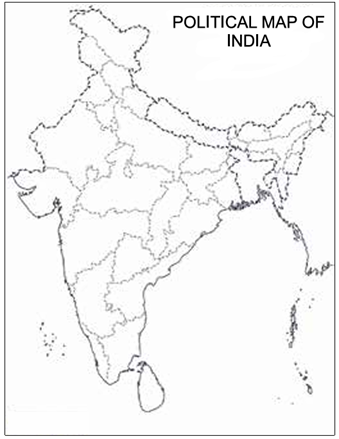
9. Two places A and B are marked on the given outline map of India. Identify them and write their correct names on the lines drawn near them.
A. The location of Indian National Congress Session of 1927.
B. The place where the Civil Disobedience Movement started.
Ans. (A) Madras
(B) Dandi
SECTION-B
GEOGRAPHY (20 marks)
10. The process of transforming raw materials into more valuable products by producing goods in large quantities falls under which of the following economic activities?
(a) Primary activities
(b) Secondary activities
(c) Tertiary activities
(d) Quaternary activities
View AnswerAns. (b) Secondary activities
11. Identify the appropriate options to fill in the empty boxes regarding industrial products and their primary raw materials.
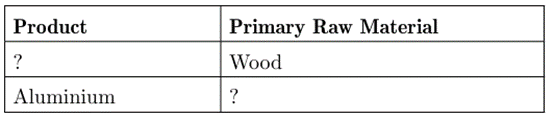
(a) Cement, Bauxite
(b) Sugar, Sugarcane
(c) Paper, Bauxite
(d) Steel, Iron Ore
View AnswerAns. (c) Paper, Bauxite
12. The Government of India has a policy of establishing public sector industries in tribal and backward areas. These regions often lack private investment despite being rich in natural resources.
What is the most likely socio-economic objective behind this policy?
(a) To maximize profits for the government from these industries.
(b) To exclusively use the local raw materials for export.
(c) To bring down regional disparities by generating employment and developing infrastructure.
(d) To relocate urban populations to these less-developed areas.
View AnswerAns. (c) To bring down regional disparities by generating employment and developing infrastructure.
13. Based on the classification of industries by the source of raw materials, which of the following is an example of an agro-based industry?
(a) Cement Industry
(b) Iron and Steel Industry
(c) Sugar Industry
(d) Petrochemical Industry
View AnswerAns. (c) Sugar Industry
14. Which of the following inorganic chemicals is used to manufacture a wide range of products like fertilizers, synthetic fibres, plastics, adhesives, and paints?
(a) Soda Ash
(b) Caustic Soda
(c) Nitric Acid
(d) Sulphuric Acid
View AnswerAns. (d) Sulphuric Acid
15. Which of the following statements best evaluates a major environmental concern associated with the cement industry?
(a) It is the leading cause of thermal pollution in rivers.
(b) It consumes a large amount of water for processing, leading to water scarcity.
(c) It generates a huge quantity of dust, which retards water infiltration and causes air pollution.
(d) It is responsible for the discharge of organic and chemical waste into the soil.
View AnswerAns. (c) It generates a huge quantity of dust, which retards water infiltration and causes air pollution.
16. India has world-class production in spinning, but our weaving sector is weak. Using your understanding of the textile industry, explain two reasons for this disparity.
View AnswerAns. This disparity exists for two main reasons:
- Low Quality of Fabric: The weaving, knitting, and processing units are highly decentralized and cannot use much of the high-quality yarn produced in the country.
- Fragmented Nature: Most of the weaving is done in small, fragmented units, which cater to a local market, unlike the large, modern spinning mills.
17. A. “The electronics industry has had a major impact on India’s economy and society.” Justify this statement by evaluating five key contributions of this industry.
View AnswerAns. The electronics industry has indeed had a major impact for these five reasons:
1. Wide Range of Products: The industry covers a wide range of products from transistor sets and televisions to computers and telecommunication equipment, touching every aspect of modern life.
2. Employment Generation: A major impact of this industry has been on employment generation. The continuing growth in the hardware and software sectors has created a vast number of jobs for skilled professionals.
3. Emergence as a Global Hub: India, particularly Bengaluru, has emerged as the ‘electronic capital’ and a global hub for the IT and electronics industry, attracting foreign investment.
4. Foreign Exchange Earnings: The growth of the software sector, which is a key part of this industry, has been a major earner of foreign exchange through exports.
5. Foundation for Digital India: The electronics industry provides the essential hardware and infrastructure for telecommunication, which is the backbone of India’s digital transformation and knowledge economy.
or
B. “The jute industry in India is highly concentrated in the Hugli basin.” Justify this statement by evaluating five geographical and economic factors responsible for this concentration.
View AnswerAns. The concentration of the jute industry in the Hugli basin is due to these five factors:
1. Proximity to Jute Producing Areas: The region is located right in the heart of the jute-producing areas of West Bengal, ensuring a steady supply of raw material.
2. Inexpensive Water Transport: The Hugli river provides a network of inexpensive water transport, which is crucial for moving the bulky raw material to the mills.
3. Abundant Water for Processing: The processing of raw jute requires an abundant supply of water, which is readily available from the Hugli river.
4. Cheap Labour: The region has access to cheap labour from West Bengal and the adjoining states of Bihar, Odisha, and Uttar Pradesh, which is essential for this labour-intensive industry. 5. Port and Urban Facilities: Kolkata, as a large urban centre, provides crucial facilities like banking, insurance, and a port (Kolkata and Haldia) for the export of jute goods.
18. Read the given text and answer the following questions:
Every litre of waste water discharged by our industry pollutes eight times the quantity of freshwater. To reduce this, industries can minimize water use by reusing and recycling it, harvest rainwater, and treat effluents before release. A corporation that shows the way is NTPC, which has an ISO certification for its Environment Management System (EMS). It has a proactive approach for preserving the natural environment and resources where it is setting up power plants. This has been possible through several measures. It focuses on the optimum utilisation of equipment and upgrading existing equipment to reduce waste. It also works on minimising waste generation by maximising ash utilisation from its thermal plants. NTPC is also engaged in providing green belts for nurturing ecological balance and has adopted special purpose vehicles for afforestation. It has robust systems for ash pond management, ash water recycling, and liquid waste management. Furthermore, it conducts ecological monitoring and reviews for all its power stations.
1. According to the passage, how much freshwater is polluted by every litre of industrial wastewater?
2. Mention any one method suggested for reducing water pollution.
3. “NTPC shows the way for sustainable industrial development.” Analyse this statement based on the measures adopted by the corporation.
View AnswerAns. 1. Every litre of wastewater discharged by industry pollutes eight times the quantity of freshwater.
2. One method suggested is minimising water use by reusing and recycling it or treating effluents before release.
3. This statement is accurate because NTPC has adopted a proactive and multi-faceted approach to sustainability. Instead of just focusing on power generation, it actively works on preserving the environment through measures like maximising ash utilisation, providing green belts for ecological balance, and implementing robust waste and water management systems. This holistic approach makes it a model for sustainable industrial development.
MAP SKILL-BASED QUESTION (3 marks)
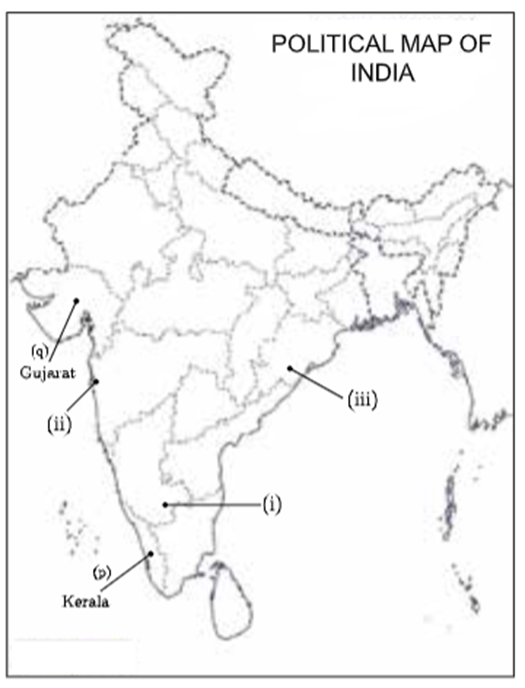
19. On an outline political map of India, locate and label the following with suitable symbols:
I. (p) The leading producer state of Rubber.
View AnswerAns. (p) Leading Rubber Producer: Kerala
Or
(q) The leading producer state of Cotton.
View AnswerAns. (q) Leading Cotton Producer: Gujarat
II. Any two of the following:
- New Mangalore – Major Sea Port
- Mumbai – Software Technology Park
- Bailadila – Iron Ore Mines
Ans.
SECTION-C
POLITICAL SCIENCE (20 marks)
20. Which of the following statement(s) are true regarding the expected positive outcomes of democracy?
I. It promotes equality among citizens.
II. It enhances the dignity of the individual.
III. It is a guarantee of rapid economic development.
IV. It provides a method to resolve conflicts peacefully.
Choose the correct option:
(a) I and III
(b) I, II and IV
(c) II and III
(d) All of the above
View AnswerAns. (b) I, II and IV
21. The cartoon depicts ‘Democracy’ being burdened with multiple demands from all sides. What does this cartoon signify?
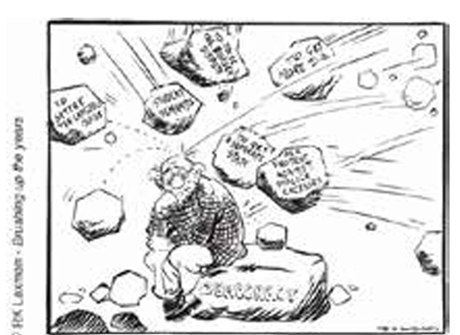
(a) Democracy has failed to address any demands of the people.
(b) In a democracy, people have high expectations and look to it to solve all their problems.
(c) People have no faith in democracy to solve their issues.
(d) Dictatorship is better at handling diverse demands.
View AnswerAns. (b) In a democracy, people have high expectations and look to it to solve all their problems.
22. Consider the following case and choose the correct option
A study comparing all democratic regimes and all dictatorial regimes between 1950 and 2000 finds that the rate of economic growth is slightly higher in dictatorial regimes.
Based on this evidence, what is the most reasonable conclusion?
(a) Dictatorship should be preferred for a country’s development.
(b) Democracy is a guarantee of economic development.
(c) Democracy cannot be rejected on this ground alone as it has several other positive outcomes.
(d) Democracies are incapable of achieving economic growth.
View AnswerAns. (c) Democracy cannot be rejected on this ground alone as it has several other positive outcomes.
23. Two statements are given below as Assertion (A) and Reason (R). Read the statements and choose the most appropriate option.
Assertion (A): A democratic government is a legitimate government.
Reason (R): It may be slow and less efficient, but it is the people’s own government.
(a) Both A and R are true, and R is the correct explanation of A.
(b) Both A and R are true, but R is not the correct explanation of A.
(c) A is true but R is false.
(d) A is false but R is true.
View AnswerAns. (a) Both A and R are true, and R is the correct explanation of A.
24. Highlight any two factors on which the economic development of a country depends.
View AnswerAns. Economic development depends on several factors:
- Country’s population size and global situation.
- Cooperation from other countries and the economic priorities adopted by the country.
25. ‘Democracies do not appear to be very successful in reducing economic inequalities.’ Highlight any two facts that support this statement.
View AnswerAns. This statement is supported by the following facts:
- A small number of ultra-rich individuals enjoy a highly disproportionate share of wealth and incomes.
- In many democratic countries, the poor constitute a large proportion of voters, yet democratically elected governments do not appear to be as keen to address the question of poverty as one would expect.
26. ‘Democracy stands much superior to any other form of government in promoting the dignity and freedom of the individual.’ Support this statement with suitable arguments.
View AnswerAns. Democracy is superior in promoting individual dignity and freedom for these reasons:
1. The passion for respect and freedom are the basis of democracy, recognizing the principle of individual dignity for all.
2. It provides a legal and moral basis for disadvantaged groups to wage struggles against what is unacceptable.
3. It has strengthened the claims of women and discriminated castes for equal status and opportunity in India.
27. A. ‘The most basic outcome of democracy should be that it produces a government that is accountable, responsive, and legitimate.’ Explain the statement.
View AnswerAns. This statement outlines the fundamental expectations from a democratic government.
1. Accountable: A democracy produces an accountable government because it is a government formed by regular, free, and fair elections. The rulers are chosen by the people and are responsible to the people and the parliament. Citizens also have the right to examine the process of decision-making, which is known as transparency.
2. Responsive: A democratic government is expected to be responsive to the needs and demands of the people. It is based on the idea of deliberation and negotiation, so it follows procedures that make its decisions more acceptable to the people.
3. Legitimate: A democratic government is a legitimate government because it is the people’s own government. People wish to be ruled by representatives elected by them. This is why there is overwhelming support for the idea of democracy all over the world.
or
B. ‘It is necessary to understand that democracy is not simply rule by majority opinion.’ Analyse the statement by explaining the two conditions a democracy must fulfill to accommodate social diversities.
View AnswerAns. The statement correctly points out that a true democracy must be inclusive and not just a tyranny of the majority. To achieve this and accommodate social diversity, a democracy must fulfill two key conditions.
1. Majority and Minority Work Together: It is necessary to understand that the majority always needs to work with the minority so that the government can function to represent the general view. Majority and minority opinions are not permanent, and different groups can form a majority in different elections or on different issues.
2. Rule by Majority is Not Rule by Majority Community: It is also necessary that rule by majority does not become rule by a majority community based on religion, race, or linguistic group. Democracy remains a democracy only as long as every citizen has a chance of being in the majority at some point in time. If someone is barred from being in the majority on the basis of birth, then the democratic rule ceases to be accommodative for that person or group.
28. Read the given text and answer the following questions.
In a democracy, citizens have the right and the means to examine the process of decision-making. This is known as transparency. This factor is often missing from a non-democratic government. Therefore, when we are trying to find out the outcomes of democracy, it is right to expect it to produce a government that follows procedures and is accountable to the people. While democratic governments do not have a very good record when it comes to sharing information with citizens, they are much better than any non-democratic regime in this respect. Practices like regular, free and fair elections, and open public debate on major policies contribute to transparency.
- What is meant by ‘transparency’ in a democracy?
Ans. Transparency means that a citizen has the right and the means to examine the process of decision-making in the government.
- Why is transparency often missing from a non-democratic government?
Ans. Transparency is often missing because non- democratic rulers do not have to bother about public opinion and are not accountable to the citizens.
- Explain how free and fair elections and open public debate contribute to a transparent government
Ans. (i) Free and Fair Elections: Regular elections provide a fair chance for everyone to choose their rulers and hold them accountable. The fear of being voted out compels the government to be more open about its functioning.
(ii) Open Public Debate: Open public debate on major policies and legislations ensures that decisions are not made in secret. It allows citizens and the media to scrutinize government actions, forcing it to be more transparent.
SECTION-D
ECONOMICS (20 marks)
29. The notion that different persons can have different developmental goals can best be described as:
(a) All individuals share the same idea of development.
(b) Development is a universal concept with a single definition.
(c) What constitutes development depends on an individual’s life situation and aspirations.
(d) Only economic growth is considered a developmental goal..
View AnswerAns. (c) What constitutes development depends on an individual’s life situation and aspirations.
30. What can be inferred about using ‘average income’ or ‘per capita income’ as the sole indicator of development?
(a) It is the most comprehensive measure of development.
(b) It perfectly reflects the quality of life and equality in a country.
(c) It is a useful measure for comparison but hides disparities in the distribution of income.
(d) It is no longer used by any international organization.
View AnswerAns. (c) It is a useful measure for comparison but hides disparities in the distribution of income.
31. Besides higher income, which of the following is an example of an equally important non-material developmental goal?
(a) Buying a more expensive car.
(b) Getting a larger house.
(c) Getting equal treatment, freedom, and respect from others.
(d) Investing in the stock market.
View AnswerAns. (c) Getting equal treatment, freedom, and respect from others.
32. The Human Development Report, which compares countries based on education, health, and income, is published by:
(a) The World Bank
(b) The International Monetary Fund (IMF)
(c) The United Nations Development Programme (UNDP)
(d) The World Health Organisation (WHO)
View AnswerAns. (c) The United Nations Development Programme (UNDP)
33. The number of children that die before the age of one year as a proportion of 1000 live children born in that particular year is known as:
(a) Literacy Rate
(b) Net Attendance Ratio
(c) Infant Mortality Rate (IMR)
(d) Life Expectancy at Birth
View AnswerAns. (c) Infant Mortality Rate (IMR)
34. Recognize and choose the option that correctly matches the term with its description.
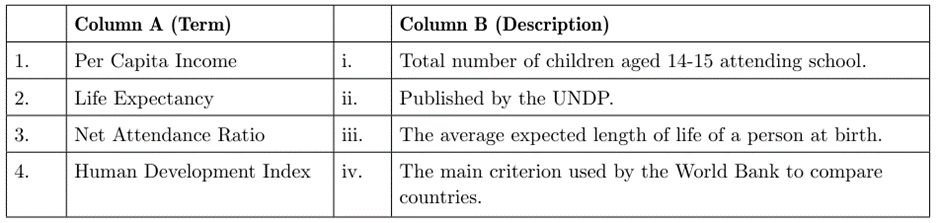
Choose the correct option:
(a) 1-iv, 2-iii, 3-i, 4-ii
(b) 1-iii, 2-iv, 3-i, 4-ii
(c) 1-ii, 2-iv, 3-i, 4-iii
(d) 1-iv, 2-ii, 3-iii, 4-i
View AnswerAns. (a) 1-iv, 2-iii, 3-i, 4-ii
35. Evaluate the utility of public facilities in contributing to a country’s development.
View AnswerAns. Public facilities play a crucial role in a country’s development because:
- Overcome Income Limits: They provide services like clean air and disease control that money alone cannot ensure.
- Ensure Affordability: Collective provision of education and healthcare makes them accessible to all, rich or poor.
- Promote Human Development: Adequate health and education facilities improve literacy and reduce infant mortality, boosting overall development.
36. ‘Sustainability of development is a new area of knowledge in which scientists and social scientists are working together.’ Justify this statement.
View AnswerAns. Sustainability of development is indeed a new interdisciplinary field because:
1. Global Concern: Environmental problems like climate change cross national boundaries, affecting all nations.
2. Shared Future: The development choices of one country influence the well-being of others, now and in the future.
3. Collaborative Approach: Scientists and social scientists work together to create solutions that are both environmentally sustainable and socially just.
37. Highlight three significant limitations of using per capita income as the main indicator of development.
View AnswerAns. Per capita income is a limited indicator of development because:
1. Hides Disparities: It conceals unequal income distribution, as wealth may be concentrated among a few.
2. Ignores Non-Material Goals: It overlooks factors like freedom, equality, and security that ensure quality of life.
3. Overlooks Public Facilities: It fails to show access to essential services such as healthcare, education, and sanitation.
38. A. ‘The notion of development can be different and conflicting for different groups of people.’ Support this statement with arguments, using the example of the construction of a large dam.
View AnswerAns. This statement correctly captures the complex and often contested nature of development, as illustrated by the example of building a dam.
- Different Goals: People have diverse views of development; what benefits one may harm another.
- Industrialist’s View: For industrialists, a dam means cheap electricity, industrial growth, and higher profits.
- Tribal’s View: For tribals, development means secure livelihood and irrigation without losing homes or forests.
- Conflict of Interests: The dam that helps industries also submerges tribal lands, causing displacement and loss.
- Conclusion: Thus, development can have contradictory meanings-progress for some but destruction for others-proving that it cannot be defined by one single perspective.
or
B. Public facilities are essential for a country’s development. On the basis of this statement, analyze why a state like Kerala, with a lower per capita income, has a better human development ranking than a high-income state like Punjab.
View AnswerAns. The case of Kerala and Punjab shows that public facilities are more vital for human development than income alone.
1. Income vs. Other Criteria: Punjab has a higher per capita income, yet Kerala performs better in overall development.
2. Health Indicator: Kerala’s IMR is 7 per 1000 live births, while Punjab’s is 18, showing better child survival in Kerala.
3. Education Indicator: Kerala’s Literacy Rate (94%) is higher than Punjab’s (76%), reflecting better education.
4. Public Facilities: Kerala provides better health, education, and PDS facilities, ensuring wider access and quality.
5. Conclusion: Kerala’s higher human development proves that efficient public services contribute more to well-being than income alone.