Sample Paper 1
Class X 2025-26
Social Science (087)
Time Allowed: 3 Hours Maximum Marks: 80
General Instructions:
1. There are 38 questions in the Question paper. All questions are compulsory.
2. The question paper has Four Sections – A-History, B-Geography C- Political Science, and D- Economics.
3. Each Section is of 20 Marks and has MCQs, VSA, SA, LAs and CBQ. 4. Very Short Answer Type Questions (VSA), carry 2 marks each. Answers to each question should not exceed 40 words.
5. Short Answer Type Questions (SA), carry 3 marks each. Answers to each question should not exceed 60 words.
6. Long answer type questions (LA), carry 5 marks each. Answers to each question should not exceed 120 words.
7. There are case based questions (CBQ) with three sub questions and are of 4 marks each. Answers to each question should not exceed 100 words.
8. The map-based questions, carry 5 marks with two parts- Q9. In Section A-History (2 marks) and Q19. In Section B -Geography (3 marks)
9. There is no overall choice in the question paper. However, an internal choice has been provided in few questions. Only one of the choices in such questions must be attempted.
10. In addition to this, NOTE that a separate question has been provided for Visually Impaired candidates in lieu of questions having visual inputs, map etc. Such questions are to be attempted by Visually Impaired candidates only.
SECTION-A
HISTORY (20 marks)
- Match the following and choose the correct option:
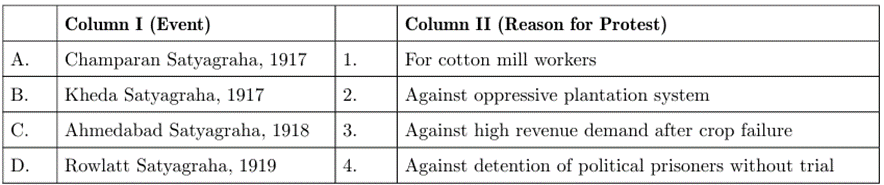
(a) A-1, B-4, C-2, D-3
(b) A-3, B-1, C-4, D-2
(c) A-4, B-2, C-3, D-1
(d) A-2, B-3, C-1, D-4
View AnswerAns. (d) A-2, B-3, C-1, D-4
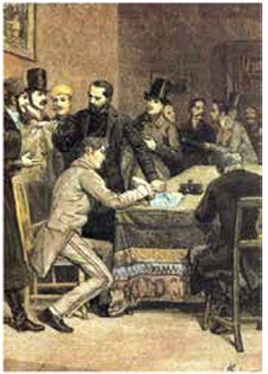
2 Identify the historical event depicted in the image below
(a) The Khilafat Movement procession
(b) The Non-Cooperation Movement in the cities
(c) The Salt March to Dandi
(d) The Quit India Movement procession
View AnswerAns. (c) The Salt March to Dandi
3. Why was the Khilafat Committee formed in Bombay in March 1919?
(a) To protest against the Jallianwala Bagh massacre.
(b) To defend the temporal powers of the Ottoman Emperor, the Khalifa.
(c) To demand separate electorates for Muslims.
(d) To launch a peasant movement in Awadh.
View AnswerAns. (b) To defend the temporal powers of the Ottoman Emperor, the Khalifa.
4. Mahatma Gandhi in his book Hind Swaraj (1909) declared that “British rule was established in India with the cooperation of Indians, and had survived only because of this cooperation. If Indians refused to cooperate, British rule in India would collapse.” This idea was the basis for which movement?
(a) Satyagraha Movement
(b) Quit India Movement
(c) Civil Disobedience Movement
(d) Non-Cooperation Movement
View AnswerAns. (d) Non-Cooperation Movement
5. A. What was the Rowlatt Act of 1919?
View AnswerAns. 1. The Rowlatt Act was an unjust law hurriedly passed by the Imperial Legislative Council in 1919, despite the united opposition of Indian members.
- It gave the government enormous powers to repress political activities and allowed for the detention of political prisoners without trial for two years.
or
B. How did the First World War create a new economic situation in India?
View AnswerAns. 1. The war led to a huge increase in defence expenditure, which was financed by war loans and increasing taxes like customs duties and a new income tax.
2. Through the war years, prices of essential goods doubled, leading to extreme economic hardship for the common people of India.
6. A. Why did the Non-Cooperation Movement gradually slow down in the cities?
View AnswerAns. 1. Expensive Khadi: Khadi cloth was often more expensive than mass-produced mill cloth, which poor people could not afford to buy for long.
2. Lack of Alternatives: The boycott of British institutions posed a problem because alternative Indian institutions like schools and courts were slow to be set up.
3. Return to British Institutions: Consequently, students and teachers began trickling back to government courts, weakening the boycott movement.
or
B. How was the idea of ‘swaraj’ interpreted by plantation workers in Assam?
View AnswerAns. 1. Freedom of Movement: For plantation workers, freedom meant the right to move freely in and out of the confined spaces of the tea gardens where they were enclosed.
- Link to Village: It also meant retaining a link with the village from which thewy had come, a right denied to them under the restrictive Inland Emigration Act of 1859.
- Gandhi Raj: They believed the ‘Gandhi Raj’ was coming, a time when all their troubles would be over and everyone would be given land in their own villages.
7. A. Explain the role and significance of the Salt March as an effective symbol of resistance against colonialism.
View AnswerAns. 1. A Unifying Symbol: Mahatma Gandhi found in salt a powerful symbol that could unite the nation, as it was an essential item consumed by both the rich and the poor alike.
2. Oppressive Policy: The British government’s tax on salt and its monopoly over production was a policy that revealed the most oppressive face of colonial rule.
3. Mass Mobilization: The 240-mile march from Sabarmati to Dandi attracted thousands of people, who came to hear Gandhiji explain the meaning of swaraj and urge them to peacefully defy the British.
4. Initiation of Movement: On reaching Dandi, Gandhiji ceremonially violated the law by manufacturing salt from boiling sea water, which marked the beginning of the mass Vivil Disobedience Movement.
5. Nationwide Defiance: This symbolic act inspired thousands across the country to break the salt law, boycott foreign cloth, and refuse to pay taxes, transforming the march into a powerful, nationwide movement of resistance.
or
B. How did different social groups in the countryside participate in the Civil Disobedience Movement? Explain with examples
View AnswerAns. 1. Rich Peasants: Rich peasant communities, like the Patidars of Gujarat and Jats of Uttar Pradesh, were active participants. For them, swaraj was a struggle against high revenue demands.
2. Impact of Depression: They were severely affected by the economic depression and falling prices, so they organized their communities to participate in boycott programs.
3. Poor Peasants: The poorer peasantry had different goals. They were small tenants who wanted their unpaid rent to landlords to be remitted and often joined radical movements.
4. Tribal Peasants: Tribal peasants, for instance in the Gudem Hills of Andhra Pradesh, interpreted swaraj as a fight affected their livelihoods and traditional rights.
5. Cpongress’s Stance: The Congress was often reluctant to support the ‘no rent’ campaigns of poor peasants to avoid alienating its rich peasant and landlord supporters, leading to an uncertain relationship.
8. Read the given text and answer the following questions:
The identity of the nation is most often symbolised in a figure or image. This helps create an image with which people can identify the nation. It was in the twentieth century, with the growth of nationalism, that the identity of India came to be visually associated with the image of Bharat Mata. The image was first created by Bankim Chandra Chattopadhyay. In the 1870s he wrote ‘Vande Mataram’ as a hymn to the motherland. Moved by the Swadeshi movement, Abanindranath Tagore painted his famous image of Bharat Mata. In this painting, Bharat Mata is portrayed as an ascetic figure; she is calm, composed, divine and spiritual. Ideas of nationalism also developed through a movement to revive Indian folklore. In late nineteenth-century India, nationalists began recording folk tales sung by bards and they toured villages to gather folk songs and legends. They believed these tales gave a true picture of traditional culture that had been corrupted by outside forces.
- Who first created the image of Bharat Mata?
Ans. The image of Bharat Mata was first created by Bankim Chandra Chattopadhyay.
- How did Abanindranath Tagore portray Bharat Mata in his famous painting?
Ans. Abanindranath Tagore portrayed Bharat Mata as an ascetic figure who is calm, composed, divine, and spiritual.
- Analyze the role of folklore in spreading the ideas of nationalism in late-nineteenth-century India.
Ans. Nationalists in the late nineteenth century collected and recorded folk songs, tales, and legends from villages to revive Indian folklore. They believed this was essential to discover India’s national identity and restore a sense of pride in a traditional culture that had been damaged by outside forces.
MAP SKILL-BASED QUESTION (2 marks)
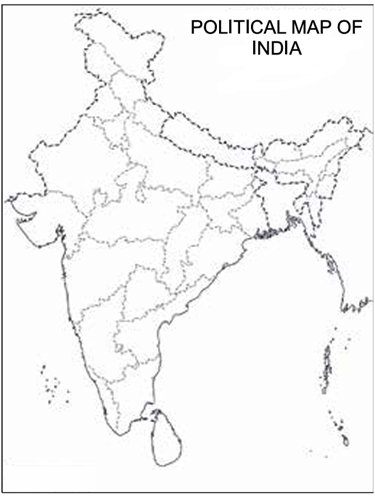
9. Two places A and B are marked on the given outline map of India. Identify them and write their correct names on the lines drawn near them.
A. The place associated with the cotton Mill’s worker’s Satyagraha.
B. The place where an incident occurred due to which Mahatma Gandhi called off the Non-Cooperation Movement.
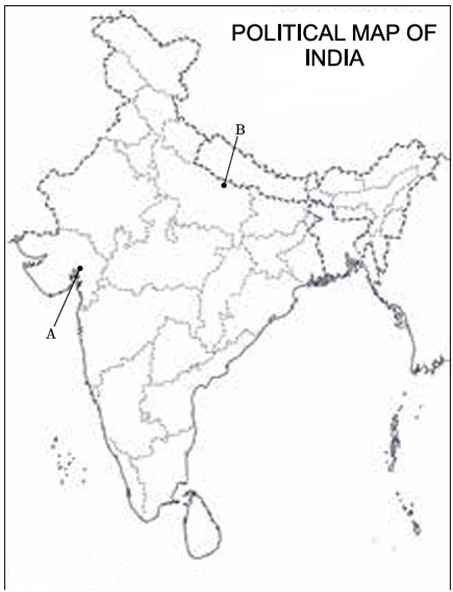
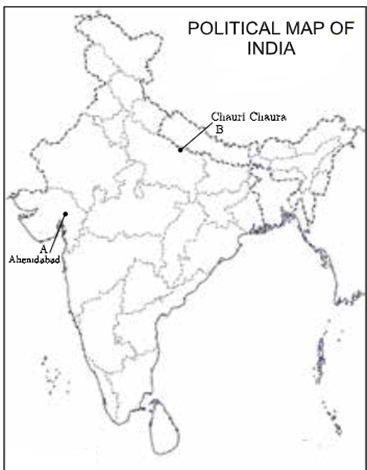
Ans. (A) Ahmedabad
(B) Chauri Choura
SECTION-B
GEOGRAPHY (20 marks)
10. Biodiversity is immensely rich and diverse in form and function. What is the key characteristic of the ecological system that this biodiversity forms?
(a) Species exist in complete isolation from one another.
(b) It is a simple system with limited interactions.
(c) Species are closely integrated through a multiple network of interdependencies.
(d) Only the larger species are important for the system’s survival.
View AnswerAns. (c) Species are closely integrated through a multiple network of interdependencies.
11. Identify the appropriate options to fill in the empty boxes regarding different categories of existing species.

(a) Endangered Species, Black buck
(b) Extinct Species, Nicobar pigeon, Andaman wild pig
(c) Vulnerable Species, Asiatic elephant
(d) Rare Species, Himalayan brown bear
View AnswerAns. (b) Extinct Species, Nicobar pigeon, Andaman wild pig
12. In many tribal areas of India, such as the Chota Nagpur region, communities worship specific trees like mahua and kadamba. In Rajasthan, the Bishnoi community actively protects species like the blackbuck (chinkara), nilgai, and peacocks, considering them an integral part of their community. What is the most significant inference that can be drawn from these traditional practices?
(a) These practices are the main cause of human-wildlife conflict.
(b) Traditional beliefs and nature worship have played a crucial role in conserving biodiversity.
(c) The government has mandated these practices in all tribal areas.
(d) These communities protect only commercially valuable species.
View AnswerAns. (b) Traditional beliefs and nature worship have played a crucial role in conserving biodiversity.
13. Based on your understanding of conservation efforts, which of the following community-led movements is known for showing that adequate levels of diversified crop production are possible and economically viable without the use of synthetic chemicals?
(a) The Chipko Movement
(b) Joint Forest Management (JFM)
(c) The Beej Bachao Andolan in Tehri
(d) Demarcation of Bhairodev Dakav ‘Sonchuri’
View AnswerAns. (c) The Beej Bachao Andolan in Tehri
14. According to the classification of forests by the Forest Department, which of the following states has a bulk of its forest area under ‘Protected Forests’?
(a) Jammu and Kashmir
(b) Madhya Pradesh
(c) Rajasthan
(d) West Bengal
View AnswerAns. (c) Rajasthan
15. Which of the following statements best evaluates the primary purpose of creating ‘Reserved’ and ‘Protected’ forests?
(a) To exclusively provide land for industrial development.
(b) To create wastelands for urban expansion.
(c) To maintain them for producing timber and other forest produce, and for protective reasons.
(d) To transfer the management of all forests to local communities.
View AnswerAns. (c) To maintain them for producing timber and other forest produce, and for protective reasons.
16. What are ‘permanent forest estates’? State their two main purposes.
Ans. 1. Definition: Permanent forest estates’ is a term used to refer to Reserved and Protected forests collectively.
2. Purposes: They are maintained for the purpose of producing timber and other forest produce and for protective reasons like conservation of the ecosystem.
17. A. “Different types of conservation measures have been adopted in India.” Justify this statement by evaluating five distinct conservation strategies, ranging from legal acts to community-based projects.
View AnswerAns. India has adopted a multi-pronged approach to conservation, justifying the statement.
- Legal Framework: The government implemented the Indian Wildlife (Protection) Act in 1972, which provided legal protection to habitats and banned the hunting of endangered species.
- National Parks and Sanctuaries: Central and many state governments have established national parks and wildlife sanctuaries to provide protected areas where wildlife can thrive without human interference.
- Specific Projects: The government announced several projects targeting specific, gravely threatened animals like the tiger (Project Tiger), the one-horned rhinoceros, and the Asiatic lion.
- Community Participation: In many areas, local communities have been at the forefront of conservation. Examples include the Chipko movement against deforestation and the Bhairodev Dakav ‘Sonchuri’ created by villagers in Rajasthan.
- Joint Forest Management (JFM): this programme formalizes the partnership between local communities and the Forest Department for managing and restoring degraded forests, sharing the benefits and responsibilities.
or
B. “Negative factors have caused a fearful depletion of flora and fauna in India.” Justify this statement by evaluating five such negative factors and their impacts.
View AnswerAns. The depletion of flora and fauna in India is a result of several negative factors:
1. Habitat Destruction: The expansion of agriculture, industries, and urban settlements has led to the large-scale clearing of forests and wetlands, destroying the natural habitats of countless species.
2. Shifting Agriculture: In many tribal parts of India, ‘slash and burn’ (Jhum) agriculture has led to the deforestation and degradation of valuable forest lands.
3. Large-Scale Development Projects: The construction of massive river valley projects has submerged thousands of hectares of forests, leading to immense biodiversity loss. For instance, the Narmada Sagar project in Madhya Pradesh inundated a vast forest area.
4. Mining Activities: Mining operations, especially in the mineral-rich regions of Central and Eastern India, have caused severe deforestation, land degradation, and have disrupted wildlife corridors. The Buxa Tiger Reserve in West Bengal is threatened by ongoing dolomite mining.
5. Poaching and Hunting: Illegal hunting and poaching for commercial purposes, such as for skins, horns, and bones, have driven many species like the tiger and rhinoceros to the brink of extinction.
18. Read the given text and answer the following questions:
Based on the International Union for Conservation of Nature and Natural Resources (IUCN), we can classify species into different categories. Normal species are those whose population levels are considered normal for their survival, such as cattle and sal. Endangered species, like the black buck and Indian rhino, are in danger of extinction because negative factors continue to deplete their populations. Vulnerable species, such as the Asiatic elephant and Gangetic dolphin, have populations that have declined to a level where they are likely to become endangered in the near future. Rare species, like the Himalayan brown bear and wild Asiatic buffalo, have small populations and may move into the endangered or vulnerable category if not protected. Endemic species are those found only in specific geographical areas, like the Nicobar pigeon and Andaman wild pig. Finally, Extinct species are those that are no longer found on Earth, such as the Asiatic cheetah and the pink head duck. This classification helps in understanding the level of threat and prioritizing conservation efforts for different species.
1. According to the passage, on what basis are species classified into different categories?
View AnswerAns. 1. According to the passage, species are classified based on the threat level to their survival and their population levels.
2. Distinguish between Endangered and Vulnerable species.
View AnswerAns. 2. Endangered species are currently in danger of extinction. In contrast, Vulnerable species are not yet endangered but their populations have declined to a level where they are likely to become endangered soon if negative factors persist.
3. “The classification of species is a crucial tool for conservation planning.” Analyse this statement.
View AnswerAns. 3. This statement is accurate because classifying species helps conservationists identify which species are at the greatest risk of extinction. By understanding whether a species is endangered, vulnerable, or rare, authorities can prioritize resources, create specific protection plans like ‘Project Tiger’ for endangered species, and implement targeted conservation strategies to prevent them from becoming extinct.
MAP SKILL-BASED QUESTION (3 marks)
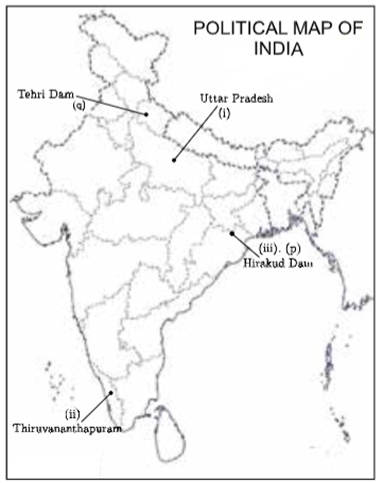
19. On an outline political map of India, locate and label the following with suitable symbols:
I. (p) A dam built on the Mahanadi River.
Or
(q) A dam built in the state of Uttarakhand on the Bhagirathi River.
View AnswerAns. (P) Dam on Mahanadi River: Hirakud Dam.
Or
(q) Dam in Uttarakhand on Bhagirathi River: Tehri Dam.
II. Any two of the following:
- A major sugarcane producing state.
- A Software Technology Park
- A major dam in Odisha.
Ans.
SECTION-C
POLITICAL SCIENCE (20 marks)
20. Which of the following statement(s) are true regarding the actual performance of democratic governments?
I. They are often slow and less efficient in decision-making.
II. They are not always very responsive to the people or free from corruption.
III. They have a very good record when it comes to sharing information with citizens.
IV. They often ignore the demands of a majority of the population.
Choose the correct option:
(a) I and III
(b) I, II and IV
(c) II and III
(d) All of the above
View AnswerAns. (b) I, II and IV
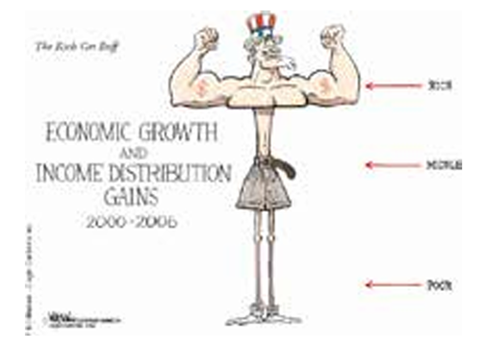
21. This cartoon illustrates a common outcome of economic growth in many democracies. What does it signify?
(a) Economic growth benefits all sections of society equally.
(b) In a democracy, economic growth leads to the reduction of poverty.
(c) The gains of economic growth are often disproportionately enjoyed by a small number of ultra-rich individuals.
(d) Poor people are becoming physically stronger than the rich.
View AnswerAns. (c) The gains of economic growth are often disproportionately enjoyed by a small number of ultra-rich individuals.
22. Consider the following case and choose the correct option
A citizen wants to find out if a government decision was made according to the correct norms and procedures. She files an application under a specific law to access the relevant government files.
What democratic right and mechanism is the citizen using?
(a) The right to vote in regular, free, and fair elections.
(b) The right to open public debate on major policies.
(c) The right to information and the mechanism of transparency.
(d) The right to form a political party to contest elections.
View AnswerAns. (c) The right to information and the mechanism of transparency.
23. Two statements are given below as Assertion (A) and Reason (R). Read the statements and choose the most appropriate option.
Assertion (A): In a democracy, it becomes easier for women to wage a struggle against what is now legally and morally unacceptable.
Reason (R): The principle of individual freedom and dignity has legal and moral force in a democracy, which may not be the case in a non-democratic set-up.
(a) Both A and R are true, and R is the correct explanation of A.
(b) Both A and R are true, but R is not the correct explanation of A.
(c) A is true but R is false.
(d) A is false but R is true.
View AnswerAns. (a) Both A and R are true, and R is the correct explanation of A.
24. Highlight two conditions a democracy must fulfill to successfully accommodate social diversity.
View AnswerAns. To achieve this outcome, a democracy must fulfill two conditions:
1. Rule by Majority is Not Rule by Majority Community: It is necessary that rule by majority does not become rule by the majority community in terms of religion, race, or language.
2. Majority Works with Minority: The majority always needs to work with the minority so that governments function to represent the general view.
25. ‘The fact that people are complaining is itself a testimony to the success of democracy’. Highlight any two aspects that this public expression of dissatisfaction shows.
View AnswerAns. This public expression of dissatisfaction shows two successful outcomes:
1. Awareness and Expectation: It shows that people have developed awareness and the ability to expect things from those in power.
2. Transformation into Citizens: It transforms people from the status of a ‘subject’ into that of a ‘citizen,’ who can look critically at power holders.
26. ‘Democracy is just a form of government that can only create conditions for achieving something’. Support this statement with suitable arguments.
View AnswerAns. This statement is correct for these reasons:
1. Democracy is a form of government, not a guarantee of specific outcomes like economic development or social harmony.
2. It can only create the necessary conditions for achieving something, such as ensuring political equality and individual freedom.
3. The citizens must use these conditions to achieve those goals; the final outcome depends on their active participation.
27. A. ‘Democracies are based on political equality, but we find growing economic inequalities alongside it’. Explain the statement.
View AnswerAns. This statement highlights a major contradiction and challenge within many democracies.
1. Political Equality: Democracies are founded on the principle of political equality. All individuals have equal weight in electing representatives, with each adult citizen having one vote, and each vote having one value.
2. Economic Inequality: However, parallel to this process of bringing individuals into the political
arena on an equal footing, we find growing economic inequalities.
3. Concentration of Wealth: A small number of ultra-rich individuals enjoy a highly disproportionate share of the nation’s wealth and incomes. Their share in the total income has also been increasing.
4. Plight of the Poor: Those at the bottom of society have very little to depend upon, and their incomes have sometimes been declining. They find it difficult to meet their basic needs of life like food, clothing, housing, education, and health.
5. Failure to Address Poverty: In actual life, democracies do not appear to be very successful in reducing economic inequalities. Even though the poor constitute a large proportion of voters, democratically elected governments do not seem as keen to address the question of poverty as one would expect.
or
B. ‘There is one respect in which democratic government is certainly better than its alternatives’. Analyse the statement by explaining why a democratic government is considered legitimate.
View AnswerAns. While democracies may have shortcomings, they are undeniably better than alternatives like dictatorships in one key aspect: legitimacy:
1. Definition of Legitimacy: A democratic government is a legitimate government. This is its most significant and defining outcome. 2. People’s Own Government: It is considered legitimate because it is the people’s own government. The rulers are elected by the people and are accountable to them.
3. Source of Support: This sense of ownership is why there is overwhelming support for the idea of democracy all over the world. People wish to be ruled by representatives elected by them. 4. Generation of Own Support: Democracy’s ability to generate its own support is itself an outcome that cannot be ignored. This popular backing gives it a legitimacy that non- democratic regimes can never have.
5. Superiority Over Alternatives: Even if a democratic government is slow, less efficient, and not always clean, its legitimacy makes it a superior and more stable form of government compared to any non-democratic alternative.
28. Read the given text and answer the following questions.
We often face a dilemma: democracy is seen to be good in principle, but felt to be not so good in its practice. This dilemma invites us to think hard about the outcomes of democracy. Democracy is better than other forms of government because it promotes equality, enhances dignity, improves decision-making, provides methods to resolve conflicts, and allows room to correct mistakes . However, in real life, many democracies fall short of these ideals. They may be slow, inefficient, and not always responsive. The first step towards thinking carefully about the outcomes of democracy is to recognise that it is just a form of government. It can only create conditions for achieving something; the citizens have to take advantage of those conditions to achieve their goals.
- What is the dilemma that we often face regarding democracy?
Ans. The dilemma is that democracy is seen to be good in principle, but felt to be not so good in its practice.
- Mention any one reason why democracy is considered better than other forms of government in principle.
Ans. In principle, democracy is considered better because it promotes equality among citizens (or enhances the dignity of the individual, improves decision-making, etc.)
3. Explain the role of citizens in achieving the goals of a democracy.
View AnswerAns. (i) Democracy is just a form of government that creates conditions for achieving something like freedom or development.
(ii) It is the citizens who have to take advantage of those conditions and achieve those goals. The outcomes depend on the active participation and awareness of the citizens.
SECTION-D
ECONOMICS (20 marks)
29. The sector that covers activities that do not directly produce a good but provide support for the production process is known as the:
(a) Primary Sector
(b) Secondary Sector
(c) Tertiary Sector
(d) Private Sector
View AnswerAns. (c) Tertiary Sector
30. What is the primary reason that the value of intermediate goods is not included in the calculation of GDP?
(a) Because intermediate goods are of poor quality.
(b) Because the value of intermediate goods is already included in the value of final goods.
(c) Because it is too difficult to calculate the value of intermediate goods.
(d) Because intermediate goods are not important for the economy.
View AnswerAns. (b) Because the value of intermediate goods is already included in the value of final goods.
31. Which of the following examples best demonstrates an enterprise from the organized sector?
(a) A street vendor selling vegetables.
(b) A daily wage laborer working at a construction site.
(c) A teacher working in a government-registered school with a regular salary and benefits.
(d) A small tailor shop run by a single person.
View AnswerAns. (c) A teacher working in a government-registered school with a regular salary and benefits.
32. The sum of production in the three sectors of an economy gives what is called the:
(a) Per Capita Income (PCI)
(b) Gross Value Added (GVA)
(c) Net National Product (NNP)
(d) Gross Domestic Product (GDP)
View AnswerAns. (d) Gross Domestic Product (GDP)
33. The Mahatma Gandhi National Rural Employment Guarantee Act (MGNREGA), 2005, aims to enhance livelihood security by providing:
(a) Free food grains to all rural households.
(b) A guaranteed 100 days of wage employment to every rural household.
(c) Free healthcare and education in rural areas.
(d) Loans to start small businesses in villages.
View AnswerAns. (b) A guaranteed 100 days of wage employment to every rural household.
34. Recognize and choose the option that correctly matches the term with its description.
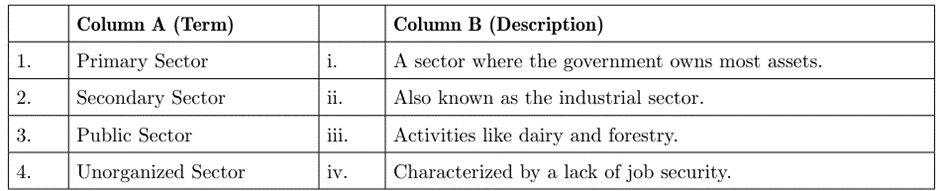
Choose the correct option:
(a) 1-iv, 2-iii, 3-i, 4-ii
(b) 1-iii, 2-ii, 3-i, 4-iv
(c) 1-ii, 2-iv, 3-i, 4-iii
(d) 1-iv, 2-ii, 3-iii, 4-i
View AnswerAns. (b) 1-iii, 2-ii, 3-i, 4-iv
35. Evaluate the utility of classifying economic activities into primary, secondary, and tertiary sectors.
View AnswerAns. Classifying economic activities into primary, secondary, and tertiary sectors is useful because:
1. Understanding Structure: It shows the relative importance of agriculture, industry, and services in the economy.
2. Analyzing Growth: GDP contribution by each sector helps identify which sectors are growing or lagging.
3. Guiding Policy: This information aids policymakers in addressing unemployment and planning for balanced, inclusive economic development.
36. ‘There has been a change in the share of the three sectors in GDP, but a similar shift has not taken place in employment.’ Justify this statement with reference to the Indian economy.
View AnswerAns. In India, the share of GDP and employment across sectors shows a mismatch:
1. GDP Shift: The tertiary sector’s share in GDP has grown significantly, while the primary sector’s share has declined.
2. Employment Stagnation: Despite this, many workers remain in agriculture; the employment shift has not matched the GDP change.
3. Primary Sector Dominance: About half of India’s workforce is still in the primary sector, indicating underemployment and low productivity in agriculture.
37. Highlight the key differences between the organized and unorganized sectors of the economy.
View AnswerAns. The key differences are:
1. Registration and Rules: The organized sector is registered by the government and has to follow its rules and regulations. The unorganized sector is largely outside the control of the government.
2. Job Security: In the organized sector, employment is secure with regular terms. In the unorganized sector, jobs are insecure, and workers can be asked to leave without reason.
3. Benefits: The organized sector provides benefits like paid leave, provident fund, and gratuity. The unorganized sector offers no such benefits.
38. A. Analyze the reasons for the rising importance of the tertiary sector in production in India over the last few decades.
View AnswerAns. The tertiary sector has become the largest producing sector in India due to several reasons:
1. Basic Services Demand: The government provides essential services like education, healthcare, banking, and law enforcement, increasing employment in this sector.
2. Support to Other Sectors: Growth in agriculture and industry raises demand for services such as transport, storage, and trade.
3. Rising Incomes: Higher income levels lead people to spend more on services like tourism, education, and entertainment.
4. Information Technology Boom: Rapid development in IT and communication has created new service opportunities and boosted productivity.
5. Globalisation Impact: Globalisation has expanded service-based jobs like call centers, software development, and data processing, making the tertiary sector the leading contributor to India’s GDP.
or
B. ‘The public sector plays a vital role in a nation’s development, especially in areas where the private sector might not invest.’ Support this statement with arguments.
View AnswerAns. The public sector plays a vital role in a nation’s development, especially where the private sector may not invest.
1. Infrastructure Development: Large projects like roads, railways, bridges and dams require heavy investment, which only the government can afford.
2. Support to Key Industries: The government provides essential inputs like electricity and water at affordable rates to promote industrial growth.
3. Essential Services: Quality healthcare and education are provided by the government to ensure equal access for all, especially the poor. 4. Social Welfare: Through programmes like the Public Distribution System (PDS), the government ensures food security and helps the needy.
4. Public Welfare Motive: Unlike the private sector, the public sector focuses on social welfare rather than profit, promoting inclusive and sustainable development.