Class X Session 2025-26
Subject – Science
Time Allowed: 3 hours Maximum Marks: 80
General Instructions:
1. This question paper consists of 39 questions in 3 sections. Section A is Biology, Section B is Chemistry and Section C is Physics.
2. All questions are compulsory. However, an internal choice is provided in some questions. A student is expected to attempt only one of these questions.
Section A
1. As compared to daytime, the amount of carbon dioxide released by the plants during night is more because:
a) Plants do not respire during daytime.
b) It is not produced during daytime.
c) It is stored in the leaves of plants during daytime.
d) Major amount of carbon dioxide produced is used up for photosynthesis during daytime.
View AnswerAns. d) Major amount of carbon dioxide produced is used up for photosynthesis during daytime.
2. In a cross between pure tall pea plants (TT) and pure dwarf pea plants (tt) the offsprings of F1 generation were all tall. When F1 generation was self-crossed, the gene combinations of the offsprings of F2 generation will be:
a) Tt : tt
b) TT : tt
c) TT : Tt : tt
d) TT : Tt
View AnswerAns. c) TT : Tt : tt
3. Match the following with correct response.
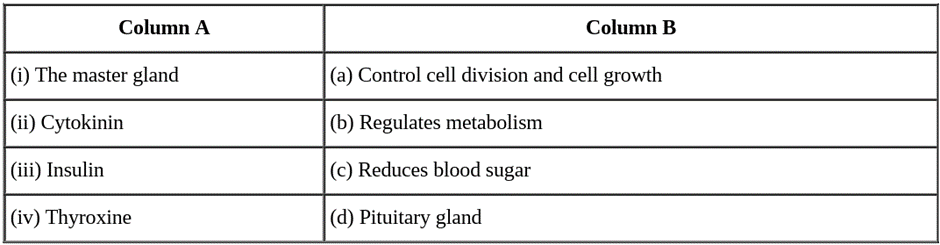
a) (i) – (d), (ii) – (a), (iii) – (c), (iv) – (b)
c) (i) – (a), (ii) – (c), (iii) – (b), (iv) – (d)
b) (i) – (c), (ii) – (b), (iii) – (d), (iv) – (a)
d) (i) – (b), (ii) – (d), (iii) – (a), (iv) – (c)
View AnswerAns. a) (i) – (d), (ii) – (a), (iii) – (c), (iv) – (b)
4. Progesterone and relaxin bring about changes in the body of a
a) Old woman
b) Pregnant woman
c) Young girl
d) Teenaged girl
View AnswerAns. b) Pregnant woman
5. Which one of the following is not a natural ecosystem?
a) Cropland ecosystem
b) Forest ecosystem
c) Grassland ecosystem
d) Pond ecosystem
View AnswerAns. a) Cropland ecosystem
6. Opening and closing of stomata is due to
a) Diffusion of CO2 in and out of the guard cells.
b) High pressure of gases inside the cells.
c) Stimulus of light in the guard cells.
d) Movement of water in and out of the guard cells.
View AnswerAns. d) Movement of water in and out of the guard cells.
7. United Nations Environment Programme forged an agreement to
a) control water pollution
b) reduce CFC production
c) control CO2 emissions in the environment
d) conserve biodiversity
View AnswerAns. b) reduce CFC production
8. Two of the following four figures that illustrate budding are
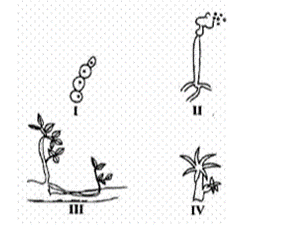
a) I and II
b) I and IV
c) II and IV
d) I and III
View AnswerAns. b) I and IV
9. Assertion (A): Variation is useful for the survival of a species over time.
Reason (R): The process of DNA copying will have variation each time because biochemical reactions are not reliable.
a) Both Assertion (A) and Reason (R) are true and Reason (R) is the correct explanation of the Assertion (A).
b) Both Assertion (A) and Reason (R) are true, but Reason (R) is not the correct explanation of the Assertion (A).
c) Assertion (A) is true, but Reason (R) is false.
d) Assertion (A) is false, but Reason (R) is true.
View AnswerAns. b) Both Assertion (A) and Reason (R) are true, but Reason (R) is not the correct explanation of the Assertion (A).
10. Explain the events that take place once a sperm reaches the oviduct till it becomes a foetus. Write the role of placenta in pregnancy.
View AnswerAns. i. In the oviduct, sperm encounters the egg and fertilisation takes place.
ii. The fertilized egg (zygote) starts dividing and forms a ball of cells or embryo.
iii. Embryo is implanted in the lining of the uterus, where it continues to grow and develops organs to become a foetus.
iv. Role of Placenta:
– Provides a large surface area for glucose and oxygen to pass from the mother to the embryo.
– Waste generated by the embryo will be removed by transferring them into the mother’s blood.
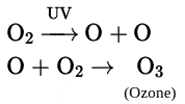
11. a. Explain the role of UV radiation in producing ozone layer.
View AnswerAns. High energy UV radiations split apart some molecular oxygen into free (O) atoms, these atoms combine with molecular oxygen to form ozone.
b. Mention the reaction involved.
View AnswerAns. The reaction involved.
c. Why is excessive use of CFCs a cause of concern?
View AnswerDepletion of the ozone layer. If these UV radiations reach the earth they may cause skin cancer in human beings.
OR
What is an ecosystem? Give one example each of
i. natural, and
ii. man-made ecosystem.
View AnswerAns. The interaction of living organism with the non-living components in an area of the environment is called as ecosystem.
i. Natural: forests / deserts / oceans / ponds / lakes
ii. Man-made: crop field / garden / aquarium / zoo
12. i. State the function of the following plant hormones
a. Abscisic acid
b. Cytokinin
View AnswerAns. a. Abscisic acid
- inhibits growth
- promotes dormancy in seeds and buds.
- Promotes closing of stomata.
b. Cytokinin
- delays aging in leaves
- promotes fruit growth.
- promotes cell division
ii. Define chemotropism
View AnswerAns. ii. Chemotropism – It is the directional movement or orientation of the plant part in response to chemical stimulus.
13. a. Name the two types of gametes produced by men.
View AnswerAns. Sperm having X chromosome and sperm having Y chromosome
b. Does a male child inherit X chromosome from his father? Justify.
View AnswerAns. No, As male child gets only Y chromosome from his father and X chromosome from mother to have XY chromosome.
c. How many types of gametes are produced by a human female?
View AnswerAns. One type/only ovum/egg
14. a. Mention one function each of the following organs in human male reproductive system:
i. Testis
View AnswerAns. to produce male gametes.
ii. Scrotum
View AnswerAns. to provide optimal temperature to testis for the formation of sperm.
iii. Vas deferens
View AnswerAns. to deliver the sperms to the urinary bladder.
iv. Prostate gland
View AnswerAns. to secrete the fluid which provides nutrition and medium for transport of sperms.
b. Name the type of germ cell which (i) is motile, and (ii) stores food.
View AnswerAns. Conventionally, the motile germ-cell is called the male gamete and the germ-cell containing the stored food is called the female gamete.
15. During respiration in an organism A, one molecule of glucose produces 2 ATP molecules whereas in respiration of another organism B, one molecule of glucose produces 38 ATP molecules.
i. Which organism is undergoing aerobic respiration?
ii. Which organism is undergoing anaerobic respiration?
iii. Which type of organism A or B can convert glucose into alcohol?
iv. Name one organism which behaves like A.
v. Name one organism which behaves like B.
View Answeri. Organism B undergoes aerobic respiration. In aerobic respiration more ATP is produced.
ii. Organism A undergoes anaerobic respiration. In anaerobic respiration less ATP is produced.
iii. Organism A can convert glucose into alcohol
iv. Yeast (anaerobic respiration)
v. Human being (aerobic respiration)
Anaerobic respiration can be of 2 types one is known as fermentation in which end products are ethyl alcohol and carbon dioxide along with ATP and other one is when pyruvate gets converted to lactic acid and carbon dioxide along with ATP.
16. a. What is puberty? Write any two changes that occur in boys during early teenage years.
b. List two functions performed by testis in human males.
Mention one role each of (i) Vas deferens, (ii) Seminal Vesicle (iii) Urethra and (iv) Scrotum in human male reproductive system.
View AnswerAns. a. When the rate of general body growth begins to slow down and reproductive tissue begins to mature. In boys – New thick hair growth on face, voice begins to crack, penis begins to enlarge and become erect.
b. Testis – Formation of sperms, Secretion of hormone testosterone Role of:
i. Vas deferens – Delivery of sperms from testes to urethra.
ii. Seminal vesicle – Provides nutrition to sperms /makes the transport(movement) of sperms easier.
iii. Urethra – Common passage for sperms and urine.
iv. Scrotum – Providing required temperature for sperm formation
OR
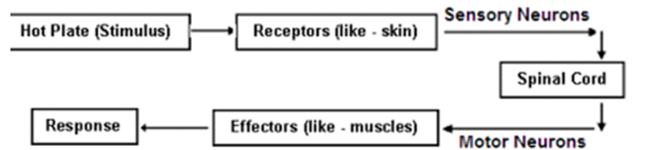
i. Define a reflex arc. Why have reflex arcs evolved in animals? Trace the sequence of events which occur, when you suddenly touch a hot object.
ii. Name the part of nervous system which helps in communication between the central nervous system and other parts of the body. What are the two components of this system?
View AnswerAns. i. The pathway in which impulses travel during the reflex action is called a reflex arc. Because the thinking part of the brain is not fast enough/for quick response to avoid injury.
Reflex arc:
ii. Peripheral Nervous System
Components: Cranial Nerves; Spinal Nerves
Section B
17. When sodium hydrogen carbonate is added to ethanoic acid a gas evolves.
Consider the following statements about the gas evolved?
A. It turns lime water milky.
B. It is evolved with a brisk effervescence.
C. It has a smell of burning sulphur.
D. It is also a by-product of respiration.
The correct statements are:
a) (B) and (D) only
b) (A) and (B) only
c) (A), (B) and (D)
d) (A), (C) and (D)
View AnswerAns. c) (A), (B) and (D)
18. Which of the given statement is correct or wrong:
Statement A: Detergent with less branching in the molecule is degraded more easily than branched-chain detergents.
Statement B: Soaps are 100% biodegradable.
a) Both the statements A and B are true.
c) Statement B is true; Statement A is false.
b) Neither statement A nor statement B is true.
d) Statement A is true; Statement B is false.
View AnswerAns. a) Both the statements A and B are true.
19. Which of the following statements is true for an amphoteric oxide?
a) It reacts with acid as well as base to form salt and hydrogen gas.
b) It reacts only with base and does not form water.
c) It reacts only with acid and does not form water.
d) It reacts with both acid as well as base to form salt and water.
View AnswerAns. d) It reacts with both acid as well as base to form salt and water.
20. Match the following with the correct response:
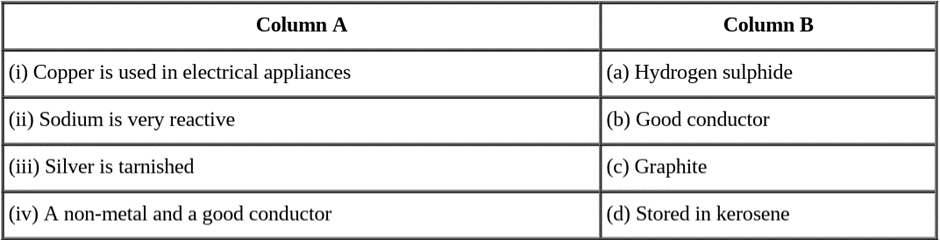
a) (i) – (b), (ii) – (d), (iii) – (a), (iv) – (c)
b) (i) – (d), (ii) – (a), (iii) – (c), (iv) – (b)
c) (i) – (c), (ii) – (b), (iii) – (d), (iv) – (a)
d) (i) – (a), (ii) – (c), (iii) – (b), (iv) – (d)
View AnswerAns. a) (i) – (b), (ii) – (d), (iii) – (a), (iv) – (c)
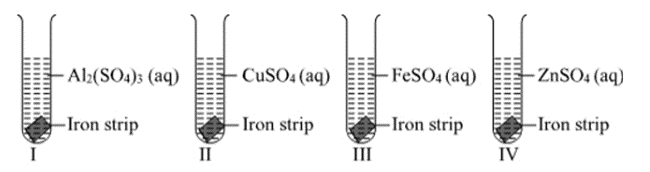
21. A student adds one big iron nail each in four test tubes containing solution of zinc sulphate, aluminium sulphate, copper sulphate and iron sulphate. A reddish brown coating was observed only on the surface of iron nail which was added in the solution of:
a) Aluminium sulphate
b) Iron sulphate
c) Zinc sulphate
d) copper sulphate
View AnswerAns. d) copper sulphate
22. The number of shells required to write the electronic configuration of Potassium (At. No. 19)
a) 1
b) 2
c) 4
d) 3
View AnswerAns. c) 4
23. If 10 mL of H2SO4 is mixed with 10 mL of Mg(OH)2 of the same concentration, the resultant solution will give the following colour with universal indicator:
a) Yellow
b) Red
c) Blue
d) Green
View AnswerAns. d) Green
24. Reaction between X and Y, forms compound Z. X loses electron and Y gains electron. Which of the following properties is not shown by Z?
a) Has high melting point
b) Has low melting point
c) Occurs as solid
d) Conducts electricity in molten state
View AnswerAns. b) Has low melting point
25. Solution X turns universal indicator blue to purple whereas solution Y turns universal indicator orange to red.
a. What will be the action of solution X on litmus?
b. What will be action of solution Y on litmus?
c. Name any two substances which can give solutions like X.
View AnswerAns. a. Solution X will turn red litmus paper to blue as it is basic in nature.
b. Solution Y will turn blue litmus paper to red as it is acidic in nature.
c. Milk of Magnesia (saturated Mg(OH)2 ) and Sodium Hydroxide (NaOH) solution are bases like solution X.
26. What is a displacement reaction? Write balanced chemical equation for a displacement reaction in which iron is a reactant. Name one more element whose behaviour is similar to that of iron in such reactions. Why will this kind of behaviour not be shown by gold?
View AnswerAns. Displacement reaction is a type of reaction in which a more reactive element displaces another less reactive element. The reactivity series of metals can be used to find out the displacement reaction. Chemical equation for a displacement reaction in which Iron is a reactant:
Fe + CuSO4 → FeSO4 + Cu
One more element whose behaviour is similar to that of iron in such reaction is Zn.
Zn + 2HCl → ZnCl2 + H2 ↑
This is not shown by Gold as it is the least reactive element.
OR
Translate the following statement into a chemical equation and then balance it :
Barium chloride reacts with aluminium sulphate to give aluminium chloride and a precipitate of barium sulphate.
View AnswerAns. Barium chloride reacts with aluminium sulphate to give aluminium and separates Barium sulfate (BaSO4).
3BaCl2(aq) + Al2(SO4)3 (aq) → 2AlCl3(aq) + 3BaSO4(s)↓
27. Sample pieces of five metals A, B, C, D and E were added to the tabulated solutions separately. The results observed are shown in the table:
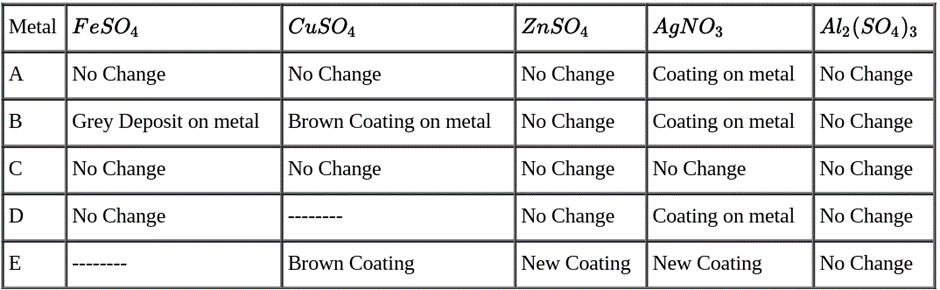
Based on the observations recorded in the table, answer the following:
(1) Which is the most reactive metal?
(2) Which is the least reactive metal?
(3) What would be observed if metal D were added to a solution of copper (II) sulphate?
(4) What would be observed if metal E were added to a solution of iron (II) sulphate?
(5) Arrange the metals A, B, C, D and E in decreasing order of their reactivity?
View AnswerAns. (1) Metal E is most reactive because it displaces zinc from ZnSO4 solution.
(2) Metal C is the least reactive since it has not displaced any of the metals from their respective salt solutions.
(3) Metal D is more reactive than Ag and less reactive than Fe. It can displace Cu from CuSO4 solution.
(4) Since metal E has displaced Zn from ZnSO4 solution, it is more reactive than Zinc. It is therefore expected to be more reactive than iron as well because iron is placed below zinc in the reactive series. Therefore, metal E displaces Fe from solution. A grey /black coating of iron will be deposited on the metal E.
(5) Decreasing order of reactivity E>B>D>A>C
28. Read the following text carefully and answer the questions that follow: No Change A hydrocarbon (P) has the molecular formula C10H22. A hydrocarbon (Q) has two carbon atoms less than (P) and belong to the same homologous series. A hydrocarbon (R) has two carbon atoms more than (P) and belong to the same homologous series.
i. What is the molecular formula of (Q)? Also write its IUPAC name.
ii. To which homologous series do the compound (P), (Q) and (R) belong?
iii. State two characteristics of homologous series?
View AnswerAns. i. Molecular formula of (Q) is C8H18 as it has two carbon atoms less than (P). Its IUPAC name is octane
ii. Compounds (P), (Q) and (R) are alkanes having general formula CnH2n+2. alkanes are the compounds having single bond between carbon atoms
iii. a. All the members of the homologous series can be represented by the same general formula.
b. Any two adjacent homologues differ by 1 carbon atom and 2 hydrogen atoms in their molecular formulae.
OR
What can you say about properties of compounds (P), (Q) and (R)
View AnswerAns. They have same chemical properties.
Compound (P), (Q) and (R) belong to same homologous series so they have different physical properties but similar chemical properties. They have same general formula CnH2n+2. They differ by 2 carbon atoms and 4 hydrogen atoms.
Read the following text carefully and answer the questions that follow:
Carbon compounds can be easily oxidised on combustion. In addition to this complete oxidation, we have reactions in which alcohols are converted to carboxylic acids. We see that some substances are capable of adding oxygen to others. These substances are known as oxidising agents. Also some compounds are capable of adding hydrogen. These substances are known as reducing agents.
i. Give any two examples of good oxidising agent.
ii. Complete the reaction:
CH3CH2CH2OH + Alk. KMnO4 →
iii. Give some uses of Alcohol.
View AnswerAns. i. Alkaline potassium permanganate or acidified potassium dichromate are examples of good oxidising agents.
ii. CH3CH2CH2OH + Alk. KMnO4 → CH3CH2COOH
iii. Alcohol is used as a solvent, spirit, alcoholic drinks, fuels, etc
OR
Why Acidified potassium dichromate is called an oxidising agent?
View AnswerAns. Acidified potassium per magnet K2Cr2O7 is a good oxidising agent because it can add oxygen to the reactant molecule very easily and convert them to acid.
29. Define water of crystallisation. Give the chemical formula for two compounds as examples. How can it be proved that the water of crystallisation makes a difference in the state and colour of the compounds?
View AnswerAns. The water of crystallization is the fixed number of water molecules present in one formula unit of a salt.
For example CuSO4.5H2O (Copper sulfate Penta hydrate) Blue vitriol.
FeSO4.7H2O (Ferrous sulfate heptahydrate) Green vitriol.
- By heating these salts they lose their water molecules and hence result in a change in state and color taking place.
- Blue vitriol is blue as it contains 5 molecules of water of crystallization.
- When it is heated, it loses water of crystallisation and becomes anhydrous copper sulfate (CuSO4) which is grey-white.
- On heating green vitriol, anhydrous ferrous sulfate (FeSO4) is formed, which is white.
- Anhydrous ferrous sulfate (FeSO4) on further heating, decomposes into ferric oxide (Fe2O3), Sulfur dioxide (SO2), and sulfur trioxide (SO3) gas is released.
OR
Common salt is a very important raw material as many compounds of industrial use can be prepared from it. Explain, giving chemical equations, the method of preparation of washing soda from sodium chloride. List four industrial/domestic uses of washing soda.
View AnswerAns. The method of preparation of washing soda from sodium chloride are as follows
Concentrated solution of sodium chloride reacts with ammonia and carbon dioxide to obtain sodium hydrogen carbonate and ammonium chloride.
NaCl + NH3 + CO2 + H2O → NaHCO3 + NH4Cl
When sodium hydrogen carbonate is heated strongly, sodium carbonate is obtained. Heat 2
2NaHCO3 → Na2CO3 + CO2 + H2O
Sodium carbonate is dissolved in water to obtain washing soda. Na2CO3 + 10H2O → Na2CO3 .10H2O
Uses:
In glass, soap and paper industries.
Manufacture of borax.
As cleaning agent for domestic purposes.
For removing permanent hardness of water.
Section C
30. Which of the following statement(s) is/are correct regarding scattering of light?
i. Scattering is responsible for the bluish appearance of the sky.
ii. Clouds having droplets of water scatter all wavelengths almost equal and so are generally white.
iii. Advanced sunrise and delayed sunset are due to atmospheric reflection.
a) (i), (ii) and (iii)
c) Only (i) and (ii)
b) Only (ii) and (iii)
d) Only (iii)
View AnswerAns. c) Only (i) and (ii)
31. Assertion (A): Large concave mirrors are used to concentrate sunlight to produce heat in solar cookers.
Reason (R): Concave mirror converges the light rays falling on it to a point.
a) Both A and R are true and R is the correct explanation of A.
b) Both A and R are true but R is not the correct explanation of A.
c) A is true but R is false.
d) A is false but R is true.
View AnswerAns. a) Both A and R are true and R is the correct explanation of A.
32. The resultant magnetic field at point P situated midway between two parallel wires (placed horizontally each carrying a steady current I is
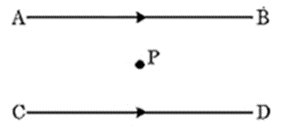
a) in the vertically upward direction.
c) in the vertically downward direction.
b) in the same direction as the current in the wires.
d) zero
View AnswerAns. d) zero
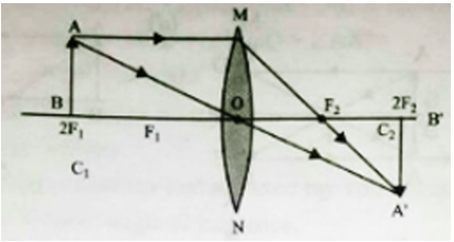
33. Draw ray diagram showing the image formation by a convex lens when an object is placed at twice the focal length of the lens.
Ans.
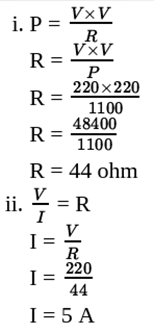
34. An electric heater rated 1100 W operates at 220 V. Calculate (i) its resistance, and (ii) the current drawn by it.
View AnswerAns.
OR
a. Write the mathematical expression for Joule’s law of heating.
b. Compute the heat generated while transferring 96000 coulomb of charge in two hours through a potential difference of 40 V.
View AnswerAns. The mathematical expression of the Joules Law of heating is: H = I2 Rt
Here, H is a heating effect, I is the current flowing through the device and t is the time taken.
b. Given:
Amount of charge transferred = 96000 C
Time taken = 2hrs = 2 × 60 × 60 sec = 7200 sec
Potential difference = 40 V
Heat generated = V x I × t
and we know that; I = Q/t
So, H = VQ
= 40 × 96000
= 3.84 x 10⁶ J
35. What are the common defects of vision that can be corrected by the use of suitable eyeglasses or spectacles?
View AnswerAns. There are mainly four common defect of vision that can be corrected by the use of suitable eyeglasses or spectacles. There are
i. Myopia or near-sightedness,
ii. Hypermetropia or far-sightedness,
iii. Presbyopia, and
iv. Astigmatism
36. Draw a schematic diagram of a circuit consisting of a battery of three cells of 2 V each, a 5 Ω resistor, an 8 Ω resistor, and a 12 Ω resistor and a plug key, all connected in series. Now, connect the ammeter to measure the current through the resistors and a voltmeter to measure the potential difference across the 12 Ω would be the readings in the ammeter and the voltmeter?
View AnswerAns. The total resistance of the circuit is given by
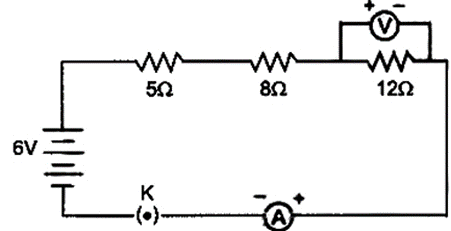
R = 5 + 8 + 12 = 25 Ω
We know, R = V/I
Hence, 25 = 6/I
I= 6/25 = 0.24 A
Since, resistances are connected in series, thus electric current remains the same through all resistors. Here we have, Electric current, I = 0.24 A
Resistance, R = 12 Ω
Thus, potential difference (V) through the resistor of 12 is given by
V = I × R
= 0.24 x 12 = 2.88 V
Reading of ammeter = 0.24 A
Reading of voltmeter through resistor of 12 Ω = 2.88 V
37. a. Draw the pattern of magnetic field lines produced by a current carrying circular loop showing the direction of current in the loop and the direction of the magnetic field lines.
View AnswerAns.
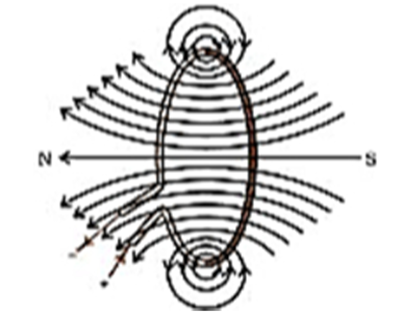
b. State the rule which can be applied to know the direction of magnetic field lines in the above case.
View AnswerAns. Right Hand Thumb Rule:- When a current carrying straight conductor is held in the right hand in such a way that the thumb points towards the direction of the current, then the fingers will wrap around the conductor in the direction of the field lines of the magnetic field
38. Read the following text carefully and answer the questions that follow:
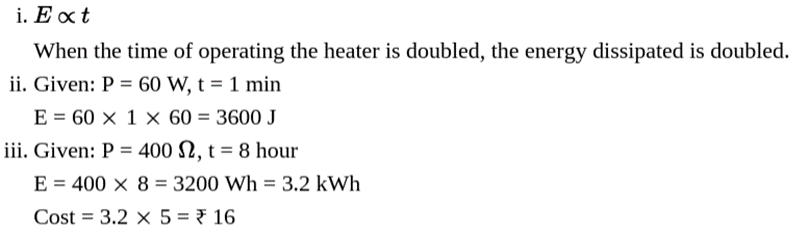
The electrical energy consumed by an electrical appliance is given by the product of its power rating and the time for which it is used. The SI unit of electrical energy is Joule. Actually, Joule represents a very small quantity of energy and therefore it is inconvenient to use where a large quantity of energy is involved. So for commercial purposes, we use a bigger unit of electrical energy which is called kilowatt-hour. 1 kilowatt-hour is equal to 3.6 × 10⁶ joules of electrical energy.
i. The energy dissipated by the heater is E. When the time of operating the heater is doubled, what would be the energy dissipated?
ii. The power of a lamp is 60 W. What will be the energy consumed in 1 minute?
iii. The electrical refrigerator rated 400 W operates 8 hours a day. The cost of electrical energy is ₹ 5 per kWh. Find the cost of running the refrigerator for one day.
View AnswerAns.
OR
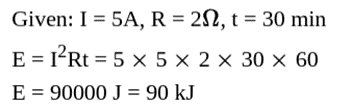
Calculate the energy transformed by a 5 A current flowing through a resistor of 2 for 30 minutes. (2) Ω
View AnswerAns.
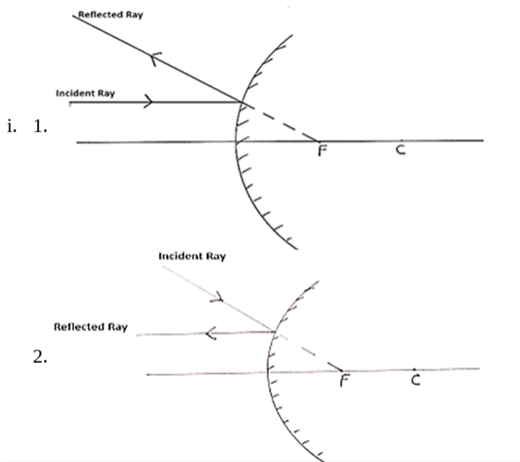
39. i. Draw a ray diagram to show the path of the reflected ray in each of the following cases:
A ray of light incident on a convex mirror
1. parallel to its principal axis, and
2. is directed towards its principal focus
View AnswerAns.
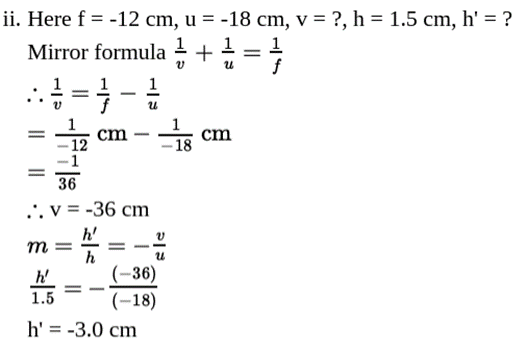
ii. A 1.5 cm tall candle flame is placed perpendicular to the principal axis of a concave mirror of focal length 12 cm. If the distance of the flame from the pole of the mirror is 18 cm, use mirror formula to determine the position and size of the image formed.
View AnswerAns.
OR
a. What is a lens? List two main categories of lenses. In which category is a double concave lens placed?
View AnswerAns.
A transparent material bounded by two surfaces of which one or both surfaces are spherical / curved.
a. Converging lens
b. Diverging lens
Double concave lens is a diverging lens.
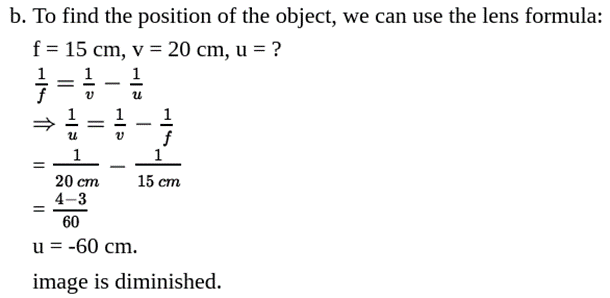
b. A convex lens of focal length 15 cm forms a real image at a distance of 20 cm from its optical centre. Find the position of the object. Is the image formed by the lens magnified or diminished?
View AnswerAns.