SCIENCE (086)
CLASS- X
Max. Marks: 80 Time Allowed: 3 hours
General Instructions:
- This question paper consists of 39 questions in 3 sections. Section A is Biology, Section B is Chemistry and Section C is Physics.
- All questions are compulsory. However, an internal choice is provided in some questions. A student is expected to attempt only one of these questions.
Section – A
1. An organism which breaks down the food material outside the body and then absorbs it is
(a) A plant parasite, Cuscuta
(b) An animal parasite, Tapeworm
(c) A bacterium, Rhizobium
(d) A fungi, Rhizopus
View AnswerAns. (d) A fungi, Rhizopus
2. Carefully study the diagram of the human respiratory system with labels (i), (ii), (iii) and (iv). Select the option which gives correct identification and main function and /or characteristic.
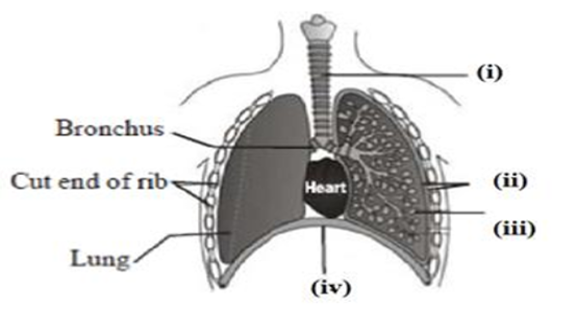
(a) Trachea (i): It is supported by bony rings for conducting inspired air.
(b) Ribs (ii): When we breathe out, ribs are lifted.
(c) Alveoli (iii): Thin-walled sac like structures for exchange of gases.
(d) Diaphragm (iv): It is pulled up when we breathe in.
View AnswerAns. (c) Alveoli (iii): Thin-walled sac like structures for exchange of gases.
3. There was a cerebellar dysfunction in a patient. Which of the following activities will get disturbed in this patient as a result of this?
(a) Salivation
(b) Hunger control
(c) Posture and balance
(d) Regulation of blood pressure
View AnswerAns. (c) Posture and balance
4. Receptors are usually located in sense organs. Gustatory receptors are present in :
(a) tongue
(b) nose
(c) eye
(d) ear
View AnswerAns. (a) tongue
5. Height of a plant is regulated by:
(a) DNA which is directly influenced by growth hormone.
(b) Genes which regulate the proteins directly.
(c) Growth hormones under the influence of the enzymes coded by a gene.
(d) Growth hormones directly under the influence a gene.
View AnswerAns. (c) Growth hormones under the influence of the enzymes coded by a gene.
6. Identify the food chain in which the organisms of the second trophic level are missing:
(a) Grass, goat, lion
(b) Zooplankton, phytoplankton, small fish, large fish
(c) Tiger, grass, snake, frog
(d) Grasshopper, grass, snake, frog, eagle
View AnswerAns. (c) Tiger, grass, snake, frog
7. Some wastes are given below:
(i) Garden waste
(ii) Ball point pen refills
(iii) Empty medicine bottles made of glass
(iv) Peels of fruits and vegetables
(v) Old cotton shirt
The non-biodegradable wastes among these are:
(a) (i) and (ii)
(b) (ii) and (iii)
(c) (i), (iv) and (v)
(d) (i), (iii) and (iv)
View AnswerAns. (b) (ii) and (iii)
The following two questions consist of two statements – Assertion (A) and Reason (R). Answer these questions by selecting the appropriate option given below:
A. Both A and R are true, and R is the correct explanation of A.
B. Both A and R are true, and R is not the correct explanation of A.
C. A is true but R is false.
D. A is false but R is true.
8. Assertion (A): Testes lie in penis outside the body.
Reason (R): Sperms require temperature lower than the body temperature for development.
A. Both A and R are true, and R is the correct explanation of A.
B. Both A and R are true, and R is not the correct explanation of A.
C. A is true but R is false.
D. A is false but R is true.
View AnswerAns. D. A is false but R is true.
9. Assertion (A): If the lions are removed from a food chain it will not affect the food chain, however if the plants are removed from a food chain it will disturb the ecosystem.
Reason (R): Plants are producers who can make food using sunlight, while lions are consumers.
Ans. A. Both A and R are true, and R is the correct explanation of A.
B. Both A and R are true, and R is not the correct explanation of A.
C. A is true but R is false.
D. A is false but R is true.
View AnswerAns. D. A is false but R is true.
10. Name the substances other than water that are reabsorbed during urine formation. What are the two parameters that decide the amount of water that is reabsorbed in the kidney?
View AnswerAns. Glucose, amino acids, salts (any 2, 0.5 mark each) and a major amount of water are selectively re-absorbed as the urine flows along the tube.
The amount of water reabsorbed depends on –
- how much excess water there is in the body and
- how much of dissolved waste there is to be excreted
11. Attempt either option A or B.
A. List the steps for the synthesis of glucose by the plants. What special feature is found in desert plants related to this process?
View AnswerAns. Steps of photosynthesis:
- Absorption of light energy by chlorophyll
- Conversion of light energy to chemical energy and Splitting of water into H₂ and O₂
- Reduction of CO₂ to glucose
Special feature in desert plants: They perform CAM photosynthesis – They take up carbon dioxide at night and prepare an intermediate which is acted upon by the energy absorbed by the chlorophyll during the day.
OR
B. Explain the role of the following enzymes in the process of digestion of food in humans:
(i) Salivary amylase
(ii) Pepsin
(iii) Trypsin
(iv) Lipase
View AnswerAns. Roles of enzymes:
Salivary amylase: Converts starch → maltose in mouth
Pepsin: Breaks down proteins → peptides in stomach
Trypsin: Acts in small intestine; proteins → amino acids
Lipase: Converts fats → fatty acids and glycerol
12. Study the food chain given below and answer the questions that follow:
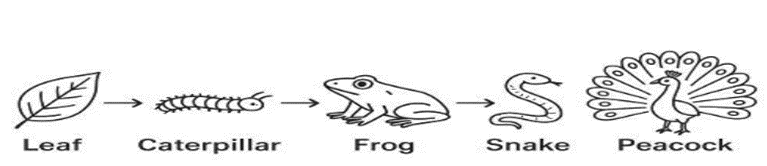
a) If the amount of energy available at the third trophic level is 100 joules, then how much energy will be available at the producer level? Justify your answer.
View AnswerAns. If 100 J is available at the third trophic level, then 10 × 10 = 100 × 100 = 10,000 J at producer level (10% energy rule).
b) Is it possible to have 2 more trophic levels in this food chain just before the fourth trophic level? Justify your answer.
View AnswerAns. No — adding more trophic levels would leave negligible energy for higher consumers; hence only limited levels exist.
13. Study the diagram of reflex arc and answer the following questions:
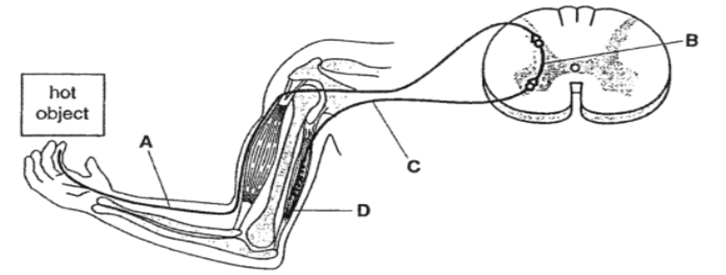
(i) Identify the parts labelled as A, B, C, and D.
View AnswerAns. (i) Parts of reflex arc:
a → Sensory neuron
b → Spinal cord (interneuron)
c → Motor neuron
d → Effector (muscle)
(ii) Reflex arcs have evolved in animals. Why?
View AnswerAns. (ii) Reflex arcs evolved for quick response to stimuli, helping protect organisms from harm without involving the brain immediately.
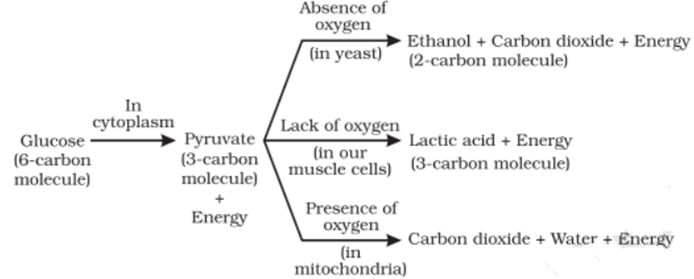
14. Explain the process of breakdown of glucose in a cell.
View AnswerAns.
15. Sahil performed an experiment to study the inheritance pattern of genes. He crossed tall pea plants (TT) with short pea plants (tt) and obtained all tall plants in F1 generation.
Attempt either subpart C or D.
A. What will be set of genes present in the F1 generation?
B. Give reason why only tall plants are observed in F1 progeny.
C. When F1 plants were self – pollinated, a total of 800 plants were produced. How many of these would be tall, medium height or short plants? Give the genotype of F 2 generation.
View AnswerAns. (A) Genotype in F₁ = Tt (all tall)
(B) All tall plants because T (tallness) is dominant over t (dwarfness)
(C) In F₂ after self-pollination:
Genotypic ratio = 1 TT : 2 Tt : 1 tt
Phenotypic ratio = 3 tall : 1 short
Out of 800 plants → 600 tall (200 TT + 400 Tt) and 200 short (tt)
OR
D. When F1 plants were cross – pollinated with plants having tt genes, a total of 800 plants were produced. How many of these would be tall, medium height or short plants? Give the genotype of F 2 generation.
View AnswerAns. (D) If F₁ (Tt) × tt → 1 Tt : 1 tt → 400 tall and 400 short.
16. (a) List two reasons for appearance of variations among the progeny formed by sexual reproduction.
View AnswerAns. (a) Causes of variation:
- Crossing over during meiosis
- Random fusion of gametes
- Inaccuracies in DNA copying (any two)
(b) Study the diagram given below and answer the following questions:
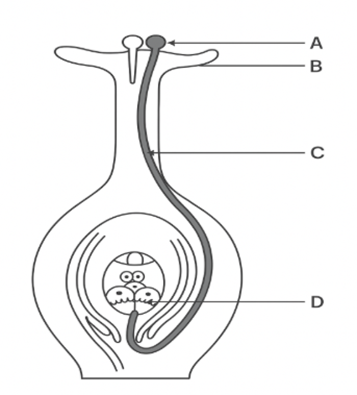
(i) Name the part marked ‘A’ in the diagram given.
(ii) How does ‘A’ reaches part ‘B’?
(iii) State the importance of part ‘C’.
View AnswerAns. (b) Diagram identification:
(i) ‘A’ = Pollen grain
(ii) By pollination through wind, water or animals.
(iii) ‘C’ is the pollen tube that carries the male gamete from stigma through style to the embryo sac for fertilization with egg.
OR
(a) Certain specialised cells in animals called stem cells have the ability to divide and differentiate into different cell types. This helps in the replacement of a damaged organ.
Name and explain two methods of asexual reproduction that are similar to stem cells and occur mostly in multicellular organisms.
(b) Identify TWO pairs of reproductive organs in males and females that are functionally similar to each other. Justify.
View AnswerAns. (a) Two asexual reproduction methods similar to stem-cell behaviour:
Regeneration (e.g., Planaria). Explanation
Budding (e.g., Hydra). Explanation
(b) Analogous reproductive organs:
Testes ↔ Ovaries (both produce gametes and hormones)
Vas deferens ↔ Oviduct (both transport gametes)
Section – B
17. Zn + 2CH3COOH —> (CH3COO)2Zn + H2
The above reaction is a
(a) Decomposition reaction
(b) Displacement reaction
(c) Double displacement reaction
(d) Combination reaction
View AnswerAns. (b) Displacement reaction
18. Four solutions, namely glucose, alcohol, hydrochloric acid and sulphuric acid filled in four separate beakers are connected one by one in an electric circuit with a bulb. The solutions in which the bulb will glow when current is passed are :
(a) Glucose and alcohol
(b) Alcohol and hydrochloric acid
(c) Glucose and sulphuric acid
(d) Hydrochloric acid and sulphuric acid
View AnswerAns. (d) Hydrochloric acid and sulphuric acid
19. Match column I with column II and select the correct option using the given Codes:
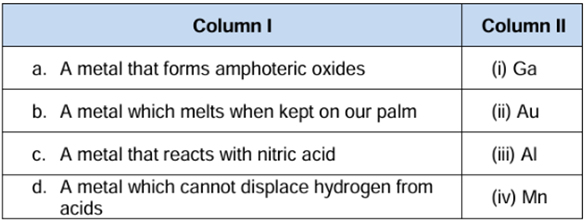
(a) a – (ii), b – (i), c – (iii), d – (iv)
(b) a – (iii), b – (i), c – (iv), d – (ii)
(c) a – (iv), b – (ii), c – (iii), d – (i)
(d) a – (iii), b – (ii), c – (i), d – (iv)
View AnswerAns. (b) a – (iii), b – (i), c – (iv), d – (ii)
20. A metal and a non-metal that exists in liquid state at room temperature are respectively:
(a) Bromine and Mercury
(b) Mercury and Iodine
(c) Mercury and Bromine
(d) Iodine and Mercury
View AnswerAns. (c) Mercury and Bromine
21. Anita added a drop each of diluted acetic acid and diluted hydrochloric acid on pH paper and compared the colours. Which of the following is the correct conclusion?
(a) pH of acetic acid is more than that of hydrochloric acid.
(b) pH of acetic acid is less than that of hydrochloric acid.
(c) Acetic acid dissociates completely in aqueous solution.
(d) Acetic acid is a strong acid
View AnswerAns. (a) pH of acetic acid is more than that of hydrochloric acid.
22. When excess of carbon dioxide is passed through lime water, the milkiness disappears because
(a) water soluble calcium carbonate converts to water soluble calcium bicarbonate.
(b) insoluble calcium carbonate converts to water soluble calcium bicarbonate.
(c) water soluble calcium carbonate converts to insoluble calcium bicarbonate.
(d) insoluble calcium carbonate converts to insoluble calcium bicarbonate.
View AnswerAns. (b) insoluble calcium carbonate converts to water soluble calcium bicarbonate.
23. The number of single and double bonds present in a molecule of benzene (C6H6) respectively, are :
(a) 6 and 6
(b) 9 and 3
(c) 3 and 9
(d) 3 and 3
View AnswerAns. (b) 9 and 3
The following question consists of two statements – Assertion (A) and Reason (R). Answer these questions by selecting the appropriate option given below:
A. Both A and R are true, and R is the correct explanation of A.
B. Both A and R are true, and R is not the correct explanation of A.
C. A is true but R is false.
D. A is false but R is true.
24. Assertion(A): If the first member of a homologous series is Methanal, its third member will be Propanal.
Reason (R): All the members of a homologous series show similar chemical properties.
A. Both A and R are true, and R is the correct explanation of A.
B. Both A and R are true, and R is not the correct explanation of A.
C. A is true but R is false.
D. A is false but R is true.
View AnswerAns. B. Both A and R are true, and R is not the correct explanation of A.
25. Explain why we cannot have isomers of first three members of Alkane series?
View AnswerAns. First three alkanes (CH₄, C₂H₆, C₃H₈) cannot form isomers because branching requires a minimum of 4 carbon atoms.
26. Attempt either option A or B.
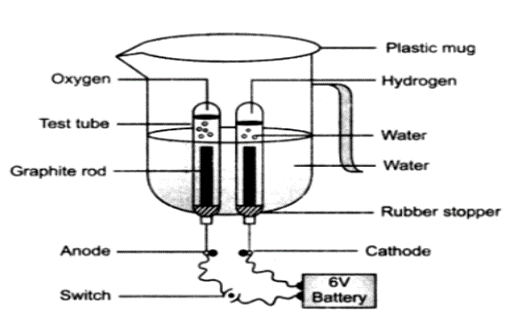
Amrita electrolysed distilled water using the set-up shown in figure 1. She was expecting two gases to be evolved at the anode and cathode respectively
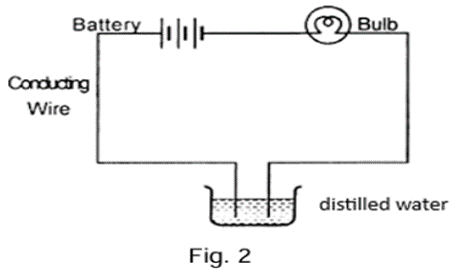
Suddenly, she realised that the bulb in the circuit did not glow when she used distilled water (figure 2)
After this realization, she added a substance to the distilled water for electrolysis to take place.
Answer the following questions based on the information given above:
(i) Which gas was she expecting to be formed at the anode and which one at the cathode respectively?
(ii) Why did the bulb not glow when Amrita passed electricity through distilled water?
(iii) Which substance was added by Amrita to distilled water to get the expected result?
View AnswerAns. (i) Gases formed – O₂ (at anode) and H₂ (at cathode).
(ii) Distilled water does not conduct electricity – no ions present.
(iii) Adding acid/salt (e.g., a few drops of dilute H₂SO₄)
OR
B. The domes of many building in Europe are made of copper. These domes now appear greenish in colour.
(i) Why do the domes appear greenish though copper is orange-red in colour?
(ii) In your opinion, should the copper domes be replaced by iron domes to overcome the problem of change of colour of copper domes?
(iii) Domes used to be made from thin sheets of metals. Why did the ancient architects use copper to make domes?
27. (i) Suggest a safe procedure of diluting a strong concentrated acid.
(ii) Name the salt formed when sulphuric acid is added to sodium hydroxide and write its pH.
(iii) Dry HCl gas does not change the colour of dry blue litmus paper. Why?
View AnswerAns. (i) Diluting a strong acid: Always add acid to water slowly with stirring, never water to acid — prevents splashing due to exothermic reaction.
(ii) Salt formed: Sodium sulphate (Na₂SO₄); pH ≈ 7 (neutral)
(iii) Dry HCl and litmus: Dry HCl has no H⁺ ions — acid behaviour only in aqueous solution, so litmus colour unchanged.
28. The metals produced by various reduction processes are not very pure. They contain impurities, which must be removed to obtain pure metals. The most widely used method for refining impure metal is electrolytic refining.
(i) What is the cathode and anode made of in the refining of copper by this process?
(ii) Name the solution used in the above process and write its formula.
(iii) How copper gets refined when electric current is passed in the electrolytic cell?
View AnswerAns. (i) Cathode – pure copper plate; Anode – impure copper block
(ii) Electrolyte – acidified copper sulphate solution (CuSO₄)
(iii) On passing current, pure copper from anode dissolves and gets deposited on cathode; impurities settle as anode mud / DIAGRAM
OR
(iii) You have two beakers A and B containing copper sulphate solution. What would you observe after two hours if you dip a strip of zinc in beaker A and a strip of silver in beaker B? Give reasons for your observations in each case.
View AnswerAns. (iii) In Beaker A (Zn in CuSO₄) → Reddish-brown Cu deposited; Zn displaces Cu.
In Beaker B (Ag in CuSO₄) → No change; Ag is less reactive than Cu.
29. An organic compound ‘X’ with molecular formula C2H6O on reacting with acidified K2Cr2O7 gives an organic compound ‘Y’. X reacts with Y on warming in the presence of conc. H2SO4 to give a sweet smelling compound ‘Z’.
(i) Identify X, Y and Z.
(ii) Write the chemical equations for the reactions involved in both cases.
(iii) State the role of – (a) acidified K2Cr2O7 in the conversion of X to Y (b) Conc. H2SO4 in the reaction of X and Y.
(iv) Name the reaction, which occurs when Z reacts with an alkali.
View AnswerAns. (i) X = Ethanol / C₂H₅OH/ Ethyl alcohol
Y = Ethanoic acid / CH₃COOH/ Acetic acid
Z = Ethyl ethanoate / CH₃COOC₂H₅/ ethyl acetate
(ii) Reactions:
C₂H₅OH + [O] (acidified K₂Cr₂O₇) → CH₃COOH + H₂O
(iii) Roles:
K₂Cr₂O₇: Oxidising agent / provides oxygen
Conc. H₂SO₄: Catalyst/dehydrating agent
(iv) Saponification reaction
OR
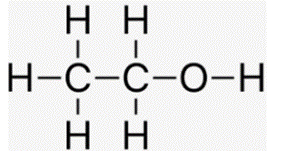
(i) Write the name and structure of an organic compound ‘X’ having two carbon atoms in its molecule and its name is suffixed with ‘-ol’.
(ii) What happens when ‘X’ is heated with excess conc. Sulphuric acid at 443 K? Write chemical equation for the reaction stating the conditions for the reaction. Also state the role played by conc. Sulphuric acid in the reaction.
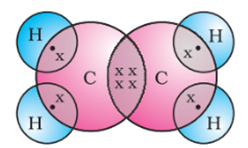
(iii) Name and draw the electron dot structure of hydrocarbon produced in the above reaction.
View AnswerAns. (i) X = Ethanol (C₂H₅OH)
(ii) Heating with conc. H₂SO₄ at 443 K → Dehydration:

(iii) Hydrocarbon name = Ethene (C₂H₄)
Section – C
30. Consider these indices of refraction: glass: 1.52; air: 1.0003; water: 1.333. Based on the refractive indices of three materials, arrange the speed of light through them in decreasing order.
(a) The speed of light in water > the speed of light in air > the speed of light in glass.
(b) The speed of light in glass > the speed of light in water > the speed of light in air.
(c) The speed of light in air > the speed of light in water > the speed of light in glass.
(d) The speed of light in glass > the speed of light in air > the speed of light in water.
View AnswerAns. (c) The speed of light in air > the speed of light in water > the speed of light in glass.
31. A prism ABC (with BC as base) is placed in different orientations. A narrow beam of white light is incident on the prism as shown in below Figure. In which of the following diagrams, after dispersion, the third colour from the top of the spectrum corresponds to the colour of the sky?
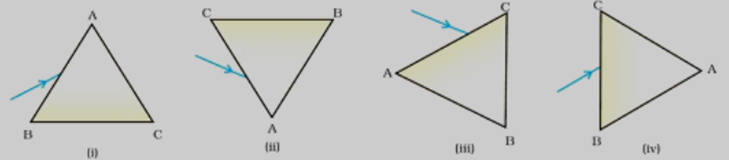
A. (i) B. (ii) C. (iii) D. (iv)
View AnswerAns. (b) Diagram (ii)
The following question consists of two statements – Assertion (A) and Reason (R). Answer these questions by selecting the appropriate option given below:
A. Both A and R are true, and R is the correct explanation of A.
B. Both A and R are true, and R is not the correct explanation of A.
C. A is true but R is false.
D. A is false but R is true.
32. Assertion (A): The rainbow is a natural spectrum of sunlight in the sky.
Reason (R): Rainbow is formed in the sky when the sun is overhead and water droplets are also present in air.
Ans. A. Both A and R are true, and R is the correct explanation of A.
B. Both A and R are true, and R is not the correct explanation of A.
C. A is true but R is false.
D. A is false but R is true.
View AnswerAns. C. A is true but R is false.
33.
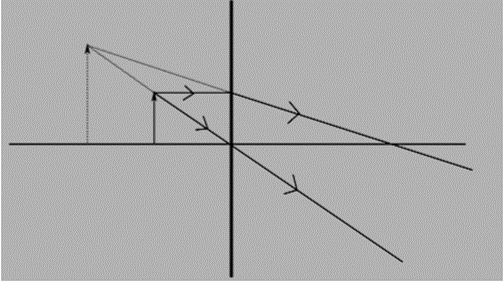
The above figure shows the formation of an image by a lens shown by a thick line.
Analyse the figure and answer the following questions.
(i) What is the type of lens used?
(ii) What is the nature of the image?
(iii) If the image is formed at a distance of 30 cm from the lens and the
image is twice the size of the object, then where is the object placed?
View AnswerAns. (i) The lens is a convex lens.
(ii) The image is virtual.
(iii)
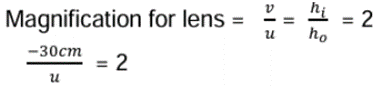
Hence u = -15 cm
34. Attempt either option A or B.
A. Show how you would connect three resistors each of resistance 6 Ω, so that the combination has a resistance of 9 Ω. Also justify your answer.
View AnswerAns.
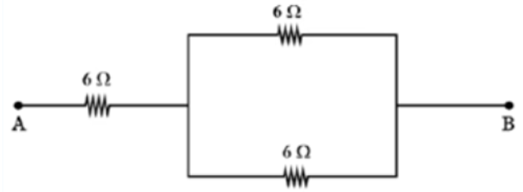
OR
Connect two resistors (6 Ω each) in parallel → 3 Ω.
Then connect this parallel combination in series with the third 6 Ω resistor → 3 Ω + 6 Ω = 9 Ω
OR
B. In the given circuit calculate the power consumed in watts in the resistor of 2 Ω:
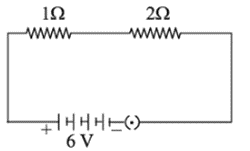
Ans. Equivalent resistance = R1 + R2 = 1 Ω + 2 Ω = 3 Ω
Using Ohm’s law, I = V/ R = 6/3 = 2 A
Power consumed by 2 Ω resistor:
P = I2 x R = (2)2 x 2 = 8 W
35. A person is suffering from an eye defect in which the far point of the eye is nearer than infinity. Identify the defect. List two main causes of this defect. Draw a ray diagram to show how this defect is corrected by using a suitable lens.
View AnswerAns. Defect: Myopia (short-sightedness) – far point nearer than infinity.
Causes: (i) excessive curvature of the eye lens,
(ii) elongation of the eyeball
Diagram: Should show concave lens diverging rays to retina.
36. (a) State Fleming’s left hand rule. Apply this rule to determine the direction of force experienced by a straight current carrying conductor AB placed in a uniform magnetic field as shown.
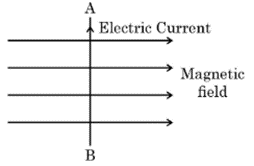
(b) What will happen to an electron that enters in the same magnetic field in the same direction in which the current is flowing in the conductor AB? Give reason to justify your answer.
View AnswerAns. (a) Fleming’s left-hand rule: Stretch the thumb,forefinger and middle finger of your left handsuch that they are mutually perpendicular. If the first finger points in thedirection of magnetic field and the secondfinger in the direction of current, then thethumb will point in the direction of motion orthe force acting on the conductor.
The direction of force on conductor AB will be into the plane of paper.
(b) As direction of current is opposite to the direction of electron, so direction of force will be out of the plane of paper.
37. What is a solenoid? When does a solenoid behave as a magnet? Draw the pattern of the magnetic field produced inside it showing the directions of the magnetic field lines.
View AnswerAns. A solenoid is a coil of many circular turns of insulated copper wire.
It behaves like a bar magnet when current flows through it.
Diagram: Magnetic field lines are uniform (parallel lines) inside the coil and N→S around it.
38. A highly polished surface such as a mirror reflects most of the light falling on it. In our daily life, we use two types of mirrors plane and spherical. The reflecting surface of spherical mirrors may be curved inwards or outwards. In concave mirrors, reflection takes place from the inner surface, while in convex mirrors reflection takes place from the outer surface.
(a) Define the principal focus of a concave mirror.
(b) A ray of light is incident on a concave mirror, parallel to its principal axis. If this ray after reflection from the mirror passes through the principal axis from a point at a distance of 10 cm from the pole of the mirror, find the radius of curvature of the mirror.
(c) An object is placed at a distance of 10 cm from the pole of a convex mirror of focal length 15 cm. Find the position of the image.
View AnswerAns. (a) Principal focus (F): Point on principal axis where rays parallel to it converge after reflection from mirror.
(b) Given: f = 10 cm → Radius of curvature = 2f = 20 cm.
(c) Object at 10 cm, f = 15 cm (convex mirror):
Using mirror formula → 1/f = 1/v + 1/u → 1/15 = 1/v – 1/10 → v ≈ 6 cm (virtual image behind mirror)
OR
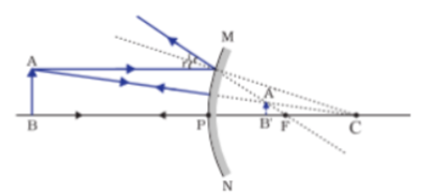
(c) A mirror forms a virtual, erect and diminished image of an object. Identify the type of this mirror. Draw a ray diagram to show the image formation in this case.
View AnswerAns.
39. (a) Define electric power and state its SI unit. The commercial unit of electrical energy is known as ‘unit’. Write the relation between this ‘unit’ and joule.
(b) In a house, 2 bulbs of 50 W each are used for 6 hours daily and an electric geyser of 1 kW is used for 1 hour daily. Calculate the total energy consumed in a month of 30 days and its cost at the rate of ₹8.00 per kWh.
View AnswerAns. (a) Definition: Electric power is the rate at which electrical energy is dissipated or consumed in an electric circuit.
SI unit is the watt (W)
1 kWh = 3.6 × 10⁶ J
(b) Step 1: Calculate the daily energy consumption of each device:
Energy (kWh) = Power (kW) x Time (h)
Bulbs:
Total power of the bulbs = 2 x 50 = 100 W = 0.1 kW
Daily energy consumed by bulbs = 0.1 kW x 6 h = 0.6 kWh
Geyser:
Power of the geyser = 1 kW
Daily energy consumed by geyser = 1 kW x 1h =1kWh
Step 2: Calculate the total energy consumed in a month:
Total daily energy consumption = 0.6kWh+1kWh=1.6kWh
Total monthly energy consumption = 1.6kWh x 30 days = 48kWh
Step 3: Total cost = 48kWh x Rs.8 = Rs. 384
OR
(a) Draw a schematic diagram of a circuit consisting of a battery of four dry cells of 1.5 V each, a 2 Ω resistor, a 6 Ω resistor, a 16 Ω resistor and a plug key all connected in series. Put an ammeter to measure the current in the circuit and a voltmeter across the 16 Ω resistor to measure the potential difference across its two ends. Use Ohm’s law to determine:
(i) ammeter reading, and
(ii) voltmeter reading when the key is closed.
(b) A 4 Ω resistance wire is doubled on it. Calculate the new resistance of the wire.
View AnswerAns.
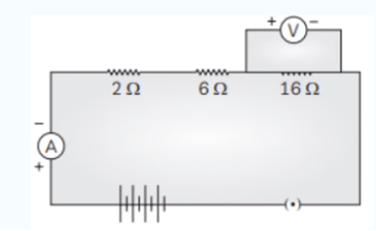
Equivalent Resistance in the circuit, R = 2 + 6 + 16 = 24 Ω
V = 4 x 1.5 = 6 V
- Ammeter reading, I = V / R = 6 / 24 = 0.25 A
- Voltmeter reading, V = IR = 0.25 x 16 = 4 V
(b) When a wire doubled on itself → length is halved, area of cross – section is doubled.
R = ρ l/A
New R = R/4 = 1 Ω