Sample Paper 15
Class X 2025-26
Science (086)
Time: 3 Hours Max. Marks: 80
General Instructions:
1. This question paper consists of 39 questions in 3 sections. Section A is Biology, Section B is Chemistry
and Section C is Physics.
2. All questions are compulsory. However, an internal choice is provided in some-questions. A student is
expected to attempt only one of these questions.
SECTION-A
1. What is the muscular wall that separates the right and left sides of the human heart, preventing the mixing of oxygenated and deoxygenated blood?
(a) Valve
(b) Atrium
(c) Ventricle
(d) Septum
View AnswerAns. (d) Septum
2. The main thinking part of the human brain, which is the site of learning, memory, intelligence, and voluntary
actions, is the:
(a) Cerebellum
(b) Cerebrum
(c) Medulla
(d) Pons
View AnswerAns. (b) Cerebrum
3. The malarial parasite, Plasmodium, exhibits a specific type of asexual reproduction where a single parent
cell divides into many daughter cells simultaneously. This process is known as:
(a) Budding
(b) Binary Fission
(c) Multiple Fission
(d) Fragmentation
View AnswerAns. (c) Multiple Fission
4. Mendel’s experiments with pea plants led to the formulation of several laws of inheritance. Which law states
that alleles for different traits are inherited independently of one another?
(a) Law of Dominance
(b) Law of Segregation
(c) Law of Independent Assortment
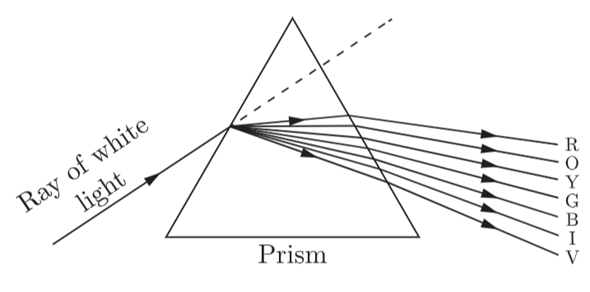
(d) Law of Unit Factors
View AnswerAns. (c) Law of Independent Assortment
5. Ozone is a molecule that plays a crucial role in protecting life on Earth. What is the correct chemical
formula for an ozone molecule?
(a) O
(b) O2
(c) O3
(d) CO2
View AnswerAns. (c) O3
6. Consider the following statements about the parts of a typical flower:
(i) The stamen is the male reproductive part, consisting of the anther and filament.
(ii) The pistil (or carpel) is the female reproductive part, consisting of the stigma, style, and ovary.
(iii) Petals are often brightly coloured to attract insects for pollination.
(iv) Sepals are the primary reproductive organs of the flower.
Which of the above statements are correct?
(a) (i) and (ii) only
(b) (i), (ii), and (iii)
(c) (iii) and (iv) only
(d) All are correct.
View AnswerAns. (b) (i), (ii), and (iii)
7. The human excretory system removes metabolic wastes from the body. What is the main nitrogenous waste
product found in human urine?
(a) Ammonia
(b) Uric acid
(c) Creatine
(d) Urea
View AnswerAns. (d) Urea
8. Assertion (A) : Very little digestion takes place in the large intestine.
Reason (R) : The primary function of the large intestine is the absorption of water from undigested food.
(a) Both A and R are true, and R is the correct explanation of A.
(b) Both A and R are true, and R is not the correct explanation of A.
(c) A is true but R is false.
(d) A is false but R is true.
View AnswerAns. (d) A is false but R is true.
9. Assertion (A) : Geographical isolation of a population can lead to speciation.
Reason (R) : The separated population accumulates different genetic variations over time, which can lead
to it becoming reproductively incompatible with the original population.
(a) Both A and R are true, and R is the correct explanation of A.
(b) Both A and R are true, and R is not the correct explanation of A.
(c) A is true but R is false.
(d) A is false but R is true.
View AnswerAns. (a) Both A and R are true, and R is the correct explanation of A.
10. Aquatic animals like fish have a much faster rate of breathing compared to terrestrial animals. Provide a scientific reason for this observation.
View AnswerAns. The amount of dissolved oxygen in water is very low compared to the amount of oxygen in the air. Therefore, aquatic animals need to breathe faster and pass a larger volume of water over their gills to extract the required amount of oxygen for their metabolic needs, whereas terrestrial animals can obtain sufficient oxygen with a slower breathing rate.
11. A. What is the function of the enzyme salivary amylase? Where is it found, and what would happen to starch digestion if this enzyme were absent?
View AnswerAns. A. Salivary amylase is found in saliva in the mouth. Its function is to begin the digestion of starch, breaking it down into simpler sugars (maltose). If it were absent, the chemical digestion of starch would not begin in the mouth and would have to be carried out entirely in the small intestine, potentially making the process less efficient.
OR
B. What are the two main conducting tissues in plants? Name the substance that each of them transports.
View AnswerAns. The two main conducting tissues are:
1. Xylem: It transports water and dissolved minerals from the roots to the rest of the plant.
2. Phloem: It transports soluble food products (sucrose) from the leaves to other parts of the plant.
12. What are producers, consumers, and decomposers? Give one example of each from a forest ecosystem.
View AnswerAns. 1. Producers: Organisms that produce their own food, usually through photosynthesis. They form the first trophic level. Example: Trees, grass.
2 Consumers: Organisms that obtain energy by feeding on other organisms. Example: Deer (primary consumer), Tiger (secondary/tertiary consumer).
3 Decomposers: Organisms that break down dead organic matter and waste products, returning nutrients to the ecosystem. Example: Fungi, Bacteria.
13. Tabulate three key differences between the nervous system and the endocrine system for control and coordination in animals.
View AnswerAns.
| Feature | Nervous System | Endocrine System | |
| 1. | Mode of Transmission | Transmits information via electrical impulses along nerve fibres | Transmits information via chemical messengers (hormones) through the bloodstream. |
| 2. | Speed of Response | The response is immediate and rapid (within milliseconds) | The response is generally slow and takes time (seconds, minutes, or hours) |
| 3. | Duration of Effect | The effect is short-lived | The effect is usually long-lasting. |
14. In a cross between a pea plant with violet flowers (VV) and a pea plant with white flowers (vv):
(i) What will be the phenotype of the F1 generation?
(ii) If the F1 plants are self-pollinated, what will be the ratio of violet to white flowered plants in the F2 generation?
(iii) What is this type of cross, involving a single trait, called?
View AnswerAns. (i) The phenotype of the F1 generation will be all violet flowers, as violet (V) is the dominant trait. The genotype will be heterozygous (Vv).
(ii) The ratio of violet to white flowered plants in the F2 generation will be 3 (Violet): 1 (White).
(iii) This type of cross, which studies the inheritance of a single pair of contrasting traits, is called a monohybrid cross.
15. The diagram below shows a schematic representation of blood circulation in humans.
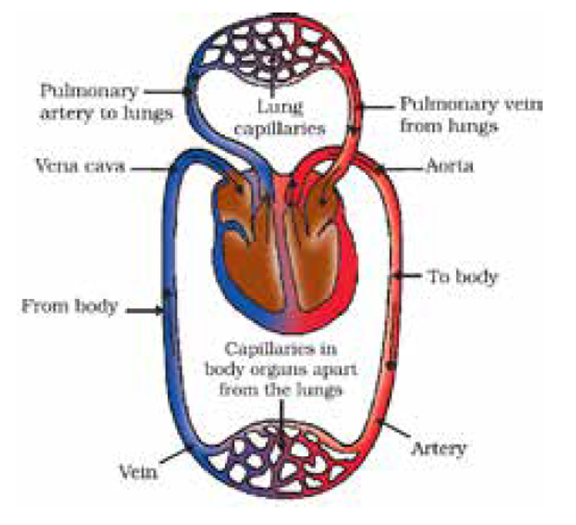
A. Why is the circulation in humans referred to as ‘double circulation’ ?
View AnswerAns. It is called double circulation because the blood passes through the heart twice during each complete cycle. One cycle carries deoxygenated blood from the body to the heart and then to the lungs. The second cycle carries oxygenated blood from the lungs back to the heart and then to the rest of the body.
OR
B. Differentiate between pulmonary circulation and systemic circulation.
View AnswerAns. Pulmonary circulation is the movement of deoxygenated blood from the heart (right ventricle) to the lungs for oxygenation and the return of oxygenated blood from the lungs to the heart (left atrium). Systemic circulation is the movement of oxygenated blood from the heart (left ventricle) to all body parts and the return of deoxygenated blood from the body back to the heart (right atrium).
C. Trace the flow of deoxygenated blood from the body tissues until it is oxygenated in the lungs.
View AnswerAns. Deoxygenated blood from body tissues is collected by veins and poured into the right atrium. The right atrium contracts, pumping the blood into the right ventricle. The right ventricle then contracts and pumps this deoxygenated blood into the pulmonary artery, which carries it to the lungs for oxygenation.
16. A. (i) Draw a diagram to show regeneration in Planaria.
View AnswerAns. (i) A diagram should be drawn showing a Planaria cut into three pieces (head, middle, tail), with each piece shown growing into a complete new Planaria.
(ii) How is this process different from reproduction?
View AnswerAns. (ii) Regeneration is the regrowth of lost or damaged body parts. While in some simple organisms like Planaria it can result in a new individual from a body fragment (a form of asexual reproduction), in more complex organisms, it is limited to tissue repair and is not a mode of reproduction.
(iii) Name another organism that shows a high capacity for regeneration.
View AnswerAns. (iii) Another organism with a high capacity for regeneration is Hydra or a starfish.
OR
B. (i) State the function of the following parts of the human female reproductive system:
(a) Ovary,
View AnswerAns. Produces female gametes (eggs or ova) and secretes female sex hormones (estrogen and progesterone).
(b) Oviduct.
View AnswerIt is the site where fertilization of the egg by the sperm takes place.
(ii) What is the placenta? List its two main functions.
View AnswerAns. (ii) The placenta is a special disc-like tissue that connects the developing fetus to the uterine wall of the mother. Its two main functions are to provide nourishment and oxygen to the fetus and to remove waste products from the fetus’s blood.
(iii) What happens to the uterine wall if fertilization of the egg does not occur?
View AnswerAns. (iii) If fertilization does not occur, the thick and spongy lining of the uterus is no longer needed. It breaks down and is discharged through the vagina along with blood and mucus. This is known as menstruation.
SECTION-B
17. The reaction between nitrogen and hydrogen to produce ammonia is represented as xN2(g) + yH2(g) zNH3(g)
The values of x, y, and z required to balance the equation are:
(a) x=1, y=3, z=2
(b) x=2, y=3, z=2
(c) x=1, y=2, z=3
(d) x=2, y=2, z=3
View AnswerAns. (a) x=1, y=3, z=2
18. A solution turns red litmus paper blue. Its pH is likely to be:
(a) 1
(b) 4
(c) 5
(d) 10
View AnswerAns. (d) 10
19. Most non-metals are not lustrous. Which of the following non-metals possesses lustre?
(a) Sulphur
(b) Oxygen
(c) Nitrogen
(d) Iodine
View AnswerAns. (d) Iodine
20. Which of the following is considered a weak acid?
(a) Hydrochloric acid (HCl)
(b) Sulphuric acid (H2SO4)
(c) Acetic acid (CH3COOH)
(d) Nitric acid (HNO3)
View AnswerAns. (c) Acetic acid (CH3COOH)
21. Saturated hydrocarbons contain only carbon-carbon single bonds. Which of the following is a saturated
hydrocarbon?
(a) Ethene (C2H4)
(b) Propyne (C3H4)
(c) Butane (C4H10)
(d) Ethyne (C2H2)
View AnswerAns. (c) Butane (C4H10)
22. To prevent the oil and fats in potato chips from getting oxidised, manufacturers fill the bags with which gas?
(a) Oxygen
(b) Hydrogen
(c) Nitrogen
(d) Carbon dioxide
View AnswerAns. (c) Nitrogen
23. Brass is an important alloy used in making decorative items and musical instruments. It is an alloy of:
(a) Copper and Tin
(b) Copper and Zinc
(c) Aluminium and Copper
(d) Lead and Tin
View AnswerAns. (b) Copper and Zinc
24. Assertion (A) : Butane and Propane are members of the same homologous series.
Reason (R) : Members of a homologous series have the same general formula and successive members differ
by a -CH2 group.
(a) Both A and R are true, and R is the correct explanation of A.
(b) Both A and R are true, and R is not the correct explanation of A.
(c) A is true but R is false.
(d) A is false but R is true.
View AnswerAns. (a) Both A and R are true, and R is the correct explanation of A.
25. Why is it recommended to clean a magnesium ribbon with sandpaper before burning it in air?
View AnswerAns. A magnesium ribbon, when exposed to air, reacts with oxygen to form a thin, protective layer of magnesium oxide (MgO) on its surface. This layer is stable and can prevent or slow down the combustion of the magnesium underneath. Cleaning the ribbon with sandpaper removes this oxide layer, allowing the pure magnesium to react readily with oxygen upon heating.
26. Attempt either option A or B.
(A) Explain the process of extracting mercury from its chief ore, cinnabar (HgS). Write balanced chemical equations for the reactions involved.
View AnswerAns. Mercury is a metal of low reactivity. It is extracted from its sulphide ore, cinnabar, simply by heating it in the air. This process involves two steps:
1. Roasting: Cinnabar is first converted into mercuric oxide (HgO) by heating it in the presence of excess air.
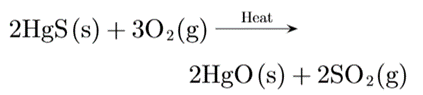
2. Reduction: The mercuric oxide formed is unstable and decomposes upon further heating to give liquid mercury metal.

OR
(B) What are amphoteric oxides? Give an example of an amphoteric oxide and support your answer by writing one balanced chemical equation for its reaction with an acid and one with a base.
View AnswerAns. Amphoteric oxides are metal oxides that exhibit both acidic and basic properties. They react with both acids and bases to form salt and water.
Example: Aluminium oxide (Al2O3) is an amphoteric oxide.
Reaction with an acid (HCl): It reacts as a base.

Reaction with a base (NaOH): It reacts as an acid.

(Sodium Aluminate)
27. A student is given three solutions labelled A, B, and C with pH values of 4, 7, and 10, respectively. Answer the following questions:
(a) Which solution is neutral? Justify your answer.
View AnswerAns. (a) Solution B is neutral. A neutral solution has a pH value equal to 7.
(b) Which solution is alkaline?
View AnswerAns. (b) Solution C is alkaline (or basic) as its pH value is greater than 7.
(c) Arrange the three solutions in increasing order of their hydrogen ion (H+) concentration.
View AnswerAns. (c) A lower pH indicates a higher concentration of H+ ions. Therefore, the increasing order of H+ ion concentration is: C (pH 10) < B (pH 7) < A (pH 4).
28. A substance ‘X’, which is a yellowish-white powder, is used for disinfecting drinking water and for bleaching
cotton in the textile industry. It is produced by the action of chlorine gas on dry slaked lime.
(a) Identify the substance ‘X’ and write its chemical formula.
View AnswerAns. (a) The substance ‘X’ is Bleaching Powder. Its chemical formula is CaOCl2.
(b) Write the balanced chemical equation for the preparation of ‘X’.
View AnswerAns. The balanced chemical equation for its preparation is:

(c) When ‘X’ is left exposed to air, it gradually loses its chlorine content. Why does this happen? Write a relevant chemical equation.
View AnswerAns. Bleaching powder reacts with the carbon dioxide present in the air to produce calcium carbonate and chlorine gas. This slow reaction is the reason it loses its chlorine content upon exposure to air.

OR
(d) State any two uses of substance ‘X’ apart from those mentioned in the question.
View AnswerAns. Two other uses of bleaching powder are:
1. As an oxidising agent in many chemical industries.
2. For making wool unshrinkable.
29. Attempt either option A or B.
(A) (a) Write the IUPAC names for the following compounds:
(i) CH3- CH2- Br (ii) HCHO
View AnswerAns. (i) Bromoethane (ii) Methanal
(b) What is an addition reaction? Illustrate with the help of a balanced chemical equation.
View AnswerAns. An addition reaction is a reaction in which an unsaturated hydrocarbon (containing a double or triple bond) reacts with another substance (like hydrogen or halogens) to form a single, saturated product.
Example: Hydrogenation of ethane
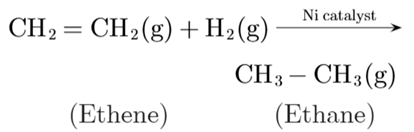
(c) Why are addition reactions characteristic of unsaturated hydrocarbons?
View AnswerAns. Unsaturated hydrocarbons have double or triple bonds which are regions of high electron density and are relatively weak compared to single bonds. These bonds can easily break to allow atoms to add across them, leading to a more stable saturated compound.
OR
(b) (a) What is a substitution reaction?
View AnswerAns. A substitution reaction is a reaction in which one or more hydrogen atoms in a saturated hydrocarbon are replaced by another atom or group of atoms (like halogens)
(b) Give an example of a substitution reaction involving an alkane. Write the balanced chemical equation.
View AnswerAns. Chlorination of methane in the presence of sunlight.

(c) Differentiate between soaps and detergents based on their chemical composition and their effectiveness in hard water.
View AnswerAns.
| Feature | Soaps | Detergents |
| Chemical Composition | Sodium or potassium salts of long-chain carboxylic (fatty) acids. | Sodium salts of long chain benzene sulphonic acids or alkyl hydrogen sulphates. |
| Action in Hard Water | Ineffective. They form insoluble scrum with calcium and magnesium ions. | Effective. They do not form insoluble precipitates with the ions in hard water. |
SECTION-C
30. A student is studying the image formed by a plane mirror and makes the following statements:
I. The image formed is always virtual and erect.
II. The image is laterally inverted.
III. The size of the image is always smaller than the size of the object.
Choose from the following the correct option that lists the correct statements.
(a) I and II
(b) I and III
(c) I, II and III
(d) II and III
View AnswerAns. (a) I and II
31. A person suffering from hypermetropia is unable to see nearby objects clearly. Which of the following
correctly describes the reason for this defect?
(a) The image of a nearby object is formed in front of the retina.
(b) The image of a nearby object is formed on the retina.
(c) The image of a nearby object is formed behind the retina.
(d) The eye lens is a concave lens.
View AnswerAns. (c) The image of a nearby object is formed behind the retina.
32. Assertion (A) : A ray of light passing through the focus of a convex lens becomes parallel to the principal
axis after refraction.
Reason (R) : The principal focus is the point on the principal axis where all parallel rays converge after refraction.
(a) Both A and R are true, and R is the correct explanation of A.
(b) Both A and R are true, and R is not the correct explanation of A.
(c) A is true but R is false.
(d) A is false but R is true.
View AnswerAns. (b) Both A and R are true, and R is not the correct explanation of A.
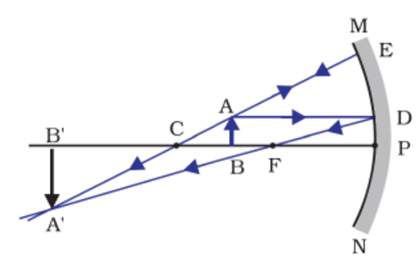
33. An object 7 cm tall is placed 27 cm in front of a concave mirror of focal length 18 cm.
A. Calculate the image distance.
View AnswerAns. v = 54 cm.
B. Find the size of the image.
View AnswerAns. m = -2 à image size = -14 cm
C. State the nature of the image.
View AnswerAns. Real, inverted, magnified
34. Attempt either option A or B
A. Two resistors of resistances 3 Ω and 6 Ω respectively are connected to a battery of 6 V so as to have :
(a) Maximum resistance,
(b) Maximum current.
(i) How will you connect the resistances in each case ?
View AnswerAns. For maximum resistance, resistors are to be connected in series.

Current in series
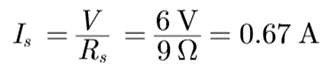
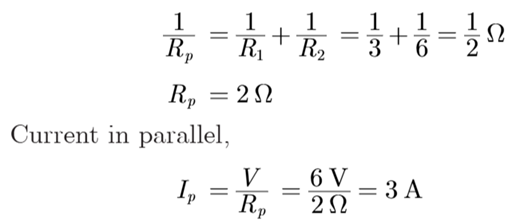
(ii) Calculate the strength of the current in the circuit in both cases.
View AnswerAns. For maximum current, resistance has to be minimum and so resistors are to be connected in parallel.
OR
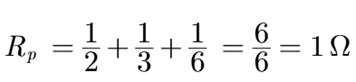
B. Calculate the equivalent resistance from the following combination of resistors.
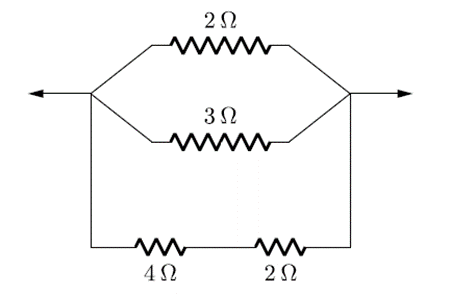
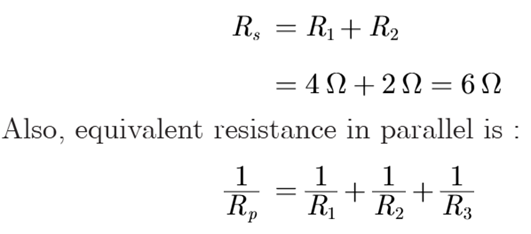
Ans. In the given circuit 4 Ω and 2 Ω are connected series. Hence the equivalent resistance is given by
35. What is dispersion of white light ? State it cause. Draw a ray diagram to show the dispersion of white light by a glass prism.
View AnswerAns. Dispersion of white light: When a beam of white light is passed through a triangular glass prism, the white light splits up-to form a band of seven colours on a white screen. This splitting of white light into seven colours on passing through a transparent medium like a glass prism is called dispersion of light.
The dispersion of white light occurs be- cause the angle of refraction (or angle of deviation) of light of different colours is different when pass- ing through the glass prism. So, when white light consisting of seven colours passes through a glass prism, each colour of it is refracted (or deviated) by a different angle with the result that seven colours are spread out to form a spectrum.
36. The values of current I flowing in a given resistor for the corresponding values of potential difference V across the resistor are given below:

Plot a graph between V and I and calculate the resistance of the resistor.
View AnswerAns.
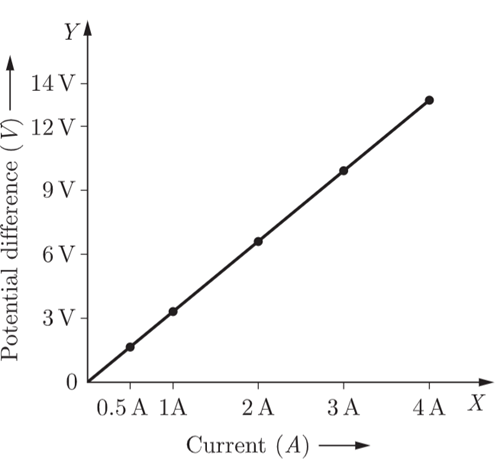
From the graph, we can take values of V and I
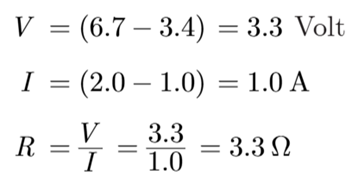
So, Resistance = 3.3 Ω
37. A student states that a rainbow is formed due to reflection, refraction, and dispersion of sunlight by water droplets.
(i) Is the statement correct?
View AnswerAns. Yes, correct
(ii) Explain briefly.
View AnswerAns. Water droplets act like tiny prisms, refracting and dispersing sunlight, then internally reflecting it, and refracting again to form a rainbow.
38. The image formed by a convex lens depends on the position of the object in front of the lens. When the object is placed anywhere between focus and infinity, the image formed by convex lens is real and inverted. The image is not obtained on the screen why the object is placed between the focus and the lens. The distance between the optical centre O of the convex lens and the focus point F1 and F2 is its focal length. When the object shifts from – ∞ to F1, the image moves from F2 to +∞.
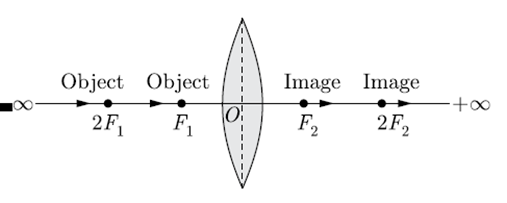
When the object shifts from F1 to O, the image moves -∞ to O.
A student did an experiment with a convex lens. He put an object at different distances from the lens. In each case, he measured the distance of the image from the lens. The results were recorded in the following table.
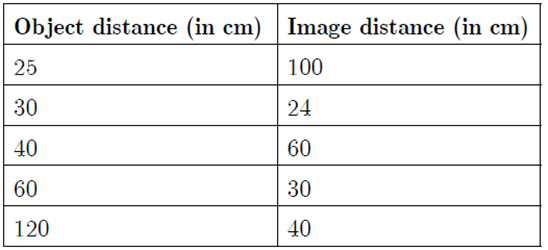
Unfortunately, his results are written in the wrong order.
(i) What is the focal length of this lens ?
View AnswerAns. When the object distance equals the image distance, they are at twice the focal length from the lens.
When, 2F = 60 cm
F = 30 cm
When an object is placed at focus (F = 30 cm) of a convex lens, the image formed is at infinity. But infinity is not any observation in the given table.
Hence, F = 30 cm is not possible
Now, when, 2F = 40 cm
F = 20 cm
(ii) Rewrite the image distances in the correct order.
View AnswerAns. Correct order: 100, 60, 40, 30, 24
OR
(iii) What is the minimum distance between an object and its real image formed by a convex lens ?
View AnswerAns. 4f
39. Attempt either option A or B.
A. In our daily life we use two types of electric current whose current time graphs are given below :
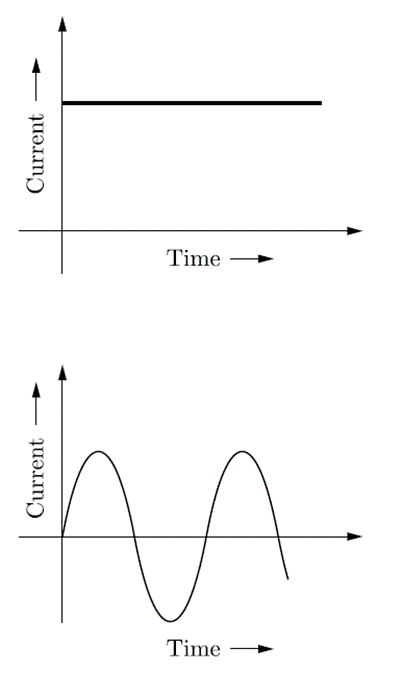
(i) Name the type of current in two cases.
View AnswerAns. Direct current and alternating current respectively.
(ii) Identify any one source for each type of current.
View AnswerAns. Battery and AC generator respectively.
(iii) What is the frequency of current in case (b) in our country?
View AnswerAns. Frequency of AC in our country, 50 Hz.
(iv) On the basis of these graphs list two differences between the two currents.
View Answer(a) Magnitude of current in DC remains fixed, while in AC it changes continuously.
(b) Direction of current in DC remains fixed, while in AC it changes after every 1/2n second, where n is the frequency of AC.
(v) Out of the two which one is used in transmitting electric power over long distances and why?
View AnswerAns. For transmitting electric power over long distances AC is used instead of DC because loss of energy during transmission is comparatively very small.
OR
B. The flow of current in a circular loop of wire creates a magnetic field at its center. How may existence of this field be detected ? State the rule which helps to predict the direction of this magnetic field.
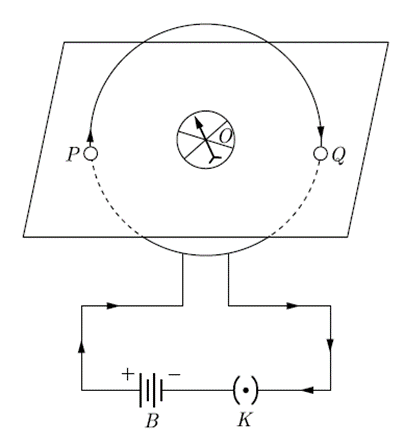
Ans. Take a cardboard sheet. Drill two fine holes P and Q on it along a straight line at a suitable distance. Take an insulated copper wire loop and pass it through the holes so that the loop is in a vertical plane. Connect a 6-12 V battery B and a plug key K with the ends of wire loop. Put a sensitive compass at the center point 0 of the cardboard. The compass rests in north-south direction. Now put the plug in key K so that a current begins to flow in the loop as shown in Figure. We observe that the compass needle gets deflected. It shows that a magnetic field is set up at the center of current- carrying circular loop. The direction of field is given by right-hand rule.