How do Organisms Reproduce
How do Organisms Reproduce
1. Name the life process of an organism which helps in the growth of its population.
View AnswerAns. Reproduction
2. Where is DNA found in the cell?
View AnswerAns. DNA is found in the nucleus.
3. What is DNA?
View AnswerAns. DNA means deoxyribo nucleic acid. It lies in the cell nucleus, which is the source of information for making proteins and different proteins lead to different body designs.
4. Name the information source of making proteins in the cell. State two basic events in reproduction.
View AnswerAns. DNA in the nucleus of a cell is the source of information for making proteins. The two basic events in reproduction are:
(i) creation of copy of DNA
(ii) creation of an additional cellular apparatus by cell then the DNA copies separate, each with its own cellular apparatus.
5. What is the effect of DNA copying which is not perfectly accurate in the reproduction process?
View AnswerAns. DNA copying will lead to variation in populations which helps in evolution of the species.
6. Explain how do organisms create an exact copy of themselves.
View AnswerAns. The cell uses biochemical reactions to make exact copies of DNA or genetic material.
7. What is the importance of DNA copying in reproduction?
OR
Why is DNA copying an essential part of the process of reproduction?
View AnswerAns. Reproduction involves producing same kind of species from parents. The genetic information is passed to the offspring by DNA present in each cell. This DNA, which is replicated (copied) is responsible for the resemblance of parents with offsprings with same traits. New traits are passed on due to difference in copying, new variations may occur and new species may evolve.
8. (a) What is the location of following: (i) DNA in a cell, (ii) Gene
View AnswerAns. (i) DNA is found in nucleus of cell, (ii) Genes are located on the chromosomes.
(b) Expand DNA.
View AnswerAns. Deoxyribonucleic acid.
9. When a cell reproduces, what happens to its DNA?
View AnswerAns. During the process of reproduction, transmission of DNA from parents to offspring takes place. Before reproduction, DNA is replicated, which means two copies of DNA are produced. When the cell divides into two, these two copies are distributed equally between the two daughter cells so that similar amount and type of DNA is transferred from the parent cell to the daughter cells. It maintains the consistency in the amount and type of DNA in the living organism of a particular species.
10. Reproduction is one of the most important characteristics of living beings. Give three reasons in support of the statement.
View AnswerAns. Reproduction is an energy consuming process which is not essential for the survival of an individual. But it is the most important characteristic of all living beings, because of the following reasons:
(i) Reproduction helps in increasing the number of members of a population.
(ii) By replacing the dead members with the new ones, it minimises the risk of extinction of a species.
(iii) It brings about variations in species, thus leading to their evolution.
11. (a) (i) Write full form of DNA.
View AnswerAns. Deoxy Ribonucleic Acid
(ii) State the role of DNA in the cell nucleus.
View AnswerAns. It helps in synthesis of protein and transfer of genetic characteristics.
(iii) What will be the effect if the information of the DNA is changed?
View AnswerAns. Proteins will be changed.
(b) Explain the importance of DNA copying in reproduction
View AnswerAns. Body designs are similar due to DNA copying.
DNA cell nucleus carry information for synthesis of protein.
If DNA copying will not take place, then body design will change.
12. Name the part of Bryophyllum where the buds are produced for vegetative propagation.
View AnswerAns. Buds arise from the notches in the leaf margins of Bryophyllum.
13. What happens when a Planaria gets cut into two pieces?
View AnswerAns. Each piece regenerates into new organism, planaria.
14. What happens when a mature Spirogyra filament attains considerable length?
View AnswerAns. A mature spirogyra filament breaks into smaller fragments and each fragment grows into a new plant. This process of reproduction is called fragmentation.
15. Name the method by which hydra reproduces. Is this method sexual or asexual?
View AnswerAns. Hydra reproduces by budding. It is an asexual mode of reproduction.
16. Name two simple organisms which have ability of regeneration.
View AnswerAns. Planaria and Hydra
17. Name the causative agent of the disease ‘kala-azar’ and its mode of asexual reproduction
View AnswerAns. Leishmania causes ‘kala-azar’. It reproduces by binary fission in a definite orientation.
18. Give the respective scientific term used for studying.
(i) The mechanism by which variation are created and inherited and
View AnswerAns. Heredity
(ii) The development of new type of organism from the existing ones.
View AnswerAns. Evolution
19. Name the type of cells which undergo regeneration.
View AnswerAns. Specialised cells called regenerative cells which can make large number of new cells.
21. What is the advantage of reproduction through spores?
OR
How will organism be benefitted if it reproduces through spores
View AnswerAns. Spore with a cell wall can survive even in adverse conditions. Large number of spores are produced in one sporangium. It is easily dispersed through wind as they are large in number and light in weight.
22. Name the method by which spirogyra reproduces under favourable conditions. Is this method sexual or asexual?
View AnswerAns. Under favourable conditions, spirogyra reproduces by a process known as fragmentation. This is an asexual method of reproduction.
23. How does Planaria reproduce? Is this method sexual or asexual?
View AnswerAns. Planaria reproduces by a process known as regeneration. It is a type of asexual reproduction in which if Planaria can be cut into any number of pieces, each piece grows into a new individual organism.
24. How does Plasmodium reproduce? Is this method sexual or asexual?
View AnswerAns. Plasmodium is a single celled organism which reproduces by the process of multiple fission. Multiple fission (i.e. breaking up of a single cell into many daughter cells) is an asexual mode of reproduction.
25. List two advantages of growing grapes or banana plants through vegetative propagation.
View AnswerAns. (i) Characteristics of parent plants are preserved.
(ii) Since these plants do not have viable seeds, therefore vegetative propagation is advantageous.
26. List three conditions favourable for spores to germinate and grow.
View AnswerAns. (i) Availability of nutrition (food),
(ii) moist place,
(iii) warmth,
(iv) dark place.
27. Name the type of asexual reproduction in
(a) Planaria
View AnswerAns. Regeneration
(b) Rhizopus
View AnswerAns. Spore formation
(c) Spirogyra
View AnswerAns. Fragmentation
(d) Hydra
View AnswerAns. Budding
28. Leaves of Bryophyllum fallen on the ground produces new plants, why?
View AnswerAns. Leaves of bryophyllum has adventitious buds or plantlets in the notches along the leaf margin. When buds fall on the soil, they develop into new plant under favourable conditions.
29. Name the type of asexual reproduction in which two individuals are formed from a single parent and the parental identity is lost. Write the first step from where such a type of reproduction begins. Draw first two stages of this reproduction.
View AnswerAns. Binary fission, e.g. Fission in Amoeba
Elongation of cell and its nucleus is the first step.
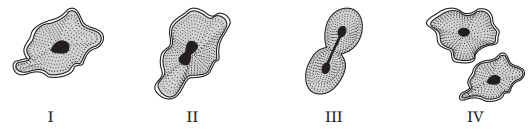
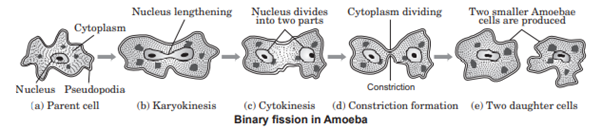
30. Draw in sequence (showing the four stages), the process of binary fission in Amoeba.
View AnswerAns. Sequence (showing the four stages), the process of binary fission in Amoeba.
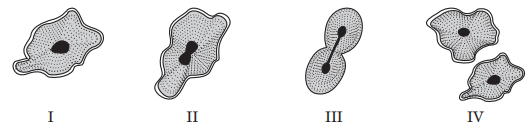
31. What is multiple fission? How does it occur in an organism? Explain briefly. Name an organism which exhibits this type of reproduction.
View AnswerAns. The process in which parent cell divides into several small and equal sized daughter cells, which grows into a new organism is called multiple fission.
The nucleus of a cell divides into large number of nuclei and cytoplasm separates, forming a membrane around it. All this occurs within a protective covering. Plasmodium exhibits multiple fission.
32. Explain the term ‘Regeneration’ as used in relation to reproduction of organisms. Describe briefly how regeneration is carried out in multicellular organisms like Hydra.
View AnswerAns. Regeneration is the ability to produce an organism from their body parts. Many fully differentiated organisms show ability to reproduce by regeneration. In hydra, if the body is cut into two or three pieces, the lower part will develop head while the upper part will develop rest of the body. If its cells are separated, hydra will reform its structure by regeneration.
33. In the context of reproduction of species state the main difference between fission and fragmentation. Also give one example of each.
View AnswerAns.

34. What happens when
(i) Planaria gets cut into two pieces
View AnswerAns. Each piece will regenerate into complete organism. Cells at the location of the site of cut or wound, forms a small ball of cells that will differentiate into new tissues and regenerate the missing parts of the cut piece of the planaria.
(ii) A mature spirogyra filament attains considerable length
View AnswerAns. When spirogyra attains considerable length, it breaks into smaller fragments and each fragment grows into a new plant.
(iii) On maturation sporangia burst
View AnswerAns. On maturation, sporangial wall breaks and spores are dispersed to grow into new individual. These spores are very light and easily dispersed by wind.
35. Explain budding in hydra with the help of labelled diagrams only.
View AnswerAns. A bud is an outgrowth from the body part of parent due to repeated cell division at a specific site. These buds develop into new individuals, which detach from the parent body on maturation. In hydra, the cells divide very fast at a specific site as an outgrowth called bud. These bud develops into a small individual, while remaining attached to the parent. When it matures, it detaches from the parent body to exist as an independent organism.
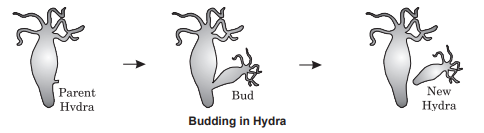
36. What happens when:
(a) Accidently, Planaria gets cut into many pieces?
View AnswerAns. When Planaria gets cut into many pieces, it will undergo a process known as regeneration due to which each piece will grow into a new planaria organism.
(b) Bryophyllum leaf falls on the wet soil?
View AnswerAns. When bryophyllum leaf falls on the wet soil, the buds that are produced in the notches along the leaf will develop into new plants by the process known as vegetative propagation.
(c) On maturation sporangia of Rhizopus bursts?
View AnswerAns. When the sporangia of Rhizopus bursts upon maturation, the spores present inside it spread in the open environment. Then, with the help of different agents, they are carried to different places and when they land on a favourable surface, they start growing and produce new organism.
37. What is vegetative propagation? State two advantages and two disadvantages of this method.
View AnswerAns. Vegetative propagation is a mode of asexual reproduction in which new plants are obtained from vegetative parts of the plants. It does not involve the production of seeds or spores for the propagation of new plants.
Two advantages of vegetative propagation are:
(i) Plants which do not produce seeds are propagated by this method, for example sugarcane, potato, etc.
(ii) Vegetative propagation is a cheaper, easier, rapid method of propagation in plants than growing plants from their seeds. For example, lilies grow very slowly and take 4 to 7 years to develop flowers when grown through their seeds, but flowers are produced only after a year or two when grown vegetatively.
Two disadvantages of vegetative propagation are:
(i) As there is no genetic variation, there is no chance of development of new and better varieties.
(ii) The vegetatively propagated plants are more prone to diseases that are specific to the species. This can result in the destruction of an entire crop.
38. Define the term pollination. Differentiate between self-pollination and cross pollination. What is the significance of pollination?
View AnswerAns. Pollination: The process in which pollen is transferred from stamen to the stigma is called pollination.

Significance: After the pollen lands on suitable stigma, it needs to reach the female germ cells in the ovary where fertilisation takes place, zygot is formed. Zygot divides several times to form embryo with in ovule which develops a tough coat around it called seed coat and seed is formed. The ovary grows rapidly and ripens to form fruit.
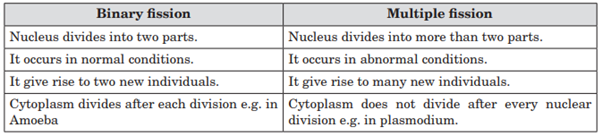
39. (a) List in tabular form two differences between binary fission and multiple fission.
View AnswerAns.
(b) What happens when a mature spirogyra filament attains considerable length.
View AnswerAns. A mature spirogyra filament breaks into smaller fragments and each fragment grows into a new plant. This process of reproduction is called fragmentation.
40. What is binary fission in organisms? With the help of suitable diagrams, describe the mode of reproduction in amoeba.
View AnswerAns. Binary fission is a fission in which two daughter cells are formed of nearly equal size after replicating the genetic material of a single cell. Single-celled organisms like amoeba undergoes binary fission.
41. Identify the following methods and give one example of each:
(a) Process in which reproduction takes place by breaking up of parent into several fragments.
View AnswerAns. Fragmentation, Spirogyra
(b) Process of dividing of organisms into many cells simultaneously.
View AnswerAns. Multiple fission, Plasmodium
(c) Process of reproduction by formation of bud on the parent body.
View AnswerAns. Budding, Yeast/Hydra
(d) Process of reproduction by formation of spores.
View AnswerAns. Spore formation, Rhizopus
(e) Process used by multi-cellular organisms to reproduce by cutting into many pieces and each piece forms a new individual.
View AnswerAns. Regeneration, Planaria
42. (a) Identify the organism A, B and mode of asexual reproduction exhibited by them.
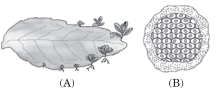
Ans. ‘A’ is Bryophyllum–Vegetative propagation; ‘B’ is Plasmodium–Multiple fission
(b) How will an organism be benefitted if it reproduces through spores?
View AnswerAns. Spores are covered with thick walls which protect them until they come into contact with a moist surface.
(c) Mention the two asexual methods by which hydra can reproduce. Explain briefly any one such method.
View AnswerAns. Budding and regeneration
43. (i) Describe the various steps involved in the process of binary fission with the help of a diagram.
View AnswerAns.
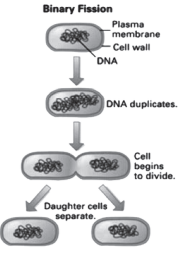
(ii) Why do multicellular organisms use complex way of reproduction?
View AnswerAns. Multicellular organisms cannot reproduce by cell because they are not simple random collection of cells.
They have specialised cells, organised as tissues which are organised into organs.
Cell-by-cell division would be impractical (not practical).
Multicellular organisms require to use more complex ways of reproduction.
44. What are those organisms called which bear both the sex organs in the same individual? Give one example of such organisms
View AnswerAns. These are called hermaphrodites, e.g. earthworm and leech.
45. Why is fertilisation not possible without pollination in plants?
View AnswerAns. Fertilisation is the process in which pollen grain and egg fuse to form zygote. Pollination is the process of transfer of pollen grains from stamen to the stigma of carpel. It means that fertilisation is not possible without pollination.
46. List two unisexual flowers
View AnswerAns. Watermelon, Cucumber and Willows
47. List two reasons for the appearance of variations among the progeny formed by sexual reproduction
View AnswerAns. (i) Special cell division involved in the process of gametes formation is the cause of variations.
(ii) Genetic material comes from two parents, which brings variations in offsprings.
48. List two functions performed by testis in human beings.
View AnswerAns. (i) Testis produces sperms.
(ii) It produces testosterone hormone.
49. Name the parts of a bisexual flower that are not directly involved in reproduction.
View AnswerAns. Sepals and petals are not directly involved in reproduction.
50. How can the chromosomes be identified?
View AnswerAns. Chromosomes can be seen as thread like structure having specific shape when cell is dividing by which they can be identified.
51. Why is temperature of scrotal sac 2°C less than the body temperature?
View AnswerAns. Scrotal sac temperature is less by 2° because sperms are safe at a little lower temperature than body temperature. It is outside the body that is why it has lower temperature than body.
52. Differentiate between pollen grain and ovule.
View AnswerAns. Pollen grains contain male gametes in plants and ovules contain female gametes.
53. Differentiate between germination and fertilisation.
View AnswerAns. Germination: Involves development of embryo into a seedling.
Fertilisation: It involves fusion of male with female gametes.
54. What are sexually transmitted diseases? Name a STDs which damages the immune system of human body
View AnswerAns. Diseases that spread through the sexual contact are called STDs
AIDS damages the body’s immune system.
55. What happens when egg is not fertilised?
View AnswerAns. When egg is not fertilised, blood and mucus comes out through vagina. This process is called menstruation.
56. Why does the lining of uterus becomes thick and spongy during every month?
View AnswerAns. The lining of uterus becomes thick and spongy by the action of progesterone to receive and nurture the development of embryo.
57. Give an example of a flower which contains both stamens and carpels
View AnswerAns. Hibiscus, Mustard
58. What is the role of seminal vesicles and prostate gland?
OR
Write the functions of secretions of prostate gland and seminal vesicles in humans.
View AnswerAns. Seminal vesicle: It holds the liquid that mixes with sperm to form semen.
Prostate gland: It secretes fluid adding upto the semen and contains enzymes and other substances. It also provides nutrition to the sperms, in the form of fructose and calcium. It protects sperms.
59. List two preparations shown every month by the uterus in anticipation of pregnancy in the humans.
View AnswerAns. (i) The inner uterine wall becomes thick.
(ii) More blood vessels develop in its lining.
60. Write the number of immature eggs present in the ovaries of newly born baby girl. Mention what happens to these immature eggs when the girl attains maturity.
View AnswerAns. Ovaries contain thousands of immature eggs at the time of birth. Some of these eggs start maturing when girls attain puberty. One egg is produced every month by one of the ovaries.
61. Trace the path of sperms from where they are produced in human body to the exterior.
View AnswerAns. Testes –> vas deferens –> urethra –> penis and then opens to outside.
62. What is the main difference between sperms and eggs of humans? Write the importance of this difference.
View AnswerAns. Sperms are motile (movable) and have X or Y chromosomes whereas eggs are non-motile and have X chromosome only.
The sperms can reach to egg for fertilisation because these are motile. Chromosomes in them help in determination of sex of a new born child.
63. Differentiate between plumule and radicle.
View AnswerAns.

64. Why do we need to adopt contraceptive measures?
View AnswerAns. (i) To prevent unwanted pregnancies.
(ii) To prevent STD (Sexually Transmitted Diseases).
(iii) To have proper gap between two children.
(iv) To control population.
(v) To have sound health.
65. Give two differences between male gametes and female gametes.
View AnswerAns.

66. State one function each performed by following organs in human beings.
(a) Testes
View AnswerAns. Formation of sperms takes place in testes.
(b) Prostate gland.
View AnswerAns. Prostate gland contributes fluid to the semen
67. What are the two roles of testosterone?
View AnswerAns. (i) Testosterone regulates formation of sperms.
(ii) The appearance of secondary sexual characteristics at puberty like beard, genital hair, change in voice is due to testosterone.
68. List three techniques that have been developed to prevent pregnancy. Which one of these is not meant for males? How does the use of these techniques have a direct impact on health and prosperity of a family?
View AnswerAns. The three techniques which prevent pregnancy are:
(i) Barrier method, (ii) Chemical method (iii) Surgical method
Chemical methods are not for males.
The use of contraceptive has a direct effect on the health and prosperity of the family.
(i) To avoid unwanted pregnancy–if the woman is not physically or mentally prepared to bear a child her health gets adversely affected.
(ii) Contraception allows the parents to space the birth of two children and helps in family planning.
(iii) This way they can decide how many children to have and allows them to bring them up properly especially in case of limited resources.
69. Name the parts A, B and C shown in the following diagram and state one function of each
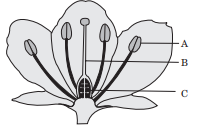
Name the reproductive parts of an angiosperm. Where are these parts located? Explain in brief the structure of female reproductive parts.
View AnswerAns. ‘A’ is anther. It contains pollen grains.
‘B’ is style. It allows growth in pollen tube up to the ovary from the stigma.
‘C’ is ovary. It contains ovules.
70. Suggest three contraceptive methods for birth control, which is essential for the health and prosperity of a country. State the basic principle involved in each.
View AnswerAns. (i) Barrier method: Condom is placed on the erect penis of male before sexual intercourse. In female, a thin rubber disc is placed in the vagina, which covers the opening of cervix.
(ii) Oral pills: Birth control pills can be taken to prevent pregnancy.
(iii) Surgical methods: Use of Copper-T in females, surgically implanted at the opening of the cervix, prevents entry of sperms.
Vasectomy in males, tubectomy in females can also help in population control. In vasectomy, sperm ducts are cut. In tubectomy, oviducts are tied, blocked or cut. Sperms cannot reach the ova and thus pregnancy is avoided.
71. List three distinguishing features between sexual and asexual types of reproduction in tabular form
View AnswerAns.
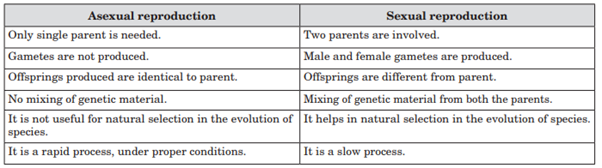
72. Describe the structure and function of placenta.
View AnswerAns. Structure of placenta: It is a special disc like tissue embedded in mother’s uterine wall and connected to the foetus/embryo.
Functions of placenta: It provides a large surface area for glucose and oxygen/nutrients to pass from mother’s body to the developing/developed embryo/foetus and also helps in passing the waste from the foetus/embryo to the mother’s body.
73. Differentiate between self-pollination and cross pollination.
View AnswerAns.
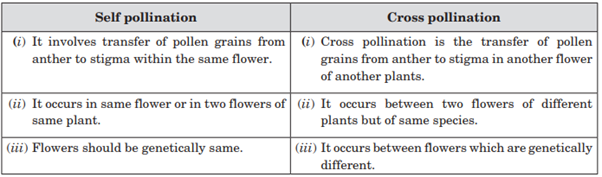
74. Why are testes located outside the abdominal cavity? Mention the endocrine and exocrine functions of the testes
View AnswerAns. Sperm formation takes place at a lower temperature than body temperature therefore testes are located outside the body and its temperature is 2°C below the body temperature.
Functions of Testes:
Endocrine Function: The production of testosterone hormone.
Exocrine Function: The production of sperms.
75. List six specific characteristics of sexual reproduction.
View AnswerAns. (i) Two parents are involved
(ii) Two dissimilar gametes are formed
(iii) Variations are produced
(iv) Occurs in higher and some of lower organisms
(v) Fertilisation is needed for zygote formation
(vi) It is a slow process.
76. (a) State in brief the functions of following female reproductive system
(i) Ovary, (ii) Fallopian tube, (iii) Uterus
View AnswerAns. (i) Ovary: It produces ova and female sex hormones.
(ii) Fallopian tube: It is the site of fertilisation and transfer of female gamete from the ovary.
(iii) Uterus: Implantation of zygote and it keeps foetus till complete development.
(b) State in brief the functions of following male reproductive system
(i) Scrotum, (ii) Testes, (iii) Vas deferens
View AnswerAns. (i) Scrotum: It protects testes.
(ii) Testes: It produces sperms.
(iii) Vas deferens: It delivers sperms from testes to urethra.
77. Draw a labelled diagram of longitudinal section of pistil of flower showing germination of pollen grains on the stigma.
View AnswerAns.
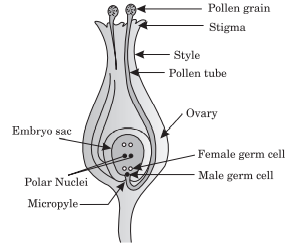
78. State the basic requirements for sexual reproduction. Write the importance of such reproduction in nature.
View AnswerAns. The basic requirements for sexual reproduction to take place are involvement of two parents and fusion of their haploid gametes. In the sexual reproduction, a new individual is formed by the fusion of two haploid gametes, one from the male parent and the other from the female parent. Since the new individual formed is diploid in nature, the gametes must be formed by meiosis, so that chromosome number can be reduced to half. When fusion of gametes occurs, the two nuclei of these two gametes fuse and the chromosome number is restored to normal. The zygote, thus formed is diploid in nature.
Importance of sexual reproduction:
Sexual reproduction involves fusion of male and female gametes coming from both the parents. The fusion of these gametes results in genetic variations in the offsprings. This way sexual reproduction promotes diversity of characters in offsprings by providing genetic variations. These genetic variations, thus lead to evolution of species as well as allow the organisms to become better adapted in the changing environment.
79. State the changes that take place in the uterus when:
(a) Implantation of embryo has occurred.
View AnswerAns. When the implantation has occurred in uterus of the mother, the inner lining of the uterus thickens and is richly supplied with the blood vessels to provide nourishment to the growing embryo.
(b) Female gamete/egg is not fertilised.
View AnswerAns. If the egg is not fertilised, it lives for about one day. Since, the thickened uterus lining is no more required, it will slowly break down and come out through the vagina as blood and mucus known as menstruation which lasts for about two to eight days.
79. List any four steps involved in sexual reproduction and write its two advantages.
View AnswerAns. The four main steps involved in sexual reproduction are:
(i) In the first stage of sexual reproduction, meiosis process occurs and the number of chromosomes reduces from diploid (2n = 46) to haploid (n = 23) for each gamete.
(ii) In the second stage, there is transfer of male gametes into the female body.
(iii) In the third stage, the two gametes will fuse together after fertilisation, a single male gamete will fuse with a female gamete. i.e. fertilisation process takes place.
(iv) After fusion of male and female gametes, they form a zygote, in which the number of chromosomes is restored to diploid (2n = 46).
The two main advantages of sexual reproduction are:
(i) There are more variations, which leads to better adaptability of the offsprings in the environment.
(ii) Promotes the diversity in the characteristics of offspring, because it results by fusion of gametes.
80. (i) Identify A, B, C and D in the given figure. Write their names.
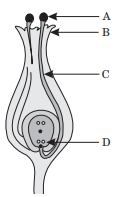
Ans. ‘A’ is stigma, ‘B’ is pollen tube, ‘C’ is ovary and ‘D’ is egg cell (female germ cell).
(ii) What is pollination? Explain its significance.
View AnswerAns. Pollination is a process of transfer of pollen grains from the anther of stamen to the stigma of carpel. It is necessary for fertilisation by sexual reproduction.
(iii) Explain the processes of fertilisation in flowers. Name the parts of the flower that develop after fertilisation into (a) seed (b) fruit.
View AnswerAns. When male gamete and egg fuse together to form zygote, it is called fertilisation. It takes place in ovule. After that the ovule develops a tough coat and is gradually converted into seed.
Fruit: The ovary grows rapidly and ripens to form a fruit after ovule has been fertilised.
81. (i) Draw a sectional view of human female reproductive system and label the part where
(a) Egg develops,
View AnswerAns. Egg develops in ovary.
(b) fertilisation takes place,
View AnswerAns. Fertilisation takes place in fallopian tube.
(c) fertilised egg gets implanted.
View AnswerAns. The fertilised egg gets implanted in uterus.
(ii) Describe in brief the changes that uterus undergoes
(a) to receive the zygote
View AnswerAns. The inner uterus lining becomes thick to receive the zygote and is supplied with blood and nutrients to nourish the embryo.
(b) if zygote is not formed.
View AnswerAns. The inner uterus lining breaks and released in the form of blood and mucus through vagina.
82. List four points of significance of reproductive health in society. Name any two areas related to reproductive health which have improved over the past 50 years.
View AnswerAns. Significance of reproductive health in society are:
(i) Prevent STD (Sexually Transmitted Disease)
(ii) Advantages of small family
(iii) Less mortality among new borns
(iv) Reduces cases of maternal mortality
Two areas of Improvement are:
(i) Family planning.
(ii) Decrease in STD cases.
83. Explain what happens when:
(a) Testosterone is released in males.
View AnswerAns. (i) Formation of sperms and change in appearance.
(ii) Thick hair growth on face stet and pubic region and change in voice.
(b) Pollen grains falls on the stigma of flowers.
View AnswerAns. A tube grows out of the pollen grain and travels through the style to the ovary.
(c) Egg fuses with sperm cell.
View AnswerAns. Zygote is formed i.e. fertilisation takes place.
(d) Planaria is cut into many pieces.
View AnswerAns. Each piece grows into new organism
(e) Buds are formed on notches of the Bryophyllum leaf.
View AnswerAns. Buds may fall on the soil and change into new organism.
84. Write two causes of human population explosion. Explain with the help of a suitable examples how this explosion can be checked.
View AnswerAns. Two causes of human population explosion are:
(i) Reduced mortality rate due to better medical facilities.
(ii) Desire for male child.
(iii) Less awareness of birth control methods.
(iv) Illiteracy and poverty.
Methods to check population explosion are:
(i) By using contraception methods.
(ii) Awareness among people of the advantage of small family.
85. (a) Name the organ that produces sperms as well as secretes a hormone in human males. Name the hormone it secretes and write its functions.
View AnswerAns. The organ that produces sperms as well as secretes male hormone is testis. The hormone secreted by it is testosterone. Its important functions are as follows: It stimulates sperm production. It stimulates the development of secondary sexual characters in males like growth of beard hairs, low pitch voice, etc. It involves in the development, maturation and functioning of the male accessory sex organs like vas deferens and seminal vesicles
(b) Name the parts of the human female reproductive system where fertilisation occurs.
View AnswerAns. In human female reproductive system, the process of fertilisation takes place in one of the fallopian tubes.
(c) Explain how the developing embryo gets nourishment inside the mother’s body.
View AnswerAns. The embryo gets nutrition from the mother’s blood with the help of a special tissue called placenta. Placenta is a vascular membranous organ that connects the developing foetus to the uterine wall of the mother. It contains villi on the embryo’s side of the tissue. On the mother’s side are blood spaces, which surround the villi. This provides a large surface area for glucose and oxygen to pass from the mother to the embryo. The placenta draws nutrients and oxygen, which it supplies to the foetus, from the maternal circulation. In turn, the placenta receives carbon dioxide and wastes of foetal metabolism and discharges them into the maternal circulation for disposal.
86. (a) Draw the diagram of female reproductive system and match and mark the part (s):
(i) Where block is created surgically to prevent fertilisation.
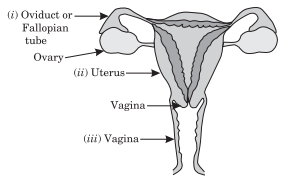
Ans. (i) Fallopian Tube/Oviduct
(iii) Vagina
(ii) Where CuT is inserted.
View Answer(ii) Uterus
(iii) Inside which condom can be placed.
View AnswerVagina
(b) Why do more and more people prefer to use condoms? What is the principle behind use of condoms?
View AnswerAns. People prefer use of condoms as it prevents STDs/gives privacy to the user. Condoms help create a mechanical barrier preventing meeting of sperms and ovum.
87. (i) Describe the role of prostate gland, seminal vesicle and testes in the human male reproductive system.
(ii) How is the surgical removal of unwanted pregnancies misused?
(iii) Explain the role of oral contraceptive pills in preventing conception.
View Answer88. (a) List three different categories of contraception methods.
View AnswerAns. (i) Barrier method, (ii) Oral pills, (iii) Use of copper-T, (iv) Vasectomy in males, tubectomy in females.
(b) Why has Government of India prohibited prenatal sex determination by law? State its benefits in the long run.
View AnswerAns. • It is because female foeticide is increasing.
• It leads to unbalanced sex ratio i.e., more males, less females.
On long run, it will help in maintaining healthier (equal) sex ratio.
It will save mothers from illegal medical termination of pregnancy and health issues.
(c) Unsafe sexual act can lead to various infections. Name two bacterial and two viral infections caused due to unsafe sex.
View AnswerAns. Gonorrhoea and syphilis are bacterial infections. Warts and HIV-AIDS are viral infections.