Social Science (087)
Class IX (2024-25)
Time Allowed: 3 hours Maximum Marks: 80
General Instructions:
1. The question paper comprises Six Sections – A, B, C, D, E and F. There are 37 questions in the Question paper. All questions are compulsory.
2. Section A – From questions 1 to 20 are MCQs of 1 mark each.
3. Section B – Question no. 21 to 24 are Very Short Answer Type Questions, carrying 2 marks each. Answer to each question should not exceed 40 words.
4. Section C contains Q.25to Q. 29 are Short Answer Type Questions, carrying 3 marks each. Answer to each question should not exceed 60 words.
5. Section D – Question no. 30 to 33 are long answer type questions, carrying 5 marks each. Answer to each question should not exceed 120 words.
6. Section-E – Questions no from 34 to 36 are case based questions with three sub questions and are of 4 marks each. Answer to each question should not exceed 100 words.
7. Section F – Question no. 37 is map based, carrying 5 marks with two parts, 37a from History (2 marks) and 37b from Geography (3 marks).
8. There is no overall choice in the question paper. However, an internal choice has been provided in few questions. Only one of the choices in such questions must be attempted.
Section A
1. Which of the following is a fundamental right?
a) Right to Freedom of Press
b) Right Against Exploitation
c) Right to Food
d) Right to Security
View AnswerAns. b) Right Against Exploitation
2. When people appear to be employed but are actually not employed fully, this kind of unemployment is called:
a) Disguised Unemployment
b) Educated unemployment
c) All of these
d) Seasonal unemployment
View AnswerAns. a) Disguised Unemployment
3.Read the given table that shows some important features of PDS in India. Read the data and select the appropriate option from the following.
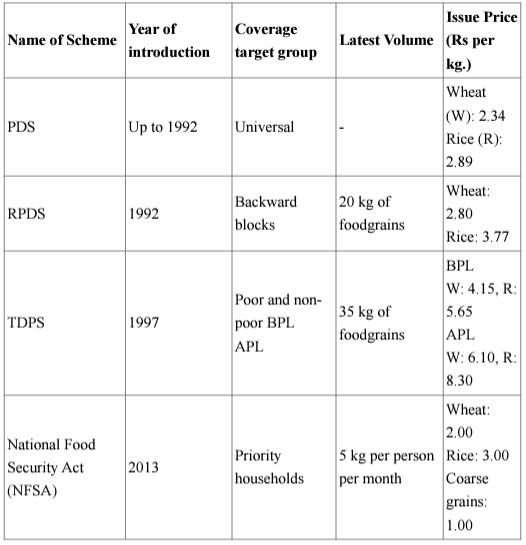
[Source: Economic Survey]
Which of the following scheme aims to provide food and nutritional security life at affordable prices and helps people to live a life with dignity?
a) RPDS
b) NFSA
c) PDS
d) TDPS
View AnswerAns. b) NFSA
4. What are the options with the President if a bill is sent to him/her for assent?
A. He/she has to sign it.
B. He/She can sent it back to the House for reconsideration.
C. If bill is sent to the President second time he/she has to sign it.
a) Only C is true.
b) Only A is true.
c) Only A and B are true.
d) Only B and C are true.
View AnswerAns. d) Only B and C are true.
5. The Nordic German Aryans were in which position in term of racial hierarchy system?
a) Aryans of German origin
b) Jews living in Germany
c) Germans of Aryan origin
d) Jews of German origin
View AnswerAns. a) Aryans of German origin
6. One person one vote means:
a) One person has one vote and each vote has one value
b) One vote have two value
c) A person can vote only once in his life
d) One person is to be voted by all
View AnswerAns. a) One person has one vote and each vote has one value
7. Assertion (A): The subsistence crisis occurred frequently during the Old Regime.
Reason (R): In Old Regime, the monarch did not have the power to impose taxes.
a) Both A and R are true and R is the correct explanation of A.
b) Both A and R are true but R is not the correct explanation of A.
c) A is true but R is false.
d) A is false but R is true.
View AnswerAns. b) Both A and R are true but R is not the correct explanation of A.
8. Consider a case of a small village near Karur town in Tamil Nadu. The village is facing a very poor condition. There are unmetalled roads in the village. Along with this, the village has no access to pure drinking water. There is no clinic or a school in the village. Even people have to live without electricity. Subsequently, in order to curb such conditions, the central government assisted the state government and launched a scheme. After the implementation of the scheme, villagers have access to basic services such as primary health, primary education, rural shelter, rural drinking water, and rural electrification. Give the name of the scheme that lead the village to prosperity.
a) Mahatma Gandhi National Rural Employment Guarantee Act.
b) Swarnajayanti Gram Swarozgar Yojana
c) Antyodaya Anna Yozana
d) Pradhan Mantri Gramodaya Yozana
View AnswerAns. d) Pradhan Mantri Gramodaya Yozana
9. For how many years does the President of India remains in office?
a) Five
b) Two
c) Four
d) Ten
View AnswerAns. a) Five
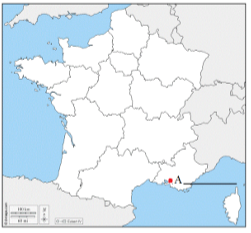
10. On the given map of France, A is a place that is the namesake of the French national anthem. Identify it from the following options.
a) Nantes
b) Paris
c) Marseillaise
d) Bastille
View AnswerAns. c) Marseillaise
11. Which of the following is/are not function of the Election Commissioner of India ?
A. EC takes decision on every aspect of conduct and control of elections.
B. It implements the code of conduct.
C. It issues election Manifesto.
a) Only A
b) Only A and B
c) Only C
d) Only B
View AnswerAns. c) Only C
12. Which one of the following is a demerit of democracy?
a) Free and fair election
b) Democracy leads to delays in decision making
c) Equality
d) Rule of law
View AnswerAns. b) Democracy leads to delays in decision making
13. Arrange the following events in chronological order:
i. The Youth League of the Nazis was founded.
ii. Allied victory in Europe.
iii. Hitler said: “In my state, the mother is the most important citizen.”
iv. Tripartite Pact was signed between Germany, Italy and Japan.
a) iv, iii, ii, i
b) ii, i, iii, iv
c) i, iii, iv, ii
d) ii, i, iv, iii
View AnswerAns. c) i, iii, iv, ii
14. Read the information given below and select the correct option Before the French Revolution, society was divided into three estates.
i. The 1st estate consists of the clergy
ii. The 2nd estate consists of the nobles
iii. The 3rd estate included big businessmen, merchants, court officials, lawyers, peasants, landless labourers, servants and artisans
With reference to the given information, choose which of the following classes formed the privileged estates?
a) Big businessmen and nobility
b) Big businessmen and the peasants
c) Clergy and the nobility
d) Clergy and the peasants
View AnswerAns. c) Clergy and the nobility
15. Choose the right term: A formal document containing an order of the court to the government issued only by High Court or the Supreme Court.
a) Claim
b) Covenant
c) Summon
d) Writ
View AnswerAns. d) Writ
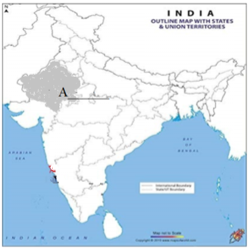
16. On the political map of India, A is marked as the largest state area-wise. Identify it from the following options
a) Madhya Pradesh
b) Rajasthan
c) Maharashtra
d) Uttar Pradesh
View AnswerAns. b) Rajasthan
17. Which one amongst the following rivers flows through a rift valley?
a) Tungabhadra
b) Krishna
c) Tapi
d) Mahanadi
View AnswerAns. c) Tapi
18. Who headed the party after the death of Lenin?
a) Trotsky
b) Stalin
c) Father apon
d) Kerenskii
View AnswerAns. b) Stalin
19. Economic activities have been divided into which of the two parts?
a) Service and Secondary activities
b) Primary and Secondary activities
c) Market and non-market activities
d) Production and non- production activities
View AnswerAns. c) Market and non-market activities
20. The total length of the coastline of the Indian mainland is
a) 9,000 km
b) 8,878 km
c) 7,516 km
d) 6,500 km
View AnswerAns. c) 7,516 km
Section B
21. Write about Ganga plains.
View AnswerAns. A. The plains of Ganga spread between Ghaggar and Teesta rivers.
B. It extends over the states of North India.
C. Including Haryana, Delhi, Uttar Pradesh, Bihar partially Jharkhand and West Bengal to its east.
22. On what factors does the quality of population depend on?
View AnswerAns. i. The literacy rate.
ii. Health of a person indicated by life expectancy and skill formation acquired by the people of a country.
iii. The quality of population ultimately decides the growth rate of the country.
iv. An illiterate and unhealthy population is a liability for the economy, whereas a literate and healthy population is an asset
OR
Why are educated parents found to invest more heavily on the education of their child?
View AnswerAns. A. Educated parents are found to invest more heavily on the education of their children.
B. This because they have realized the importance of education for themselves.
C. They are also conscious of proper nutrition and hygiene.
D. They accordingly look after their children’s needs for education at school and good health.
E. A virtuous cycle is thus created in this case.
23. Write any three drawbacks of non-democratic elections.
View AnswerAns. A. All citizens are not given right to vote.
B. Elections are not held regularly.
C. Elections are held in a free and manner.
D. People face many restrictions.
E. People don’t have choice.
24. Why is the Public Distribution System criticised?
View AnswerAns. The PDS has been criticised because:
(i) Instances of hunger are prevalent despite overflowing granaries.
(ii) The FCI godowns are overflowing with grains where some are rotting away and some are eaten by rats.
(iii) Shopkeepers of fair price shops are black marketing the goods in the retail market, though they are not allowed to do so.
Section C
25. Explain Cooperative Societies.
View AnswerAns. A. The cooperative societies are the societies which are run by the local people, who are democratically elected by the people.
B. These cooperative societies provide people the basic necessities of life like food grains, milk, vegetables, etc. at reasonable rates.
26. Highlight the ideology of Radicals?
View AnswerAns. i. They wanted a government based on the majority of a country’s population. They supported Universal Adult franchise, including the vote for women.
ii. Unlike liberals, they opposed the privileges of the landlords and the industrialists.
iii. They were not against the existence of private property but opposed concentration of property in a few hands
OR
Who was Karl Marx? What was his theory of socialism?
View AnswerAns. Karl Marx was a communist who introduced the concept of socialism. Karl Marx’ Theory:
(i) He felt that the industrial society belonged to the capitalists.
(ii) Capitalists owned the capital invested in industries, but the profit was produced by workers.
(iii) He believed that the condition of workers would never improve, as long as profit is taken by the capitalists.
(iv) Marx believed that to free themselves from the capitalists’ exploitation, workers had to form a socialist society where all property was socially controlled.
This would be a communist society.
27. ‘There has been a sudden abrupt rise in population of India since 1961’. Give reason.
View AnswerAns. Yes there was a sudden abrupt rise in population of India since 1961 because of the following reasons:
A. Medical facilities were made available to the people. Hospitals or dispensaries were opened in the rural areas.
B. By the setting up of hospitals and dispensaries the death rate was decreased and the birth rate was increased.
C. People were illiterate and they were not aware about the family planning programmes.
D. Literacy rate was also very low. Daughters were not sent to the schools especially in rural areas.
E. Early marriage of girls and boys was also a reason of population explosion.
28. Here are some facts on Indian elections. Comment on each of these to say whether they reflect the strength or the weakness of our electoral system.
a. The Lok Sabha has had less than 10% of women members till 2009.
View AnswerAns. It is the weakness of our electoral system which sends only 10% of women members to the Lok sabha while the population of women is nearly 50% of the total population.
b. The Election Commission often refuses to accept the government’s advice about when the elections should be held.
View AnswerAns. It is the strength of our electoral system which has given the power to the Election Commission to refuse or to accept the advice of the ruling party about the election dates.
c. The current Lok Sabha has more than 145 members whose assets are more than Rs. 1 crore.
View AnswerAns. This is the weakness of our electoral system, which does not give an equal chance to both poor and rich. Those candidates who are rich, have a better chance of winning than the poor in our country
d. After losing an election the Chief Minister said, “I respect the people’s verdict”.
View AnswerAns. This is the strength of our electoral system which enjoys the faith of both the defeated and winning candidates. Barring very few disputed elections, the electoral outcomes are usually accepted as ‘people’s verdict’ by the defeated party.
29. You are elected a civil servant who is a permanent executive. What values would you idolise to serve as a public servant?
View AnswerAns. If I am selected as a civil servant who is a permanent executive. I would idolise following values to serve as a public servant:
(i) Follow integrity
(ii) Be neutral
(iii) Make policies oriented in public interest
(iv) Serve people impartially
(v) Not to be iron-hearted. Implement policies with full zeal and endeavour.
(vi) Provide a secure environment and safe living to every citizen.
Section D
30. What was the contribution of the French philosophers in the outbreak of the Revolution of 1789 in France?
View AnswerAns. The revolutionary ideas of philosophers encouraged people to fight for their rights.
i. Voltaire wanted people to think about their material life on earth and forget about heaven.
ii. John Locke criticised and refuted the divine and absolute rights of the rulers.
iii. Rousseau put forward the idea of the formation of a government based on a social contract between people and their rulers. Men had the right to withdraw their loyalty to the ruler if they were not satisfied with him.
iv. Montesquieu criticised autocracy and believed that all powers should not be concentrated in one person’s hand. They should be divided between the Legislative, the Executive and the Judiciary. The ideas of these philosophers exposed the evils of society and infused people with the idea of liberty, fraternity, and equality. They inspired people to fight for their rights.
OR
State any five causes of the empty treasury of France under Louis XVI.
View AnswerAns. A. Long years of war had drained the financial resources of France. Added to this was the cost of maintaining an extravagant court at the immense palace of Versailles.
B. Under Louis XVI, France helped the thirteen colonies to gain their independence from the common enemy, Britain.
C. The war added more than a billion livres to a debt that had already risen to more than 2 billion livres.
D. Lenders, who gave the state credit, now began to charge 10 percent interest on loans.
E. To meet its regular expenses, such as the cost of maintaining an army, the court, running government offices or universities.
31. Write a note on South-west Monsoon season or Rainy season.
View AnswerAns. The Monsoon or rainy season begins from mid – June and lasts till the end of September. By the end of May, pressure over North India becomes lower due to the increasing temperature. This causes air from high-pressure zones over the Indian Ocean to move towards India as monsoon winds. These winds are moisture-laden and cause heavy rainfall in India. Since these winds, called the advancing monsoon, enter India from the southwest, they are called the south-west monsoon. During this time of the year, the southwest monsoon winds start blowing from the sea to land. When these winds strike the mountain barriers, rainfall occurs.
OR
Give a brief account of the condition and characteristics of the retreating monsoons.
View AnswerAns. (i) This is the transition period during the months of October and November.
(ii) With the apparent movement of the Sun towards the south, the low pressure trough over the northern plains becomes weaker. This is gradually replaced by a high pressure system.
(iii) The south-west monsoon winds weaken and start withdrawing gradually.
(iv) By the beginning of October, the monsoon withdraws from the northern plains.
(v) The months of October and November form a period of transition from hot rainy season to dry winter conditions.
(vi) When monsoons retreat, skies get clear and the temperature rises.
(vii) While day temperatures are high, nights are cool and pleasant. The land is still moist.
(viii) Owing to the conditions of high temperature and humidity, the weather becomes oppressive during the day. This is commonly known as October Heat.
(ix) The low pressure conditions get transferred to the Bay of Bengal by early November.
(x) The cyclonic depressions originate from the Andaman Sea and cause heavy and widespread rains on the eastern coast.
(xi) These tropical cyclones are often very destructive and affect the coast Odisha, West Bengal and Bangladesh.
32. Do you think that people appear employed in disguised unemployment?
View AnswerAns. 1. In this kind of unemployment, people appear to be employed.
2. This usually happens among family members who are all engaged in agricultural activities.
3. The work may require the service of five people but engages eight people.
4. If these three people are removed, the work or productivity of the field won’t be affected or decline.
5. Since the field requires the service of only five people, the three extra people are disguised unemployed.
OR
What are the objectives of India’s National Policy on Health? Suggest any two ways through which the objectives of the policy can be met.
View AnswerAns. The objectives of the National Health Policy (2002) are as follows
i. Enhancing and encouraging the contribution of the private sector in the field of providing health care services to all people who can afford to pay.
ii. Giving primacy for prevention and first-line curative initiative.
iii. Emphasising rational use of drugs.
iv. Increasing access to the system of traditional medicine in all the urban and rural dispensaries.
Some of the objectives of the policy can be met through the following methods-
i. Increasing the number of trained nurses or midwives to one nurse and one midwife per village.
ii. Making generic medicines available and affordable to the people in the government hospitals and dispensaries (instead of branded medicines).
33. Why is the Preamble very important?
View AnswerAns. A. The Preamble was adopted with the constitution in the constituent assembly. It came into effect in 1950 along with the constitution.
B. The preamble is based on the Objectives which were drafted and moved in the Constituent Assembly by Jawaharlal Nehru on 13 December 1946.
C. It declares India to be a sovereign, socialist, secular democratic republic.
D. It envisages Justice-Social, Economic and political for all the citizens of the Republic.
E. It ensures all types of freedom necessary for the individuals.
F. It strives for equality of status and opportunity to all individuals and safeguards their dignity irrespective of their religious belief or section.
G. It promotes a sense of brotherhood among the citizens.
OR
What are the main functions of a Constitution?
View AnswerAns. (i) It generates a degree of trust and coordination that is necessary for different kinds of people to live together.
(ii) It specifies how the government will be constituted, who will have power to take which decisions.
(iii) It lays down limits on the powers of the government and tells us what the rights of the citizens are.
(iv) It expresses the aspirations of the people about creating a good society.
(v) Constitution is the supreme law that determines the relationship among people living in a territory and also the relationship between the people and the government.
Section E
34. Read the following text carefully and answer the questions that follow:
The First World War left a deep imprint on European society and polity. Soldiers came to be placed above civilians. Politicians and publicists laid great stress on the need for men to be aggressive, strong and masculine. The media glorified trench life. The truth, however, was different. Aggressive war propaganda and national honour occupied centre stage in the public sphere, while popular support grew for conservative dictatorships that had recently come into being. Democracy was indeed a young and fragile idea, which could not survive the instabilities of interwar Europe.
i. How did the First World War impact the political system of Germany?
View AnswerAns. The abdication of the emperor gave an opportunity to parliamentary parties to recast German polity. A democratic constitution was established with a federal structure.
ii. What does the given passage highlight?
View AnswerAns. The given passage highlights the impact of the First World War on European and German society.
iii. The media glorified trench life. What was the actual truth about trench life?
View AnswerAns. The truth was that soldiers lived miserable lives in these trenches, trapped with rats feeding on corpses. They faced poisonous gas and enemy shelling and witnessed their ranks reduce rapidly.
35. Read the following text carefully and answer the questions that follow:
The Indian landmass has a central location between East and West Asia. India is a southward extension of the Asian continent. The trans-Indian Ocean routes, which connect the countries of Europe in the West and the countries of East Asia, provide a strategic central location to India. The Deccan Peninsula protrudes into the Indian Ocean, thus helping India to establish close contact with West Asia, Africa, and Europe from the western coast and with Southeast and East Asia from the eastern coast. No other country has a long coastline on the Indian Ocean as India has and indeed, it is India’s eminent position in the Indian Ocean, which justifies the naming of an Ocean after it. Since the opening of the Suez Canal in 1869, India’s distance from Europe has been reduced by 7000 km. India’s contacts with the World have continued through ages but her relationships through the land routes are much older than her maritime contacts. The various passes across the mountains in the north have provided passages to the ancient travellers, while the oceans restricted such interaction for a long time. These routes have contributed to the exchange of ideas and commodities since ancient times.
i. When did the Suez Canal first open? How has it helped India?
View AnswerAns. The Suez Canal was opened in 1869. It has reduced the distance between India and Europe by 7000 km.
ii. State any two reasons that make India’s strategic location at the head of the Indian Ocean so important.
View AnswerAns. Any two points
i. India is strategically located at the center of the trans-Indian Ocean routes.
ii. India could establish close contact with Southeast and East Asia from the eastern coast.
iii. India could establish close contact with West Asia, Africa, and Europe from the western coast.
iii. Which peninsula helps India to establish easy contact with West Asia, East Africa, and Europe from the Western coast?
View AnswerAns. The Deccan Peninsula helps India to establish easy contact with West Asia, East Africa and Europe from Western coast.
36. Read the following text carefully and answer the questions that follow:
There were a number of causes for the widespread poverty in India.
One historical reason is the low level of economic development under the British colonial administration. The policies of the colonial government ruined traditional handicrafts and discouraged the development of industries like textiles. This resulted in fewer job opportunities and a low growth rate of incomes. This was accompanied by a high growth rate of population. The two combined to make the growth rate of per capita income very low. The failure at both the fronts: promotion of economic growth and population control perpetuated the cycle of poverty. Unable to find proper jobs in cities, many people started working as rickshaw pullers, vendors, construction workers, domestic servants, etc. With irregular small incomes, these people could not afford expensive housing. They started living in slums on the outskirts of the cities and the problems of poverty, largely a rural phenomenon also became the feature of the urban sector. Another feature of high poverty rates has been the huge income inequalities. One of the major reasons for this is the unequal distribution of land and other resources. Major policy initiatives like land reforms which aimed at the redistribution of assets in rural areas have not been implemented properly and effectively by most of the state governments. Since lack of land resources has been one of the major causes of poverty in India, proper implementation of policy could have improved the lives of millions of rural poor. Many other socio-cultural and economic factors also are responsible for poverty. In order to fulfill social obligations and observe religious ceremonies, people in India, including the very poor, spend a lot of money. Small farmers need money to buy agricultural inputs like seeds, fertilizer, pesticides, etc. Since poor people hardly have any savings, they borrow. Unable to repay because of poverty, they become victims of indebtedness. So the high level of indebtedness is both the cause and effect of poverty.
i. What are the reasons behind the huge income inequalities in rural areas?
View AnswerAns. One of the major reasons for this is the unequal distribution of land and other resources. Major policy initiatives like land reforms, which aimed at redistribution of assets in rural areas, have not been implemented properly, leading to poverty in India.
ii. What are the economic and socio-cultural causes of poverty?
View AnswerAns. In order to fulfill social obligations and observe religious ceremonies, people spend a lot of money. Since poor people hardly have any saving, they borrow. Unable to repay because of poverty they become victims of indebtedness, an important cause of poverty.
iii. What was the root cause of India’s poverty historically?
View AnswerAns. It is the low level of economic development under the British Colonial administration. The policies of the colonial government ruined traditional handicrafts and discouraged the development of industries like textiles.
Section F
37. i. Two places A and B have been marked on the given outline map of the world. Identify them and write their correct names on the lines drawn near them
A. North-Eastern region not affected by the Great Fear.
B. An axis power
View AnswerAns. A. France
B. England
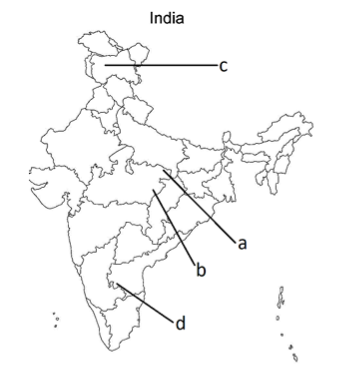
ii. On the outline map of India locate and label ANY THREE of the following with suitable Symbols.
a. The Vindhya – Mountain Range
b. Kanha – National Park
c. Dachigam – Wildlife Sanctuaries
d. The Krishna – The Peninsular rivers
View AnswerAns.