Social Science (087)
Class IX (2024-25)
Time Allowed: 3 hours Maximum Marks: 80
General Instructions:
1. The question paper comprises Six Sections – A, B, C, D, E and F. There are 37 questions in the Question paper. All questions are compulsory.
2. Section A – From questions 1 to 20 are MCQs of 1 mark each.
3. Section B – Question no. 21 to 24 are Very Short Answer Type Questions, carrying 2 marks each. Answer to each question should not exceed 40 words.
4. Section C contains Q.25to Q. 29 are Short Answer Type Questions, carrying 3 marks each. Answer to each question should not exceed 60 words.
5. Section D – Question no. 30 to 33 are long answer type questions, carrying 5 marks each. Answer to each question should not exceed 120 words.
6. Section-E – Questions no from 34 to 36 are case based questions with three sub questions and are of 4 marks each. Answer to each question should not exceed 100 words.
7. Section F – Question no. 37 is map based, carrying 5 marks with two parts, 37a from History (2 marks) and 37b from Geography (3 marks).
8. There is no overall choice in the question paper. However, an internal choice has been provided in few questions. Only one of the choices in such questions must be attempted.
Section A
1. What is PIL?
a) Public Interest Litigation
b) Public Information Litigation
c) Private Interest Litigation
d) Public Interest Legislature
View AnswerAns. a) Public Interest Litigation
2. Women generally look after ________.
a) Business
b) Teaching
c) Domestic chores
d)Fields
View AnswerAns. c) Domestic chores
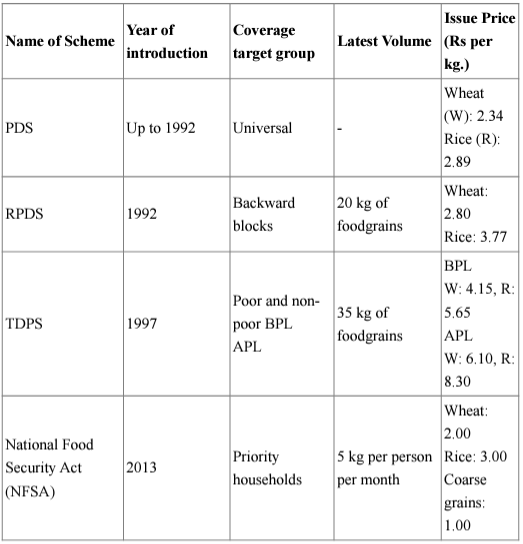
3. Read the given table that shows some important features of PDS in India. Read the data and select the appropriate option from the following
[Source: Economic Survey]
The target of which scheme was to provide the benefits of PDS to remote and backward areas?
a) TDPS
c) NFSA
b) RPDS
d) PDS
View AnswerAns. b) RPDS
4. Read the statement and choose the correct answer.
A. Lok Sabha is more powerful than the rajya Sabha
B. Both Lok Sabha and the Rajya Sabha have equal power.
a) Both A and B are false
b) A is true but B is false
c) Both A and B are true
d) A is false but B is true
View AnswerAns. b) A is true but B is false
5. Hitler’s world view was based on the principals of:
a) Lebensraum
b) One nation, One Empire, One Leader
c) Charles Darwin
d) Herbert Spence
View AnswerAns. a) Lebensraum
6. In which case was the real power with external powers and not with the locally elected representatives?
a) US in Iraq
b) Both US in Iraq and USSR in Communist Poland
c) India in Sri Lanka
d) USSR in Communist Poland
View AnswerAns. b) Both US in Iraq and USSR in Communist Poland
7. Assertion (A): The Bastille was hated by all and demolished.
Reason (R): It was a fortress prison where people hoped to find hoarded ammunition.
a) Both A and R are true and R is the correct explanation of A.
b) Both A and R are true but R is not the correct explanation of A.
c) A is true but R is false.
d) A is false but R is true.
View AnswerAns. b) Both A and R are true but R is not the correct explanation of A.
8. Tejpal Singh works as a peasant in the village. His income from agricultural production is very less. The money is not enough to sustain his family of six-that includes his wife and four children. His wife- Savita is unemployed and wishes to work for earning extra income. Recently, a new scheme has been launched in the village. Under the scheme, one-third of the proposed jobs have been reserved for women. This scheme helped Savita to get the job in the village. Name the scheme which helped Savita to get a job.
a) Mahatma Gandhi National Rural Employment Guarantee Act.
b) Antyodaya Anna Yozana
c) Pradhan Mantri Gramodaya Yozana
d) Swarnajayanti Gram Swarozgar Yojana
View AnswerAns. a) Mahatma Gandhi National Rural Employment Guarantee Act.
9. Who headed the Second Backward Classes Commission in 1979?
a) D S Kothari
b) B P singh
c) Chandrashekhar
d) B P Mandal
View AnswerAns. d) B P Mandal
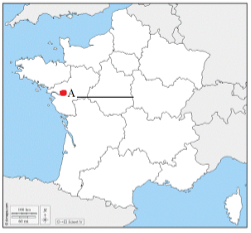
10. On the given map of France, A is marked as one of the port cities from where the merchants of France sailed to buy slaves from African countries. Identify it from the following options.
a) Nantes
b) Brest
c) Marseille
d) Bordeaux
View AnswerAns. a) Nantes
11. Which of the following is true with reference to minimum condition of a democratic election ?
A. Everyone should be able to choose.
B. The candidate preferred by people should not get elected.
a) Both A and B are true
b) Both A and B are false
c) A is false but B is true
d) A is true but B is false
View AnswerAns. d) A is true but B is false
12. Democracy is based on the fundamental principle of ________.
a) equality
b) socialism
c) discrimination
d) secularism
View AnswerAns. a) equality
13. Arrange the following events in chronological order:
i. The Great Economic Depression begins.
ii. The mass murder of the Jews begins.
iii. Second World War begins.
iv. First World War begins.
a) iv, ii, i, iii
b) iii, i, ii, iv
c) i, iv, iii, ii
d) iv, i, iii, ii
View AnswerAns. d) iv, i, iii, ii
14. In 1774, Louis XVI of the Bourbon family of kings ascended the throne of France. He was 20 years old and married to the Austrian princess. Upon his accession, the new king found an empty treasury. Long years of war had drained the financial resources of France. Added to this was the cost of maintaining an extravagant court at the immense palace of Versailles. Whom did Louis XVI get married to?
a) Queen Elizabeth
b) Marie Antoinette
c) Marie Elizabeth
d) Olympe de Gouges
View AnswerAns. b) Marie Antoinette
15. ________ is a practice where the worker is forced to render service to the master free of charge or a nominal remuneration.
a) Begging
b) Begar
c) Child labour
d) Untouchability
View AnswerAns. b) Begar
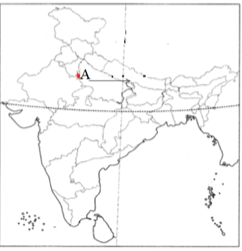
16. On the political map, A is marked as a metropolitan city characterized by River Yamuna and is located at the terminal part of the Aravali hill range. Identify it from the given options.
a) Lucknow
b) Dehradun
c) New Delhi
d) Chandigarh
View AnswerAns. c) New Delhi
17. A narrow valley with steep, rocky walls located between hills or mountains is known as:
a) Gorge
b) Bay
c) Mountain
d) Valley
View AnswerAns. a) Gorge
18. What was the other name of the October Revolution?
a) Black October
b) Red October
c) Blue October
d) Green October
View AnswerAns. b) Red October
19. Which scheme has been implemented to encourage attendance and retention of children and improve their nutritional status?
a) Aanpurna Ann Yojana
b) Vocational streams
c) Mid-day meal
d) Navodaya Vidhyalay
View AnswerAns. c) Mid-day meal
20. The advantage of opening of the Suez canal to India
a) Increase in political crisis
b) Change in culture
c) Influence the people
d) India’s distance from Europe has been reduced
View AnswerAns. d) India’s distance from Europe has been reduced
Section B
21. Name the highest peaks of the Himalayas with their heights.
View AnswerAns. (i) Mt. Everest – 8,848 metres, Nepal
(ii) Kanchenjunga – 8,598 metres, India
(iii) Makalu- 8481 metres, Nepal
(iv) Dhaulagiri – 8,172 metres, Nepal
(v) Nanga Parbat – 8,126 metres, India
(vi) Annapurna – 8,078 metres, Nepal
(vii) Nanda Devi – 7,817 metres, India
(viii) Kamet – 7,756 metres, India
(ix) Namcha Barwa – 7,756 metres, India
(x) Gurla Mandhata – 7,728 metres, Nepal
22. Discuss on Structural Employment.
View AnswerAns. A. This type of employment is caused due to mismatch in the size of population and the structure of the economy.
B. An underdeveloped infrastructure cannot provide employment to such a large population.
OR
Define human capital and human capital formation. Name any two sources of human capital formation.
View AnswerAns. When the investment is made in the form of education, training and medical care, the quality of population improves and becomes a great asset. It is known as human capital. When the investment is made in the existing human resource for further development by becoming more educated and healthy is termed as human capital formation. The two sources of human capital formation are educated and health.
23. How does democracy allow us to correct its own mistakes?
View AnswerAns. A. There is no guarantee that mistakes cannot be made in democracy.
B. No form of government can guarantee that. The advantage in a democracy that such mistakes cannot be hidden for long.
C. There is a space for public discussion on these mistakes. And there is a room for correction. Either the rulers have to change their decisions, or the rulers can be changed.
24. Briefly define MSP?
View AnswerAns. A. The FCI purchases wheat and rice from the farmers.
B. The farmers are paid a pre announced price for their crops.
C. This price is called Minimum Support Price.
D. The MSP is declared by the government every year before the sowing season to provide incentives to the farmers for raising the production of these crops.
Section C
25. Give some important cooperatives running successfully.
View AnswerAns. (i) In Delhi,Mother Dairy is making efforts in providing milk and vegetables to the consumers at controlled rates decided by the government of Delhi.
(ii) Amul is a successful cooperative in milk and milk products from Gujarat.
(iii) In Maharashtra, Academy of Development Science (ADS) has facilitated a network of NGOs for setting up Grain Banks in different regions.
26. Why did people in Central Asia respond to the Russian Revolution in different ways?
View AnswerAns. The people in Central Asia responded enthusiastically to the February 1917 Revolution because it freed them from the oppression of the Tsar region and they become masters of their land again. They expected to regain their autonomy. October Revolution, as it brought violence, robbery, extra taxes and another dictatorial power to rule over them. They feared now that their autonomy would be lost.
OR
Write a short note on women workers between 1900 and 1930.
View AnswerAns. After industrialisation expanded in Russia women were employed in large numbers in most of the factories. In 1914 women composed 31% of the labour force in Russia. They were not paid equally and the working conditions were poor. Women play their active role in the revolution of 1917. Some of them staged a demonstration and led marches from the front. Under Soviet rule women equally participated in economic progress and development.
27. What are the advantages of having a healthy population?
View AnswerAns. The advantages of having a healthy population are:
- A healthy individual is much more efficient and productive than an unhealthy individual.
- He or she is able to realize his or her potential, and play an important role in social and national development.
– Absenteeism is low where the workers are healthy.
28. Chinappa was convicted for torturing his wife for dowry. Satbir was held guilty of practising untouchability. The court did not allow either of them to contest elections. Does this decision go against the principles of democratic elections?
View AnswerAns. This decision of the court preventing Chinappa and Satbir from contesting elections does not go against the principles of democratic elections because both have been found guilty of breaking the law by the court. Criminals should not be allowed to hold a position of power because they are not good citizens and could harm the interests of the people.
29. Indian judiciary considered one of the most powerful in the world. Give any three reasons.
View AnswerAns. Indian judiciary is considered one of the most powerful in the world because:
i. Mode of appointment and removal of Judges of Supreme Court and High Courts makes Indian judiciary powerful.
ii. Our Constitution has laid down very high and specific qualifications for the appointment of judges like Well-versed in the law and 5 to 10 years of experience as an advocate and a judge of the High Court respectively.
iii. Our judiciary is independent of legislative and executive control. It can take decisions independently.
Section D
30. Describe the political and economic condition of France during the 18 century.
View AnswerAns. a. In 1774, Louis XVI ascended the throne of France. He was 20 years old and married to Austrian princess Marie Antoinette.
b. Upon his accession, the new king found an empty treasury. Long years of war and the cost of maintaining an extravagant court had drained its financial resources.
c. Under Louis XVI, France helped the thirteen American colonies to gain independence from their common enemy, Britain. The war added more than a billion livers (currency) to a debt that went to more than 2 billion livers.
d. Lenders who gave credit to the state began to charge 10 percent interest on loans. So the French government decided to spend its increased percentage of the budget on paying interest alone.The state was forced to increase the taxes to meet the cost of maintaining its army, court, and government offices or universities.
OR
What is the role of middle classes in ending the privileges?
View AnswerAns. A. In the past peasants and workers had participated in the revolts against increasing taxes and food scarcity. But they could not change the social and economic order. This was left to those groups within the Third Estate who had become prosperous and had access to education and new ideas.
B. The 18th century witnessed the emergence of social groups termed as middle class who earned their wealth through an expanding overseas trade and from manufacturing goods and exporting them.
C. In addition to merchants and manufacturers, the Third estate included professions such as that of lawyers or administrative officials. All of these were educated and believed that no group in society should be privileged by birth. Rather, a person’s social position must depend on his merit.
D. These ideas envisaging a society based on freedom and equal laws and opportunities for all, were put forward by philosophers such as John Locke and Jean Jacques Rousseau.
31. State how the pressure and wind conditions over India are unique.
View AnswerAns. (i) During winter, a high pressure area develops north of the Himalayas.
(ii) Cold dry winds blow from this region to the low pressure areas over the oceans to the south.
(iii) In summer, a low pressure area develops over interior Asia as well as over northwestern India.
(iv) This causes a complete reversal of the direction of winds during summer.
(v) Air moves from the high pressure area over the southern Indian ocean in a southwesterly direction, crosses the equator and turns right towards the low pressure area over the Indian sub-continent.
(vi) These winds are known as south-west monsoon winds.
(vii) These winds blow over the warm oceans, gather moisture and bring widespread rainfall over the mainland of India.
OR
What are Western Cyclonic Disturbances?
View AnswerAns. A. The Western Cyclonic Disturbances are weather phenomena of the winter months.
B. They are brought in by the westerly flow from the Mediterranean region.
C. They usually influence the weather of the north and north western regions of India. The western cyclonic disturbances experienced in the north and north-western parts of the country are brought in by the westerly flow.
D. They bring rainfall in the states of Punjab, Haryana and western Uttar Pradesh.
E. Tropical cyclones occur during the monsoon as well as in October-November, and are part of the easterly flow.
F. This rainfall is very beneficial for the Rabi crops.
32. Explain the term unemployment.Which type of unemployment is more prevalent in rural and urban areas? How can unemployment in a rural area be minimised?
View AnswerAns. Unemployment is a situation when people willing to work at going to wages cannot find jobs.
Unemployment in Rural India:
i. The most dangerous unemployment in the rural area is seasonal unemployment. It exists when a person willing to work does not get work making their living conditions poor with no job and money. It is more common among people who are dependent on farming.
Unemployment in Urban India:
i. Educated employment is the most common unemployment in urban areas. It usually occurs in cities where there are educated or skilled people but no job opportunities. Hence, the people who should have been regarded as an asset becomes a liability. This increases the burden of production specially on employed people.
Ways to Minimise unemployment in rural areas:
i. The government should provide adequate skills and training to landless labourers and small farmers.
ii. Navodaya Vidyalayas should be opened to impart training and minimise future unemployment.
iii. Encouragement for plantation, horticulture, dairy farming, and animal husbandry should be given to villagers by providing them training and financial help.
OR
Explain the initiatives taken by the government to improve elementary education in India.
View AnswerAns. The initiatives taken by the government to improve elementary education in India are:
i. Sarva Shiksha Abhiyan aims at the universalisation of elementary education in a timebound manner, making it tree to children between the ages of 6 and 14 years, with a special emphasis on girls’ education. It has been embodied as a right under the Right to Education Act.
ii. Mid-day Meal scheme has been implemented to encourage attendance and retention of children and improve their nutritional status.
iii. Navodaya Vidyalayas (i.e. model schools) have been opened in each district as ideal schools, whose facilities and methods can be replicated, by other schools.
iv. Vocational streams have been developed to enable a larger number of high school students to find jobs in occupations related to knowledge and skills.
v. Bridge courses and back-to-school camps have been initiated to increase enrollment in elementary education.
33. Read the following statements about a constitution. Give reasons why each of these is true or not true.
a. The authority of the rules of the constitution is the same as that of any other law.
View AnswerAns. Not True: Constitution is the supreme law. It describes how government is elected and the powers, rights of citizens and their protection. This is totally different than any other law. Constitution is the supreme law that determines the relationship among people living in a territory (called citizens) and also the relationship between the people and government.
b. Constitution lays down how different organs of the government will be formed.
View AnswerAns. True: The Constitution defines the role of the legislature, the executive and the judiciary and how they should be formed and by whom.
c. Rights of citizens and limits on the power of the government are laid down in the constitution.
View AnswerAns. True: The Constitutional setup limits the power of government through different institutions and also talks about the right of citizens. As the supreme law of the country, the constitution determines the rights of citizens, the powers of the government and how the government should function.
d. A constitution is about institutions, not about values.
View AnswerAns. Not True: The Constitution contains all the values which the institutions have to promote. The Preamble to the Constitution is a shining example of this and states clearly that justice, liberty, equality and fraternity have to be promoted. Secularism has to be followed and socialism and democracy should be the basis of the government.
OR
How did South Africa get independence?
View AnswerAns. A. As protests and struggles against apartheid had increased, the government realised that they could no longer keep the blacks under their rule through repression.
B. The White regime changed its policies. Discriminatory laws were repealed. Ban on political parties and restrictions on the media were lifted.
C. After 28 years of imprisonment, Nelson Mandela walked out of jail as a free man.
D. Finally at the midnight of 26th April 1994 the new national flag of Republic of South Africa was unfurled marking the newly born democracy in the world.
E. The apartheid government came to an end, paving the way for the formation of a multiracial government.
F. After the emergence of the new democratic South Africa, black leaders appealed to fellow blacks to forgive the whites for the atrocities they had committed while in power.
They said let us build a new South Africa based on equality of all races and men and women, on democratic values, social justice and human rights.
G. The party that ruled through oppression and brutal killings and the party that led the freedom struggle sat together to draw up a common constitution.
Section E
34. Read the following text carefully and answer the questions that follow:
Media was carefully used to win support for the regime and popularise its worldview. Nazi ideas were spread through visual images, films, radio, posters, catchy slogans and leaflets. In posters, groups identified as the ‘enemies’ of Germans were stereotyped, mocked, abused and described as evil. Socialists and liberals were represented as weak and degenerate. They were attacked as malicious foreign agents. Propaganda films were made to create hatred for Jews. The most infamous film was The Eternal Jew. Orthodox Jews were stereotyped and marked.
i. Jews were portrayed as killers of Christ and usurers. Who were ‘usurers’?
View AnswerAns. Moneylenders charging excessive interest are called Usurers. It is often used as a term of abuse.
ii. What did the Nuremberg Laws mean to the undesirables in Nazi Germany?
View AnswerAns. The Nuremberg Laws meant that the ‘undesirables’ had no right to live along with the other citizens. These included Jews, Gypsies, ‘Blacks’ and other nationalities like Polish and Russian people.
iii. Hitler could have resolved the Jewish problem by the method of conversion but he didn’t. What could be the possible reason behind it?
View AnswerAns. Hitler’s hatred of Jews was based on pseudoscientific theories of race, which held that conversion was no solution to ‘the Jewish problem’. It could be solved only through their total elimination.
35. Read the following text carefully and answer the questions that follow:
India is one of the most ancient civilizations in the world. It has achieved multifaceted socio-economic progress during the last five decades. It has moved forward displaying remarkable progress in the field of agriculture, industry, technology, and overall economic development. India has also contributed significantly to the making of world history. India is a vast country. Lying entirely in the Northern hemisphere the mainland extends between latitudes 8°4’N and 37°6’N and longitudes 68°7’E and 97°25’E. The Tropic of Cancer divides the country into almost two equal parts. To the southeast and southwest of the mainland, lie the Andaman and Nicobar islands and the Lakshadweep islands in the Bay of Bengal and the Arabian Sea respectively.
i. What is the latitudinal position of India?
View AnswerAns. 8°4’N and 37°6’N
ii. What is the longitude-wise location of India?
View AnswerAns. 68°7’E and 97°25’E
iii. Which latitudinal line divides India into approximately two equal parts? What is the latitudinal value of this line?
View AnswerAns. The latitudinal line that divides India into two equal parts is the Tropic of Cancer. Its latitudinal value is 23 1/2 N.
36. Read the following text carefully and answer the questions that follow: The proportion of people below the poverty line is also not the same for all social groups and economic categories in India. Social groups, which are most vulnerable to poverty are Scheduled Caste and Scheduled Tribe households. Similarly, among the economic groups, the most vulnerable groups are the rural agricultural labour households and urban casual labour households. The average for people below the poverty line for all groups in India is 22. The double disadvantage of being a landless casual wage labour household in the socially disadvantaged social groups of the scheduled caste or the scheduled tribe population highlights the seriousness of the problem. Some recent studies have shown that except for the scheduled tribe households, all the other three groups (i.e. scheduled castes, rural agricultural labourers and the urban casual labour households) have seen a decline in poverty in the 1990s. Apart from these social groups, there is also inequality of incomes within a family. In poor families all suffer, but some suffer more than others. In some cases, women, elderly people and female infants are denied equal access to resources available to the family.
i. How are women, children, and the elderly the poorest of the poor?
View AnswerAns. Women, elderly people and female infants are systematically denied equal access to resources available to the family. Therefore, they are the poorest of the poor.
ii. Which social and economic groups are the most vulnerable to poverty?
View AnswerAns. i. The social groups most vulnerable to poverty are scheduled castes and scheduled tribes.
ii. Among the economic groups, the most vulnerable to poverty are the rural agricultural households and the urban casual labour households
iii. How do inequities in income occur within a family?
View AnswerAns. In poor families all suffer, but some suffer more than others. Women, elderly people and female infants are systematically denied equal access to resources available to the family.
Section F
37. i. Two places A and B have been marked on the given outline map of the world. Identify them and write their correct names on the lines drawn near them
A. Central power
B. Louis XVI ascended the throne in 1774
View AnswerAns. A. Ottoman empire
B. France
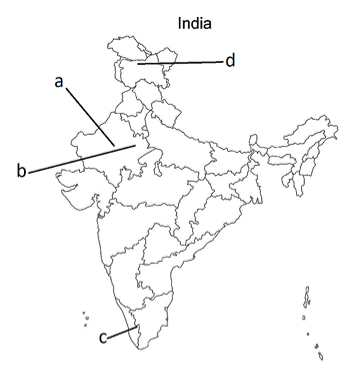
ii. On the outline map of India locate and label ANY THREE of the following with suitable Symbols.
a. Largest state according to area
b. Sariska – Wildlife Sanctuaries
c. Western Ghats
d. Wular – Lake
View AnswerAns.