Subject: Science
Class IX
Time Allowed: 3 hours
Max. Marks: 80
General Instructions:
Section A – Questions (1-16) are of 1-mark Q. No. 17 is case study based of four parts carrying one mark each.
Section B – Questions (18-27) are of 2 marks each.
Section C – Questions (28-34) are of 3 marks each
Section D – Questions (35-37) are of 5 marks each
Section E – Question 38 has four parts of 1 mark each.
Section A
Q 1. Seema visited a Natural Gas Compressing unit and found that the gas can be liquefied under specific conditions of temperature and pressure. While sharing her experience with friends she got confused. Help her to identify the correct set of conditions.
(a) Low temperature, low pressure (b) High temperature, low pressure
(c) Low temperature, high pressure (d) High temperature, high pressure
Q 2. In the tincture of iodine, find the solute and solvent?
(a) alcohol is the solute and iodine is the solvent
(b) iodine is the solute and alcohol is the solvent
(c) any component can be considered as solute or solvent
(d) tincture of iodine is not a solution
Q 3. Which of the following statements are true for pure substances?
(i) Pure substances contain only one kind of particles
(ii) Pure substances may be compound or mixtures
(iii) Pure substances have the same composition throughout
(iv) Pure substances can be exemplified by all elements other than nickel
(a) (i) and (ii) (b) (i) and (iii) (c) (iii) and (iv) (d) (ii) and (iii)
4. The image shows the stem of the plant.
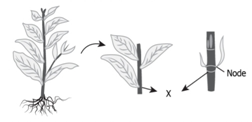
Which type of meristematic tissue is present at the labelled part ‘X’?
a) apical meristem b) intercalary meristem
c) lateral meristem d) both apical and intercalary meristem
OR
A student observes that a tree near his house is growing more in width than height. Which tissue is responsible for this type of growth?
a) apical meristem b) intercalary meristem
c) lateral meristem d) both apical and intercalary meristem
5. The image shows the structure of a specialised epithelium.
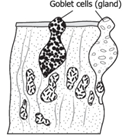
What will be the likely function of this epithelium?
a) Secretion of substances
b) Protection from wear and tear
c) Restrict movement of this tissue
d) Transport of substances across permeable surface.
6. Which of the following is not like most likely an example of uniform circular motion
a) Motion of the earth around the sun b) motion of a toy train around circular track
c) Motion of a racing car on a circular track d) Motion of hours hand on the dial of clock
OR
The numerical ratio of displacement to the distance for a moving object is
a) Always less than 1 b) Equal to 1 or less than 1 c) Always more than 1 d) Equal to 1 or more than 1
7. The rate of change of momentum of an object is directly proportional to
a) velocity of an object b) mass of an object
c) net force applied on an object d) none of these
8. The image shows some type of cells.
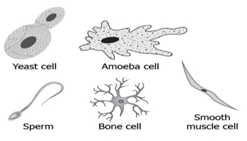
Based on the image, what could be the reason for the different shape and size?
a) to suit their function
b) as they are formed first or last in the body
c) as they are all animal cells
d) as some are plant cells and some animal cells
9. Which cell organelle is known as powerhouse of cell?
a) mitochondria b) nucleus c) endoplasmic reticulum d) none of these
10. A student observes image of the knee bones of a person who is suffering from condition called arthritis due to inflammation of joints.
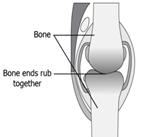
Which connective tissue can likely be added between the bones to ease the movement of joints?
a) blood as it contains proteins
b) areolar tissue as it repairs the tissue
c) ligaments as it joins the two bones easily
d) cartilage as it smoothens the surface of bones
Assertion reason:
(a) Both Assertion (A) and Reason (R) are the true and Reason (R) is a correct explanation of Assertion (A).
(b) Both Assertion (A) and Reason (R) are the true but Reason (R) is not a correct explanation of Assertion (A).
(c) Assertion (A) is true and Reason (R) is false.
(d) Assertion (A) is false and Reason (R) is true.
11. ASSERTION – Sugar and Salt both are easily dissolved in water.
REASON – Sugar and Salt are solid hence it is easily dissolved in water.
12. ASSERTION- Element is the basic form of matter.
REASON – Element is smallest unit which cannot further break in any substance hence it is pure form.
13. ASSERTION – Cell Inclusions are also known as cytoplasmic inclusions.
REASON – Cell inclusions are non-living.
14. ASSERTION- Newton’s third law of motion apply to a system where bodies do not actually touch each other.
REASON – Action and reaction forces act on only first body.
15. ASSERTION – Speedometer is a device used to measure average speed.
REASON- speedometer is used for measuring various speeds in each time interval.
16. ASSERTION- When various forces acting on a body, then body may be accelerated or static.
REASON-Acceleration in a body is produced only due to resultant force acting on it.
17. Read the passage given below and answer the questions that follow: (Do any four)
Bone is a solid, hard porous tissue. It forms the natural skeleton and gives the body its basic structure and also supports the body. Its matrix is impregnated with phosphates and carbonates of calcium and magnesium which provides hardness to it. The matrix also contains ossein protein. The matrix is arranged in concentric rings which are called lamellae. Bone cells lie between the lamellae in fluid-filled spaces called lacunae.
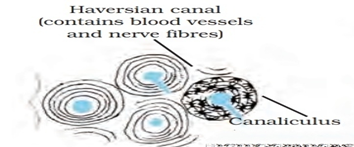
(i) Bone cells are also called:
(a) Lacunae. (b) Osteocytes. (c) Neutrophils. (d) Erythrocytes.
(ii) The matrix inside the bone is arranged in concentric rings called ………
(a) Cytoplasm. (b) Osteocyte. (c) Lacunae. (d) Lamellae.
(iii) To form natural skeleton and to give support to the body is the main function of ……….
(a) Cells. (b) Muscles. (c) Bones. (d) Ligaments.
(iv) The matrix of bone is impregnated with…………
(a) Carbon dioxide and oxygen (b) Carbon dioxide and water
(c) Sulphates of sodium (d) Phosphates and carbonates of calcium and magnesium
(v) Bone cells lie between the lamellae in fluid-filled spaces called ………….
(a) lamina (b) osteocytes (c) lacunae (d) ossein
Section B (2 Marks)
18. Why do we see water droplets on the outer surface of a glass containing ice cold water?
19. Why do wet clothes dry quickly in the sun than in the shade?
OR
Distinguish between homogeneous solution and heterogeneous solution with one example of each.
Q. 20 A solution contains 80 g of sugar in 400g of water. Calculate the concentration of solution in terms of mass by mass percentage of the solution.
21. Match the column A with the column B.
A. B.
a) Parenchyma i) Sclerenchyma
b) Aerenchyma ii) Thin walled, packing cells
c) Collenchyma iii) Buoyancy
d) Permanent tissue iv) Localised thickenings
22. Distinguish between plant cell and animal cell.
OR
How is bacterial cell different from an onion peel cell?
23. In a Tug of war game if the rope does not move in either direction, State the reason.
24. An athlete runs before taking jump. Why?
25. State Universal law of gravitation. Write its expression.
OR
Write four importance of universal law of gravitation.
26. Why is it advised to wear seat belts while driving a car?
27. Identify the following activities on the basis of voluntary (V) or involuntary (IV) muscles.
a) Jumping of frog b) Pumping of heart c) Writing with hand d) Movement of food in your intestine
Section C (3 Marks)
28. Define distillation. What type of mixtures can be separated by distillation? Draw a labelled diagram of the apparatus used for fractional distillation.
29. Describe any three properties of true solution.
OR
It is a hot summer day, Priyanshi and Ali are wearing cotton and nylon clothes respectively. Who do you think would be more comfortable and why?
Q. 30 Explain how the rate of evaporation of a liquid is affected with:
(i) Increase in temperature of the liquid.
(ii) Decrease in exposed surface area.
(iii) Increase in moisture in the surrounding air.
(iv) Increase in wind speed.
31. What are the consequences of the following conditions?
a) A cell containing higher water concentration than the surrounding medium.
b) A cell having low water concentration than the surrounding medium.
c) A cell having equal water concentration to its surrounding medium.
32. Why is the cell called the structural and functional unit of life?
33. Draw a well-labelled diagram of neuron or section of phloem.
OR
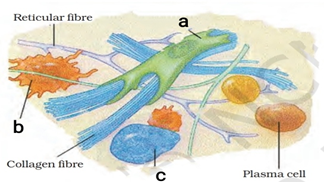
Label the a, b and c in the following diagram of areolar tissue:
Q.34.A stone of mass 1 kg rolls on the floor with initial velocity with 30m/s and stops after 5 seconds. calculate the magnitude and direction of the frictional force.
OR
How much momentum will a dumb -bell of mass 10 kg transfer to the floor , if it falls from a height of 80 cm.Take it’s downward acceleration to be 10 m/S²
Section-D (5 Marks)
35 Comment on the following statements:
(a) Evaporation causes cooling.
(b) intermolecular forces in different states of matter.
(c) Sponge though compressible is a solid.
(d) Ice is solid at 0°C, while water is liquid at room temperature.
(e) Sugar crystals dissolve faster in hot water than cold water.
OR
Observe the apparatus shown and answer the following questions.
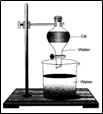
1. Identify the apparatus
2. Design an activity to use this apparatus to separate the mixture of mustard oil and water.
3. Write the principle involved in this process.
36. Give reasons for
(a) Meristematic cells have a prominent nucleus and dense cytoplasm but they lack vacuoles.
(b) Intercellular spaces are absent in sclerenchymatous tissue.
(c) We get crunchy and granular feeling when we chew pear fruit.
(d) Branches of a tree move and bend freely in high wind velocity.
(e) It is difficult to pull out husk of coconut.
37 a. Why does a fielder lower his hands before catching ball?
b. Derive the expression of S= ut + 1/2at².
Section-E (4 Marks)
Q.38 Read the paragraph and answers the following questions.
Distance is the length of the actual path covered by an object, irrespective of its direction of motion. Displacement is the shortest distance between Initial and final position of an object in a given direction.
Distance covered is scalar quantity and displacement is a vector quantity. Displacement can be zero but distance can be positive, negative and zero.
1 What is actual shortest path covered called?
2. In a circular path, what is the displacement covered in half rotation?
3. Is km SI unit of displacement?
4. Which is scalar quantity?