Subject: Science
Time Allowed: 3 hours Maximum Marks: 80
General Instructions:
1. This question paper consists of 39 questions in 5 sections.
2. All questions are compulsory. However, an internal choice is provided in some questions. A student is expected to attempt only one of these questions.
3. Section A consists of 20 objective type questions carrying 1 mark each.
4. Section B consists of 6 Very Short questions carrying 02 marks each. Answers to these questions should in the range of 30 to 50 words.
5. Section C consists of 7 Short Answer type questions carrying 03 marks each. Answers to these questions should in the range of 50 to 80 words.
6. Section D consists of 3 Long Answer type questions carrying 05 marks each. Answer to these questions should be in the range of 80 to 120 words.
7. Section E consists of 3 source-based/case-based units of assessment of 04 marks each with sub-parts.
Section A
1. Following figure shows three states of matter and its interconversion. Which process display in A and B?
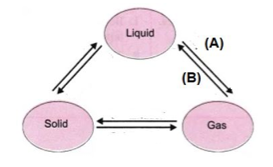
a) (A)Sublimation (B) condensation
c) (A) Vapourisation (B) Condensation
b) (A) Fusion (B) Solifification
d) (A) Fusion and (B) Condensation
View AnswerAns. b) (A) Fusion (B) Solifification
2. The cell organelle involved in forming complex sugars from simple sugars are
a) Endoplasmic reticulum
c) Golgi apparatus
b) Plastids
d) Ribosomes
View AnswerAns. c) Golgi apparatus
3. A body moving with uniform acceleration has velocities 20 ms-1 and 30 ms-1. when passing two points A and B. Then the velocity midway between A and B is:
a) 25.5 ms-1
c) 25 ms-1
b) 24 ms-1
d) 10 √6 ms-1
View AnswerAns. a) 25.5 ms-1
4. Plants can be made diseases-resistant by
a) both hybridisation and genetic modification
b) hybridisation
c) use of antibiotic
d) genetic modification
View AnswerAns. a) both hybridisation and genetic modification
5. The plant tissue provides mechanical strength and consists of living cells, is
a) sclerenchyma
b) parenchyma
c) collenchyma
d) aerenchyma
View AnswerAns. c) collenchyma
6. Most of the substances in the living world are transported across the cell membrane by the process of:
a) osmosis
b) diffusion
c) endocytosis
d) plasmolysis
View AnswerAns. a) osmosis
7. The maximum amount of sodium that can be obtained by electrolysis of 117 g of sodium chloride is [Atomic mass of Na = 23 u, Cl = 35.5 u]
a) 40 g
b) 52 g
c) 23 g
d) 46 g
View AnswerAns. d) 46 g
8. The epithelium is separated from the underlying connective tissue by
a) thick deposition of fat
b) mucosa
c) vesicles
d) basement membrane
View AnswerAns. d) basement membrane
9. In the following figure the zero error is:
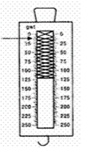
a) 5 gwt
b)– 5 gwt
c) 2 gwt
d)– 2 gwt
View AnswerAns. a) 5 gwt
10. Which of the following figures represent uniform motion of moving object correctly?
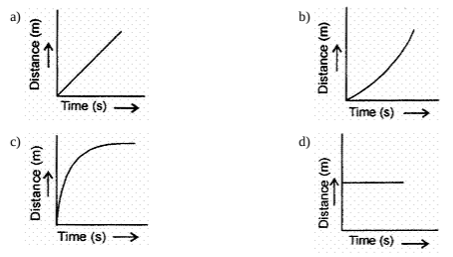
Ans. Option (a)
11. Fill in the gap using given analogy
Atomic number : Number of protons :: Mass number : _______.
a) Number of protons + Number of electrons
b) Number of neutrons + Number of protons
c) Number of electrons
d) Number of protons
View AnswerAns. b) Number of neutrons + Number of protons
12. Which of the following tissues has dead cells?
a) Collenchyma
b) Epithelial tissue
c) Parenchyma
d) Sclerenchyma
View AnswerAns. d) Sclerenchyma
13. Which of the following cell functions will stop, if its ribosomes are destroyed?
a) Formation of complex sugars
b) Lipid metabolism
c) Protein synthesis
d) ATP synthesis
View AnswerAns. c) Protein synthesis
14. Rusting of an article made up of iron is called
a) corrosion and it is a physical as well as chemical change
b) dissolution and it is a physical
c) dissolution and it is a chemical change B
d) corrosion and it is a chemical change
View AnswerAns. d) corrosion and it is a chemical change
15. oiling points of a few gases are given below:

If liquid mixture of these gases is fractionally distilled, the order of gases distilling out from first to last is
a) Z, X, Y, W
b) X, Y, Z, W
c) W, X, Y, Z
d) Y, X, Z, W
View AnswerAns. b) X, Y, Z, W
16. Kharif season extends from
a) April to June
b) January to March
c) June to October
d) October to January
View AnswerAns. c) June to October
17. Assertion (A): Motion with uniform velocity is always along a straight-line path.
Reason (R): In uniform velocity a motion, speed is the magnitude of the velocity and is equal to the instantaneous velocity.
a) Both A and R are true and R is the correct explanation of A.
b) Both A and R are true but R is not the correct explanation of A.
c) A is true but R is false.
d) A is false but R is true.
View AnswerAns. b) Both A and R are true but R is not the correct explanation of A.
18. Assertion (A): A gas fills completely the vessel in which it is kept.
Reason (R): Intermolecular force of attraction between the particles of gas is negligible.
a) Both A and R are true and R is the correct explanation of A.
b) Both A and R are true but R is not the correct explanation of A.
c) A is true but R is false.
d) A is false but R is true.
View AnswerAns. a) Both A and R are true and R is the correct explanation of A.
19. Assertion (A): 1-day Vinita went to see his brother’s competition and he saw his brother in pain and not able to run comfortably.
Reason (R): Two bones can be connected to each other by another type of connective tissue called the ligament. This tissue is very elastic. It has considerable strength.
a) Both A and R are true and R is the correct explanation of A.
b) Both A and R are true but R is not the correct explanation of A.
c) A is true but R is false.
d) A is false but R is true.
View AnswerAns. b) Both A and R are true but R is not the correct explanation of A.
20. Assertion (A): Thomson’s model of an atom is popularly known as the plum pudding or Christmas pudding model of an atom.
Reason (R): According to the Thomson’s plum pudding model, an atom is a positively charged sphere in which the electrons are embedded.
a) Both A and R are true and R is the correct explanation of A.
b) Both A and R are true but R is not the correct explanation of A.
c) A is true but R is false.
d) A is false but R is true.
View AnswerAns. a) Both A and R are true and R is the correct explanation of A.
Section B
21. The work done in lifting a box on to a platform does not depend upon how fast it is lifted up. Explain your answer giving proper reason.
View AnswerAns. The work done (W) in lifting a box through a distance s against the gravitational force (F) is given by W = Fs. Hence it is obvious that it is independent of the rate at which the box is lifted.
OR
Why does a block of plastic released under water come up to the surface of water?
View AnswerAns. The block of plastic displaces more weight of water than its own weight and therefore, experiences a buoyant force greater than its own weight. As a result, the net force acts in the upward direction. Thus on being released it comes upto the surface of water.
22. Why is it that on increasing the wind speed the rate of evaporation increases?
View AnswerAns. When the speed of wind increases, then they blow away with them the water vapour in the air and as a result rate of evaporation will increase because the surrounding air will be able to receive more vapours and hence evaporation increases.
23. Explain how defects in a metal block can be detected using ultrasound.
View AnswerAns. The ultrasound waves are allowed to pass through metal block to which detectors are fitted. If there is a small defect in the metal block like an air bubble or a crack, then the ultrasound waves are reflected from such spots. Metal block if defective is indicated by the reflected ultrasonic waves.
24. A wooden table should be called a solid. Give reason.
View AnswerAns. A wooden table should be called a solid because it matches the characteristics of the solid-state. Such as,
i. It is very hard and rigid.
ii. Its shape cannot be changed by altering temperature or pressure.
iii. It is quite heavy which means high density.
iv. There is no movement of the constituent particles present.
25. Explain why some of the leaves may get detached from a tree if we vigorously shake its branch.
View AnswerAns. When the branch of a tree is shaken vigorously, it comes in motion while the leaves tend to remain at rest due to inertia of rest. Therefore, some of the leaves get detached from the branch of the tree.
OR
Why do you fall in the forward direction when a moving bus brakes to a stop and fall backwards when it accelerates from rest?
View AnswerAns. In a moving bus, a passenger moves with the bus due to inertia of motion. As the driver applies brakes, the bus comes to rest. But, the passenger tries to maintain to inertia of motion. As a result, a forward force is exerted on him and the passenger leans forward.
Similarly, the passenger tends to fall backwards when the bus accelerates from rest because when the bus accelerates, the inertia of rest of the passenger tends to oppose the forward motion of the bus. Hence, the passenger tends to fall backwards when the bus accelerates forward.
26. Find the percentage composition of sucrose C12H22O11.
View AnswerAns. The molecular mass of sucrose C12H22O11 is:
= 12(12) + 22(1) + 11(16)
= 144 + 22 + 176
= 342 g/mol

The composition by mass of sucrose is Carbon = 42.11 percent, Hydrogen = 6.43 percent and Oxygen = 51.46 percent.
Section C
27. i. What is the difference between echo and reverberation?
View AnswerAns. The repetition of sound caused by the reflection of sound waves from an obstacle is known as an echo whereas the phenomenon of persistence or prolongation of audible sound after the source has stopped emitting it is called reverberation.
ii. How can we reduce reverberation in an auditorium or a big hall?
View AnswerAns. In an auditorium or big hall, excessive reverberation is highly undesirable. To reduce reverberation, the roof and walls of the auditorium are generally covered with sound-absorbent materials like compressed fibreboard, rough plaster or draperies.
iii. Which materials are good absorbers of sound?
View AnswerAns. The soft and the porous materials are bad reflectors of sound but are good absorbers of sound.
iv. Why we can hear more clearly in a room having curtains?
View AnswerAns. We can hear more clearly in a room having curtains because curtains are bad reflectors of sound. The curtains absorb most of the sound falling on them, and hence do not produce echoes.
28. What is the basic difference between the isotopes of an element?
View AnswerAns. (i) Different atoms of the same element are called isotopes.
(ii) Each element can have several isotopes.
(iii) The atomic weight of the element differs from the isotopic mass. The abundance of each isotope determines the atomic weight of an element.
(iv) Isotopes of an element differ in the number of neutrons leading to different mass numbers.
29. The position of a body at different times is recorded in the table given below:

i. Draw the displacement time graph for the above data.
View AnswerAns.
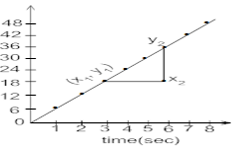
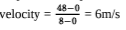
ii. What is the slope of graph?
View AnswerAns. Slope of the displacement – time graph = velocity
iii. What is the velocity of the motion?
View AnswerAns.
OR
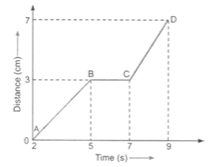
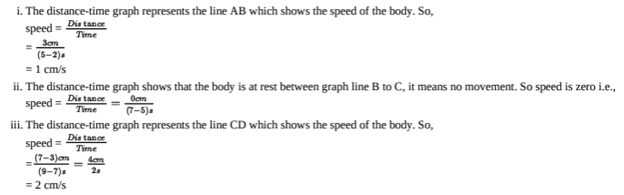
The graph given below shows the positions of a body at different times. Calculate the speed of the body as it moves from
i. A to B
ii. B to C
iii. C to D
Ans.
30. Give reason: An iron nail sinks in water, but a ship made of iron floats.
View AnswerAns. If we place an iron nail on the surface of water, it sinks. This is because the density of iron is greater than that of water, so the weight of the nail is more than the upthrust of water on it. On the other hand a ship made of iron does not sink. This is because the ship is hollow and the empty space contains air which makes the average density of the ship less than that of water. Therefore, even with a small part of it submerged into water, the weight of the water displaced becomes equal to the total weight of the ship and hence the ship floats.
31. The following is the distance-time table of an object in motion:
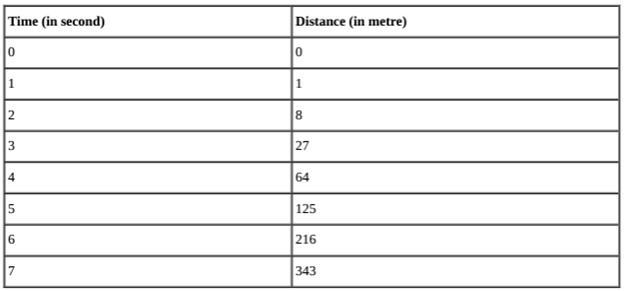
i. What conclusion can you draw about the acceleration? Is it constant, increasing, decreasing or zero?
View AnswerAns.

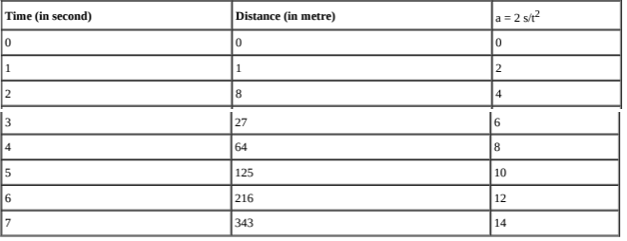
Thus, acceleration is increasing.
ii. What do you infer about the force acting on the object?
View AnswerAns. Since acceleration is increasing, so the net unbalanced force is acting on the object.
32. What is the difference between plasma membrane and cell wall ? Give the functions of each one.
View AnswerAns. 1. Plasma Membrane is the phospholipid layer, found in all types of cells; it helps in protecting the protoplasm and checks the passage of molecules inside the cell, Though cell wall is found in the plant cell, fungi, bacteria only and protects the cell from external shocks, and provide rigidity and shape to the cell.
2. The cell wall is the outermost boundary of the cell (if present), and plasma membrane is present in the inner lining of the cell. The plasma membrane is delicate thin layer while cell wall is the thick and rigid layer. Plasma Membrane is selectively permeable membrane allowing small molecules entry only; their layer is made up of lipids and proteins and few carbohydrates, while Cell wall constituents may vary from chitin, peptidoglycon, and cellulose.
3. Plasma membrane is the living membrane made up of lipids and proteins, whereas cell wall is non-living made up of cellulose
Function of Plasma membrane: It acts as semi permeable membrane which allows only selective substances to pass through it. Function of Cell Wall: It provides rigidity and protection to cell.
OR
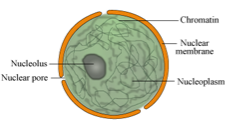
Write short note on nucleus.
View AnswerAns. The nucleus is also known as the ‘control centre of the cell’. It is generally centrally placed. It is bounded by a nuclear membrane, in which nuclear pores are present. The fluid inside the nucleus is called nucleoplasm. Nucleoplasm contains a thread-like structure called chromatin and nucleolus. Chromatin contains DNA, which condensed to form chromosomes during cell division. Nucleolus synthesizes ribosomes.
33. The transportation system of plants is composed of complex permanent tissue. They have their transportation system within themselves. Justify in detail with appropriate diagrams.
View AnswerAns. In plants, there are pipe-like vessels through which water and minerals can enter the plants. These vessels are made up of elongated cells and thick walls. A group of cells forms a tissue which performs a specialized function within the organisms. These are conducting tissues. These conducting tissues are divided into two types which are xylem and phloem. i. Xylem: It is a vascular tissue that spreads from the top to bottom of the plant. It helps in the transportation of water and minerals from roots to other parts of the plant.
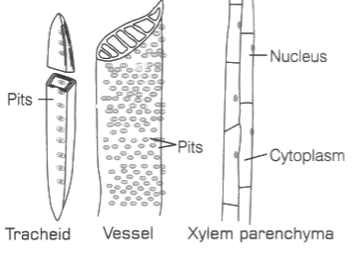
Elements of xylem:
a. Tracheids and Vessels: It is Tubular structure and transport water and minerals vertically.
b. Parenchyma: It stores food and helps in sideways conduction of water.
c. Fibres: It is supportive in function.
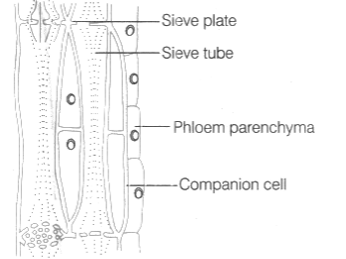
ii. Phloem It transports food from leaves to other parts of the plant. Food is prepared in leaves by the process of photosynthesis.
Elements of phloem:
a. Sieve tubes: It is tubular cells with perforated walls. These consist of living cells.
b. Companion cells: It is small elongated cells with dense cytoplasm.
c. Phloem parenchyma : It is Thin-walled cells. Mainly function in storage and transportation of food.
d. Phloem fibres It is Thick-walled cells. These are dead cells. Provide mechanical strength to tissue.
Both xylem and phloem maintain a transportation system within the plants. There is continuous transportation of food, water and minerals within the plant. This transportation is necessary for the proper growth and maintenance of the plant.
Section D
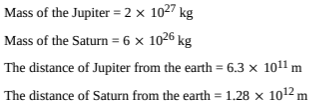
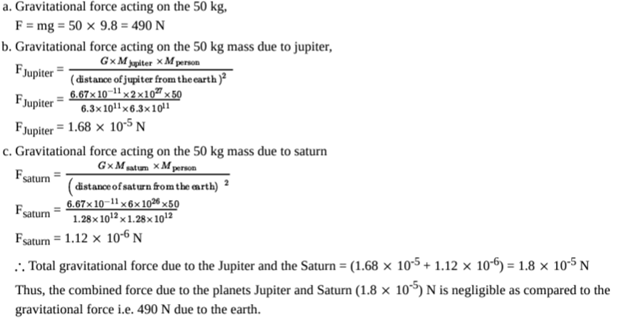
i. At some moment, two giant planets Jupiter and Saturn of the solar system are in the same line as seen from the earth. Find the total gravitational force due to them on a person of mass 50 kg on the earth. Could the force due to the planets be important?
Ans.
ii. A bag of sugar weighs ‘w’ at a certain place on the equator. If this bag is taken to Antarctica, then will it weigh the same or more or less. Give a reason for your answer
View AnswerAns. We know that g at the equator is less than g at poles (Antarctica). Thus, weight at the equator is less than weight at the pole (Antarctica). A bag of sugar weighs ‘w’ at a certain place on the equator. If this bag is taken to Antarctica, then it will weigh more due to the greater value of g.
OR
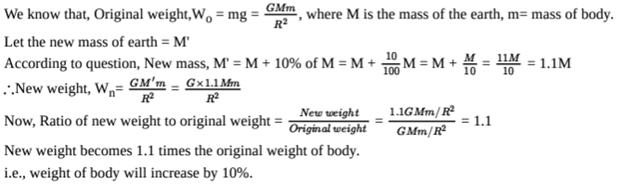
i. Suppose the mass of the earth somehow increases by 10% without any change in its size. What would happen to your weight?
View AnswerAns.
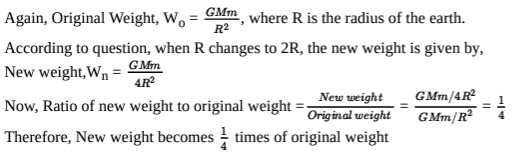
ii. Suppose the radius of the earth becomes twice of its present radius without any change in its mass. What will happen to your weight?
View AnswerAns.
35. i. Describe the role played by the lysosomes. Why are they termed as suicidal bags? How do they perform their function?
View AnswerAns.
- Lysosomes are membrane-bound sacs filled with digestive enzymes. These enzymes are made by the rough endoplasmic reticulum.
- Lysosomes are a kind of waste disposal system of the cell. During the disturbance in cellular metabolism, e.g. when a cell gets damaged, lysosomes present in the cell may burst and the enzymes digest the damaged cell. Hence, lysosomes are called as ‘suicidal bags’ of a cell.
- Lysosomes break up the foreign materials entering into the cell, such as bacteria or food into small pieces
ii. What happens to the dry raisins, when placed in plain water for some time? State the reason for whatever is observed. What would happen if these raisins are then placed in concentrated salt solution?
View AnswerAns. The dry raisins, when placed in plain water for some time will swell up due to endosmosis. If these raisins are again placed in a concentrated salt solution, they will shrink, due to exosmosis.
OR
i. State what will happen when human red blood cells are placed in a hypotonic salt/sugar solution.
View AnswerAns. When human red blood cells are placed in hypotonic salt/sugar solution they swell due to endosmosis.
ii. Why plant cell shrinks when kept in a hypertonic solution.
View AnswerAns. Plant cell shrinks when kept in hypertonic solution because the concentration of the solvent is more inside the cell. It shrinks due to exosmosis.
iii. Why lysosomes are known as suicidal bags?
View AnswerAns. Lysosomes are known as suicidal bags because, during the breakdown of cell structure, lysosome bursts and enzymes eat up their own cells.
36. Name the process associated with the following:
i. Dry ice is kept at room temperature and at one atmospheric pressure.
View AnswerAns. Sublimation
ii. A drop of ink placed on the surface of water contained in a glass spreads throughout the water.
View AnswerAns. Diffusion
iii. A potassium permanganate crystal is in a beaker and water is poured into the beaker with stirring.
View AnswerAns. Diffusion/dissolution
iv. A acetone bottle is left open and the bottle becomes empty.
View AnswerAns. Evaporation/diffusion
v. Milk is churned to separate cream from it.
View AnswerAns. Centrifugation
vi. Settling of sand when a mixture of sand and water is left undisturbed for some time.
View AnswerAns. Sedimentation
vii. Fine beam of light entering through a small hole in a dark room, illuminates the particles in its paths.
View AnswerAns. Tyndall effect
Section E
37. Read the following text carefully and answer the questions that follow:
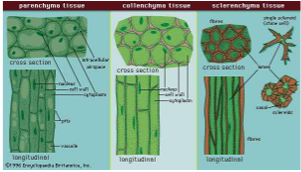
Permanent tissues are of two types that is Simple permanent tissues and Complex permanent tissues. Simple permanent tissues subdivided as follows:
i. Parenchyma: Tissues provide support to plants. They are loosely packed and has large intracellular space. Parenchyma with chlorophyll which performs photosynthesis is called chlorenchyma.
ii. Collenchyma: Tissue are thickened at the corners, have very little intercellular space. It allows easy bending of various parts of a plant without breaking.
iii. Sclerenchyma: Cells of this tissue are dead and commonly seen in the husk of a coconut.
i. In which of the simple plant tissue, deposition of lignin is found? Also describe lignin.
View AnswerAns. Sclerenchyma, Lignin is a chemical substance present in the cell wall of plant that acts as cement and hardens it.
ii. Why is cork impervious to gases and water?
View AnswerAns. Due to presence of a chemical substance called suberin.
iii. Which type of tissue is present in the cortex of the root and veins of the leaves?
View AnswerAns. The parenchyma tissue is present in the cortex of roots and sclerenchyma tissue is present in the veins of the leaves.
OR
Which tissue in plants provides them flexibility?
View AnswerAns. Collenchyma tissue in plants provides them flexibility.
38. Read the following text carefully and answer the questions that follow:
Cropping pattern refers to the proportion of land under cultivation of different crops at different points of time. Intercropping is the practice of growing more than one crop on the same field at the same time in a definite row pattern. It is much superior to mixed cropping. Intercropping can incorporate crop rotation. The technique makes the farmers busy throughout the year. Productivity is increased. Soil erosion is prevented. Pests and weeds remain under control.

i. What is Inter-cropping?
View AnswerAns. Growing two or more crops in different strips in the same field is Inter-cropping.
ii. Why intercropping is superior to all other means of cropping?
View AnswerAns. Intercropping is superior to all other means of cropping because
- Better utilisation of minerals and water from different layers of soil.
- Nonspread of weeds to whole cropping area.
- Nonspread of pests to whole cropping area.
iii. Which method of cropping prevents soil erosion by checking soil creep after harvesting a crop?
View AnswerAns. Inter-cropping
OR
Modern cropping is based on machines from sowing to harvesting. Which is the best method of cropping for this?
View AnswerAns. Monocropping
39. Read the following text carefully and answer the questions that follow:
A solution of a solid in a liquid such as water can be prepared by adding it slowly to water with constant stirring at a certain temperature (room temperature). If the addition process is continued, a stage is ultimately reached in the dissolution process when no more of the solid dissolves. Rather it starts setlling at the bottom of the container such as a glass beaker. The solution at this stage is said to be saturated. The solubility of a solute is always expressed with respect to the saturated solution. It may be defined as the maximum amount of the solute that can be dissolved in 100 g of the solvent to form a saturated solution at a given temperature. Please remember that the role of temperature is very important. If temperature is increased, the solution becomes unsaturated. In case the temperature is decreased, the solution becomes supersaturated. As a result, crust of the solute gets deposited on the surface.
i. What do mean by the term Solubility?
View AnswerAns. The maximum amount of solute that can dissolve in a given amount of solvent.
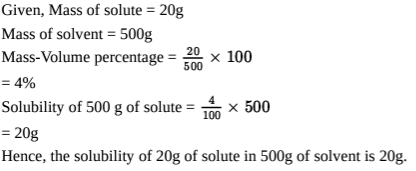
ii. 20 g of a solute are dissolved in 500 g of the solvent. The solubility of the solute is:
View AnswerAns.
iii. When a saturated solution becomes unsaturated?
View AnswerAns. A saturated solution becomes unsaturated by either heating it or by adding more of the solvent.
OR
What do you mean by concentration of solution?
View AnswerAns. Concentration of a solution is defined as the amount of solute that is present in a given amount of solution. It can be expressed in terms of: Mass by the mass percentage of a solution
