English Language and Literature (184)
Class IX (2025-26)
Time Allowed: 3 hours Maximum Marks: 80
General Instructions:
Read the instructions very carefully and strictly follow them :
1. This question paper comprises 11 questions. All questions are compulsory.
2. The question paper contains THREE sections – Section – A : Reading Skills Section – B : Grammar and Creative Writing Skills Section – C : Literature Text Book
3. Attempt questions based on specific instructions for each part.
Section A Reading
1. Read the passage given below and answer the questions that follow:
Maggie is a golden doodle. However, she turned out to be more golden than a doodle. She has lots of energy, is very loving, a people pleaser, soft and she loves every minute of life. But when she was small, we called her “The Demon”. She lived to jump on me, bite me, and steal anything. My goal had been to get a dog that would keep me walking every day. But more than that, I am in a period of my life where I was looking for a way to give back. Seeing Maggie’s loving personality and high energy, I realized that Maggie needed a job and I needed to volunteer, and if we worked together, we could both have that. But the little “demon” needed to be tamed! After going through beginner and intermediate obedience at Canine Academy, I knew that Maggie would benefit from the Off-Leash program and that would help her get ready to become a therapy dog so that she could be busy and I could give back.
She is home from the Academy now, and what a great dog she is! She loved her training and did very well at Canine Academy. Walks that used to be difficult because, at 75 lbs, her pulling on the leash was hard on me, are now a pleasure. We walk twice every day and she has many friends in the neighbourhood, that have watched her grow from an unruly puppy to a beautiful companion, thanks to the Canine Academy. We train every day and she loves to attend the weekly training sessions that the Off-Leash graduates take part in. Lisa and her trainers gave Maggie the tools she needed to be an absolutely wonderful dog. Now we work together to fine tune those tools and everyone that knew her before is quite impressed by how well-behaved she is now. My life is so much better with Maggie in it, but part of that is thanks to the wonderful people at the Canine Academy and the great work they do with dogs. If I ever add to my dog family, we will surely be calling them again!
Answer the following questions, based on the passage above.
I. In paragraph 1, what does the phrase ‘Maggie needed a job and I needed to volunteer’ emphasise? (1)
Ans. The phrase ‘Maggie needed a job and I needed to volunteer’ emphasises the writer’s desire to find a meaningful way to give back to the community by channeling Maggie’s energy into a productive activity like becoming a therapy dog.
II. Complete the following with the correct option from the two given. (1)
The writer describes Maggie as a “demon” when she was small because ________.
(a) she was mischievous, energetic, and hard to manage.
(b) she refused to participate in obedience training at first. (paragraph 1)
Ans. (a) she was mischievous, energetic, and hard to manage.
III. Support the writer’s idea that Maggie has significantly improved after her training at the Canine Academy. (paragraph 2) (2)
Ans. The writer supports this idea by explaining:
a. Maggie no longer pulls on the leash, making walks a pleasure.
b. Her improved behaviour is noticed and appreciated by neighbours who saw her grow from an unruly puppy into a wellbehaved companion.
IV. Select the option that best reflects the concept of ‘giving back’ as described in the passage. (paragraph 1) (1)
Ans. The concept of ‘giving back’ as described in the passage is best reflected by working together with Maggie to help others through volunteer activities like therapy dog work.
V. State whether the following statement is True or False. (paragraph 2) Maggie has become well-behaved and enjoys weekly training sessions after completing her Off-Leash program. (1)
Ans. True. Maggie has become well-behaved and enjoys weekly training sessions after completing her Off-Leash program.
VI. The writer mentions ‘Maggie needed a job’ in paragraph 1. Which of the following activities best represents a potential “job” for Maggie? (1)
(a) Participating in advanced obedience competitions.
(b) Becoming a therapy dog to help people in need.
(c) Guarding the house and protecting the property.
(d) Playing fetch daily as her primary activity.
Ans. (b) Becoming a therapy dog to help people in need.
VII. List any two ways the Canine Academy helped improve Maggie’s behaviour. (paragraph 2) (2)
Ans. Two ways the Canine Academy helped improve Maggie’s behaviour:
1. Teaching her obedience skills that make daily walks manageable and enjoyable.
2. Providing her with tools through training, which continue to be fine-tuned during weekly sessions.
VIII. Fill in the blank with the correct option from those given. (paragraph 2)
In the phrase ‘fine tune those tools’, the word ‘tools’ refers to ________. (1)
(a) The specific commands and techniques learned in training.
(b) The leashes, collars, and physical equipment used during walks.
(c) The toys used to keep Maggie active and entertained.
(d) The tricks Maggie learned to impress her neighbours.
Ans. (a) The specific commands and techniques learned in training.
2. Read the following passage carefully:
1. Rotation of crops is a universal phenomenon which is practised by most of the farmers of the tropical and temperate countries. The main objective of rotation of crops is to obtain higher agricultural returns on the one hand, and to maintain the soil fertility on the other.
2. In other words, the rotation of crops helps in making agriculture more sustainable. The importance of crop rotation is more in the areas where farmers grow two, or more than two crops in the same field in a year. Irrigation facilities have also been appreciably developed in the country during the last three decades. The availability of water to the arable land has helped in the intensification of agriculture.
3. In the areas such as Punjab and Haryana, where the Green Revolution is a big success, one soil exhaustive crop (rice) is followed by another soil exhaustive crop (wheat). Subsequently, the field vacated by wheat is devoted to either rice or maize or cotton. Thus, in one year, the farmers are harvesting three soil exhaustive crops from the same field. Such a rotation of crops may fetch more income to the farmers, but depletes the soil fertility at a faster pace.
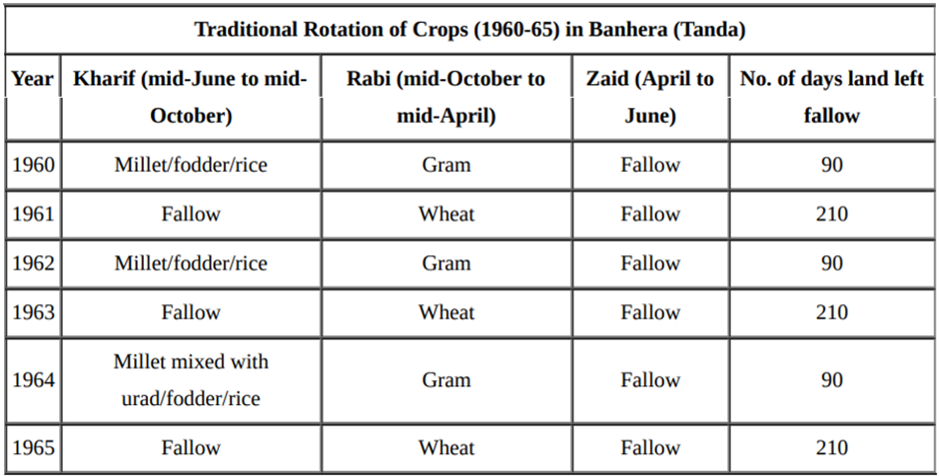
4. A number of field studies were conducted to assess the traditional crop rotation pattern. One such field study about the changes in the rotation of crops was conducted in the village Banhera (Tanda), Haridwar district. The main rotation of crops of the village is shown in the table below.
Answer the following questions, based on the above passage: (10)
i. Fill in the blanks with the appropriate option from those given in brackets, based on your understanding of para 2. (1)
One of the reasons that there has been an intensification of agriculture in the country is the development of irrigation facilities is a/an _________ (fact/opinion) because it is a/an _________ (subjective judgement/objective detail).
Ans. One of the reasons that there has been an intensification of agriculture in the country is the development of irrigation facilities is a fact because it is an objective detail.
ii. Based on your understanding of paras 1 and 2, state whether the following statement is true or false. (1)
If proper irrigation facility is provided, higher agricultural returns can be obtained by making crop rotation more sustainable.
Ans. This statement is True.
iii. Justify the following in about 40 words. Crop rotation may fetch more income to the farmers, but depletes the soil fertility at a faster pace. (2)
Ans. This statement is inaccurate. Crop rotation is a practice designed to enhance soil fertility, not deplete it. By alternating the types of crops grown on a piece of land, different nutrients are used and replenished naturally, reducing the need for chemical fertilizers and preventing the rapid depletion of soil nutrients. It helps maintain a healthy balance in the soil, leading to sustainable agriculture and potentially more income for farmers due to healthier crop yields.
iv. Based on the table, mention the years when the land was left fallow for maximum number of days. (1)
Ans. According to the table, the years when the land was left fallow for the maximum number of days are 1961, 1963, and 1965, with 210 days each of those years.
v. The study conducted in village Banhera (Tanda) reflects that during the years 1960 to 1965, from April to June, the land was left fallow or uncultivated throughout. State any one inference that can be drawn from this. (1)
Ans. One inference that can be drawn from the fact that the land in Banhera (Tanda) was left fallow from April to June during the years 1960 to 1965 is that this period, which corresponds to the Zaid cropping season, may not be suitable for cultivation due to reasons such as extreme temperatures, insufficient rainfall, or perhaps cultural practices allowing the land to recover. Leaving the land fallow during these months could help in restoring soil fertility and moisture, preparing it for the upcoming Kharif and Rabi cropping seasons.
vi. Select the option that correctly states the significance of crop rotation as given below: (1)
1. Crop rotation is done to obtain higher agricultural returns.
2. Higher agricultural returns can be obtained by harvesting soil exhaustive crops.
3. Crop rotation demands that land should be left fallow for a few months to increase the fertility of soil.
4. Better irrigation facility to the arable land has helped in the intensification of agriculture.
5. If crops to be harvested are chosen wisely, crop rotation can help in maintaining fertility of soil. Options:
A. (1), (2) and (4)
B. (1) only
C. (3) and (5)
D. (1) and (5)
Ans. D. (1) and (5)
vii. Crop rotation is helping in making agriculture more sustainable. Mention one benefit and one drawback of crop rotation. (Answer in about 40 words) (2)
Ans. One benefit of crop rotation is that it can enhance soil health by varying plant demands on soil nutrients, thus reducing the need for chemical fertilizers. A drawback is that it requires careful planning and knowledge of crop-specific requirements, which can be complex and labour-intensive.
viii. Assertion (A): Crop rotation helps in maintaining soil fertility and making agriculture more sustainable.
Reason (R): In areas like Punjab and Haryana, growing multiple soil-exhaustive crops in the same field depletes soil fertility rapidly despite higher income for farmers.
A. Both (A) and (R) are true, and (R) is the correct explanation of (A).
B. Both (A) and (R) are true, but (R) is not the correct explanation of (A).
C. (A) is true, but (R) is false.
D. (A) is false, but (R) is true.
Ans. B. Both (A) and (R) are true, but (R) is not the correct explanation of (A).
Section B Grammar
3. Complete ANY TEN of twelve of the following tasks, as directed [10]
(a) Fill in the blank by using the correct form of the word in the bracket, for the given portion of a letter:
The President
RWA, Magna Greens Apartments
42, Gandhi Marg, Jonpara
Mumbai
Subject: ________ (seek) Recommendation for ‘Serving Citizens’ Award’ Nominations.
Dear Sir
Ans. Seeking
(b) Identify the error and supply the correction, for the following:

Use the given format for your response.

Ans.

(c) Read the conversation between a teacher and a student. [1]
Complete the sentence by reporting the reply correctly:
Teacher: Would you like to take part in a debate competition?
Student: Yes, When is the competition?
The teacher asked whether the student would like to participate in a debate competition to which the student affirmed ________.
Ans. and asked when the competition was.
(d) Mom was ill and was taken to the doctor where he asked her daughter (Caroline) a few questions. [1]
Report the question.
How old is your mother?
Ans. The doctor asked Caroline how old her mother was.
(e) The vocabulary list had been memorized by _______ of the students and each one scored over 80 percent on the exam.[1]
a) the whole
b) all
c) every
d) a little
Ans. b) all
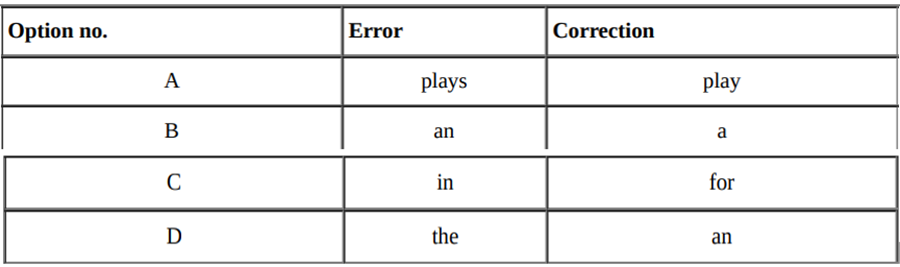
(f) Select the option that identifies the error and supplies the correction for the following line, from a news report: [1]
Education plays an important role in building the individual’s identity and personality.
Ans. (D)
(g) He ________ rather have tea than coffee. [1]
a) would
b) could
c) should
d) might
Ans. a) would
(h) Mother ________ Ali that he ________ to clean the garage after school. [1]
a) had reminded, promised
b) has reminded, promises
c) reminded, will promise
d) reminded, had promised
Ans. d) reminded, had promised
(i) Do you think he ________ to watch the match with us? I know he enjoys football. [1]
a) would sooner
b) would like
c) would mind
d) had better
Ans. b) would like
(j) Fill in the blank by using the correct form of the word in the bracket, for the given portion of a letter:
Subject: Need for ________ (promote) Healthy Eating Routines
Dear Madam
This is with reference to ….
Ans. promoting
(k) Every one of the shirts ________ a green collar.
a) is
b) are
c) has
d) have
Ans. c) has
(l) He and I ________ good friends but now we ________ anymore. [1]
a) were, aren’t talking
b) am, don’t talking
c) were, won’t talk
d) are, weren’t talking
Ans. a) were, aren’t talking
Section B Writing
4. Use the notes given below to write a paragraph.

Ans.
The Visit to a Historical Place (Agra)
Agra is great centre of art and architecture. This city has the famous wonder of the world-The Taj Mahal, which was built in the memory of Shahjahan’s beloved wife Mumtaz Mahal. It is build on the banks of river Yamuna. There are many other worth-seeing places in Agra, like the Agra Fort and the majestic palace of Akbar’s wife-Jodha Bai which is around 40 kms to the southwest of Agra in Fatehpur Sikri. Agra is a well known historical place. Many tourists visit it every year to see the epitome of love-The Taj Mahal.
OR
The latest trend of online classes is a bane as well as a boon. The given excerpt is taken from an article. Write a paragraph highlighting the pros and cons of online classes. Provide rationale/evidences to counter or strengthen the given statement.
Ans.
In traditional classrooms, teachers can give students immediate face-to-face feedback. Students who are experiencing problems in the curriculum can resolve them quickly and directly either during the lecture or during the dedicated school hours. Personalized feedback has a positive impact on students, as it makes learning processes easier, richer, and more significant, all the while raising the motivation levels of the students.
Due to the lack of face-to-face communication between peers, students and teachers in an online setting, the students might find that they are unable to work effectively in a team setting. Neglecting the communicational skills of the students will inevitably lead to many graduates who excel in theoretical knowledge, but who fail to pass their knowledge on to others. The E-Learning methods currently practised in education field tend to make participating students undergo contemplation, remoteness and a lack of interaction.
In schools and colleges, students have a proper environment for study. They are committed to learning with discipline and ready to explore creativity. To explore creativity and discipline we need to provide an environment for students to learn. When taking online classes at home there are fewer chances to create an environment for study. It required support from other family members. That’s not possible in joint families. This is a big disadvantage to study at home. Even getting the notification and mobile calls also disturb students to focus on study. Offline class in front of the teacher is highly focused on the topic and no one can disturb the classroom.
5. Indian summers are really unbearable. One day the maximum temperature shot up to 47°C. It was most miserable day of the year for you. Record the experience in your diary. [5]
Ans.
Delhi
20th July, 20XX
Friday, 8:00 pm
Dear Diary,
Indian summers can be really unbearable and who can live in peace and comfort when the heat waves, start blowing over the plains of north India. It was the 20th of July, 20XX, the most miserable day of my life. It was certainly the hottest day of the season. By noon the heat became unbearable. To avoid dehydration, we had already had several litres of cold water. I had to go to the market. I forgot to wear a cap. By the time I reached home, I was very miserable and started vomiting. To make things still worse, there was a breakdown of electric power during most part of the night. Without the working of fans and air-conditioners, we felt miserable. It was very uncomfortable with the dress I wore. I told my mom it was unbearable. She too felt hot. Then we both went to the hotel where there had air-conditioning. We sat for at least an hour get cooled. We ordered an ice cream and went back home. We spent a sleepless and miserable night.
Govind
OR
Write a story based on the inputs given below:
It was late night. Anjali was about to switch off the light and go to bed when she saw a light outside the window. On close observation, she realised that it was a fire…
Ans.
A BRAVE ACT
It was late night. Anjali was about to switch off the light and go to bed when she saw a light outside the window. On close observation, she realised that it was a fire. She rushed out at once to confirm her thoughts. She was shocked to discover that the front house’s kitchen was on fire. The kitchen window was emitting smoke. She realised that oblivious to the accident, the family members of the residence were fast asleep. Now it was Anjali’s responsibility to take action and save them. Initially, she struggled to comprehend her actions. Frantically, she rang their doorbell while sprinting towards the main entrance. Their dog started to bark. After letting him go, she dashed back to her own house to grab her phone. She made a hasty call to the fire department and hurried back to the burning house. By then, her neighbours had awoken. They were trying to extinguish the fire by throwing water on it from different directions. The fire brigade arrived within five minutes. After a struggle of half-an-hour, they were able to control the fire. Fortunately, no casualty took place and everyone in the house, including their pet was safely rescued. They were grateful to Anjali who was no less than a god-send for them. She was feeling proud of her brave and sensible act.
Section C Literature
6. Read the given extracts and answer the questions for ANY ONE of the two, given. [5]
(a) Read the following extract and answer the questions that follow:
Early the next morning the Mayor was walking in the square below in company with the Town Councillors. As they passed the column he looked up at the statue. “Dear me! How shabby the Happy Prince looks!” he said. “How shabby, indeed!” cried the Town Councillors, who always agreed with the Mayor and they went up to look at it. “The ruby has fallen out of his sword, his eyes are gone, and he is golden no longer,” said the Mayor. “In fact, he is little better than a beggar!” “Little better than a beggar,” said the Town Councillors. “And here is actually a dead bird at his feet!” continued the Mayor. “We must really issue a proclamation that birds are not to be allowed to die here.” And the Town Clerk made a note of the suggestion. So they pulled down the statue of the Happy Prince. “As he is no longer beautiful he is no longer useful,” said the Art Professor at the University.
i. State one inference about Town Councillors from the given extract. (1)
Ans. The Town Councillors tend to agree with and follow the Mayor’s opinions and decisions without questioning or offering different perspectives.
ii. State TRUE or FALSE. None of the options (a) – (d) below, can be applied to the question – How did the Mayor describe the Happy Prince’s condition? (1)
a. sparkling and splendid.
b. “a symbol of opulence and luxury.”
c. “lost his golden shine but gained new eyes.”
d. “an inspiration to all the townspeople.”
Ans. True. [None of the reason (a) – (d) below applied to the questions. All the statements are incorrect. The Mayor described the Happy Prince as “little better than a beggar.”]
iii. Why was the statue of the Happy Prince pulled down, and what reason did the Art Professor at the University provide for doing so? Elaborate in about 40 words, with reference to the extract. (2)
Ans. The statue of the Happy Prince was pulled down because it was no longer considered beautiful and, therefore, deemed useless. The Art Professor at the University justified this by stating that since the Happy Prince was no longer beautiful, he had lost his utility
iv. Which phrase would correctly substitute shabby, in the given sentence from the extract. (1)
Dear me! How shabby the Happy Prince looks! he said.
Ans. Worn-out/Tattered/Ragged. [or any other possible meaning.]
(b) Read the following extract and answer the questions that follow:[5]
“But my mother says a teacher has to be adjusted to fit the mind of each boy and girl it teaches and that each kid has to be taught differently.” “Just the same they didn’t do it that way then. If you don’t like it, you don’t have to read the book.” “I didn’t say I didn’t like it,” Margie said quickly. She wanted to read about those funny schools.
i. Which of the following is NOT a reason why a teacher had to be adjusted? (1)
a. It was a machine.
b. It worked on command.
c. It could not adapt to the level on its own.
d. It had to teach each child one on one.
Ans. d. It had to teach each child one on one.
ii. Why is it fair to say that Tommy’s tone, when he says, “Just the same they didn’t do it that way then”, is irritated? Answer in about 40 words. (2)
Ans. Tommy’s tone was irritated because Margie was comparing the present-day school with the school of her ancestor’s time. Her silly counter-arguments and questions annoyed him.
iii. Read the following descriptions (a)-(c) and identify which one correctly corresponds to the extract. (1)
a. For Margie school means indivizualised instruction.
b. Tommy is astonished at Margie’s innocence.
c. Margie and Tommy argue over the schools of the past and present.
Ans. a. For Margie school means indivizualised instruction.
iv. identify the statement in which Tommy is giving a suggestion to Margie. (1)
Ans. In the line: “If you don’t like it, you don’t have to read the book.” Tommy suggests to Margie that if she need not read the book.
7. Read the given extracts and answer the questions for ANY ONE of the two, given.
(a) Read the extract given below and answer the questions that follow.
I will arise and go now, and go to Innisfree,
And a small cabin built there, of clay and wattles made;
Nine bean-rows will I have there, a hive for the honey bee,
And live alone in the bee-loud glade.
a. State whether the following statement is True or False. Give reason. (2)
The poet finds the sounds in nature fascinating.
Ans. True
b. The poet’s liking for a life of ________ Comes through clearly from the last line of the extract. (1)
Ans. solitude/simplicity
c. Which of the following indicates a desire for a ‘small cabin’ of clay and wattles? (1)
(I) The poet persona does not run after the luxuries of life.
(II) The poet can not afford to build a good modern house.
(III) The simplicities of life fascinate the poet more than the comforts of life.
(IV) The poet wants to escape the responsibilities of life.
i. options (I) and (III)
ii. options (II) and (IV)
iii. options (I) and (IV)
iv. options (II) and (III)
Ans. i. options (I) and (III)
d. complete the analogy by selecting a suitable word from the extract. (1)
Wattles : twisted :: ________ : open space
Ans. glade
(b) Read the extract given below and answer the questions that follow.[5]
They tell them a curious story
I don’t believe its true;
And yet you may learn a lesson
If I tell the tale to you.
a. ________ does not believe in the story. (1)
Ans. The poet.
b. What motivates the poet to recount this tale even though she has doubts about its truthfulness? (2)
Ans. Despite the poet’s skepticism regarding the story’s authenticity, she chose to share it because she believed it conveyed a significant lesson that everyone should grasp.
c. What lesson is imparted by the story? (1)
Ans. The story imparts a valuable moral lesson, emphasizing the importance of selflessness and considering the wellbeing of others. It encourages us to exhibit generosity and extend assistance to those in need whenever we have the means to do so.
d. In the stanza provided, the speaker is: (1)
i. Certain that the story is true
ii. Doubtful about the truth of the story
iii. Eager to share the story with others
iv. Uninterested in telling the tale to anyone
Ans. ii. Doubtful about the truth of the story
8. Answer ANY FOUR of the following five questions, in about 40-50 words
(a) Why does the author call Baudhnath stupa a haven of quietness? [3]
Ans. The author finds the Boudhanath Stupa in sharp contrast with the Hindu temple. It has a sense of stillness and peacefulness. It is not crowded. People don’t make a hue and cry there. The hawkers don’t disturb the peaceful atmosphere of the temple. So, the author calls it a haven of quietness.
(b) ‘They have eyes like ours’. What similarity does the poet find in the eyes of people all over the world? [3]
Ans. All people of the world have eyes similar to ours. They too experience the phenomena of sleeping and waking up like us. The emotion of love too is experienced and responded to in a similar manner by all the people. Everyone’s physical strength can be countered with the power of love.
(c) Why does the writer describe his father as austere? [3]
Ans.
- He avoided all inessential luxuries and comforts.
- He is described as austere because he was a simple man.
(d) Why did the doctor look in the mirror over again? Write your answer in the context of The Snake and the Mirror. [3]
Ans. The doctor had developed an admiration for his looks and he wanted to appear even more handsome. Looking into the mirror gave him a chance to assess his looks again and again. He picked up a comb and parted his hair. He looked at his reflection in the mirror and smiled at his own image.
(e) How can the poem On Killing a Tree be interpreted as a protest? [3]
Ans. The poet of the poem Gieve Patel grew up in Mumbai and had witnessed its journey of becoming an urban metropolis. He equated Nature’s claim on land to that of humans. The poet conveys a profound message to the readers about saving trees. He ironically conveys a message that we should not cut trees. He says that trees are living beings just like human beings or any other form of life. This poem can be considered as a poem of environmental protest against urban expansion.
9. Answer ANY TWO of the following three questions, in about 40-50 words. [6]
(a) Who were Sue and Johnsy? Where did they live?[3]
Ans. Sue and Johnsy, were young artist friends who were struggling to establish their feet in the world of art. They shared the same house which was no less than a home. Both lived in a small flat which was on the third floor of an old house.
(b) Sergei looked satisfied with the performance of the beggar, he was happy that his words had a positive effect on him.’ Were his words really effective? Explain. [3]
Ans. No, his words did not have a positive effect on the beggar as he did not develop the habit of working hard. He was still lazy and an idle fellow, and was no less than a shirker.
(c) In the fair child wants many things. What are they? Why does the child move on without waiting for an answer?[3]
Ans. The child wants many things in the fair. He wants to have toys, different sweets, garland, balloons of different colours and has a keen desire to enjoy the roundabout. He moves on without waiting for an answer because whenever he stops to see things, his parents gave him a cautionary call, come, child, come!
10. Answer ANY ONE of the following two questions, in about 100-120 words [6]
(a) How does Kezia begin to see her father as a human being who needs her sympathy? [6]
Ans. With her mother and grandmother at the hospital, Kezia is left at home in the care of Alice, the cook. At night, after she is put to bed by the cook, she has a nightmare.
She calls for her grandmother but, to her surprise, she finds her father standing near her bed. He takes her in his arms and makes her sleep next to him. Half asleep, she creeps close to him, snuggles her head under his arm, and holds tightly to his shirt. Her father asks her to rub her feet against his legs for warmth.
Her father goes off to sleep before her. This makes her understand that he has to work hard every day and this leaves him too tired to be like Mr Macdonald. She expresses her altered feelings for her father by telling him that he has a ‘big heart’.
(b) Why was Gerrard packing a bag at the beginning of the play? How did it help him to outwit and trap the intruder? [6]
Ans. Gerrard was packing a bag at the beginning of the play as he had to deliver some props to some theatrical company for rehearsal. When the intruder broke into his cottage and threatened to kill him, Gerrard did not lose his cool. He spontaneously concocted a story that he himself was a criminal and was trying to dodge the police. This story was supported by the bag, the gun, the disguise outfit, false moustaches etc. All this misled the intruder into believing that Gerrard was telling the truth. He was so convinced that he got ready to escape along with Gerrard. He did not doubt him any longer and unsuspectingly did what he was told to, eventually getting trapped. Hence, the bag played an important role in convincing the intruder that Gerrard too was a criminal like him and was preparing to flee when he broke into his cottage.
11. Answer ANY ONE of the following two questions, in about 100-120 words. [6]
(a) How can you say that Toto was a mischievous pet? Write your answer in the context of The Adventures of Toto. [6]
Ans. Toto tore the wallpapers of the rooms, and also tore the narrator’s school blazer. He troubled the other fellow animals. He even managed to get himself into trouble by jumping into half-boiling water in the kettle. He made holes in dresses and curtains. The naughty monkey scared the ticket checker too. He even broke dishes in the narrator’s house. He proved to be a big troublemaker for everyone. He was the kind of pet that the narrator’s family could not keep for long as they were not very well to do and could not afford the frequent losses that were incurred because of Toto. He was difficult to handle and was quite a menace. Thus, we conclude that Toto was indeed a very mischievous pet.
(b) How did a wonderful woman bring happiness back in the life of the author? Write your answer in the context of the Poem A House is Not a Home. [6]
Ans. The author lost his cat in the fire and with the loss of a cat, he lost his interest in life. He tried to find the cat but did not get her. After a month, when he along with his friends was at his house, which was being rebuilt a woman came to him with his cat. He could not believe it. He grabbed his cat and started jumping. The wonderful woman somehow handed over his cat to him. She tried her best to find the owner of the cat. On seeing the collar and the phone number written on it, she decided that the cat was loved and missed. She was a good lady. She realized the feeling of the owner of the cat. The author called her wonderful as getting his cat back was no less than wonder for him. Now the course of life had changed he was surrounded by new friends and even found the dearest member of his family.