English Language and Literature (184)
Class IX (2025-26)
Time Allowed: 3 hours Maximum Marks: 80
General Instructions:
Read the instructions very carefully and strictly follow them :
1. This question paper comprises 11 questions. All questions are compulsory.
2. The question paper contains THREE sections – Section – A : Reading Skills Section – B : Grammar and Creative Writing Skills Section – C : Literature Text Book
3. Attempt questions based on specific instructions for each part.
Section A Reading
1. Read the passage given below and answer the questions that follow :
1. Plastic pollution has become one of the most pressing environmental issues, as rapidly increasing production of disposable plastic products overwhelms the world’s ability to deal with them. Plastic pollution is most visible in developing Asian and African nations, where garbage collection systems are often inefficient or nonexistent. But the developed world, especially in countries with low recycling rates, also has trouble properly collecting discarded plastics. Plastic trash has become so ubiquitous that it has prompted efforts to write a global treaty negotiated by the United Nations.
2. Plastics made from fossil fuels are just over a century old. Production and development of thousands of new plastic products accelerated after World War II. It transformed the modern age so much that life without plastics is unrecognizable today. Plastics revolutionized medicine with life-saving devices, made space travel possible, lightened cars and jets – saving fuel and pollution – and saved lives with helmets, incubators, and equipment for clean drinking water.
3. The conveniences plastics offer, however, led to a throw-away culture that reveals the material’s dark side: today, single-use plastics account for 40 percent of the plastic produced every year. Many of these products, such as plastic bags and food wrappers, have a lifespan of mere minutes to hours, yet they may persist in the environment for hundreds of years.
4. Most of the plastic trash in the oceans, Earth’s last sink, flows from land. Trash is also carried to sea by major rivers, which act as conveyor belts, picking up more and more trash as they move downstream. Once at sea, much of the plastic trash remains in coastal waters. But once caught up in ocean currents, it can be transported around the world.
5. Millions of animals are killed by plastics every year, from birds to fish to other marine organisms. Nearly 700 species, including endangered ones, are known to have been affected by plastics. Nearly every species of seabirds eats plastics. Most of the deaths of animals are caused by entanglement or starvation. Seals, whales, turtles, and other animals are strangled by abandoned fishing gear or discarded six-pack rings
6. The solution is to prevent plastic waste from entering rivers and seas in the first place, many scientists and conservationists – including the National Geographic Society – say. This could be accomplished with improved waste management systems and recycling, better product design that takes into account the short life of disposable packaging, and reduction in manufacturing of unnecessary single-use plastics.
Answer the following questions, based on the above passage: (10)
i. Which of the following statements best describes the reason why plastic pollution has become one of the most pressing environmental issues? (1)
A. Plastic trash collection systems have become inefficient or nonexistent.
B. Rapidly increasing production of disposable plastic products overwhelms the world’s ability to deal with them.
C. Some plastics have a lifespan of mere minutes to hours, yet they may persist in the environment for hundreds of years.
D. The developed world, especially in countries with low recycling rates, has trouble properly collecting plastics.
Ans. B. Rapidly increasing production of disposable plastic products overwhelms the world’s ability to deal with them.
ii. What is the tone of the writer in the given lines from paragraph 2? Rationalise your response in about 40 words. It transformed the modern age so much that life without plastics is unrecognizable today. (2)
Ans. The tone of the writer in the given lines is appreciative and positive. They highlight the transformative impact of plastics on modern life, emphasizing its indispensable role in various innovations and life-saving applications, indicating a positive view towards the advancements enabled by plastics.
iii. The passage includes some words that are opposites of each other. From the sets (A) – (E) below, identify two sets of synonyms. (1)
A. garbage and trash
B. starvation and strangled
C. disposable and reduction
D. persist and downstream
E. transformed and revolutionized
Ans. A. garbage and trash
E. transformed and revolutionized
iv. Complete the sentence appropriately: (1)
The writer says that most of the plastic trash is found in the Earth s last sink and the reason it is transported around the world is ________.
Ans. The writer says that most of the plastic trash is found in the Earth’s last sink and the reason it is transported around the world is that it gets caught up in ocean currents.
v. Based on the reading of the passage, examine, in about 40 words, the downside of the convenience that plastic offers. (2)
Ans. The downside of the convenience that plastic offers lies in its contribution to a throw-away culture, leading to significant environmental pollution. Single-use plastics, which account for 40 percent of annual plastic production, have very short lifespans yet can persist in the environment for hundreds of years, causing widespread damage to ecosystems and wildlife.
vi. Complete the sentence appropriately: (1)
According to conservationists, the two ways in which most of the deaths of animals are caused are ____________.
Ans. According to conservationists, the two ways in which most of the deaths of animals are caused entanglement or starvation.
vii. Based on the passage, how can we contibute to the reduction of plastic waste? (1)
A. by internationalising the waste management system
B. by minimizing the use of single-use plastics
C. by not abandoning fishing gear
D. by not using helmets made of plastic
Ans. B. by minimizing the use of single-use plastics
viii. State one reason why plastic pollution is most visible in developing Asian and African nations. (1)
Ans. One reason why plastic pollution is most visible in developing Asian and African nations is that garbage collection systems are often inefficient or nonexistent in these regions, leading to higher visibility of discarded plastics in the environment.
2. Read the extract given below:
1. The National Education Policy 2020 proposes the revision and revamping of all aspects of education, including the educational structure, regulations and governance, to create a new system which is aligned with the aspirational goals of 21st century students. According to the policy, by 2025, at least 50 % of learners through the school and higher education system shall have exposure to skill education, for which a clear action plan with targets and timelines are to be developed.
2. The policy aims to overcome the social status hierarchy associated with skill education and integration of skill education into mainstream education in all educational institutions in a phased manner. Beginning with skill exposure at early ages in middle and secondary school, quality skill education will be integrated smoothly into school and higher education.
3. Every child will learn at least one skill and is exposed to several more. This would lead to emphasizing the dignity of labour and importance of various vocations involving Indian arts and artisanship.
4. The development of skill capacities will go hand-in-hand with the development of ‘academic’ or other capacities. To achieve this objective, secondary schools will have to collaborate with Industrial Training Institutes (ITIs), Polytechnics, Local Industry, etc. Skill labs will also be set up and created in the schools in a Hub and Spoke model, which will allow other schools to use the facility. Higher education institutions will offer skill education either on their own or in partnership with industry and other institutions.
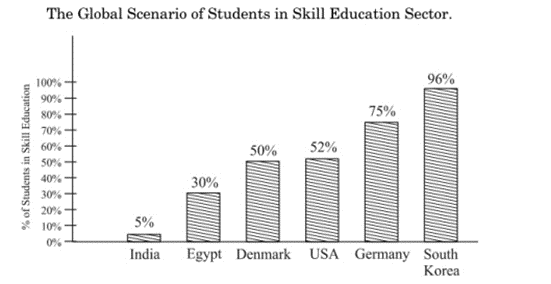
For visually challenged students only: Percentage of students in Skill Education in various countries is as follows:
India – 5%
Egypt – 30%
Denmark – 50%
USA – 52%
Germany – 75%
South Korea – 96%
Based on your understanding of the extract, answer the questions given below: (10)
i. Based on the reading of the extract, list 2 objectives of NEP 2020. (2)
Ans. a. Increase access to skill education
b. Integrate skill education into mainstream education
ii. Fill in the blank with appropriate option from those given in the brackets, based on the understanding of paragraph 4.
The statement:
“The development of skill capacities will go hand-in-hand with the development of academic or other capacities” is a / an ________ (fact / opinion) because it is a / an ________ (subjective judgement / objective detail) (1)
Ans. a fact, an objective detail
iii. Select the option that corresponds to the meaning of the statement given below: “According to the policy, by 2025, at least 50% of learners through the school and higher education system shall have exposure to skill education.” (1)
A. Maximum 50% learners shall have exposure to technical education.
B. Minimum 50% learners shall have exposure to technical education.
C. Minimum 50% learners shall have exposure to skill education.
D. Maximum 50 % learners shall have exposure to skill education.
Ans. (C) Minimum 50% learners shall have exposure to skill education.
iv. Based on the understanding of the passage, complete the following statement appropriately: (1) The benefit of the hub and spoke model will be ________
Ans. allowing other schools to access the facility of skill models.
v. Complete the following analogy correctly with a word / phrase from paragraph 3.: (1)
Racism: condemn:: ________: respect
Ans. Racism : condemn :: Skill education : respect
vi. As per the Global Scenario which country has the maximum percentage of students in Skill Education and what can be the possible reason (2)
Ans. South Korea – 96%
Reason: The possible reason for this could be the emphasis and importance laid on vocational and skill-based education in the country’s education system.
vii. Assertion (A): The National Education Policy 2020 aims to integrate skill education into mainstream education to eliminate the social status hierarchy associated with vocational training.
Reason (R): Skill education will be introduced in schools through collaboration with ITIs, Polytechnics, and Local Industry, along with the establishment of skill labs under a Hub and Spoke model.
A. Both (A) and (R) are true, and (R) is the correct explanation of (A).
B. Both (A) and (R) are true, but (R) is not the correct explanation of (A).
C. (A) is true, but (R) is false.
D. (A) is false, but (R) is true.
Ans. A. Both (A) and (R) are true, and (R) is the correct explanation of (A).
viii. Justify the statement – ‘The NEP will create an awareness and appreciation of Indian arts and artisanship.’ (1)
Ans. The NEP aims to ensure that every child learns at least one skill and is exposed to several more, including Indian arts and artisanship. By integrating skill education into mainstream education and emphasizing the dignity of labor, the NEP will promote awareness and appreciation of Indian arts and artisanship among students, thus preserving and promoting traditional Indian crafts and skills.
Section B Grammar
3. Complete ANY TEN of twelve of the following tasks, as directed [10]
(a) Fill in the blank by using the correct form of the word in the bracket, for the given portion of a letter: Such posters ________ (impact) youngsters negatively and can be hazardous to their self-esteem. [1]
Ans. impact
(b) Identify the error and supply the correction, for the following:

Use the given format for your response.

Ans.

(c) Report the dialogue between the Coach and Gautam by completing the sentence.
Coach: Gautam, have you recovered from your muscle injury?
Gautam: After physiotherapy, I am feeling much better.
The coach while trying to understand Gautam’s medical issue, asked about his muscle injury to which Gautam replied ________.
Ans. that he was feeling much better after physiotherapy
(d) Elvis went to a shop to mend his watch. The watchmaker asked a few questions related to the watch. Report his question.
Did you buy this Swiss watch at my place? [1]
Ans. The watchmaker asked (Elvis) if/whether he had bought that Swiss watch at his place.
(e) Rita had been hit on ________ nose by ________ ball.
a) the; the
b) a; the
c) a; a
d) the; a
Ans. d) the; a
(f) Select the option that identifies the error and supplies the correction for the following line, from a news report:
The roof and the backside of the bus was blown away by the blast that occurred on Thursday, but no one was injured.
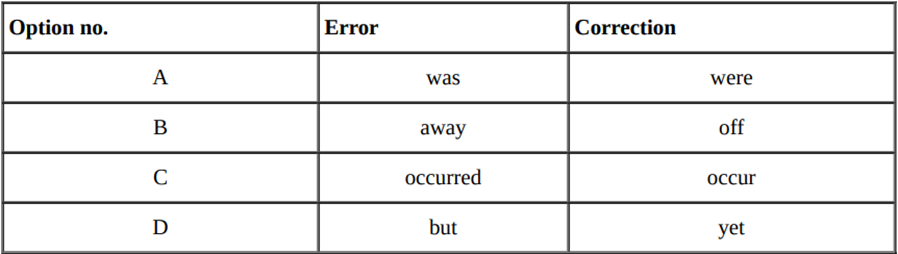
Ans. (A)
(g) Select the correct option to fill in the blank for the given line about a key quality of teachers. A good teacher ________ be alike as much as possible a bad student.
a) must
b) should
c) will
d) ought to
Ans. a) must
(h) By the time we ____ our preparations for the congress, most of the participants_____ at the hall.
a) finished / had arrived
b) finished / have arrived
c) will have finished / arrive
d) have finished / had arrived
Ans. a) finished / had arrived
(i) You really ________ be late again.
a) must
b) must not
c) don’t have to be
d) have to
Ans. b) must not
(j) Fill in the blank by using the correct form of the word in the bracket, for the given portion of a letter: This selfless initiative ________ (carry) out with dedication and responsibility, deserves due recognition.
Ans. carried
(k) The man whom I ________ with ________ the dean of our faculty.
a) was talking, were
b) was talking, was
c) can talk, were
d) were talking, was
Ans. b) was talking, was
(l) One of the books ________ been missing.
a) has
b) is
c) are
d) have
Ans. a) has
Section B Writing
4. ‘You are what you eat. Be wise.’ The given statement is taken from an article. Write a paragraph to analyse the given statement. You could think about what alternative explanations might weaken the given statement and include rationale/evidence that would strengthen or counter it. [5]
Ans.
Eating a healthy diet and following a healthy lifestyle can keep a person happy and fit. Maintaining a healthy diet is about making right food choices about what to eat with the intention of attaining good health. Healthy food means nutritious food which are considered good for the well being of an individual. According to a recent survey school students are the worst victims of malnutrition which has adversely affected their academic performance. A major cause of this condition attributes to the junk food intake. In todays hectic lifestyle where both the parents are working and the family set up is nuclear, the kids are often rewarded with junk food or in some cases literally survive on junk food. These food habits eventually effect the health of children and they suffer from life threatening diseases at the very early stage of their life. Obesity is one of the major drawbacks of junk food where the child is fat but physically very weak and fatigued.
We should inculcate good food habits in children from the very young age. We should encourage them to eat fresh fruits, green vegetables, fresh juices, coconut water, etc. Schools should neither allow junk food in school canteens nor the children to bring it from home. Healthy food keeps us away from various diseases. By eating fresh food, we feel light, relaxed and energetic. Healthy food helps a person in enhancing physical and mental well being. There are several benefits of eating healthy food:
- Healthy food promotes overall health. They provide us a strong and healthy body. Healthy food habits save us from obesity.
- Healthy food is full of different nutrients which provide us energy and also keep our brain healthy.
- Healthy food improves and strengthens our immune system and digesting.
- Healthy food keeps a lot of diseases at bay.
We should follow healthy food habits to attain a healthy life. A healthy mind resides in a healthy body, therefore it is necessary to eat healthy food to possess healthy body as well as healthy mind.
OR
One of your friends, Raman, is very gentle and polite to you. You regard him as your best friend. Describe.
Ans. I have many friends. Of them, Raman is my best friend. He is the friend I have always longed for. We are also classmates. He always stood by me in support during misfortunes. He is also a healthy critic as his criticism always helps me improve my behaviour and personality. Being a topper in the class, he also helps me in my studies. To conclude, he has been a boon to me. In the evening, he comes to me. We do homework together. Then we go to the park for playing and workout. Whenever I am wrong he explains to me my mistakes and tells me what to do next? I pray to God to bless upon our company forever.
5. Write a diary entry about how you helped an old woman who was travelling by herself in the bus. [5]
Ans.
5 June, 20XX
9:00 p.m.
Wednesday
Dear Diary, Today, I had a heartwarming encounter that reminded me of the power of kindness. While riding the bus, I noticed an elderly woman struggling to find a seat. Without hesitation, I offered her my seat and helped her settle down comfortably.
As we chatted during the journey, I learned that she was travelling alone and found it challenging to navigate the bus on her own. I offered to assist her with anything she needed, whether it was holding her belongings or helping her get off at her destination. Seeing the gratitude in her eyes filled my heart with warmth and reminded me of the importance of lending a helping hand to those in need. It was a small act of kindness that made a big difference in her day.
As I stepped off the bus, I couldn’t help but smile, knowing that I had made a positive impact on someone’s life. Today’s experience reinforced my belief in the power of compassion and reminded me to always be ready to help others in any way I can.
Lata
OR
Write a short story on the basis of given clues:
Robert Bruce, king of Scotland – often fought for the freedom of the country – no success – hiding in a cave – dejected – a spider drops by its thread from the ceiling – tries to get back to its web – again drops – succeeds in ninth attempt – inspired by the example, Bruce tries again.
Ans.
The Spider’s Persistence
Robert Bruce, the king of Scotland, was often fighting for the freedom of his country. Despite his numerous attempts, he had no success. One day, while hiding in a cave, he was dejected and lost all hope. Suddenly, a spider dropped by its thread from the ceiling. The spider tried to get back to its web but failed repeatedly. It dropped again and again, but on the ninth attempt, it finally succeeded. Inspired by the spider’s persistence, Bruce tried again and eventually achieved his goal.
The story of Robert Bruce and the spider is a powerful reminder of the importance of perseverance and determination. It serves as a cautionary tale for all individuals, especially young students like Robert, emphasizing the need to never give up on their dreams and to keep trying until they succeed.
Section C Literature
6. Read the given extracts and answer the questions for ANY ONE of the two, given. [5]
(a) Read the following extract and answer the questions that follow:
Swallow, Swallow, little Swallow,” said the Prince, “will you stay with me one night longer?” “I am waited for in Egypt,” answered the swallow. “Swallow, Swallow, little Swallow,” said the Prince, “far away across the city I see a young man in a garret. He is leaning over a desk covered with papers, and in the glass by his side there is a bunch of withered violets. His hair is brown and crisp, and his lips are red as a pomegranate, and he has large and dreamy eyes. He is trying to finish a play for the Director of the Theatre, but he is too cold to write any more. There is no fire in the grate, and hunger has made him faint.” “I will wait with you one night longer,” said the swallow, who really had a good heart. He asked if he should take another ruby to the young playwright.
i. Which of the following is NOT an attribute of the young man in the garret described by the Prince? (1)
A. His hair is brown and crisp. .
B. His lips are red as a pomegranate.
C. He is writing a play for the Director of the Theatre.
D. He has a warm fire in the grate.
Ans. D. He has a warm fire in the grate.
ii. What does the swallow’s decision to wait with the Happy Prince for one more night reveal about the swallow’s character? Answer in about 40 words. (2)
Ans. The swallow’s decision to stay with the Happy Prince for another night reflects the swallow’s compassionate and caring nature. It shows that the swallow is willing to postpone its own journey to Egypt to help someone in need, demonstrating its selflessness and kindness.
iii. Read the following descriptions (a) – (c) and identify which one correctly corresponds to the extract: (1)
a. The Happy Prince is requesting the swallow to stay with him for a longer period.
b. The swallow is describing his journey to Egypt.
c. The Prince requests the swallow to fetch him another sapphire.
Ans. a. The Happy Prince is requesting the swallow to stay with him for a longer period.
iv. If you were the young man in the garret as described in the story, what actions would you take in response to the swallow’s offer to bring you another ruby? Explain briefly. (1)
Ans. As a young man in a garret, I would express gratitude for the kind gesture and use the ruby wisely to alleviate my hunger and continue my work.
(b) Read the following extract and answer the questions that follow:
Margie went into the schoolroom. It was right next to her bedroom, and the mechanical teacher was on and waiting for her. It was always on at the same time every day except Saturday and Sunday, because her mother said little girls learned better if they learned at regular hours.
i. State any one inference about schooling in Margie’s time from the given extract. (1)
Ans. From the given extract it can be understood that schooling during Margie’s time has become more individualized and distinct from the archaic method of classroom teaching. Students need not go out for school as their bedroom could be turned into a classroom.
ii. State True or False (1)
None of the option (a)-(d) below, can be applied to Margie’s school –
a. It has a mechanical teacher.
b. The classroom was at home.
c. It was not conducted on weekends.
d. Homework was checked physically.
Ans. FALSE [Only Option(d) is not applicable as homework was inserted in the system and was not checked physically, while all the other options (a-c) are correct in the context of Margie’s school.]
iii. Identify the word in the given passage whose superlative form is best. (1)
Ans. Better
iv. Customised classroom is a futuristic reality. Elaborate on its possibilities in about 40 words, with reference to the extract. (2)
Ans. It is pretty much possible to have a customised classroom in the future society. This is so because every student would be learning a different curriculum on potentially different schedules, and it is likely that they would have less in common with their peers and less time to spend with them as children enjoy today.
7. Read the given extracts and answer the questions for ANY ONE of the two, given.
(a) Read the extract given below and answer the questions that follow.
I will arise and go now, for always night and day
I hear the lake water lapping with low sounds by the shore;
While I stand on the roadway, or on the pavement grey,
I hear it in the deep heart’s core.
a. At present the poet is most probably in (1)
i. a city
ii. a boat
iii. a lake
iv. an island
Ans. i. a city
b. Where does the poet want to go and why? (2)
Ans. The poet wants to go to the Lake Isle of Innisfree because he recollects the alluring sound of the waves there gently hitting against the shore, day and night, and wants to relish such beauty of nature.
c. The low sound is made by ________. (1)
Ans. the water gently splashing against the banks
d. It is clear that ‘Alliteration’ is the poetic device used in the second line of the extract because ________. (1)
Ans. ‘l’ and ‘w’ sound is repeatedly used.
(b) Read the extract given below and answer the questions that follow.
Where they harness the swift reindeer
To the sledges, when it snows;
And the children look like bear’s cubs
In their funny, furry clothes:
a. The children looked like ________ in their furry clothes. (1)
Ans. a bear’s cubs.
b. In what ways does the stanza evoke a sense of winter wonder? (1)
Ans. The stanza skillfully conveyed the severity of Northland’s winter climate by depicting how its inhabitants harnessed fleet-footed reindeers to sledges whenever snowfall occurred. They subtly prompted the reader to envision the vivid imagery and emotions evoked by this scene, all while astutely emphasizing the children’s appearances to establish a mood and ambience reminiscent of picturesque winters.
c. How did the people drive their sledges when it snowed? (2) .
Ans. The people of Northland harnessed the swift reindeers to the sledges, when it snowed.
d. What does the stanza describe? (1)
i. A group of children playing in the snow
ii. The preparation of sledges for a snowy ride
iii. The appearance of children in warm winter clothing
iv. The behaviour of swift reindeer in the snow
Ans. iii. The appearance of children in warm winter clothing
8. Answer ANY FOUR of the following five questions, in about 40-50 words
(a) Why does Vikram Seth decide to buy a ticket directly for the homeward journey? [3]
Ans. Vikram Seth has been away from home since quite some time. He travels a lot in Kathmandu to visit every place of any significance. He feels very exhausted and homesick. Though his enthusiasm for travelling tempts him to take a longer route to reach back home, his exhaustion and homesickness impel him to buy an air-ticket directly for the homeward journey to Delhi. Hence, he enters a Nepal Airlines office and gets his flight ticket booked to Delhi.
(b) Whom does the poet refer to as our brothers and why? Write your answer in the context of poem No Men Are Foreign. [3]
Ans. The poet refers to the people living in other countries as ‘our brothers’. He says so because of the superficial dissimilarities of language, dress, culture, and nationality do not, and must not, segregate us as human beings. The poet finds that the eyes of men all over the world have similar sights and scenes to see.
(c) Had Abdul Kalam earned any money before that? In what way? [3]
Ans. Yes, Abdul Kalam had earned some money before he started helping his cousin. When the Second World War broke out, there was a sudden demand for tamarind seeds in the market. He collected the seeds and sold them at a provision shop on Mosque Street. Usually, a day’s collection earned him one anna.
(d) Why did the doctor have to light the kerosene lamp on reaching his room? Write your answer in the context of The Snake and the Mirror. [3]
Ans. The doctor had limited money and as a result, he could not afford an any better place. The doctor had to light the kerosene lamp because the room did not have electricity and the night was pitch dark.
(e) What can a simple jab of a knife not achieve and why? Write your answer in the context of poem “On Killing a Tree.”[3]
Ans. A simple jab of a knife cannot kill a tree. It will only make the bark ooze the sap and it will heal again. Even hacking and chopping cannot kill a tree completely. The strength it has stored through a long period of hard work and patience cannot be destroyed in one go. If one wants to kill a tree, it has to be pulled out of the anchoring earth.
9. Answer ANY TWO of the following three questions, in about 40-50 words.
(a) What did the doctor tell Sue? [3]
Ans. The doctor told Sue that Johnsy had made up her mind that she was going to die. If she didn’t want to live, medicines would not help her. Her will to live and fight the problem was more important than medicines.
(b) How did Sergei recognise the beggar?[3]
Ans. Sergei looked at the beggar. Beggar’s face appeared familiar to him. Suddenly, Sergei’s eyes fell on the beggar’s shoes. Sergei noticed that One shoe was high and the other was low. Now he clearly remembered where he had seen the beggar before. He had seen the beggar in Sadovya Street.
(c) Parents were in a hurry to reach the fair but the child was delaying them. How? [3]
Ans. The child was getting tempted by the many distractions on way to the fair. Sometimes he would stop by the toy shops while at other times he would start running after butterflies. The parents had to pause frequently and call him to walk beside them.
10. Answer ANY ONE of the following two questions, in about 100-120 words [6]
(a) What message does the author wish to convey through Kezia’s story?[6]
Ans. Kezia’s story is very touching. The message of the story is that one should try to have a balance in life. One should not try to hide one’s feelings. If one is loving and caring, these feelings should be realized by others clearly. Kezia misunderstands her father only because she never sees him behave affectionately at home. She thinks that her father does not love her. She concludes that he is rude and arrogant. He punishes her with a ruler. Moreover, he never plays with her and never spends time with her. But at the end of the story, he shows his love and affection towards Kezia when she is in dire need of her father’s protection. He makes her feel comfortable and lies beside her so that she may enjoy sound sleep and she may not feel frightened due to a nightmare. The author intends to say that parents never do wrong to their children. They always think and act for the wellness of their children.
(b) The intruder announced, “I’m going to kill you”. Was Gerrard in nervous? How would you describe Gerrard’s reactions?[6]
Ans. Confident of his presence of mind, Gerrard remained unruffled of on being threatened by the intruder. He remained so calm and too nonchalant that the intruder was irritated. His sense of humour also enraged the intruder. Thus, Gerrard reacted in a calm and composed way
11. Answer ANY ONE of the following two questions, in about 100-120 words.
(a) Describe in brief, the adventures of Toto, the monkey.[6]
Ans. Toto was very naughty. Grandfather bought him from a Tonga-driver for three rupees. When he reached the Grandfather’s house for the first time, he attacked the walls of the house. The walls that were covered with some ornamental paper chosen by Grandfather were left naked with brick and plaster. The peg in the wall was wrenched from its socket. Also, the narrator’s school blazer was left in shreds. Later, when he was moved to the big cage in the servants’ quarters, where a number of Grandfather’s pets lived very sociably together, animals felt insecure in his presence. He did not let other animals sleep at night. He never missed the opportunity of disturbing others to sleep in peace at night. One day, at the table he found a dish of pulao, He started eating rice. After eating rice, he threw the plate and broke it into pieces.
(b) Why did the author keep visiting the remains of his house? Write your answer in the context of the lesson A House is Not a Home.[6]
Ans. The author loved his cat very much. He was grief-stricken when he could not find the cat after the fire. The loss of his home, as well as, the cat was too much to bear. He hoped that the cat would find its way back to the house. He kept visiting the remains of his house hoping to find his cat.