English Language and Literature (184)
Class IX (2024-25)
Time Allowed: 3 hours Maximum Marks: 80
General Instructions:
Read the instructions very carefully and strictly follow them :
1. This question paper comprises 11 questions. All questions are compulsory.
2. The question paper contains THREE sections
Section – A : Reading Skills
Section – B : Grammar and Creative Writing Skills
Section – C : Literature Text Book
3. Attempt questions based on specific instructions for each part.
Section A Reading
1. Read the following passage and answer the questions that follow:
1. Mankind’s fascination with gold is as old as civilization itself. The ancient Egyptians held gold in high esteem. Gold had religious significance for them, and King Tutankhamen was buried in a solid gold coffin 3300 years ago. The wandering Israelites worshipped a golden calf, and the legendary King Midas asked that whatever he touched be turned into gold.
2. Not only is gold beautiful, but it is virtually indestructible. It will not rust or corrode. Gold coins and products fabricated from the metal have survived undamaged for centuries. Gold is extremely easy to work with. One ounce, which is about the size of a cube of sugar, can be beaten into a sheet nearly 100 square feet in size, and becomes so thin that light can pass through it. An ounce of gold can also be stretched into a wire 50 miles long. Gold conducts electricity better than any other substance except copper and silver, and it is particularly important in modern electronic industry.
3. People have always longed to possess gold. Unfortunately, this longing has also brought out the worst in human character. The Spanish conquerors robbed palaces, temples and graves and killed thousands of people in their ruthless search for gold. Even today, the economy of South Africa’s gold mines depend largely on the employment of black labourers who are paid about 40 pounds a month, plus boarding and lodging. They work in conditions that can only be described as cruel. About 400 miners die in South Africa each year.
4. Much of the gold’s value lies in its scarcity. Only about 80,000 tons have been mined in the history of the world. All of it can be stored in a vault 60 feet square, or a super tanker. Great Britain was the first country to adopt the gold standard, when the Master of the Mint, Sir Issac Newton, established a fixed price for gold in 1717. The discovery of gold in the last half of the nineteenth century in California, (1848) and later in Australia and South Africa changed everything. Before the discovery, there wasn’t enough gold around for all the trading nations to link their currencies to the precious metal.
5. An out-of-work prospector named George Harrison launched South Africa into the gold age in 1886 when he discovered the metal in a farm near what is now Johannesburg. Harrison was given a 12 pounds reward by the farmer. He then disappeared and was eaten by a lion.
6. One of the biggest gold mining areas in the Soviet Union is the Kolyma River region, once infamous for its prison camp. The camp has gone, but in a way nothing has changed. Many ex-prisoners have stayed on to work in the mines and are supervised by ex-guards.
7. Despite the current rush to buy gold, 75 percent of the metal goes into making jewellery. Italy is the biggest consumer of gold for this purpose, and many Italian jewellers even tear up their wooden floors and burn them to recover the tiny flecks of gold. Historically, the desire to hoard gold at home has been primarily an occupation of the working and peasant classes, who have had no faith in paper money. George Bernard Shaw defended their instincts eloquently, “You have to choose between trusting the natural stability of the honesty and intelligence of the members of the government,” he said “and with due respect to these gentlemen, I advise to vote for gold.”
Based on your understanding of the passage, answer the questions given below.
i. According to the passage, which of the following statements is NOT true?
a. Gold is the best conductor of electricity.
b. Apart from gold, copper and silver are good conductors of electricity.
c. Gold can be easily beaten, hence it is easy to work with.
d. Gold plays an important role in the modern electronics industry.
View AnswerAns. a. Gold is the best conductor of electricity.
ii. Based on your reading of the text, list 2 reasons why the writer says that, Not only is gold beautiful but it is virtually indestructible.
View AnswerAns. 1. It will not rust or corrode.
2. Things made of gold remain undamaged for centuries.
iii. How were the black labourers exploited? Answer in around 40 words.
View AnswerAns. The black labourers were paid less wages and made to work in cruel conditions.
iv. Select the text that displays what the writer projects, with reference to the following.
The wandering Israelites worshipped a golden calf ________.
View AnswerAns. importance of religion
v. Complete the following with the phrase from paragraph 1

Ans. Opinion: Gold had religious significance for Egyptians.
vi. Who launched South Africa into the gold age?
a. Issac Newton
b. George Harrison
c. George Bernard Shaw
d. A farmer
View AnswerAns. b. George Harrison
vii. Select the option that corresponds to the following:
The ancient Egyptians and the modern electronic industry both hold gold in high esteem.
a. The hardworking student came first because of his diligent practice.
b. Honesty is underrated whereas strategy is appreciated.
c. The vibrant colours made the interiors look luminous.
d. The steaming food was both appetizing and tasty.
View AnswerAns. b. Honesty is underrated whereas strategy is appreciated.
viii. Supply one point to justify the following:
The desire to hoard gold at home has been primarily an occupation of the working and peasant classes.
View AnswerAns. The working and peasant classes had no faith in paper money.
2. Read the following passage carefully:
1. Rotation of crops is a universal phenomenon which is practised by most of the farmers of the tropical and temperate countries. The main objective of rotation of crops is to obtain higher agricultural returns on the one hand, and to maintain the soil fertility on the other.
2. In other words, the rotation of crops helps in making agriculture more sustainable. The importance of crop rotation is more in the areas where farmers grow two, or more than two crops in the same field in a year. Irrigation facilities have also been appreciably developed in the country during the last three decades. The availability of water to the arable land has helped in the intensification of agriculture.
3. In the areas such as Punjab and Haryana, where the Green Revolution is a big success, one soil exhaustive crop (rice) is followed by another soil exhaustive crop (wheat). Subsequently, the field vacated by wheat is devoted to either rice or maize or cotton. Thus, in one year, the farmers are harvesting three soil exhaustive crops from the same field. Such a rotation of crops may fetch more income to the farmers, but depletes the soil fertility at a faster pace.
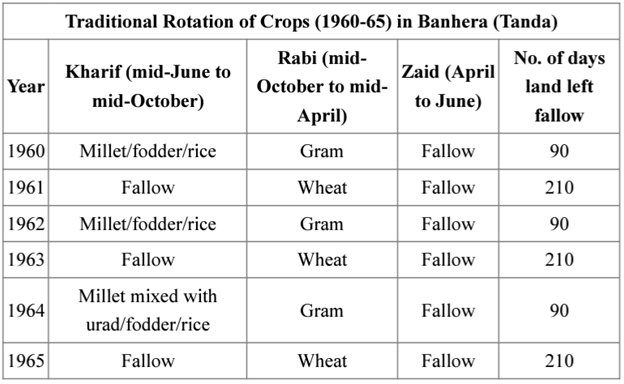
4. A number of field studies were conducted to assess the traditional crop rotation pattern. One such field study about the changes in the rotation of crops was conducted in the village Banhera (Tanda), Haridwar district. The main rotation of crops of the village is shown in the table below.
Answer the following questions, based on the above passage:
i. Fill in the blanks with the appropriate option from those given in brackets, based on your understanding of para 2.
One of the reasons that there has been an intensification of agriculture in the country is the development of irrigation facilities is a/an _________ (fact/opinion) because it is a/an _________ (subjective judgement/objective detail).
View AnswerAns. One of the reasons that there has been an intensification of agriculture in the country is the development of irrigation facilities is a fact because it is an objective detail.
ii. Based on your understanding of paras 1 and 2, state whether the following statement is true or false.
If proper irrigation facility is provided, higher agricultural returns can be obtained by making crop rotation more sustainable.
View AnswerAns. This statement is True.
iii. Justify the following in about 40 words.
Crop rotation may fetch more income to the farmers, but depletes the soil fertility at a faster pace.
View AnswerAns. This statement is inaccurate. Crop rotation is a practice designed to enhance soil fertility, not deplete it. By alternating the types of crops grown on a piece of land, different nutrients are used and replenished naturally, reducing the need for chemical fertilizers and preventing the rapid depletion of soil nutrients. It helps maintain a healthy balance in the soil, leading to sustainable agriculture and potentially more income for farmers due to healthier crop yields.
iv. Based on the table, mention the years when the land was left fallow for maximum number of days.
View AnswerAns. According to the table, the years when the land was left fallow for the maximum number of days are 1961, 1963, and 1965, with 210 days each of those years.
v. The study conducted in village Banhera (Tanda) reflects that during the years 1960 to 1965, from April to June, the land was left fallow or uncultivated throughout. State any one inference that can be drawn from this.
View AnswerAns. One inference that can be drawn from the fact that the land in Banhera (Tanda) was left fallow from April to June during the years 1960 to 1965 is that this period, which corresponds to the Zaid cropping season, may not be suitable for cultivation due to reasons such as extreme temperatures, insufficient rainfall, or perhaps cultural practices allowing the land to recover. Leaving the land fallow during these months could help in restoring soil fertility and moisture, preparing it for the upcoming Kharif and Rabi cropping seasons.
vi. Select the option that correctly states the significance of crop rotation as given below:
1. Crop rotation is done to obtain higher agricultural returns.
2. Higher agricultural returns can be obtained by harvesting soil exhaustive crops.
3. Crop rotation demands that land should be left fallow for a few months to increase the fertility of soil.
4. Better irrigation facility to the arable land has helped in the intensification of agriculture.
5. If crops to be harvested are chosen wisely, crop rotation can help in maintaining fertility of soil.
Options:
A. (1), (2) and (4)
B. (1) only
C. (3) and (5)
D. (1) and (5)
View AnswerAns. D. (1) and (5)
vii. Crop rotation is helping in making agriculture more sustainable. Mention one benefit and one drawback of crop rotation. (Answer in about 40 words)
View AnswerAns. One benefit of crop rotation is that it can enhance soil health by varying plant demands on soil nutrients, thus reducing the need for chemical fertilizers. A drawback is that it requires careful planning and knowledge of crop-specific requirements, which can be complex and labour-intensive.
viii. Which of the following is the main takeaway from the study mentioned in the passage?
A. The study needs to include more valid data to support the practice of crop rotation.
B. Crop rotation is a sustainable practice that can transform the agricultural sector.
C. The impact of crop rotation on been thoroughly explained.
D. Crop rotation is independent of the type of crops harvested and availability of water for irrigation.
View AnswerAns. B. Crop rotation is a sustainable practice that can transform the agricultural sector.
Section B Grammar
Complete ANY TEN of twelve of the following tasks, as directed
(i) Fill in the blank by using the correct form of the word in the bracket, for the given portion of a letter:
I ________ (entreat) you address this at your earliest convenience and issue the recommendation letters.
View AnswerAns. entreat
(ii) Identify the error and supply the correction, for the following:

Use the given format for your response.

Ans.

(iii) Report the dialogue between Rashid and his father, by completing the sentence.
Father: How are you getting on with your studies?
Rashid: Fine. I have got a certificate of improvement from the school.
Father asked Rashid how he was getting on with his studies. Rashid replied that ________.
View AnswerAns. Father asked Rashid how he was getting on with his studies. Rashid replied that he was doing on fine and that he had got a certificate of improvement from the school.
(iv) The instructor asked Raghav the following question during his training. Report the instructor’s question.
Have you ever worked with groups from abroad?
View AnswerAns. The instructor asked Raghav if/whether he had ever worked with groups from aboard.
(v) There aren’t _________ students in the library.
a) Most
b) Much
c) many
d) a lot
View AnswerAns. c) many
(vi) Identify the error in the given sentence and supply the correction.
There was exciting in the air, when the winning school team marched into the hall.
Use the given format for your response.

Ans.

(vii) When I entered the kitchen I realized that the chocolate cake was all gone! Someone ________ it.
a) must have eaten
b) had to eat
c) would have eaten
d) should have eaten
View AnswerAns. a) must have eaten
(viii) The doctor ________ examined the patient when the family arrived.
a) was
b) had
c) has
d) have
View AnswerAns. b) had
(ix) Select the correct option to fill in the blank for the given line from a travel magazine.
Tourists are warned that they ________ be fined if they tease animals.
a) should
b) might
c) will
d) may
View AnswerAns. c) will
(x) Fill in the blank by using the correct form of the word in the bracket for the given portion of the letter:
Subject: Complaint about Poor Service.
Dear Sir,
I ________ (will) like to draw your attention to the poor service provided by your technical team.
View AnswerAns. would
(xi) Complete the given narrative by filling in the blank with the correct option: Excited about his newly earned powers, Midas started touching all kinds of things, ________ each item into pure gold.
a) turning
b) turns
c) to turning
d) turned
View AnswerAns. a) turning
(xii) Few students who ________ playing football missed the class.
a) were
b) could be
c) was
d) had
View AnswerAns. a) were
Section B Writing
4. Use the notes given below to write a paragraph.
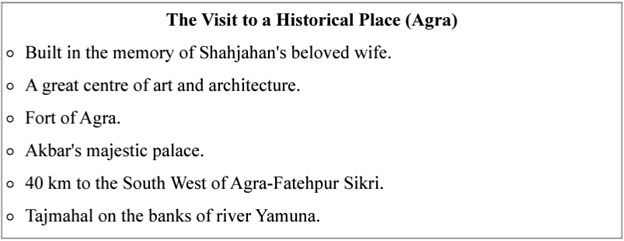
Ans. The Visit to a Historical Place (Agra)
Agra is great centre of art and architecture. This city has the famous wonder of the worldThe Taj Mahal, which was built in the memory of Shahjahan’s beloved wife Mumtaz Mahal. It is build on the banks of river Yamuna. There are many other worth-seeing places in Agra, like the Agra Fort and the majestic palace of Akbar’s wife-Jodha Bai which is around 40 kms to the southwest of Agra in Fatehpur Sikri. Agra is a well known historical place. Many tourists visit it every year to see the epitome of love-The Taj Mahal.
OR
Use the notes in the following box to write a paragraph.
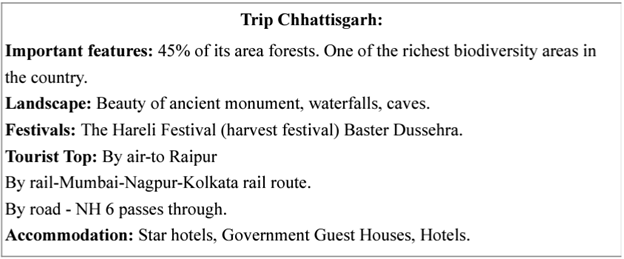
Ans. Trip to Chhattisgarh
Chhattisgarh is one of the richest biodiversity areas in the country. 45% of its area is covered by forests. The beautiful landscape of Chhattisgarh comprises of the ancient monuments, waterfalls and caves. Its important festivals are the Hareli Festival and Baster Dussehra. The Hareli festival is the harvest festival and is celebrated in a joyous mood by everyone. The Baster Dussehra is a 75 days long event celebrated in honour of the ancient goddess of arms. It is well connected to Raipur by air and to Mumbai, Nagpur and Kolkata by rail route. The National Highway 6 (NH6) passes through this magnificent place. There are many government Guest Houses, Hotels and Star Hotels here which makes it easier for tourist to accommodate themselves.
5. Write a diary entry describing your meeting with any celebrity of your choice.
View AnswerAns.

OR
Write a story from the outline given below. Give a suitable title to the story. 5 years old Sumit – back from school saw a baby bird under a tree – unable to fly worried – nest seen on the tree – 2 little birds – picked the baby bird – placed carefully in the nest – mother bird return just then – song of thanks for Sumit.
View AnswerAns. A Kind Act
Five-year-old Sumit skipped home from school, his eyes sparkling with excitement. As he reached the old banyan tree, he noticed a baby bird chirping weakly beneath it. Looking up, he saw a nest with two little birds. Concerned, Sumit realized that the baby bird had fallen and was unable to fly. Worried about the baby bird’s safety, Sumit carefully picked it up and gently placed it back in the nest. Just as he finished, the mother bird returned and perched on the edge of the nest. She looked at Sumit with beady eyes, and then, to Sumit’s amazement, she began to sing a melodious tune. Sumit felt a warm feeling in his heart as if the bird was thanking him for his help. From that day on, Sumit made sure to check on the nest every day, and he was delighted to see the baby bird growing stronger. Sumit’s simple act of kindness had created a ripple of gratitude, not just from the mother bird, but also within his own heart. He learned that every small act of compassion, no matter how insignificant it may seem, can make a big difference in the world.
Section C Literature
6. Read the given extracts and answer the questions for ANY ONE of the two, given.
(i) Read the following extract and answer the questions that follow:
“Here, Olga,” he said, “take this gentleman into the wood-shed and let him chop wood.” The scarecrow of a beggar shrugged his shoulders, as if in perplexity, and went irresolutely after the cook. It was obvious from his gait that he had not consented to go and chop wood because he was hungry and wanted work, but simply from pride and shame and because he had been trapped by his own words. It was obvious, too, that his strength had been undermined by vodka and that he was unhealthy and did not feel the slightest inclination for toil. Sergei hurried into the dining-room. From its windows one could see the wood-shed and everything that went on in the yard. Standing at the window, Sergei saw the cook and the beggar come out into the yard by the back door and make their way across the dirty snow to the shed. Olga glared wrathfully at her companion, shoved him aside with her elbow, unlocked the shed, and angrily banged the door.
i. Which of the following is NOT a reason why the beggar agreed to go and chop wood in the woodshed?
A. He was hungry and wanted work.
B. He was physically fit and eager for toil.
C. He had been trapped by his own words.
D. He was motivated by pride and shame
View AnswerAns. B. He was physically fit and eager for toil.
ii. What were the physical and emotional conditions of the beggar that became apparent as he headed to the woodshed?
View AnswerAns. The beggar’s physical condition was unhealthy and weakened due to alcohol consumption, and he showed no inclination for labour. Emotionally, he felt trapped and reluctant due to his pride and shame.
iii. Read the following descriptions (a)-(c) and identify which one correctly corresponds to the extract:
a. The beggar willingly went to the woodshed, eager to find work.
b. The beggar reluctantly went to the woodshed due to pride and shame.
c. Sergei observed the scene from a window, detached from the situation.
View AnswerAns. b. The beggar reluctantly went to the woodshed due to pride and shame.
iv. Put yourself in Olga’s shoes. How would you handle the situation with the reluctant beggar who has been asked to chop wood? Explain your approach.
View AnswerAns. I would approach the reluctant beggar with empathy, acknowledging his condition, offering support, and suggesting alternatives, prioritizing compassion over anger.
(ii) Read the extract given below and answer the questions that follow.
Has a snake ever coiled itself round any part of your body? A full-blooded cobra? All of us fell silent The question came from the homeopath. The topic came up when we were discussing snakes. We listened attentively as the doctor continued with his tale. It was a hot summer night; about ten o’clock. I had my meal at the restaurant and returned to my room. I heard a noise from above as I opened the door. The sound was a familiar one. One could say that the rats and I shared the room. I took out my box of matches and lighted the kerosene lamp on the table. The house was not electrified; it was a small rented room. I had just set up a medical practice and my earnings were meagre. I had about sixty rupees in my suitcase. Along with some shirts and dhotis, I also possessed one solitary black coat which I was then wearing.
a. Which item from the doctor’s possessions was particularly limited during that time, as mentioned in the paragraph?
i. Money
ii. Shirts and dhotis
iii. Black coat
iv. Kerosene lamp
View AnswerAns. iii. Black coat
b. What inference can you draw from the homeopath’s way of narrating the incident?
View AnswerAns. The doctor’s style of narration was informal, personal, and descriptive. It provided insight into his financial situation, his comfort with his living conditions, and his attention to detail in describing the scene. The homeopath provided vivid and specific details about the time, setting, and his actions (lighting the kerosene lamp). This attention to detail helps the reader visualize the scene and feel more immersed in the narrative.
c. Why is it fair to say that the doctor’s house was not electrified possibly due to his financial conditions?
View AnswerAns. The doctor had just started his practice. His earnings were, therefore, meagre, so, he lived in a small rented room, which was not electrified. It projected his not so good economic condition. Therefore, it can be one of the reasons for his room being not electrified.
d. Which phrase would correctly substitute’ just set up’ in the given sentence from the extract?
I had just set up a medical practice and my earnings were meagre.
View AnswerAns. recently established/recently opened/just founded (any other similar answer)
7. Read the given extracts and answer the questions for ANY ONE of the two, given.
(i) Read the extract given below and answer the questions that follow.
And both that morning equally lay
In leaves, no step had trodden black.
Oh, I kept the first for another day!
Yet knowing how way leads on to way,
I doubted if I should ever come back.
a. ‘Both’ refers to ________.
View AnswerAns. the two roads that lay in front of the poet.
b. What is the centric idea of the given stanza?
View AnswerAns. The poet craftily focused on the fact that in real life once we choose an option we ought to move ahead with that option and we never get a chance to come back. So, the entire stanza revolves around the fear of missing out on opportunities.
c. What is the emotion that the poet expresses in the given lines?
i. remorse
ii. anger
iii. content
iv. sorrow
View AnswerAns. i. remorse
d. Why does the poet doubt his coming back? Explain in 40 words.
View AnswerAns. The poet harboured uncertainty about his return, as he was aware that embarking upon his selected path would eventually guide him towards different crossroads. This would take him to a distance so great from the initial road that a return would be unattainable.
(ii) Read the extract given below and answer the questions that follow.
A slumber did my spirit seal-
I had no human fears.
She seemed a thing that could not feel
The touch of earthly years.
a. ‘slumber’ refers to ________.
View AnswerAns. deep sleep/death
b. What does she not possess now? Explain in 40 words.
View AnswerAns. She did not possess the motion, force and ability to hear and see as she was motionless and lifeless. She could not see or hear anything anymore for she was buried in the earth.
c. What could she not feel?
View AnswerAns. She could not feel the touch of earthly years.
d. Who composed the given lines?
i. William Shakespeare
ii. Robert Frost
iii. William Wordsworth
iv. W.W.E Ross
View AnswerAns. iii. William Wordsworth
8. Answer ANY FOUR of the following five questions, in about 40-50 words
(i) What was Einstein’s Theory of Relativity?
View AnswerAns. In 1905, in his first published letter on ‘Special Theory of Relativity’ Einstein wrote that time and distance are not accurate. In fact, two perfectly accurate clocks will not show the same time if they come together again after a journey if one of them had been moving faster than the other.
(ii) Who all does the poet remember while listening to the rain? Write your answer in the context of poem Rain on the Roof.
View AnswerAns. While listening to the rain, the poet remembers his mother who used to put him to bed every night and then used to look at him lovingly while he slept. He also remembers his siblings.
(iii) What was the reaction of Abdul Kalam’s father when he wanted to leave home? What was his mother’s reaction?
View AnswerAns. Abdul Kalam’s father gave him his permission gladly. But his mother was a little worried. At this, his father told her that a child is like a seagull. He quoted Khalil Gibran to Kalam’s hesitant mother. He said that one’s children have their own thoughts, thus, highlighting the need to let go.
(iv) Why did the policeman not allow the westerners to enter the temple?
Ans. The priests allowed only Hindus to enter the temple. The westerners wore saffron clothes and struggled to get an entry in the shine but they fail to do so. The policeman did not allow a party of saffron-clad westerners to enter the temple because he was not convinced that they were ‘Hindus’. Only Hindus were allowed to enter the temple.
[/expand](v) What kind of days and nights are there in the Northland?
View AnswerAns. In the extremely cold climate of Northland, the days are very short and the nights are very long. Closeness to the North Pole makes the nights exceedingly cold and uncomfortable. The people in the Northland are not able to sleep throughout the night because the nights are intensely cold and much longer than the days
Answer ANY TWO of the following three questions, in about 40-50 words.
(i) Describe the strange belief of Johnsy. Did it come out to be true? Write your answer in the context of The Last Leaf.
View AnswerAns. The strange belief of Johnsy was that she would die once the last leaf on the creeper would fall. Johnsy kept on counting the remaining leaves on the Ivy creeper outside her window. No, her strange belief did not come true as the last painted leaf did not fall from the ivy creeper.
(ii) Whom all did the author feel grateful to after getting his cat? Write your answer in the context of A House is Not a Home.
View AnswerAns. After getting his cat, the author felt grateful to his life, his new friends, the kindness of the stranger and his beloved pet cat. He was back to normal life. He was grateful for everything now and very happy as his cat was back.
(iii) How did the mother distract the child’s mind from the toy-seller?
View AnswerAns. The child ran to a temple. It was crowded with people. A man in the crowd heard his cry. He lifted him up in his arms. He offered to buy him a garland, balloons and some sweet The mother distracted the child’s mind from the toy-seller by pointing towards a flowering mustard-field. The child was attracted by the beauty of the field. He began to run after the colourful dragon-flies.
10. Answer ANY ONE of the following two questions, in about 100-120 words
(i) Evelyn’s determination to overcome her disability has made her a source of inspiration for deaf children. Comment.
View AnswerAns. In spite of becoming deaf, Evelyn was determined to lead a normal life. She was a fighter and due to her determination and hard work, she managed to defeat her physical disability. She was encouraged by Ron Forbes, a percussionist, who spotted her potential. She learnt to sense music through different parts of the body and opened her mind and body to vibrations. She could feel higher drums from waist up and xylophone music through her fingertips. She used to remove her shoes on the wooden floors. She was the master of a thousand instruments and was most sought after as a multipercussionist.
(ii) Write a brief character sketch of Santosh Yadav.
View AnswerAns. Santosh was born in the Joniyawas village in Haryana. She was the only sister of five brothers. The girl was given the name Santosh, which means contentment. She began living life on her own terms from the start. Where other girls wore traditional Indian dresses, Santosh preferred shorts. Santosh did not yield to the traditions. In opposition to her family, she enrolled herself in a school in Delhi. She politely informed them of her plans to earn money by working part-time to pay her school fees. This shows that she was a determined child. She developed a love for mountaineering. She saved money and enrolled herself in a course of mountaineering. She scaled Mt. Everest twice. This is the achievement of her heroic character. She threatened her parents that she would never marry if she would not get a proper education.
11. Answer ANY ONE of the following two questions, in about 100-120 words.
(i) Describe in brief the strange case brought to the king and the king’s judgement in the kingdom of fools.
View AnswerAns. In the kingdom of fools, a thief broke into a rich merchant’s house one day. He made a hole on a wall and sneaked in. While he was carrying out his loot, the wall of the old house collapsed on his head causing his death. His brother ran to the king and complained about the same. He blamed the owner of the house for his brother’s death as he did not build a strong wall. The owner shifted the blame over to the bricklayer. The bricklayer held a dancing girl responsible for distracting him. The dancing girl safeguarded herself by blaming a goldsmith who made many excuses while making jewellery for her. The goldsmith blamed his client – the impatient rich merchant, who in turn blamed his dead father who had constructed the house. The king and his minister decided that since the rich man’s father had died, he should be executed in his father’s place. For this purpose, a new stake was ordered. But the rich merchant was too thin to fit the stake. So the disciple was arrested for execution as he could fit the stake properly.
(ii) The spring season is a festive season that brings people together: The Lost Child. Write about the qualities of the stranger who tried to soothe and help the lost child.
View AnswerAns. The stranger who tried to soothe and help the lost child was very compassionate towards the child’s emotions. He not only rescued the child from being trampled but, also lifted him in his arms. He tried every possible way to soothe the desperate child. He was a generous human being. He took the child to the nearest roundabout swing; offered him a horse ride; tried to make him listen to the snake charmer’s song; offered him balloons and sweets. Just out of empathy, he tried every possible method to console him. He hadn’t done all that for any compensation or reward from the child’s father but he really had respect for the feelings of the ‘lost’ child. The stranger went out of the way to divert the poor child’s attention and also to unite him with his parents.