Class XII Session 2025-26
Subject – Business Studies
Time Allowed: 3 hours Maximum Marks: 80
General Instructions:
1. This question paper contains 34 questions.
2. Marks are indicated against each question.
3. Answers should be brief and to the point.
4. Answers to the questions carrying 3 marks may be from 50 to 75 words.
5. Answers to the questions carrying 4 marks may be about 150 words.
6. Answers to the questions carrying 6 marks may be about 200 words.
7. Attempt all parts of the questions together.
1. Garima is working in a private sector bank. One of her key function relates to the formulation of the overall organisational goals and strategies of the bank. Identify the level of management at which she is working?
a) Top Level
b) Middle Level
c) Lower Level
d) Floor level
View AnswerAns. a) Top Level
2. Capital Market instruments are riskier both with respect to returns and principal repayment as compared to Money Market instruments. This highlights the following point of difference between Capital Market and Money Market:
a) Liquidity
b) Instruments
c) Duration
d) Safety
View AnswerAns. d) Safety
3. Assertion (A): Developing Planning Premises is the primary step.
Reason (R): Objectives are end results which the management wants to achieve by its operations.
a) Both A and R are true and R is the correct explanation of A.
b) Both A and R are true but R is not the correct explanation of A.
c) A is true but R is false.
d) A is false but R is true.
View AnswerAns. d) A is false but R is true.
4. Statement I: A financial market facilitates the transfer of savings from savers to investors.
Statement II: It gives savers the choice of different investments and helps to channelise surplus funds into the most productive use.
a) Statement I is true and Statement II is false.
b) Both the Statements are true.
c) Statement II is true and Statement I is false.
d) Both the Statements are false.
View AnswerAns. b) Both the Statements are true.
5. Which of following is a function prerequisite for controlling?
a) Staffing
b) Planning
c) Organizing
d) Directing
View AnswerAns. b) Planning
6.

a) Business
b) Government
c) Customers
d) Financial markets
View AnswerAns. d) Financial markets
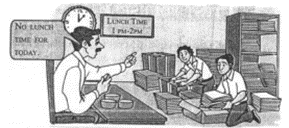
7. Identify the principle of scientific management being ignored in the given picture, where boss is eating food whereas workers are not allowed to take lunch.
a) Science, not rule of thumb
b) Co-operation not individualism
c) Mental revolution
d) Harmony not discord
View AnswerAns. b) Co-operation not individualism
8. Assertion (A): Accountability is absolute and can never be delegated.
Reason (R): Superior also remains accountable even after creating accountability on subordinates.
a) Both A and R are true and R is the correct explanation of A.
b) Both A and R are true but R is not the correct explanation of A.
c) A is true but R is false.
d) A is false but R is true.
View AnswerAns. a) Both A and R are true and R is the correct explanation of A.
9. A company gets application on and off even without declaring any vacancy. However, as and when the vacancy arises, the company makes use of such applications. Name the source of recruitment used by the company.
a) Recommendations of employees
b) Direct recruitment
c) Casual Callers
d) Web publishing
View AnswerAns. c) Casual Callers
10. Rahul wants to buy shares of Rexter Ltd. which are being traded at the National Stock Exchange. He feels that the share prices will go up in the future. Which market should he approach for this purpose?
a) Money market
b) Both (b) and (c)
c) Primary market
d) Secondary market
View AnswerAns. d) Secondary market
11. Which of the following statement is false?
a. Fixed Assets should never be financed through short-term sources.
b. Labour intensive organisation require less fixed capital.
c. Higher growth of an organisation requires less fixed capital.
d. Working capital affects both the liquidity as well as profitability of a business.
a) option (c)
b) option (b)
c) option (d)
d) option (a)
View AnswerAns. a) option (c)
12. Elpis Ltd. is registered with an authorised capital of ₹10 crore. The paid-up capital of the company is ₹6 crore. The company was facing shortage of funds. The management of the company decided to raise funds by issue of 1,00,000 equity shares of ₹100 each. The issue was fully subscribed. After this it was realised that the funds raised were in excess of the actual requirement. The concept which was not considered by the company before deciding the amount of funds to be raised is ________.
a) Capital structure decision
b) Financing decision
c) Financial Planning
d) Dividend decision
View AnswerAns. c) Financial Planning
13. Match the functions of management with their respective examples.
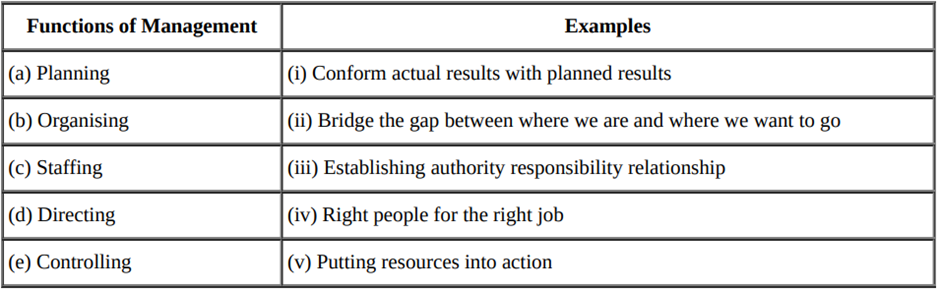
Identify the correct option.
a) (a) – (i), (b) – (iv), (c) – (iii), (d) – (ii), (e) – (v)
b) (a) – (ii), (b) – (iii), (c) – (iv), (d) – (v), (e) – (i)
c) (a) – (iii), (b) – (iv), (c) – (i), (d) – (v), (e) – (ii)
d) (a) – (i), (b) – (v), (c) – (iv), (d) – (ii), (e) – (iii)
View AnswerAns. b) (a) – (ii), (b) – (iii), (c) – (iv), (d) – (v), (e) – (i)
14. Statement I: In case of a minor, complaint can be filed in a consumer court by a parent or legal representative.
Statement II: A complaint can be filed by the central or state government or the central authority.
a) Both the Statements I and II are not correct.
b) Both the Statements I and II are correct.
c) Statement I is correct and Statement II is not correct.
d) Statement II is correct and Statement I is not correct.
View AnswerAns. b) Both the Statements I and II are correct.
15. A.co. is manufacturing garments. The manager wants to increase profits by purchasing new high-speed machines or increasing the sale price or using waste materials in manufacturing stuffed toys. He decided that using waste material is the best solution for him. Identify the concept of management involved.
a) Planning
b) Directing
c) Coordination
d) Organizing
View AnswerAns. a) Planning
16. Statement I: The important decision areas under physical distribution include managing inventory (levels of stock of goods), storage and warehousing and transportation of goods from one place to the other.
Statement II: Transportation involves physical movement of goods from one place to the other.
a) Both the Statements I and II are correct.
b) Both the Statements I and II are not correct.
c) Statement II is correct and Statement I is not correct.
d) Statement I is correct and Statement II is not correct.
View AnswerAns. a) Both the Statements I and II are correct.
17. Which of the following statements does not highlight the importance of financial planning?
a) It helps in avoiding business shocks and surprises and helps the company in preparing for the future.
b) Detailed plans of action prepared under financial planning increase waste, duplication of efforts and gaps in planning.
c) It helps in forecasting what may happen in future under different business situations.
d) It provides a link between investment and financing decisions on a continuous basis.
View AnswerAns. b) Detailed plans of action prepared under financial planning increase waste, duplication of efforts and gaps in planning.
18. It is a process that allocates or directs funds available for investment into their most productive instrument opportunity. This is known as:
a) Allocative function
b) Financial Intermediation
c) Capital budgeting
d) Financial planning
View AnswerAns. b) Financial Intermediation
19. ________ is not included in the controlling process.
a) Doing work of financial management
b) Comparison of actual performance with standards
c) Analysing deviations
d) Measurement of actual performance
View AnswerAns. a) Doing work of financial management
20. Statement I: Policy is a general plan prepared by top management outlining resource allocation, priorities and takes into consideration the business environment and competition.
Statement II: Objectives are usually set by the top management and serve as a guide for overall planning.
a) Both the Statements I and II are not correct.
b) Both the Statements I and II are correct.
c) Statement I is correct and Statement II is not correct.
d) Statement II is correct and Statement I is not correct.
View AnswerAns. d) Statement II is correct and Statement I is not correct.
21. What is meant by management as an art? Explain with the help of any three features.
View AnswerAns. Art is the skilful and personal application of existing knowledge and creativity to achieve desired goals Management is said to be an art, since it satisfies the following features of an art
i. Manager practices the art of management in day-to-day activities.Job of managing an enterprise on the basis of study, observation and experience. There are a lot of books available to get the desired knowledge of any management field.
ii. Because of the availability of the theoretical knowledge of management, a manager is able to apply It in a personalised manner. As the two students of same dance teacher are not same in dancing two manager of the same college are not same in their professional activities.
iii. Art requires creativity, similarly manager also requires creativity to apply the acquired knowledge in a personalised and skilful manner in real situations. Management is totally based on practice and creativity.
OR
Identify the characteristic of management which states that the activities involved in managing an enterprise are common to all organisations whether economic, social or political. Also state two other characteristics of management.
View AnswerAns. The characteristic of management that states the activities involved are common to all organizations is known as “Management is universal.” Two other characteristics of management are “Management is goal-oriented” and “Management involves the utilization of resources.
22. The performance of an organisation depends upon how a supervisor instructs and guides the subordinates at operative level. Explain.
View AnswerAns. Supervisor maintains day-to-day contact with workers. He is the link between workers and management. His role is to monitor and instruct the activities of employees from over and above. The supervisor occupies a strategic position in the organisation. He represents management’s ideas, thoughts and desires to the operative workers and conveys workers’ attitudes and opinions to the top management. Thus, we can say that the performance of an organisation depends on how supervisor instructs and guides the subordinates.
OR
Ayasha Ltd. assured their employees that inspite of recession, no worker will be retrenched from the job.
(i) Name and explain the type of incentive offered to the employees.
View AnswerAns. The name of the incentive offered is Job security. Employees want their job to be secure. They want certain stability about future income and work so that they do not feel worried on these aspect and work with greater zeal.
(ii) Explain one more incentive of the same category.
View AnswerAns. Employee participation: It means involving employees in decision making if the issues related to them. In many companies, these programmes are in practice in the form of joint management committees, work committees, canteen committees etc.
23. Identify the financial decision that is concerned with deciding how much of the profit earned by a company is to be distributed to shareholders and how much should be retained in the business. Also state any three factors affecting the identified decision.
View AnswerAns. Dividend Decisions:
i. The important decision that every financial manager has to take relates to the distribution of dividend. Dividend is that portion of profit which is distributed to shareholders. it effect the market value of the organisation.
ii. The decision involved here is how much of the profit earned by company (after paying tax) is to be distributed to the shareholders and how much of it should be retained in the business. While the dividend constitutes the current income reinvestment as retained earning increases the firm’s future earning capacity. Good dividend decision create a sense of development in the organisation.
iii. The extent of retained earnings also influences the financing decision of the firm. Since the firm does not require funds to the extent of re-invested retained earnings, the decision regarding dividend should be taken keeping in view the overall objective of maximising shareholder’s wealth.
Factors Affecting Dividend Decision:
i. Amount of Earnings: Dividends are paid out of current and past earning. Therefore, earnings is a major determinant of the decision about dividend.
ii. Stability of Dividends: Companies generally follow a policy of stabilising dividend per share. The increase in dividends is generally made when there is confidence that their earning potential has gone up and not just the earnings of the current year. In other words, dividend per share is not altered if the change in earnings is small or seen to be temporary in nature.
iii. Growth Opportunities: Companies having good growth opportunities retain more money out of their earnings so as to finance the required investment. The dividend in growth companies is, therefore, smaller, than that in the non-growth companies.
iv. Cash Flow Position: The payment of dividend involves an outflow of cash. A company may be earning profit but may be short on cash. Availability of enough cash in the company is necessary for declaration of dividend.
24. Himanshu purchased a new car from ‘Galaxy Motors’ for Rs.25 lakhs. He was offered free insurance for the first year and three free servicing to be availed after the car had covered 5,000 km, 10,000 km and 15,000 km respectively. When Himanshu took the car for the first free servicing, he was told that the car was not new and first service had already been availed on this car. He felt cheated and filled a complaint in the State Commission. Being not satisfied with the decision of the State Commission, after two months he decided to file and appeal against it. Can Himanshu appeal against the decision of the State Commission? Give reason in support of your answer.
View AnswerAns. Himanshu had the right to appeal against the judgment of the State Commission within 30 days of such judgment in the National Commission if he was not satisfied with it. However, in this case, he took 2 months to decide to appeal against the judgment of the State Commission in the National Commission, therefore, he cannot file the appeal in the National Commission as the stipulated time limit has expired.
25. Vardan Patel started the business of preparation and supplying sweets through home delivery at a production cum show-room Express Sweets at Ahmedabad. He made a plan forecasting the sales of different types of sweets in various localities of Ahmedabad for each month of the year to earn a profit of 20% on Capital employed. He sets a sales target of ₹20,00,000 in the current year with a 10% increase every year.
He then set the criteria for selecting suppliers from whom he would make purchases of raw material. The planning paid off and the business was able to achieve its targets.
a. Identify any two types of plans by quoting the lines from the above.
View AnswerAns. The two types of plans are:
i. Objective ‘He set a sales target of ₹20,00,000 in the current year with a 10% increase every year.’ ‘He made a plan forecasting the sales of different types of sweets in various localities of Ahmedabad for each month of the year to earn a profit of 20% on Capital employed.’
ii. Policy ‘He then set the criteria for selecting suppliers from whom he would make purchases of raw material.’
b. Also give the meaning of the types of plans identified in part (a) above.
View AnswerAns. Objectives are the basics of every company and the desired objective/result that the company plans on achieving, so they are the endpoint of every planning activity.
Policies are generic statements, which are basically a guide to channelize energies towards a particular strategy. It is an organization’s general way of understanding, interpreting and implementing strategies.
26. How does controlling help in achieving objectives and improving employee’s morale ?
View AnswerAns. Controlling helps in achieving objectives and improving employees’ morale by following ways:
1. By continuously measuring the performance in the light of organisational goals brings out the deviations, if any, and indicates the corrective actions to be taken which helps in measuring the status. Thus, controlling keeps the organisation on the right track and helps the organisation to manage future contingencies.
2. The implementation of controlling makes all the employees to work with complete dedication and boost their morale because they are aware that their performance will be evaluated, and they will have a chance to build their reputation in the organisation. The employees with good performance record are promoted or given higher incentives or bonus for their achievement.
OR
Controlling is a systematic process involving a series of steps. Explain.
View AnswerAns. Yes, controlling is a systematic process which involves the following steps:
i. Establish the Standards: Within an organization’s overall strategic plan, managers define goals for organizational departments in specific, precise, operational terms that include standards of performance to compare with organizational activities. However, for some of the activities the standards cannot be specific and precise. Standards, against which actual performance will be compared, may be derived from past experience, statistical methods and benchmarking (based upon best industry practices). As far as possible, the standards are developed bilaterally rather than top management deciding unilaterally, keeping in view the organization’s goals. Standards may be tangible (clear, concrete, specific, and generally measurable) – numerical standards, monetary, physical, and time standards; and intangible (relating to human characteristics) – desirable attitudes, high morale, ethics, and cooperation.
ii. Measure Actual Performance: Most organizations prepare formal reports of performance measurements both quantitative and qualitative (where quantification is not possible) that the managers review regularly. These measurements should be related to the standards set in the first step of the control process.
iii. Compare Performance with the Standards: This step compares actual activities to performance standards. When managers read computer reports or walk through their plants, they identify whether actual performance meets, exceeds, or falls short of standards. Typically, performance reports simplify such comparison by placing the performance standards for the reporting period alongside the actual performance for the same period and by computing the variance—that is, the difference between each actual amount and the associated standard. The manager must know of the standard permitted variation (both positive and negative). Management by exception is most appropriate and practical to keep insignificant deviations away. Timetable for the comparison depends upon many factors including importance and complexity attached with importance and complexity.
iv. Take Corrective Action and Reinforcement of Successes: When performance deviates from standards, managers must determine what changes, if any, are necessary and how to apply them. In the productivity and quality-centered environment, workers and managers are often empowered to evaluate their own work. After the evaluator determines the cause or causes of deviation, he or she can take the fourth step— corrective action. The corrective action may be to maintain status quo (reinforcing successes), correcting the deviation, or changing standards. The most effective course may be prescribed by policies or may be best left up to employees’ judgment and initiative. The corrective action may be immediate or basic (modifying the standards themselves).
27. Damini D’Souza took over the reins of ‘Kinsa Retail’ as its Managing Director in India. ‘Kinsa Retail’ with its headquarter at Japan has been in the retail business for the last 40 years. It has regional offices in many countries that take care of the shops in that region. As it is a large organisation, the regional officers have been given the powers to decide and spend funds sanctioned to them by the headquarter for the welfare of the customers of their region. ‘Kinsa Retail’ wants the highest possible standards of ethical conduct being followed, for which a code of conduct is in place for putting values into practice. All employees as well as Board members are required to act in accordance with the highest standards of personal and professional integrity when acting on behalf of the company. Non-compliance involves a heavy penalty including termination of employment. Explain any two principles of general management being followed by ‘Kinsa Retail’.
View AnswerAns. Principles of General management being followed by Kinsa Retail are:
i. Discipline: This management principle is essential and is seen as the oil to make the engine of an organization run smoothly.
ii. Centralisation and Decentralisation: Management and authority for decision-making process must be properly balanced in an organization. This depends on the volume and size of an organization including its hierarchy.
28. Describe the role of communication in the directing function of management.
View AnswerAns. Communication plays a key role in the directing function of management. The communication is an important element of directing because of the following points:
i. Acts as a basis of coordination and cooperation: Communication acts as a basis of coordination. It provides coordination among departments, activities and persons in the organisation. Such coordination is provided for explaining about organisational goals, the mode of their achievement and inter- relationships between different individuals, etc.
ii. Increases managerial efficiency: The employees must know clearly about their responsibilities and authority, who will report to whom, what part of the total job they are expected to perform and what are then decision-making powers. This leads to a smooth flow of communication.
iii. Promotes cooperation and industrial peace: Efficient operation is the aim of all prudent management. It may be possible only when there is industrial peace in the factory and mutual cooperation between management and workers. The two-way communication promotes cooperation and mutual understanding between the management and workers.
iv. Helps in smooth working of an enterprise: All interactions in an organisation and smooth working of an enterprise is possible only when there is no communication gap. Right from establishing of enterprise till its survival, communication is essential.
29. These days, the development of a country is also judged by its system of transferring finance from the sector where it is in surplus to the sector where it is needed most. To give strength to the economy, SEBI is undertaking measures to develop the capital market. In addition to this there is another market in which unsecured and shortterm debt instruments are actively traded everyday. These markets together help the savers and investors in directing the available funds into their most productive investment opportunity.
i. Name the function being performed by the market in the above case.
View AnswerAns. The function performed by the market here is mobilisation of savings and channelising them into the most productive use/allocative function.
ii. Also, explain briefly three other functions performed by this market.
View AnswerAns. The other three functions of financial market are:
a. Facilitating price discovery: The price of any goods or services is determined by the forces of demand and supply. Like goods and services, the investors also try to discover the price of their securities. The financial market is helpful to the investors in giving them proper price.
b. Reduce the cost of transactions: Financial market provides complete information regarding price, availability and cost of various financial securities So, investors and companies do not have to spend much on getting this information.
c. Provides liquidity to financial assets: The investors can invest their money, wherever they desire, in securities through the medium of financial market and convert them into cash by selling their financial assets through the mechanism of financial market.
30. State the role of consumer organisations and non-governmental organisations for the protection and promotion of consumers interests on the basis of any four points.
View AnswerAns. The role of consumer organisations and non-governmental organisations for the protection and promotion of consumers interests is as follows:
i. The role of consumer organisations and non-governmental organisations for the protection and promotion of consumers interests.
ii. Publishing periodicals and other publications to impart knowledge about consumer problems, legal reporting, reliefs available and other matters of interest.
iii. Carrying out comparative testing of consumer products in accredited laboratories to test relative qualities of competing brands and publishing the test results for the benefit of consumers.
iv. Encouraging consumers to strongly protest and take an action against unscrupulous, exploitative and unfair trade practices of sellers.
v. Providing legal assistance to consumers by way of providing aid, legal advice, etc. in seeking legal remedy.
31. Anoop Gaur started ‘Cat’s Eye’, a company for providing cyber security solutions to businesses. Its objective is to prevent, detect, respond to cyber-attacks and protect critical data. He was a hardworking software engineer and an expert in cybersecurity. His reputation grew by leaps and bounds as he was not only a person of integrity but also did his work with utmost honesty and sincerity. The business started growing day-by-day. He was delighted when he was offered a big project by the Ministry of Science and Technology. While working on the project he found that the volume of work made it impractical for him to handle all the work by himself. Therefore, he decided to expand the team. The company maintained a close liaison with an engineering college in the state. During a campus placement, Aarav and Pranshi were appointed to work for the new project. He found the new employees capable, enthusiastic and trustworthy. Anoop Gaur was thus, able to focus on the objectives and with the help of Aarav and Pranshi, the project was completed on time. Not only this Anoop Gaur was also able to extend his area of operations. On the other hand, Aarav and Pranshi also got opportunities to develop and exercise initiative.
i. Identify and explain briefly the concept used by Anoop Gaur in the above case which helped him in focusing on the objectives.
View AnswerAns. Anoop Gaur has used ‘Campus Recruitment’ as a source of external recruitment which helped him in achieving his objective. Campus recruitment: It refers to recruitment from educational institutions. Some big organizations remain in touch with the educational institutions with the proposal of recruiting young talented people. These persons come from colleges, universities, management institutes, technical institutes etc. These institutions have placement cell each with the purpose of helping their young students to find suitable jobs. The human resources managers of various companies get in touch with these placement cells and obtain suitable persons for appointment. The recruiters of the organizations visit various professional colleges, technical institutes to recruit fresh graduates or the people with the latest technical know-how. This type of requirement is more common for engineers, computer programmers, MBAs, etc. Organisations prefer this mode because fresh graduates can be moulded according to the organisation’s requirement easily.
ii. Also, explain any four points of importance of the concept identified in part (i).
View AnswerAns. Importance of external source of recruitment are:
a. Fresh talent: The entry of fresh talent into the organization is encouraged. New employees bring new ideas to the organization.
b. Wider choice: As a mode of external recruitment, the organization gets a wider choice.
c. Qualified personnel: By using this mode, the management can get qualified and trained persons.
d. Latest technical knowledge: Through campus placement, the organization gets employees with the latest technical knowledge.
32. How does the understanding of business environment help the management in the following
i. Identification of threats and early warning signals
ii. Identify threats and early warning signals
iii. Assist in planning and policy formulation
iv. Improving performance
v. Tapping useful resources
View AnswerAns. In the present day of competitive market, it is essential for a business to remain alert and aware of its environment, because of the following reasons:
i. Identify opportunities & getting the first mover advantage: Awareness of environment helps an enterprise to identify the opportunities prevailing in the market. They can make strategies to capitalise such opportunities at the earliest. e.g. Maruti Udyog became the leader in the small car market because it was the first company who recognised the need for small cars in the environment.
ii. Identify threats and early warning signals: Environmental awareness helps an enterprise in identifying possible threats in the future, so that the enterprise can take timely measures to minimise the threat and its adverse effects, if any, e.g; when the new firms entered the mid-segment cars (threat), Maruti Udyog increased the production of its Esteem car. Increase in production enabled the company to make faster delivery. As a result, the company captured a substantial share of the market and became a leader in this segment.
iii. Assist in planning and policy formulation: Environment awareness helps a business unit to identify opportunities and threats in the market. These serve as a basis for planning future course of action and making policies for the same.
iv. Improving performance: An enterprise that monitors its environment continuously is in a position to improve not only its present performance but also improve its future performance. This ensures success of the business in the long-run.
v. Tapping useful resources: A business environment is an open system which gets resources such as capital, labour, machines, materials, etc from the environment, converts them into goods and services desired by the customers and then supplies its output to the environment. Thus, a business firm depends on its external environment for tapping various resources and for the sale of its output.
OR
What is meant by Business environment? State any three points of its importance.
View AnswerAns. Ans. Business environment means the sum total of those factors which influence the business and over which the business has no control. The importance of the business environment is highlighted by the following facts:
i. Enables to Identify Business Opportunities: All changes are not negative. If they understood and evaluated, they can be the reason for the success of a business. It is very necessary to identify a change and use it as a tool to solve the problems of the business or populous.
ii. Helps in Tapping Useful Resources: Careful scanning of the Business Environment helps in tapping the useful resources required for the business. It helps the firm to track these resources and convert them into goods and services.
iii. Coping with Changes: The business must be aware of the ongoing changes in the business environment, whether it be changes in customer requirements, emerging trends, new government policies, technological changes. If the business is aware of these regular changes then it can bring about a response to deal with those changes.
33. Aman, Avneesh and Amrish have decided to start a business of manufacturing toys. They identified the following main activities which they have to perform: Purchase of raw materials Purchase of machinery Production of toys Arrangement of finance Sales of toys Identifying the areas where they can sell their toys Selection of employees In order to facilitate the work, they thought that four managers should be appointed to look after
a. production
b. finance
c. marketing
d. personnel.
i. Identify the function of management involved in the above mentioned para.
ii. Quote the lines from the above para which help you to identify this function.
iii. State the steps followed in the process of this function of management.
View AnswerAns. i. Organising
ii. “They identified the following main activities which they have to perform”.
“In order to facilitate the work, they thought that four managers should be appointed to look after
a. production
b. finance
c. marketing
d. personnel
iii. Steps of organising are as follows:
a. Identification and division of work: The first step in the process of organising involves identifying and dividing the work that has to be done in accordance with previously determined plans. The work is divided into manageable activities so that duplication can be avoided and the burden of work can be shared among the employees.
b. Departmentalisation: Once work has been divided into small and manageable activities then those activities which are similar in nature are grouped together. Such sets facilitate specialisation. This grouping process is called departmentalisation. Departments can be created using several criteria as a basis. Examples of some of the most popularly used basis are territory (north, south, west, etc.) and products (appliances, clothes, cosmetics etc).
c. Assignment of duties: It is necessary to define the work of different job positions and accordingly allocate work to various employees. Once departments have been formed, each of them is placed under the charge of an individual. Jobs are then allocated to the members of each department in accordance to their skills and competencies. It is essential for effective performance that a proper match is made between the nature of a job and the ability of an individual. The work must be assigned to those who are best fitted to perform it well.
d. Establishing authority and reporting relationships: Merely allocating work is not enough. Each individual should also know who he has to take orders from and to whom he is accountable. The establishment of such clear relationships helps to create a hierarchal structure and helps in coordination amongst various departments.
34. Explain the following sales promotion activities
i. Discount
ii. Product combination
iii. Financing
iv. Lucky draw
View AnswerAns. i. Discount: It refers to offering products at less than the list price e.g. a shoe company’s offer discount @50%. It attracts a pocket-friendly customer to immediately buy the product.
ii. Product combination: It refers to offering another product along with the purchase of a product, say the offer of a pack of half a kilogram of rice with the purchase of a bag of atta (wheat flour). In this way, the combined needs of the customer are satisfied at a reasonable price.
iii. Financing: It refers to offering easy financing schemes, e.g. 24 easy instalments or the amount to be paid as post-dated cheques. This has brought a revolution in the consumer market and is largely responsible for spreading consumerism.
iv. Lucky draw: It refers to taking out a draw on the purchase of the product and giving a gift to the winner, e.g. lucky draw coupon for free petrol on the purchase of a certain quantity of petrol from the given petrol pump.
OR
Explain the following as elements of marketing mix:
i. Product
ii. Place
iii. Price
View AnswerAns. i. Product: Definition: This refers to the good or service you offer to your customers. It encompasses everything from its tangible features (e.g., physical characteristics) to its intangible benefits (e.g., emotional connection). Marketing decisions: Involves decisions related to product development, branding, packaging, quality, and product lifecycle management.
ii. Place: Definition: This element focuses on distribution channels and how your product or service reaches your target customers. Marketing decisions: Involves decisions related to choosing the right channels, managing inventory across those channels, and ensuring accessibility and availability for customers.
iii. Price: Definition: This refers to the monetary value assigned to your product or service. It’s a crucial element influencing customer purchase decisions and impacting your business’s revenue and profitability. Marketing decisions: Involves setting the initial price, managing price discounts and promotions, and considering competitor pricing strategies.