Class XII Session 2025-26
Subject – Geography
Time Allowed: 3 hours Maximum Marks: 70
General Instructions:
Read the following instructions carefully and follow them:
1. This question paper contains 30 questions. All questions are compulsory.
2. Question paper is divided into five sections A, B, C, D and E.
3. Section A Questions no. 1 to 17 are Multiple Choice type questions. Each question carries 1 mark.
4. Section B Questions no. 18 and 19 are Source-based questions. Each question carries 3 marks.
5. Section C Questions no. 20 to 23 are Short Answer type questions. Each question carries 3 marks. Answer to these questions shall be written in 80 to 100 words.
6. Section D Questions no. 24 to 28 are Long Answer type questions. Each question carries 5 marks. Answer to these questions shall be written in 120 to 150 words.
7. Section E Questions no. 29 and 30 are Map-based questions. Each question carries 5 marks.
8. There is no overall choice given in the question paper. However, an internal choice has been provided in a few questions in all sections other than Section A.
Section A
1. Consider the following and tell which of them can be reason/reasons for scarce population in an area?
1. Presence of river valleys
2. Mountains and hills
3. Harsh climate
4. Rich mineral deposits
a) 2, 3 and 4
b) 1 and 4
c) 1, 3 and 4
d) 2 and 3
View AnswerAns. d) 2 and 3
2. Which one of the following periods had witnessed rapid growth of population?
a) 1951-1981
b) After 1981
c) Before 1921
d) 1921-1951
View AnswerAns. a) 1951-1981
3. Which of the following is the earliest approach to human development?
a) Income approach
b) Basic needs approach
c) Capabilities approach
d) Welfare approach
View AnswerAns. a) Income approach
4. Assertion (A): Migration is the induced factor in population growth.
Reason (R): They result in natural population growth.
a) Both A and R are true and R is the correct explanation of A.
b) Both A and R are true but R is not the correct explanation of A.
c) A is true but R is false.
d) A is false but R is true.
View AnswerAns. c) A is true but R is false.
5. Which among the following is an important region for commercial livestock rearing?
a) Canada
b) USA
c) India
d) Malaysia
View AnswerAns. b) USA
6. Match the following and choose the correct option.
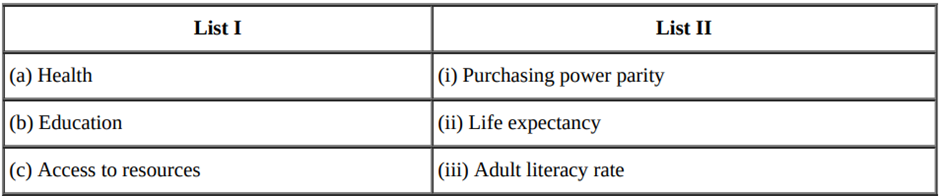
a) (a) – (iii), (b) – (ii), (c) – (i)
b) (a) – (ii), (b) – (i), (c) – (iii)
c) (a) – (i), (b) – (ii), (c) – (iii)
d) (a) – (ii), (b) – (iii), (c) – (i)
View AnswerAns. d) (a) – (ii), (b) – (iii), (c) – (i)
7. Which one of the following South American nations, is a part of OPEC?
a) Brazil
b) Chile
c) Peru
d) Venezuela
View AnswerAns. d) Venezuela
8. Which port handles manufactured goods?
a) Oil port
b) Outport
c) Inland port
d) Comprehensive port
View AnswerAns. d) Comprehensive port
9. Where does India rank in the world in regards to the area?
a) Seventh
b) Sixth
c) Eighth
d) Fifth
View AnswerAns. a) Seventh
10. When many industries are concentrated in a particular region to share factors of production, it is termed as ________.
a) proffesionalisation
b) agglomeration economies
c) flexibility
d) joint sector
View AnswerAns. b) agglomeration economies
11. What rank does India hold in terms of cotton production in the world?
a) First
b) Third
c) Fourth
d) Second
View AnswerAns. d) Second
12. Match the following correctly and choose the correct option:
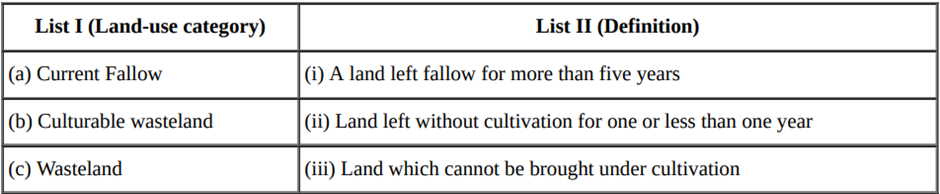
a) (a) – (ii), (b) – (i), (c) – (iii)
b) (a) – (ii), (b) – (iii), (c) – (i)
c) (a) – (i), (b) – (ii), (c) – (iii)
d) (a) – (i), (b) – (iii), (c) – (ii)
View AnswerAns. a) (a) – (ii), (b) – (i), (c) – (iii)
13. Which of the following is a metallic mineral?
a) Graphite
b) Coal
c) Bauxite
d) Mica
View AnswerAns. c) Bauxite
14. Choose the correct option regarding the stretch of National Waterways No.1:
a) Kottapuram – Kollam
b) Allahabad/Prayagraj – Haldia
c) Sadiya – Dhubri
d) Kakinada – Puducherry
View AnswerAns. b) Allahabad/Prayagraj – Haldia
15. Assertion (A): Development is dynamic and complex in nature.
Reason (R): The objective of planning is to utilise resources in sustainable manner.
a) Both A and R are true and R is the correct explanation of A.
b) Both A and R are true but R is not the correct explanation of A.
c) A is true but R is false.
d) A is false but R is true.
View AnswerAns. b) Both A and R are true but R is not the correct explanation of A.
16. Match Column I with Column II and choose the correct option:
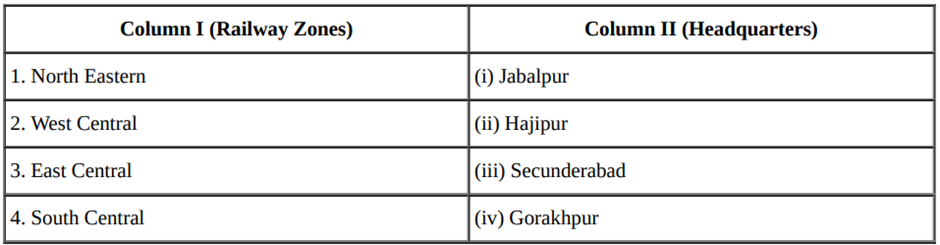
a) 1-(iv), 2-(i), 3-(iii), 4-(ii)
b) 1-(iv), 2-(i), 3-(ii), 4-(iii)
c) 1-(i), 2-(iv), 3-(iii), 4-(ii)
d) 1-(i), 2-(iv), 3-(ii), 4-(iii)
View AnswerAns. b) 1-(iv), 2-(i), 3-(ii), 4-(iii)
17. Indian was merged with Air India to form a single airline in which of the following years?
a) 2011
b) 1981
c) 2009
d) 1992
View AnswerAns. a) 2011
18. Read the following text carefully and answer the questions that follow:
Benda lives in the wilds of the Abujh Maad area of central India. His village consists of three huts deep in the wilds. Not even birds or stray dogs that usually crowd villages can be seen in these areas. Wearing a small loin cloth and armed with his axe he slowly surveys the penda (forest) where his tribe practices a primitive form of agriculture called shifting cultivation. Benda and his friends burn small patches of forest to clear them for cultivation. The ash is used for making the soil fertile. Benda is happy that the Mahua trees around him are in bloom. How lucky I am to be a part of this beautiful universe, he thinks as he looks up to see the Mahua, Palash and Sal trees that have sheltered him since childhood. Crossing the penda in a gliding motion, Benda makes his way to a stream. As he bends down to scoop up a palmful of water, he remembers to thank Loi-Lugi, the spirit of the forest for allowing him to quench his thirst. Moving on with his friends, Benda chews on succulent leaves and roots. The boys have been trying to collect Gajjhara and Kuchla, from the forest. These are special plants that Benda and his people use. He hopes the spirits of the forest will be kind and lead him to these herbs. These are needed to barter in the madhai or tribal fair coming up the next full moon. He closes his eyes and tries hard to recall what the elders had taught him about these herbs and the places they are found in. He wishes he had listened more carefully. Suddenly there is a rustling of leaves. Benda and his friends know it is the outsiders who have come searching for them in the wilds. In a single fluid motion, Benda and his friends disappear behind the thick canopy of trees and become one with the spirit of the forest.
i. Based on the story, it seems that there existed a kind of interaction between nature and humans. What was it called?
View AnswerAns. The story represents the direct relationship of a household belonging to an economically primitive society with nature. This type of interaction between primitive human society and strong forces of nature was termed as environmental determinism.
ii. The story gives a hint of the presence of naturalised humans. State one possible reason for this.
View AnswerAns. In that primitive human society, there was very low technological development, we can imagine the presence of a naturalised human, who listened to Nature, was afraid of its fury and worshipped it. Also, there was a direct dependence of human beings on nature for resources which sustain them.
iii. In certain primitive societies nature was a powerful force, worshipped, revered and conserved. Pick one such instance from the given story
View AnswerAns. Nature is a powerful force, worshipped, revered and conserved. In the story, Benda remembers to thank Loi-Lugi, the spirit of the forest for allowing him to quench his thirst. He closes his eyes and tries hard to recall what the elders had taught him about these herbs. These show that nature of revered and worshipped.
19. Read the following text carefully and answer the questions that follow:
Equity refers to making equal access to opportunities available to everybody. The opportunities available to people must be equal irrespective of their gender, race, income and in the Indian case, caste. Yet this is very often not the case and happens in almost every society. Sustainability means continuity in the availability of opportunities. To have sustainable human development, each generation must have the same opportunities. All environmental, financial and human resources must be used keeping in mind the future. Misuse of any of these resources will lead to fewer opportunities for future generations. Productivity here means human labour productivity or productivity in terms of human work. Such productivity must be constantly enriched by building capabilities in people. Ultimately, it is people who are the real wealth of nations. Therefore, efforts to increase their knowledge, or provide better health facilities ultimately leads to better work efficiency. Empowerment means to have the power to make choices. Such power comes from increasing freedom and capability. Good governance and people-oriented policies are required to empower people. The empowerment of socially and economically disadvantaged groups is of special importance.
i. What is explained in the given passage?
View AnswerAns. The given passage explains the concepts of equity, sustainability, productivity and empowerment which form the pillar that supports the idea of human development.
ii. How is equity different from sustainability?
View AnswerAns. Equity refers to making equal access to opportunities available to everybody. The opportunities available to people must be equal irrespective of any bias. Whereas, sustainability means continuity in the availability of opportunities. To have sustainable human development, each generation must have the same opportunities.
iii. Mention two ways in which we can empower people.
View AnswerAns. Good governance and people-oriented policies are required to empower people.
Section C
20. What do you mean by medical tourism? Which country has emerged as a leader in it?
View AnswerAns. When medical treatment is combined with tourism it is called medical tourism. In other words, when foreigners visit a country with the objective of medical treatment, it is called medical tourism. Medical tourism is also an important part of quinary activities. India has emerged as the leading country of medical tourism in the world.Nearly 55,000 patients from the USA visited India in 2005 for treatment. World class hospitals located in metropolitan cities cater to patients all over the world. Medical tourism brings abundant benefits to developing countries like India, Thailand, Singapore and Malaysia
21. Why do cities become multi-functional?
View AnswerAns. Cities specialise in some specific activities, products or services performing a number of functions.
1. Cities are not static in their functions and functions change due to their dynamic nature.
2. Even specialised cities, as they grow in metros become multi-functional where industries, business, administration and transport become important.
3. The functions get so interwined that the city cannot be categorised in a particular functional class.
OR
Give examples of uneven levels of urbanisation in India.
View AnswerAns. In Class I towns, more than 60% of urban population lives:
1. Out of 423 cities, 35 are metropolitans.
2. With population of over 5 million each, six of them are megacities.
3. More than 1/5th, i.e., 21.0% of population lives in these mega cities.
4. The largest agglomeration is in the Greater Mumbai with 16.4 million people Kolkata, Delhi, Chennai, Bangalore, and Hyderabad are other mega cities of the country.
22. Evaluate the factors affecting the different types of rural settlements in India.
View AnswerAns. Types of the settlement are determined by the extent of the built-up area and inter-house distance. In India compact or clustered village of a few hundred houses is a rather universal feature, particularly in the northern plains. However, there are several areas, which have other forms of rural settlements.
Factors affecting different types of rural settlement in India:
i. Physical features: nature of terrain, altitude, climate and availability of water.
ii. Security factors: defence against thefts and robberies. Cultural and ethnic factors: social structure, caste and religion.
iii. Cultural and ethnic factors: social structure, caste and religion.
iv. Rural settlements in India can broadly be put into four types:
a. Clustered, agglomerated or nucleated.
b. Semi-clustered or fragmented.
c. Dispersed or isolated.
d. Hamleted.
23. What indicators can be used to study the demographic characteristics of an area?
View AnswerAns. Patterns of population distribution and density help us to understand the demographic characteristics of any area. The term population distribution refers to the way people are spaced over the earth’s surface. Broadly, 90 per cent of the world population lives in about 10 per cent of its land area. About 60% of thus population resides in only 10 countries. Population density refers to people living per km2 of an area. Places which are sparsely populated contains few people. Places which are densely populated contains many people. Sparsely populated places tend to be difficult to live. Apparently, there are places with hostile environment e.g. Antarctica. Places which are densely populated have habitable environments e.g. Europe.
OR
Analyse any three causes for uneven spatial distribution of population in India.
View AnswerAns. Causes of uneven spatial distribution of population in India are as follows:
i. Physical/Geographical factors: Relief, Climate, and Availability of water
ii. Socio-economic factors: Development of irrigation and agriculture, availability of minerals and energy resources, development of transport, industrialization and urbanization.
iii. Historical factors: Evolution of settled agriculture, pattern of human settlement.
Section D
24. Examine the main characteristics of Dairy Farming in the world.
View AnswerAns. Characteristics of dairy farming in the world are:
i. Dairy farming involves cattle rearing for milk and milk products.
ii. It is done extensively in developed countries of the world.
iii. It is done near urban and industrial centres.
iv. Cattle are reared in grasslands having soft and long grasses.
v. Fodder crops and grasses are cultivated over extensive areas and special breeds of animals are reared to get maximum yields of milk.
vi. Health care and Veterinary services are provided.
vii. The development of transportation, refrigeration, pasteurization and other preservation processes have increased the duration of storage of various dairy products.
viii. N.W. Europe, Canada, New Zealand etc. are the main dairy centers.
OR
Explain any five features of Extensive commercial grain cultivation practised in the world.
View AnswerAns. The five characteristics of extensive commercial grain cultivation are as follows:
i. Commercial grain cultivation is practised in the interior parts of semi-arid lands of the mid-latitudes.
ii. Wheat is the principal crop, though other crops like corn, barley, oats and rye are also grown.
iii. The size of the farm is very large and often runs into hundreds of hectares.
iv. This is highly mechanised agriculture in which all operations from ploughing to harvesting are done by machines.
v. Yield per acre is low, but yield per person is high because farms are mechanised and the population is sparse.
vi. This type of agriculture is best developed in Eurasian steppes, the Canadian and American Prairies, the Pampas of Argentina, the Velds of South Africa, the Australian Downs and the Canterbury Plains of New Zealand.
25. Write a short note on the distribution of iron and steel industries of the world.
View AnswerAns. Iron and steel industry is a basic industry which provides raw material to other industries such as machine tools, used for further production. It is complex and capital intensive in nature.
It is distributed in the following regions
North America In North America, most of the production comes from North Appalachian Region, Great Lakes region, and the Atlantic coast of USA. The important industries centres include Pittsburgh, Chicago, Lorain, Cleveland, Buffalo, Sparrows Point and Morisville. It also extends towards the Southern State of Alabama.
Europe In Europe, the major producers of Iron and Steel are UK, Germany, France, Belgium, Netherlands and Russia. Important centres are:
UK: Scun Thorpe, Port Talbot, Birmingham
Germany: Duisburg, Dortmund, Essen.
France: Le Creusot, St. Ettinne.
Russia: St. Petersburgh, Moscow.
Ukraine: Krivoi Rog, Donetsk.
Asia The major producers in Asia are Japan, China, India. The important centres are:
Japan: Nagasaki, Yokohama.
China: Shanghai, Wuhan.
India: Jamshedpur, Durgapur, Rourkela, Bhilai, Bokaro etc.
OR
Describe the characteristics of a region that attract tourists all over the world.
View AnswerAns. The characteristics of a region that attract tourists all over the world are as mentioned below:
i. Climate: Most people from colder regions expect to have warm sunny weather for beach holidays. This has increased the importance of tourism in southern Europe and the Mediterranean climate offers higher temperatures, long hours of sunshine and low rainfall throughout the peak holidays season. In India, people from warm areas such as Delhi go to Shimla and other places during the summer holidays.
ii. Landscape: People prefer mountains lakes, spectacular sea coasts and landscape not completely altered by man.
iii. History and Art: People visit historical places, ancient towns and archaeological sites. Some enjoy exploring castles, palaces and churches.
iv. Culture and Economy: Tourists go to a place to experience ethnic and local customers. Cheap tourist spots also become a centre of attractions. For example, the homestay has emerged as a profitable business such as heritage homes in Goa, Medicare and Coorg in Karnataka.
26. Discuss the features of different types of rural settlements. What are the factors responsible for the settlement patterns in different physical environments?
View AnswerAns. The features of rural settlement in India are:
i. In India compact or clustered village of a few hundred houses is common, particularly in the northern plains. But, there are areas, with other forms of rural settlements.
ii. Rural settlement is purely residential, and shops are few and far between the villagers getting their supplies at the periodical, weekly or biweekly markets or the fair to which people flock in from the neighbourhood.
There are various factors and conditions responsible for having different types of rural settlements in India:
i. The relief of the land exercises a direct influence is that of elevation and landforms on settlements.
ii. The direct influence of geological structure of the world on a settlement is primarily, through the deposition of minerals of economic importance. (Minerals attract) settlement and population are attracted by the places, which are having minerals. Ex: The areas of gold mines of Peninsular India.
iii. Soil conditions are now recognized to be one of the most important series of factors in the distribution of settlement.
iv. cultural and ethnic factors – social structure, caste, and religion.
27. Explain the following Basis of International trade:
a. The Difference in National Resources
b. Population Factors
View AnswerAns. a. Difference in National Resources: The world’s national resources are unevenly distributed because of differences in their physical make-up i.e. geology, relief soil and climate.
i. Geological structure: It determines the mineral resource base and topographical differences ensure the diversity of crops and animals raised. Lowlands have greater agricultural potential. Mountains attract tourists and promote tourism.
ii. Mineral Resources: The availability of mineral resources provide the basis for industrial development.
iii. Climate: It influences the type of flora and fauna that can survive in a given region. It also ensures diversity in the range of various products e.g. wool production can take place in a cold region. Banana, rubber can grow in tropical regions.
b. Population Factors: The size distribution and diversity of people between countries affect the type and volume of goods traded.
i. Cultural Factors: Distinctive forms of art and craft develop in certain countries that are valued the world over eg. China produces the finest porcelains and brocades. The carpets of Iran are famous.
ii. Size of Population: Density of population have a large volume of internal trade but little external trade because most of the agricultural and industrial production is consumed in the local markets. The standard of living of the population determines the demand for better quality imported products because with a standard of living only a few people can afford to buy costly imported goods.
28. Describe the main geographical and other features of the Bharmaur region of Himachal Pradesh.
View AnswerAns. Main features of the Bharmour Region of Himachal Pradesh are as given below:
i. It comprises Bharmour and Holi Tehsil of Chamba district.
ii. It is a notified tribal area since 21 November 1975.
iii. Bharmour is inhabited by Gaddis, a tribal community, which converse through the Gaddiali dialect.
iv. The region has harsh climate conditions, a low resource base and fragile environment.
v. In 2001 census its total population was 37246 in 20 people per sq.km.
vi. The region economically and socially backward and the economy is largely based on agriculture sheep and goat rearing.
vii. The Gaddis are still Metropolitan sizeable section.
viii. The most significant contribution of tribal sub-plan in the Bharmaur region is the development of infrastructure in terms of schools, health care facilities, potable water, roads, communications and electricity.
OR
Describe the geographical features of Bharmaur Tribal Region.
View AnswerAns. Bharmaur Tribal Region is a notified tribal area since 21 November 1975. Bharmaur tribal area comprises Bharmaur and Holi tehsils of Chamba district of Himachal Pradesh. It is inhabited by ‘Gaddi’, a tribal community. The region has harsh climate conditions, low resource base and fragile environment. The geographical features are:
This region lies between 32° 11’ N and 32°41’ N latitudes and 76° 22’ E and 76° 53’E longitudes.
Spread over an area of about 1,818 sq km, the region mostly lies between 1,500 m to 3,700 m above the mean sea level.
This region popularly known as the homeland of Gaddis is surrounded by lofty mountains on all sides.
It has Pir Panjal in the north and Dhaula Dhar in the south. In the east, the extension of Dhaula Dhar converges with Pir Panjal near Rohtang Pass.
The river Ravi and its tributaries– the Budhil and the Tundahen, drain this territory, and carve out deep gorges.
These rivers divide the region into four physiographic divisions called Holi, Khani, Kugti and Tundah areas. Bharmaur experiences freezing weather conditions and snowfall in winter. Its mean monthly temperature in January remains 4°C and in July 26°C.
Section E
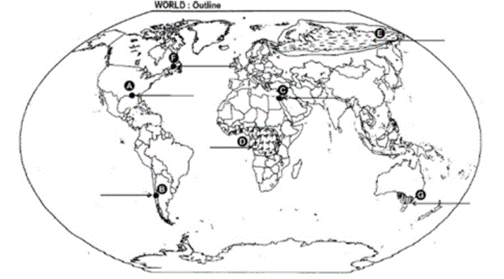
29. On the given political outline map of the world, seven geographical features have been shown as A, B, C, D, E, F and G. Identify any five with the help of following information and write their correct names on the lines drawn near them:
A. A major sea-port
B. An international airport
C. An important shipping canal
D. An area of subsistence gathering
E. An area of nomadic herding
F. A terminal station of trans-continental railway.
G. An area of extensive commercial grain farming
View AnswerAns. A. NEW ORLEANS is sea poat
B. SANTIAGO
C. SUEZ CANAL
D. TROPICAL AFRICA
E. TUNDRA REGION
F. HALIFAX
G. DOWNS
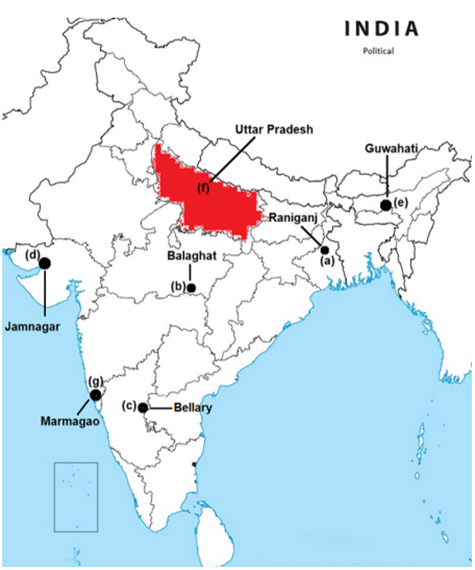
30. Locate and label any five of the following geographical features on the Political Outline map of India with appropriate symbols:
a. Raniganj – Coal mines
b. Balaghat – Manganese mines
c. Bellary – Iron-ore mines
d. Jamnagar – Oil refineries
e. An international airport in Assam
f. The state leading in the production of Wheat
g. An important seaport in Goa
View AnswerAns.