Sample Paper 4
Class X 2025-26
Social Science (087)
Time Allowed: 3 Hours Maximum Marks: 80
General Instructions:
1. There are 38 questions in the Question paper. All questions are compulsory.
2. The question paper has Four Sections – A-History, B-Geography C- Political Science, and D- Economics.
3. Each Section is of 20 Marks and has MCQs, VSA, SA, LAs and CBQ. 4. Very Short Answer Type Questions (VSA), carry 2 marks each. Answers to each question should not exceed 40 words.
5. Short Answer Type Questions (SA), carry 3 marks each. Answers to each question should not exceed 60 words.
6. Long answer type questions (LA), carry 5 marks each. Answers to each question should not exceed 120 words.
7. There are case based questions (CBQ) with three sub questions and are of 4 marks each. Answers to each question should not exceed 100 words.
8. The map-based questions, carry 5 marks with two parts- Q9. In Section A-History (2 marks) and Q19. In Section B -Geography (3 marks)
9. There is no overall choice in the question paper. However, an internal choice has been provided in few questions. Only one of the choices in such questions must be attempted.
10. In addition to this, NOTE that a separate question has been provided for Visually Impaired candidates in lieu of questions having visual inputs, map etc. Such questions are to be attempted by Visually Impaired candidates only.
SECTION-A
HISTORY (20 marks)
1. Match the following and choose the correct option:
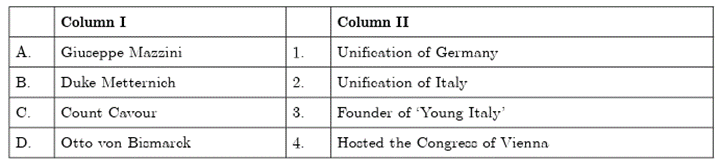
(a) A-3, B-4, C-2, D-1
(b) A-2, B-1, C-4, D-3
(c) A-4, B-3, C-1, D-2
(d) A-1, B-2, C-3, D-4
View AnswerAns. (a) A-3, B-4, C-2, D-1
2. Identify the historical event depicted in the image below:
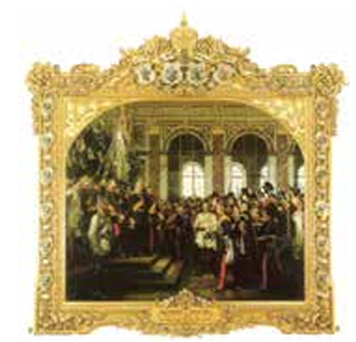
(a) The Frankfurt Parliament
(b) The founding of Young Europe in Berne
(c) The proclamation of the German Empire in 1871
(d) The signing of the Treaty of Vienna
View AnswerAns. (c) The proclamation of the German Empire in 1871
3. The main objective of the representatives of the European powers who met at the Vienna Congress in 1815 was to
(a) Establish democratic governments across Europe.
(b) Draft a new constitution for a unified Europe.
(c) Restore the monarchies overthrown by Napoleon and create a new conservative order.
(d) Promote the ideas of liberty, equality, and fraternity.
View AnswerAns. (c) Restore the monarchies overthrown by Napoleon and create a new conservative order.
4. The Austrian Chancellor Duke Metternich once remarked, “When France sneezes, the rest of Europe catches cold.” What did he mean by this?
(a) France’s climate was the cause of widespread disease in Europe.
(b) The revolutionary and political events in France had a significant impact on the rest of Europe.
(c) France held economic dominance over all European nations.
(d) The French monarchy was related by marriage to all other European royal families
View AnswerAns. (b) The revolutionary and political events in France had a significant impact on the rest of Europe.
5. A. What was the main objective of the ‘Zollverein’ or customs union formed in 1834 at the initiative of Prussia?
View AnswerAns. Objective of the Zollverein
1. To unify the German states economically by removing internal tariff barriers for free trade.
2. To standardize currencies and promote the smooth movement of goods, people, and capital.
or
B. State any two measures introduced by the French revolutionaries to create a sense of collective identity.
View AnswerAns. Measures by French Revolutionaries :
1. Promoted the concepts of la patrie (fatherland) and le citoyen (citizen) to build a sense of unity and equality.
2. Adopted a new tricolour flag to symbolize the birth of a unified and modern French nation.
6. A. How did culture, through art and language, play an important role in the development of nationalist feelings in Europe? Explain with examples.
View AnswerAns. Role of Culture in Developing Nationalist Feelings
1. Romanticism and Collective Heritage: Romantic thinkers emphasized emotions, folk traditions, and shared cultural heritage as the true essence of the nation, moving away from rationalism.
2. Example of Germany: Philosopher Johann Gottfried Herder promoted the idea that German culture resided in folk songs, poetry, and dances (das volk), uniting people through shared traditions.
3. Example of Poland: Polish language became a symbol of resistance against Russian rule, with clergy using Polish in churches to assert national identity and unity.
or
B. Explain the conditions that were viewed as obstacles to economic exchange and growth by the new commercial classes in nineteenth-century Europe.
View AnswerAns. Obstacles to Economic Growth in Nineteenth- Century Europe
1. Fragmented Economies: The German confederation of 39 states had separate currencies, weights and measures, complicating trade.
2. Excessive Customs Duties: Merchants often crossed multiple customs barriers, like the 11 barriers between Hamburg and Nuremberg, paying around 5% duty at each.
3. Trade Inefficiency: These barriers slowed economic exchange and restricted the free movement of goods, people, and capital, frustrating the commercial classes seeking growth.
7. A. “Like Germany, Italy too had a long history of political fragmentation.” Explain the process of the unification of Italy.
View AnswerAns. Process of the Unification of Italy
1. Political Fragmentation: Before unification, Italy was divided into seven states, with Sardinia-Piedmont being the only one ruled by an Italian princely house.
2. Early Revolutionary Attempts: Giuseppe Mazzini tried to unify Italy through his secret society, Young Italy, but his uprisings in 1831 and 1848 failed.
3. Diplomatic Leadership: Leadership passed to King Victor Emmanuel II and his minister Cavour, who formed a diplomatic alliance with France to counter Austria.
4. Military Successes: In 1859, Sardinia-Piedmont and France defeated Austrian forces, gaining Lombardy in the north.
5. Garibaldi’s Campaign: In 1860, Giuseppe Garibaldi and his Red Shirts liberated South Italy, and by 1870, Venetia and Rome were annexed, completing the unification.
or
B. “The 1830s were years of great economic hardship in Europe.” Support this statement with five arguments.
View AnswerAns. The 1830s were indeed years of great economic hardship in Europe, characterized by several issues:
1. Population Growth and Unemployment: The first half of the nineteenth century saw a massive increase in population across Europe, leading to a surplus of job seekers over available employment.
2. Urbanization and Slums: A large-scale migration from rural areas to cities occurred, but the migrants were forced to live in overcrowded and unsanitary slums.
3. Competition from Imports: Small producers in towns faced stiff competition from cheap, machine-made goods imported from England, where industrialization was more advanced. This was particularly damaging for the textile industry.
4. Feudal Burdens: In regions where the aristocracy still held power, peasants were burdened with feudal dues and obligations, which exacerbated their financial struggles.
5. Food Prices and Pauperism: The rise in food prices, often coupled with bad harvests, led to widespread poverty and hunger (pauperism) in both towns and the countryside. The food shortages and unemployment of 1848, for instance, led to popular uprisings in cities like Paris.
8. Read the given text and answer the following questions:
The first clear expression of nationalism came with the French Revolution in 1789. The political and constitutional changes that came in the wake of the French Revolution led to the transfer of sovereignty from the monarchy to a body of French citizens. The revolution proclaimed that it was the people who would henceforth constitute the nation and shape its destiny. From the very beginning, the French revolutionaries introduced various measures and practices that could create a sense of collective identity amongst the French people. The ideas of la patrie (the fatherland) and le citoyen (the citizen) emphasised the notion of a united community enjoying equal rights under a constitution. A new French flag, the tricolour, was chosen to replace the former royal standard. The Estates General was elected by the body of active citizens and renamed the National Assembly. New hymns were composed, oaths taken and martyrs commemorated, all in the name of the nation. A centralised administrative system was put in place and it formulated uniform laws for all citizens within its territory. Internal customs duties and dues were abolished and a uniform system of weights and measures was adopted.
1. What was the most significant political change brought about by the French Revolution?
View AnswerAns. The most significant political change was the transfer of sovereignty from the absolute monarch to a body of French citizens, establishing the principle that the people would constitute the nation.
2. Mention one measure introduced by the revolutionaries that emphasized the idea of a united community.
View AnswerAns. The revolutionaries promoted the ideas of la patrie (the fatherland) and le citoyen (the citizen), which emphasized the concept of a united community enjoying equal rights under a single constitution.
3. Analyze the economic measures taken by the revolutionaries to forge a sense of national unity.
View AnswerAns. To forge national unity, the revolutionaries implemented key economic reforms. They established a centralized administrative system that created uniform laws for all citizens. Critically, they abolished internal customs duties and dues and adopted a uniform system of weights and measures, which facilitated unhindered trade and economic exchange across regions, reinforcing the idea of a single, unified nation.
MAP SKILL-BASED QUESTION (2 marks)
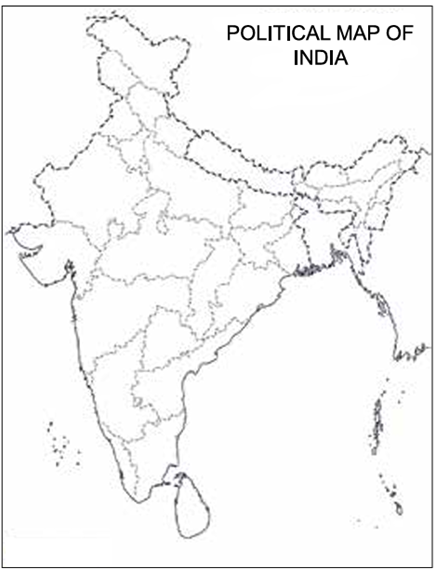
9. Two places A and B are marked on the given outline map of India. Identify them and write their correct names on the lines drawn near them.
A. The location of the Indian National Congress Session of 1927.
B. A place where Gandhiji ceremonially violated the Salt Law and manufactured salt by boiling salt sea water.
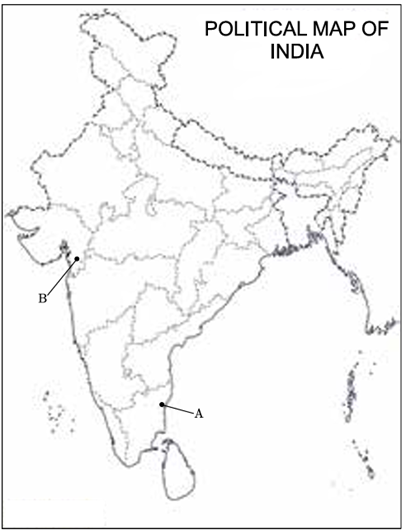
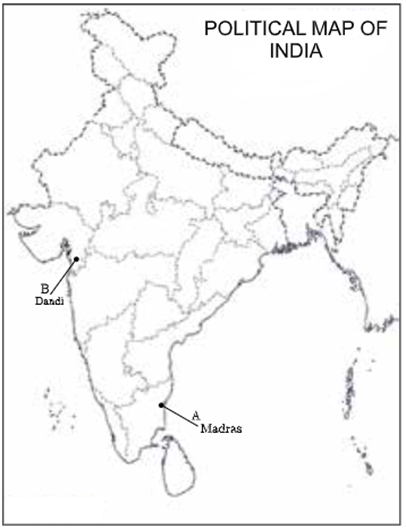
Ans. (A) Madras
(B) Dandi
SECTION-B
GEOGRAPHY (20 marks)
10. Industries that produce goods like sugar, toothpaste, paper, and fans for direct use by consumers are known as which of the following?
(a) Basic industries
(b) Key industries
(c) Consumer industries
(d) Heavy industries
View AnswerAns. (c) Consumer industries
11. Identify the appropriate options to fill in the empty boxes regarding the classification of industries based on ownership.

(a) TISCO, Joint sector
(b) OIL, Private sector
(c) BHEL, SAIL, Private sector
(d) Bajaj Auto Ltd., Public sector
View AnswerAns. (c) BHEL, SAIL, Private sector
12. The spinning sector in India’s cotton textile industry is world-class and centralized in states like Maharashtra and Gujarat. However, the weaving sector is highly decentralized and supplies low-quality fabric because it cannot utilize much of the high-quality yarn produced. What can be inferred about the textile industry from this situation?
(a) The industry is completely self-reliant and perfect in all stages.
(b) There is a significant gap in quality and integration between the spinning and weaving sectors.
(c) India exports low-quality yarn and imports high-quality fabric.
(d) The weaving sector is more technologically advanced than the spinning sector.
View AnswerAns. (b) There is a significant gap in quality and integration between the spinning and weaving sectors.
13. Based on your understanding of industrial development in India, which of the following cities has emerged as the “electronic capital of India” due to a high concentration of industries manufacturing a wide range of electronic goods?
(a) Mumbai
(b) Hyderabad
(c) Bengaluru
(d) Pune
View AnswerAns. (c) Bengaluru
14. The first jute mill in India was set up in 1855 near Kolkata at which of the following places?
(a) Hugli
(b) Rishra
(c) Howrah
(d) Murshidabad
View AnswerAns. (b) Rishra
15. Which of the following statements best evaluates the primary challenge that resulted from the Partition of India in 1947 for the jute industry?
(a) All the jute mills were relocated to Bangladesh (erstwhile East Pakistan).
(b) The jute mills remained in India, but three-fourths of the jute-producing area went to Bangladesh.
(c) The demand for jute products in India declined sharply after the Partition.
(d) India lost its entire cheap labour force for the jute mills to Bangladesh.
View AnswerAns. (b) The jute mills remained in India, but three-fourths of the jute-producing area went to Bangladesh.
16. Aluminium has gained popularity as a substitute for steel, copper, and zinc in many industries. Using your understanding of its properties, explain two reasons for its growing importance.
View AnswerAns. Aluminium’s importance is growing for two main reasons:
1. Strength and Lightness: It combines the strength of metals like iron with extreme lightness, making it ideal for manufacturing aircraft and automobiles.
2. Corrosion Resistance: It is resistant to corrosion and is a good conductor of heat, making it a popular and durable material for utensils and wires.
17. A. “The location of industries is influenced by a variety of geographical and economic factors.” Justify this statement by evaluating five such factors that affect industrial location.
View AnswerAns. The location of industries is a complex decision influenced by these five key factors:
1. Availability of Raw Materials: Industries are often located near the source of their raw materials, especially if the materials are heavy and weight-losing, like in the iron and steel industry. This minimizes transportation costs.
2. Labour: The availability of cheap and skilled labour is a crucial factor. Labour-intensive industries are often set up in regions with a high population density.
3. Power: A regular and cheap supply of power is essential for running machinery in factories. Many industries, like aluminium smelting, are concentrated near power-generating units.
4. Capital: The availability of capital for investment in land, machinery, and other infrastructure is a prerequisite for setting up any industry. Access to banking and financial services is vital.
5. Market: Proximity to markets is important for reducing the transportation cost of finished goods and for getting feedback from consumers. Consumer industries are often located near large urban centres.
or
B. “The textile industry occupies a unique position in the Indian economy.” Justify this statement by evaluating five significant contributions of this industry
View AnswerAns. The textile industry holds a unique position for these five reasons:
1. Contribution to Industrial Production: It contributes significantly to India’s overall industrial production, making it one of the most important sectors.
2. Employment Generation: It is a major source of employment after agriculture. It provides a livelihood to a wide range of workers, from farmers and cotton pluckers to those in dyeing, tailoring, and sewing.
3. Foreign Exchange Earnings: The export of textiles and garments is a major source of foreign exchange for the country, contributing significantly to India’s international trade. 4. Self-Reliance: It is the only industry in the country which is self-reliant and complete in the value chain, from raw material (fibre) to the highest value-added products (garments).
5. Linkages with other Industries: The industry supports many other sectors by creating demand for chemicals and dyes, packaging materials, and engineering works, thus having a multiplier effect on the economy.
18. Read the given text and answer the following questions:
The chemical industry in India is fast-growing and diversifying. It comprises both large and small-scale manufacturing units and has recorded rapid growth in both inorganic and organic sectors. Inorganic chemicals include sulphuric acid, nitric acid, alkalies, and soda ash, which are used to manufacture a wide range of products like fertilizers, plastics, paints, glass, soaps, and detergents. These industries are widely spread over the country. Organic chemicals include petrochemicals, which are used for manufacturing synthetic fibres, synthetic rubber, plastics, dye-stuffs, drugs, and pharmaceuticals. Organic chemical plants are located near oil refineries or petrochemical plants. A unique feature of the chemical industry is that it is its own largest consumer. Basic chemicals undergo processing to further produce other chemicals that are then used for industrial application, agriculture, or directly for consumer markets. This complex value chain makes it a critical component of India’s manufacturing sector.
1. Name one inorganic and one organic chemical mentioned in the passage.
View AnswerAns. An inorganic chemical is soda ash (or sulphuric acid), and an organic chemical is petrochemicals.
2. Where are organic chemical plants usually located?
View AnswerAns. Organic chemical plants are usually located near oil refineries or petrochemical plants.
3. “The chemical industry is its own largest consumer.” Analyse this statement.
View AnswerAns. This statement means that the output of the chemical industry often becomes the input for another process within the same industry. Basic chemicals (like sulphuric acid) are not sold directly to consumers but are used to produce other chemicals (like fertilizers), which are then sold. This internal consumption makes the industry its own biggest customer.
MAP SKILL-BASED QUESTION (3 marks)
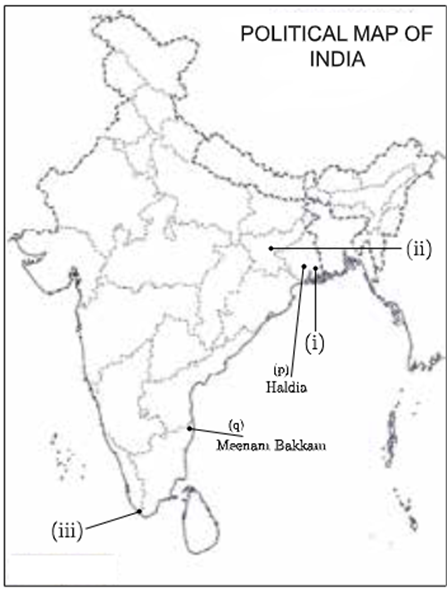
19. On the same outline map of India, locate and label any three of the following with suitable symbols.
I. (p) A major seaport in West Bengal.
or (q) An international airport in Tamil Nadu.
View AnswerAns. (p) Haldia (or Shyama Prasad Mookerjee Port, Kolkatta)
Or
Ans. (q) Meenam Bakkam (Chennai)
II. Any two of the following :
- Kolkata – An International airport
- Bokaro – An iron and steel plant
- Thiruvananthapuram – A software technology park
Ans.
SECTION-C
POLITICAL SCIENCE (20 marks)
20. Which of the following statement(s) are true regarding the major challenges faced by political parties?
I. A lack of internal democracy within the party structure.
II. The problem of dynastic succession, where top positions are controlled by one family.
III. The growing role of money and muscle power, especially during elections.
IV. Parties not offering a meaningful choice to the voters due to declining ideological differences.
Choose the correct option:
(a) I and II only
(b) I, III and IV
(c) II and IV
(d) I, II, III and IV
View AnswerAns. (d) I, II, III and IV
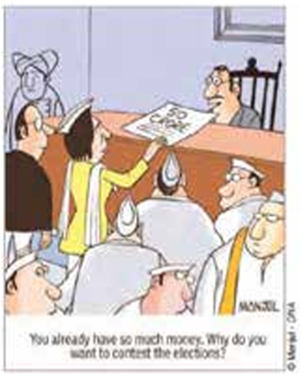
21. The cartoon below highlights a major challenge faced by political parties in a democracy. What does it suggest?
(a) The cost of contesting elections is affordable for the common citizen.
(b) Political parties are transparent about their sources of funding.
(c) There is a growing and worrying role of rich people and big companies in democratic politics.
(d) Elections are becoming less expensive over time.
View AnswerAns. (c) There is a growing and worrying role of rich people and big companies in democratic politics.
22. Consider the following case and choose the correct optionIn a country with multiple active political parties, an election is held. No single party secures a majority of seats to form the government on its own. Consequently, three parties join hands to form a government. What is this form of government called, and what kind of party system is likely present?
(a) A coalition government in a two-party system.
(b) A unitary government in a one-party system.
(c) A coalition government in a multi-party system.
(d) An opposition government in a bi-party system.
View AnswerAns. (c) A coalition government in a multi-party system.
23. Two statements are given below as Assertion (A) and Reason (R). Read the statements and choose the most appropriate option.
Assertion (A): The Indian Constitution was amended to prevent elected MLAs and MPs from changing parties after an election.
Reason (R): This was done because many elected representatives were indulging in defection in order to become ministers or for cash rewards.
(a) Both A and R are true, and R is the correct explanation of A.
(b) Both A and R are true, but R is not the correct explanation of A.
(c) A is true but R is false.
(d) A is false but R is true.
View AnswerAns. (a) Both A and R are true, and R is the correct explanation of A.
24. Define the term ‘partisan’. What is partisanship?
View AnswerAns. 1. Partisan: A partisan is a person who is strongly committed to a party, group, or faction.
2. Partisanship: Partisanship is marked by a tendency to take a side and an inability to take a balanced view on an issue.
25. ‘The growing role of money and muscle power is a major challenge for political parties, especially during elections.’ Highlight any two ways this challenge manifests itself.
View AnswerAns. The challenge of money and muscle power manifests in the following ways:
1. Candidate Selection: Parties tend to nominate those candidates who have or can raise lots of money, often sidelining more capable but less wealthy party workers.
2. Support for Criminals: In some cases, parties support criminals who can win elections, as they bring in both funds and the ability to influence voters through illicit means.
26. ‘A multi-party system often appears messy but allows for a variety of interests to get representation.’ Support this statement with suitable arguments.
View AnswerAns. This statement is correct for these reasons:
1. This system allows a variety of social and geographical interests and opinions to enjoy political representation, which is crucial for diverse countries like India.
2. Different parties are compelled to form alliances and coalitions, ensuring that multiple voices are part of the government.
3. While this process can appear messy and lead to instability, it is the best way to represent a country’s diversity.
27. A. ‘For an ordinary citizen, it is easier to approach a local party leader than a government officer.’ Explain the statement by describing how political parties provide people access to government machinery and welfare schemes.
View AnswerAns. The statement is accurate because political parties function as a crucial link between citizens and the government.
1. Accessibility: For an ordinary citizen, it is easy to approach a local party leader whom they know personally, whereas a government officer may seem distant and inaccessible.
2. Personal Connection: Citizens often feel close to parties even when they do not fully trust them. The local party leader is a part of their community and is often seen as someone who can understand their problems.
3. Bridge to Government: Party leaders act as intermediaries. They can communicate the needs and demands of the people in their locality to the relevant government officials and departments.
4. Access to Welfare Schemes: Parties provide people access to welfare schemes implemented by the government. A local leader can guide a citizen through the bureaucratic procedures required to avail the benefits of a scheme.
5. Responsiveness and Accountability: Parties have to be responsive to people’s needs and demands. If a local leader fails to help, citizens can raise this issue within the party or reject that party in the next election, which makes the leader more accountable than a permanent government official.
or
B. ‘There are several challenges that political parties need to face and overcome to remain effective instruments of democracy.’ Analyse any five such challenges.
View AnswerAns. Political parties in modern democracies face several serious challenges that they must overcome.
1. Lack of Internal Democracy: The first challenge is the concentration of power in one or a few leaders at the top. Parties often do not hold regular internal elections, preventing ordinary members from having a say.
2. Dynastic Succession: Related to the first challenge, leaders in positions of power often favour their family members. In many parties, top positions are controlled by members of a single family, which is unfair to other members and bad for democracy.
3. Money Power: There is a growing role of money in parties, especially during elections. Parties tend to nominate rich candidates who can fund their own campaigns, and companies that give funds to parties tend to have influence on their policies.
4. Muscle Power: In some cases, parties support criminals who can win elections. This increasing role of criminals in politics is a major concern for democrats.
5. Lack of Meaningful Choice: Very often, parties do not seem to offer a meaningful choice to the voters. In recent years, there has been a decline in the ideological differences among major parties on fundamental aspects, differing only in details.
28. Read the given text and answer the following questions.
Democracies that follow a federal system tend to have two kinds of political parties: parties present in only one of the federal units (State parties) and parties present in several or all units of the federation (National parties). The Election Commission has laid down detailed criteria for a party to be recognised as a ‘State’ or ‘National’ party. A party that secures at least six per cent of the total votes in a state legislative assembly election and wins at least two seats is recognised as a State party. A party that secures at least six per cent of the total votes in Lok Sabha elections or Assembly elections in four States, and wins at least four seats in the Lok Sabha, is recognised as a national party.
1. What are the two kinds of political parties typically found in a federal democracy?
View AnswerAns. The two kinds of political parties are State parties (present in only one federal unit) and National parties (present in several or all units).
2. What is the minimum percentage of votes in a state election required for a party to be recognised as a State party?
View AnswerAns. A party must secure at least six per cent of the total votes in an election to the Legislative Assembly of a State to be recognised as a State party.
3. Explain the criteria for a political party to be recognised as a National party in India.
View AnswerAns. (i) A party must secure at least six per cent of the total votes in Lok Sabha elections or in Assembly elections in four different States.
(ii) In addition to the vote share, the party must win at least four seats in the Lok Sabha.
SECTION-D
ECONOMICS (20 marks)
29. A system where goods are directly exchanged without the use of money is known as the:
(a) Credit System
(b) Banking System
(c) Barter System
(d) Monetary System
View AnswerAns. (c) Barter System
30. In India, which institution is responsible for issuing currency notes and supervising the functioning of banks?
(a) The State Bank of India (SBI)
(b) The Ministry of Finance
(c) The Reserve Bank of India (RBI)
(d) The World Bank
View AnswerAns. (c) The Reserve Bank of India (RBI)
31. Which of the following examples best demonstrates a loan from the informal sector?
(a) A loan taken from a nationalized bank.
(b) A loan taken from a cooperative society.
(c) A loan taken from a village moneylender.
(d) A loan taken through a Self-Help Group linked to a bank.
View AnswerAns. (c) A loan taken from a village moneylender.
32. An asset that the borrower owns (such as land or vehicle) and uses as a guarantee to a lender until the loan is repaid is called:
(a) Interest
(b) A Cheque
(c) Credit
(d) Collateral
View AnswerAns. (d) Collateral
33. Modern currency (paper notes and coins) is accepted as a medium of exchange. Which of the following justifications best explains why?
(a) Because it is made of valuable metals.
(b) Because it has a promise written on it by the Governor of the RBI.
(c) Because it is easy to carry and store.
(d) Because it is authorized by the government of the country.
View AnswerAns. (d) Because it is authorized by the government of the country.
34. Recognize and choose the option that correctly matches the term with its description.
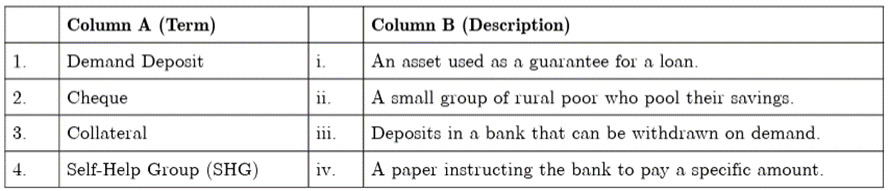
Choose the correct option:
(a) 1-iv, 2-iii, 3-i, 4-ii
(b) 1-iii, 2-iv, 3-i, 4-ii
(c) 1-ii, 2-iv, 3-i, 4-iii
(d) 1-iv, 2-ii, 3-iii, 4-i
View AnswerAns. (b) 1-iii, 2-iv, 3-i, 4-ii
35. Evaluate the utility of money in eliminating the need for a ‘double coincidence of wants’.
View AnswerAns. Money’s utility is immense as it solves the core problem of the barter system.
1. Problem of Barter: The barter system requires a double coincidence of wants, where two people must have goods that the other wants.
2. Money as an Intermediate: Money serves as an intermediate in exchange, allowing a person to buy any commodity or service.
3. Simplifies Trade: By acting as a medium of exchange, money eliminates the need to find someone with matching needs, making trade easier and more efficient.
36. ‘It is necessary to expand the availability of cheap and affordable credit from the formal sector.’ Justify this statement.
View AnswerAns. This statement is justified for several crucial reasons for India’s development.
1. High Cost of Informal Credit: Poor and rural households rely on informal lenders who charge very high interest rates, limiting their ability to increase income.
2. Prevents Debt Traps: Access to cheap credit helps people avoid falling into debt traps caused by expensive loans.
3. Promotes Development: Affordable credit enables investment in businesses, agriculture, and other productive activities, boosting incomes and overall economic growth.
37. Highlight the three significant components that together comprise the ‘terms of credit’.
View AnswerAns. The ‘terms of credit’ refer to the conditions of a loan agreement. Three significant components are:
1. Interest Rate: The borrower must pay a specified rate of interest along with the principal amount to the lender.
2. Collateral and Documentation: Collateral serves as a guarantee for the loan, and banks require proper documentation before lending.
3. Mode of Repayment: This defines the duration and method of repayment, such as monthly installments or a lump-sum payment at the end of the loan period.
38. A. ‘Credit can play a vital and positive role, but in high-risk situations, it can also push the borrower into a debt trap.’ Support this statement with arguments, using the examples of Salim and Swapna from the textbook.
View AnswerAns. This statement highlights that credit can either help or harm a borrower depending on circumstances. Positive Role of Credit (Salim’s Case):
1. Salim obtained credit to meet the working capital needs for a large shoe order.
2. The loan enabled him to buy raw materials and pay workers in advance, allowing him to complete production on time.
3. He earned a good profit and repaid the loan, showing how credit can improve business and income.
Negative Role of Credit (Swapna’s Case):
4. Swapna, a small farmer, depended on a successful harvest for repayment. The failure of her crop made repayment impossible.
5. She was trapped in debt, forced to sell part of her land, illustrating that credit in high-risk situations can worsen the borrower’s condition.
or
B. Self-Help Groups (SHGs) are seen as a solution to the credit problems of the rural poor. On the basis of this statement, analyze the role and functioning of SHGs in the rural economy
View AnswerAns. Self-Help Groups (SHGs) play a vital role in solving the credit problems of the rural poor, particularly women.
1. Organizing the Rural Poor: SHGs bring together 15-20 members, creating a collective platform for rural poor, especially women, to support each other.
2. Pooling Savings: Members save regularly, from 25 to 100 or more, creating a pooled fund that acts as the group’s capital and encourages financial discipline.
3. Overcoming Collateral Issues: SHGs help members access bank loans without collateral, as lending is based on the group’s savings record and repayment reliability.
4. Providing Affordable Loans: Members can borrow from the group or banks at reasonable interest rates for self-employment, such as buying sewing machines or livestock.
5. Empowerment and Social Platform: Regular meetings also address social issues like health, nutrition, and domestic violence, making members financially and socially empowered.