Social Science (087)
Class X (2024-25)
Time Allowed: 3 hours Maximum Marks: 80
General Instructions:
1. The question paper comprises Six Sections – A, B, C, D, E and F. There are 37 questions in the Question paper. All questions are compulsory.
2. Section A – From questions 1 to 20 are MCQs of 1 mark each.
3. Section B – Question no. 21 to 24 are Very Short Answer Type Questions, carrying 2 marks each. Answer to each question should not exceed 40 words.
4. Section C contains Q.25to Q. 29 are Short Answer Type Questions, carrying 3 marks each. Answer to each question should not exceed 60 words.
5. Section D – Question no. 30 to 33 are long answer type questions, carrying 5 marks each. Answer to each question should not exceed 120 words.
6. Section-E – Questions no from 34 to 36 are case based questions with three sub questions and are of 4 marks each. Answer to each question should not exceed 100 words.
7. Section F – Question no. 37 is map based, carrying 5 marks with two parts, 37a from History (2 marks) and 37b from Geography (3 marks).
8. There is no overall choice in the question paper. However, an internal choice has been provided in few questions. Only one of the choices in such questions must be attempted.
Section A
1. One important feature of the Civil Disobedience Movement was:
a) The large-scale participation of the Dalits or Harijans
b) Large-scale participation of women
c) The complete change in the status of women in society
d) Gandhiji’s belief that women should not join it and remain at home
Ans. b) Large-scale participation of women
2. In arid and semi-arid regions, agricultural fields were converted into rain-fed storage structures that allowed the water to stand and moisten the soil like the
a) inundation channels
b) lakes
c) ‘guls’ or ‘kuls’
d) ‘khadins’ and ‘Johads’
Ans. d) ‘khadins’ and ‘Johads’
3. Read the given data in the table and find out the average monthly income of Country A. Choose the correct option.
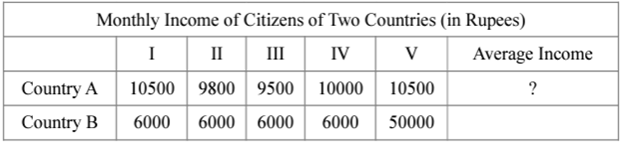
a) 9500
b) 10060
c) 10000
d) 10500
Ans. b) 10060
4. Which of the following options represents the steps that can be involved to produce rice in Haryana and Punjab?
i. Using high-yielding variety seeds.
ii. Using insecticides and pesticides and chemical fertilisers.
iii. Using machines and other modern methods for cultivation.
iv. Production of rice involves subsistence farming methods.
a) Statement i and ii are correct.
b) Statement ii is correct.
c) Statement i, ii, & iii are correct.
d) Statement ii, iii & iv are correct.
Ans. c) Statement i, ii, & iii are correct.
5. ________ ensured that the spirit of federalism, respect for diversity, and desire for living together became shared ideals in our country.
a) Judiciary
b) Democratic politics
c) Constitutional provisions
d) Federal nature
Ans. b) Democratic politics
6. Which one of the following is correct regarding power-sharing?
A. It leads to conflict between different groups.
B. It ensures the stability of the country?
C. It helps to reduce the conflict between different groups.
a) Both A and B are true
b) Only B is true
c) Both B and C are true
d) Only A is true
Ans. c) Both B and C are true
7. Assertion (A): In a non-democratic setup, the unacceptability of mistreatment towards women would not have a legal basis.
Reason (R): Individual freedom and dignity, which are foundational principles in democracies, may not have the same legal and moral force in such systems.
a) Both A and R are true and R is the correct explanation of A.
b) Both A and R are true but R is not the correct explanation of A.
c) A is true but R is false.
d) A is false but R is true.
Ans. a) Both A and R are true and R is the correct explanation of A.
8. Banker Megha diligently managed the local bank. With prudent planning, she allocated a small portion of the deposits as cash reserves for withdrawals. Meanwhile, Entrepreneur Ram approached the bank seeking a loan for his business venture. Megha, acting as a mediator, granted him the funds, charging a higher interest rate than what she offered to depositors. How do banks primarily generate income?
a) Interest paid to depositors
b) Interest charged from borrowers
c) Cash reserves held by banks
d) Deposits made by the public
Ans. b) Interest charged from borrowers
9. European Union Parliament is located in:
a) Spain
b) Germany
c) Austria
d) Belgium
Ans. d) Belgium
10. Identify the person depicted in the caricature from the options given below.
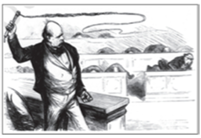
a) Bismarck
b) Napoleon
c) Garibaldi
d) Mazzini
Ans. a) Bismarck
11. Evaluate the ways MNCs play a major role in the globalization process by identifying the appropriate statements among the following options:
i. They take over some local companies in the existing country.
ii. Influencing the government’s foreign policies of trade restrictions.
iii. Removing tax barriers from developing countries.
iv. They set up production in more than one country thus interlinking the economies.
a) Statements i, ii and iii are appropriate.
b) All the statements are appropriate.
c) Statements i and ii are appropriate.
d) Only statement iv is appropriate.
Ans. d) Only statement iv is appropriate.
12. Which country has successfully negotiated differences among ethnic populations?
a) Belgium
b) Srilanka
c) Pakistan
d) Nepal
Ans. a) Belgium
13. Arrange the following statements in sequential order:
i. Alluri Sitarama was Raju arrested ending a two-year armed tribal struggle.
ii. The Lahore Congress formalised the demand of ‘Purna Swaraj’ or full independence for India.
iii. Gandhiji withdraws Non-Cooperation movement.
iv. Ambedkar establishes Depressed Classes
a) iv, iii, ii, i
b) iii, i, ii, iv
c) ii, iv, i, iii
d) ii, iii, iv, i
Ans. b) iii, i, ii, iv
14. Laxmi, owning about two hectares of unirrigated land-dependent only on rain and growing crops, like jowar and arhar. All five members of her family work in the plot throughout the year. Everyone is working, none remains idle, but in actual fact, their labour effort gets divided. Each one is doing some work but no one is fully employed.
Which situation is being faced by Laxmi and her family?
a) Structural unemployment
b) Seasonal unemployment
c) Frictional unemployment
d) Disguised unemployment
Ans. d) Disguised unemployment
15. Consider the statements given below and choose the correct answer
Statement I: New forms of popular literature appeared in print, targeting new audiences.
Statement II: Books were of various sizes, serving many different purposes and interests.
a) Statement (i) is correct and (ii) is incorrect
b) Both (i) & (ii) are incorrect
c) Statement (i) is incorrect and (ii) is correct
d) Both (i) & (ii) are correct
Ans. d) Both (i) & (ii) are correct
16. In a geography class, the teacher engaged the students in a discussion to identify a specific type of soil. She provided them with four clues. The students had to use these clues to identify the soil type. Based on the clues given, which type of soil is being discussed?
Clues:
i. It is ideal for growing cotton.
ii. The formation of this soil depends on climatic conditions and parent rock material.
iii. It is typical of the Deccan trap (Basalt) region
iv. They cover the plateaus of Maharashtra, Saurashtra, Malwa, Madhya Pradesh and Chhattisgarh and extend in the south east direction along the Godavari and the Krishna valleys.
a) Laterite soil
b) Alluvial soil
c) Black soil
d) Red soil
Ans. c) Black soil
17. Which of the following statements will be considered by a political party while shaping public opinion?
Statement i: Raise and highlight issues popular issues.
Statement ii: Launch movements for the resolution of problems faced by people.
Statement iii: Provide access to government machinery and welfare schemes implemented by the government.
Statement iv: Voice different views and criticize the government for its failures or wrong policies.
a) Statement i, ii and iii are right.
b) Statement i and ii are right.
c) Statement iii is right.
d) Only statement iv is right.
Ans. b) Statement i and ii are right.
18. The Prime Minister’s High-Level Committee is popularly known as:
a) Poonchi Committee
b) Mandal Committee
c) Sarkaria Committee
d) Sachar Committee
Ans. d) Sachar Committee
19. Read the following statements regarding the role of the Opposition party.
i. Opposition parties voice different views
ii. Opposition parties criticise government for its failures or wrong policies.
iii. Opposition parties mobilise opposition to the government.
Which of the following is the accurate role of the Opposition party? Choose the correct option.
a) only iii
b) ii and iii
c) i, ii and iii
d) only i
Ans. c) i, ii and iii
20. Read the information given below and select the correct option
Amrita is a government teacher and belongs to a rich urban household whereas Rani – A Dalit, works as a helper on a construction site and comes from a poor rural household. Both have a crisis at home and wish to take a loan. Amrita got the loan from easily as compared to Rani. Why is Rani not able to get the loan? Tick the most appropriate reason.
a) Because Rani is uneducated.
b) Because Rani is engaged in informal sector.
c) Because Rani is from an untouchable caste, Dalits.
d) Because Rani is poor.
Ans. b) Because Rani is engaged in informal sector.
Section B
21. Study the map thoroughly and mention the language that is dominantly spoken in the Wallonia region.
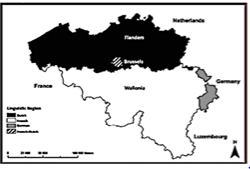
Ans. Country’s 40 per cent people live in the Wallonia region and speak French.
22. Describe the role of Otto von Bismarck in the making of Germany.
Ans. The role of Otto von Bismarck in the making of Germany:
i. Prussian Leadership: After the failure of the 1848 liberal initiative, Prussia, under Bismarck’s leadership, took charge of the movement for German unification.
ii. Architect of Unification: Otto von Bismarck, the chief minister of Prussia, played a crucial role in the unification of Germany by leading the nationalist movement.
iii. Use of Prussian Army: Bismarck utilized the strength of the Prussian army and bureaucracy to achieve unification through military means.
iv. Wars for Unification: He fought three wars over seven years – with Austria, Denmark and France.
v. Victory: The wars ended with Prussian victory and completed the process of unification
OR
What were the political, social and economic ideas supported by the liberals in Europe?
Ans. The political, social and economic ideas supported by the liberals were as follows:
a. From the political point of view, they demanded constitutionalism with national unification, parliamentary administration and a nation-state with a written constitution. In German regions, a large number of political associations whose members were middle-class professionals, businessman and prosperous artisans came together in the city of Frankfurt and decided to vote for all German National Assembly.
b. From the social viewpoint, they wanted to free the society of its class-based biases and rights growing out of births. A large number of women had participated actively and formed their own political associations founded a newspaper, took part in political meetings and struggled for the right to vote.
c. Economically, they demanded markets to be free and the right to property. Abolition of state-imposed restrictions on the movements of goods and capital were also demanded.
23. What are millets and why are they called coarse grains? Give some examples of millet crops and areas they are grown in.
Ans. Jawar, Bajra and ragi are the important Millets grown in India. These are known as coarse grains but they have very high nutritional value.
i. Jawar: Maharashtra is the largest producer of jawar followed by Karnataka, Andhra Pradesh and Madhya Pradesh.
ii. Bajra: Rajasthan is the largest producer of Bajra followed by Uttar Pradesh, Maharashtra, Gujarat, and Haryana.
iii. Ragi: Karnataka is the largest producer of ragi followed by Tamil Nadu.
iv. Millets are also known as dry crops because they are tough and hardy. They are draught resistant crops and requires less rainfall and high temperatures.
v. Millet crops are favored due to productivity and short growing season under dry, hightemperature conditions.
24. Describe any three features of unitary government.
Ans. Three features of the unitary government are:
i. Under the unitary system, either there is only one level of government or the sub-units are subordinate to the central government.
ii. The central government can pass on orders to the provincial or the local government.
iii. The local governments do not enjoy any freedom or powers. E.g. England, France, Italy, and Japan have adopted the Unitary system of government.
Section C
25. Print popularized the ideas of the enlightenment thinkers. Explain.
Ans. Print popularized the ideas of the enlightenment thinkers in the following ways:
a. Collectively the writings of thinkers provided a critical commentary on tradition, superstition, and despotism.
b. Scholars and thinkers argued for the rule of reason rather than custom and demanded that everything should be judged through the application of reason and rationality.
c. They attacked the sacred authority of the church and the despotic power of the state thus eroding the legitimacy of a social order based on tradition.
d. Print created a new culture of dialogue and debate. All values, norms, and institutions were re-evaluated and discussed by a public that had become aware of the power of reason and recognised the need to question existing ideas and beliefs.
e. The writings of Voltaire and Rousseau were read widely and those who read these books saw the world through new eyes, eyes that were questioning critical and rational.
26. Suggest any three steps to minimize the environmental degradation caused by the industrial development in India.
Ans. The following three steps can be taken to minimize environmental degradation by the industries:
a. Treating hot water and effluents before releasing them in rivers and ponds.
b. Fitting smokestacks to factories with electrostatic precipitators.
c. Smoke can be reduced by using oil or gas instead of coal in the factories.
OR
“Industrialization and urbanization go hand in hand.” Justify the statement by giving any three arguments.
Ans. The given statement is justified because
a. Industrialization causes growth in available factory jobs. Thus, people from various places migrate towards the places where industries are located.
b. Movement of people towards cities for jobs gradually develop cities into urban centres. Sometimes industries are located in or near cities.
c. Cities provide not only markets for the industries but services such as banking, insurance, transport, labour and financial advice, etc also.
Thus, we can say that industrialization and urbanization go hand in hand.
27. Compare and contrast the changes in India with the pattern that was observed for developed countries. What kind of changes between sectors were desired but did not happen in India?
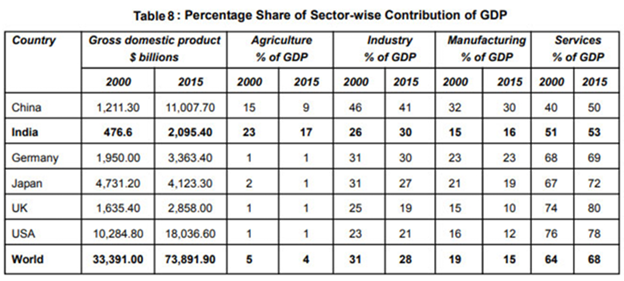
Ans. In case of developed countries, the evolution of the economy happened in the most logical pattern. Growth in the primary sector was followed by a growth in the secondary sector. After that, the growth of the tertiary sector followed. The employment generation also kept pace with related changes in different sectors.
The case of India is somewhat different. Both the Secondary and Tertiary sectors are increasing at the expense of the Primary sector, but the increase in Tertiary sector is more. The growth of the primary sector was not followed by the growth of the secondary sector, rather it was the tertiary sector which took the lead. But employment generation in either the secondary or tertiary sector could not keep pace. For India, to become a strong industrialised nation, the Secondary sector should have increased more but this is not happening due to a variety of reasons.
28. Judiciary plays an important role in Indian federalism. Justify the statement.
Ans. a. Judiciary with the supreme court at the apex is the sole interpreter of the Indian Constitution.
b. Independent judiciary is the essence of the federal government. Here, courts have the power to interpret the constitution and the powers of the different levels of government.
c. Judiciary administers both the union and state laws which are applicable to the cases coming up for adjudication.
d. The disputes about the division of powers are settled by the Judiciary. In India, the highest court—the Supreme Court—acts as an umpire if a dispute arises between the different levels of government in the exercise of their respective powers. Hence, the judiciary is considered as the guardian of the Indian federalism.
29. If we look at the country as a whole, we find that 93% of the workers in India are in the unorganized sector. Organized sector employment is available to only about 7% of the workers in India.
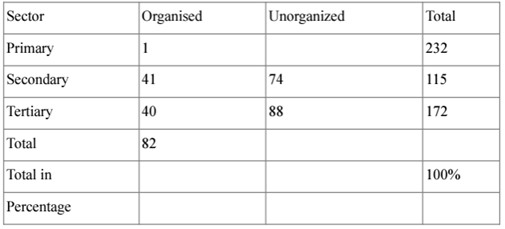
Workers in the unorganized sector work hard, but earn very little. Give reasons. What problems do they face there? Think why they are forced to work in this sector.
Ans. A. The unorganized sector consists of small and scattered units which are largely outside the control of the government.
B. These units are owned by private individuals. Their aim is to maximize profit. The wages are very low and there is no provision for overtime, paid leave etc. Here workers have to face social discrimination also besides getting irregular and insecure employment.
C. But they continue to do work in this sector because they do not have a better option.
Section D
30. How can biogas solve the energy problem mainly in rural India? Give your suggestion.
Ans. Biogas can solve the energy problem in the rural areas due to the reasons mentioned below:
i. It produces a gas having higher thermal efficiency than charcoal and kerosene.
ii. It provides a way for optimum utilization of animal and plant waste.
iii. It produces enriched organic manure that can supplement or even replace chemical fertilizers.
iv. It burns smoothly and does not leave much residue behind.
v. It is easy to produce and store.
vi. It is a renewable source of energy.
vii. It will reduce the burden on conventional sources of energy.
viii. It is eco-friendly, therefore it will help in reducing environmental pollution.
ix. It provides twin benefits to farmers by acting as an energy resource and improved quality of manure.
Some suggestions to improve the biogas energy production in rural areas given below
i. The Government should provide monetary assistance to people in rural areas.
ii. Also, awareness must be created for using this alternative sources of energy.
OR
How is the per capita consumption of electricity considered as an index of development? Explain with examples.
Ans. i. Electricity is required in all sectors of the economy.
ii. In agriculture use of electricity for the running the pump of water to irrigate the field helps to increase the output.
iii. Electricity is needed in food processing industry.
iv. Cottage and small scale industries cannot be developed without the use of electricity.
v. Higher consumption of electricity in households indicates the higher standard of living.
vi. Development and increase in the demand for electricity go hand in hand. vii. Any other relevant point.
Any five points to be explained.
31. Write a note on The role of women in nationalist struggles.
Ans. Women actively participated in movements, faced the tortures of police, stood by their male counterparts, spread the idea of liberal nationalism and also were members of various revolutionary organisations. They faced the torture of police but still, they stood by their male counterparts.
The issue of extending political rights to women was a controversial one within the liberal movement, in which large numbers of women had participated actively over the years.
Women had formed their own political associations, founded newspapers and taken part in political meetings and demonstrations. Despite this, they were denied suffrage during the election of the Assembly. They were given little or no political rights or the right to vote till the end of the 19th century.
OR
Describe the impact of Napoleonic reforms on the rest of Europe.
Ans. Napoleon had destroyed democracy in France, but in the administrative field he had incorporated revolutionary principles in order to make the whole system more rational and efficient, which were as follows:
i. The Civil Code of 1804, also known as Napoleonic Code, abolished all the privileges based on birth, established equality before the law and gave the right to property.
ii. This Code was implemented in the regions under French control.
iii. Napoleon simplified administrative divisions, abolished the feudal system and freed peasants from serfdom and manorial dues in the Dutch Republic, in Switzerland, in Italy and Germany.
iv. Guild restrictions were removed in the towns too.
v. Uniform weights and measures were adopted. A common national currency helped in the movement of goods and capital from one region to another.
vi. Transport and communication systems were improved.
32. How would you explain the situation without political parties in country?
Ans. A. We can understand the necessity of political parties by imagining a situation without parties.
B. Every candidate in the elections will be independent. So no one will be able to make any promise to the people about any major policy changes.
C. The government will be formed but its utility will remain ever uncertain.
D. Elected representatives will be responsible only to their constituency and not for the entire country.
E. But no one will be responsible for how the country run.
F. Elections without political parties will also be responsible for the disintegration of the country.
G. India also has non-party based elections to the panchayats in many states. Although parties do not contest formally, it is generally noticed that the village splits into more than one faction, each of which puts up a ‘panel’ of its candidates. This is exactly what the party does. That is why we have political parties in almost all the countries of the world.
H. The rise of political parties is directly linked to the emergence of representative democracies, large-scale societies need representative democracy. Large societies needed some way to bring various representatives together so that a responsible government could be formed.
OR
Political parties play an important role in democratic countries. Justify the statement.
Ans. Political parties play a vital role in democracies which makes them an essential component of a democracy. The rise of political parties is directly linked to the emergence of representative democracies The key role played by the political parties in a democracy is listed below:
Political Parties contest elections. Those who win form the government and those parties that lose in the elections play the role of opposition to the parties in power.
They offer different policies, schemes, and programs and the voters chose from them.
Political Parties play a decisive role in making laws for the country.
Parties form and run the government. The political executives of the political party in power take big policy decisions.
Political Parties shape public opinion. They provide people access to government machinery and welfare schemes implemented by governments.
33. How are formal sources of credit different from informal sources? Explain with example.
Ans. People obtain loans from various sources. The two sources of credit are formal sources and informal sources and can be differentiated on the basis of following features:
Formal sources of credit:
Banks and cooperative societies fall under the formal sector. One can obtain loans from banks or cooperative societies.
The Reserve Bank of India supervises the functioning of formal sources of loans.
Bank loans require documentation and collateral (collateral is an asset such as land, building, vehicle, livestock, deposits with the bank, etc.). This is used as a guarantee to the lender until the loan is paid back.
Formal sources cannot charge any rate of interest from the borrowers according to their whims.
The rich households avail cheap credit from formal lenders as 90 per cent of the rich urban households take credit from formal sources.
(any 3 points of both the sources)
Informal sources of credit:
In the informal sector money can be borrowed from a person, friend, relative, moneylender, traders, employers, etc.
No organization checks or supervises the activities of lenders in the informal sector.
Loans from informal sources do not require any such collateral.
They charge a very high rate of interest on loans as they do not require any collateral.
Poor households pay a large amount for borrowing as they take credit from informal sources. About 85 per cent of the loans taken by poor households in urban areas are from informal sources.
OR
Describe the role played by Grameen Bank of Bangladesh in improvement of the condition of poor particularly women.
Ans. Grameen Bank of Bangladesh was started in the 1970s. It has now over 6 million borrowers in about 40,000 villages. Almost all the borrowers are women and belong to poorest sections of the society. These borrowers have proved that not only are poor women reliable borrowers, but they can start and run a variety of small income generating activities successfully. Thus, the Grameen Bank has played a significant role in the improvement of the condition of the poor women in Bangladesh. Professor Muhammad Yunus, the founder of Grameen Bank and a recipient of 2006 ‘Nobel Peace Prize’ for peace has stated that, “if credit can be made available to the poor people on terms and conditions that are appropriate and reasonable these millions of small people with their millions of small pursuits and add up to create the biggest development wonder.”
Section E
34. Read the following text carefully and answer the questions that follow:
The movement started with middle-class participation in the cities. Thousands of students left government-controlled schools and colleges, headmasters and teachers resigned, and lawyers gave up their legal practices. The council elections were boycotted in most provinces except Madras, where the Justice Party, the party of the non-Brahmans, felt that entering the council was one way of gaining some power – something that usually only Brahmans had access to. The effects of noncooperation on the economic front were more dramatic. Foreign goods were boycotted, liquor shops picketed, and foreign cloth burnt in huge bonfires. The import of foreign cloth halved between 1921 and 1922, its value dropping from ₹ 102 crore to ₹ 57 crore. In many places, merchants and traders refused to trade in foreign goods or finance foreign trade. As the boycott movement spread, and people began discarding imported clothes and wearing only Indian ones, the production of Indian textile mills and handlooms went up.
i. Explain the meaning of picketing liquor shops.
Ans. Picketing is a form of demonstration or protest by which people block the entrance to a shop, factory, or office.
ii. When did the Non-Cooperation-Khilafat Movement begin?
Ans. The Non-Cooperation-Khilafat Movement began in January 1921.
iii. Why did the movement in the cities gradually slow down?
Ans. The movement in the cities gradually slowed down for a variety of reasons: Khadi being expensive was unaffordable was poor people, lack of alternative Indian institutions posed a problem in boycotting British institutions.
35. Read the following text carefully and answer the questions that follow: A dam is a barrier across flowing water that obstructs, directs or retards the flow, often creating a reservoir, lake or impoundment. “Dam” refers to the reservoir rather than the structure. Most dams have a section called a spillway or weir over which or through which it is intended that water will flow either intermittently or continuously. Dams are classified according to structure, intended purpose or height. Based on structure and the materials used, dams are classified as timber dams, embankment dams or masonry dams, with several subtypes. According to the height, dams can be categorised as large dams and major dams or alternatively as low dams, medium height dams and high dams.
i. What does the word ‘Dam’ actually refer to?
Ans. “Dam” refers to the reservoir rather than the structure or a dam is a barrier across flowing water that obstructs, directs or retards the flow, often creating a reservoir, lake or impoundment.
ii. Mention any one benefit of a Multi-purpose River Valley Project.
Ans. a. Dams are used for electricity generation.
b. Dams are used for irrigation purpose.
c. Any other relevant point.
Any one point to be mentioned.
iii. How have multi-purpose river valley projects a cause of social movements? Explain.
Ans. a. Large scale displacement of local communities.
b. Local people had to give up their land and livelihood.
c. Local people lost control over their meagre resources for the greater good of the nation.
d. Any other relevant point.
Any two points to be mentioned.
36. Read the following text carefully and answer the questions that follow:
The average person in Haryana has more income than the average person in Kerala but lags behind in the crucial areas. The reason is – money in your pocket cannot buy all the goods and services that you may need to live well. So, income by itself is not a completely adequate indicator of material goods and services that citizens are able to use.
Actually for many of the important things in life the best way, also the cheapest way, is to provide these goods and services collectively. Even now, in many areas, children, particularly girls, are not able to go to high school because the government/ society has not provided adequate facilities. Kerala has a low Infant Mortality Rate because it has an adequate provision of basic health and educational facilities. Similarly, in some states, PDS functions well. Health and nutritional status of people of such states is certainly likely to be better.
i. Why in some areas children are unable to go to high school?
Ans. Due to the lack of adequate government facilities in many areas particularly girls are not able to go to high school in many areas.
ii. State the effect of adequate public facilities.
Ans. Having adequate public facilities can improve the overall health condition of a region. For example, Kerala has a low Infant Mortality Rate because it has an adequate provision of basic health and educational facilities.
iii. Substantiate the statement with two instances: Income by itself is not a completely adequate indicator of material goods and services.
Ans. Income by itself is not a completely adequate indicator of material goods and services, for instance:
a. Money cannot buy you a pollution-free environment or ensure that you get unadulterated medicines, unless you can afford to shift to a community that already has all these things.
b. Money may also not be able to protect you from infectious diseases unless the whole of your community takes preventive steps.
Section F
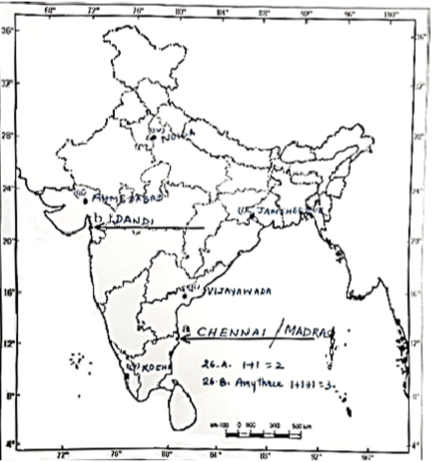
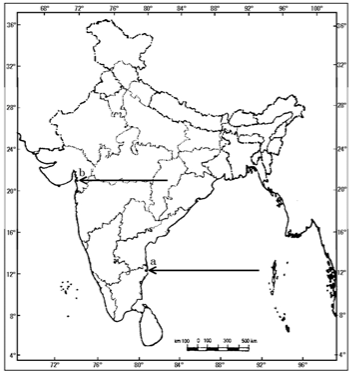
37. A. Two features a and b are marked on the given political outline map of India. Identify these features with the help of the following information. Write their correct names on the lines marked near them:
a. Place where Congress Session was held in 1927.
b. Place from where Gandhiji started the Civil Disobedience Movement.
B. Locate and label any three of the following with appropriate symbols on the same given political outline map of India:
i. Jamshedpur – Iron and Steel Plant
ii. Vijayawada – Thermal Power Plant
iii. Ahmedabad – Cotton Textile Centre
iv. Noida – Software Technology Park
v. Kochi – Sea-port
Ans.